Northwest

‘A really tough decision’: The 2021 Iditarod won’t end in Nome, but local leaders and mushers understand

Norwegian musher Thomas Waerner is the champion of the 2020 Iditarod Trail Sled Dog Race, the third Norwegian to ever win the race and the second in the past three years. (KJ McElwee/KNOM)

In a historic first, the Iditarod Trail Sled Dog Race will not be finishing in Nome this year. The race was rerouted because of COVID-19 concerns.

Iditarod musher Aaron Burmeister said he was distraught when he heard that he would not be racing to Nome this year.

“My whole dream, most of my adult life and since childhood, has been to bring a winning team from Nome back to Nome. And bring the victory home to Nome,” he said. “So that’s something I’ve worked very hard for, and it’s been a goal of mine.”

Burmeister is a Nome local who grew up in the city and trades his time between Nome and Nenana, where he trains his team. This will be his 20th Iditarod, and he’s been in the top five finishers three times.

But the COVID-19 pandemic caused the Iditarod race organizers to create an altered route, one that goes through mostly unpopulated checkpoints.

The 2021 race begins and ends in Willow and sticks to tradition by following the southern route it uses every odd year. Teams will go to the abandoned mining town of Flat before turning returning to Willow, making a run of 810 miles.

Most of the checkpoints are abandoned mining towns or have just one cabin. The largest community along the route is McGrath, with a population of 310.

So if Burmeister wins, it won’t be beneath Nome’s Burled Arch.

“The reason I love Iditarod is the communities we traveled through the people along the trail. I feel at home on the Yukon River when I hit the coast,” he said. “I think the Iditarod had a really tough decision. I think they made that decision in the best interest of the communities along the trail.”

Last year, the COVID-19 pandemic began to escalate while mushers were out racing the Iditarod Trail. It caused one community, Shaktoolik, to make the last minute decision to ban the race from entering their village.

Barely two-and-a-half months out from the ceremonial start of the 2021 Iditarod, some communities like Unalakleet hadn’t made a final decision about they felt safe enough to host the race. That’s according to Unalakleet Mayor Kira Apaachuaq Eckenweiler.

“It’s going to be difficult to not have them come here this year. And it’ll be strange. But we support their efforts to try to protect our community from COVID-19,” Eckenweiler said.

She says the community still puts their support behind the Iditarod and hopes to see it next year.

Unalakleet is one of the largest communities on the trail most years, with a population of about 700 people. It’s the first checkpoint on the Norton Sound coast and an often critical rest stop as teams prepare to traverse the ice of the sound.

And as Iditarod Board member and Nome Mayor John Handeland says, teams need lots of time to know how to prepare for the race.

“People have said, ‘Why didn’t you just wait till the beginning of March? You know, we’re getting a vaccine right now, and things could change.’ Well, that’s true, it’s just that things just seem to change every day with this,” he said.

Handeland says they were already cutting it close to make a decision. If a village forced the race to reroute at the last minute due to an outbreak, it would cause massive logistical challenges.

“Our mushers need to know right now, how to prepare,” Handeland said. “Where they’re going depends on what they put in their sled bags and the like, you know, if they’re not going to have checkpoint support along the way, that adds to their planning.”

Handeland found himself in a tricky position. As the mayor of Nome, he says the city was open to hosting the Iditarod. The Nome City Council passed a resolution of support for the race earlier in the year. But as a member of the Iditarod board, he understands the difficult decision race organizers found themselves in.

“Ultimately, the position that I took for the city was that we are disappointed that it’s happening, but we support the idea that the Iditarod’s needs to do this after they had consulted with many of the checkpoint villages in our area,” he said.

Handeland did vote in favor of changing the race route, a decision he says was made unanimously among the board.

Mushers will be following a safety plan which includes multiple rounds of COVID-19 testing and quarantining at the Lakefront Hotel in Anchorage before they can run the race. They’ll also take another rapid test in McGrath before they can finish the race.

It’s still unclear how social distancing will be enforced at the ceremonial start in Anchorage.

Nome musher Aaron Burmeister says he feels absolutely safe under the plans from Iditarod.

It’s become a common misconception that the Iditarod race commemorates the 1925 Serum Run when dog teams carried life-saving serum to Nome during a diphtheria outbreak. But according to the site’s website, the race was created to preserve the sport of dog mushing.

And during a time of global pandemic, staying safe and being with his dogs is what matters most for Burmeister.

“I would be racing regardless of the virus or not, regardless of knowing what the trail was going to be or not, because it’s not just an event,” Burmeister said. “It’s a lifestyle.”
Solar project in Northwest Arctic villages set to break ground next spring

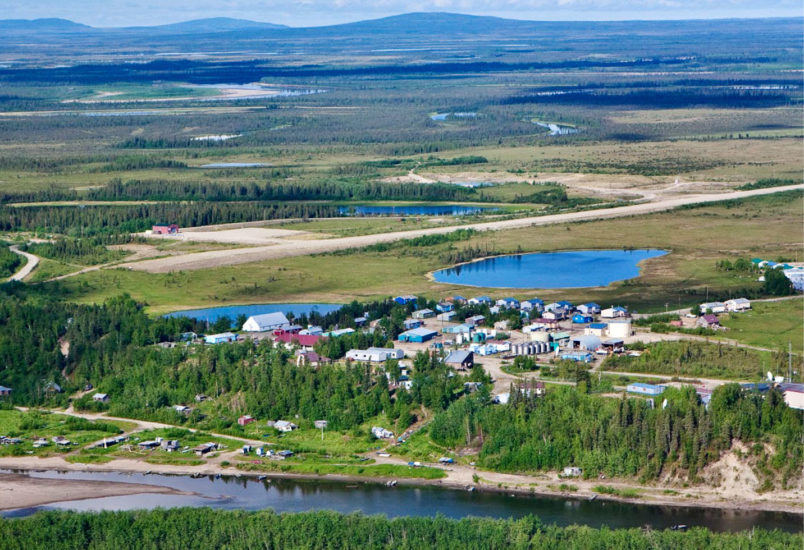
Aerial view of the Native Village of Shungnak
The Native Village of Shungnak (Photo courtesy of Northwest Arctic Borough)

Construction is set to start next spring on a solar battery project in the Northwest Arctic villages of Shungnak and Kobuk. It’s the latest renewable project for a region routinely struck by high energy costs.

It’s always been expensive to provide energy to rural Alaska. With most communities not falling on the road system, locals are forced to barge and fly in diesel fuel to power generators. There is a state program that reduces energy costs but with the state’s budget crisis, it’s unknown how long that program will be around.

Edwin Bifelt said even with state support, energy in rural Alaska remains pricey.

“Even with Power Cost Equalization, people see rates anywhere from 20 cents up to 40 to 50 cents a kilowatt-hour, which is four or five times the national average,” Bifelt said.

Bifelt, who grew up in the village of Huslia, is the founder and CEO of Alaska Native Renewable Industries. The company specializes in providing renewable energy to rural Alaska communities.

ANRI wrapped up the construction of Alaska’s largest rural solar farm in Kotzebue earlier this year, a 576-kilowatt project with more than 1,400 solar panels. Combined with the local electric co-op’s wind turbines, it’s estimated that Kotzebue is about 50% powered by renewable energy.

Now, ANRI is contracted with the Northwest Arctic Borough for just over $2.1 million to construct similar arrays in the villages of Shungnak and Kobuk, the easternmost communities in the borough. Bifelt said he expects the arrays to lower utility bills in the villages.

“Definitely see a decrease in the amount of diesel fuel that they have to fly in every year, but it’s tough to say right now what end effect it’s going to have for residents in the long run,” Bifelt said.

Kobuk and Shungnak combined have about an eighth the population of Kotzebue. Bifelt said the two new arrays will follow a similar design to the Kotzebue project, but they will be much smaller.

“The tentative design we have is for approximately a 38-kilowatt array in Kobuk and a 186-kilowatt array in Shungnak, I believe,” Bifelt said.

Bifelt said rural energy projects aren’t new to the region, though his company puts an emphasis on hiring locals to help with construction rather than fly up workers from larger cities.

“Just to provide some temporary jobs, provide some new skills for people within the community relating to renewable energy, and giving them education and experience with solar,” Bifelt said.

Construction of the solar arrays should wrap up by summer next year.

Moving forward, Bifelt anticipates rural renewable energy will be more important as lawmakers struggle with funding Power Cost Equalization. In 2019, a procedural delay in the legislature held up those funds, and there have been proposals from Gov. Mike Dunleavy and more conservative lawmakers to use funds from the program to help balance the state’s deficit.

Bifelt said the uncertainty over PCE should worry rural Alaskans.

“I guess it’s something we don’t think about enough, just because it’s been around the past 30-plus years,” Bifelt said. “But who knows if it’ll be there the next 10, 15 years, and then what situation communities be in at that point.”

Without PCE, Bifelt said rural Alaska residents could end up paying double for their energy costs.

Over the next decade, he said investing in solar, wind and hydroelectric power could save rural communities from potentially drastic hikes in energy bills. The more positive impact to the environment from these renewable resources is a bonus.

Crews working to clean diesel spill in Northwest Arctic village water treatment plant

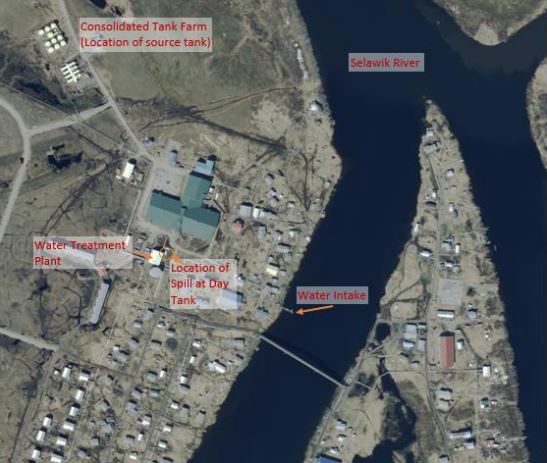
City of Selawik and the location of the diesel spill (Google Earth graphics courtesy of Alaska Department of Environmental Conservation)

A response crew is working to clean up a diesel fuel spill in the Northwest Arctic village of Selawik.

According to a release from the state Department of Environmental Conservation (DEC), the spill originated last Wednesday at a fuel tank for the village’s water treatment plant.

Officials say the fuel was transferred from a city fuel tank to the plant tank, though the transfer was left unattended for about seven and a half hours before the operator was alerted to the spill and shut off the valve at roughly 10 p.m. The spill was reported to DEC at roughly 1:30 a.m. Thursday.

The city tank holds just under 46,000 gallons of diesel and the water plant tank has a capacity of roughly 4,000 gallons. DEC’s Sarah Moore says officials are still trying to determine the total amount of diesel spilled.

“We know that there’s still 35,000 gallons approximately left in the tank following the release, and that source tank itself wasn’t damaged. It was an overfill due to transferring,” Moore said. “So we know that 35,000 gallons is still in the tank and is not threatening to release at this time. So we have a ballpark estimate, but are still working on some more concrete numbers about the volume spilled.”

A response crew has cleared 750 gallons of diesel so far, but due to fresh snow cover, DEC officials say it’s difficult to determine the total amount of diesel or the extent of the spill at this time.

“It can be a bit of a double edged sword,” Moore said. “It takes more work to find out where the diesel is because you have to dig holes in the snow and see if you can find it, but it also helps keep it more contained.”

The spill is about 610 feet from the Selawik River, a water source for the village.

Coast Guard officials arrived in Selawik on Tuesday to help provide safety and response equipment. Moore says, in keeping with pandemic safety mandates, the only people doing the cleanup are people from Selawik.

This story has been updated with comments from the Alaska Department of Environmental Conservation.

Emergency access road opens for Northwest Alaska village facing coastal erosion, rising sea levels

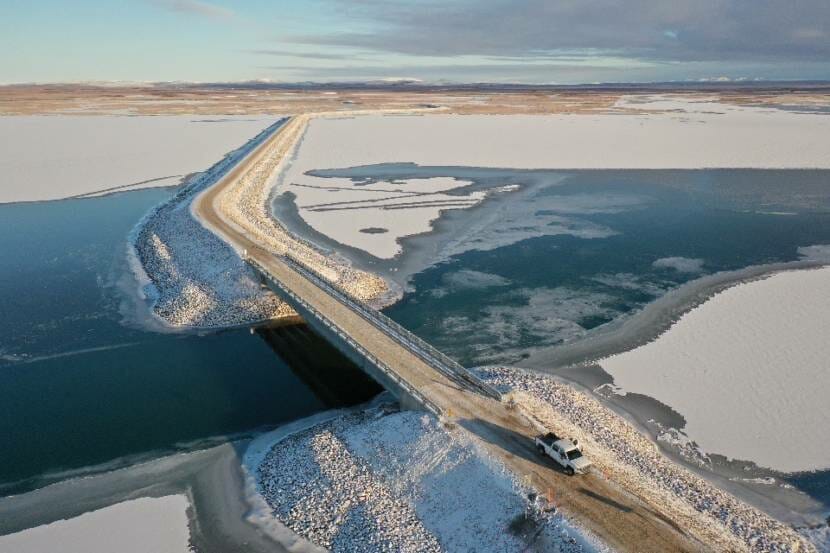
Kivalina Access Road (Photo courtesy of Jonathan Hutchinson, Alaska Department of Transportation)

After two years of construction, the Kivalina Access Road project is now usable by the community. It’s the first step in the process to potentially relocate the entire Northwest Alaska village from the threat of an eroding coast and rising sea levels.

Kivalina sits on a barrier island, surrounded by the Chukchi Sea. The area is prone to heavy wind and rainstorms. The protection of sea ice has become less reliable. Sea levels have risen with climate change, and so the ocean has chewed into the shore.

“It was always eroding,” said tribal administrator Millie Hawley. “We’re on a small spit of land that has diminished in size over the last century.”

The storms also bring the risk of flooding. Hawley said it had been difficult to evacuate people from the village during emergencies.

“According to the U.S. Coast Guard, it takes at least a day or two to come assist us,” Hawley said. “In a state of emergency, that’s just not acceptable.”

The solution was to build an eight-mile gravel road from the northern part of the community near the airport. The road stretches over the Kivalina Lagoon, allowing evacuees to head to a higher ground area known as K-Hill.

After three years of planning and two years of construction, the lion’s share of the road was completed at the end of October. Jonathan Hutchinson is the project manager with the state Department of Transportation.

“The project is substantially complete,” Hutchinson said. “There’s a need to install dust pallets next summer, and without getting into details, minor concrete finish work on the bridge.”

Hutchinson said the road is usable now, though that has brought up a new concern.

“One of the safety concerns that I’ve heard from the community has been lighting the route,” Hutchinson said. “Because you’re crossing the lagoon, everything’s going to be dark. Typically late fall, it’s going to be pretty dark by then when you’re wanting to evacuate on that road.”

With the new road, the community is also looking to relocate its school.

It’s part of a wider conversation to move the entire village and its more than 400 residents. A similar move was made by residents of the Western Alaska village of Newtok.

Residents of Shishmaref near the Bering Sea have discussed a move as well. Some scientists estimate the entire community could be underwater by 2025. Hutchinson said there is already a school site in mind.

“At the very end of the road, we’re putting a staging pad that’s intended to support future development in that area for the construction of the school,” Hutchinson said.

Hawley with the tribe said final inspections on the road are set to happen in early summer. For now, she said locals are getting use out of the new road.

“It’s been used every single day for subsistence,” Hawley said. “We’ve got access to our fishing sites even if the lagoon didn’t freeze over; we’re able to go there.”

As for the school, construction for that project is expected to break ground late next fall.

‘I’ve made it this far largely because of where I’m from’: Noorvik man is now a Rhodes Scholar

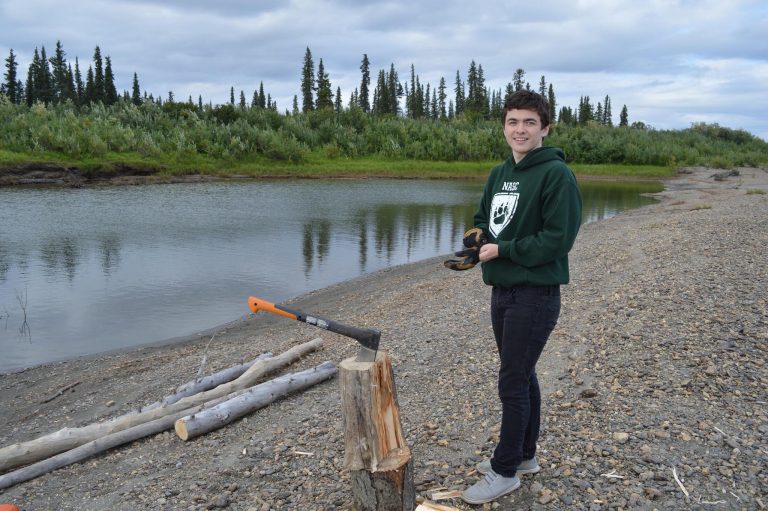
Wilfried Kuugauraq Zibell pictured by the Kobuk River. Zibell is a Harvard senior from Noorvik who was recently awarded the Rhodes Scholarship. (Photo courtesy of Wilfried Kuugauraq Zibell)

A university student from the Northwest Arctic village of Noorvik, population 600, was just awarded one of the world’s oldest and most prestigious academic awards. The Rhodes Scholarship funds two to three years of academic study at Oxford University in the United Kingdom.

In Noorvik, everyone spends a lot of time at the Noorvik Aqqaluk School. Wilfried Kuugauraq Zibell, whose parents were teachers, spent even more time there.

“My dad would teach me these big words,” Zibell said. “And I was two years old, wandering around the gym asking people for ‘assistance’ rather than for ‘help.’ And people just got a kick out of that, and that’s the kind of thing that I think set me on the course that I’m on today.”

Though not Iñupiaq, both Zibell and his father grew up in the village. His ties to the community run deep. He says he was encouraged by everyone in Noorvik to develop a love of learning.

“Whenever they saw me walking around with a book, they would hype me up a little bit and cheer me on,” Zibell said. “Being a creature of attention the way I am, I think that positive reinforcement really had a Pavlovian effect where now I’m addicted to reading books.”

Zibell excelled as a student throughout high school, serving as a student member of the state Board of Education as well as being part of the U.S. Senate Youth Program. He says when he found out he was accepted to Harvard, he was at a Ravn airline terminal in Kotzebue, where he and surrounding passengers erupted in joyous celebration.

Zibell brought his love of reading to Harvard, where he studies comparative literature, primarily between Yiddish and Iñupiaq works.

“I look at specifically displacement and people losing land and the way that is reflected in poetry,” Zibell said.

Zibell wanted to continue his studies of cultural displacement and the efforts to revitalize culture, which led him to apply for the Rhodes Scholarship. He said it was an arduous 7-month process where he was tasked with writing essays and other scholastic work, getting letters of recommendation and securing a sponsorship from Harvard. It didn’t help that Zibell was fighting COVID-19 when he started applying.

Though Harvard already has a competitive acceptance rate of around 4.7%, the acceptance rate for the Rhodes Scholarship is even lower, at roughly 0.7%. By the end of the process, when he was selected as a finalist, Zibell figured he was a long shot and prepared for the worst.

“And so when they actually said my name, and said that I won, I was completely unprepared,” Zibell said. “I had no idea how to react. I just stared at the Zoom camera in complete shock.”

Compared to his public celebration of getting accepted to Harvard, Zibell says getting the Rhodes Scholarship while hunkered down was more of a private affair. Though he admits he screamed with excitement out his window before calling his parents and other community members with the good news.

Zibell plans to study economic and social history while attending Oxford. He wants to tie all of his studies into helping support the culture of Native communities, as well as cultures of any communities in the world displaced by colonialism.

“Connect Iñupiaq revitalization work with Kalaallit revitalization work in Greenland or Irish revitalization work in Ireland,” Zibell said. “Because all of these fights are kind of the same work being done, the same fundamental struggle, for lack of a better word.”

Zibell says unlike some of his peers, many of whom come from well to do families, he owes everything to growing up in a tight-knit village.

“I’ve made it this far largely because of where I’m from and the people that raised me, and no shortage of blessings, of course,” Zibell said. “And it’s my responsibility to make sure that by my success, I can help other people. If I can’t do that, there’s no point in me having gotten this success in the first place.”

Zibell says the only uncertainty in his next steps will be if the pandemic forces him to learn remotely, or if he can pack his bags for Europe.

Alaska wanted Arctic ringed seals off endangered species list; federal officials rejected that request

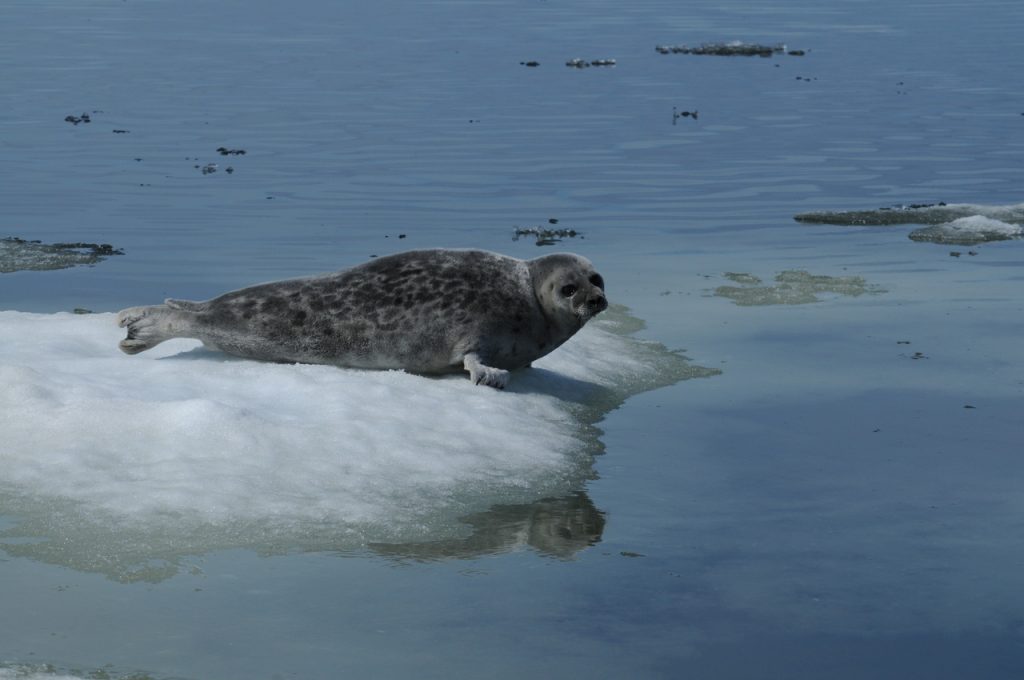
Ringed seal in Kotzebue Sound, Alaska
Ringed seal in Kotzebue Sound, Alaska. (Photo courtesy of NOAA)

On Wednesday, the National Marine Fisheries Service ruled against a petition from the state of Alaska to delist the Arctic ringed seal from the Endangered Species Act.

Last year, the state of Alaska partnered with several North Slope entities to write the petition, arguing that keeping the ringed seal listed as endangered could negatively impact economic opportunities for the state, as well as subsistence rights.

“Although we provided substantial new information to the service, they argued that information was considered in other ways, even though that information wasn’t available previously,” said Chris Krenz, a wildlife science coordinator for the state. “We are disappointed that they took that tact with this petition.”

Krenz says the state believes that the ringed seal isn’t threatened. Officials noted the ringed seal population is in the millions, despite measurable losses in sea ice. Though climate scientists with the National Marine Fisheries Service predict that by the year 2100, there will be little to no sea ice in the Arctic, Krenz argues that looking that far ahead doesn’t constitute the foreseeable future.

“There is way too much uncertainty to really understand how ringed seals will adapt or not to changes in our environment,” Krenz said. “We’ve also documented additional information that indicates ringed seals may have higher resilience than initially anticipated.”

The Obama administration listed the Arctic ringed seal under the Endangered Species Act in 2012, citing the effects of climate change on the ringed seal’s sea ice habitat.

Kristen Monsell with the Center for Biological Diversity agrees with the federal ruling.

“The best available science shows that within the foreseeable future, so much of their habitat will be destroyed — it will just melt away from greenhouse gases — that the species will not be able to withstand that loss,” she said.

Monsell says the fact that the ruling came from the Trump administration underscores the need for federally protecting the Arctic ringed seal.

National Marine Fisheries Service will soon begin a five-year review of the Arctic ringed seal to determine whether or not the species should still be listed under the Endangered Species Act. Krenz with the state of Alaska says this will provide an opportunity for the state to continue to make their case for delisting.

Site notifications
Update notification options
Subscribe to notifications