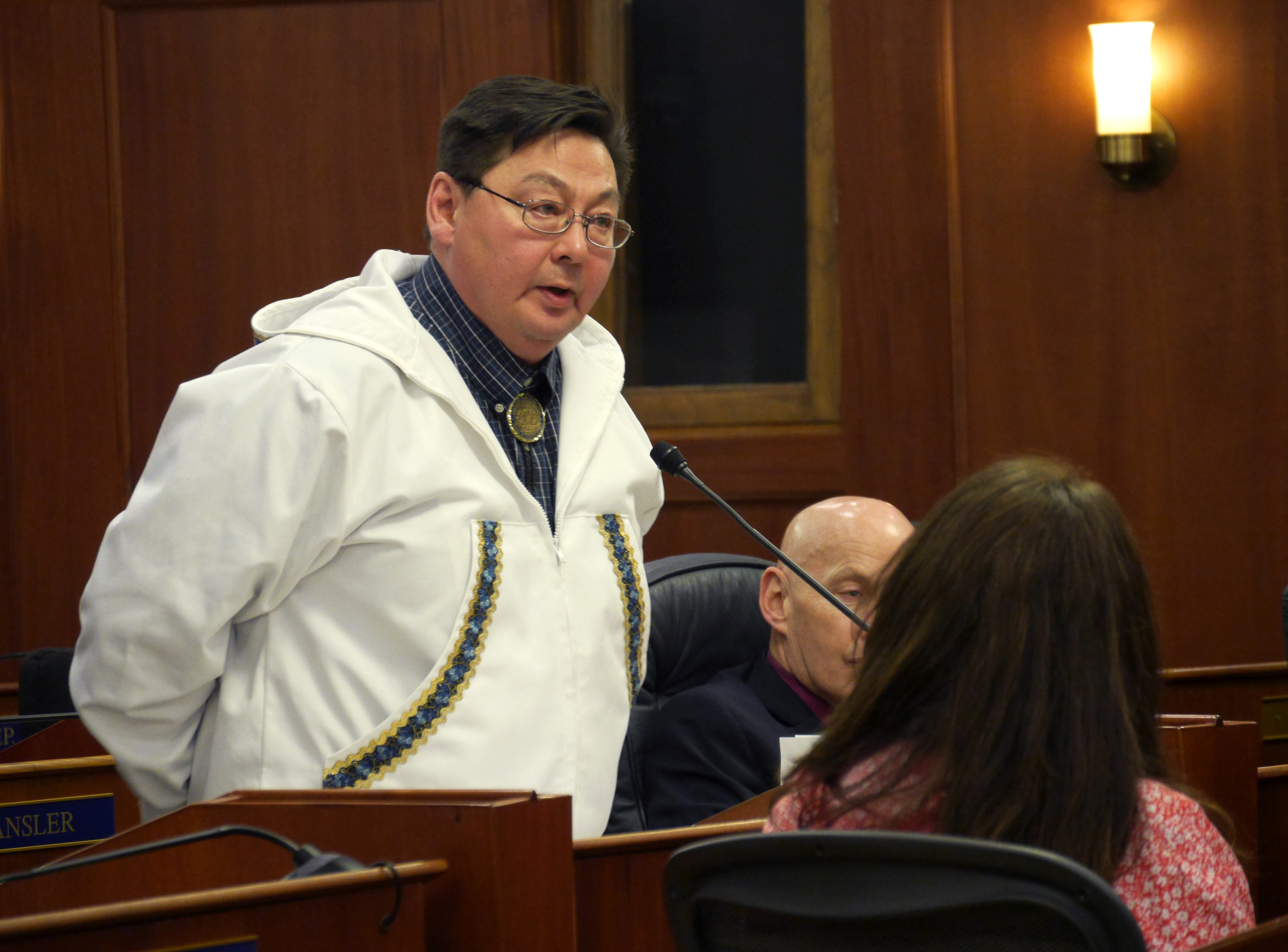
Rep. Dean Westlake, D-Kotzebue, speaks in support of House Bill 78, during a House Floor Session on Feb 3, 2017. (Photo by Skip Gray/360 North)
Dean Westlake of Kiana announced today he will resign after several women accused him of sexual harassment.
The first-term lawmaker said in his resignation letter, “The conversation about my behavior has been elevated above the needs of my district, and that is not why I ran for office.” He thanked the women for telling their stories and apologized for the pain he caused.
“It shows that more and more so, people who do these kinds of things are going to be held accountable for their actions,” Garrett said. “And it definitely shows that we’re making progress and I am thrilled to see that.”
Garrett said it took courage for the others to come forward.
“People who do these sorts of things, like Rep. Westlake, they don’t just do them once or twice and never make inappropriate comments or grope people ever again. It’s a pattern of behavior and when it goes unchecked, it escalates and can really end up hurting a lot of people.”
Westlake’s district covers the North Slope and Northwest Arctic boroughs. District Democrats will nominate three people to fill the position.
Garrett said the Democrats should live up to their professed values in who they nominate.
“It’s a party that supports women and they should definitely look for candidates who will follow through and actually live those values.”
Westlake’s resignation takes effect on Dec. 25. Then, Governor Bill Walker will have 30 days to pick one of the nominees as a replacement.
Nome’s Seaside Center. (Photo by Laura Kraegel/KNOM)
After more than an hour of discussion, Nome City Council decided not to allow sex offenders who actively are receiving treatment to stay at the Seaside halfway house.
Lance Johnson with Norton Sound Health Corporation Behavioral Health Services was one of the first to address the Council on the issue during last night’s regular meeting.
Johnson had a clarification point to make about sex offender treatment.
“I wanted to dispel any notion that BHS is able to or is providing sexual offender treatment services in this region. You have to be an approved provider to do that, and we do not have one right now; we have one who is currently looking to be approved here in February, but not currently approved.”
Most of the public comments revolved around sex offender treatment or the security of Seaside.
“Two things that are really important that I’ve been hearing people talk about and I’ve really been listening, I think what Trinh is saying is the location,” Nome resident Denise Gilroy said “If that is an issue, which has been brought up quite a bit, then I think the guarantee of security is really important. And I think setting in stone the treatment is really important, because I think what Lance just said kind of threw me through a loop.”
Even though Behavioral Health Services won’t provide treatment for sex offenders, one unnamed individual from the community has been approved by the Alaska Department of Corrections and will provide some treatment services directly at Anvil Mountain Correctional Center.
“We actually do have, for the first time ever, an approved sexual offender treatment provider there in the Nome area that is a local individual. And that’s why we are starting the program at Anvil Mountain, as well.”
Those opposed to housing sex offenders at Seaside, such as Melissa Ford, seemed to support efforts to provide treatment for sex offenders at the correctional center, but not at the halfway house.
“I think what we’ve seen happen here is we’ve created a moral issue out of a fiscal issue,” she said. “We keep hearing ‘treatment, treatment, treatment,’ but it’s about filling beds. That’s even what the ordinance says: it’s about filling beds. When Dean Williams came here with his blackmail, it was about ‘you will do this, or we will close it (Seaside) down.’ So, it’s a fiscal issue that we are talking about.”
Before making their final decision on the ordinance, the Council passed an amendment that would have allowed certain sex offenders to be housed at Seaside for treatment and limit the terms of their stay at the facility.
City Clerk Bryant Hammond read through the amendment.
“An agreement by applicant that they will not take for placement any untreated sex offenders except those actively receiving treatment, and are from the Nome region, are classified as low risk, and will be confined to Seaside for the duration of their treatment phase,” Hammond said.
After approving the amendment to the ordinance, all five present councilmen then voted on the main motion.
Councilmen Adam Martinson, Stan Anderson and Mark Johnson said no, while Doug Johnson and Gerald Brown said yes.
Councilman Lew Tobin was absent from the meeting.
In other business, the City Council passed an amended version of the other ordinance in the second reading phase.
Individuals who live on the Nome-road system and are 18 years or older are now eligible to serve as port commissioners.
The amended version also requires that an already appointed commissioner, who currently serves as mayor or as a council member, must vacate their seat on the port commission.
Before adjourning last night’s meeting, Mayor Richard Beneville recommended that Russell Rowe be appointed to the vacant seat on the port commission and Jessica Farley be reappointed to her seat on the planning commission.
Both nominations and all other business on the agenda passed.
Nome’s City Council will convene for their next regular meeting Jan. 8, 2018.
Rep. Dean Westlake, D-Kotzebue, speaks during a House floor session in February. He faces sexual harassment allegations by a former legislative staff member. (Photo by Skip Gray/360 North)
A former Alaska House staff member has alleged two incidents of sexual harassment by Rep. Dean Westlake, a Kotzebue Democrat. A report on the allegations today prompted House Speaker Bryce Edgmon to encourage victims of harassment to come forward.
Olivia Garrett worked for Fairbanks Democratic Rep. Scott Kawasaki during the legislative session this spring. She said Westlake harassed her on two occasions.
Garrett said she addressed a letter to Edgmon and House Majority Leader Chris Tuck, an Anchorage Democrat. In it, she wrote that Westlake grabbed her and told her that her hair “turned him on.”
On the second occasion, she said he grabbed her buttocks as she passed by.
Garrett said she wrote the letter at Tuck’s direction, including his instruction to include the phrase, “I hope we can both move forward in a professional manner so no one is embarrassed or damaged.” She said she never heard anything more about it from Tuck. She said she believes Tuck never showed Edgmon the letter or spoke with Westlake.
Tuck gave limited comment.
“She is free to say that, but at this time we are not free to respond, because of the nature of the allegations, as well as preserving the privacy rights for future complainants coming forward,” he said.
He added that any response he made could be construed as a form of retaliation.
The blog Must Read Alaska reported on the allegations Wednesday morning. Soon after the report, Edgmon responded.
The Dilligham Democrat said he welcomes those who’ve experienced harassment to bring their concerns to his office.
“We don’t condone this kind of activity and we’re committed to making changes in the Legislature so it doesn’t happen in the future,” Edgmon said.
An aide to Westlake said the representative is recovering from heart surgery he recently had and wouldn’t have a comment at this time.
A subcommittee is meeting Thursday with a goal of making recommendations to revise the Legislature’s sexual harassment policies. They were last updated in 2000.
Edgmon explained the subcommittee’s task.
“It’s our intent to go back and revisit those policies and to look at the formal complaint process and certainly the informal complaint process and to see how we can strengthen and modernize, if you will, how that occurs,” he said.
Garrett wasn’t available for a phone call on Wednesday, but answered questions by email. She made her concerns about Westlake public at an Alaska Democratic Party meeting last week. She also raised concerns about how the party handled a separate complaint she made last year.
The party then announced that it would require all candidates participating in the party’s coordinated campaign next year to complete an online sexual harassment awareness course.
Garrett said mandatory training is a positive step but isn’t enough. She said: “I hope there are consequences for offending staff and legislators and that they’re enforced.”
Garrett also called on Westlake to resign. She said the House majority should remove Westlake from committees and take away his staff.
Alaska Democratic Party Executive Director Jay Parmley said the Legislature should investigate Garrett’s allegations.
“If all of these accusations are true, there’s no doubt that Rep. Westlake should step aside and should resign, because there’s just no place for this in the Legislature,” he said.
Edgmon said the national attention on harassment could prove to be a watershed moment in reducing harassment.
“I think we ought to seize the moment and do whatever we can to make sure we can change the culture going forward,” he said.
The sexual harassment policy subcommittee is expected to submit recommendations before the next legislative session starts.
Purple sea stars and other species caught during the Alaska Fisheries Science Center’s 2010 survey of the Northern Bering Sea (Photo courtesy National Oceanic and Atmospheric Administration)
A group of marine scientists visited Western Alaska recently to discuss the results of a second bottom-trawl survey of the northern Bering Sea.
Bob Lauth is a research fisheries scientist with NOAA’s Alaska Fisheries Science Center.
This round of research comes seven years after their first survey of the area in 2010.
“We were really quite surprised and quite shocked at what a big difference there was,” said Lauth, who leads the Bering Strait survey program.
Lauth’s team used a large trawl net this summer to survey and identify species in the northern Bering Sea.
Among the results: the pollock population jumped by 6,000 percent, and there were also large increases in Pacific cod and smaller snow crab. According to the surveys, the water is warmer than it was in 2010, so cold-water species like saffron cod were much sparser, with Arctic cod numbers down 90 percent.
Jellyfish and sea stars, called “keystone species” because they help to structure marine ecosystems, were also found in higher populations.
“In an area where you may have concerns about food supplies for marine mammals and walrus and whatnot, something like an increase in sea stars could be something we really want to track,” said Lyle Britt, a fisheries research biologist on the team.
Britt said the warmer water has caused a shift from a “bottom-up” ecosystem — centered around the sea floor — to a “top-down” one — with more activity higher up in the water.
“When you have two that are just so diametrically different, it’s really hard to say — is this a trend, or is this more like a weather event? We just don’t know now,” Britt said.
Britt hits on a key footnote of the findings: The team needs more data to accurately describe what’s changing.
Jeff Napp said it’s about identifying larger processes within the ecosystem.
“Is the change that we saw last year really tied to the ice, or is it tied to something else? What things change first? What things change more slowly?” asked Napp, the director of the Resource Assessment and Conservation Engineering Division at NOAA. “It’s those mechanisms we really want to be able to discover, so that we can do a better job at predicting, and then communicate that along the way to the people living here, the people who are reliant on the resources.”
The team is meeting with representatives at Kawerak, the Norton Sound Economic Development Corporation and other regional organizations while they’re in Nome.
They’re also teleconferencing with leaders from some of the Bering Strait communities that are most dependent on these marine ecosystems: places like Gambell, Savoonga and Wales. And they plan to send their report to all the tribes in the region.
For now, the team said the increase in fish they saw this year doesn’t necessarily mean commercial fishing for pollock could start any time soon in the Bering Sea.
“Given how mobile we know pollock can be, this could be an ephemeral thing: They’re here this year, and they’re not coming back. Or they’re here to stay,” Britt said. “We just really don’t know. And even if, conceptually, say, this area was open to fishing, and there was interest, I think the time it would take even a company or something to even set up to do such a thing is going to be a number of years, and they’d want to know that these fish are truly going to be here for the long term before they’d even try.”
But if the funding is there, the scientists say, and they’re able to start doing surveys every other year, that answer could become much clearer as soon as 2019.
The entire report from the scientists’ surveys will available to the public online in the near future.
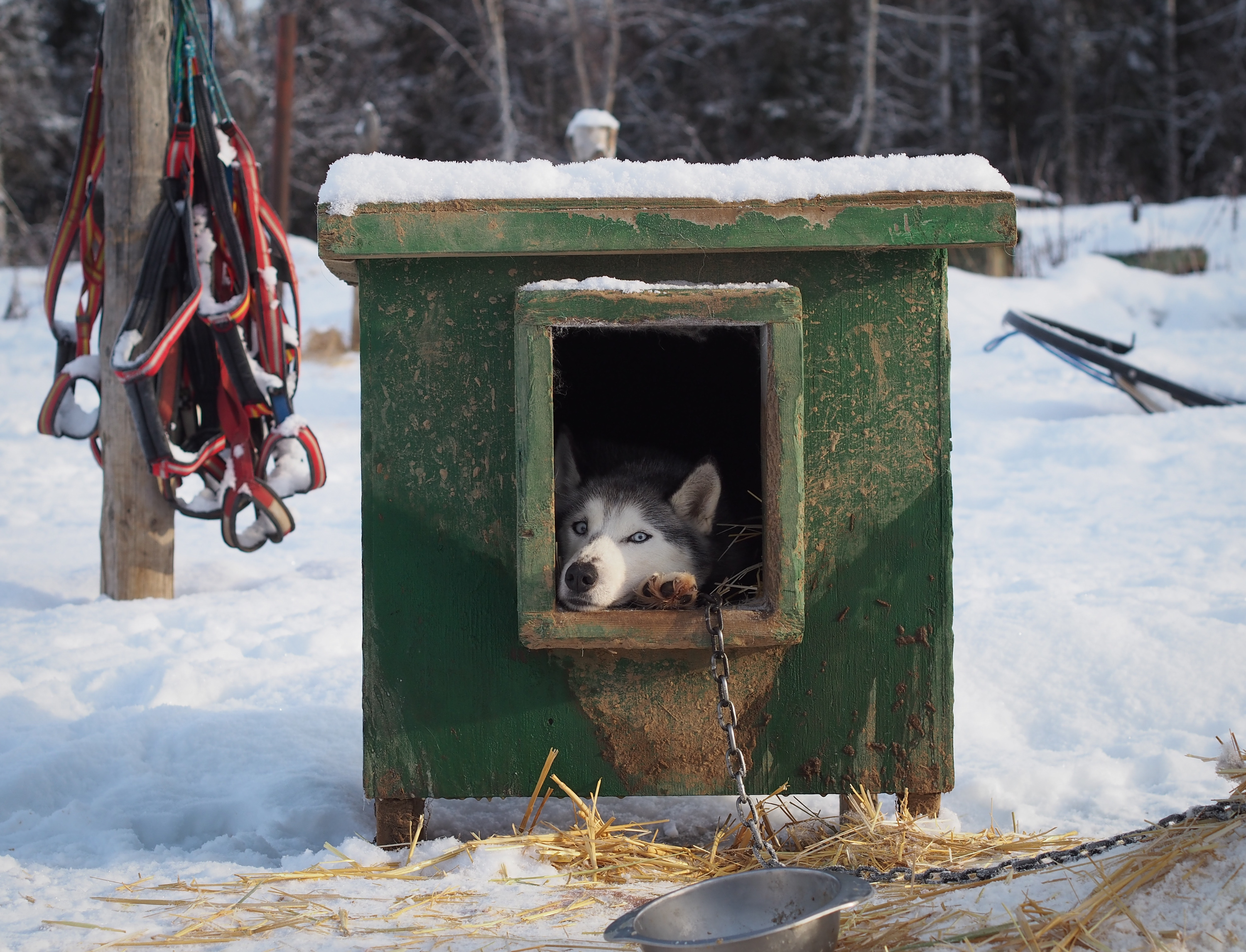
A Siberian husky rests at a well-maintained kennel in Willow. (Photo by Zachariah Hughes/Alaska Public Media)
The Iditarod Trail Committee’s Board of Directors wants to set up a kennel management program, a move aiming to set up new guidelines and counteract negative press directed at mushing’s most high-profile event.
Mushers who qualify for and race in the Iditarod already are expected to maintain standards of care for their animals and kennels. But many of those guidelines are fuzzy, outdated and due for review.
Now, ITC’s board is establishing an advisory committee made up of prominent mushers like Jeff King, Aliy Zirkle and DeeDee Jonrowe to begin drafting more specific standards for kennel management.
“There needed to be a better way to communicate what was really happening in our Iditarod kennels,” said Chas St. George, ITC’s operations director.
According to St. George, board members have been considering setting up kennel management standards for some time.
One of the motivating factors is a change over the last decade in how mushers run their dog lots, including more year-round training and tourism programming outside of winter race season.
ITC’s board also wants to counter a recent wave of negative press leveled at the Iditarod and mushing community from animal rights activists.
“This actually all began after the film ‘Sled Dogs’ first came out, and we recognized right away that this film was literally attacking kennels,” St. George said of the 2016 film, which alleges widespread abuse in commercial kennels catering to mushing tourism and draws a link teams competing in the Iditarod.
The hope is that the advisory group will have plans ready for implementing the kennel management program by June 2018, as mushers are beginning to register for the 2019 race.
But as for the particulars of the eventual proposals, they don’t yet exist.
With dozens of mushers entering the Iditarod in recent years from around the globe, states in the Lower 48 and kennels in many far flung parts of Alaska, policing dog lots for bad behavior is a practical impossibility for the Iditarod Trail Committee’s small permanent staff.
According to St. George, ITC’s board of directors isn’t imagining a regulatory body with agents monitoring compliance.
Instead, the advisory group will come up with a set of best-practices and guidelines for mushers, veterinarians, handlers, and community members to observe.
At present, St. George said it is still too early to know if race officials will be forced to modify the race’s planned route because of snow conditions.
The Board of Directors voted in May to break precedent and have the race follow its southern route in both 2018 and 2019. Typically, the event alternates between a northern path going through middle Yukon communities like Galena, and a southern route through the historic Iditarod checkpoint and several communities in the Yukon-Koyukuk census area.
Poor snow conditions in sections of the Alaska Range in 2015 and 2017 led to alternate routes that skipped those communities.
Race officials hope that back-to-back Iditarods through the southern route will help restore relationships and checkpoint protocols with residents.
Mitch Seavey pulls his team past the finish line after officially checking off the Iditarod Trail. (Photo by David Dodman/KNOM)
Almost 70 mushers signed up for the 2018 Iditarod sled dog race by the Friday registration deadline.
Veteran musher John Baker of Kotzebue was the final one out of 69 people to enter into the 1,000-mile sled dog race before this morning. Also on the list are 16 rookies, mushers representing more than four different nationalities, and the 2017 champion, Mitch Seavey.
Mitch’s son, Dallas Seavey, is still listed as withdrawn since he took himself out of the race in protest for the way the Iditarod Trail Committee handled the positive drug tests that were taken from his dog team earlier this year.
On Thursday, Seavey announced that he would compete in Norway’s 745-mile Finnmarkslopet. held about the same time as the Iditarod.
All 69 mushers signed up to compete in the 2018 Iditarod sled dog race will participate in the ceremonial start on March 3, with the race restart taking place the day after.
Close
Update notification options
Subscribe to notifications
Subscribe
Get notifications about news related to the topics you care about. You can unsubscribe anytime.