A Mountain Village man is charged in the death of his girlfriend.
Alexie Walters, 34, reportedly assaulted multiple people on the night of Oct. 4 in Mountain Village, according to Alaska State Troopers, before barricading himself inside his home with Gertrude Queenie, 22
Public information officer Megan Peters said village police officers as well as state troopers responded to the scene.
“Two village police officers did respond to the residence to check on Queenie, but they fled when Walters came to the door with a shotgun, and he fired a shot,” she said. “At approximately 2:10 in the morning, Walters ran out of his house and essentially fled the scene.”
After Walters left, a village police officer entered the home and located Queenie, who was pronounced dead.
Troopers reported that approximately 12 hours after fleeing the scene, Walters turned himself in at the Mountain Village Public Safety Building.
Walters was arrested and charged with second-degree murder, two charges of third-degree assault, fourth-degree assault, and tampering with evidence.
Walters was arraigned Friday morning in district court in Emmonak. A preliminary hearing is scheduled on Oct. 16at the Aniak Courtroom.
Queenie’s body will be sent to the state medical examiner’s office in Anchorage for autopsy.
Alaska Lt. Gov. Byron Mallott steps offstage after giving his opening speech to those gathered at Kawerak’s Leadership Summit. (Photo by Gabe Colombo/KNOM)
Alaska Lt. Gov. Byron Mallott and Gov. Bill Walker’s administration has taken steps recently toward a climate change action plan.
Just this week, Mallott was in Nome for Kawerak’s Leadership Summit, but also, he says, to discuss Arctic policy.
“During the prior federal administration, the Obama administration, what was called the Bering Sea Resilience Area was established, a series of executive actions by the president. And it’s important to note that all of that was begun by local leadership in the region taking the initiative to ask the federal government to be responsive to a rapidly changing Arctic, a rapidly changing Bering Sea.”
Through his talks with Kawerak on Tuesday, Mallott revisited the idea of a local Native council on climate change, which previously existed along with the Northern Bering Sea Climate Resilience Area.
The lieutenant governor believes that a group like the Bering Intergovernmental Tribal Advisory Council should be formed again:
“The role, the place, and the involvement of the Native community, I think, can add to the growing response to climate change and be a somewhat unique and leading voice; in being able to describe existing impacts, be able to inform policy making, informed by what they see out of their front windows.”
Mallott has seen through many front windows in Western Alaska, so to speak, since he entered into State office. The lieutenant governor recently visited Nome in August for the arrival of the Crystal Serenity, but he also recalls a visit when he and Walker held an inauguration celebration in Nome.
“We were in the parade, marching and having fun and talking with folks. All of sudden someone said: ‘Hey, there’s no one watching the parade,’ and someone else said ‘That’s because everybody in town is in the parade’ … and that was so fun. The governor and I just kind of stopped marching in one place and made our way through the crowd. It was wonderful and kind of uniquely Alaskan.”
After leaving Nome this time around, Mallott hosted a roundtable meeting back in Anchorage which featured oil industry employees, environmentalists, and local community leaders.
The group discussed their efforts to curb climate change, while assisting in the development of the Walker-Mallott administration’s action plan on the subject, which could be released later this year.
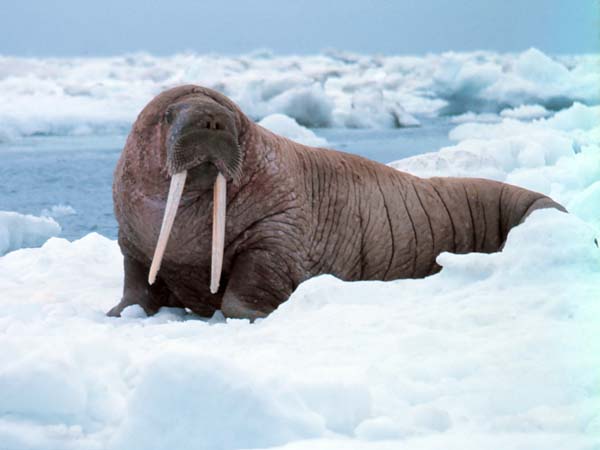
Pacific walrus. (Photo courtesy National Oceanic and Atmospheric Association)
The U.S. Fish and Wildlife Service announced its determination that Pacific walrus will not be listed under the Endangered Species Act days after a court mandated deadline passed.
According to a statement released today from the Fish and Wildlife Service, principal deputy director Greg Sheehan said the service’s decision is “based on a rigorous evaluation of the best available science, which indicates the population appears stable, and the species has demonstrated an ability to adapt to changing conditions.”
The Fish and Wildlife Service said the Pacific walrus population looks to be approaching stability, based on higher reproductive and survival rates than what was seen in the 1970s to 1980s.
Although decreasing sea ice has impacted walruses’ behavior regarding breeding, resting, and more, according to the service, it could not confidently predict how the animal would respond to sea ice loss in the future, beyond 2060.
In a news release, the Fish and Wildlife Service says “beyond that time, predicting behavioral responses becomes too speculative to be considered best available science for the purposes of a listing determination.”
According to the Service, the decision to not list walrus under Endangered Species Act will not affect the animal’s protection under the Marine Mammal Protection Act.
This concludes the Fish and Wildlife Service’s efforts in responding to a 2008 petition requesting the listing of Pacific walrus under Endangered Species Act.
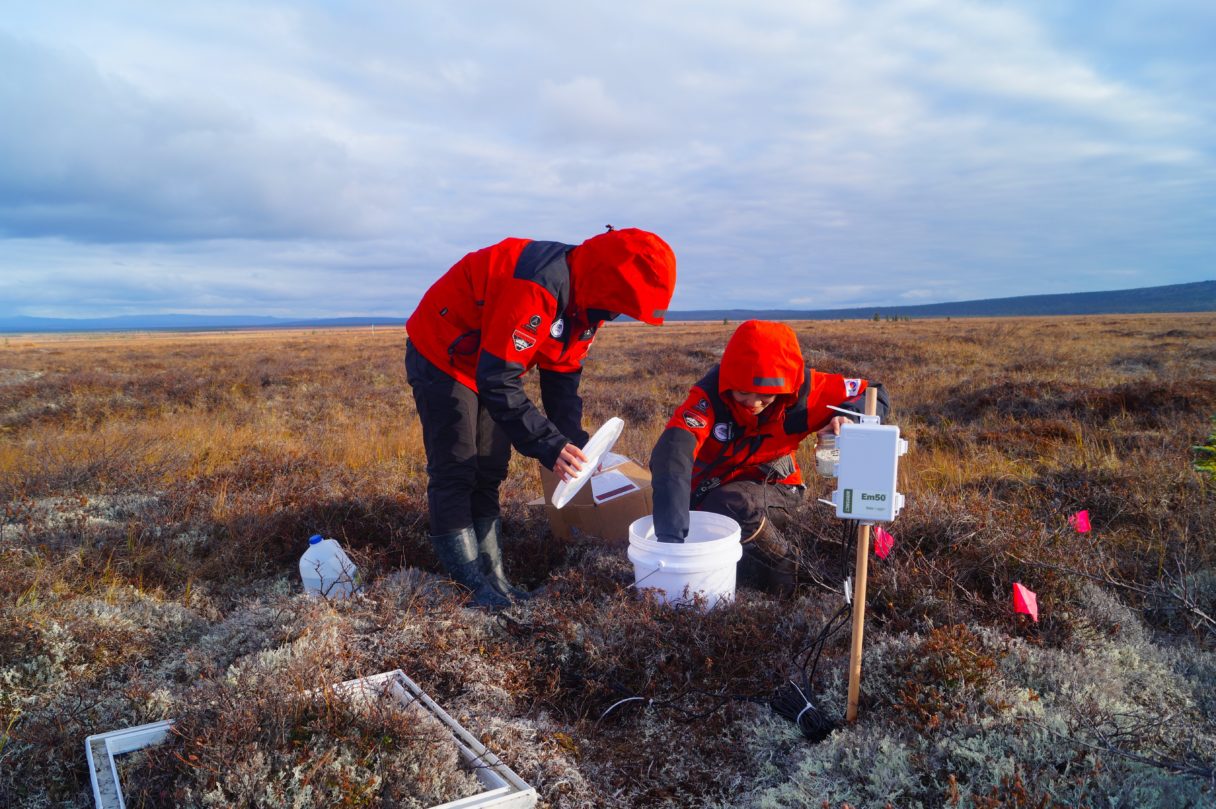
Members of the Korean Polar Research Institute research team take samples at their site near Council, Alaska. (Photo courtesy Min Jung Kwon)
A team of South Korean researchers were in Nome during September to study the effects of climate change on Arctic permafrost ecosystems. The project is one of many throughout the Arctic and Antarctic sponsored by the Korean Polar Research Institute, or KOPRI.
The small group of scientists and technicians on this Western Alaska expedition stayed in Nome for several weeks and drove daily to a site near Council. They used a special automated chamber system to measure concentrations of carbon dioxide in the permafrost and how fast it’s being released into the atmosphere. They also looked at some of the physical and chemical properties of the permafrost and its microorganisms.
Min Jung Kwon is a postdoctoral researcher with KOPRI.
“With the atmospheric temperature rising, and sea level rise, and all the sorts of phenomena associated with climate change, we’re trying to understand it,” she said through a a translator about the urgency of the research. “We’re trying to see the big picture in how the phenomena of climate change is affecting the environment.”
Building that big picture includes gathering data from KOPRI’s two Antarctic research stations and its Dasan Research Station, on Norway’s Svalbard Island.
KOPRI also operates an icebreaker, Aeron, which stopped in Nome on Sept. 16 as part of its annual Arctic voyage. It visits the Arctic in the summer and the Antarctic the other half of the year, during the southern hemisphere’s summer.
KOPRI also collaborates with institutions around the world, including the University of Alaska Fairbanks specifically for this Western Alaska project.
For a non-Arctic country like South Korea, Kwon said such collaboration is essential:
“We rely on the cooperations with institutes and researchers in the Arctic countries to not only give us tips on where we should set up our research stations but if we have common interests and research fields, then we will try to collaborate and see where we can help one another.”
Kwon’s collaborative research has taken her around the world, to sites in Russia and Canada. But, she says, “In Nome is where I find the most beautiful landscape. To see the many trees, to see the many mountains — it’s a great sight.”
And it’s an odd place, she admits, to find researchers from Korea. But Kwon stressed that Arctic climate change is a global issue.
“What happens in the Arctic does not stay in the Arctic. It’s actually affecting the entire globe. And we, as a mid-latitude country, we are also very much affected by the changes in the Arctic climate. Qe have been experiencing more and more colder temperatures during the winter and more extreme weather. I don’t think we try to see it as an isolated phenomenon, but we try to see it as a connected system.”
Kwon and her colleagues are back in Korea for now, compiling and analyzing the data they’ve collected.
But she said, in the future, KOPRI hopes expand its work in the Alaskan Arctic to the winter months, though they’ll probably need a few more layers for that.
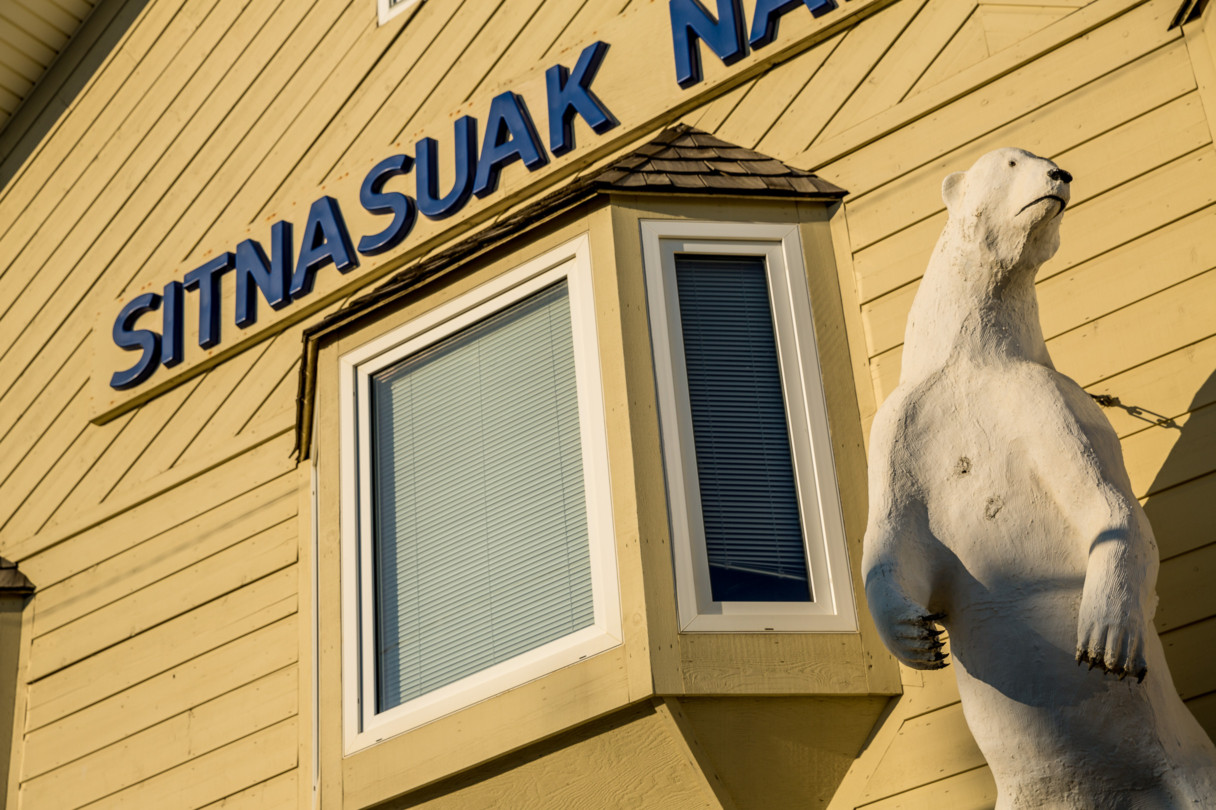
Detail of the Sitnasuak Native Corporation building on Front Street in Nome. (File photo by David Dodman/KNOM)
Legal battle and controversy plague Sitnasuak Native Corporation ahead of its upcoming annual shareholder meeting Sept. 30.
The corporation filed a lawsuit on Aug. 16 against three current members of its Board of Directors and one non-director. The suit alleges the three directors were involved in distributing an anonymous proxy solicitation to shareholders, which violated provisions of the Alaska Securities Act.
“This group during the 2017 election, the June 3rd election cycle, failed to follow those rules,”said Sitnasuak CEO and President Bobbi Quintavell.
The three directors, Quintavell said, “failed to disclose a series of required disclosures, which includes your identity, how much you expect to spend on that solicitation, and who is actually paying for that solicitation.”
SNC’s lawsuit specifically names directors Charles Fagerstrom, Edna (Becca) Baker, Barbara Amarok, and recently added defendant Marie Tozier on Aug. 30.
The three directors are being sued for their alleged involvement in distributing an anonymous mailer to over 1,000 of SNC’s shareholders.
According to the official complaint filed with the Superior Court in Alaska this August, Fagerstrom allegedly drafted the anonymous mailer, while directors Baker and Amarok allegedly participated in the drafting and were aware of the mailer.
Due to the ongoing lawsuit and upcoming annual meeting, Baker and Amarok declined to comment at this time. However, on behalf of all four defendants, Fagerstrom and his hired attorney filed an answer to SNC’s allegations, which says the following:
“This litigation is a last-ditch effort by the current majority of the Sitnasuak board of directors to retain political control by silencing directors and shareholders speaking out against discretionary proxy voting practices. Through the concerted efforts of Answering Defendants and like-minded Sitnasuak shareholders, an increasingly large number of shareholders have refused to participate in discretionary proxy voting in recent elections.”
Fagerstrom continues to read from the defendants’ filed answer:
“While technically lawful under Alaska statutes and regulations, Sitnasuak shareholders are becoming increasingly skeptical of discretionary proxy voting practices, which have been used in the past to gain strategic advantage in elections and directly contradict and circumvent Sitnasuak’s corporate values rooted in the traditional values and ethical beliefs of Inupiaq and Alaska Native culture.”
The defendants’ publicly filed answer to Sitnasuak’s allegations also admits that Charles Fagerstrom did send the mailer to certain shareholders.
According to the mailer sent out in June, Sitnasuak Native Corporation board member Jason Evans used discretionary proxies to change the outcome of prior corporation elections.
The corporation, including its CEO and chairman, claim that allegation, and others listed in the mailer, are false.
Sitnasuak’s Corporate Affairs Vice President Ukallaysaaq Okleasik shared his input on the anonymous mailer.
“Because it benefited certain people with a secret identity and it also disparaged certain people, it made people look bad in another light. And that was unfair because it didn’t say who was doing it. It could’ve been Exxon Oil Corporation. I mean, we really didn’t know when it first came out, who did it, who was it? And that was a big question mark, and the State of Alaska didn’t know, either.”
SNC chairman Bobby Evans adds, “Every shareholder deserves a fair election. Every shareholder deserves that directors are truthful and honest, and when they’re not, we have to tell people.”
And weighing in again, Quintavell said, “To the best of what we’ve been able to uncover so far, we discovered that it breaches the fiduciary duties of these directors. When our directors come on board, they sign a code of conduct to uphold our ethical standards. There’s a number of issues related to that which are then crossed, not just is it fair. The anonymous mailer also says that, Sitnasuak, we have unfair hiring practices, we have questionable elections. These things are not correct.”
The anonymous mailer also references Sitnasuak’s past elections, when the Alaska Division of Banking and Securities investigated SNC for violating the Alaska Securities Act during their 2014 and 2015 elections. This Division is under the Alaska Department of Commerce, Community, and Economic Development.
According to court documents, on its 2014 and 2015 notices of annual meeting and proxy statements, Sitnasuak failed to disclose Trudy Sobocienski’s two year-long employment as chief executive officer of Deloycheet. The Native corporation was then ordered to cease and desist from “omitting mandatory disclosures in proxy solicitations.”
As a result, Sobocienski was subsequently elected to the Board in 2014 and is up for re-election at SNC’s annual meeting later this month.
For the most recent lawsuit Sitnasuak is involved in, SNC is seeking monetary compensation for the damages incurred in this incident as well as the removal of all three directors named in the lawsuit. According to the defendants’ answer, they deny that the Native corporation is entitled to the relief it seeks.
Court records state the defendants have been given their summons; however, a follow up court date has not yet been set.
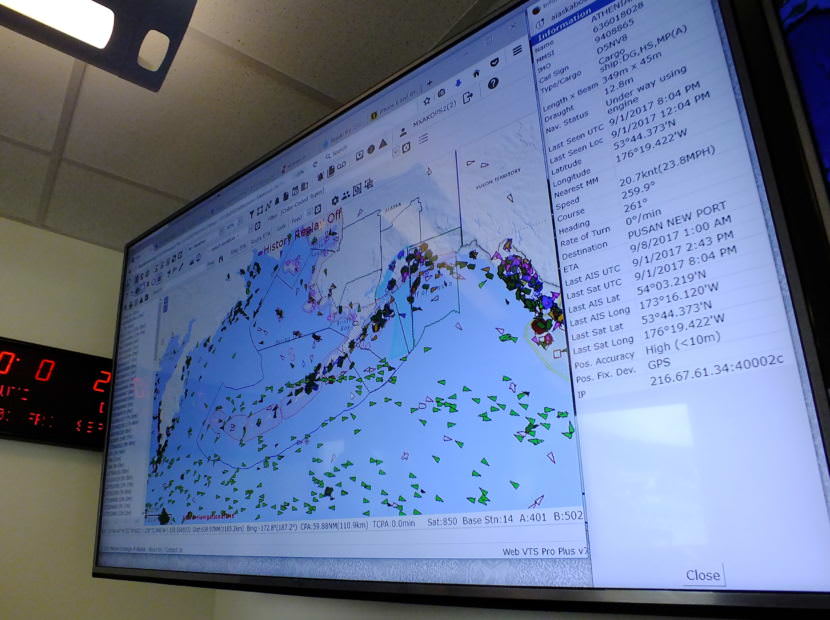
Every different colored triangle represents a vessel equipped with automatic identification system, or AIS, that can be tracked in the Northeast Pacific Ocean by Marine Exchange of Alaska. (Photo by Matt Miller/KTOO)
In a new building on the downtown Juneau waterfront, three people are watching rows of large monitors which line the wall of an operations center.
One of the monitors shows the latest marine and weather information from around Southeast Alaska. Another shows an Alaska map with dozens, perhaps even hundreds of colored triangles that represent — in real time — every large vessel traveling through Alaska waters and the Northeast Pacific.
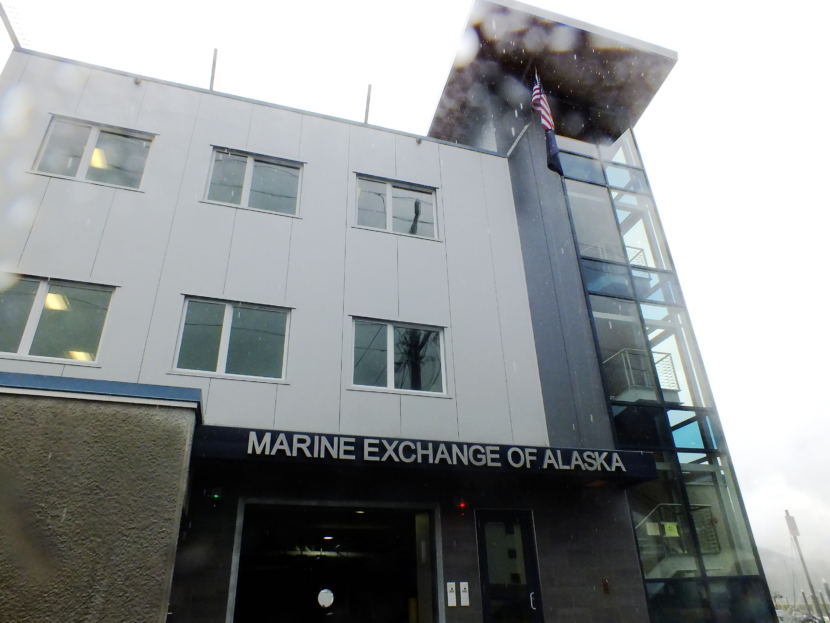
The three-story building adjacent to Harris Harbor is the new location for employees of a statewide vessel tracking system, and it’s not far from their old building.
“Even though it’s only a hundred yards, it’s a big deal,” said Ed Page, executive director of Marine Exchange of Alaska. “I remember myself carrying these some of these servers and ‘I hope I don’t trip in the rain!’”
Page said they kept operating during the recent move, and any related outages probably lasted only for minutes.
“We literally had cables running along the waterfront on the beach, from one (building) to the other to ensure we had never lost any connectivity,” Page said. “Finally, we said ‘OK, we can throw that switch. Now, we’re operating on this side.’ But for a period of time, we had the servers in one building and the operations center in another building.”
It wasn’t ideal to have those servers down for any length of time, especially when they’re used to pull in information from other organizations around the world, like U.S. Coast Guard headquarters and Lloyd’s of London.
Those servers also are used to simultaneously monitor hundreds of vessels in Alaska waters in real time. But Page said they had no other option.
The new building for Marine Exchange of Alaska in downtown Juneau is adjacent to Harris Harbor. (Photo by Matt Miller/KTOO)
Headquarters and operations center for the Marine Exchange used to be located in the nearby Juneau Electronics building next to the Douglas Bridge.
But Page said they began to outgrow it, and the building’s electrical and air conditioning systems couldn’t handle the load from all of those servers.
He said they began setting aside a portion of their revenue years ago to help pay for their own new $4 million building.
The private, non-profit organization tracks vessels using an automatic identification system, or AIS, box that each ship carries on board. It’s like an aircraft transponder for ships.
The Exchange tracks all of the vessels with nearly a hundred remote tracking stations they have built all along Alaska’s coastline.
The real-time data feeds into the operations center that was mentioned earlier by Page.
The organization has clients ranging from vessel owners to marine pilots, tug operators, cruise lines, tanker operators, and fish processing and shipping companies.
They pay a membership fee to see all the AIS information that comes into the Exchange.
Marine Exchange employees stand watch 24 hours a day, 365 days a year.
If any vessel appears to suffer from mechanical problems or deviates from established traffic routes, then an employee will contact the vessel’s crew to find out what’s happening.
Ed Page, executive director of Marine Exchange of Alaska, checks the latest marine and weather information from around the region. (Photo by Matt Miller/KTOO)
“The fact that you’re monitoring activity influence(s) behavior,” Page said.
Page is referring to extremely risky behavior like exceeding speed limits or straying outside of traffic lanes and getting too close to a dangerous shoreline.
Good information about a vessel’s location also is critical for efficient marine operations.
“Getting cargo off, getting supplies to the vessel, whatever, all dependent when a certain vessel arrives at a certain place,” Page said.
Page used an example of a typical cargo or container ship that that may be coming into port.
“Maybe 10 miles out, the pilot boards the vessel,” Page said. “A couple miles out, a tugboat meets the vessel. And then, closer to the dock, the shore gang, the line handlers show up. And then when it actually docks, the trucks and the cargo movers are there. There’s many different steps. All of that can be much more efficient if you have better information on where the vessel is all the time.”
Nineteen people work at the Marine Exchange of Alaska. Page said their annual budget is over $3.5 million dollars.
An open house of the new building is planned for next Friday and Saturday, Sept. 15 and 16.
Close
Update notification options
Subscribe to notifications
Subscribe
Get notifications about news related to the topics you care about. You can unsubscribe anytime.