Northwest

Aboard NOAA ship, challenges and adventure while mapping sea floor

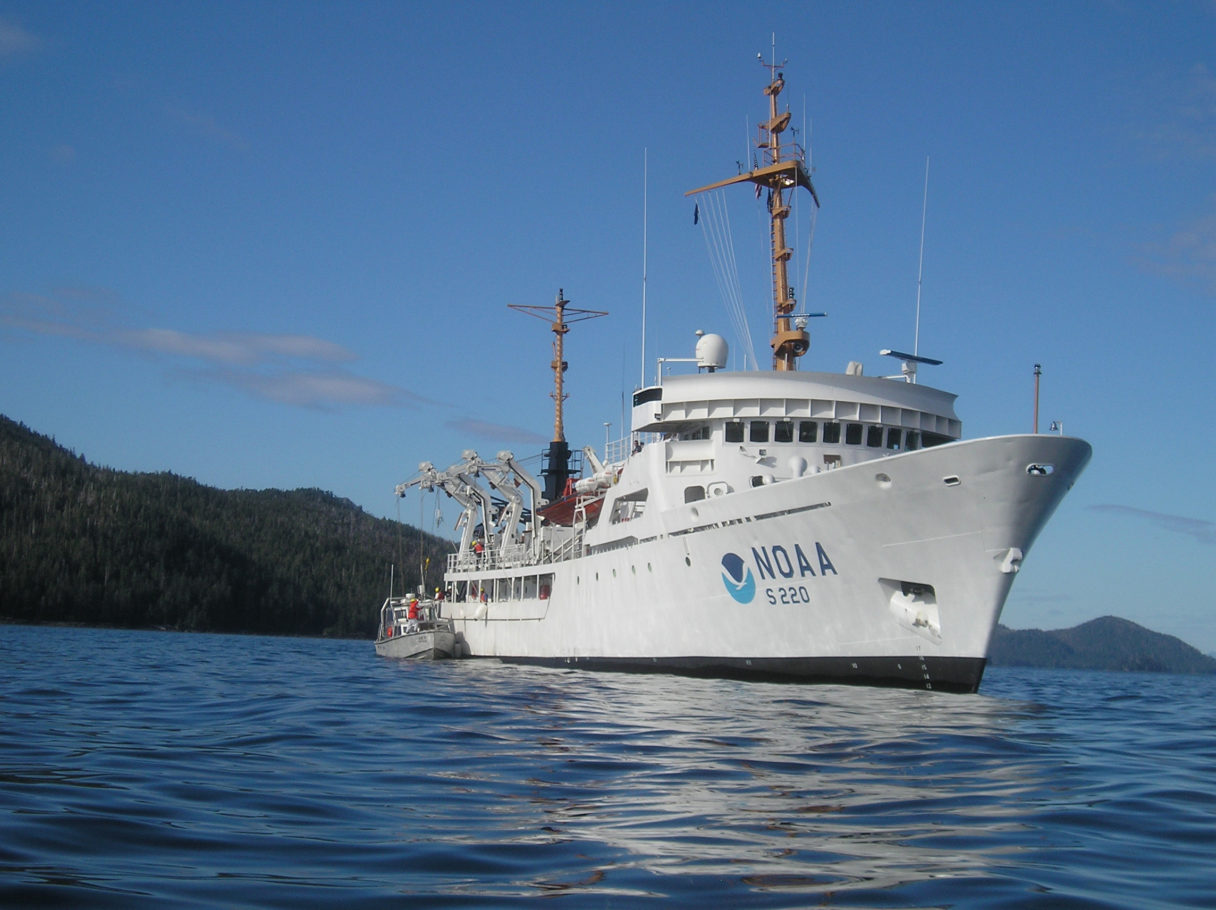
The NOAA Ship Fairweather in 2015. (Photo courtesy NOAA)

Summer is the busy season for marine research in the waters of Western Alaska, and that means plenty of ship traffic through the Port of Nome.

One such ship is the National Oceanic and Atmospheric Administration vessel Fairweather, which recently made a third stop in Nome during a mission to map the ocean floor.

Bon Jovi’s hit single blasts from the speakers aboard the Fairweather as Ensign Patrick Lawler gives me a tour of the research vessel’s main deck.

It’s a cool, sunny morning in Nome’s outer harbor, where the Fairweather — named after Mount Fairweather in Glacier Bay National Park — is anchored for the weekend.

We pass a parked motorcycle beneath the ship’s massive steel crane on our way to check out the sonar equipment on board.

 “A lot of people have their bikes,” Lawler said. “It’s actually pretty crucial to have some way of getting away from the boat.” 

Lawler is a member of the NOAA Corps, a commissioned uniformed service whose officers lead NOAA research missions in the air, on land, and, of course, at sea.

The Corps’ officers have backgrounds in a variety of scientific disciplines.

Lawler says he had been interested in joining the military until he enrolled at the Citadel Military College of South Carolina:

“I just majored in biology, and I just loved it all. And I wanted to do something similar to that, something scientific. And then I found NOAA, and I said, this is pretty perfect — I get to do it all, essentially. I grew up loving ships and boats, so driving the ship is so much fun to me.”

Along with things like driving the ship, Lawler and his colleagues are in charge of the research operations aboard the Fairweather. For the past month and a half, the ship has been mapping the ocean floor near Port Clarence in order to update nautical charts. The goal is to provide more reliable routes for ships navigating along the coast of Western Alaska.

Lt. Damian Manda, a NOAA Corps member from Colorado, is the operations officer on the Fairweather.

“In Port Clarence, that area is one of the few safe anchorages in this region, and in the Arctic in general, for larger deeper-draft vessels if there were to be a large storm that they didn’t want to be out in the Bering Strait for,” Manda says.

The Fairweather uses a multi-beam sonar to sweep the ocean floor for obstacles that could pose a hazard for such vessels. It turns out that technology can also be used to find missing ships, such as the fishing vessel Destination, which sunk in February without a trace. The Fairweather was able to locate the lost ship.

And, earlier in the summer, it conducted a survey of the Yukon Delta, helping to find safe navigation channels in the constantly changing waters.

Manda says some of the charts haven’t been updated since the late 1800s:

“We’re often driving over areas on the chart that were marked as land or as no depths at all where there was no channel previously — or vice versa, where there was a channel, there was now land.”

He says it’s that sense of constant discovery that keeps him going:

“Kind of that adventure — being out here in places not too many people go. We’re definitely some of the first people to see some of the things that we do on the sea floor.” 

And for the approximately 10 NOAA Corps officers and 20 civilian mariners on board, that has to keep them going for a while, since missions last for months at a time during the summer season.

But the crew also has access to a full range of amenities aboard the Fairweather, including a workout room, hot showers, and a lounge fully stocked with games, books, and movies.

In addition, the crew changes week by week, so, Manda says:

“There’s always training that’s going on, and you’re always meeting new people, and learning about their interests, so it’s always interesting to find out what their prior experiences are and find out how they ended up where we are.”

Manda’s path to the NOAA Corps began at an early age.

“I always had a love for maps and mapping, even since I was a child. I was always the navigator in the car, and that kind of thing.” 

He minored in geography at the University of Colorado and later received a master’s degree in ocean engineering from the University of New Hampshire, which houses a joint research center with NOAA. He even did an internship on the Fairweather during his undergraduate studies, which motivated him to pursue the NOAA Corps. 

On Saturday morning, while music blasted over the near-empty ship, Manda was off-board with some colleagues enjoying brunch at a local restaurant before heading south to continue their adventure in Kodiak.

Sitnasuak Native Corporation opens lawsuit against three directors

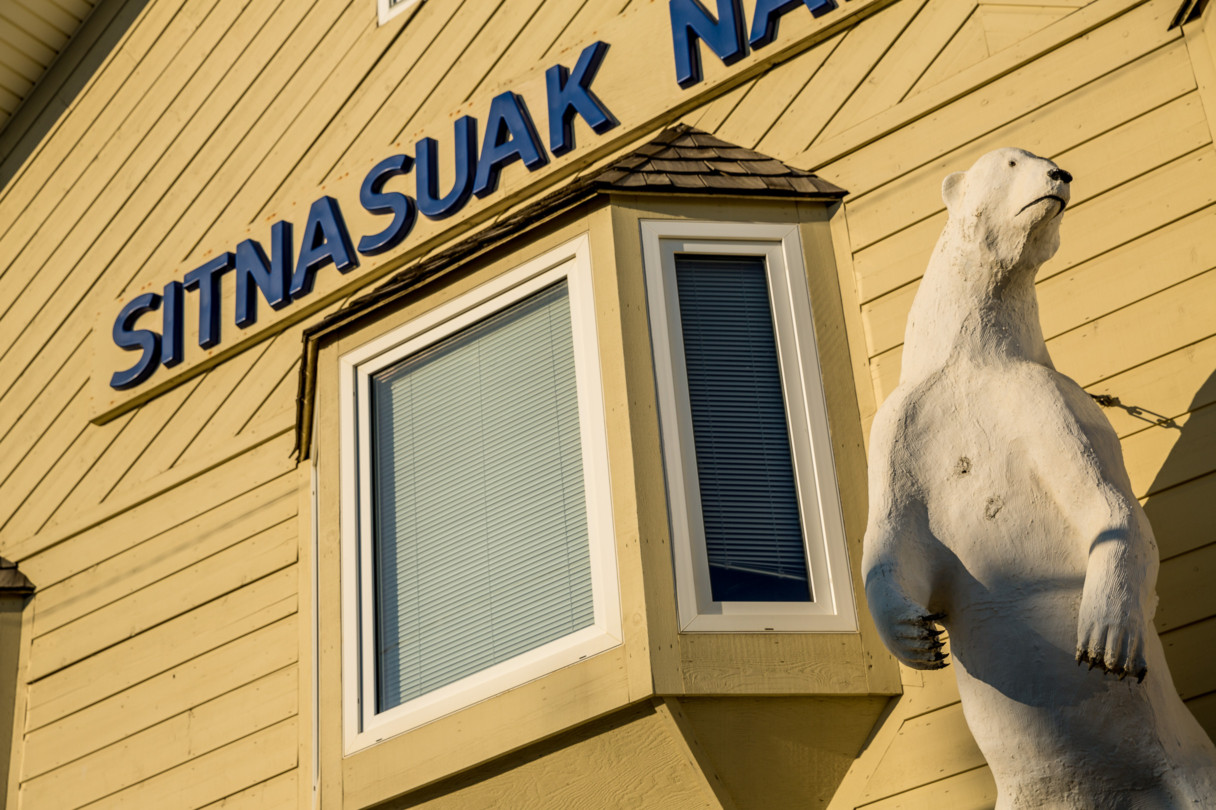
Detail of the Sitnasuak Native Corporation building on Front Street in Nome. (File photo by David Dodman/KNOM)

Sitnasauk Native Corporation announced August 16 that it has filed a lawsuit against three of its own directors.

The complaint, filed in the Superior Court for the State of Alaska, alleges that Barbara Amarok, Edna Baker and Charles Fagerstrom violated their fiduciary duties of loyalty and care by distributing an anonymous mailer that “misinformed Sitnasuak shareholders and damaged the corporation.”

Sitnasuak seeks the removal of the three directors from the board, as well as damages to compensate for harm allegedly done to the corporation.

The mailer at the center of the lawsuit was sent to Sitnasuak shareholders in advance of what was supposed to be the 44th annual meeting of shareholders on June 3.

That meeting failed to reach quorum, leading the board of directors to reschedule for September 30 in Anchorage.

On the agenda for the upcoming meeting is the election of four directors to the board, as well as a vote on an amendment to lower the quorum requirement for shareholder meetings.

Sitnasuak shareholders can vote in person at the meeting, or by proxy between now and September 27.

Coming in 2033: the “Great Bering Strait eclipse”

A total solar eclipse is seen on Monday, August 21, 2017 above Madras, Oregon. A total solar eclipse swept across a narrow portion of the contiguous United States from Lincoln Beach, Oregon to Charleston, South Carolina. A partial solar eclipse was visible across the entire North American continent along with parts of South America, Africa, and Europe. (Public domain photo by Aubrey Gemignani/NASA, via Wikimedia Commons)
A total solar eclipse is seen on Monday, August 21, 2017 above Madras, Oregon. A total solar eclipse swept across a narrow portion of the contiguous United States from Lincoln Beach, Oregon to Charleston, South Carolina. (Public domain photo by Aubrey Gemignani/NASA, via Wikimedia Commons)

Clouds and rain obscured Nome’s view Monday of the “Great American Eclipse,” but Western Alaskans can take heart: another total solar eclipse is coming in 2033, and this time, Nome will be at the center of it all.

Call it the “Great Bering Strait Eclipse.”

On the morning of Wednesday, March 30, 2033, a total solar eclipse will darken skies throughout western Alaska and eastern Russia.

The path of “totality,” in which the moon will completely block the light of the sun, will directly cross the city of Nome.

Totality also will happen throughout the Seward Peninsula, Norton Sound coast, and St. Lawrence Island, in addition to Kotzebue and Utqiagvik, as well as the eastern Russia cities of Provideniya, Anadyr, and Uelen.

By the luck of the astronomical lottery, Nome lies directly in the center of the eclipse’s path.

The eclipse will peak at 9:47 a.m. in Nome’s southern sky, with totality happening several minutes beforehand in communities like Unalakleet, Koyuk, Emmonak, Savoonga, and Gambell, and then several minutes later in places like Teller, Wales, Diomede, and Shishmaref.

Western Alaska’s good astronomical fortune could also spell logistical headaches for the region.

The 2033 eclipse may lure to rural sub-Arctic communities hundreds or even thousands of eclipse tourists, or so-called “eclipse chasers.”

Earlier this week, tourists seeking a good view of the August 21 eclipse sold out hotels and choked highway systems throughout the path of totality in the Lower 48, from Oregon to South Carolina.

Even a small fraction of those visitors would overwhelm the tourism capacities of Nome, Kotzebue, Utqiagvik, and nearby villages.

Assuming that the Iditarod Trail Sled Dog Race is still alive and well in 2033, the eclipse will be the second event in just a matter of weeks to bring a large share of visitors to Nome, a city of only 3,000 people.

The 1,000-mile Iditarod, which runs from Anchorage to Nome, typically finishes in mid-to-late March.

And while beds and airline flights to Nome will be booked months or even years in advance, what won’t be known until just hours or even minutes beforehand is whether the skies over the Bering Sea will be clear enough to see the solar eclipse in all of its majesty.

With 5,700 days to go to the 2033 eclipse, it may not be too early to start crossing fingers for clear skies.

Global warming makes expedition to ice-locked North Pole possible

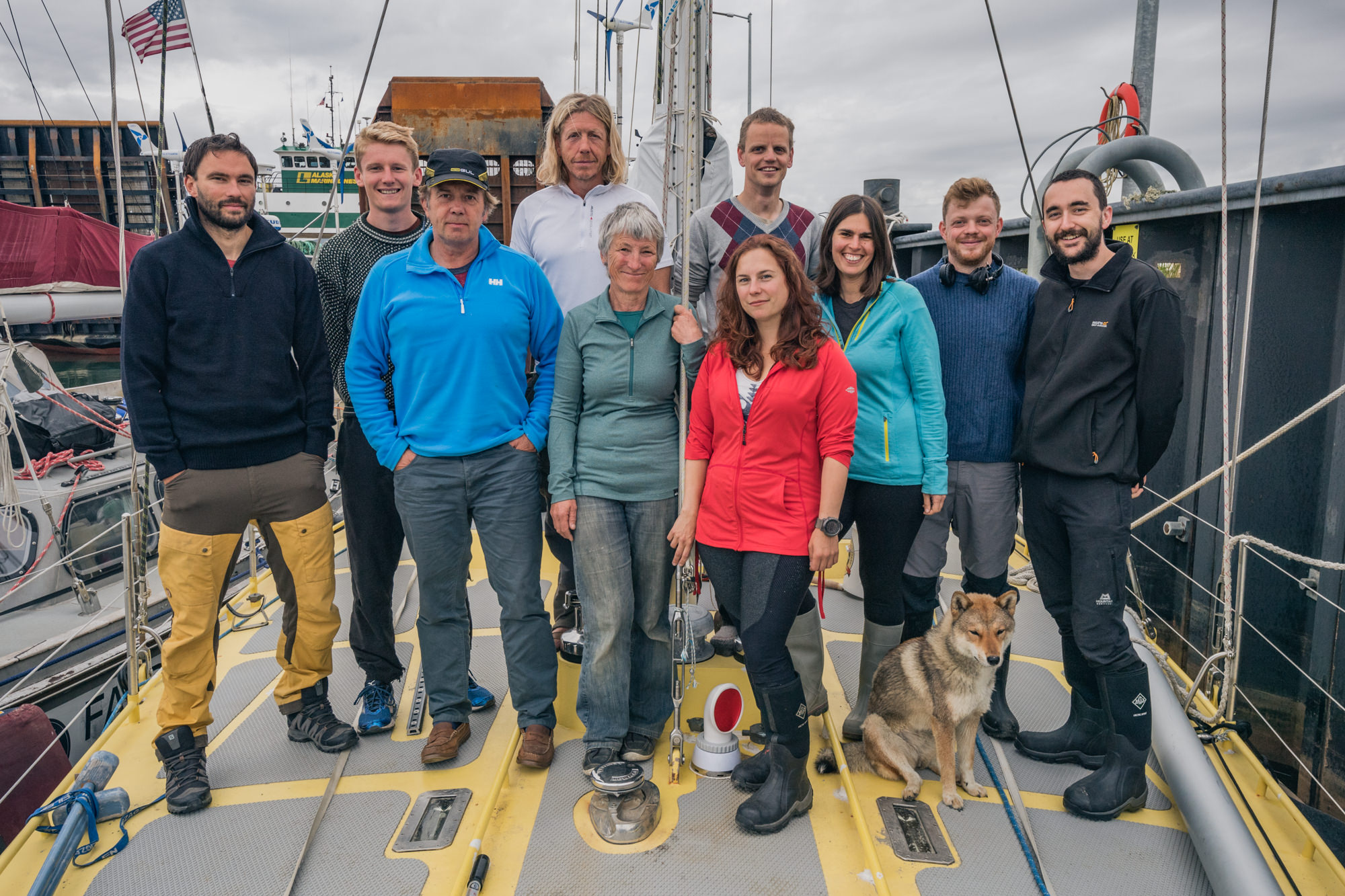
Arctic Mission’s crew hails from Britain, the Netherlands, and the United States. From left to right: Jaap van Rijckevorsel, Tim Gordon, Pen Hadow, Nick Carter, Frances Brann, Heather Bauscher, Erik de Jong, Krystina Scheller, Fukimi, Tegid Cartwright and Conor McDonnell. (Photo courtesy Conor McDonnell)

Two specially equipped sailboats are attempting a voyage that’s never been done before – a trip to the North Pole.

Led by a British explorer, the international crew has moved the boats from their home in Sitka up to Nome, where they’re hoping to launch for their journey to the Pole this weekend.

Melting sea ice in the Arctic could make their voyage possible for the first time in history.

The North Pole has long been locked in ice. But climate change is breaking the Arctic apart, turning a polar landscape into something far more friendly for boats.

Like the Snow Dragon II.

With its big white sail, the yacht looks like a pleasure craft but is sturdy enough to collide with sea ice at full speed without breaking apart.

Explorer Pen Hadow is actually taking two boats on the trip: the Snow Dragon with its aluminum hull and the Bagheera, which is made of steel. He hopes their journey will send a powerful message to world leaders that something isn’t right at the top of the world.

“We are not going to be able to carry on mindlessly taking whatever we want from the environment and I think a lot of people are looking to this as a symbol for a new debate,” Hadow said.

If two sailboats can get there, a whole universe of economic activity opens up – including shipping and fishing.

Both Russia and Denmark have filed a claim for the seafloor of the North Pole and other countries want to expand northward too.

Unlike the South Pole, the North Pole has no legal protections.

Hadow wants to shine a spotlight on the vulnerability of this region, by being the first to get there.

“It is a strange challenge and ambition indeed working very hard to put together a project that you don’t want to succeed,” Hadow said.

Because success means the ice is going or gone. Hadow calls the project Arctic Mission. His crew of 10 includes lead scientist Tim Gordon, who will collect data from creatures both well-known and mysterious.

“When the ice melts polar bears struggle to hunt seals, but there’s a lot going on beneath the waves that we know much less about.”

Like bacteria, plankton and other species living in frigid temperatures and total darkness.

In studying them, Gordon wants to create a snapshot of how human action is changing the world.

“Now that the ice is melting, they are all of a sudden going to be exposed to commercial fishing, to commercial shipping, to a whole wave of new competitor animals that will come in.”

In other words, Gordon said the whole food chain could be altered without ice to protect the region. There’s broad scientific consensus that the Arctic is warming twice as fast as the rest of the planet.

NOAA scientist finds rare whales in the Bering Sea

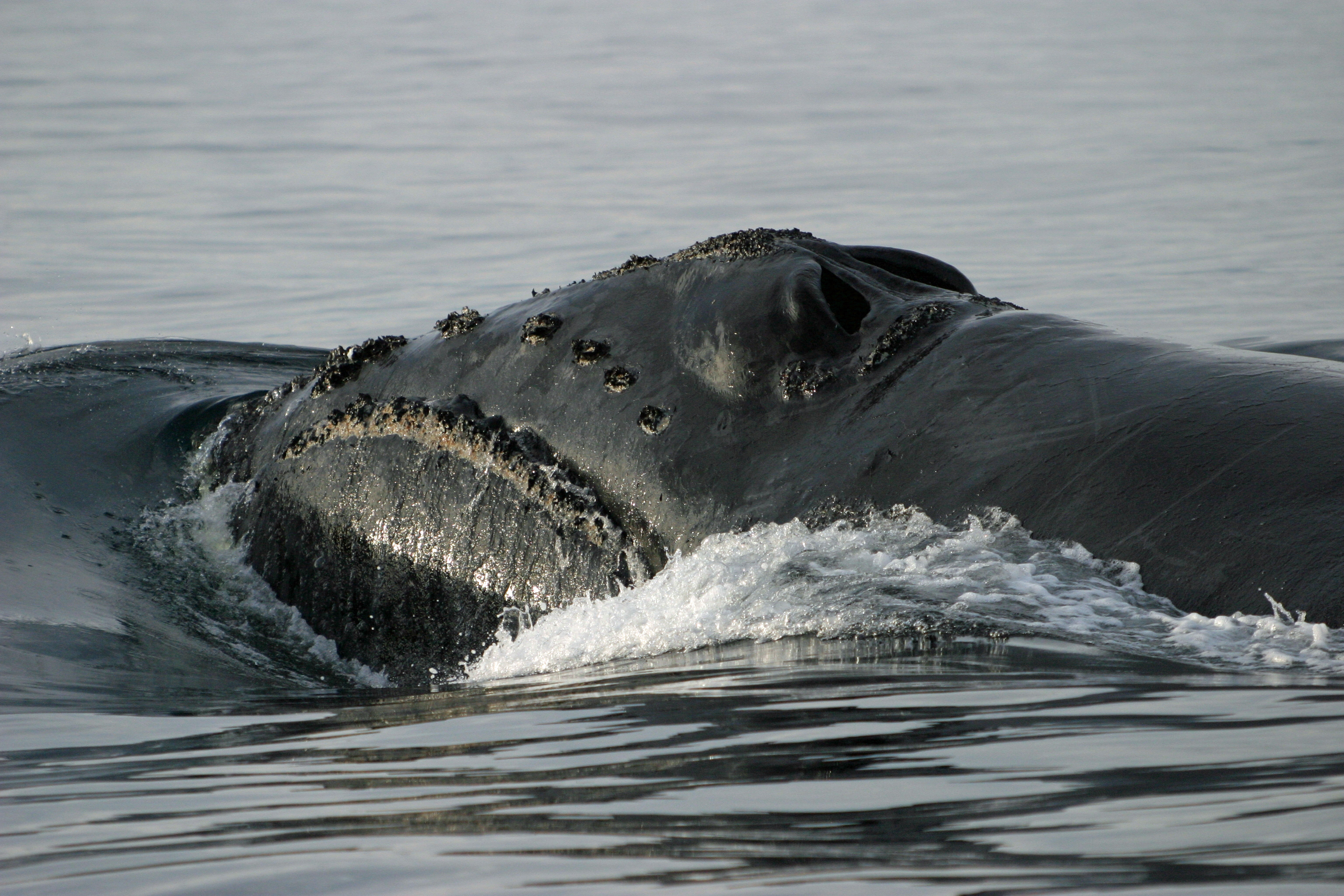
An extremely rare North Pacific right whale. (Public domain photo by John Durban, NOAA, Wikipedia Commons)

The North Pacific right whale is one of the rarest animals in the Bering Sea.

Only about 30 North Pacific right whales inhabit the eastern Bering Sea, according to the National Oceanic and Atmospheric Administration, or NOAA.

This week, a NOAA researcher was able to find and collect information on not one but two of these whales.

NOAA Fisheries researcher Jessica Crance uses acoustic instruments to listen for whales, finding them by sound.

Crance is part of an international team of scientists studying large whales in the Bering Sea this summer.

The team set sail from Dutch Harbor in July to conduct the International Whaling Commission’s Pacific Ocean Whale and Ecosystem Research survey.

This is the eighth year of the survey, and the first to use acoustic instruments to listen for whales.

NOAA plans to survey the entire Bering Sea over the next three years. Besides the rare North Pacific right whales, the scientists on board will study several other species, including humpback, sperm and fin whales.

The long-term goal of the surveys is to assess the populations of large whales in the North Pacific, in order to determine what, if any, conservation measures may be necessary.

The project is expected to last 10 years or more.

Egan calls for criminal justice bill, income tax

State Sen. Dennis Egan, D-Juneau, speaks at the Juneau Chamber of Commerce, Aug. 3, 2017. (Photo by Andrew Kitchenman/KTOO)
State Sen. Dennis Egan, D-Juneau, speaks to the Juneau Chamber of Commerce on Thursday. He called for another attempt to revise the 2016 criminal justice law. (Photo by Andrew Kitchenman/KTOO)

State Sen. Dennis Egan said the Legislature should have passed a bill revising last year’s criminal justice overhaul.

Senate Bill 54 would have increased jail times for some offenses. The Senate passed the bill by a wide margin.

“Senate Bill 54 passed the Senate on a vote of 19 to 1,” said Egan, a Juneau Democrat. “It’s now being held up in the House of Representatives. I think that should have gone immediately, but it’s being held up in a committee. So, we’ll bring it up in the second session.”

Egan made the remarks about this year’s regular legislative session and three special sessions Thursday to the Juneau Chamber of Commerce.

The criminal justice bill became stuck in the House State Affairs Committee. Two other committees – judiciary and finance – also were scheduled to discuss the legislation.

People who support the bill have said the Legislature went too far last year in reducing penalties. Critics of the bill have said it’s too soon to know what changes are needed in response to last year’s law.

Egan said there are other bills he’d like to see the Legislature pass. He wants the state to reintroduce an income tax, which he said would provide balance, along with a reduction to Permanent Fund dividends.

“We didn’t make government stable, and that really, really concerns me,” Egan said. “We can stop the slashing of state jobs.”

Egan said the Legislature could address a new source of state revenue during a fourth special session. He said he expects it to happen after the Alaska Federation of Natives annual convention ends in late October.

Egan also defended the Juneau Access Project, a road that would extend north of the city. He said road supporters worked to keep one half the funding for the project.

The capital budget the Legislature passed last week shifts some of the money to other Lynn Canal area projects. But Egan said he’s disappointed that other road money was shifted to build a school in Kivalina in Northwest Arctic Borough.

“We had promises the money would remain in District Q,” he said. “It didn’t happen. We had school construction at a location 1,066 miles from us.”

The school funding follows up on a 2011 settlement of the Kasayulie lawsuit that required the state to provide money for schools in some remote villages.

Site notifications
Update notification options
Subscribe to notifications