Northwest

Last season’s difficulties for Bering Strait auklets may indicate changing climate

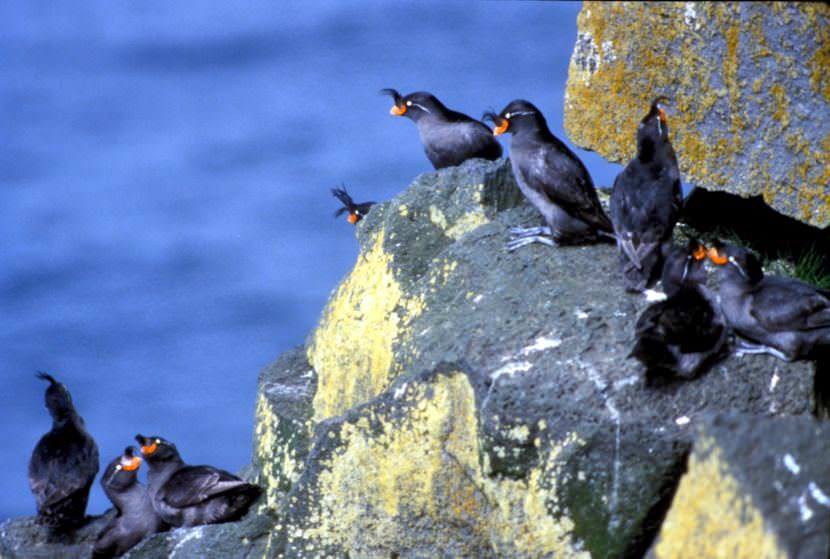
Crested Auklets
Crested Auklets (Photo by Josh Keaton/NOAA)

Following changes in climate variability, one University of Alaska Fairbanks assistant professor has discovered surprising changes in the Little Diomede auklet population.

Working at Bethel’s Kuskokwim campus, Hector Douglas has been studying the crested auklet’s fluorescent pigment for more than a decade.

His most recent study on the pigment started in the summer of 2015. Douglas describes the seabirds that year as normal, saying, “the crested auklet is a bird you can hold in your hand. Overall, the body is a dark gray, a little brownish in the plumage, and during the breeding season, it has these bright orange bill plates.”

The next year, in June of 2016, when Douglas came back to finish his study, other changes in the population took hold of his attention.

What he saw was an unusual sight for the month of June. Attendance at the crested auklet’s breeding colonies had dropped by 35-50% from the previous year [2015].

In Douglas’ experience, crested auklets arrive at the island in June with bright orange bills, a signal that they’re ready to mate. But in 2016, the birds were coming later than expected, and their bills weren’t fully orange. Douglas doubts that these latecomers, who lay a single egg per season, could breed successfully.

“And to see those birds arriving in the latter part of July with this not fully acquired coloration suggests that these birds were distressed in some way,” says Douglas.

Auklets can cope with difficult conditions, like those that would spur a delayed arrival, by secreting corticosterone, a hormone that helps the animals mediate stress of certain types.

“And by ‘stress,’ I mean things like your energy balance.” Douglas adds, “And the amount of energy you need to mobilize from your fat stores to cope with the demands that your body requires.”

The corticosterone levels in auklets can give scientists a look into other facets of their life. In this instance, by looking at the hormone, scientists like Douglas can get an idea of possible nutritional stress the auklets may have experienced.

Compared to the 2015 auklets, Douglas found an increased baseline corticosterone paired with a decrease of the carbon-13 isotope in blood samples. This suggests a decrease in zooplankton that auklet diets specialize in.

When faced with a lack of their favorite food, rather than move to a different type of food, Douglas thinks that the auklets may have varied their diet to include less nutritious zooplankton. But a lack of easy food availability can halt normal breeding activity. And in the auklet life cycle, Douglas says, consistency and good conditions are important.

Compared to the 2015 auklets, Douglas found an increased baseline corticosterone paired with a decrease of the carbon-13 isotope in blood samples. This suggests a decrease in zooplankton that auklet diets specialize in. When faced with a lack of their favorite food, rather than move onto a different type of food, Douglas thinks that the auklets may have varied their diet to include less nutritious zooplankton. But a lack of easy food availability can halt normal breeding activity. And in the auklet life cycle, Douglas says, consistency and good conditions are important.

“In terms of looking at a population, it is important to have successful years. So, what we need to be concerned about if we’re continuing to see warming trends, how is that going to impact birds in terms of breeding? They have roles in nature, but they also supply humans with food.”

Douglas suspects the changes seen in the population may be related to variable changes in climate. In 2016, it was reported that a particularly strong surge of above-average temperature water called “the blob” also contributed to a mass disruption of Alaskan marine life.

And while experts may not be reporting a “blob”- like event this summer, National Weather Service climatologist Rick Thoman says current waters in the Northern Bering Sea have taken a departure from normal conditions.

“With summertime here, and the Alaska current flowing now bringing water from the Northeast Pacific into the Bering Sea, we’re likely to see those above-normal sea surface temperatures continue into the fall months, at least.”

The possible effects of these water temperatures on the 2017 auklet population are yet to be studied.
Confusion over legalities is hurting Alaskan ivory market, locals say

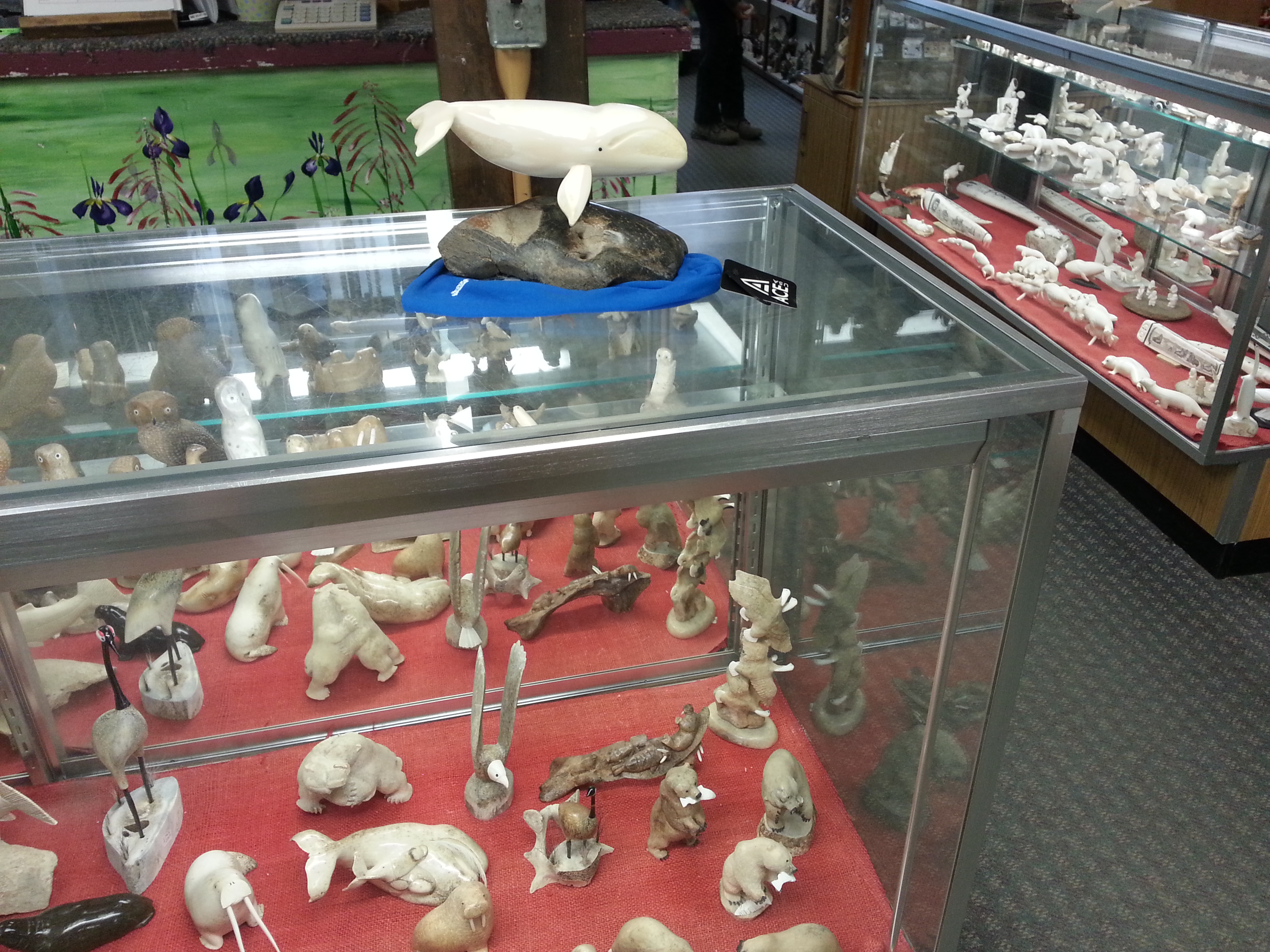
An ivory carving of a beluga whale is set to be purchased by a couple from Washington State. (Photo by Davis Hovey/KNOM)

With five different states’ ivory bans currently in effect, the latest passed by Hawaii at the beginning of this year, confusion remains among potential walrus ivory buyers in Alaska about what ivory is legal and what isn’t.

Robert James is the manager of Maruskiya’s, a small business in Nome that sells local gifts and handmade crafts, including ivory carvings.

He says most of their ivory pieces, made from mastodon, whale bone and walrus ivory, are all sold to a specific clientele.

“It’s a very client-based business,” James said, “We don’t necessarily have to get out there too much. I mean, the challenges are more and more so it might get to that point where we’ll have to. But a lot of times people will seek us out, or we have certain clients because we end up wholesaling a lot out of Nome. It’s a great place to buy, but we don’t get the foot-traffic like in Southeast or anywhere else.”

James is wrapping a mounted beluga whale, carved out of walrus ivory, for a couple of tourists from Washington state.

According to James, the best months for ivory sales at Maruskiya’s are July through September, which also is when a few cruise ships, like the Crystal Serenity, make port in Nome.

Maruskiya’s receives and sells ivory pieces from Native carvers throughout the Bering Straits region.

Susie Silook, a Native ivory carver from Gambell, recalls a time she addressed a tourist group in Nome and one potential ivory customer mentioned their hesitancy to make a purchase.

“They were scared to buy any ivory without a piece of paper that gives information on where it’s from and the fact that it is legal. In the elephant ivory ban, antiquities are allowed up to 100 years old, but it’s up to the owner to prove that this piece is 100 years old and, therefore, is legal,” Silook said. “People are worried about that, worried about having to prove that their item is actually legal.”

Silook feels that if carvers don’t get their artwork certified, then it will hurt their business.

James said even if they wanted to get certifications for the ivory Maruskiya’s sells, it’s just not feasible.

“We can’t get any kind of formal documentation that says this is authentic, Native art. Ideally, we’d get it from CITES, which is the international trade exporting association, but it’s not that simple, because every time you apply for that, it’s on each individual piece, and there’s a huge fee each time,” James said, “A lot of the time, it’s not worth (it), and it’s like a 3-6 month wait, so a lot of people aren’t going to wait that long, anyway.”

James believes it would take some clear legislation from the Alaska delegation to clarify the differences between walrus and elephant ivory as a way to reassure people who are concerned about buying ivory carvings.

Although that state legislation does not yet exist, Silook said an educational brochure is available that explains how Alaska Natives’ use of walrus ivory is excluded from an elephant ivory ban in the U.S., which was established by an executive order last year from President Barack Obama.

“Even though there’s an exemption for existing federal legislation permitting other items, which would be us under the Marine Mammal Protection Act, not many people are aware of, not just that law, but our legal use of walrus ivory,” Silook said. “This brochure is part of the ongoing effort by organizations to inform the American public about our legal, cultural use of walrus ivory in the hopes that states will not ban it along with other items they are attempting to ban as they respond to the executive order.”

This Alaska Native Ivory brochure was created through collaboration between the Eskimo Walrus Commission, the Alaska State Council on the Arts and others.

In Nome, Vera Metcalf, the director of the Eskimo Walrus Commission, explains how walrus and their ivory tusks are priceless in more ways than one.

“I’m from Savoonga, St. Lawrence Island, and I grew up with ivory. I have many relatives and friends who make crafts to make income,” Metcalf said. “It is highly utilized and valued, so it is a valuable, beautiful piece of a resource that we have been utilizing for centuries. It’s part of our identity, it’s part of our lifeways.”

The Commission is also working with the Alaska delegation to educate other state delegations about walrus ivory before they decide to implement more inclusive ivory bans, Metcalf said.

As it stands, California, New York, New Jersey, Washington, and Hawaii all have their own state ivory legislation, some of which ban walrus ivory along with elephant ivory.

When asked if these state bans have affected Maruskiya’s ivory sales, James replied, “Oh absolutely, sure, and we’ve just had to adapt, find other clients. We used to go to California and do a show in San Francisco, but we can’t do that anymore. That was a big weekend for us, because we really only get out of Alaska and bring large amounts of inventory to a couple shows, and that was one of them. We aren’t panicking yet, but sure, it has affected sales.”

James is hopeful that the Alaska Native Ivory brochure will continue to educate his potential customers and help carvers in the region sell more pieces of ivory off Maruskiya’s shelves.

For now, James says Maruskiya’s will operate as usual and participate in a crafts show in Santa Fe, New Mexico, this August.

Social worker receives national award for suicide prevention efforts in Y-K Delta

A Lower Kuskokwim School District social worker received a national award this week in Washington D.C. for his work in the Yukon-Kuskokwim Delta on suicide prevention.

James Biela is an itinerant Social Worker for LKSD, frequently traveling out to Newtok, Tununak, Toksook Bay, Nightmute, Mekoryuk, and Nunapitchuk to hold trainings and lectures on suicide prevention.

He received the Sandy Martin Grassroots Award, given out to three members of the National American Foundation for Suicide Prevention, for work in grassroots programs. Beila is a volunteer and the founder of the AFSP Alaska Chapter.

Winning the award was an honor, says Biela, an honor he was not prepared for.

“Actually, I was totally shocked that I’d be receiving this award. I didn’t have anybody giving me a heads up,” said Biela. “I feel it’s an honor, but it was also a sad time because one of my friends out in a village before I got on the plane, died by suicide.”

For Biela, the news underscored his life’s work.

“It gives you more power to do more,” said Biela. “Actually, this year I was very fortunate to have a young man from Newtok, an Alaska Native, come with me to Washington D.C. to talk to the congressional leaders about suicide. But on this one it just makes our work more important. To be the voice about how suicide can be prevented and get the Congressional leaders in D.C. to listen.”

And they did just that. They sat down for twenty-five minutes with Senator Dan Sullivan and Senator Lisa Murkowski, discussing village suicides in the YK Delta.

“I know everybody needs to pitch in with the leadership that they can afford to understand our needs,” said Biela.

That’s especially important now, said Biela, with the ongoing healthcare debate and the possibility that mental health care will be cut out of the budget.

Two boaters found dead south of Unalakleet after joint search and rescue efforts

What started as search-and-rescue efforts turned into a death investigation in Unalakleet.

Two boaters, Peter Nanouk, 55, and Justin Nanouk, 35, from Unalakleet, were reported overdue Sunday evening, according Alaska State Troopers.

The two relatives were reportedly heading south towards Klikitarik to fish.

After searchers from St. Michael did not locate the fishermen on Monday, more volunteers in boats joined the search efforts in the area.

Peter Nanouk’s boat, an aluminum open-top skiff, was found in a swamp Tuesday without the two men onboard.

Both Nanouks later were found deceased on the beach near Golsovia River.

Foul play is not suspected in their deaths. Their remains will be sent to Anchorage for autopsies.

Feds to gain control over Alaska river

BETHEL, Alaska (AP) — Starting next month, the management of king salmon on a southwestern Alaska river will transfer from state control to federal.

KYUK-AM reports that as of June 12, the U.S. Fish and Wildlife Service will begin to oversee the salmon living on lower and middle Kuskokwim River. Under federal law, the switch is necessary when there is poor return of king salmon. By taking over the fishery, the service is responsible for ensuring that local people receive subsistence priority.

According to the report, the feds may announce gillnet fishing openings depending on the condition of the run.

Refuge Manager Ken Stahlnecker says one opening is already scheduled for June 12. He expects fishers will be allowed to harvest as many as salmons this year as last year: about 40,000 kings.

Alaska House calls for more stringent measures on vessels in Bering Sea

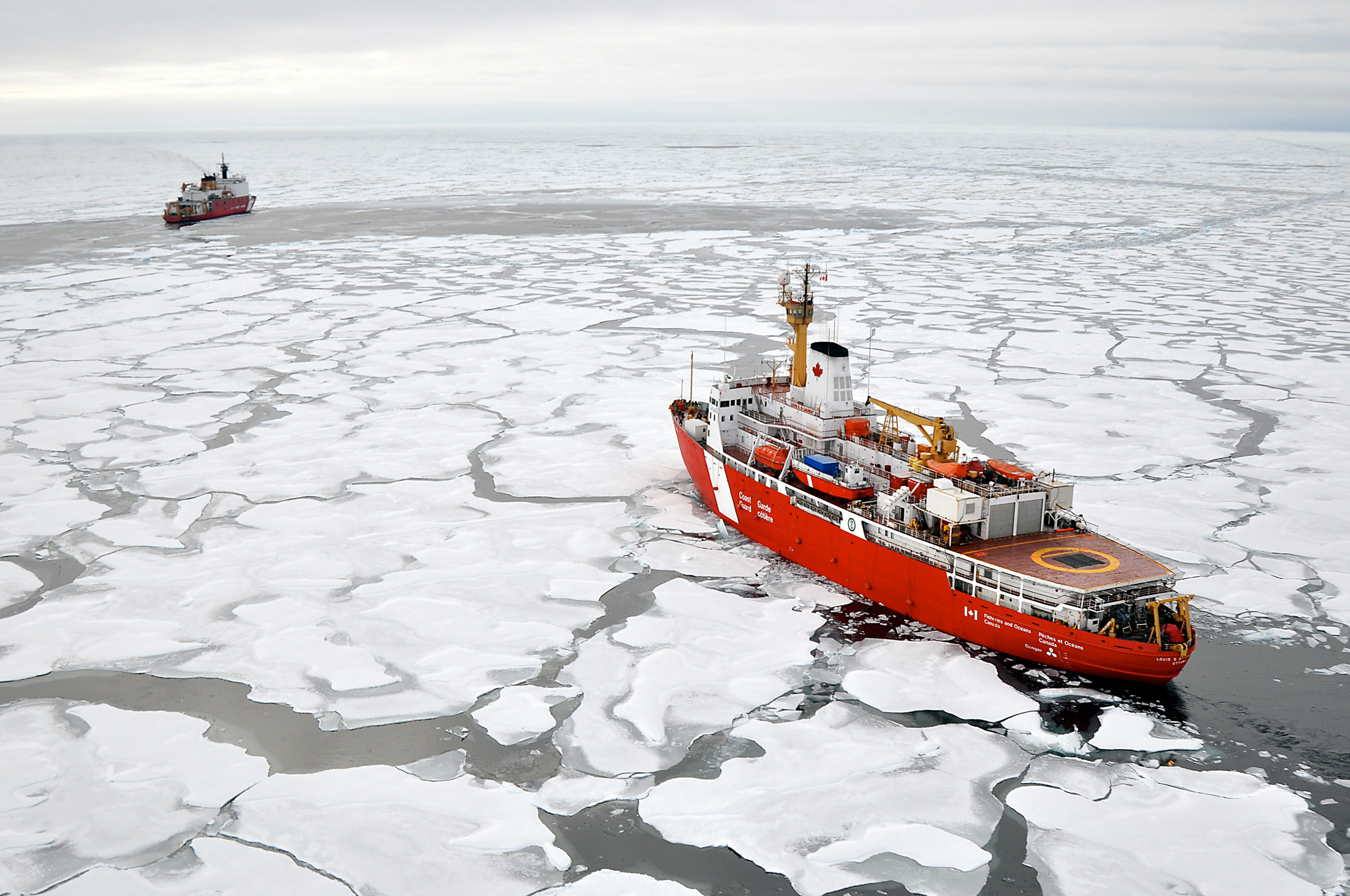
Canadian Coast Guard ship Louis S. St-Laurent makes an approach to the Coast Guard cutter Healy in the Arctic Ocean Sept. 2009. As Arctic marine traffic increases, several northwest Alaska communities have joined forces to establish a new waterway safety committee. (Photo by Patrick Kelley/U.S. Coast Guard)

Vessel traffic in the Bering Sea is the focus of a new resolution that passed through the Alaska House of Representatives with a vote of 33-6 on May 16.

One of the sponsors of House Joint Resolution 19 is District 40 Rep. Dean Westlake.

“In a nut shell, what we are looking at is knowing who is out there, which way they’re going, their speed,” Westlake said. “We’re trying to keep everyone in their own lane if you will.”

This new resolution is aimed at incorporating a set of Arctic Marine Safety Agreements into the U.S.’s international agreements with countries like Alaska’s coastal neighbors.

An Arctic Waterways Safety Committee will be involved in locally monitoring these agreements, Westlake said.

“What it is, is Alaska municipalities, marine mammal hunting groups, and this as well, the Arctic marine ship operators,” he said. “What they do is promote and identify safe and environmentally responsible shipping operations for us in the Arctic here.”

Earlier this year, the International Maritime Organization put a new Polar Code into effect, which regulates how international ships operate in polar waters.

If action is taken on Westlake’s resolution by the Senate and Gov.  Bill Walker, then the representative says it will augment the existing Polar Code, with additional spill prevention measures for transiting vessels.

“There’s something called innocent passage, now if you’re going through and you’re not stopping at an American port, which is us, you can have your own safety standards, safety codes, ship codes, whatever you want over there or you can have the lack thereof,” Westlake said. “We want to see these safety codes in place for every ship that is going through, whether you’re stopping or not. We need that assurance that we are all on the same page when it comes to environmental responsibility.”

The future of this resolution depends on the Senate, but will not reach them until the next session in January 2018.

Regardless, Westlake is optimistic about the potential of HJR 19.

“It has passed the House; the resolution is there so our federal delegation already knows it’s in the works,” Westlake said. “That’s a good thing, we broadcast loudly with a majority of the vote that this should happen and I think with that we are going to have Senator Murkowski and Sullivan as well as Rep. Young out there going to bat and starting to push for this.”

Currently Westlake and the rest of the Alaska Legislature are in the midst of a special session, focusing on balancing the State’s budget and managing its debt.

The House convened Monday, while the Senate is scheduled to convene Wednesday morning.

Site notifications
Update notification options
Subscribe to notifications