Southwest

To center Yup’ik culture, a Southwest Alaska school district has adopted a subsistence calendar

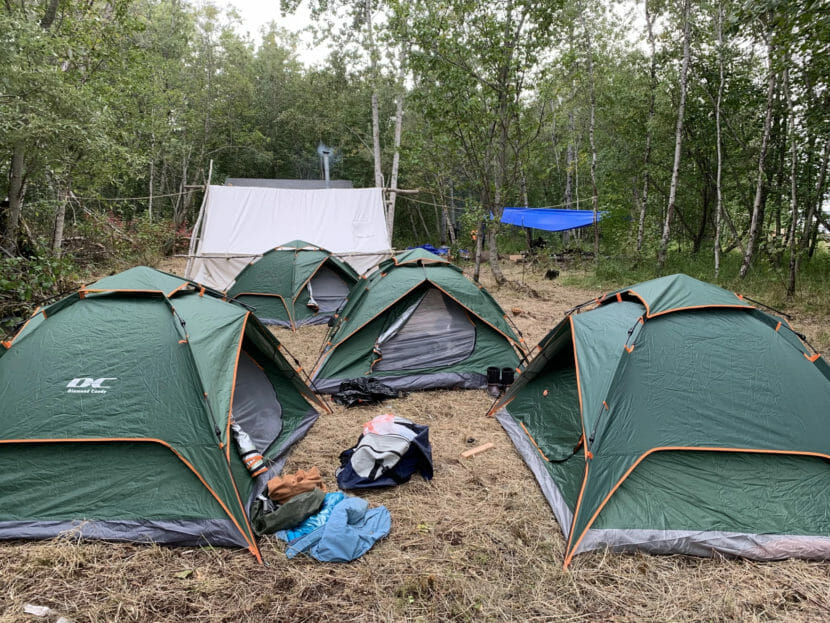
Tents set up in a clearing
A jumbled drift net, like one the district may have used at their summer fish camp. (Photo by Woody Woodgate/
Yupiit School District)

For years, students in the Yupiit School District were already following an unofficial subsistence calendar. That meant that they just wouldn’t show up to classes during bird hunting season in the spring and moose hunting season in the fall. Now, thanks to a shift to a subsistence calendar, students at the small district — made up of Tuluksak, Akiak, and Akiachak — will no longer have to miss school to go hunting.

To Scott Ballard, the superintendent, it always made sense to change the school year so that it wouldn’t interfere with those activities. When Ballard first began the process of changing the schedule, he thought it would be pretty straightforward.

“It’ll be a slam dunk. We’ll petition the commissioner of education, he’ll give us the waiver, and we’ll be done with it,” Ballard said. “It was not simple at all.”

Instead, Ballard said that it took months of phone calls. Ballard morphed from superintendent to activist as he worked to earn support from state senators and representatives. He negotiated with the Alaska Department of Education and its commissioner.

Finally, in April, the department approved the waiver for a subsistence calendar. To Ballard, all the effort was worth it.

“We think it’s going to really benefit our students and get our communities connected to the school,” Ballard said. “Instead of seeing the school as this alien institution that occupies their village that promotes Western values and Western instruction.”

The change is simple. Instead of August through May, school will only be in session from September to the end of April. To make up the time lost, 30 minutes of instruction are added to each day. There is also an optional, two-week summer school in August, which incorporates subsistence activities.

According to Moses Peter, a Yupiit School Board member, the change is all part of a decades-long initiative to center Yup’ik culture in the district’s educational goals and curriculum.

“We don’t want our future generations to forget who we are,” Peter said. “We want to educate them about our ancestors and how they survived in this harsh environment.”

That effort goes beyond changing the rhythm of the school year. It means incorporating Yup’ik culture into everything the district does.

Woody Woodgate, the federal programs director for the Yupiit School District, said the district tries to match traditional cultural activities with state educational standards. The summer school this year was a fish camp organized by the district. Woodgate said the kids loved it.

“They were just coming out, having a blast. They had a chance to do all kinds of activities,” Woodgate said. “They sat around and drank ayuk tea, tundra tea, and they heard stories from elders and community members.”

The district is already incorporating activities like fishing, hunting and gathering into their curriculum for the rest of the year. They’re also studying other issues important to the community, like science labs on river erosion.

Peter believes that this is the best way for kids to learn. It’s how he learned. When he was growing up, his parents would pull him out of the Bureau of Indian Affairs school he attended to bring him to spring camp.

“The actual environment was our education,” Peter said. “How to survive, how to get along as a village, as a whole village.”

Ballard and the board believe that centering Yup’ik culture should permeate every aspect of the school, from the topics students study to the meals that they eat. If students are excited about what they’re learning and eating salmon they caught instead of chicken nuggets for lunch, Ballard believes that they’ll be happier and more engaged in education. If students are happier, then teachers are happier, which makes it easier to keep teachers around.

“We’re striving for every child, when they get up in the morning, as much as possible is going to look forward to coming to school,” Ballard said.

This is the district’s first year operating under a subsistence calendar. Ballard said that they’ll be able to assess if the change increased attendance and student engagement by the end of the school year.
Dillingham moose hunter survives bear mauling

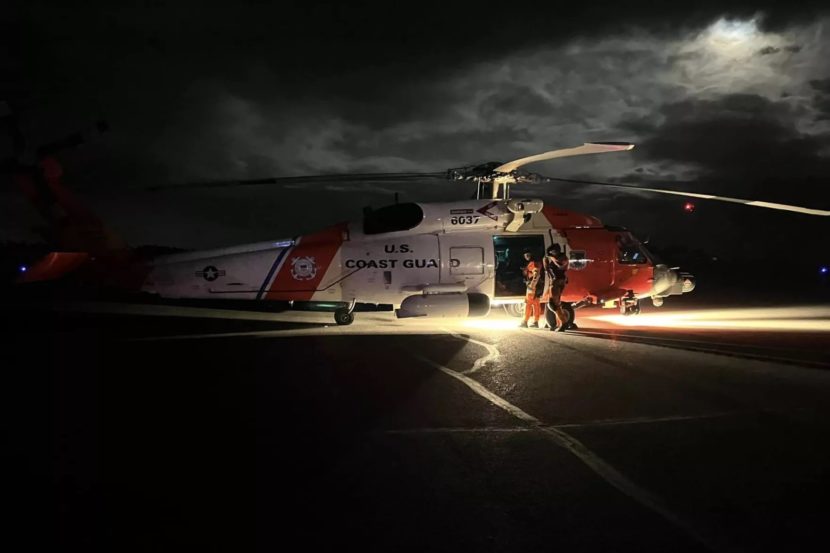
A Coast Guard helicopter on tarmac at night
The U.S. Coast Guard helicopter that responded to the request for help from John Casteel’s hunting party after Casteel was injured by a bear near Dillingham on Sept. 10, 2022. (From Rodger Goddard/Dillingham Police Department)

A Dillingham hunter was mauled by a bear on Friday. Alaska State Troopers spokesperson Tim DeSpain said in an email that 40-year-old John Casteel was hunting up the Nushagak River, about 20 miles by air from Dillingham, when he was mauled.

Casteel’s aunt, Marjorie Nelson, said he came upon the bear while moose hunting. The bear attacked, and Casteel called out to his hunting partner, who shot and killed the bear. His partner sent a satellite message requesting help, saying that Casteel had injuries on his arm and leg. He was conscious but couldn’t move.

“They had a nurse with them and other hunting parties that helped stabilize him and control his wounds,” she said. “He stayed out in the wilderness for four hours, laying on the tundra. But you know, those people, the hunting party that he was with, they started a fire and they tried to keep him warm and keep him conscious and awake until the helicopter came and got him. It was a rough Friday night for us.”

It was dark by the time the helicopter arrived. Nelson said the group shot flares into the air to show their location. The helicopter took Casteel to Dillingham.

“The whole time, John was conscious. He was awake during this whole ordeal,” she said. “And after they got him stabilized, cleaned up, they got a medevac out of Dillingham and sent him to Anchorage.”

Casteel has deep wounds on his leg and arm and was in the Alaska Native Medical Center’s critical care unit in Anchorage over the weekend. Nelson says he went into surgery Saturday morning. It lasted for about eight hours.

“He’s still in a lot of pain, but they’re trying to manage that pain right now,” she said. “He’s pretty overwhelmed with what happened to him. And, you know, totally understandable. I can’t imagine. I can’t — it’s overwhelming to me.”

Nelson doesn’t expect recovery to be easy and said Casteel may have to undergo additional surgeries. She added that the family is grateful to his hunting partner and thanks everyone for their prayers.

Watch: With the salmon collapse on the Yukon River, families are losing a vital food source and way of life

For the second year in a row, a severe and sudden salmon collapse has affected Indigenous residents on the Yukon River. Subsistence fishing for the two main salmon species, king and chum, has been closed for two summers due to record low runs. Residents of traditional villages are now facing food insecurity because of the collapse. Now, the Indigenous communities on the river whose ways of life have revolved around the fish for thousands of years are also facing a devastating loss of culture. Olivia Ebertz reports from the Lower Yukon.

Search for moose hunters missing near Bethel is a test of hope and endurance

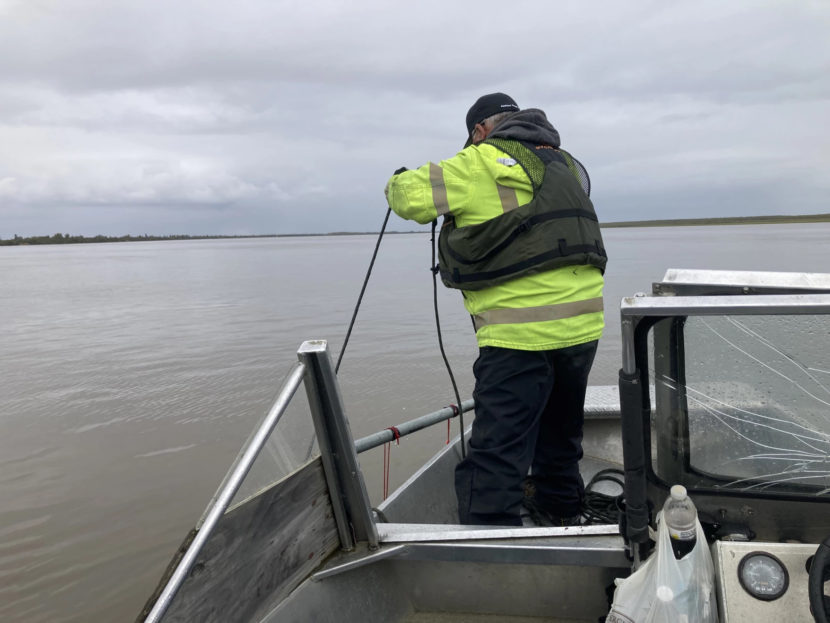
A man stands in the bow of a boat in a wide river, dangling something into the water
Bethel Search and Rescue President Mike Riley searches the Kuskokwim River with a drag bar. (Photo by Will McCarthy/KYUK)

Bethel Search and Rescue is still searching for a group of moose hunters missing for a week and a half near Bethel — and for another hunter missing for over a week near Kalskag.

On day eight of the search, about a dozen volunteers headed toward their boats after a morning briefing. It was raining, as it has been for much of the time since Justin Crow, Shane McIntyre, and Carl Flynn went missing. Mike Riley, the longtime president of BSAR, drove toward the harbor.

“It being so close to home with three people involved, it’s hard,” Riley said. “We know that is someone’s loved one out there. People depend on you to look for them and bring them home for closure.”

At the harbor, Riley checked his gear. BSAR has been working under the assumption that the boat sank in rough waters after the men dropped off equipment at their hunting camp upriver.

After leaving the harbor, Riley headed toward Straight Slough. Six boats were there, searching for the missing hunters. Riley pulled up beside one.

“I’m sorry it took so long to come out here, but I was told something that I think will enlighten us,” Riley said.

Riley said he got a tip that two people were coming home to Bethel the day after the hunters were reported missing. Apparently they saw an aluminum pole bobbing upright in the water about 20 feet from shore, a few hundred yards upriver of Straight Slough. They had to swerve to avoid it. Riley thought it could be a clue.

“So that’s that side of the river, coming up,” Riley said. “That side of the river has never really been dragged.”

After hours of scanning sonar and dragging lines, hoping to catch something, even just this little piece of information seemed like a burst of energy.

Searching the river is a test of endurance. A few of the boats scan the search area with sonar, slowly making a grid of each section of the river. The rest use drag bars, which are long ropes attached to a metal bar. Each of the lines have a weighted hook at the end. The idea is that if there’s something underwater, the hooks will catch on it. Hope, Riley said, is the name of the game.

He dragged the bottom of a 100-yard portion of the river. The tide was slack, so he kept one hand on the rope and the other on the steering wheel. Nothing. He tried again. Nothing. It started to rain. Riley tried again.

“The majority of the people that are out here have been out here since day one,” Riley said. “It’s a lot of stress and frustration, you know. We’re working in the dark.”

So far, the main clues BSAR have are debris from the missing boat that turned up near the head of Straight Slough, but there’s still so much river to cover. BSAR has never given up on a search, and there are no plans for them to give up on this one.

“That was the question: how long are you going to search,” Riley said. “As long as someone is willing to come out here, we’re going to continue.”

Climate change has made fuel safety inspections in the Y-K Delta more important than ever

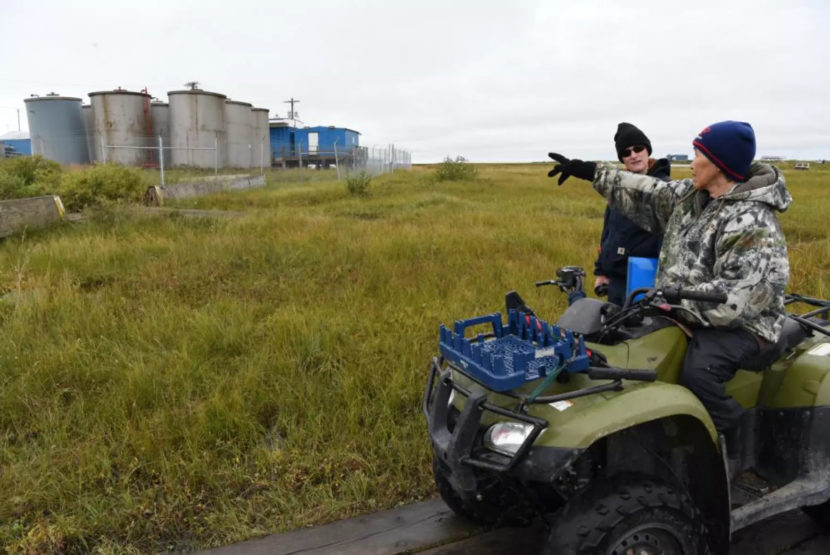
A person on an ATV points at a set of fuel tanks on the tundra
The goal of the fuel inspections is simple: prevent a catastrophic oil spill that would make its way into Y-K Delta rivers, devastate the ecosystem, and threaten a subsistence lifestyle. (Photo by Nate Littlejohn/U.S. Coast Guard Anchorage Sector)

The U.S. Coast Guard recently completed a series of fuel tank safety inspections in communities across the Yukon-Kuskokwim Delta. In the face of climate change, these checks are becoming all the more important as the land beneath the tanks melts.

The goal of the fuel inspections is simple: prevent a catastrophic oil spill that would make its way into Y-K Delta rivers, devastate the ecosystem and threaten a subsistence lifestyle.

In large part, villages were found to be following best practices to prevent oil spills. Most of the issues that the inspectors identified were administrative, like having a written plan for how to respond to a potential oil spill.

“Staying in compliance with things like paperwork may seem extremely tedious, and it is, but it’s really not about the paperwork,” said Petty Officer 1st Class Nate Littlejohn, who works with the Coast Guard’s Anchorage sector. “It’s about getting together and talking about how you would respond to a spill with your community.”

The coast guard conducts semi-annual checks of bulk fuel facilities in Bethel and surrounding communities. In their most recent deployment during the last week of August, Coast Guard and EPA inspectors visited two dozen communities.

The investigators check to make sure that fuel storage facilities have the right containment measures in place, that there’s a system to respond to a spill, and that communities have appropriate equipment to do so. These failsafes are becoming increasingly important as the land that fuel tanks sit on becomes more unstable.

Climate change is creating a series of long term problems that threaten the security of fuel tanks and could cause spills down the line. As the region warms and permafrost begins to melt, the foundations upon which many of these fuel storage tanks sit have begun to slowly sink. According to Littlejohn, in some cases they are already seeing fuel tanks sitting at an angle because of permafrost thaw.

“The aging infrastructure combined with a changing climate is continuing to be a problem,” Littlejohn said. “And we’re absolutely going to see more spills if a solution isn’t provided.”

As the foundations of these storage facilities shift, Littlejohn said that it’s all the more important for communities to inspect them regularly, work to keep them level, and develop design adaptations that take climate change and permafrost thaw into account.

The region is not equipped to handle a catastrophic spill. If that were to happen, it wouldn’t just take an environmental toll. It would also immediately put human lives at risk.

“If thousands of gallons of heating oil are lost in the dead of winter, we have to come up with a solution for how that heating oil is going to be replaced,” Littlejohn said. “How are these folks going to heat their homes? That’s a big concern.”

The Coast Guard intends to return for another round of inspections next year.

A landing craft sank near Napakiak. The barge sent to recover it sank, too

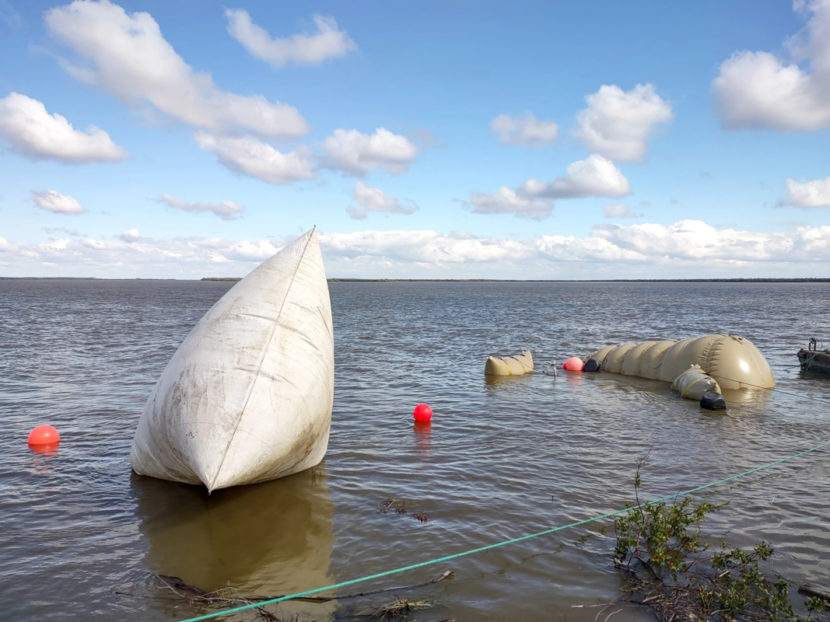
""
(Photo courtesy of Earl Brock)

A small ship graveyard is forming on the Kuskokwim River outside Napakiak.

During the last week of July, a landing craft sank while carrying construction equipment to Napakiak for work on the high school.

Bethel-based contracting company Jobs Done Right, which was operating the landing craft, then brought in a Homer-based Kachemak Marine to help salvage it. They sent a 20-by-45-foot barge upriver to serve as a work platform for salvage divers, who planned to attach lift bags to float the sunken landing craft.

The barge sank, too.

Earl Brock, Kachemak Marine’s salvage master, says no one saw either vessel sink. He blames last week’s storm.

“I am sure that between the high waves, the high wind, and all the other things that could possibly go wrong, Murphy showed up and that was the end of it,” Brock said. “It sank that barge.”

Brock says it’s likely no one will ever know why the landing craft sank.

“I’m going to tell you that if you talk to 15 different people in the community, you’ll get 15 different answers,” Brock said. “What I’ll also tell you is that nobody has a smoking-gun, rock-solid explanation of why the landing craft sank.”

According to Brock, no one was on either vessel when it sank, and both have been secured to land and aren’t blocking river traffic. He says no fuel is leaking.

“We don’t see any environmental threat,” Brock said. “There is a very small amount of fuel that was released when the vessels went down, possibly less than a gallon, but a gallon looks like a lot of fuel.”

If there is oil in the water, the U.S. Coast Guard said that it would be Jobs Done Right and Katchemak Marine’s responsibility to clean it up.

Kevin Williams, a marine casualty investigator with the Coast Guard’s Anchorage sector, says there’s a lot they don’t know about the landing craft.

“We don’t know if the tanks were full or half empty, or if there was oil in the bilges in the engine room, ” Williams said. “The vessel name that was given to us is not even in our database.”

Brock, the salvage master, gave no timeline for recovery of the two vessels but said they’re constructing rigging to refloat the two boats. He doesn’t expect either to be damaged.

“We’re still in the middle of sourcing the equipment we need, but the short version is, we’re going to lift them up, refloat them, and take them and deal with them once they’re refloated,” Brock said.

Hale, the owner of Jobs Done Right, says the sinkings have not slowed the timeline of the school construction.

According to Sally Benedict, the site administrator for Napakiak’s schools, construction was supposed to be completed on Aug. 21. The school is still waiting to be hooked up to water and heat before they bring students back into the building.

Site notifications
Update notification options
Subscribe to notifications