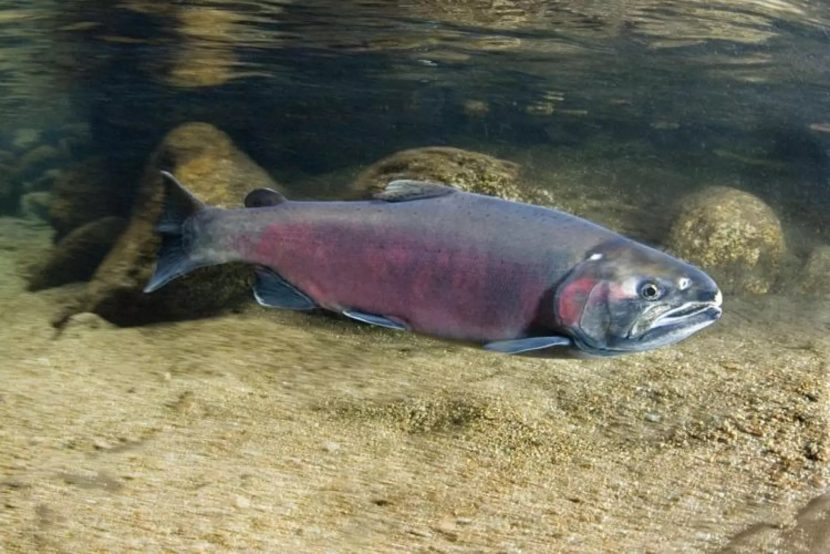
For the first time ever, state fishery managers are closing the Kuskokwim River and nearly all its tributaries to coho fishing to conserve the species’ low returns. Anticipated federal action could still allow for some subsistence openings in the lower river.
For now, the month-long closure takes effect at 12:01 a.m. on Wednesday, Aug. 17. At that time, subsistence fishermen will no longer be allowed to fish with gillnets, fish wheels, beach seines, or dipnets on the Kuskokwim River, from the mouth upstream to the headwaters.
Nearly all Kuskokwim River tributaries will also close to this gear, except for the Gweek, Johnson, Kialiq, Tagayarak, and Eenayarak Rivers, which will remain open 100 yards upstream from their confluence with the Kuskokwim.
Subsistence fishing with this gear will continue to be allowed in non-flowing waters, including lakes, ponds, backwaters, and oxbow lakes of the Kuskokwim River drainage, according to the Alaska Department of Fish and Game.
Hook and line fishing will continue to be allowed throughout the drainage, but fishermen are not allowed to target coho and must return any coho back to the water alive.
The closures would mark the first time managers have closed the river to conserve coho salmon returns. State data indicates that the run is the second-lowest in the past decade and that the species is not expected to meet the state’s escapement goals for coho reaching the spawning grounds.
“As of Aug. 14, the Bethel test fishery cumulative CPUE for coho salmon was 746 (2008–2021 average is 2,112), and the total estimated passage past the sonar was 104,346 coho salmon,” Fish and Game wrote in its announcement.
However, federal managers could override the state’s actions in the lower river, from the mouth upstream to Aniak. These waters flow through federal land. Last week, Yukon Delta National Wildlife Refuge Manager Boyd Blihovde said that he planned to declare federal management of the coho run in these waters if returns remained low. Blihovde said that he would seek to allow some fishing opportunities for coho. The announcement is expected later this week.
The federal government has a restraining order against the state that prevents the state from issuing conflicting management orders.
News of the low coho run comes as a worrisome blow to people along the river. While other runs have been tightly restricted in recent years, fishermen could rely on an open river to catch coho at the end of the summer. Last month, many fishermen had said that they were planning to target coho after a summer of limited fishing openings.
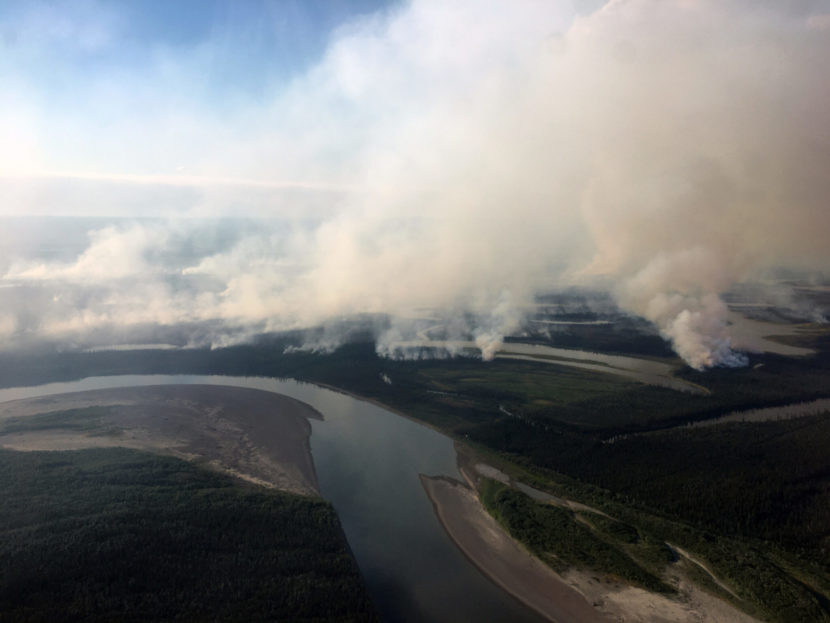
The Goose Fire is seen burning on Aug. 4 in the Yukon Flats area of northeast Alaska, about 41 miles east of Fort Yukon. Smokejumpers were assigned to protect two Native allotments from this and the neighoring Belle Fire. The two fires have merged into one fire that is nearly 12,000 acres and is one of the last still staffed this summer. (Photo by John Lyons/BLM Alaska Fire Service)
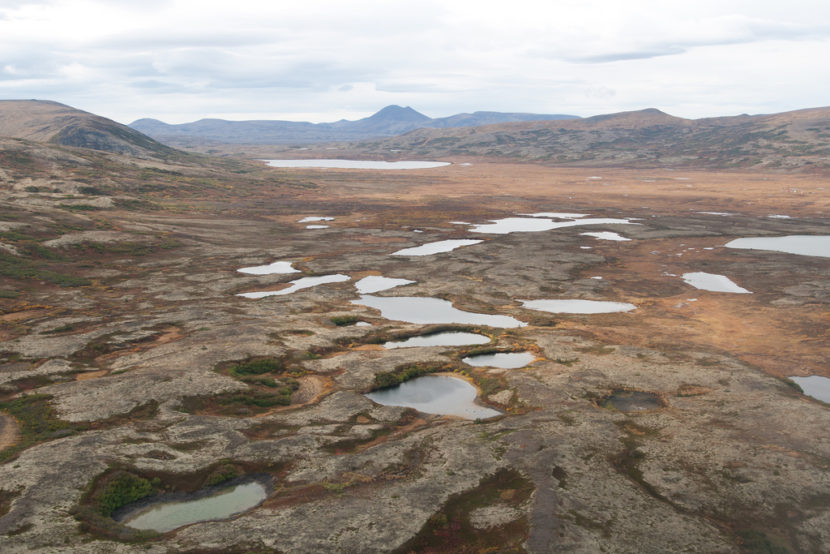
Alaska is closing out what is likely to be the state’s seventh-biggest wildfire season since 1950, wrapping up a summer notable for record-breaking fires in the tundra of the Yukon-Kuskokwim Delta in the southwestern part of the state.
In all, more than 3 million acres have been burned by wildfires this year, according to the federal-state Alaska Interagency Coordination Center. The 2022 total of 3.08 million acres, as of Friday, is slightly less than Alaska’s sixth-biggest season, when 3.189 million acres burned in 1990, according to University of Alaska Fairbanks data.
The high 2022 total was driven in large part by the fierce fires in the Yukon-Kuskokwim Delta, said Rick Thoman, a scientist with the Alaska Center for Climate Assessment and Policy at UAF.
Those include the two largest Yukon-Kuskokwim Delta tundra fires on record, the 166,760-acre East Fork fire, which started on May 31, and the 89,909-acre Apoon Pass fire nearby, which started about a week later.
Those fires and others like it are products of new conditions created by climate change, Thoman said.
“Decades of warmer springs and summers means there is so much more vegetation on the tundra now. From the fires’ perspective, it means there’s much more fuel,” he said. “There’s just more vegetation to burn.”
Until 2015, tundra fires in the Yukon-Kuskokwim Delta were small and infrequent. That changed suddenly seven years ago.
“Obviously, there’s been a sea change in southwestern Alaska, starting in 2015,” Thoman said.
Fires on the tundra and in the boreal forest can have particular impacts on climate change because they can burn the layer of vegetative duff within the ground, a vegetative layer that often insulates permafrost below.
A newly published study by scientists with the Woodwell Climate Research Center and other institutions calculated the carbon released by the 2015 Yukon-Kuskokwim tundra fires – nearly 1 million metric tons – and urges more attention to the way tundra fires are adding greenhouse gases to the atmosphere. The study calculated the climate-warming effects of those fires as continuing for 80 years into the future. “Our results stress the importance of considering tundra wildfires in assessing climate feedbacks and the need for future research that more explicitly discerns the warming effect of fires across the tundra biome,” the study concludes.
This year’s Yukon-Kuskokwim fires posed their own logistical challenges, said Beth Ipsen, a public affairs specialist with the Alaska Fire Service.
“All of these fires were not accessible by road. You either had to fly in or boat in,” Ipsen said. But even fires in road-accessible areas require some similar off-road travel, like the boat travel that was required for firefighters assigned to some Interior fires, she said. “That’s the way it is in Alaska.”
As of Friday, there were still two fires being actively managed, and conditions in the northeastern Interior remained warm and dry, she said. Otherwise, most fire activity has quieted, according to managers’ reports.
Preliminary estimates for this year’s fire-management costs will not be available until later in the fall, Ipsen said.
Geographically, wildfires this year ranged from nearly Alaska’s southernmost point – Adak Island in the Aleutians– to the Beaufort Sea coastline in the Arctic, according to the Alaska Interagency Coordination Center.
The Adak fire, which was reported at 919 acres, was human-caused, though the Alaska Fire Service does not have many details about it, Ipsen said. The fire was reported to have started on May 8 and determined to be out on Aug. 3. It was handled by the military, Ipsen said.
The Beaufort Sea coastline fire was a small blaze set off accidentally on June 30 by workers shooting explosives to shoo a caribou away from a runway that serves the Point Thomson natural gas field on the North Slope, according to fire managers’ reports. That fire was only about a tenth of an acre and was quickly extinguished.
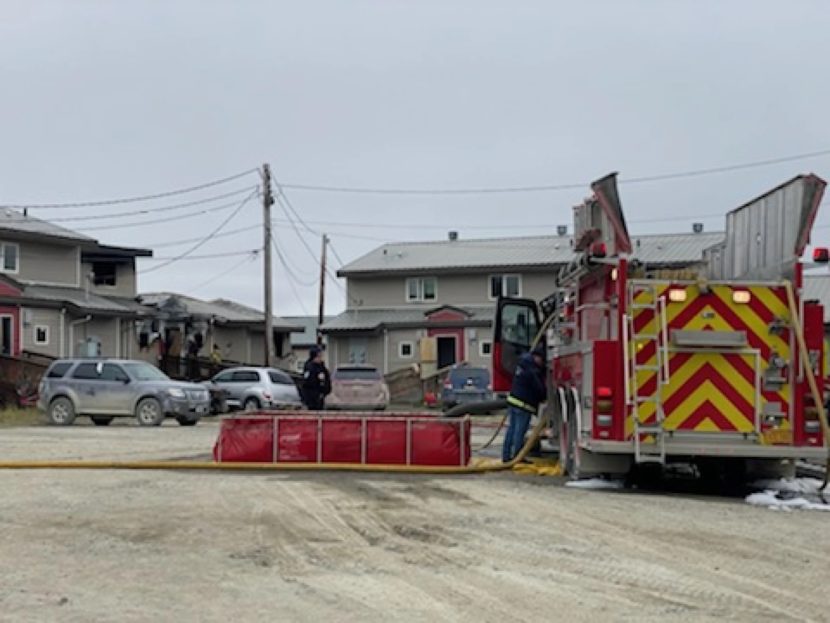
Three people died in a fire at an Association of Village Council Presidents Regional Housing Authority apartment complex in Bethel on Friday, Aug. 12, 2022. (Photo by Olivia Ebertz / KYUK)
Three people died early this morning in a fire in a low-income rental unit in Bethel, according to Bethel Fire Chief Daron Solesbee.
“There were reports of people who were entrapped,” Solesbee said. “We were not successful getting anybody out.”
Solesbee said that he could not publicly identify the victims. He also said that an additional two people were taken to the hospital. He said that he could not comment on their current condition.
The fire took place at an Association of Village Council Presidents Regional Housing Authority apartment complex at 409 Ptarmigan St.
Solesbee said that the fire is still smoldering. So far, it has destroyed two units in a building that he said has six units in total.
“We’re trying to overhaul it right now and find all the hidden fires,” Solesbee said. “There’s a lot of cracks and stuff in the walls and up in the ceiling and that kind of stuff, and we have some floor collapse and roof collapse issues.”
Solesbee said that all of the people who died in the fire were in one unit, and that the second unit that burned was unoccupied. He said that he and his staff responded to the fire at 4 a.m. on Aug. 12 with several fire trucks and ambulances. He and his staff remain on the scene addressing hot spots.
The president and CEO of AVCP Regional Housing Authority said that the apartment complex is known as the Bethel Low Rent Units. He said that the building is likely at least three decades old, and that the larger complex contains 31 units.
Solesbee said that state fire marshals are on their way to investigate the cause of the fire and will be on the scene by late morning. The fire department is understaffed right now, and he said that his firefighters are working hard on putting out the rest of the fire.
“We’re all pretty tired; we’ve been here since early this morning and we’re probably going to be here most of the day,” Solesbee said. “We’re just trying to get through it and just keep focusing on the task. We’re just trying to just deal with the situation that we have.”
Solesbee asked the public to be careful when driving near the apartment complex since there are lots of people and parked cars at the scene.
The proposed Pebble Mine site, pictured in 2014. (Photo by Jason Sear/KDLG)
In late July, Northern Dynasty Minerals received $12 million from a new, unnamed investor. Coming after a series of significant setbacks for the proposed Pebble Mine, this would seem like unusual time for a big investment.
In May, the EPA issued a proposed determination to prohibit the discharge of mining materials in the waters around the Pebble deposit — a decision that would effectively kill the project if it stands — and the Army Corps of Engineers denied Pebble’s permit in 2020. Pebble and Gov. Dunleavy are fighting to have that permit denial reversed.
Then, in July, a fire swept through the Pebble Mine supply camp. Odds seem slim that the mine breaks ground in the foreseeable future.
Despite all this, the new investor signed an agreement for even greater potential investment over a two-year period — up to $60 million in total, according to Mike Westerlund, vice president of investor relations for Northern Dynasty Minerals.
Westerlund said the investor is a private asset management company and that Northern Dynasty won’t provide the investor’s name because of the treatment previous partners have faced.
“We found in the past that many of the ENGO [Environmental Non-Governmental Organization] community will use this information to wage public campaigns against our investors, which doesn’t seem fair to me or reasonable even, but they try to pressure them and they try to block them, etc., and make life unpleasant for them. So we’re just choosing not to release their name at this time,” he said.
Westerlund explained that Northern Dynasty wanted to raise funds without issuing equity because their stock prices are low.
On July 27, the day Mining Journal announced the new investment, Northern Dynasty’s stock jumped $0.05, to $0.32 per share.
But this is just a fraction of the company’s peak price of more than $20 on Feb. 17, 2011. Westerlund said the new investment will help “move the permitting forward.”
He added that the investor is aware of the history of public opposition against the mine and the EPA’s proposed determination released in May. They’re motivated to put money into the project anyway.
“So the investor believes in the long term value of gold and silver, that they see gold and silver being very valuable metals in the future,” Westerlund said.
Westerlund said that with each $12 million the new investor commits, it will receive 5% of silver and 6% of gold produced over the lifetime of the mine.
Bob Loeffler is a research professor of public policy at the University of Alaska Anchorage Institute of Social and Economic Research. His work includes studies on land and resource issues. He said the investor may believe the reward is high enough to warrant a risky investment.
“I don’t know who the investor is,” Loeffler said. “But clearly some investor thinks the odds are non-zero. So it’s a risk/reward. And the investor must believe that the reward is high enough.”
Loeffler worked for the Alaska Department of Natural Resources for over two decades. His job at UAA is funded in part by the Council of Alaska Producers, a mining trade association. Loeffler said his professional obligation is to the university, not the industry.
He said Pebble seems to be preparing for a long, expensive battle over permitting because keeping the Pebble Mine project alive is critical for the existence of Northern Dynasty itself.
“Northern Dynasty has only one asset, and that’s the Pebble Project. It’s not like, you know, General Motors, which can say, well, this particular car isn’t selling, concentrate on other cars. Or even a large mining company, which might say, this particular prospect is becoming expensive. I’ll concentrate on my other prospects. As far as I know, their only asset is the Pebble prospect. So they don’t have any alternatives,” he reflected.
The EPA’s Proposed determination to nix the mine is not final. The agency held public hearings in Dillingham, Newhalen and online in June. The written comment period is open until September 6. Comments can be submitted online at regulations.gov.
Correction: An earlier version of this story had incorrectly converted monetary values from CAD, when the investment was made in USD. The values have been updated.
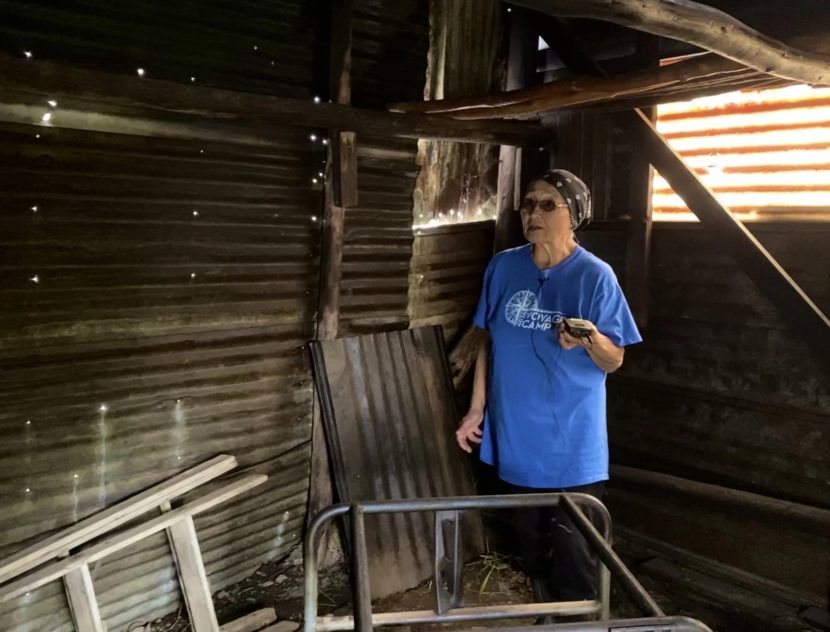
St. Mary’s Elder Sophie Beans stands inside her empty smokehouse. (Photo by Olivia Ebertz/KYUK)
At the AC store in Emmonak, near the mouth of the Yukon River, Maggie Westlock was picking up a few things for dinner. In her cart she had grapes, coleslaw, sandwiches and some canned ham.
These are not the foods she and her family of 8 prefer to eat.During a normal summer, Westlock would be filling her family’s dinner plates and chest freezers with lots of wild chum and chinook salmon they catch themselves. But fishing for those two species on the Yukon has been closed for two summers because of a sudden and severe collapse.
That means Westlock’s diet is changing. Her family is relying more on store bought food. Her grocery bill has gone way up, and inflation is making things far worse.
Westlock rolled her cart over to the freezer section.
“I’ll show you something,” she said.
Westlock picked up a small pack of ribs, less than 2 pounds worth.
“This one is $37.10,” Westlock said.
On the other side of the store, things were even more dire.
“The detergent is very expensive! $62.99, that’s Tide and that Kirkland is $55.99. Expensive I tell you. And look at these pampers, huggies: $84.99. One box,” Westlock said.
The final damage was $81.81 for five items.
Residents are feeling the loss 100 miles upriver in St. Mary’s too. Elder Sophie Beans lives on the banks of the Andreafsky River, one of the Yukon’s salmon-spawning tributaries. She says when there was fishing, her whole block would be orange and smoke-filled.
“Full of kings and fish,” Beans said.
And now?
“Nothing! Nobody’s cutting,” Beans said.
Beans stood inside her empty smokehouse. The leftover smell lingered in the wooden walls, but it’s been two years since her smokehouse held fish. Both of those years, managers closed subsistence fishing for both chum and chinook to try to protect their dwindling numbers.
Last summer, the Yukon’s summer chum run sank to just a tenth of its average size. This year numbers ticked up slightly for chum but collapsed even more for chinook, the Yukon’s most prized species. Normally, families would put away hundreds of both species to get through the winter.
“My son when he went drifting one time he caught 700 chums and it took us three days. Seven totes!” Beans said.
And that wasn’t even including the kings.
Beans uses every part of the fish from the head to the tail. She makes culunaq and egamaarrluk.
Beans usually keeps three chest freezers full of salmon, but now only one has salmon. It’s about a third full. That fish is from two years ago, when fishing was still allowed. She and her husband are now rationing, taking fish out for special occasions only.
Scientists point to warming seas
Scientists have been scrambling to figure out why western Alaska chum and chinook stocks are crashing. They’re starting to hone in on one primary cause for the chum collapse: recent marine heatwaves in the Bering Sea and Gulf of Alaska. Dr. Katie Howard from the Alaska Department of Fish and Game says that’s linked to climate change. There have always been marine heatwaves, but the recent ones are different.
“They were just bigger, they were geographically larger, they were more intense. And they lasted over a much, much longer period of time than is typical. And so that is what has been tied to a changing climate — that it’s more extreme when it happens. And the other expectation is that they may occur more often,” Howard said.
But Howard says they’re not exactly sure what’s impacting wild chinook, and that species has been on the decline in many Alaska rivers for a decade now.
Many residents also point to another driver behind the low returns of both species: commercial fisheries in the Bering Sea. State and federal managers have allowed these commercial fisheries to continue to operate, even as they have placed more stringent measures on Yukon River subsistence users.
Frozen donated salmon coordinated through the state is some of the only fish people on the lower Yukon river will eat all year. (Photo by Katie Basile/KYUK)
The state says it wants to keep studying the fish before it takes action against commercial fisheries, but most subsistence users say they don’t have time for years-long scientific studies. Many want the state and the feds to more strictly manage the commercial fisheries now.
Some scientists argue that the numbers are now so low that getting each and every spawner back to the Yukon River matters. Dr. Howard says she is getting concerned, and this issue will only get more urgent as time goes on.
“If, over the course of more than five years, you’re not getting enough fish to the spawning grounds to replenish the population, you really start to become very concerned,” Howard said.
The low chinook runs are well past that five year mark.
Higher grocery bills, less protein
Across town in St. Mary’s, in a small house with a view of the Andreafsky and Yukon rivers, Jolene Long and Troy Thompson live with their six young children.
Thompson used to work as a commercial fisherman and has now been out of work for two years. He says they’re relying much more on the store and are spending two or three times as much on groceries compared to when the salmon ran abundantly.
To feed their family of 8, they spend $400 to $600 per week. They don’t eat much protein these days.
“When they do get a little bit of fish, they just gobble it up,” said Long.
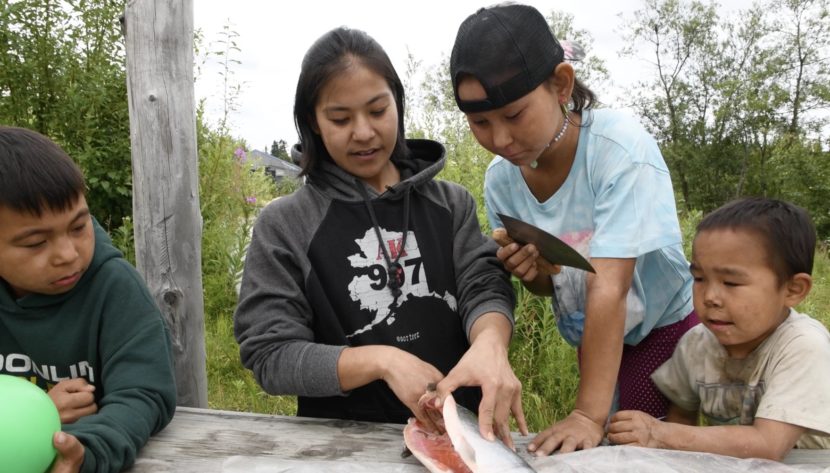
11-year-old Nicole Long practices cutting fish for the first time in two years with her mother, Jolene Long. (Photo by Katie Basile/KYUK)
The salmon crash means it’s become more difficult for parents to pass on their Yup’ik culture to their kids. Long used to cut fish with her oldest daughter every summer. Now her daughter barely remembers how to cut.
She did get a little practice after most tribal members in St. Mary’s received a couple of donated salmon each from the state.
For many in St. Mary’s, that small amount of donated salmon is the only taste they’ll get all year.
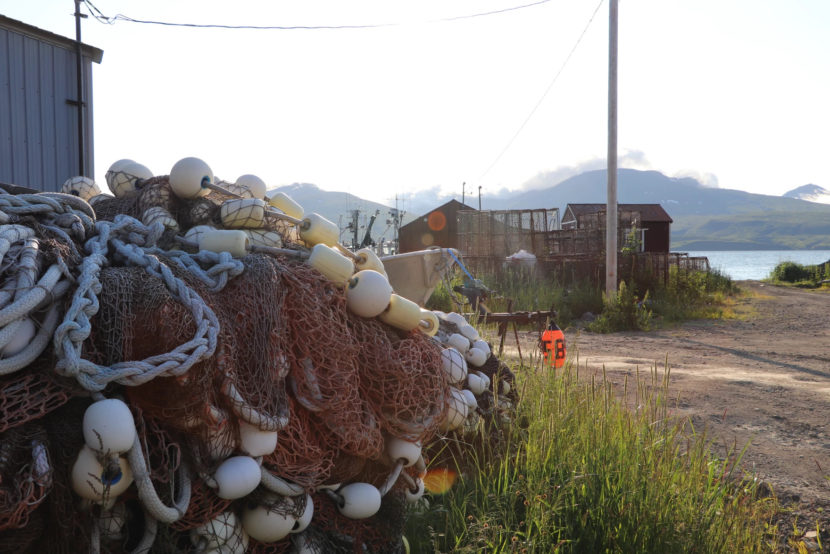
Buoys and nets in Chignik Lagoon. (KDLG File Photo)
The Chignik River has an early and a late sockeye run. The early run’s escapement is now over 420,000, and the late run’s escapement is now over 220,000 as of July 29.
It’s the first time the early sockeye run has met its minimum escapement since it collapsed in 2018.
The Alaska Board of Fisheries designated the early run as a stock of management concern in March as part of an agreement between the Chignik Intertribal Coalition and the Area M Seiners Association.
The Chignik Intertribal Coalition originally proposed to indefinitely reduce Area M’s harvest around the Shumagin Islands by about half until the Chignik River passes the early run’s minimum escapement goal.
But the board’s final decision is a compromise that will allow Area M fishers to harvest at full capacity once the Chignik early run is no longer a stock of management concern.
The president of the Chignik Intertribal Coalition, George Anderson, was one of the people who supported that change.
“The first attempt at having this, possibly, might have worked because we finally hit our lower end of our escapement goal for our early run this year and have achieved our late run escapement goal,” he said.
Area M is a mixed stock fishery. The northern part of the area fishes from Port Heiden along the Alaska Peninsula to Unimak Island. The southern part of the fishery sits west of Chignik on the Alaska Peninsula, stretching to Unimak Island.
Fishermen there catch salmon swimming to rivers and lakes in that area, but they also harvest fish headed to spawning grounds further away such as the Yukon-Kuskokwim Delta, Bristol Bay and Chignik areas.
Anderson said while the factors that determine Chignik’s escapement are likely more complex than just Area M’s harvest, he thinks it could be a major factor.
“It’s very possible that these restrictions benefited our area and allowed for fish to escape,” he said.
Anderson said he’s excited about the new strategy. But he said the Chigniks will need more support in order to have a sustainable commercial fishery.
“We do have some proposals in for this upcoming winter’s meeting and we will be asking for additional changes,” he said. “So we can not only achieve escapement but possibly get some yield and some harvestable surplus in our area.”
Chuck McCallum is the Lake and Peninsula Borough Fisheries Advisor. He also thinks the closure was just one factor in this year’s higher returns. The forecast was also higher.
“I have no doubt at all that Chignik escapement goals were met and partly with the help of those closures there,” said McCallum. “We’re dealing with a natural system and so the interception is part of it and nature’s the other part. And we do the best we can with what we’re given.”
McCallum added that reduced harvest near the Shumagin Islands specifically was likely a major factor in Chignik’s returns this year.
“If the Shumagin Islands had been included in the Chignik area, then when Chignik had a bad run, we wouldn’t be allowed to fish in the Shumagins because there’s Chignik sockeye that are being harvested there and they’d be protecting those fish just like they would be protecting them if they were in in the lagoon,” he said.
Kiley Thompson is the President of the Area M Seiners Association.
Thompson says the association agreed to the change because he and other fishermen want to see Chigniks succeed as well.
“We supported that, because when the stock of concern is lifted, the regulations will be lifted,” he said. “And, you know, we want to see more fish go to Chignik – it benefits everyone,”
But Thompson says Area M communities also depend on salmon, and he’s wary of further fishing restrictions.
“Without the salmon fisheries, healthy salmon fisheries, these communities are absolutely going to fail,” he said.
He says the reduced fishing time has already been difficult for fleets on the south side of the peninsula.
“I’m sure the (Bristol) Bay and the North Peninsula systems are doing really well, but on the south side, we normally have a pretty robust sockeye fishery and this year we don’t,” he said.
Thompson says he’s glad the Chigniks are getting a stronger return of sockeye this year, but he’s doesn’t think it is all due to the reduced harvest in Area M.
“If the Area M fishery was going to destroy other fisheries, it would have done so in its previous 100 years of existence,” he said.
Thompson isn’t the only one skeptical about whether Area M’s reduced fishing time has influenced Chignik’s returns. Carl Burnside became Fish and Game’s Chignik area management biologist in April. The previous biologist, Reid Johnson left the department earlier this year to work in a different department.
Burnside says while he’s new to the position, he’s unsure of how much the Area M changes affected Chigniks’ Early Run escapement counts.
“It’s really difficult for us to know, one way or the other if that is something that is helpful,” he said.
He says he thinks it’s more likely that improved spawning conditions have helped boost returns.
“We think it’s more likely that the biggest thing helping it out is just that rearing conditions improved in fresh and saltwater,” he said.
Most of the fish this year were the offspring of the low runs in 2018 and 2019. Burnside says this could be a turning point for the Chignik fishery.
“Assuming that they have favorable conditions going forward, then this run will produce a much larger one four or five years from now that should be harvestable,” he said.
Anderson, with the Chignik Intertribal Coalition, says that until the fishery has fully recovered, he hopes the Board of Fish will continue to consider further support.
“It was the Board of Fisheries’ responsibility to share the wealth when you know when fish are coming back good,” he said. “But it’s also their responsibility to share the burden of conservation across all users.”
The next Board of Fisheries finfish meeting for Chignik and the Alaska Peninsula is set for February.
Close
Update notification options
Subscribe to notifications
Subscribe
Get notifications about news related to the topics you care about. You can unsubscribe anytime.