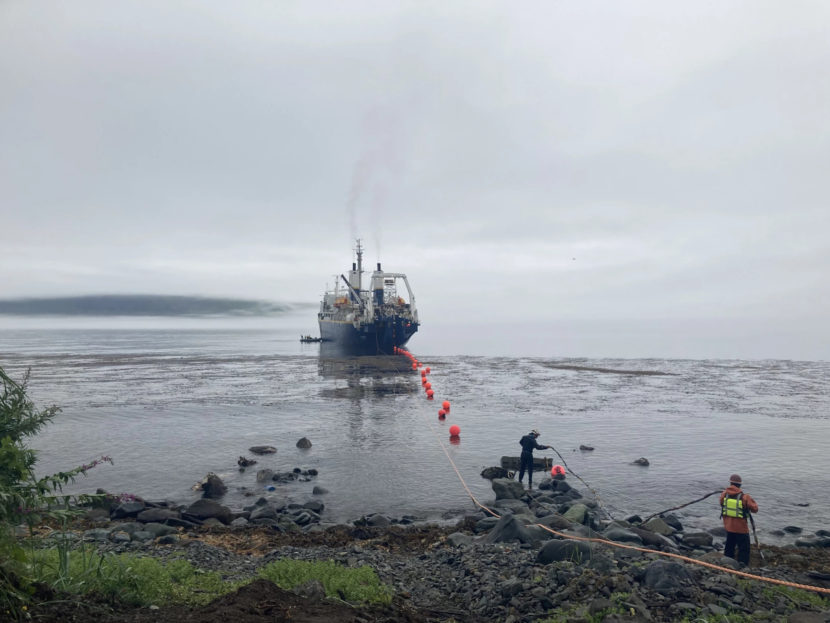
The C/S IT Intrepid begins deploying subsea fiber in Unalaska. (Photo by Laurelin Kruse/KUCB)
Work has started to lay 800 miles of subsea fiber-optic cable that project engineers say will bring high-speed internet to Unalaska and Akutan by the end of the year.
“What you will get in Unalaska is what you would get here in Anchorage,” said GCI Rural Affairs Director Jen Nelson. “It’s going to open up so many capabilities, whether it be education, commerce, or entertainment.”
GCI began surveying for the cable network — called the AU Aleutians Fiber Project — in 2017. Last week, the ship responsible for laying the cable left Unalaska for Kodiak.
Geoff Dunlop is the captain of the C/S IT Intrepid, the 377-foot ship that’s laying the cable.
“Planning a cable route is much like planning a railroad, or a goat trail,” he said. “You take the path of least risk and least resistance. Cables don’t like going over things. They want to follow a contour.”
To find the best possible route, engineers surveyed the geology and marine habitat of the ocean floor. They also met with local fishermen to make sure the cable isn’t in a position where it could get dug up by trawlers.
Once the route was set, the cable had to be specifically engineered to fit the conditions of where it will sit on the ocean floor.
The IT Intrepid typically lays cable at speeds from one to two-and-a-half miles per hour.
While en route to Larsen Bay on Kodiak, the ship will lay cable to Akutan, Sand Point, King Cove and Chignik Bay. It’s expected to complete its work by early fall.
Dunlop said bringing internet to these remote communities is part of a bigger picture — creating infrastructure for the globe.
“The reality is that there’s literally hundreds of thousands if not millions of kilometers of cable on the bottom laid by people like ourselves,” said Dunlop. “It’s not just a local event where small islands are being interconnected. It’s the global network.”
If all goes according to plan, Unalaska and Akutan will have high-speed internet by the end of this year. Service to Sand Point and King Cove will follow by the end of 2023, and Chignik Bay and Larsen Bay in late 2024.
Yukon river residents are not able to make dry fish from chum and chinook for the second year in a row. (Photo by Shane Iverson/KYUK)
Each week during the summer, subsistence users and managers up and down the Yukon meet on a teleconference to share fish news and reports. On last week’s call, Anvik First Chief Robert Walker said that people are hanging on by a thread.
“These people are running out of food, basically,” Walker said.
That’s because there’s not much food swimming up the river. As the summer salmon runs finish up, counts are once again at record lows. Chinook runs had been dwindling for years, but last year the region suffered an unexpected chum salmon crash, too. Now, no one has been able to subsistence fish for either species in two years.
When the chum ran abundantly, they provided subsistence users with a buffer zone against the low chinook counts. With that buffer gone, salmon conservation scientist Peter Westley said that the record low chinook run has become glaringly obvious.
“There are no chinook in the Yukon. They’re at 40,000. Remember how last year was like this terrible year, there was 150,000. This year, there’s 40,000. That’s my point. I’m not trying to be dramatic, but there are no chinook,” Westley said.
He said that last year, he was optimistic chinook could bounce back. This year, he’s not so sure.
“I thought all these things, like, if we did X, Y, and Z, they’ll come back. I think I might be wrong. It’s a collapse. I mean, it’s heartbreaking,” said Westley.
The Yukon River is not the only river system with low chinook runs. Other parts of the state are suffering low runs, too. The state says that Bristol Bay is likely having some of its lowest chinook runs yet, and the Kenai River is also set to miss its escapement goal. Most scientists point to something in the ocean causing the low chinook runs.
Subsistence users on the Yukon River say they’re going broke trying to replace the salmon.
“We’re spending more money on food than we ever did before because we don’t have that bump of salmon to ease the price,” said Anvik’s First Chief Robert Walker.
Walker said that they’re having to rely on government subsidies.
“We don’t want more food stamps, we just want our way of life, good lord,” Walker said.
Walker said that people are not the only species being impacted by the low runs.
“Since there’s no fish coming up the Anvik River, we had grizzly bears coming through our dump. This is really early. It doesn’t usually happen until October,” Walker said.
Normally this time of year, bears would be filling their bellies with river fish, and people would be preparing for the fall chum run. But that won’t be an option this year either.
“We’re looking at a critically low fall chum run again this year,” said Christie Gleason, the fall manager from the Alaska Department of Fish and Game, who said she expects subsistence fishing for fall chum will remain closed on the whole Yukon for the second season in a row.
Gleason said that fall chum have begun to enter the river, and they expect to start seeing coho salmon in a few weeks. Last year was the worst year on record for coho salmon on the Yukon too, so this year the department has implemented a new project to try to understand that crash. They’ll begin radio tagging coho salmon in August to track their movements up the river.
In a bit of good news, Basil Larson from Russian Mission reported that the pink salmon run is strong this year.
“The humpies are running pretty thick. I get probably 50 of them in no time,” Larson said.
Plus, he said, there’s an odor that makes him think the chum may, at least, be reproducing well.
“The mud is pretty stink, which kind of indicates that there’s some local spawners in the creeks,” Larson said.
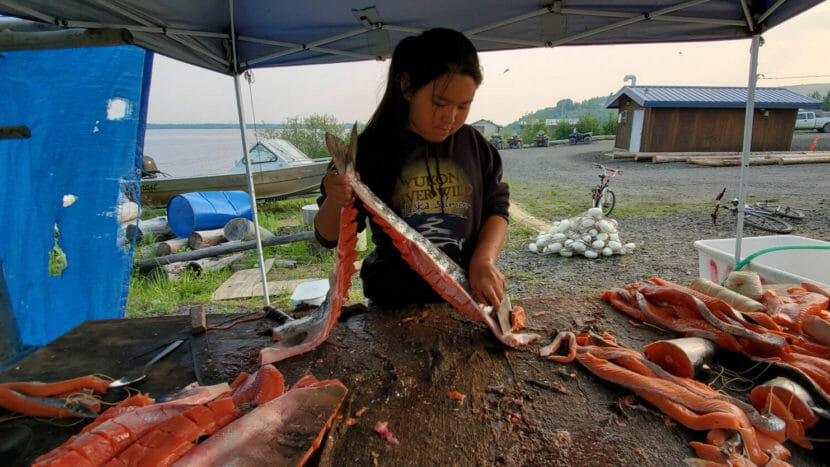
Serena Fitka’s daughter, Hali, cutting chum in St. Mary’s. June 10, 2020. (Photo courtesy of Serena Fitka)
Bristol Bay’s sockeye run is the largest on record this season. It has been an astounding summer: More than 70 million sockeye have returned, and fleets have pulled in record harvests of more than 53 million fish.
Fish for Families is a new program that aims to share that catch. The program is an extension of the Alaska Longline Fishermen’s Association and the Alaska Sustainable Fisheries Trust. Since 2020, these groups have helped coordinate sockeye salmon donations from Bristol Bay to Alaska Native communities in southwest Alaska.
At the end of June, it sent out its first shipment of the season — 1,000 pounds of salmon to Chignik communities on the Alaska Peninsula. The program plans to send a total of 8,000 pounds of salmon there this month.
But the fish donations come at a cost. Those 8,000 pounds run about $64,000 to purchase, process and ship. They’ve gotten some donations and grants, but they’re also fundraising with a GoFundMe account to cover the other costs.
The group also wants to send salmon to communities on the Yukon and Kuskokwim Rivers that are facing record low chum salmon returns. That will require more funds. They’re asking the Alaska Department of Fish and Game for help shipping the salmon there.
Deenaalee Hodgdon fishes commercially and is helping to coordinate the salmon donations. Hodgdon, who is Deg Xit’an Athabaskan and Supiaq, said it’s important to look at the state as a community.
“How do we collaborate across our different regions, as Yup’ik and Sugpiaq people, reaching across to Dine and Tanana and Koyukon, all the way up into the border?” they said.
Part of doing so is trying to help people in other places who need salmon. It’s a central food source for people who live along the Yukon River. But in the past two years, multiple species have crashed to record lows, and people have struggled to catch enough fish to feed their families.
Serena Fitka, the executive director for the nonprofit Yukon River Drainage Fisheries Association, grew up subsistence hunting and fishing in St. Mary’s, along the lower Yukon River. She said the decline of the salmon runs has changed ways of life in her home village.
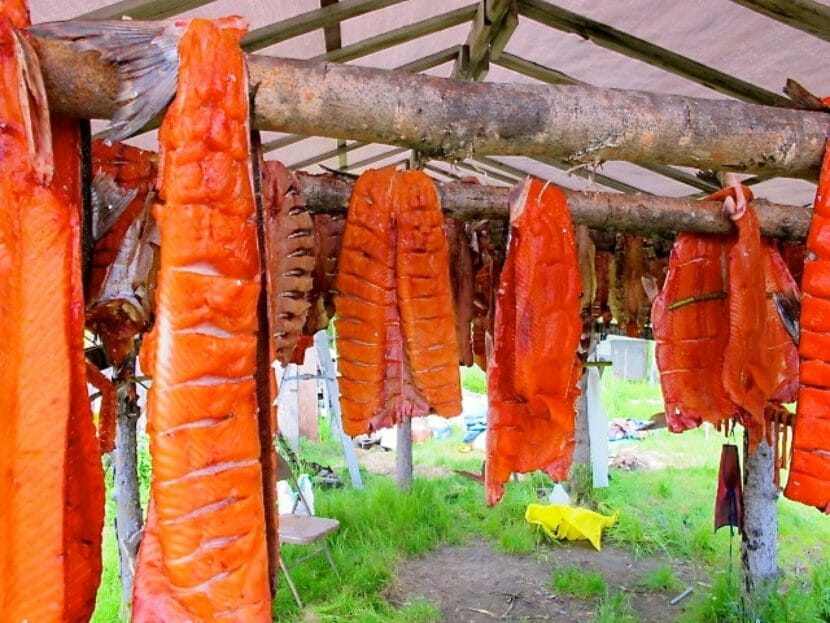
“The river was barren,” she said. “And it was sad, not seeing people gathered at their fish camps, not seeing the smoke come out of smokehouses.”
Fitka said the low numbers have been incredibly difficult to contend with. Last year’s chum run was a record low at under 200,000 fish. But these donations do help to feed people and further Southwest Alaska’s culture of sharing.
“With the efforts that are underway with sharing of the fish, our Native instincts, it’s ingrained in us to share our foods,” she said. “We’ve always shared our catch with people. And with another fishing region sharing their fish with us — it’s a great, great honor.”
The donations build off other efforts to bring salmon to communities in need in the past. In 2020, the fishermen’s association helped coordinate tribes, fishermen, local governments and Native organizations and nonprofits to donate fish from areas around the state, including from Bristol Bay and southeast Alaska. To date, the association said it has deployed $2.5 million to buy salmon and donate more than half a million meals.
Other organizations stepped in, too. Tanana Chiefs Conference helped organize fish donations, and fishermen gave thousands of pounds of chinook and chum salmon. Operation Fish Drop distributed more than 12,000 pounds of Bristol Bay sockeye to hundreds of families.
Maio Nischkian, who fishes in Bristol Bay and owns a direct marketing company, works with the fishermen’s association. She said it’s important that people who make their living fishing in Alaska give back some of that wealth.
“We have a really big responsibility to share, not only with our local communities, but throughout the state,” she said. “Especially to Alaska Native communities that are struggling right now when, you know, they are the reason that we’re allowed to be here. And they’re the reason this fish has kept running.”
In the wake of the recent reversal of Roe v. Wade, abortion remains legal in Alaska and is protected by the state constitution’s right to privacy.
But that doesn’t mean it’s available across the state. In Bristol Bay, patients seeking abortions have always faced obstacles to care. Like many medical procedures, the long-held understanding is: If you need an abortion, fly to Anchorage. Beyond that, figuring out how to access care is like trying to solve a puzzle. There are multiple health care providers in the region, but none provide abortion services.
Mary Swain, executive director of Camai Community Health Center in Naknek, emphasized that the clinic offers contraception and the morning after pill. But for abortions, they only make referrals.
“We refer everybody to Planned Parenthood in Anchorage,” she said.
Cynthia Rogers, a public information officer for the Bristol Bay Area Health Corporation in Dillingham, echoed Swain’s information in an email. She said that anyone seeking an abortion in Bristol Bay can arrange an appointment with a provider in Anchorage.
Even Safe and Fear-Free Environment, a Dillingham organization that offers support for victims of sexual assault and domestic violence, doesn’t have a clear policy for people who seek abortions. Executive Director Marilyn Casteel said they do provide the morning after pill for anyone, no questions asked. But they would also tell people to travel for an abortion.
“We could say, well, there’s a Planned Parenthood in Anchorage, have you given them a call?” Casteel said.
Limited information about telehealth options
For Bristol Bay residents, many health care services are only available by traveling to Anchorage, so abortion is not unique in that regard.
In areas where in-person health care services are limited, telehealth has the potential to fill the gap. For medication abortions, all that the patient requires is two pills, mifepristone and misoprostol, which can be taken at home.
But it’s unclear how accessible telehealth services are to residents, and the medical experts interviewed for this story declined to provide more information on the availability of self-administered medication abortions.
Each local representative cited different reasons for not providing or assisting with abortions. At the Camai health center, Swain said they don’t have the facilities to address possible complications from an abortion, either medication or surgical. Casteel said SAFE would have to receive grants specifically for abortion in order to support access, and they have never received those grants in the past.
Camai and BBAHC also pointed to restrictions on abortion connected to funding from the federal Health Resources and Services Administration and Indian Health Services. Both funds do include exceptions for victims of rape or incest or in cases when the health of the parent is in danger. But when asked about these exceptions, Rogers repeated that BBAHC does not provide abortions and that patients can make appointments in Anchorage.
When KDLG called the State Medical Board, the representative who answered offered to relay an interview request. Once they learned the conversation would be about abortion, they warned that board members would probably decline to talk because the board is non-partisan.
However, the Board’s director of the Division of Corporations, Business, and Licensing, Sara Chambers, said questions about access to and legality around abortion are not partisan.
Chambers said that in Alaska, it’s legal for patients to be prescribed abortion pills via telehealth appointment and then receive the pills by mail.
She added that individuals who obtain abortion pills without a legal prescription will not be penalized.
“There’s no law penalizing a person for receiving a prescription that has been shipped to them illegally. The penalty would come to the person or the company who is either providing a false prescription or the company that’s shipping illegally without a prescription,” Chambers said.
Other Bristol Bay providers were contacted for this story and declined to comment, including Southcentral Foundation and the Dillingham Public Health Center.
Rose O’Hara-Jolley, the Alaska state director at Planned Parenthood, said via email that in Alaska, it’s legal for patients to be prescribed abortion pills via telehealth appointment and then receive the pills by mail. But in practice, they said, it’s difficult for Alaska providers to offer telehealth abortion services due to factors like outdated telehealth infrastructure and insurance coverage restrictions.
They also said that pills obtained without an appointment can be safe and effective, but they did not comment on the legality of that method. Planned Parenthood does not currently prescribe pills to pregnant people remotely, but O’Hara-Jolley said the organization is working on making that service available from their Alaska clinics.
Traveling for care is costly
For residents of Bristol Bay, the lack of telehealth abortion access leaves them with limited options. The most obvious choice is to travel to a Planned Parenthood clinic, which has locations in Anchorage, Fairbanks, and Juneau. But the price tag can add up quickly.
A roundtrip flight to Anchorage ranges from $443 to $643, while tickets to Fairbanks and Juneau can surpass $1,000. Beyond that, there’s the cost of lodging, food and the abortion itself.
According to Zhenia Peterson, a volunteer with the Northwest Abortion Access Fund, the average cost of an abortion appointment is $550, but it varies depending on the provider. Peterson said the Access Fund aims to provide financial assistance and help patients who can’t meet those costs.
“The services that we provide are pretty extensive,” she said. “The main one is we do fund abortion and we help folks travel to their appointments. You know, we help folks with airfare, any type of lodging. We also do rideshares and we have volunteers that give rides. And then we have emotional support as well.”
The Fund has helped many Alaskans in the past, and their coverage includes Bristol Bay. Once a patient has an appointment, the Fund provides varying levels of support, depending on each person’s income and needs. Alaska’s Medicaid program includes coverage for abortion care, so Peterson encourages patients to apply for Medicaid as well.
In Anchorage, Planned Parenthood has trained staff to discuss all of a patient’s choices. This includes abortion, adoption, and parenting. The clinic provides abortion pills 11 weeks after the patient’s last menstrual period and surgical abortions up to 17 weeks and 6 days.
Beyond that timeframe, patients are referred to providers outside the state.
This story has been updated with information from the Division of Corporations, Business, and Licensing at the State Medical Board, including new information on liability for providers of abortion pills mailed without a legal prescription.
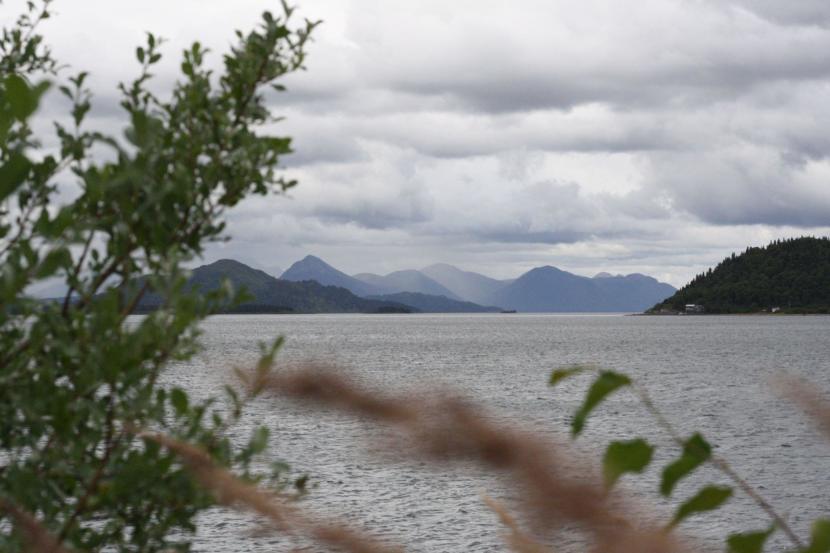
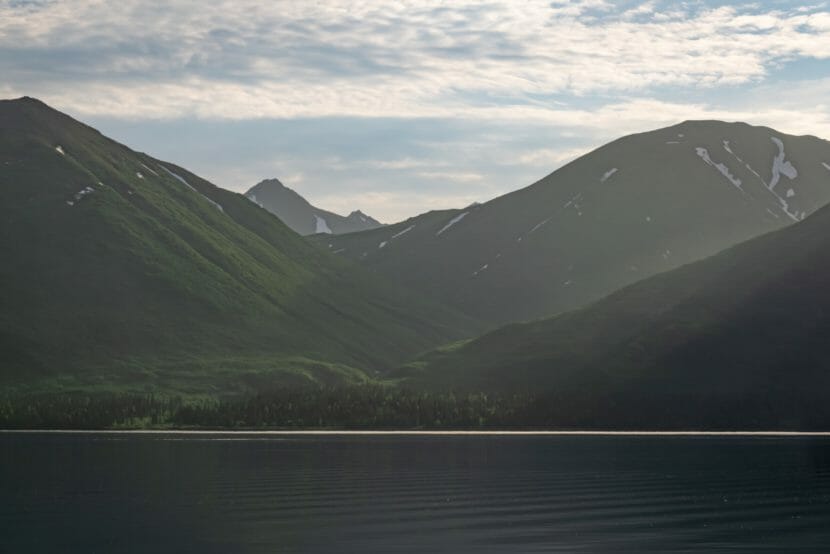
A view of mountains from Lake Aleknagik. June 7, 2022. (Photo by Brian Venua/KDLG)
Fishermen aren’t the only ones hunting salmon in Bristol Bay. Last week, people spotted mysterious shapes in the freshwater lake about 20 miles inland from Dillingham.
Sherol Mershon runs the Silver Fin Bed and Breakfast, on the shore of Lake Aleknagik. She’s hung fishing nets for 45 years and has seen her fair share of wildlife. So when her guests told her they saw whales in the lake, she had her doubts.
But the next day, she decided to take a closer look.
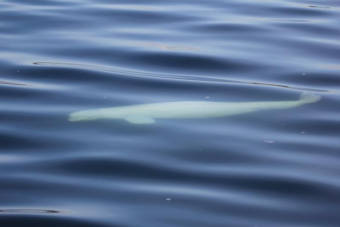
“Oh my! There are beluga. I said, ‘You guys come down — come down and look.’ And sure enough, I bet we saw seven. And they were traveling, but traveling slow,” she said.
About a hundred feet beyond the buoys off the boat launch, she saw pale shapes swimming through the water.
“There were two big white shadows in the water. Two big beluga there. One of the people here saw the baby kind of by the mama, they were gray,” she said.
Belugas have been sighted in Lake Aleknagik before, but Mershon said this is the first time she’s ever seen a beluga there.
“Some were kind of heading over to Yako Creek,” she said. “It was fun. This was the best I’ve ever seen them. The only time I’ve ever seen them. The only time is these last couple days.”
Lori Quakenbush, a marine mammal biologist with Fish and Game, happened to be staying at Mershon’s bed and breakfast.
“Belugas have no problem at all going up rivers into fresh water and can stay in fresh water for long periods of time. They’ll follow fish up rivers,” she said.
Quakenbush said belugas probably venture into fresh water more often than people realize.
A beluga whale from the Beaufort Sea photographed in Puget Sound earlier in October, 2021. (Photo from NOAA Fisheries, World Vets under MMHSRP 18786-05)
“They’re very shallow water cetaceans, or small whales, so they can handle the shallow waters of the rivers to get into places like lakes,” she said.
The whale sightings in Lake Aleknagik were serendipitous for Quakenbush, who is surveying Bristol Bay’s belugas this month.
“We’re here to do aerial surveys to count belugas in Bristol Bay, which we last did in 2016,” she said. “So we’re trying to do a count of the entire bay in order to see if we can tell if the population is declining, stable or increasing.”
In 2016, there were around 2,000 belugas in Bristol Bay, Quakenbush said. Fish and Game biologists are conducting aerial surveys between Dillingham and King Salmon and don’t have the final counts for this year. But she said so far, it doesn’t look like much has changed.
The west side of Bristol Bay, including the Wood River, has seen one of the largest sockeye runs on record this summer. More than 3 million sockeye salmon have swum up the Wood, which flows from Lake Aleknagik out into Nushagak Bay. And while belugas do eat a lot of salmon when they’re available, there’s a limit to how much fish one whale can hold.
“A large red salmon run like you’re having here in Bristol Bay now is good for belugas, but they can only fill their stomachs so many times a day,” she said. “If the run lasted longer from beginning to end that might be a better year for belugas than if there’s more fish coming in at the normal time — they can’t really take advantage of that.”
Mershon, the bed and breakfast owner, said it was great to learn how to spot belugas in the lake.
“In the olden days I’ve heard people say they’ve seen them here, but since I ran my own boat for 15 years and went set netting for 20, I was gone a lot,” she said. “It’s been really fun. I’m really glad they came and helped me train my eyes to what the belugas look like.”
You can find out more about Fish and Game’s Bristol Bay beluga studies on the department’s website.
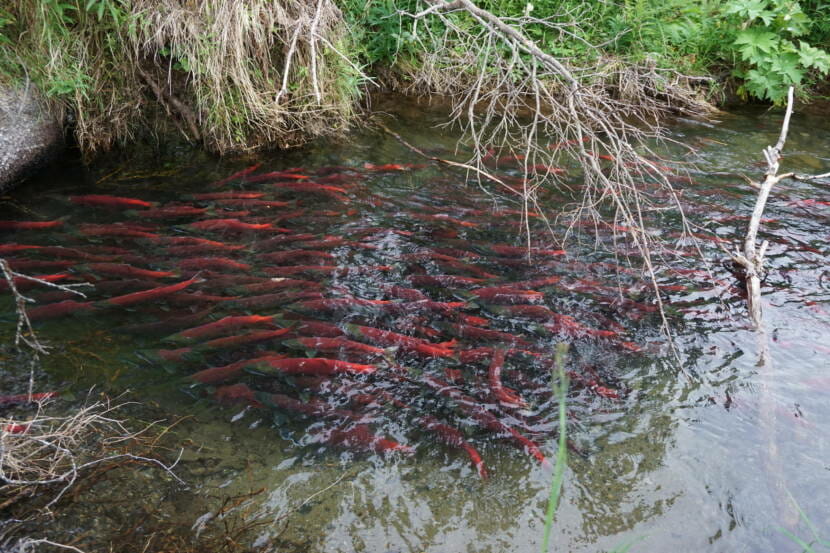
Sockeye in a creek in the Wood River watershed. July 28, 2021. (Photo by Stephanie Maltarich/KDLG)
Bristol Bay’s 2022 sockeye run is now the biggest on record: 69.7 million fish have returned this summer. That surpasses the previous record of 67.7 million fish, which was set last year.
More than 3 million sockeye have swum up the Wood River to spawn in the tributaries around Lake Aleknagik, about 20 miles from Dillingham, according to the state’s counting tower on the river.
Sherol Mershon lives along the lake near the head of the river. She owns a bed and breakfast there and has hung commercial fishing nets for 45 years. She said this year’s runs are remarkable.
“They just pour by. Sometimes there’s 500 in the air, breaking the water. When it’s dead calm you can see really well,” she said. “I lay in my bed at night with the window open and I can hear them jumping, and it’s just amazing. It’s absolutely beautiful.”
The east side of Bristol Bay has seen robust sockeye returns as well. Shaelene Holstrom grew up in Naknek and returns each summer to subsistence fish.
“I have been enjoying hearing how everybody is catching and how it’s just been crazy processing and running all over the place, trying to figure out what to do with fish,” she said. “I think that’s a great feeling, cause then we know we’re getting our numbers up at the river, and that warms my heart.”
Huge commercial harvests
Bristol Bay’s commercial fleet hauled in the most fish on record this year. Fishermen in the Nushagak, one of the bay’s five commercial districts, harvested more than 2 million sockeye in one day this season.
William P. Johnson just finished his sixty-second year as a boat captain. He grew up set net fishing near Igushik in the 1940s with his family. After more than six decades of fishing, he wasn’t phased by the large returns this season.
“Our goal was to get at least 100,000 [pounds]. We exceeded that, and so we came home after our last delivery on [July] 12th,” he said.
For thousands of years, Yup’ik, Alutiiq and Dena’ina peoples have presided over Bristol Bay. The commercial fishery began in 1884, as outsiders came to the region and built canneries. The federal government managed the fishery until the state took over in 1960.
Johnson believes that change was an improvement.
“I think the local control by our local Fish and Game department has a lot to do with the improvement of the resource that we participate in,” he said.
Johnson, who also fishes for subsistence, said the large sockeye runs haven’t changed how much food he and his family put away for winter.
“There has never been any problem for us in getting our fish,” he said. “But one thing that has been impacted is that king salmon seem to have declined.”
As sockeye abound, chinook and chum runs decline
While sockeye have returned in droves, chinook and chum salmon runs have dropped. Scientists don’t know why that is, either.
Dan Schindler is a professor of aquatic and fisheries sciences at the University of Washington. He’s studied sockeye on the west side of Bristol Bay for decades and says the exact reasons for why the bay’s sockeye runs are so huge will probably always remain a mystery.
“In terms of what the mechanism is, it’s really hard to really pinpoint that,” he said. “What we have is correlations. And the correlations are that when we’ve had really warm — to hot, even — eastern Bering Sea sea surface temperatures, Bristol Bay sockeye have done really well. And other species in the region haven’t,” he said.
There are slight differences in how these fish behave.
“We know they eat slightly different things in the ocean. They migrate to the ocean at slightly different times during the season. They probably have slightly different behaviors in the ocean,” Schindler said. “All of those things are making chinook and chums vulnerable to something that sockeye aren’t – at least sockeye that are returning to Bristol Bay.”
Of course, this isn’t the case for sockeye returning to rivers in other parts of the state. Runs to tributaries along the Gulf of Alaska have performed poorly over the past decade.
“I suspect it’s something to do with ocean temperatures causing some change in the food web — that smolts leaving the west side of Bristol Bay are hitting really excellent conditions for survival, whereas smolts leaving places like Chignik and the Copper River are hitting ocean conditions that have been really poor for smolt survival,” he said.
Warming oceans and lakes coincide with big Bristol Bay returns
River systems on the west side of Bristol Bay have seen an especially large sockeye boom over the past few years.
“All the way up along the western north side of Bristol Bay all the way to the Kuskokwim. So something anomalous has happened here. And it has coincided with some of the warmest ocean temperatures ever observed in the eastern Bering Sea and in the Gulf of Alaska,” Schindler said.
Warming waters at the spawning grounds likely also affect their growth, Schindler said.
“As the lakes have warmed up, we see more plankton in the lakes, and of course the plankton are the food for juvenile sockeye,” he said. “So over the last 60 years, we actually see that juvenile sockeye are growing much faster now than they were 30 or 40 years ago, which means they’re leaving for the ocean as bigger smolts. And presumably, that has something to do with their higher survival rates in the ocean.”
The sockeye runs now returning to Bristol Bay may be the largest of the past several hundreds of years. Schindler and other scientists have attempted to reconstruct how big the bay’s runs were hundreds of years ago.
“Salmon coming back from the ocean bring back a distinctive marine nitrogen signature, which we’ve used to reconstruct how many sockeye were spawning in places like the Word River and the Kvichak and throughout the Togiak refuge over the last thousand years or so,” he said.
This is called paleolimnology, where researchers take the mud out of the bottom of lakes and scan that sediment for an isotope, Nitrogen-15. Schindler said even with commercial exploitation of the sockeye populations, the recent runs have returned at historically high rates.
“If you add up the catch and escapement that we’ve observed in the last 25 or 30 years, the sum of those two numbers appears to be higher than the number of fish that ever returned to these lakes in the last 500 to 1,000 years,” he said. “And while that might seem surprising, it really does support what we’ve seen with our real time data over the last 50 or 60 years that climate warming has actually made these lakes more productive than they were 100, 200, and 300 and longer — 400 years in the past.”
The total run is now 69.7 million sockeye, but the season isn’t over yet. Fish and Game forecast a run of 75 million fish, but it could go as high as 90 million this summer.
Mackenzie Mancuso conducted an interview with Shaelene Holstrom which was used in this story.
Close
Update notification options
Subscribe to notifications
Subscribe
Get notifications about news related to the topics you care about. You can unsubscribe anytime.