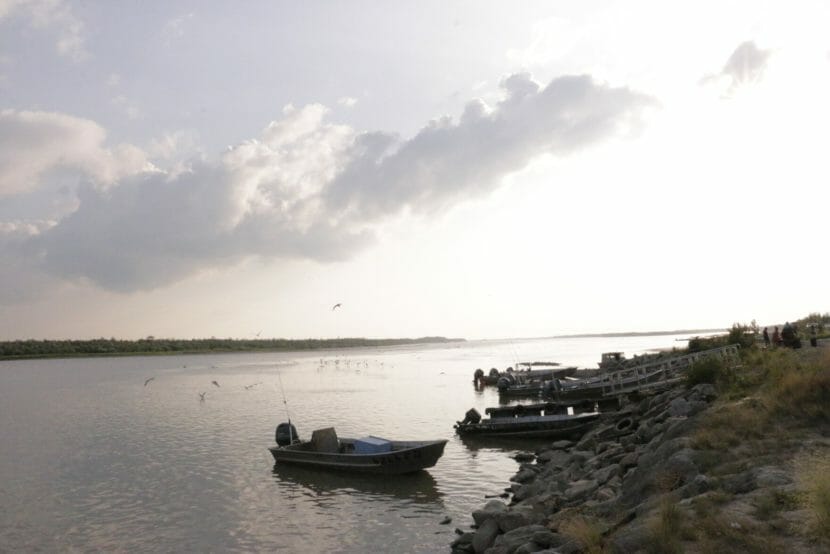
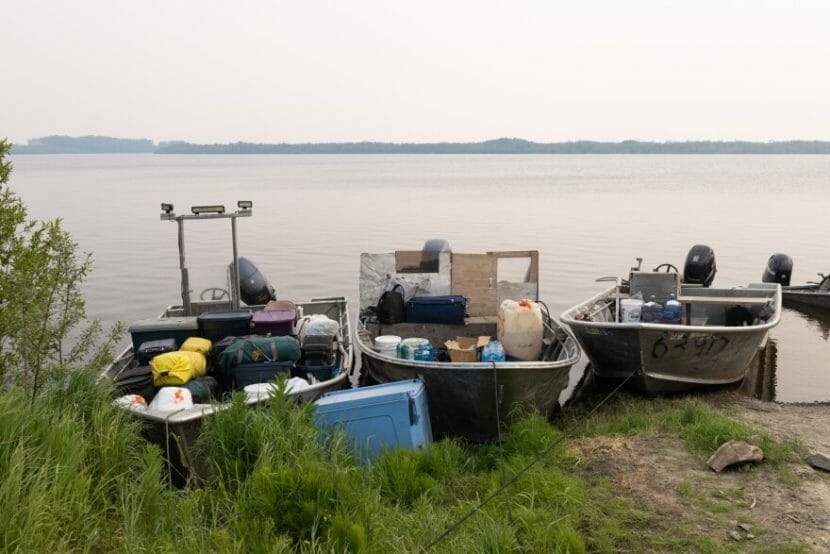
Skiffs line the Yukon River bank near the Kwik’Pak fish plant in Emmonak, Alaska on June 15, 2019. (Photo by Anna Rose MacArthur/KYUK)
Subsistence fishing for Yukon River chinook and summer chum salmon will likely remain closed through the end of the season.
It’s a possibility that fishery managers had warned could happen since before the salmon arrived.
Now, with both runs past their midpoints, fisheries officials say there’s no indication that there will be enough fish to meet the goals managers set for fish to escape to their spawning grounds.
“So unless these runs are abnormally, exceptionally, extremely late, it’s unlikely that we’ll get enough fish coming in the last part of this season,” said Alaska Department of Fish and Game Yukon River Fishery Manager Deena Jallen. Jallen gave the update during a weekly salmon teleconference hosted by the Yukon River Drainage Fisheries Association.
Only about 20% of the average amount of chinook and summer chum have returned to the lower river, according to data from the Pilot Station sonar. It’s the lowest chinook run ever, and the second lowest summer chum run, just barely more than what returned last year.
“So we know that it’s incredibly disappointing,” said Jallen. “It’s extremely hard to see these runs come back so low. It’s hard to have fishing be closed, but that’s unfortunately what we have to do when the runs are this small.”
A caller who identified herself as Ruby in Eagle said that she couldn’t provide a subsistence report during the teleconference since no one had been fishing.
“It’s very, very quiet at the public boat landing in town,” she said. “Almost eerily quiet.”
The community is facing other challenges as wildfires burn across the Alaska Interior.
“Very dry, very hot, lots of smoke. We haven’t had any measurable rain for a very long time, probably a month,” Ruby said.
Downriver, in Russian Mission, a caller who identified herself as Olga said that an elder has been asking her for a taste of fish.
“Then I told her that it’s not us that’s saying that they can’t fish; it’s just a regulation from way up high. And then she was practically crying and said, ‘Well, tell those people not to go shop for four weeks in their store. They have it easy to go to the store to get what they want to eat,’” Olga said.
Pink salmon counts are picking up in the lower river. Subsistence users can target pink and red salmon with 4-inch mesh set nets, 60 or fewer meshes in length, along with other gear types.
U.S. Fish and Wildlife Service Fishery Manager Holly Carroll asked fishermen to move their nets if they’re catching a lot of summer chum or chinook. She said that it’s important that each of those fish makes it to the spawning grounds.
“We have had years like this before, certainly for chum in 2000 and 2001, and we recovered. And I have faith that we can recover again and we’ll be fishing that species again, but just not this year,” Carroll said.
She also referenced the moratorium in 2013 and 2014, prohibiting all chinook harvest, and the rebound that followed. She acknowledged that prohibiting fishing for both summer chum and chinook is a compounded hardship.
“So while it may be hard right now, I’m just trying to put out a message for hope that if we let these fish go by now, we will be fishing on them again in five years time, four years time for the chum. That’s my hope. Maybe even less for the chum; maybe two or three years we could see these runs rebound,” Carroll said.
In the meantime, fishing for summer chum and chinook remains closed on the Yukon River for the second consecutive year.
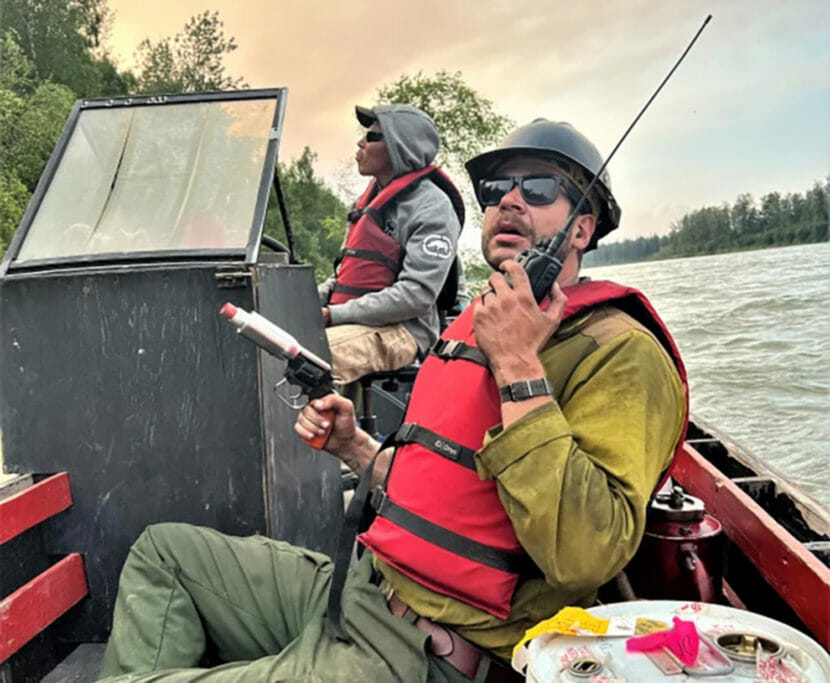
Firefighters from the Gannett Glacier Type 2 Initial Attack Crew conduct defensive burning operations from a river near Lime Village in July 2022. (Photo courtesy of Bryan Quimby, Alaska Incident Management Team)
A Southwest Alaska wildfire has burned through the site of a support camp for the Pebble Mine project as the state’s wildfire season remains on pace to be one of the worst on record.
Almost 2.4 million acres have burned through Wednesday morning, according to the Alaska Interagency Coordination Center.
Firefighters have kept flames away from most structures across the state, according to reports submitted through Wednesday, successfully defending villages and towns even as smoke blankets many of the state’s largest cities.
Over the Fourth of July weekend, part of the Upper Talarik fire burned through the site of a supply camp constructed to support the controversial Pebble Mine, a planned metal mine in the headwaters of Bristol Bay.
Mine construction is on hold, pending the result of several legal fights and permitting processes, but geologists have been exploring the site’s potential.
No one was present at the site when the fire burned through the area.
Joe Holzinger, a public information officer assigned to the Upper Talarik and a handful of other fires collectively known as the Lime Complex, said it isn’t clear how much of the camp was damaged or destroyed.
He said assessors are en route to the area, which is within a temporary flight restriction intended to aid firefighting aircraft.
“At this point, we’re just waiting for that assessment to see how much it was impacted,” he said of the mine site.
A spokesman for Pebble Limited Partnership did not return a phone call Wednesday.
Abe Davis, operations chief for the Lime Complex fires, said firefighters have successfully burned out some areas around Lime Village, the town for which the fires are named. Those controlled burns are intended to protect the village against wildfires.
The wildfire season has been exceptionally bad in Southwest Alaska this year, with more than 1.2 million acres burned, a record for the region.
Elsewhere in the state, fires have prompted evacuation watches near the town of Anderson, on the Parks Highway, and in locations near Fairbanks.
Clear Space Force Station, which houses one of the United States’ main ballistic missile alert radars, is among the areas in the alert zone. The town of Nenana is just north of the zone.
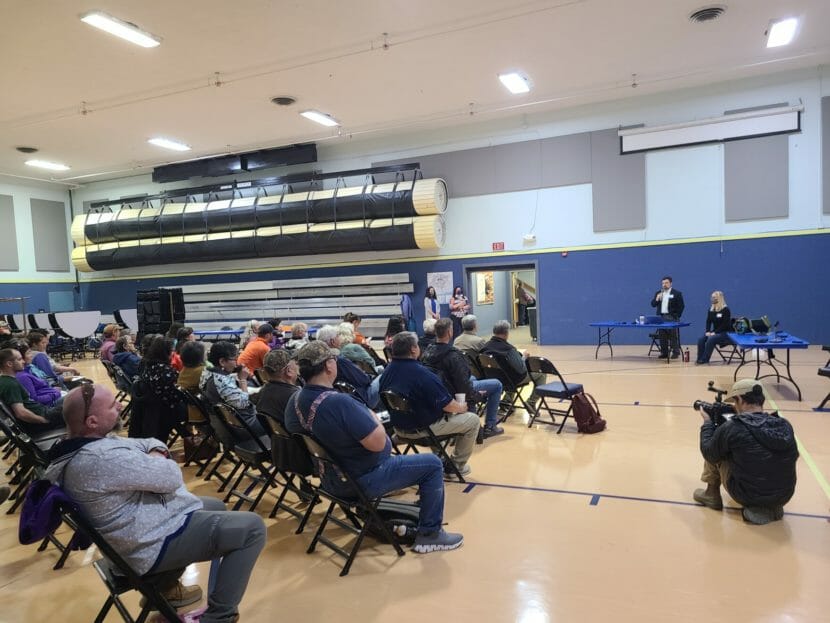
Residents flew in from around the Bristol Bay region to give public comment on the EPA’s proposed determination. (Photo by Corinne Smith/KDLG)
The Environmental Protection Agency announced last week that it is extending its comment period for proposed restrictions on mining of the Pebble deposit. The comment period was originally set to end in July. Now it will continue for two more months, to Sept. 6.
Representatives with the EPA visited Dillingham and Newhalen earlier this month to hear public testimony on the agency’s proposal to protect waters around the Pebble deposit. It was the first in-person public hearings since the start of the COVID-19 pandemic.
Dozens of residents from around the Bristol Bay region traveled to Dillingham to weigh in.
Robin Samuelsen is a board member of the Bristol Bay Native Corporation. He has fished in the bay for 57 years and now fishes with four grandsons on his boat.
Samuelsen urged the EPA to take action to protect salmon runs that support Alaska Native ways of life.
“My family has subsisted in Bristol Bay for thousands of years. Subsistence is the most important fish you can put in front of an individual in Bristol Bay,” he said. “We live and die by our fish.”
If finalized, the EPA’s determination would implement federal watershed protections for South Fork Koktuli River, North Fork Koktuli River, and Upper Talarik Creek watersheds. It would also pose restrictions on mining waste discharges around the proposed mine site.
Bertha Pavian-Lockuk flew in to testify from Togiak, a community about 67 miles southwest of Dillingham.
“This two minutes, you will not fully get all the detailed information that each person that flew in from each village has. It’s not enough time for me, or any of us,” she said.
She thanked the EPA representatives for visiting in-person and stressed the importance of healthy salmon runs in her community.
“Our subsistence lifestyle, each and every one in here is carrying on. My children and my grandchildren are still subsisting today. And we are teaching our children of what we have learned from our parents and grandparents,” she said. “And we’ve gone through this COVID, we just we are still going over (it), and subsistence was our only way, only source of food that we were able to survive by.”
In 2014, when the Obama administration released a proposed determination for protections, more than a million people — including tens of thousands of Alaskans — commented in support of the federal protections for Bristol Bay. In 2019, the Trump administration revoked the proposal.
In May, the EPA used its authority under the Clean Water Act to issue a revised proposal that included analysis from multi-year environmental reviews and Pebble’s mining proposal.
EPA spokesperson Suzanne Skadowski says the agency found that the mine would negatively affect salmon habitat in the area.
“Basically, within the mine footprint, the fisheries are too sensitive and too important to be doing any any discharges in related to the mine, in that footprint,” she said.
But Skadowski says the EPA’s plan would only limit mining of the deposit as proposed by the Pebble Limited Partnership.
“It’s very specific to the Pebble deposit and the Pebble Mine to that area, and not to any other development or mining that might be happening in Alaska, it’s very specific to their plan,” she said.
Many Bristol Bay tribes, fishermen and environmental advocates want to see comprehensive protections and bans on any mining activity near the bay.
Skadowski says the EPA can only restrict digging and dumping that would impact waterways around the Pebble Mine site, but federal authorities could further restrict mining. For example, Congress could create a protected area in Bristol Bay.
During a virtual hearing, interim CEO of Pebble Limited Partnership John Shively opposed EPA restrictions on the mine, citing demand for copper resources.
“Copper is essential to the green economy,” Shively said. “This federal administration is attacking not only Pebble but, for other mines, how it thinks you’re gonna get all the minerals you need in order to do the green economy?”
Shively has served as interim CEO since 2020, when former CEO Tom Collier resigned after secretly recorded comments about close relationships with elected officials and federal regulators were released, known as the Pebble Tapes.
Dillingham Mayor Alice Ruby says that since the EPA started to deliberate about protections for Bristol Bay, the economic value of the commercial fishing industry has only increased. She says the city opposes any mining activity that puts it at risk.
“We’re even more committed now to protecting that industry from the huge risk presented by large scale mining in the very waters that assure our industry, our economy and our future,” Ruby said.
Bristol Bay is forecasted to see a record-breaking harvest of 75 million sockeye salmon this summer. The commercial fishing industry is estimated at roughly $2 billion in 2019 and 15,000 jobs.
The EPA announced last week that it would extend the comment period on its proposal by another two months. At another public hearing, the state Department of Environmental Conservation spoke in favor of an extension. But mining opponents have said they want this process to wrap up as quickly as possible.
The EPA will accept written comments on the proposed restrictions on mining of the Pebble deposit until Sept. 6. A final determination is expected to be issued before the end of the year.
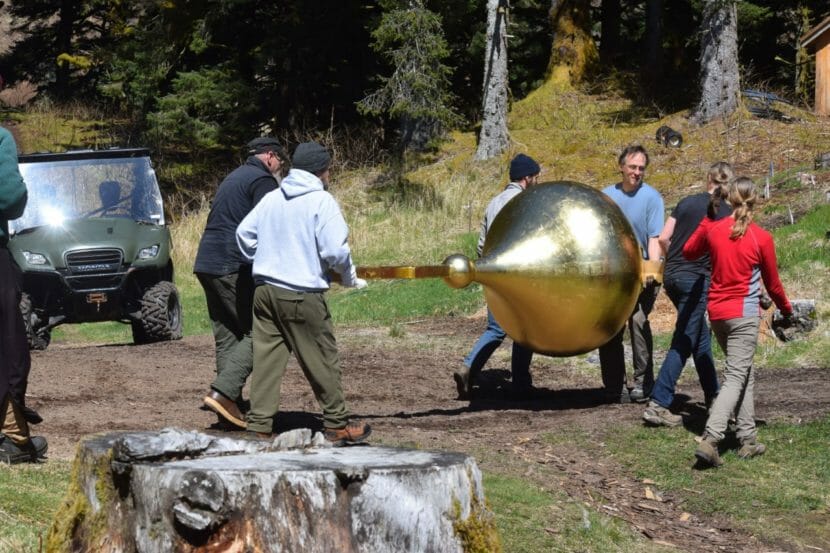
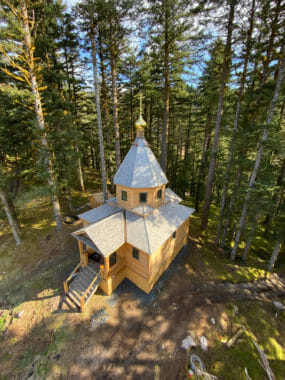
Monks and volunteers carry the dome that is now installed on the top of Spruce Island’s newest chapel. (Photo courtesy of Father Andrew)
The village of Ouzinkie on Spruce Island has an Orthodox church, and the far side of the island also has its own chapel over the grave site of St. Herman. But the three monks who live in the middle part of the island only have a small indoor chapel in their shared house.
Father Andrew is the superior of the monks living on Spruce Island. He said that even though there are places of worship on either side of the island, the new chapel will give the small community their own place of worship.
“This is our home,” said Andrew. “And we have guests, especially in the summer months, and now also, local people in our Sunny Cove area who attend church here.”
The chapel is nearing completion and should be finished sometime in the fall of this year. A golden dome has already been raised over the structure, but final artistic work still needs to be done. Father Andrew is hoping that it will be open for services in spring of 2023.
The chapel should be open for services in spring of 2023. (Photo courtesy of Father Andrew)
“Like other churches in Alaska,” Andrew said, “although it’s very remote, you can see some nice architecture and fine carpentry.”
Over 200 years ago, the first Russian Orthodox monastery in North America was founded in Kodiak, in the modern-day city of Kodiak. The head of the monastery at the time, Herman of Valaam — known today as St. Herman — renounced his position and took on the life of a hermit on Spruce Island.
“He ended up taking care of orphans, especially after the 1819 epidemic. Many orphans were sent to him, and he had a community down in Monk’s Lagoon, and there are now four chapels down there. And it is a place of pilgrimage where people come from all over the world,” Andrew said.
Father Andrew says many visitors from Russia and Ukraine typically pilgrimage to Spruce Island during the summer months. He doesn’t expect them this year due to Russia’s ongoing invasion of Ukraine, but he is still expecting summer visitors from around the United States and Alaska.
Boats along the Andreafsky River are packed and ready if evacuation orders come through in St. Mary’s. (Photo by Katie Basile/For KYUK)
It’s a grim outlook for Yukon River Chinook and summer chum salmon.
Chinook salmon counts are the lowest ever recorded at this point in the season, and state and federal fishery managers do not expect them to meet escapement goals. The low numbers are also making it difficult for biologists to determine if the run is late.
The summer chum run looks slightly better in comparison, but only in that it’s the second-lowest run ever recorded at this point in the season, just barely ahead of last year’s record low. It’s too soon to tell if summer chum will meet escapement goals. But if the run tracks with last year, then it won’t.
As long as escapement appears unlikely for Chinook and summer chum, subsistence salmon fishing will remain closed for a second year.
Frustrations are building along the Yukon River amid the closures so far.
Some Alaska Native residents claim that the restrictions are eroding their cultural inheritance. But the managers making the regulations say that opening the fishery could jeopardize the fish runs long-term.
“This is the most disconnection to the river I’ve had in all my life,” said Holy Cross resident David Walker, who called into the weekly Yukon River salmon management teleconference hosted by the Yukon River Drainage Fisheries Association.
Walker said that no one nearby is fishing, and described neglected fish camps overgrown with grass.
“I don’t want to get too negative, but I heard one Elder tell me, ‘It’s like cultural genocide,’” Walker said.
A caller from Marshall said that not being allowed to fish was restricting Alaska Natives from their ancestral rights. Rampart tribal member Brook Woods said that there is a reason why fishery testimony becomes emotional.
“These are fishermen facing a crisis. We are tied to these salmon. They’re our cultural wellbeing, and one thing that wasn’t taken away from us with assimilation,” Woods said.
Federal fishery manager Holly Carroll with the U.S. Fish and Wildlife Service said that she understood that closing all salmon fishing is “incredibly severe.” But she said that with Chinook runs already unlikely to meet escapement, managers cannot allow even a single opening.
“Right now, we’re nervous that if we don’t get all the fish to the spawning grounds, then four or five years from now we would have poor returns that could mean closures again,” Carroll said.
Compounding escapement concerns is that of the Chinook that enter the river, fewer than expected are making it to Canada. Biologists are researching why. One theory is that they are dying in the river from disease. Biologists are collecting heart, kidney, egg and blood samples from Chinook caught in test fisheries to test for health issues like Ichthyophonus and kidney disease.
Carroll repeated many times that if there were enough salmon to open fishing, then managers would do so.
Some callers did support the closures. A caller who identified herself as Ruby in Eagle said that she supported the restrictions as a way to protect salmon runs and encouraged managers to maintain their escapement goals.
While directed salmon fishing is closed on the Yukon, fishing is open for non-salmon species, like whitefish, using 4-inch gillnets that are no more than 60 feet in length. Some callers said residents did not have 4-inch nets, while others reported steady whitefish harvests.
Pink salmon began hitting the coast in recent days and entering the Yukon River mouth. Sockeye and pink salmon caught in all gear can be kept. Managers ask that fishermen release Chinook and chum back to the water when alive.
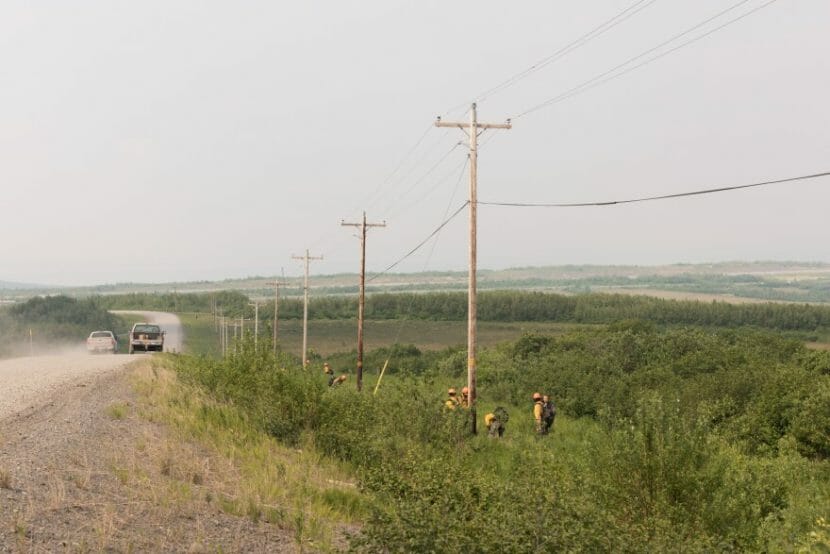
The North Star Fire Crew clears brush around power poles on the road between St. Mary’s and Pitka’s Point on June 11, 2022. The crew is made up of firefighters in training from around the country. (Photo by Katie Basile/For KYUK)
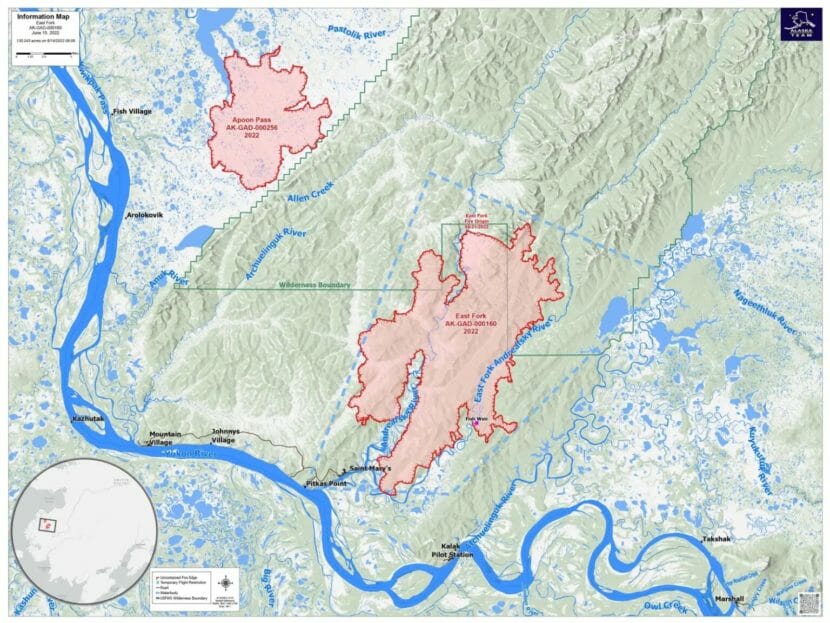
The East Fork Fire in Western Alaska is the state’s largest fire at the moment, estimated at more than 150,000 acres Thursday, and it’s burning in a region where, just a couple decades ago, large fires would not have been expected.
And a major contributing factor is our warming climate, says climate specialist Rick Thoman with the Alaska Center for Climate Assessment and Policy at the University of Alaska Fairbanks.
Thoman says hot, dry weather and a lightning strike at the end of May combined to make the East Fork Fire the biggest tundra fire on record, by far, for the Yukon-Kuskokwim Delta region.
Listen:
The following transcript has been lightly edited for clarity.
Rick Thoman: You know, really prior to about 2015, there were a handful of documented wildfires on the tundra in the Y-K Delta, but very few. There’s been a big uptick. Similarly, in the upper Bristol Bay Area, the Dillingham, King Salmon area, historically there’s been only a relatively few number of fires. Most of them have been documented in the last decade or so. But this year, we’ve had easily the largest wildfires, for instance, anywhere close to Dillingham. So really quite remarkable. And it really is a big change from what we saw even 10 or 15 years ago. We just didn’t think about, or really expect, these kinds of fires on the tundra landscape.
Casey Grove: What even is a tundra fire? What is burning out there?
Rick Thoman: So tundra comes in many different shapes and sizes and types of vegetation. So Southwest Alaska, their vegetation is much thicker, much denser, the willows and alders growing up, you know, taller than your head, versus on the coastal North Slope, where most of the plants aren’t much above your ankle. So they’re both tundra but very different environments, from a wildfire perspective. Of course, the more plant material you have to burn, the hotter the fire is, potentially. If you’ve got a hotter fire burning deeper into that duff layer, the surface layer, that’s going to be harder to extinguish. In tundra fires, you don’t have the tree mass to burn like you do in the boreal forests. In areas where the tundra is quite thick with vegetation, there’s still plenty to burn from willows and alders and through the the tundra grasses, as well.
Casey Grove: So whether it’s tundra, or trees or whatever burning, how is our fire season shaping up this year? And how does that rank in terms of other fire seasons that we’ve seen at this point in the season?
Rick Thoman: Well, that’s the million dollar question here. As of Wednesday, the total acreage burned is now over 800,000 acres in the state. The only other year that was even approximately this high at this point in the season, on June 15, was back in 2010. Now, 2010 is not one of the big fire years in Alaska. We had burned a lot of acreage in the Interior in May and early June. But then the weather turned cloudier or rainier. And while 2010 did exceed a million acres, it didn’t exceed it by very much. And some of the very biggest wildfire seasons — 2004, 2005, 2015 — they were not really going yet at this point of the season. On the other hand, 2002 — which is now the third largest wildfire season to June 15th — did wind up being a very big season. So the bottom line is: what the rest of the wildfire season brings for the state, as a whole, is going to depend entirely on what the weather does over the coming four weeks or so.
Casey Grove: So we’ve talked about the shorter-term implications of the weather changing, but then there’s some longer-term things that are affecting this too, right? So how does the changing climate factor into this?
Rick Thoman: Well, our changing climate, our changing environment, of course, didn’t cause the thunderstorm on May 31 that sparked the East Fork Fire. But what our warming environment does is it supports, for instance, the increased growth of plants on the tundra in Southwest Alaska. And so as elders from St. Mary’s and really all around Western Alaska had been reporting for years, that vegetation is thicker. It’s growing taller. We see trees, spruce trees, are advancing into places where they didn’t grow or places where trees were just very spindly and few and far between. They’re getting more robust and thicker now. And all of this is the result of this long-term, decades-long warming. Spruce trees, of course, don’t spread because you have one warm week. It’s that sustained, year after year, warmer conditions that are allowing plants to grow more, grow in places they didn’t before. Plants don’t care how we measure anything. They just grow where they can and don’t grow where they can’t.
Casey Grove: Is it fair to say that this might be the future that we should expect? That there would be these fires out in that region?
Rick Thoman: Certainly, that’s been the case so far in the Y-K Delta. Wildfire on the tundra used to be very rare, and when it happened it was pretty darn small. That is clearly not the case. 2015, 2020, now 2022, have featured these very large fires without precedent in this part of the state. Now, of course, in the boreal forest portion of the state, fires this size happen somewhere literally most years. But out on that tundra, where it’s a cooler environment, there’s less fuel to burn, fires this size didn’t used to occur, and they are now. There’s no reason to think that this isn’t going to be a feature going forward. Of course, they won’t occur every year. You have to have all the weather ingredients come together, as well. That is dry conditions and something to spark the fires, like lightning. But when all of those pieces come together, this is the kind of thing that will result. We’re seeing it now.
Casey Grove: Rick, speaking of those ingredients, how are we seeing things shape up, you know, either in Western Alaska or elsewhere in Alaska, as far as the dryness, and just the weather going forward? What do you expect to see in terms of potential fire danger?
Rick Thoman: Well, the big risk right now, Casey, is that most of mainland Alaska has had very little rain since the snow melted in April or May, depending on where exactly you’re at. And that means that there has been drying of the land surface since then. For instance, in Fairbanks, there has been no measurable rain, not enough to completely wet the ground, since the snow was completely melted in mid-May. And this is now the longest dry streak on record in Fairbanks that’s gone into the summer. There’s much longer dry streaks in the spring. That’s not uncommon, but not at this time of year, when the snow is gone. It’s warmer, things are drying out. That kind of dryness covers a large portion of the central and western Interior and Southwest Alaska and really much of Southcentral, as well, although there were those thunderstorms last week. You know, some places got a lot of rain, nearby places got almost nothing. So overall, it’s very dry across much of Alaska right now. And if — big if — we get into a pattern where we get a lot of lightning, we have a lot of land that is primed for wildfire.
Close
Update notification options
Subscribe to notifications
Subscribe
Get notifications about news related to the topics you care about. You can unsubscribe anytime.