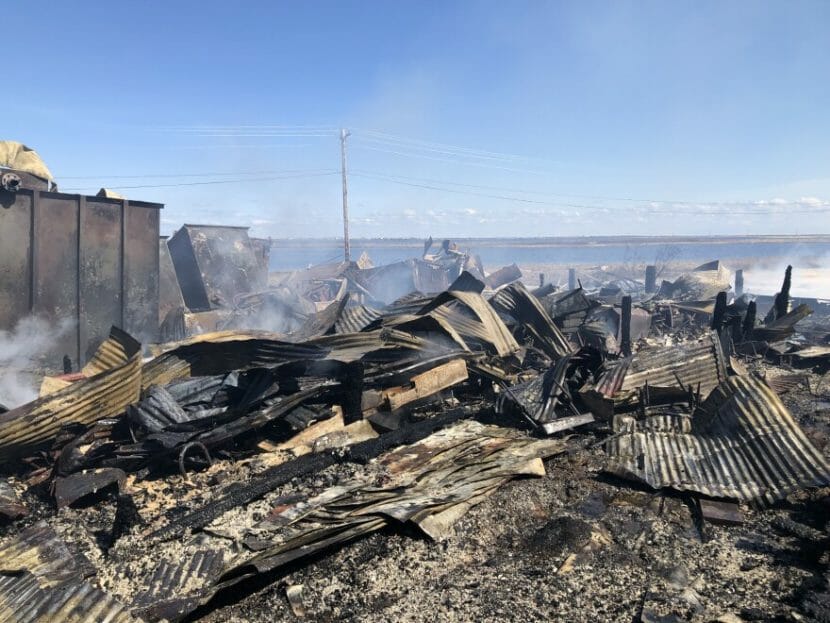
Fire damage at the Akiuk Memorial School campus in Kasigluk, Alaska on May 27, 2022. (Photo courtesy of Kimbery Hankins/Lower Kuskokwim School District)
More is now known about the extent of the damage from the fire that burned on May 26 at the Akiuk Memorial School campus in Kasigluk. The fire did not damage the school building. However, three other school structures were destroyed.
Lower Kuskokwim School District Superintendent Kimberly Hankins visited the Akiuk Memorial School the day after the fire on May 27. In an email to KYUK, she wrote that the three buildings that burned included a teacher housing unit, an old utility building and the school’s current utility building. All three structures were completely destroyed. Pictures from the site show collapsed, charred remains.
Hankins said that the teacher who had been living in the now destroyed housing unit had already moved out of the building before the fire began. The semester ended last week, and many teachers had left the village for summer break.
Though the school building itself stands undamaged, Hankins said that she could smell smoke inside the school gym and kitchen. Both are located near the utility building that burned.
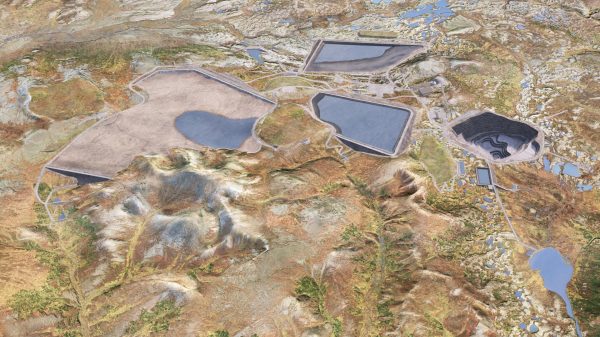
A digital simulation of what the proposed Pebble Mine’s foundation will look like if it receives a federal permit. (U.S. Army Corps of Engineers)
In late May, the U.S. Environmental Protection Agency announced it wants to veto development of the Pebble Mine — a vast deposit of copper and gold at the headwaters of Bristol Bay.
The proposal is a step toward permanently blocking development of the proposed open-pit mine in the Bristol Bay watershed. Mine opponents have pursued a veto for more than a decade.
The EPA said mining the Pebble deposit would result in unacceptable loss of salmon habitat, both at the site and further downstream. Using its authority under the Clean Water Act, the agency proposes to prohibit the discharge of mining materials in waters and wetlands at the Pebble site. That could make it impossible to extract minerals from the deposit.
The executive director of the United Tribes of Bristol Bay, Alannah Hurley, opposes the mine and said the EPA’s move is a step in the right direction.
“Today is a really big day for Bristol Bay — for us to get back on track in this process, and for the Biden administration to be committed to finishing the job to stop Pebble Mine once and for all is very exciting,” she said. “But we’re not there yet. We definitely need to get through the rest of this process.”
She said her organization will closely read EPA’s proposal, which it has released for public review.
The mine would result in the loss of almost 100 miles of stream habitat, 8.5 miles of salmon habitat, and 2,113 acres of wetlands and waters at the mine site, the EPA notes, drawing from the mine plan.
If finalized, the EPA’s decision would ban digging and dumping material in the area delineated in Pebble’s 2020 mine proposal. That could kill the project. The EPA also wants to restrict the use of waters as disposal sites for any future mine proposals that are as big or bigger.
The EPA has used its “veto” power under section 404(c) of the Clean Water Act just 13 times in the law’s 50-year history. It allows the agency to nix projects that would significantly damage habitat or recreational areas.
Hurley said she hopes the EPA’s proposal will ban the mine forever, but she’s been here before. The Obama administration proposed vetoing the mine, too. That was in 2014 — three years before Pebble submitted its proposal.
“As many remember, those got held up in court,” Hurley said. “And when the federal administration changed [with the election of Donald Trump], they eventually were withdrawn.”
Meanwhile, the U.S. Army Corps of Engineers denied Pebble a federal permit in 2020. The company that wants to build the mine, Pebble Limited Partnership, has appealed that decision.
Pebble, for its part, called the EPA’s proposal a step backward not just for the mine, but for President Biden’s climate goals. Minerals like copper are used to make batteries and in other renewable energy technologies. Pebble said the administration shouldn’t hinder domestic production.
Pebble Spokesperson Mike Heatwole said the company will give the EPA proposal a close look to see which areas it’s placing restrictions on.
“Reading between the lines on the EPA action here — that’s upwards of 400 square miles of state of Alaska land that the federal government is proposing taking off the table,” Heatwole said. “There’s just a lot of details within what the EPA is proposing that really needs to be scrutinized to know how it’s all going to work.”
Heatwole said the company will examine how the EPA incorporates the U.S. Army Corps of Engineers’ environmental findings.
“Which are very clear in terms of both the fishery not being impacted and on the water resources as well,” he said.
The company has consistently maintained that the mine would bring jobs and wealth to the region without significant harm to Bristol Bay’s fishery.
The scope of the EPA’s proposal only extends to the discharge of materials associated with the Pebble deposit. While Pebble is the largest mining claim in the region, it’s not the only one.
Hurley, with the United Tribes of Bristol Bay, said Tribes and mining opponents in the region and around the country want broader protections of the area.
“How do we make sure that our future generations aren’t fighting these types of proposals 20 years from now?” she said. “That includes finalizing this EPA process to protect what we hope will be the entirety of the headwaters of our region up near the Pebble mining site.”
Public hearings on the EPA’s proposal will take place in June. The EPA will also accept written comments until July 5.
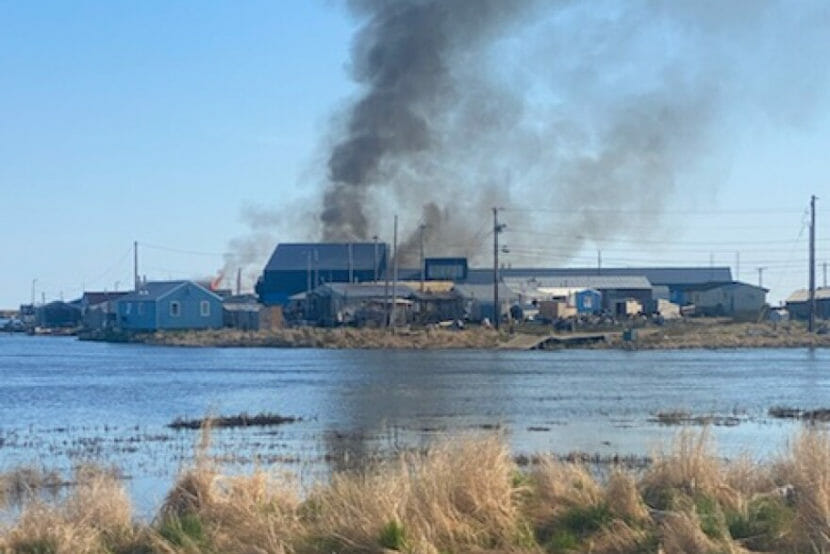
School facilities burn in Akiuk Kasigluk, Alaska on May 26, 2022. (Photo courtesy of Natalia Brink)
School facilities burned at Akiuk Memorial School in Kasigluk on Thursday. No injuries or deaths have been reported, but multiple buildings were damaged as local and state agencies worked to suppress the flames.
The fire started around 10:30 a.m. on May 26. Third and fourth grade teacher Laura Spence was inside her home. She lives with her husband and their dog in a teacher housing unit next to the school.
“What I saw was dark black smoke,” she said.
The building that housed the old generator for the school was on fire. Her husband came in from outside.
“He just told me to get up and get our stuff, and get our dog and get out,” Spence said.
She grabbed the dog but was not able to gather many belongings before evacuating.
The fire spread to the principal’s housing unit and then to the teacher housing. The school semester ended last week, and classes were not in session.
Kasigluk Tribal Council President Natalia Brink said that the principal had already left for the summer, and so had several teachers. Other teachers who had planned to leave had already packed their belongings and were able to move them out of the houses before the fire reached the units.
After the fire overtook the teacher housing, Brink said it spread beneath the school.
“Holy cow! It’s getting worse. Under the school and teacher quarters are on fire, and it’s getting really smoky,” she said, observing the fire around 12:30 p.m., two hours after it began.
Brink said that volunteer firefighters were using hoses to spray the buildings with water from the Johnson River. She said that the water pump initially did not work in Kasigluk, but volunteer fire fighters from the nearby community of Nunapitchuk quickly boated over with their equipment to help.
“They’re splashing water with hoses. They’re spraying along the ground because it’s really dry,” Brink said.
The Alaska Division of Forestry sent smokejumpers and two airplane tankers filled with fire retardant to the site.
Division spokesperson Kale Casey said that the fire spread to five acres, but it’s now contained after a tanker released two-thirds of its load. The other tanker flew back to McGrath without needing to deploy its retardant. Two smokejumpers remain in Kasigluk.
The division said that dry conditions are a concern across much of Alaska this year. In April, a wildfire in the region grew to 10,305.5 acres over 12 days. It did not reach any villages or private property and eventually burned out on its own. It was Alaska’s largest April wildlife in 25 years.
Alaska State Troopers are also responding to the Kasigluk fire. Trooper spokesperson Austin McDaniel said deputy fire marshal will investigate its origin and cause.
Lower Kuskokwim School District Superintendent Kimberly Hankins said that she was in contact with community members in Kasigluk, who were updating her as the fire progressed.
If a new school is needed, constructing one before the fall semester is unlikely. In Bethel, a fire destroyed two schools in 2015. Their replacement is being constructed this year, seven years afterwards.
This is the second large fire in the village in recent years. In September 2020, the only store in Kasigluk burned down and has not yet been rebuilt.
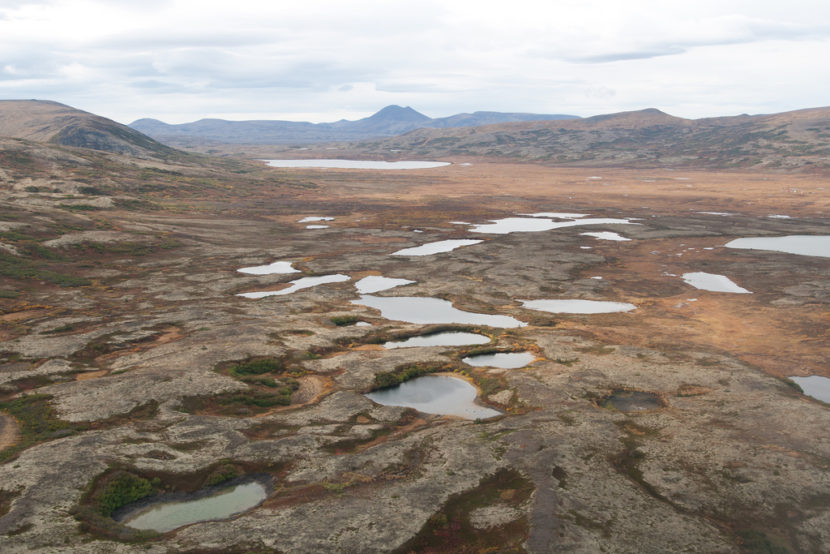
The proposed Pebble Mine site, pictured in 2014. (Photo by Jason Sear/ KDLG)
The U.S. Environmental Protection Agency is proposing protection for the Bristol Bay watershed that would permanently ban the Pebble Mine.
The EPA announced the proposed ban Wednesday morning, using its authority under a section of the Clean Water Act called 404(c). It’s the “veto” of Pebble that fishermen and tribes in the Bristol Bay region have requested for years.
“Where that mine is is the spawning beds of the greatest salmon-producing rivers in the world,” Curyung tribal chief Tom Tilden said earlier this month at the U.S. Capitol. He’d gone there to press for a mine veto, as he and others have done many times before.
The company seeking to build the open-pit gold and copper mine, Pebble Limited Partnership, has said it would enrich the region with good salaries and other income.
It has repeatedly argued that its state-of-the-art mine design will have no significant effect on Bristol Bay’s fish run.
EPA’s new Region 10 administrator, Casey Sixkiller, does not see it that way.
“Two decades of scientific study show us that mining the Pebble Deposit would cause permanent damage to an ecosystem that supports a renewable economic powerhouse and has sustained fishing cultures since time immemorial,” Sixkiller said in the EPA news release announcing the proposal.
As an example, the EPA notes that the mine plan calls for destroying 8.5 miles of fish streams.
The EPA action would be similar to the veto the Obama administration proposed in 2014. That one was called a “pre-emptive veto” because it came before the Pebble Partnership had submitted its permit application.
During the Trump presidency, Pebble finally submitted a mine plan. But the Republican-led government seemed to be of two minds. The EPA took steps toward dismantling the Obama administration’s barriers to mine development but reversed course, and then reversed course again.
Ultimately, in late 2020, the U.S. Army Corps of Engineers rejected Pebble’s permit application to dredge and fill in the area. Pebble is appealing that decision.
The EPA’s latest proposal is broader. If made final, it would ban any dredging or filling of federal waters and wetlands in service of mining the Pebble Deposit, at least within the footprint of the mine plan Pebble drafted in 2020.
The EPA’s proposed ban will be published in the Federal Register this week and will be the subject of public hearings next month. The agency will accept written comments through July 5.
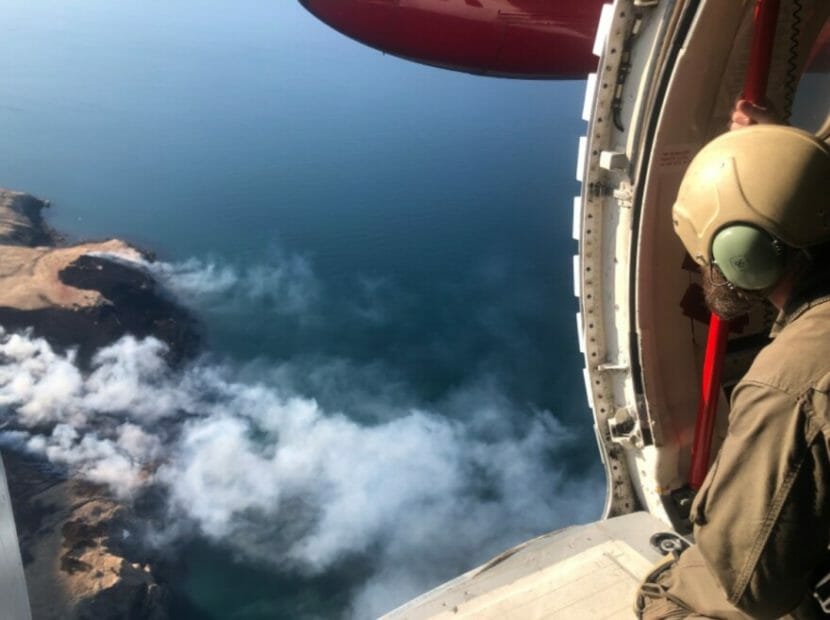
Jared Weber, a smokejumper spotter, watches the Walrus Islands fire on Tuesday evening, May 17, 2022. (Kevin Pabinquit/BLM Alaska Fire Service)
Firefighters on Wednesday contained a fire on Round Island that was caused by a staff burn barrel near Fish and Game’s campsite, officials said. The ground was damp, but sparks escaped and spread through dry grass to cover about 40 acres of the roughly 720-care island.
“It ignited dead grass that had been recently exposed after snowmelt, and the fire quickly took off from there and spread through the grass,” said Fish and Game’s lands and refuges manager Adam Dubour.
No one lives on the island year-round. But it’s an important site for subsistence hunts, which take place in the spring and fall. A limited number of people can also get permits to visit. Plus, the Alaska Department of Fish and Game staffs a camp on the island during the summer to conduct research and monitor walruses and other wildlife. The fire started near that camp.
Dubour said staff thought it was safe to use the burn barrel because the ground was damp, but they didn’t take into account how dry the grass was.
“We’re still doing a debriefing and assessment of the situation to try to learn from it,” he said.
Staff first reported the fire to the Alaska Division of Forestry late Tuesday afternoon. It got close to four buildings, but did not cause major damage, and no one was injured.
Sam Harrel, an information officer with the Alaska Division of Forestry, said the division sent an air tanker and six smoke jumpers from Fairbanks to the island.
“The tanker dropped water and the smokejumpers deployed,” he said. “I think we got six smokejumpers on that fire. They worked last night to stop the forward progression of that fire.”
In videos taken from an airplane responding to the fire, smoke streamed steadily from the eastern edge of the island.
Harrel said the vegetation and steep terrain were a challenge for firefighters. The crew worked Tuesday evening to contain most of the fire and mopped up hotspots on Wednesday. Harrel said they will continue to monitor the fire, but that it’s no longer a threat.
The island is one of four major haul out sites for Pacific walruses in Alaska. Each summer, thousands of males haul out on its beaches. Walruses are particularly sensitive to air traffic, and Dubour said Wednesday evening that they were likely disturbed by the smoke and aircraft that responded to the fire, but that wildlife hadn’t been harmed directly.
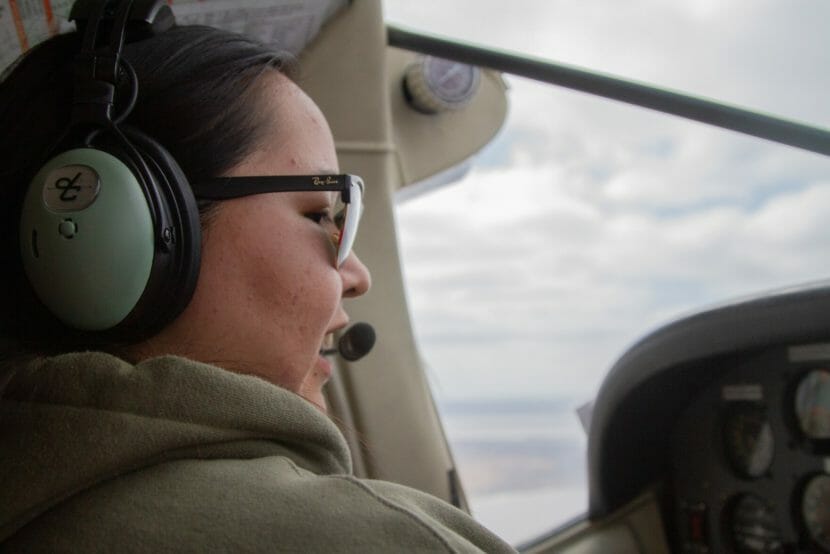
Pilot Dolena Fox flying a silver and blue-striped Cessna 207 to Tuntutuliak. (Photo by Olivia Ebertz/KYUK)
Pilot Dolena Fox is flying a silver and blue-striped Cessna 207 to Tuntutuliak. At 26 years old, Fox is at least a decade younger than her plane.
It’s the end of Fox’s first two-week shift as a commercial pilot. She said that the first 10 days have been exhausting but interesting.
“Lots of learning, and very challenging in a good way,” said Fox.
Fox grew up mostly in Kipnuk, and a little in Kwigillingok and Bethel, too. That meant lots of flying back and forth between villages. The first time Fox remembers being excited by the idea of flying was in middle school, when she flew with a female pilot for the first time. It sparked the idea that maybe she could fly too.
“That’s kind of like when it felt real. Like it’s achievable, you know?” said Fox.
Only about 6% of professional American pilots are women. At regional airline Grant Aviation, where Fox works, only five of their 60 pilots are female.
And Fox is the first female Yup’ik pilot to work for Grant. There’s been at least one other female Yup’ik commercial pilot before her: Lindsey Jean Laraux flew commercially in the Y-K Delta from 2007-2010.
Fox’s uncle Andy Fox also works for Grant. He’s worked for them on and off for 49 years. He said he was proud of her.
“Yeah. I sure am,” Andy said.
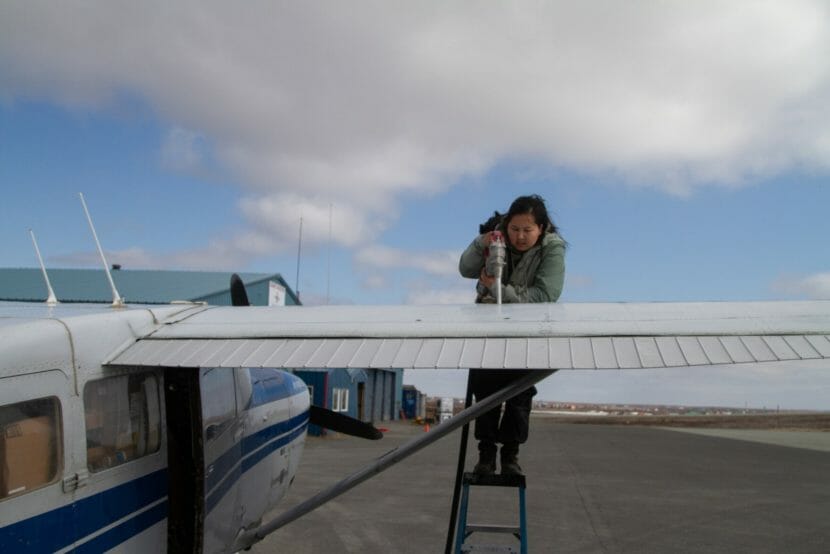
Dolena Fox refuels her plane before taking off. (Photo by Olivia Ebertz/KYUK)
Fox first worked near airplanes before pursuing her dream of flying them. She worked for a few years at Ravn, selling airplane tickets. Then, during the first year of the pandemic, Ravn went bankrupt and she lost her job. That was the final push she needed.
“And I was like, ‘Well, I’m just gonna go for it.’ So I did. I moved to Anchorage and I went to flight training,” said Fox.
Less than two years later, she had her private pilot’s license, her instructor’s certification, and her commercial pilot’s license.
On the way to Tuntutuliak, we chat about how the job has been. She said that the first village she ever flew to for work was her home village of Kipnuk. She said that it was a coincidence. When she landed, lots of people came to greet the plane.
Once we land in Tuntutuliak, Fox wastes no time in unloading her cargo. She passes each box to the gate agent, a man with a four-wheeler. There’s a box with a grocery store sheet cake, and another with blue sprinkle cupcakes. It’s someone’s birthday in Tuntutuliak. The agent swaps the cargo for passengers: a girl and her mom. Fox greets them and takes their luggage.
The dad who has dropped them off, Andrew Frank, said that it’s incredible to have a pilot in the Y-K Delta who can communicate in Yugtun with them.
“It’s always really impressive and makes us very proud that we see Native pilots. Elders that don’t know how to speak English can always talk to them,” said Frank.
Fox said that speaking Yugtun and flying locals around the Y-K Delta has been her dream since middle school. But she didn’t always think that dream could be a reality.
“For me personally, it was really hard to even just leave Bethel. To go to flight training and to go to school and to do something that I never saw as a successful goal. But I want more people to know that doing what they want to do is actually very achievable,” said Fox.
Helping people learn how to fly without leaving Bethel is the reason she got her instructor’s certificate. According to Grant Aviation, when there was a local flight school in Bethel there were more pilots from the Y-K Delta. Now, Fox is one of the only ones. Out of the 60 pilots at Grant, only five are from the region.
As far as what’s next for Fox, she may move on to bigger aircraft one day. But for now she’s content to fly in her home region.
“I feel like everything I have on the ground dissipates in the air. That’s all I have to care for: keeping the plane in the air. So everything else, all my problems or all my things I need to do in life, is left on the ground when I take off,” said Fox.
Close
Update notification options
Subscribe to notifications
Subscribe
Get notifications about news related to the topics you care about. You can unsubscribe anytime.