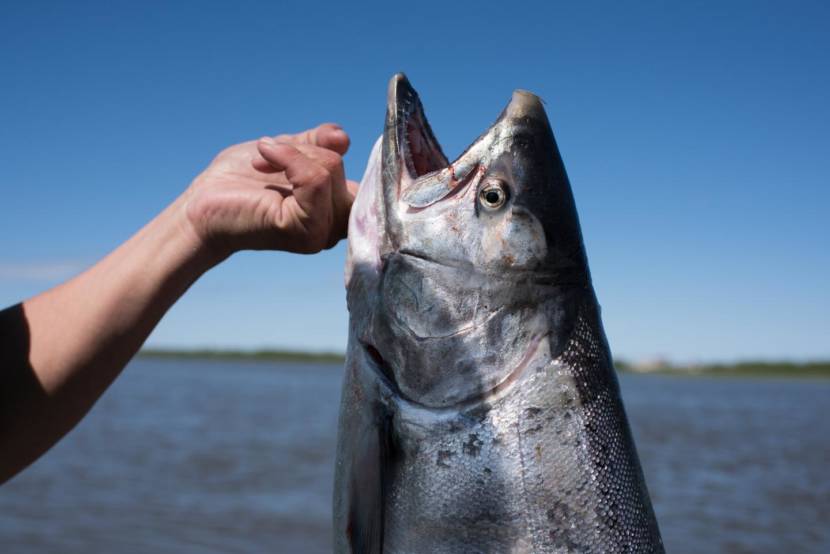
Kuskokwim king salmon caught near Bethel, Alaska on June 12, 2018. (Katie Basile/KYUK)
The federal government is suing the state of Alaska over its management of salmon fishing on the Kuskokwim River.
The lawsuit says the state is violating Alaska National Interest Lands Conservation Act by allowing all Alaska residents, no matter where they live, to engage in subsistence fishing of king and chum salmon when there isn’t enough fish for all uses. But ANILCA specifies that the subsistence preference is for “rural Alaska residents.”
The lawsuit was filed Tuesday in U.S. District Court in Anchorage.
For years, both the state and federal governments have managed fisheries in the Yukon Delta National Wildlife Refuge, which covers virtually all of the Yukon-Kuskokwim Delta.
Sometimes their rules conflict. For instance, in June of 2021, the state declared the lower Kuskokwim open to subsistence gill nets while federal managers said it was closed, to protect the resource.
Kevin Whitworth, interim director of the Kuskokwim River Inter-Tribal Fish Commission, sees the lawsuit as beneficial to tribes and rural residents.
“The fish commission is heartened to see the federal government basically stand up to protect salmon and the importance of federal management,” he said.
Gov. Mike Dunleavy’s office referred questions to the state Department of Law. The department’s spokesperson, Assistant Attorney General Grace Lee, said the state’s management is based on sound science and input from local stakeholders.
“This ensures that there are adequate subsistence opportunities for Alaskans while adhering to the sustainability principle enshrined in the Alaska Constitution,” she said in an email.
The conflict over subsistence has been brewing for a few decades. The heart of the problem remains the same: Federal law mandates that rural residents’ subsistence needs come first in times of scarcity. State law doesn’t allow a rural preference, the state Supreme Court decided in 1989.
When the Legislature would not change state law to conform to ANILCA in the 1990s, the U.S. government took over management of fishing on federal land and adjacent rivers. But it delegated much of that management to the Alaska Department of Fish and Game.
The lawsuit names Fish and Game Commissioner Doug Vincent-Lang and his department as defendants.
KYUK reporter Olivia Ebertz contributed to this story from Bethel.
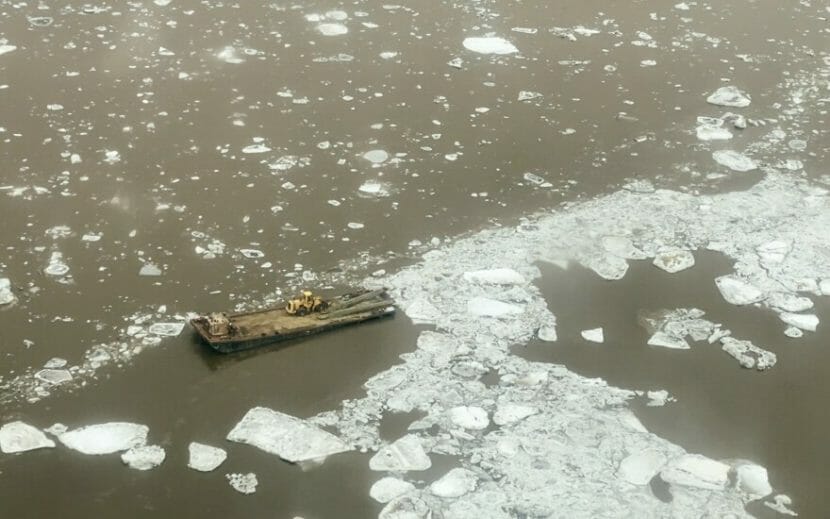
The Lily at Bogus Creek, about 9 miles upriver from Tuluksak, on May 10, 2022. (Photo by Olivia Ebertz/KYUK)
Last fall, Alaska Logistics left two barges to freeze in Yukon-Kuskokwim Delta rivers. One has dislodged and become a free-floating ghost barge, winding down the Kuskokwim River. It’s been stuck at the Macivik Slough, just below Tuluksak, since May 10.
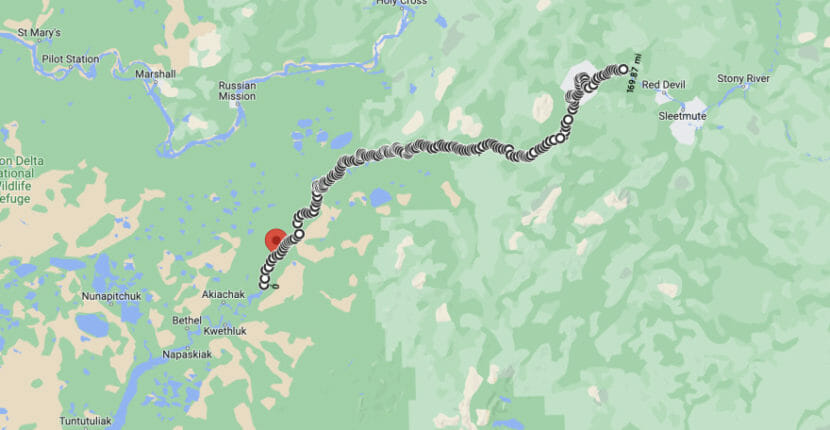
The ghost barge has a name. It’s called The Lily. It traveled about 170 river miles down the Kuskokwim after dislodging from the ice when the river broke up at Georgetown on May 8.
“I dunno, it just kinda caught us,” said Allyn Long, a co-owner and manager of Alaska Logistics.
Long said he made the decision to let the Lily freeze into the river when ice started to form around it in October 2021, and the barge’s accompanying tugboat experienced motor issues. But he did take a couple of measures to secure it for breakup. His crew tried to brace the barge against a sandbar, then they fastened the loader it was carrying to its top and pumped the barge full of water to try to weigh it down and keep it from capsizing.
“We pumped about 15 or 20 thousand gallons of water into it,” Long said.
But despite their efforts, the barge got loose and the loader on top moved.
Willie Phillips from Tuluksak saw it more than 150 miles into its journey. He took a boat out for logging and spotted it on May 10 as it was passing the village.
“It seems like it shifted a little bit forward. The front area was lower than the back,” Phillips said.
It moved past the village and lodged into a sandbar at the Macivik Slough. Other villagers along the Kuskokwim have been checking on it.
Someone in Akiak traveled up the river to take photos of The Lily and posted them to Facebook.
Long chuckles when he thinks about the barge entertaining Kuskokwim residents. He is not concerned about the barge drifting too far or floating out to sea.
“The likelihood of it getting out the mouth is very, very, very small. It’ll go aground somewhere. Probably even before, I’m gonna say, Napakiak. Yeah. That would be my guess. Somewhere down there, somewhere probably around Oscarville,” Long said.
Long said that it’s not safe to go after the barge until the ice is all cleared from the river. Ice has jammed on the Kuskokwim at Bethel. But once it’s safe, Long said that it should be easy to get the barge back.
“We have our own tugboats and different friends that would help find it. People kind of on standby with fishing boats,” Long said.
The Lily wasn’t the only Alaska Logistics barge to freeze into Y-K Delta rivers last fall. Another barge froze near Eek, but they anchored that one, and it’s stayed in place.
The Lily’s journey down the Kuskokwim (Olivia Ebertz/KYUK)
In 2019, Alaska Logistics had another barge freeze in place and then drift down the Kuskokwim during spring break up in 2020. That one traveled from Aniak to Bethel.
Long said that his company has been moving freight by barge in the region for 20 years. He blames climate change for making freeze ups and breakups “more dramatic.”
When Long left the barges to freeze into the rivers in the fall, the U.S. Coast Guard told KYUK that they were planning to do an investigation to see if there was any wrongdoing on the part of Alaska Logistics. The Coast Guard did not return phone calls on May 12.
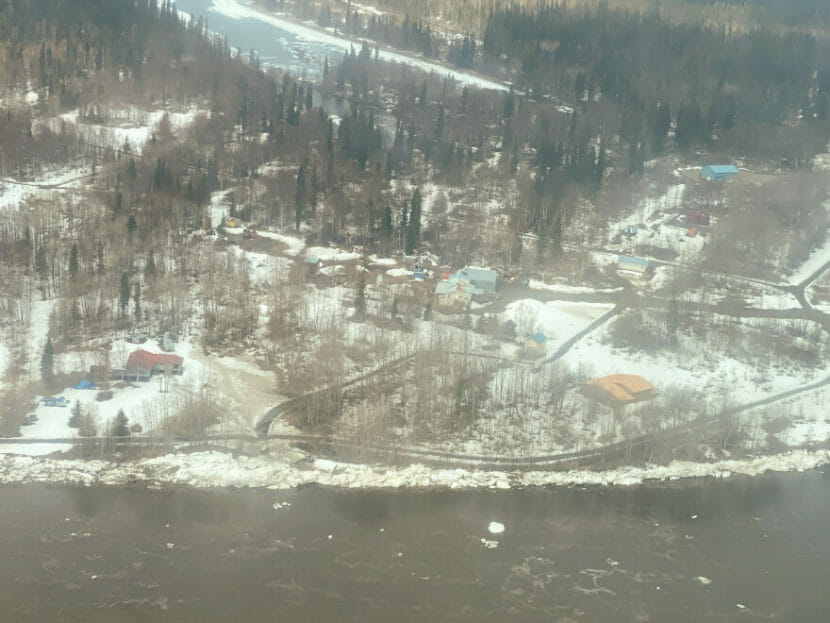
The upper Kuskokwim River community of Sleetmute as seen on May 10, 2022 following flood damage. (Photo by Olivia Ebertz/KYUK)
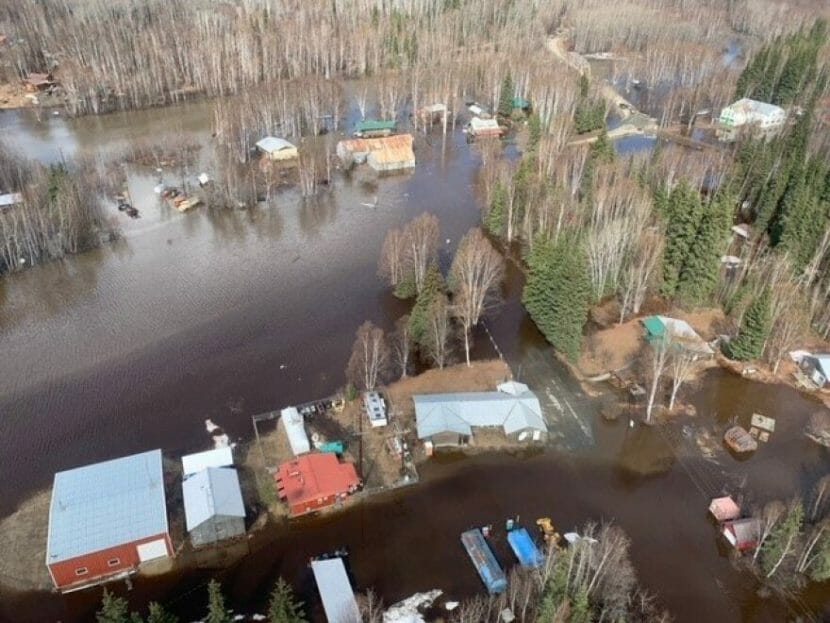
The upper Kuskokwim River communities of Sleetmute and Red Devil have both declared local disaster emergencies following flood damage the occurred on Sunday, May 8. The water has since receded, and the National Weather Service has ended its flood warning for the Kuskokwim River.
Tim Andreanoff lives in Sleetmute. He remembers the water rising fast, flooding his yard around 8 a.m. on Sunday.
“All of a sudden the water was just coming in so quickly. I had no time to move anything,” Andreanoff said.
The water swamped three snowmachines and a Yamaha boat motor. Andreanoff said that he had placed them beyond the usual flood point, but the water rose above that level.
“I can probably fix them. It’ll probably take about a week or more,” Andreanoff said, noting that it will depend on his ability to get parts. The water did not reach Andreanoff’s house, but others were not so lucky.
The state Emergency Operations Center reported that flood water inundated at least five homes in Sleetmute. Outside other homes, the water damaged insulation, freezers, and vehicles. Also damaged are roads, the dump, the cemetery, and Tribal equipment.
Downriver, in Red Devil, the state reported that flood waters damaged two roads, the runway, inundated a home, and contaminated water wells.
Theresa Morgan said that the flooding has turned her home in Red Devil into an island after the water washed out a nearby road.
“Once all this is all over and the danger is gone, we have to go back and forth with a boat to go to the post office,” Morgan said.
The state Emergency Operations Center said that it is coordinating flood response with the Yukon-Kuskokwim Health Corporation and the Association of Village Council Presidents. It said that the Red Cross is coordinating with community leaders in Sleetmute to provide flood assistance.
Manley Hot Springs on Saturday, May 7, 2022. (Photo courtesy Alaska State Troopers)
GCI customers across the Yukon-Kuskokwim Delta could experience slower data and internet speeds.
GCI communications director Heather Handyside said that flooding at Manley Hot Springs in Interior Alaska on Saturday knocked out power to a repeater station that helps distribute internet to the Yukon-Kuskokwim Delta. The repeater has been running on backup battery power for over 48 hours, and that power is about to run out. GCI has been unable to install a generator at the site due to the flooding.
“We have a helicopter on standby. We tried to use ATVs, but because of the flooding, the ground is really muddy. So we haven’t been successful getting up there,” Handyside said.
When the battery dies, many Yukon-Kuskokwim Delta customers will notice a slow-down in data and internet speeds. Customers might not be able to stream video or do gaming. Other services should remain accessible.
“We think essential functions like email will remain intact. Definitely their voice service over wireless and voice over landline service will remain intact. That means 911 will remain available,” Handyside said.
The repeater that lost power is part of GCI’s TERRA network, which serves 45,000 people across 84 Alaska communities. Internet disruptions will occur until a generator is installed or power is restored to the area.
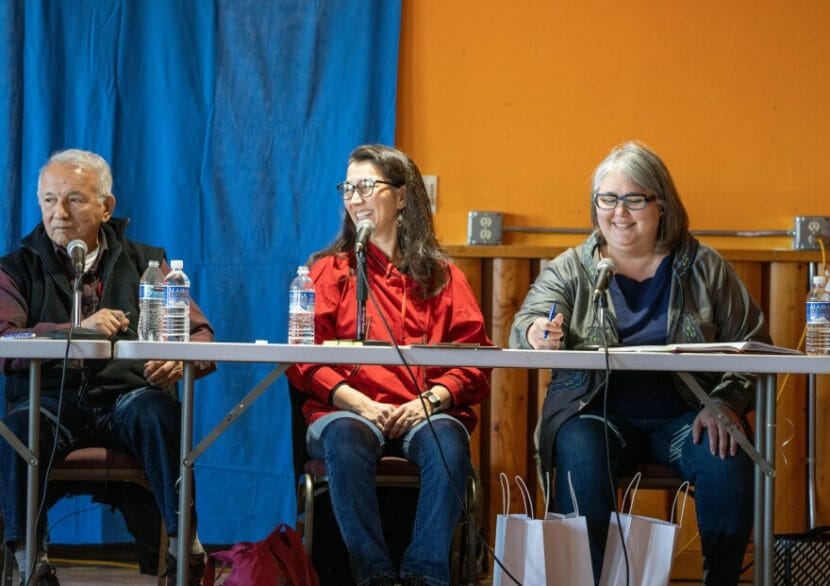
Emil Notti, Mary Peltola, and Tara Sweeney discuss rural issues in Bethel. (Photo by Elyssa Loughlin/KYUK)
Three Alaska Native candidates running in the special primary election for Alaska’s U.S. House seat came to Bethel for a candidate forum on May 6. Constituents attending the forum brought up three main issues important to them: abortion access, salmon conservation and public safety.
Four of the 48 candidates in the race were slated to attend: Emil Notti, Mary Peltola, Tara Sweeney and Sarah Palin.
Peltola, a Democrat, is Yup’ik and served as a legislator for the Bethel region for a decade. Most recently, she served as the executive director of the Kuskokwim Inter-Tribal Fish Commission.
Notti, a Democrat, is Athabascan from Koyukuk. At age 89, he’s the oldest candidate in the race. Notti is best known for being AFN’s first president and helping to author the Alaska Native Claims Settlement Act.
Sweeney, a Republican, is Iñupiat from Utqiagvik. She served as the assistant secretary of Indian Affairs during the Trump administration.
But Bethel resident Trim Nick did not attend the forum to see these three candidates.
“I came to see Sarah [Palin],” Nick said.
But Palin didn’t show. Heavy fog delayed Sweeney and Palin’s flight by hours. In the interim, Palin canceled her ticket and wasn’t able to get a new one. That’s according to event organizer and moderator Ana Hoffman, President and CEO of Bethel Native Corporation.
Hoffman asked the candidates six questions about rural Alaska issues. In one of the final questions, she asked the candidates if they supported overturning Roe v. Wade and allowing individual states to legislate abortion access. Alaska’s constitution protects the freedom to choose abortion, but that could change next year if a constitutional convention is held and the state constitution is amended.
Peltola and Sweeney both said that they were pro-abortion rights. Peltola said that she would work to defend Roe v. Wade. Sweeney added that she does not support government funding for abortion. Emil Notti said that he believes in state’s rights, which would mean overturning Roe v. Wade, but he said that the choice should remain legal at the state level.
“As far as abortion goes, I think that’s a three-way decision. It’s between a woman and her doctor, and the woman and god,” Notti said.
Multiple people who attended the forum said that abortion was the most important issue for them this election cycle.
“I wanted to ask what they will do about this Roe v. Wade because it’s really scary. It’s really alarming. And it definitely puts the safety of Indigenous women in the ring,” Bethel resident Victoria Sosa said.
Other attendees said that salmon conservation was their main issue. All three candidates spoke about the importance of protecting salmon during the forum. In a follow up interview with KYUK, each candidate said that they would work to reauthorize the Magnuson-Stevens Act. The act was originally authored by the late congressman Don Young, whose seat the candidates are vying to fill. Its aim is to protect threatened or overfished stocks.
Jayvin Williams was helping out at the event. His job was to pick up candidates from the airport and play a traditional drum during the forum when the candidates’ time to answer the questions was over. Williams said that there was one issue that was most important to him.
“I really think that public safety is the main issue,” Williams said.
Only one candidate, Peltola, offered solutions for local public safety during the forum. She responded to a question from Hoffman about how candidates would propose improving access to health care, public safety and education.
“Public safety is intertwined with so many other issues. A lot of people remain in dangerous households because of Alaska’s chronic housing shortages. So among other things, I will seek opportunities to increase our housing supply and make housing genuinely accessible,” Peltola said.
Later, in a response to a question about rural Alaska’s role in national security, Peltola said that she supports an increased military personnel presence in rural Alaska. She said that could also aid in local public safety with military officers acting as first responders in emergencies like floods or fires.
Sweeney also addressed national security.
“It’s about securing our borders, and ensuring that we continue to provide the necessary services to the rest of the country through our natural resource development. Whether it’s oil and gas up on the North Slope or critical minerals that this country needs so badly to wean itself off of the dependence that we have from China,” Sweeney said.
At the end of the event, Sweeney’s campaign handed out bags of muktuk from Utqiagvik. But Peltola, the local candidate, seemed to have the hometown advantage. Many constituents said that they were voting for her, including Bethel voter Madison Glore. She just turned 18 and is voting for the first time in this special primary election.
“I knew her [Peltola] personally. And I know her goals as a candidate. And I’m just excited to see where she takes it. I know a little bit about her and know what she wants. She is also Alaska Native, so that’s pretty exciting to see one up there,” Glore said.
If one of the four Alaska Native candidates running in this special election wins, they would be the first Alaska Native elected to the U.S. Congress.
The deadline to register to vote in the special primary election for Alaska’s U.S. House seat is May 12. Ballots must be postmarked by June 11.
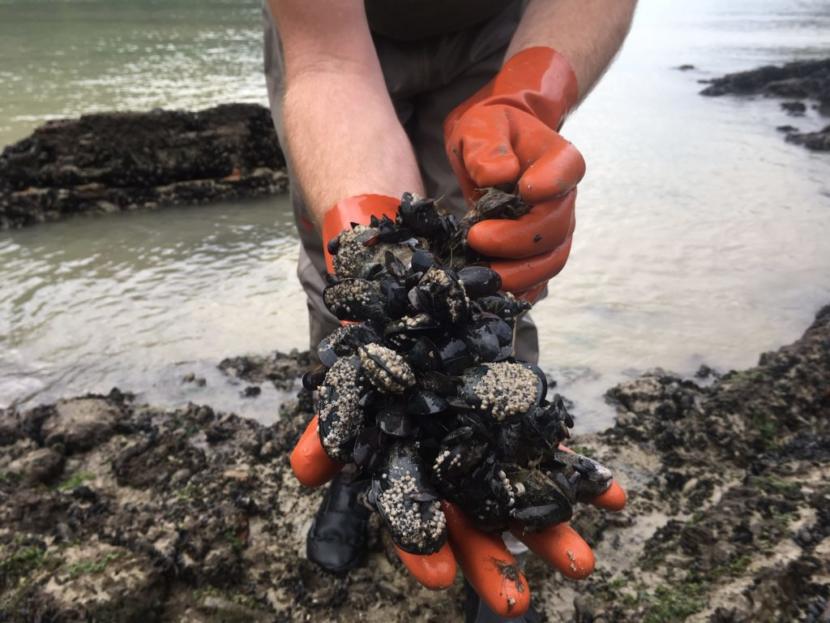
Blue mussels at Nahku Bay. (Photo by Claire Stremple/KHNS)
Kodiak Island had the most cases of paralytic shellfish poisoning in Alaska over the last nearly 30 years, according to a wide-ranging April report by state health authorities.
The state’s latest data dump provides a look at paralytic shellfish poisoning in Alaska between the years 1993 and 2021. Paralytic shellfish poisoning is an illness caused by a marine toxin that’s spread by harmful algal blooms. It’s serious, sometimes fatal, and most commonly found in butter clams and blue mussels, and according to the latest data from the state Department of Health and Social Services, it has started to be more common year-round and not just in warmer months.
Andie Wall, an environmental coordinator at the tribal health nonprofit Kodiak Area Native Association, said commercially harvested shellfish has to be tested for PSP toxins before it can be sold to customers.
“But there’s no state testing program for subsistence harvest,” Wall said.
Statewide, 53% of PSP cases were among Alaska Natives. Wall said the gap in subsistence testing is a big deal in coastal communities across the state — including Kodiak, where digging clams is a popular sunny day pastime and clams are an important food source.
Cases on Kodiak comprised 25% of statewide incidents of the illness. Areas in Southeast Alaska — like Juneau, Ketchikan and Prince of Wales Island — also recorded high case rates.
“Shellfish are an important subsistence resource to a lot of people around the state and to just say ‘don’t collect shellfish, don’t harvest shellfish,’ it’s not feasible,” she said.
KANA was awarded a federal grant from the Bureau of Indian Affairs back in 2018 to monitor beaches on Kodiak Island for high levels of toxins. And the public could send in locally harvested clams and mussels to the organization as part of the program.
KANA would ship the samples to the Southeast Alaska Tribal Ocean Research in Sitka for testing free of charge, and they would let people know if their shellfish was safe to eat — per guidelines from the Food and Drug Administration — based on the levels of toxins detected. But the program’s funding ran out at the end of last year, and KANA hasn’t been able to restart testing since.
Sen. Lisa Murkowski’s office announced in March that $50,000 in federal stopgap funds were included in the omnibus spending package to jumpstart the program. KANA won’t receive the funds and won’t be able to start testing again until September.
Meanwhile, the latest state data also showed a 77% decline in reported cases of PSP across Alaska over the last four years. Wall said that might not paint a full picture of what’s going on.
“The question there is: Is that from people not eating it? Is that from people losing this important resource or is that from increased testing?” Wall said. “I don’t know the answer to that. I hope one day it will be the increased testing.”
Subsistence harvesters on Kodiak Island can still send their local shellfish to SEATOR for $75. Alaska’s Department of Environmental Conservation also provides testing for a fee.
Close
Update notification options
Subscribe to notifications
Subscribe
Get notifications about news related to the topics you care about. You can unsubscribe anytime.