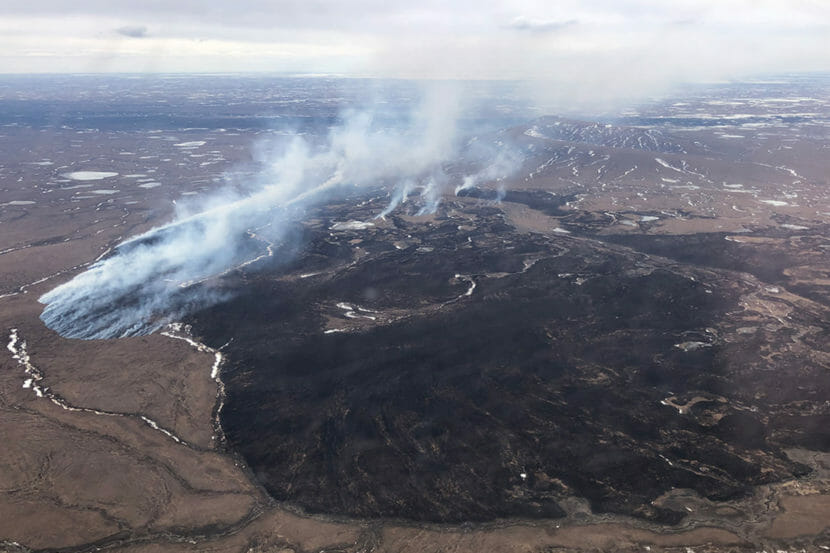
The Kwethluk Fire (40,48 acres) photographed during a flyover on Monday Afternoon, April 18, 2022. (Photo by Matt Snyder/Alaska Division of Forestry)
Alaska’s first large wildfire of the season is burning 25 miles east of Kwethluk. Officials said on Monday that the fire was not threatening villages, but it was threatening the Kwethluk fish weir and two Native allotments.
On Monday evening, April 18, the Alaska Division of Forestry said the fire had grown to 4,048 acres.
According to forestry division spokesperson Kale Casey, it’s the state’s largest wildfire so far this season. The cause is unknown, but Casey said tundra fires in April are not uncommon.
“When you have a long, big, deep winter, like we had in Alaska, areas are dried out and getting these 16 hour days and 17 hour days of sunlight, that you’re gonna have that possibility,” he said.
Casey said that as the spring snow melts, the sun dries out the dead, brown vegetation, turning it into kindling. That kindling can quickly ignite and become a tundra fire.
The Alaska Division of Forestry said it plans to investigate the cause of the fire.
Commercial pilots first spotted smoke from the tundra blaze on April 16 at noon and reported it to the state. A pilot and firefighter from the Alaska Division of Forestry’s fire prevention branch flew over the fire on April 16 and April 17.
Casey said that although the fire is threatening two Native allotments and a fish weir, it is not expected to endanger villages or lives. After hearing reports that the fire was moving westward toward Three Step Mountain, the division flew over the fire again on April 18.
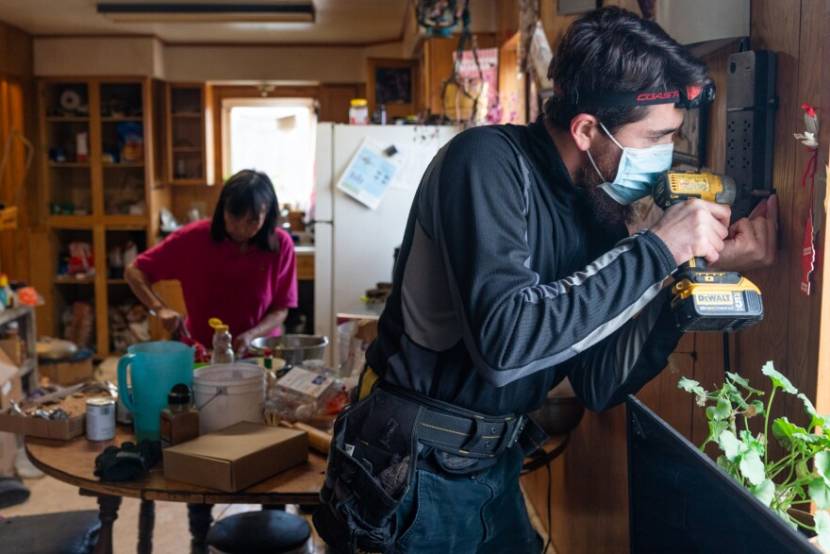
An engineer installs an antenna receiver on October 19, 2021 in a home in Akiak, Alaska. (Katie Basile/KYUK)
On Friday, a bill that would pave the way for improved and equitable high-speed internet in rural Alaska passed out of its final House committee. Next, the bill will head to the House floor for a vote. Its Senate counterpart is still in committee.
Earlier this year, the U.S. passed a federal infrastructure bill that set aside $65 billion for broadband projects in the U.S. It prioritizes unserved and underserved communities. This state bill sets up systems that would make Alaska eligible for that funding.
The representative who wrote the bill, Bryce Edgmon, said that Alaska stands to gain at least $1 billion to $2 billion in federal funding for broadband infrastructure. He said that when you account for broadband dollars headed to tribes, that actual amount will likely be much higher.
Edgmon’s bill does three main things. First, it creates a broadband office. Second, it sets up an advisory board. And third, it sets up a broadband “parity fund” to equalize costs.
The broadband office would be in charge of applying for, receiving and distributing federal dollars. But first, it will have to create a map that shows where Alaskans have limited or no access to high-speed internet.
The advisory board would include nine governor-appointed members. Two of them would have to come from unserved or underserved communities.
The bill also aims to make high-speed internet affordable for all Alaskans. It would set up a broadband parity fund that would keep costs in rural areas similar to the costs in urban areas. Edgmon said that the money for this program would come from the federal government.
This would be a change from how things are now. In rural areas of Alaska, residents with low-speed internet can pay hundreds of dollars per month on their bills. Alaskans in urban areas pay far less for high-speed internet.
The bill also requires that the office be “technologically neutral.” That means they can’t favor one type of internet technology over another, like satellites over fiber-optic cables. As long as the technology is high-speed, it’s good to go.
Two callers from the Yukon-Kuskokwim Delta called in to provide public testimony on the bill: Chief Mike Williams Sr. of Akiak, from the Kuskokwim Tribal Broadband Consortium, and Mark Springer, a consultant for the same organization. Both advocated for the bill.
“We want to allow everyone to have equal access to the funds, especially our tribes,” Williams Sr. said.
Akiak is the first community with high-speed internet in the Yukon-Kuskokwim Delta, having set up satellite internet over the summer.
The House vote for the broadband bill is not yet scheduled.
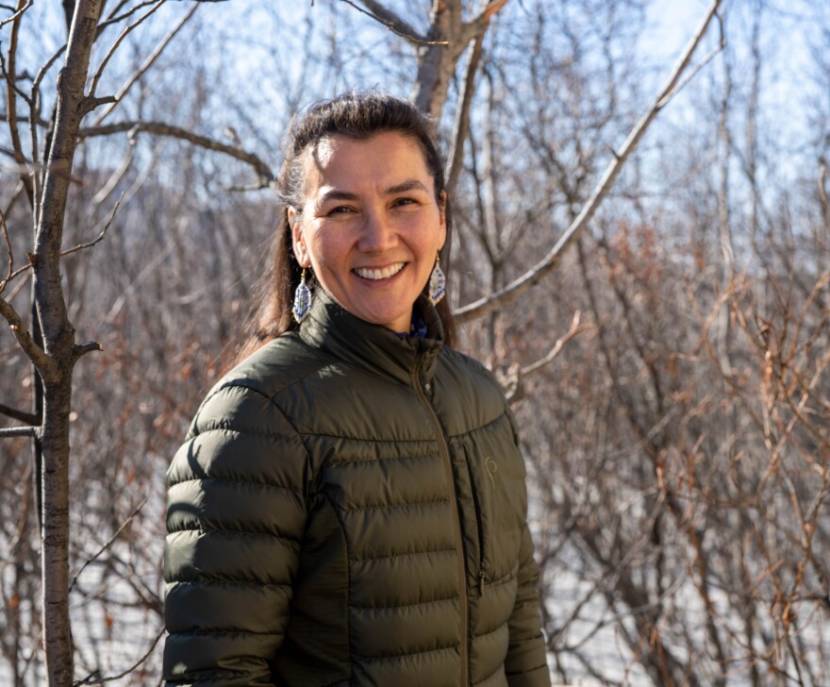
Mary Peltola is one of 48 candidates whose names will appear on the June 11, 2022 primary ballot for a special election to fill Alaska’s only U.S. House seat. Pictured April 1, 2022 in Bethel, Alaska. (Photo by Elyssa Loughlin/KYUK)
Former Rep. Don Young’s death on March 18 triggered the need for a special election to fill the rest of his term.
Peltola, age 48, is running as a Democrat, one of only six in the sprawling field. She identifies as a moderate and has supported Republicans in past elections, including Sen. Lisa Murkowski and the late Rep. Don Young, whose seat she is campaigning to fill.
Peltola says she knew Young from her earliest years. Her parents were friends with him and helped him campaign. She ate Thanksgiving dinner with him in high school. As an adult, she would raise her political concerns with him.
The last time Peltola saw Young was in November 2021 when she was testifying in D.C. on the Magnuson-Stevens Act fishery legislation. She says did not completely agree, but they had a laugh.
“When I went to his office to give him dry fish and visit with him and talk about the legislation, I told him I have often thought about running for his seat,” Peltola said. “We laughed, because I said I would tell everyone, ‘I’m just doing this for name recognition, but vote for Don.’”
That’s a reference to the first time Young ran for the U.S. House with the idea of gaining name recognition for a future run for governor, which never came. He ended up in Congress for the rest of his life.
Peltola has served in public office before. At age 24, she was elected to represent the Bethel region in the state House of Representatives. She served in that seat for a decade, from 1999 until 2009. She and Lisa Murkowski entered the state legislature the same year, and Peltola said that she’s respected Murkowski ever since.
“She really is a national leader, and she is a moderate person who is a free-thinker, and I have tremendous respect for that,” Peltola said.
Peltola praised the times Murkowski has brokered bipartisan support on contentious issues that otherwise would have left the U.S. Senate gridlocked. and she says she would seek to work across the political aisle, too. Peltola says her history in the state Legislature shows she can do that — she chaired the bi-partisan Bush Caucus of rural representatives for eight years.
“I’m very proud of the work that the Bush Caucus did. We coalesced, there were 10 of us out of 40, and we were able to get critical issues addressed for all regions of rural Alaska. And we had incredible cohesion, despite being a bipartisan group,” Peltola said.
After leaving office, Peltola worked for Donlin Creek Mine as manager of community development and sustainability from 2008 to 2014. She served one term on Bethel City Council from 2011 to 2013. Then she worked as a state lobbyist from 2015 to 2017.
For the past five years, she’s led the Kuskokwim River Inter Tribal Fish Commission as its executive director. The group advocates for Kuskokwim River Tribal interests on fishery management and salmon conservation. She says she would seek to advance that work in the U.S. House.
For her campaign, Peltola said that she is still crafting her platform, but she knows that she wants to elevate issues related to Alaska subsistence fishing and food security. She said that she would work to reauthorize and amend the Magnuson-Stevens Act, which governs fishery management in federal waters. The act was last reauthorized in 2007, before the widespread decline in salmon runs across Alaska.
“Clearly, there needs to be changes in terms of exporting the vast majority of seafood from our state when our own Alaska citizens are having severe food insecurity issues,” Peltola said.
Subsistence salmon fishing in the Yukon-Kuskowkim Delta, where Peltola lives, has become increasingly restricted as chinook and chum salmon runs have dropped, cutting off a primary food source for residents.
Peltola wants to amend the Magnuson-Stevens Act to protect subsistence and personal use fishing. She also wants to impose stricter limits on bycatch in trawl fisheries.
The Kuskokwim River Inter-Tribal Fish Commission, which Peltola serves as Executive Director, formed a coalition with 118 tribes across Western Alaska that petitioned the U.S. Department of Commerce to eliminate Chinook salmon bycatch in the Bering Sea and to cap Chum salmon bycatch. The department denied the petition.
Peltola also wants to amend the Magnuson-Stevens Act to make federal fishery managers more responsive to ecosystem changes.
“If you are a person that believes that we are witnessing an ecosystem collapse both in the Bering Sea and our river system, we do feel there is a need for adaptive management and pivoting when we need to pivot,” Peltola said.
Peltola is Yup’ik and one of four Alaska Natives running for the U.S. House seat. The others are Laurel Foster, Cup’ik; Emil Notti, Koyukon Athabascan; and Tara Sweeney, Inupiat. In her interview with KYUK, Peltola did not emphasize her heritage. But she did emphasize multiple times that she is Alaskan — she was born, raised and has lived her adult life in the state.
“I really feel that as an Alaskan, that we need to have representation at all levels, and that’s not to say that you have to be born here to represent anyone. It’s just there are a lot of us who are very sensitive about being a colony and that perpetuating,” Peltola said.
She said that as an Alaskan she’s highly aware of Alaskans’ relationship with the land.
“I feel that for many Alaskans, so many of the places where we hunt and gather are sacred places to us. They are like another entity in our life. They are like another person,” Peltola said.
She said that her strongest tie in this world is to an area of the Kuskokwim River where her grandparents lived. Pelota grew up in the Kuskokwim area communities of Kwethluk, Tuntutuliak, Platinum, and Bethel, where she fished commercially and for subsistence.
Her ties are to the Kuskokwim, but as a statewide candidate, she said that she would work to understand issues across Alaska and to find solutions.
“Each region is so unique, and so many of the issues aren’t necessarily transferable. I’m going to be very interested to learn what the issues are in the other five regions of our state and talk with as many people as I can,” Peltola said.
The special primary election date is June 11. It will be Alaska’s first state-wide by-mail election. Alaskans have until May 12 to register or update their mailing address to receive a ballot. The top four candidates who receive the most votes will appear on the August 16 ballot for the special general election.
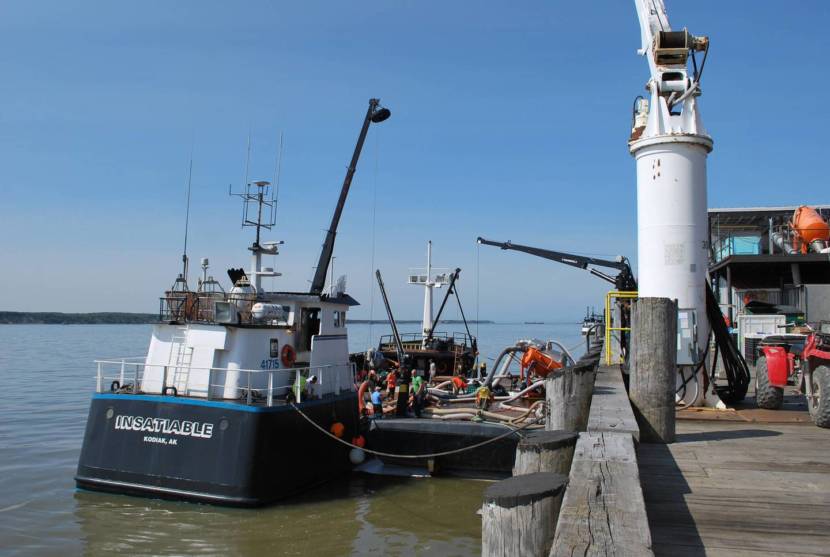
The tender Insatiable unloads salmon at Naknek. (Alaska Journal of Commerce file photo)
Alaska biologists are forecasting another massive run of sockeye salmon in Bristol Bay this summer, raising questions in commercial fishing circles about whether the industry in the Southwest Alaska region will be able to keep up.
The Bristol Bay Regional Seafood Development Association, representing the area’s commercial driftnet fleet, is urging processors to boost their capacity to maximize the fishery’s value and prevent harm to future runs if too many salmon return.
“We’re in unprecedented territory as far as what is forecast, so we never had a test like this to see how it would go,” said Andy Wink, executive director of the association.
The Alaska Department of Fish and Game predicts that a record 75 million fish will return to Bristol Bay rivers this summer, with 60 million available for harvest, according to the agency’s commercial fisheries division.
But the agency reported early this year that 15 main commercial processors said they expect to buy 52 million Bristol Bay salmon, according to a survey. That amount of purchased fish would also be a record.
The large gap in expected returns and planned processing means fishermen might have to forgo large numbers of fish and could easily lose out on $100 million, Wink said.
The group in February highlighted the problem in an article on its website and encouraged processors to bring in more floating processing capacity to supplement shore-based processing facilities.
“Processors, fishermen, and fishery managers are gearing up to make the most of 2022, and those efforts are highly commendable but with such a large forecast it begs the question of what happens if processors and tenders cannot keep up,” the group said in the update.
Processing companies are not divulging their plans. A representative with OBI Seafoods, with three processing plants in the Bristol Bay region, declined to provide comment.
Norm Van Vactor, a general manager with Silver Bay Seafoods, which operates a processing plant in Naknek on Bristol Bay, said the prospect of another epic salmon harvest is a “pleasant dilemma” for a processor.
Salmon returns to Bristol Bay have been exceptionally strong in recent years even as other areas of Alaska have experienced declining runs, he said. A record 66 million salmon returned to Bristol Bay last year, and about 40 million were harvested, the state said.
Silver Bay and other processors are keeping their plans close to their vests, Van Vactor said. But he thinks they are all looking at options to increase processing this summer.
“I have to believe without question that everyone is doing everything they can to maximize the efficiency and capability of plants in the region and looking at how to get extra fish out of region, like putting it on planes for fresh markets or using faster vessels to process it somewhere else,” Van Vactor said.
Among the concerns this summer is whether there will be enough of the tenders, or delivery vessels, to get a surge of fish quickly from fishing boats to processing plants, Wink said.
Another issue is the industry’s ongoing challenge of finding enough workers for a brief processing period in a remote area. That’s been complicated by increased competition for workers during the COVID-19 pandemic, he said.
“With the labor situation and how tight the labor market is, it will be challenge to keep processing capacity where it’s been,” Wink said.
Van Vactor said there are many uncertainties that will determine whether fishermen and processors can harvest all the available salmon. That includes the weather, and whether the salmon return in an overwhelming surge or in steadier numbers that allow different different fishing districts in the region to keep up.
“At the the end of the day, Mother Nature will dictate how this unfolds,” he said.
The H-2B visa program, often used by fishing processors and tourism businesses in Alaska to bring in foreign workers, will help processors overcome difficulties finding workers, he said.
The U.S. departments of Labor and Homeland Security announced late last month that they will make an additional 35,000 nonagricultural worker visas available in the U.S. for the summer.
“With the tourism and fishing season right around the corner, and the economic fallout we have seen from COVID, it is vital to ensure Alaskans have the needed workers to supplement our local workforce,” Alaska Sen. Lisa Murkowski said in a March 31 statement.
Chris Barrows, president of the Pacific Seafood Processors Association, said in thesame statement that the federal agencies need to take steps to ensure that the foreign workers can arrive in time for the summer season.
They’ll be a “lifeline” to some seafood processing companies that might otherwise be short-staffed this summer, he said.
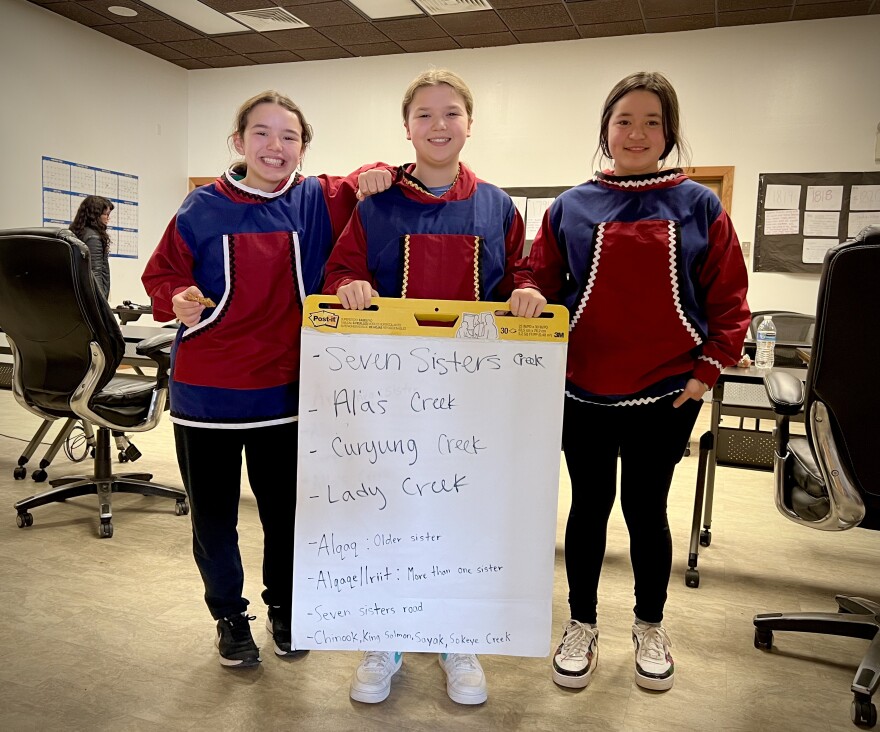
Alora Wassily, Harmony Larson, and Trista Wassily with names community members suggested for the creek in Dillingham. They began advocating to change the creek’s name, which currently includes a slur against Native women, last year. (Photo by Avery Lill/KDLG)
Everyone who spoke at the Curyung Tribe’s talking circle on Saturday supported changing the name of a stream that runs through Dillingham.
The current name includes a slur against Indigenous women. The proposed replacement that gained broad approval was “Al’a Creek.” Al’a means older sister in Yup’ik.
“The creek, in a way she is our al’a,” Katirina Mowrer said. “The land ultimately takes care of us.”
Those gathered in person and via Zoom discussed variations on the form and spelling of “al’a,” but they agreed the new name should honor Native women.
“I think this is the beginning of some healing and boldness that we, as a tribe and members, can begin to see,” said Carol Luckhurst, a member chief of the Curyung Tribal Council.
Tribal administrator Courtenay Carty said in the meeting that the Choggiung Limited board of directors and the Bristol Bay Native Corporation also support changing the creek’s name to one the Curyung Tribal Council recommends.
Dillingham elementary students, Alora Wassily, Trista Wassily and Harmony Larson, began advocating to change the creek’s name last year. Separately, Secretary of the Interior Deb Haaland established a federal process last fall to review and replace derogatory names for geographic features, including streams.
In February, the Department of the Interior proposed replacement names for 660 places across the country. For the creek in Dillingham, DOI suggests naming it after nearby features–Grassy Island, Snag Point, Sheep Island, Picnic Point or Bradford Point. Those names didn’t gain any traction at Saturday’s talking circle.
The Curyung Tribal Council will finalize the name it supports for the creek next week, taking into account input from the talking circle. Then it will consult with the U.S. Board on Geographic Names about renaming the creek on April 19.
“That’s something our tribe takes very seriously is our government-to-government relationship with the feds,” Carty said. “Our tribe also takes very seriously our relationship here with our own people. And so we wanted to make sure we have this opportunity to hear from our people, to make sure that the message we’re sending up is really our community’s message.”
DOI is accepting public comment on the replacement names for the creek through April 25 online and by mail.
Changing the name of the creek would not change the name of other features around Dillingham that share the name, notably the private road.
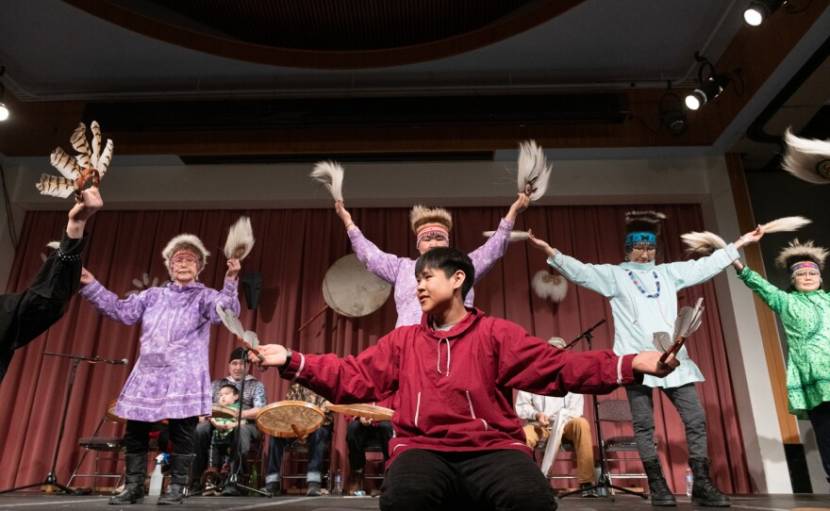
Chefornak dancers at Cama-i Dance 2022 on March 27. (Photo by Katie Basile)
As the Chefornak dancers took the stage on the first day of the Cama-i Dance Festival, the group leader reached for a microphone. Drummer Sam Flynn asked for a moment of silence to honor community members who had recently died.
“Quyana,” Flynn thanked the crowd after about 15 seconds.
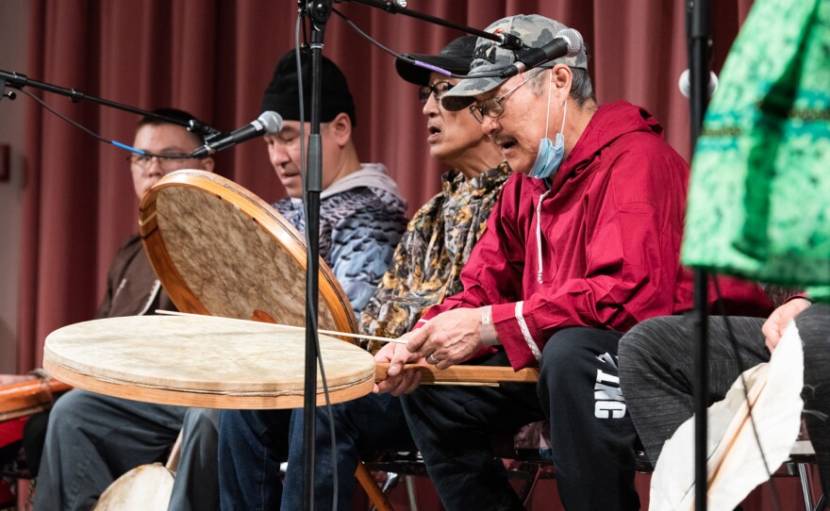
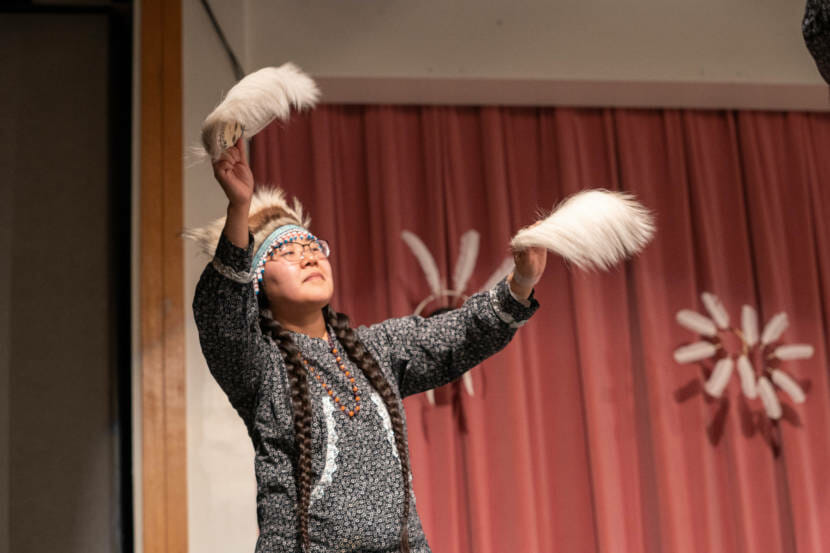
The group then arranged themselves in three rows on the Bethel stage and began to dance. Drummers seated at the back held wide, flat drums called cauyat. Dancers held fans called yurarcuutet. The first song described subsistence animals — walruses, rabbits and geese.
The group is dancing this year without one of its main elders, who died recently of COVID-19.
The Chefornak group performed at the last Cama-i in 2019. The year before that, they’d had to pull out at the last minute when Chefornak Tribal Council President and drummer Walter Lewis died suddenly in a snowmachine accident.
Chefornak drummers at Cama-i Dance 2022 on March 27. (Photo by Katie Basile)
With the losses brought on by the last few years, Flynn said, being back at Cama-i feels like a reunion.
“It’s relieving,” Flynn said. “Because those people that pass [are] out there in their spirit … joining us.”
Just gathering to yuraq together is a relief, too. Chefornak dancer Lorraine Tom said yuraqing, or Yup’ik dancing, is something her whole village does together, especially in the winter.
“When the days are shorter, that’s when we enjoy dancing more. Wintertime was pretty hard for a lot of us,” Tom said.
The group was able to practice a little outdoors over the summer, but gathering during a pandemic has proved difficult because most of the indoor gathering spaces they would usually dance in were closed to the public.
The Chefornak dancers began yuraqing regularly again just a few months ago to get ready for Cama-i. Tom said it felt restorative.
“Some people like to say that it’s like Yup’ik medicine … like, mentally and physically. I feel like it’s very healthy,” she said.
Lorraine Tom performs with her fellow Chefornak dancers on stage at Cama-i Dance Festival 2022. (Photo by Elyssa Loughlin)
In their final dance, the Chefornak group invited the crowd to join in on a well-known song depicting a seal hunt. Children and adults climbed on stage alongside them and performed in sync. Audience members mirrored the dancers’ hand movements and elders nodded and tapped their feet as drums grew more intense.
Tom was happy to share the stage.
“I really like it because a lot of us get to scoot up front to make room for the others. The way we share some joy with the people that we don’t normally yuraq with feels pretty good,” she said. “Even feels good that they even know the songs that we yuraq.”
The Chefornak dancers expect to be back again next year.
Julia Jimmie contributed Yugtun translation to this story.
Close
Update notification options
Subscribe to notifications
Subscribe
Get notifications about news related to the topics you care about. You can unsubscribe anytime.