Southwest

Underdog Toksook Bay wins state 1A basketball tournament

A high school basketball player stands on a stepladder to cut down a net
Toksook Bay Islanders center Colton Angaiak, a senior, scored 11 points and pulled down 16 rebounds in the 1A state basketball championship game to help his team win the tournament. (Photo by Shane Iverson/KYUK)

The Toksook Bay Islanders, huge underdogs going into their final games of the state tournament, are this year’s 1A state basketball champions.

By the time the Islanders upset the second-seeded Lumen Christi boys team in the March 18 semifinal match, sixth-seeded Toksook Bay had already exceeded expectations.

Then, in the March 19 championship game, the Islanders took down the top-seeded Tanana Wolves. The Islanders used their speed and ball handling to match up against Wolves’ size.

The final score was 51-47.

Tanana jumped out to an early 8-0 lead in the first quarter. But by halftime, Toksook Bay cut that lead down to two.

After several lead changes in the third quarter, Toksook Bay led by as many as 15 before weathering a Tanana comeback at the very end.

Tooksook Bay held on despite seeing their lead shrink to three in the final minute.

Toksook Bay point guard Abraham Julius, a senior, finished the game with 21 points, three steals, and six deflections. For his all around effort, he was awarded player of the game.

Julius said that it took the Islanders’ best game of the season to beat the formidable Wolves.

“They’re a complete squad. But I don’t know, their shots weren’t going in like the previous games. And our shots were,” Julius said.

Center Colton Angaiak, another senior, added another 11 points and pulled down 16 rebounds. That was especially impressive because Angaiak was the only big man on the Islanders, battling three bigs on the opposing Wolves.

“It was more challenging,” Angaiak said. “A lot of big guys around me. Taller than me.”

Toksook Bay coach Simeon Lincoln said his team tried to take advantage of the fact that Tanana only had seven players.

“We saw how good they were, and we wanted them to get into foul trouble cause they had a limited number of players,” Lincoln said.

After a storybook ending to their tournament, Lincoln said that he told his team to enjoy the moment.

“Let’s go home and celebrate. Let’s bring home the trophy. Let’s go have fun. Let’s be happy,” Lincoln said.

Another Lower Kuskokwim School District team, the Scammon Bay Eagles, finished fifth in the state tournament. They fell to Lumen Christi 74-59 in their last game of the season. Players and coaches said that they were hungry to come back stronger next year.

Alaska Senate bill seeks to address low graduation rates by allowing tribes to set curriculum

Graduating seniors line up to receive their high school diplomas at the Bethel Regional High School graduation ceremony on May 16, 2020 in Bethel, Alaska. A bill in the Alaska Senate would create a pilot program for Alaska Native tribes to begin running their own public schools through a compact agreement with the State of Alaska. Supporters say the bill could address low graduation rates and improve education for Alaska Native communities. (Photo by Katie Basile/KYUK)

A proposed bill seeks to address high school dropout rates by putting the education plans in the hands of tribes. 

Senate Bill 34 would create a pilot program for Alaska Native tribes to begin running their own public schools through a compact agreement with the State of Alaska. These agreements allow tribes to create K-12 curriculums.

Supporters of the bill say tribal education compacts could lead to a drastic improvement in education for Alaska Native communities. 

Alaska ranks among the bottom states for graduation rates. Within the state, Alaska Native students drop out of secondary school at higher rates than their peers. According to data from the past three decades, Yukon-Kuskokwim Delta schools consistently have the highest dropout rates in the state. 

The Alaska Federation of Natives collaborated with the state on the bill. AFN wants the state to allow five schools to be included in an initial demonstration project. After five years of funding, the state would reassess what’s working and what’s not. But right now, AFN president Julie Kitka says it’s clear that the Western-centric model isn’t working.

“The state and the commissioners are saying that the state is failing Native students right now,” Kitka said.

Hooper Bay Elder William Naneng also supports the bill.

“Our people and our parents want to learn, they want to see the students excel. They want to see our people are going to school, they're being very curious,” Naneng said.

Naneng serves on the board of a new charter school in Hooper Bay. The school’s curriculum is centered around Yup’ik values, called yuuyaraq. He hopes that the state will choose his school in the first round of demonstration projects.

Naneng said that years of imposed, colonial Western education in Hooper Bay has led to poor outcomes for students. He says he only attended school because his parents were afraid he’d get taken away. 

Naneng wasn’t allowed to speak Yup’ik in class. He says such practices have led to low graduation rates in the Lower Yukon School District. He worries this makes it look like Yup’ik people don’t care about education, but he said that couldn’t be further from the truth. 

Naneng said that Yup’ik people survive through education, but theirs is different from Western education.

“We're taught as, like, life-and-death situation. Things that we needed to know in order to survive and do very well in the environment that we live in,” Naneng said.

In order for students to succeed, Naneng said that they need to be taught in ways that are relevant to their lives. That’s why he says education should be placed in the hands of the tribe.

Kitka said that she hopes a culturally relevant education can lead to better outcomes for Native students.

“Greater attendance, greater life skills, greater community support, parent involvement, greater teacher recruitment and retention, all components that make a healthy school,” Kitka said.

Joel Isaak, the Alaska Department of Education & Early Development’s tribal liaison, has been advising the state on what the bill should look like for Alaska Native communities.

Isaak said that the bill was carefully crafted to allow schools to do just what Naneng is asking for — create curriculums and schedules that work for each individual tribe. 

“Alaska is not a monolith. And there's no one clear education model for all Alaska Native peoples, that's not the case,” Isaak said.

If this bill becomes law, tribes will be able to restructure their school years around subsistence activities and create their own curriculums.

In Hooper Bay, the charter school’s principal, Jamie Wollman, said that this bill could allow her more consistent funding to hire local elders to help the teachers plan their lessons. 

Right now, elders are helping plan an entire curriculum around eggs. Bird eggs in the spring and fish eggs in the summer help infuse local traditions into traditional Western teaching.

Wollman said the funds ensured by the bill will allow her to channel some of the school’s resources away from grant writing and back into the students. Plus, she said that the school will be able to contribute to the local economy.

The schools would still need to match education standards and classroom hours set by the state and have state-certified teachers, but other than that, the tribes could implement whatever they want.

Isaak said that this bill is modeled, in part, on the success of a similar program in the state of Washington. Washington has three tribal-compacted schools, and they’ve done well. 

According to a study done by Evergreen State University, the schools showed improvement in graduation and retention rates, reputation, enrollment, teacher recruitment and retention, and student connection to culture.

Kodiak Sen. Gary Stevens first introduced the bill in the Alaska Senate. Bethel Rep. Tiffany Zulkosky sponsored the House version. Zulkosky also chairs the House Tribal Affairs Committee and serves on the House Education Committee.

Zulkosky said that tribes have great infrastructure and ideas in place to help support compacting projects. She pointed out that there’s already a good model in place for education compacting: tribal health care.

“I think tribes are a quiet, but mighty, incredible resource to providing culturally relevant services across Alaska. I absolutely am excited about this bill,” Zulkosky said.

The bill must pass through the Senate Judiciary and Finance committees before it can be voted on the floor. If the bill is passed by both the Senate and House and signed by the governor, it will be sent to the next Legislature. If the next Legislature passes the bill, tribal-compacted schools could open their doors as soon as fall 2025.

A new study gives many Alaska communities their first look at how fast erosion is approaching

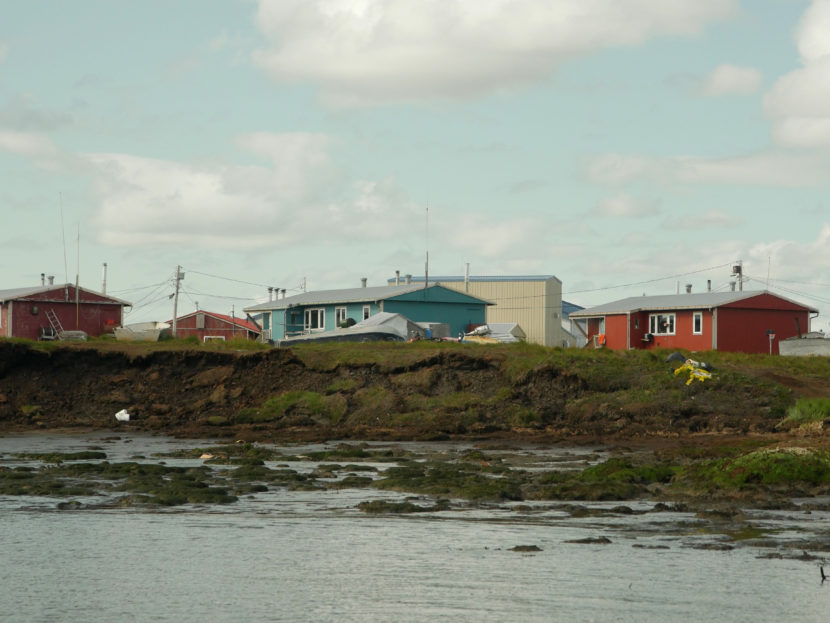
The village of Newtok in western Alaska, in August 2016. (Photo by Eric Keto/Alaska’s Energy Desk)

Erosion is threatening coastal communities around the state, but until now it hasn’t been clear to what extent. A study published in November 2021 by the state’s coastal hazards program forecasts how much land erosion could wipe away in 48 of Alaska’s coastal communities.

It’s the most comprehensive erosion assessment ever done in the state, and the results are both surprising communities and helping them receive funding to adapt.

On the lower Yukon River, Leo Mahaney leads the village of Nunam Iqua’s environmental department. Before Mahaney saw the state’s erosion forecast for Nunam Iqua, he said that he wasn’t that worried about erosion.

“I don’t think the community really looks at erosion being a big problem right now,” Mahaney said. “Because it’s barely noticeable.”

Mahaney said that the erosion was easy to ignore because Nunam Iqua does not have high, cut banks. In other communities that do, it’s noticeable when a chunk of the riverbank falls off into the water. In Nunam Iqua, it can seem like erosion is taking land more gradually.

But according to the state’s assessment, erosion is happening quickly in Nunam Iqua. The study predicts that in the next 40 years, 11 structures in the village will be threatened.

Looking at the state’s study, Mahaney was surprised to see how much land is projected to disappear.

“I had no idea that by 2039 to 2059 it would go that far,” Mahaney said. “Moving houses and all that water line infrastructure. I know it’s not going to be cheap.”

The study roughly estimates that replacing the threatened infrastructure in Nunam Iqua will cost over $4 million over the next 40 years.

Many communities in the Yukon-Kuskokwim Delta face much higher costs to adapt to the changing environment. Although Yukon-Kuskokwim Delta villages only make up a third of the communities included in this study, they made up 80% of the costs caused by erosion.

Mahaney said that he would share this study with community leaders, who he expects will start taking more action on erosion.

“I think it will start kicking off a long term plan,” Mahaney said.

For many communities, this is their first ever erosion forecast based on scientific data. Other reports that  looked at erosion in the past, like the Denali Commission’s 2019 statewide threat assessment, often relied on a community’s anecdotal record of erosion rates.

But anecdotal evidence of erosion can sometimes be insufficient proof when applying for grants.

“There have been plenty of issues with Alaska Native communities accessing agency resources to work on erosion issues because there was no scientific documentation,” said Jacquelyn Overbeck, manager of the state’s coastal hazards program, which conducted this study.

Several grants that help communities facing environmental threats, like the U.S. Department of Housing and Urban Development Imminent Threat Program and the Federal Emergency Management Agency’s Hazard Mitigation Assistance Program, require a third party to verify the threat exists. That’s what this new study helps to do.

The Denali Commission recognized this need for Alaskan communities to have a science-based erosion assessment and funded the state coastal hazards program’s study.

Jessica Lewis-Nicori is a tribal council member and a high school science teacher in Chefornak, another village in the Yukon-Kuskokwim Delta. She said that Chefornak used the state’s erosion assessment in a recent grant application to move five homes in the village that are in the most immediate danger due to erosion.

“It’s kind of like, ‘Oh look, the science does support our claim that these houses are falling and the river’s eroding,’” Lewis-Nicori said.

Chefornak received the funding and plans to move those homes by 2023.

One reason why this kind of comprehensive erosion assessment is only coming out now is that new technology just recently made it possible.

The erosion forecasts are created by measuring how much each community’s coastline has moved in the past to predict how much it will move in the future. That’s done by taking aerial images of each community, dating back from the 1950’s to present day. Those images are then mapped on top of each other and combined with data on where the community’s infrastructure is located.

Overbeck, one of the study’s authors, says that takes a lot of computing power.

“In the last five to 10 years has been the development of that technology to do it on a really large scale, which is what we needed for Alaska,” Overbeck said.

There is one key limitation of the state’s erosion assessment. It did not take climate change into account.

Scientists believe that climate change is accelerating erosion in many of Alaska’s coastal communities as sea ice protects shorelines for fewer months of the year. Studies predict that storms will also increase in frequency in Western Alaska.

However, Overbeck said that the state’s erosion study lacked the data to show how much that would affect erosion rates. There were not enough images of communities’ shorelines to calculate any change in erosion rates.

She said that means communities can likely expect more erosion than what these forecasts show.

Overbeck said that the state is involved in efforts to collect aerial images of communities more often, including high-resolution satellite images. That could help answer the question of how much climate change is accelerating erosion. Until then, this study is the best erosion estimate many communities have to help them plan for the future.

But for now, Overbeck said the state’s coastal hazards program is moving on from erosion to look at how much flooding Alaska’s coastal communities can expect to see in the future.

Alaska Board of Game to consider subsistence use protections for Nushagak Peninsula caribou herd

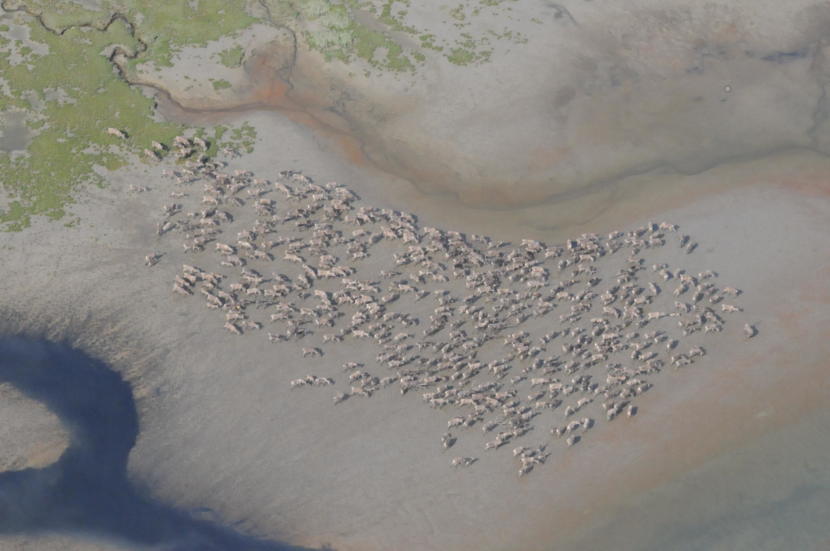
A group of 551 caribou on tidal flats of the Nushagak Peninsula seeking relief from biting insects, July 9, 2019. (Photo by Andy Aderman/USFWS)

The Nushagak Peninsula caribou herd ranges across more than 400 square miles of tundra, streams and ponds on a piece of land that juts into Bristol Bay. For thousands of years, people in the area have subsisted on caribou in the region.

Now, the Alaska Department of Fish and Game Division of Subsistence is asking the statewide Board of Game to place additional protections on the herd.

This week, the board will consider a proposal to designate the Nushagak Peninsula caribou herd as a resource culturally and traditionally used for subsistence. If it does, the herd will be protected by law, which ensures that subsistence is prioritized above commercial and sport uses.

In order to make that decision, the board will consider eight criteria, said Bronwyn Jones, the southwest subsistence resource specialist for the state’s Division of Subsistence.

Reliance on the herd

As part of the proposal, Jones and her team provided information about how the Nushagak herd meets those criteria, which include sharing of intergenerational knowledge, efficient harvesting and cost, and how the population fits into subsistence in the area.

The team also had to determine a pattern of use and reliance on the population over a long period of time.

“How people in the Nushagak Peninsula have used this caribou population since it was established, and also prior to its establishment, before it was kind of wiped out in the early 1900s,” Jones said.

The Division of Subsistence cited documentation of people using caribou in that area for more than 2,000 years. Historically, a large number of caribou lived along the coast of the Bering Sea, from Bristol Bay to Norton Sound.

The state says that in the western portion of the Mulchatna Caribou herd’s range, archaeological evidence points to caribou hunting since prehistoric times in the mountains southeast of the Kuskokwim River. That includes parts of land that now fall in Unit 17.

Along salmon streams northwest of Togiak Bay, remains of caribou are common in Norton tradition sites dating back 2,500 years. Local traditional knowledge and oral history suggest caribou were always significant to people residing in the area.

“We had done some traditional ecological knowledge interviews about historical caribou uses,” Jones said. “People talked about stories that they had heard of people using caribou bones for nets, just all the different uses of caribou that had been in the community that they lived in before and no longer were.”

For example, the state Division of Subsistence worksheet for the proposal points to a 2008 study in which the division interviewed elders in Togiak, who described traditional uses of caribou.

“Before there were rifles, they used the caribou rib bone for part of the ‘spear’ because caribou rib bone doesn’t break,” said one elder. “At one location, when the walrus were hauling out, they would go up to the one farthest from the water when he was asleep and drive the caribou spear into the walrus near where the collar bone is sticking out, to try to reach the heart to make it bleed.”

Fluctuating caribou populations

Caribou populations can fluctuate dramatically. In 2019, around 700 animals made up the Nushagak Peninsula herd. But after managers liberalized harvest, in part to protect lichen cover, the numbers dropped to around 250, and the hunt was severely restricted. Last summer the herd was estimated at just under 300 animals.

In the late 1800s, the region’s caribou population declined.

In 1979, a researcher with the Division of Subsistence recorded an elder in Togiak who said caribou disappeared from the area in the early 1900s. He reported hearing stories from his elders in the men’s community house about wolves driving out caribou, and talked about how elders would talk and sing about past hunts.

Jones said that when Nushagak Peninsula’s herd declined, residents of the region didn’t stop hunting caribou — they just traveled farther to do so.

“Just because caribou were no longer available doesn’t mean that the traditional use was gone,” she said. “It once existed, and people kind of adjusted their ways. But now the opportunity is back because the herd has been transplanted, and — well, available to harvest until recent years anyways.”

The Board of Game did make a customary and traditional determination for caribou in the area for subsistence in 1988 in units 9A and B, 17 and 18. That was primarily for the Mulchatna herd.

But that year, the state and the federal government teamed up with Tribes, municipalities and village corporations in the area to reintroduce caribou to the peninsula, and transplanted around 140 caribou from the Northern Alaska Peninsula Herd to the Nushagak Peninsula. That provided a new resource for people in Togiak, Twin Hills, Manokotak, Aleknagik and Dillingham.

In the mid-1990s, the Federal Subsistence Board found that those communities had customary and traditional uses for the Nushagak caribou. But the state never made a designation for that herd.

The Mulchatna herd has declined drastically in the past several years, which Jones said sparked this proposal.

“I think to document the importance of each herd separately, and un-lump the Nushagak from the Mulchatna is important,” Jones said. “When the Nushagak are back up to optimal harvest, people can just go ahead and use them again for subsistence while the Mulchatna caribou herd is unavailable while they’re trying to figure out what’s happening there and waiting for that herd to recover again.”

Board decision could set protections for subsistence uses of the herd

If the board does make a positive finding for the Nushagak caribou, nothing concrete would change — for now.

“Basically, we are documenting that there is a positive use finding it is a subsistence resource that’s depended on, and so the next step will be for the board to establish an ANS, or an amount reasonably necessary for subsistence,” Jones said.

That’s a range of harvest numbers the board will consider to determine whether subsistence needs are being met. Once that harvest range is established, people can reference it when discussing their subsistence needs and spur changes to the hunt for that herd, like moving it to a different tier or limiting registration hunts.

“That’s basically what this [customary and traditional determination] is — the first step towards just being able to protect subsistence uses of the resource,” she said.

Jones and her colleagues also submitted a proposal for the board to apply the same designation to the Unimak caribou herd in Unit 10, which comprises the Aleutian, Unimak and Pribilof islands.


Federal government to fund relocation projects for 6 Alaska communities

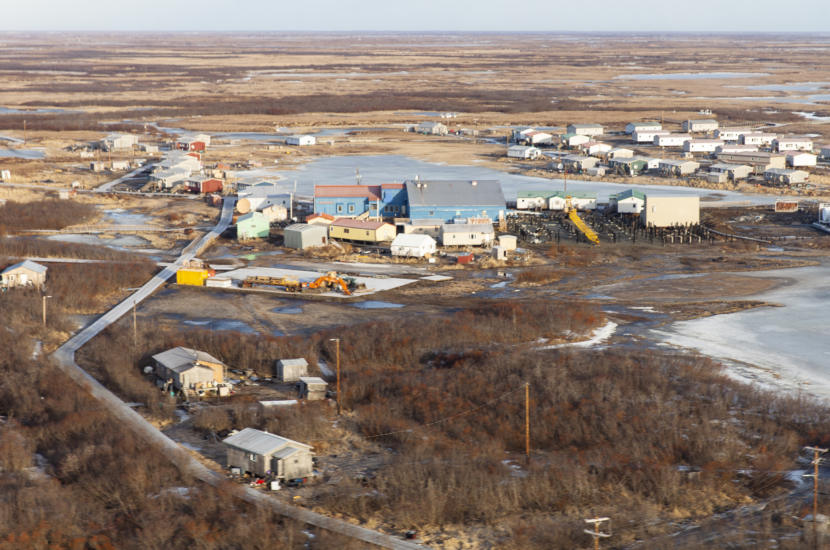
The Lewis Angapak Memorial School stands above other buildings on Wednesday, April 3, 2019, in Tuntutuliak, Alaska. (Photo by Rashah McChesney/Alaska’s Energy Desk)

The federal government will fund relocation efforts for six Alaska communities threatened by erosion and flooding. Most are in the Yukon-Kuskowkim Delta, where erosion and flooding are pervasive problems. The projects will play out over time, and other threatened communities can still apply for funding.

The U.S. Department of Agriculture announced on March 4 that it will pay for Alaska communities to relocate buildings and infrastructure. The communities with projects that have already been funded include Kotlik, Alakanuk, Kwigillingok, Golovin, Tuntutuliak, and Tununak.

What do they have in common? They’re all threatened by erosion and flooding — problems made worse by climate change.

“We are very excited,” said Brett Nelson, a conservation engineer for the USDA.

His team has worked to provide flood and erosion mitigation around rural Alaska for years. He knows the communities and their needs.

Nelson said that this type of federal funding is a big deal because it’s a first. Usually the federal government only funds his department to relocate buildings when there’s an emergency, like when a home or building is about to fall into a river.

But this funding will be preventative so that communities can begin their relocation efforts before it’s too late.

“This was a new thing for up here,” said Nelson.

Nelson said that the entire process will take about five years. It involves multiple stages of planning before they can move into actual construction and relocation. But he said that if any one building in those communities becomes urgently threatened, they can speed up the process for those structures.

The application is still open for villages. Any village with an erosion, flooding, or permafrost issue is eligible to receive funding. Nelson can be reached at 907-761-7717 or Brett.Nelson@usda.gov.

5 survive plane crash near Iliamna

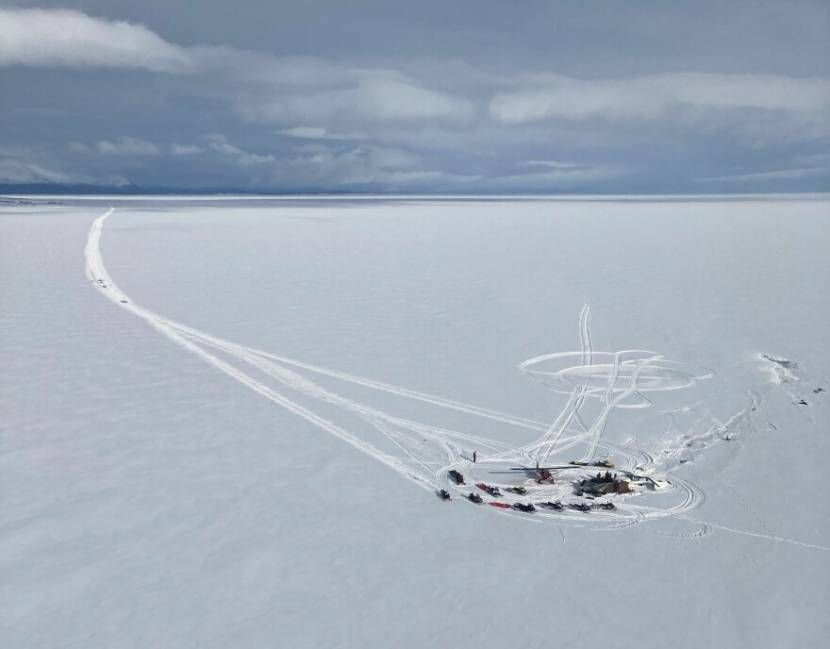
An aerial view of a crowd of people with snowmachines gathered in a remote spot on flat, snowy tundra
Responders at the site of the March 5 plane crash on Lake Iliamna. (Alaska State Troopers photo)

A plane carrying five adults crashed about eight miles southwest of Iliamna around 1 p.m. on Saturday, according to a dispatch from Alaska State Troopers. All five survived the initial impact and are receiving medical care at Anchorage-area hospitals.

One person is in serious condition, one is in fair condition and three are in stable condition, troopers said in an update Sunday afternoon.

Around 1 p.m. on Saturday, troopers received notice of a signal from an emergency locator transmitter — a device that sends out an audio alert and GPS signal when activated. The signal was coming from the offshore ice on the lake.

Alaska Wildlife Troopers launched an R44 helicopter from the King Salmon area, and local crews and private aircraft from Iliamna tried to reach the site. Responders included Lake and Peninsula Airlines, Iliamna Air Taxi, search-and-rescue volunteers and others from the Iliamna area.

Trooper spokesperson Austin McDaniel said the helicopter arrived at the scene around 3:45 p.m.

Rescue teams and troopers found a Cessna 206, which had been destroyed in the crash. According to the Federal Aviation Administration registry, the plane — which has a tail number of N1853Q — is owned by Send North, the Anchorage-based branch of evangelical missions organization Send International. Send North “supports and administers remote ministry activity” in Alaska and parts of Canada.

Bad weather conditions initially stopped rescue teams from the Alaska Air National Guard at Joint Base Elmendorf Richardson and the U.S. Coast Guard in Kodiak from reaching the area.

At about 6 p.m. — at least five hours after the plane went down — those teams arrived at the crash site and lifted all five people from the scene. They were flown to Iliamna and then medevaced to hospitals in the Anchorage area.

The National Transportation Safety Board was notified of the incident and will investigate the cause of the crash.

Site notifications
Update notification options
Subscribe to notifications