Fall chum are expected to begin entering the Yukon River soon, and the Alaska Department of Fish and Game is projecting another low run for the species after 2021’s record low return. To conserve the salmon, government fishery managers will keep fishing for fall chum closed unless an unexpected surge of the species arrive.
Fish and Game is projecting that less than 300,000 fall chum will return to the Yukon River. That’s fewer than the state’s drainage-wide escapement goal of 300,000 to 600,000 fall chum reaching the spawning grounds. On average, 1 million of these fish return to the Yukon River each year.
To help the fraction of fall chum expected to arrive have a chance to spawn, managers are keeping chum fishing closed.
“I just want to let fishermen know that we’re really sorry that we don’t have better news,” Fish and Game fisheries manager Christy Gleeson said during a weekly teleconference about Yukon salmon hosted by the Yukon River Drainage Fisheries Association. ”These fish counts are devastating for people trying to live along the Yukon River. We know that it’s been a really difficult fishing season so far with these salmon closures. But we really appreciate everyone coming together and doing continued cooperation during these times of salmon conservation.”
That conservation has led to no salmon fishing for chinook or chum along the river for the second year in a row.
2021 saw the lowest fall chum run on record. This year’s chinook and summer chum runs have continued the same trend from last year. Neither are expected to meet escapement goals set by state and federal fishery managers. The continued closures are economically and culturally straining Yukon River residents.
“We long to taste our fish that we smoked and dried. This is our food, our livelihood,” Russian Mission resident Sandra Kozevnikoff said during the Yukon River salmon teleconference.
Fishing will remain open for other species on the river, including red, pink and coho salmon, along with non-salmon fish.
Another Russian Mission resident, Basil Larson, said during the teleconference that pink salmon are passing by in “full force.” In a six-hour stretch, he and his brother caught enough pinks to feed their dogs for three to four days.
“There’s some pretty good, healthy looking ones that we’re taking and eating, along with the whitefish,” Larson said.
Upriver in Huslia, Lisa Bifelt said that local fishermen were making a 75-mile round-trip to a slough to target sheefish.
“People were having some luck down there, not much though. I think seven was the most caught,” Bifelt said.
But when she boated there with her mother, she said that they didn’t catch anything.
Meanwhile, other callers said that berry picking season had begun, a hopeful abundance of local food amid the historic declines of salmon.
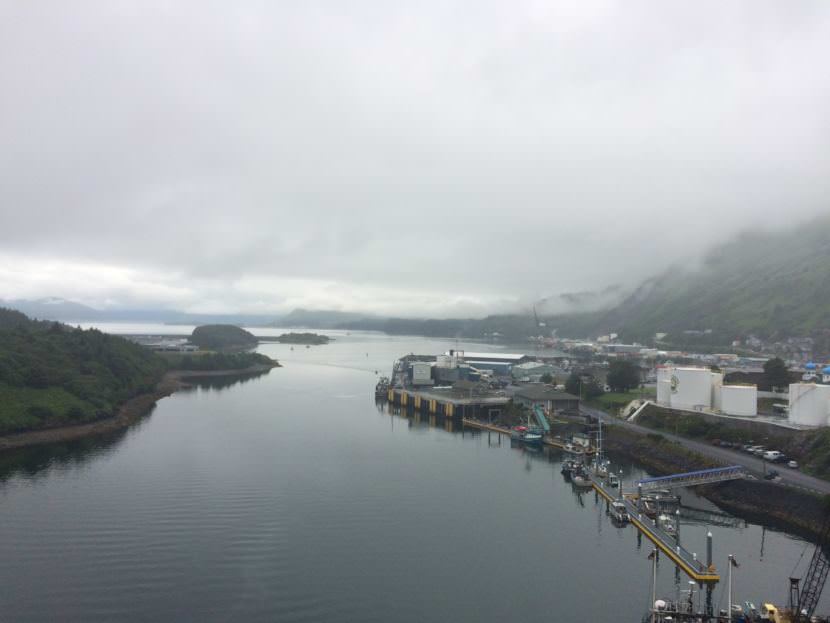
View from the Near Island Bridge. (Photo by Mitch Borden/KMXT)
This week marks the start of Kodiak’s first cruise ship season since 2019 — 565 passengers will be on board the Roald Amundsen when it docks at Pier 2 in Kodiak on Thursday.
Aimee Williams is the executive director of the visitors center Discover Kodiak.
“This is a good sign that life is returning back to normal and tourism is returning back to normal.” she said.
Kodiak’s cruise ship season tends to look a little different compared to other parts of the state, Williams says. The ships tend to be smaller than the ones that frequent Southeast Alaska — and there’s a lot less of them.
Thirty large and small cruise ships called in Kodiak back in 2019. That was a record year. This year, just 10 cruise ships will visit the island. Juneau saw 70 large and small cruise ships over the course of its shortened season in 2021, by comparison.
Fifteen cruises were originally on the schedule released by Alaska Maritime Agencies in March, but that number has gone up and down due the ongoing pandemic and invasion of Ukraine.
Williams says that while cruise ship tourism gives Kodiak businesses a boost, its downtown was spared from some of the economic hardships faced by other coastal communities when COVID stopped the cruises from coming.
“When they weren’t here for the last two years, we weren’t devastated, and we didn’t lose businesses because cruise ships weren’t in town,” Williams said. “It’s exciting, and those businesses that are going to make money I’m sure are very excited, but we don’t have to change our posture a lot for when there’s a cruise ship here or when there’s not.”
The Roald Amundsen will continue on to Dutch Harbor after it stops in Kodiak this week, and it will visit twice again in August. Six cruise ships will call in Kodiak throughout September including the Nieuw Amsterdam, which has a carrying capacity of more than 2,000 passengers.
“When those big ships come, anything that’s over like 900 people, we kind of have to change the way we do business downtown,” said Williams.
Kodiak’s cruise ship season wraps up in early October, when the nearly 700-passenger Regatta calls in Kodiak on its voyage from Los Angeles to Tokyo.
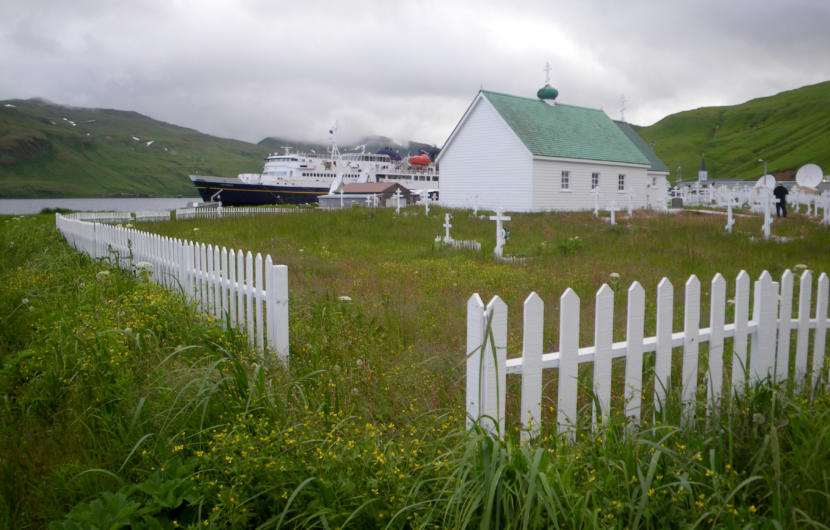
The Alaska Marine Highway System ferry Tustumena sits at the dock in Akutan on the Alaska Peninsula, July, 28, 2012. (Photo by David Waters/KTOO)
The M/V Tustumena returns to service this week. It’s the only Alaska Marine Highway System ferry that sails between all 13 ports of call out the Aleutian Chain and regularly visits Kodiak Island.
The Tustumena’s first sailing since then will be on Saturday, when it departs Homer on its way to Kodiak.
The M/V Kennicott has been the only ferry sailing to Kodiak since the nearly 60-year-old Tustumena went into the shipyard for repairs back in December.
“The Kennicott’s been pulling double duty trying to fill in for Tustumena, but obviously it doesn’t provide as many runs as the Tustumena’s normal schedule, so it will be nice to have that boat back out there and doing what it does best,” said Sam Dapcevich of the state Department of Transportation.
The Kennicott was able to serve most but not all of the Tustumena’s port calls. Several communities in the Aleutians have had to skip ferry service all-together because the Kennicott is too large to make it into their smaller ports.
A replacement is in the works for the aging Tustumena, but the more than $200 million project isn’t expected to be completed for another five years.
Dapcevich says DOT hopes to begin construction on the replacement vessel next year.
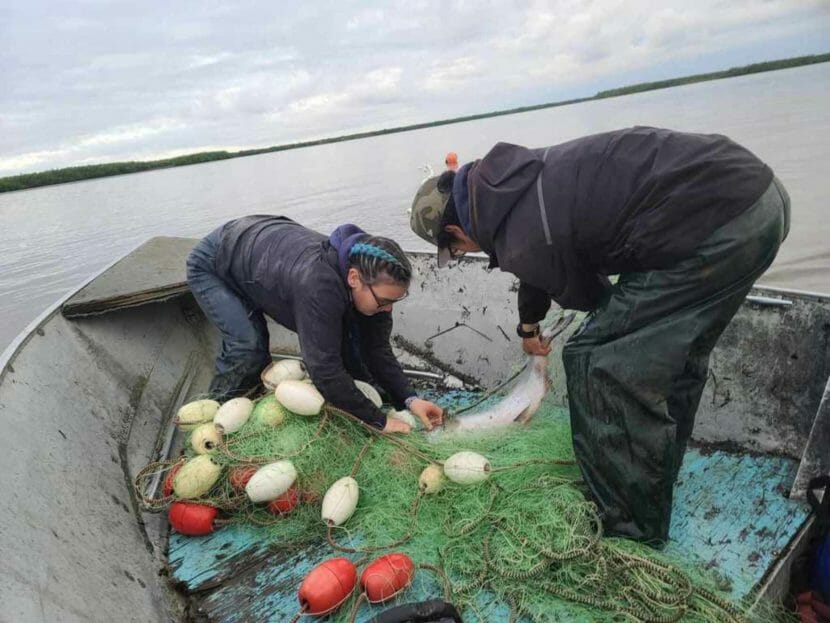
Fritz Charles’ family picks a chinook salmon from the net. (Photo courtesy of Sharon F. Charles)
There have been clashes over regulating Area M for decades, but the battle heated up after the Yukon-Kuskokwim chum crashes began. This is the first in a three-part series.
Kuskokwim fisherman Fritz Charles grew up in Tuntutuliak, on the lower river. There were so many fish then that his parents would put away literal barrels of them. His job as a child was to pack the dry fish tight in the barrels using a special method.
“Somebody would put me in the drum and start stomping on the fish so they can pack more in there. They put away two drums of salmon. One drum would mainly be king slabs, and the other one would be chums and reds. And that was our main diet for the winter back then,” Charles said.
Nowadays, there’s no more stomping on dry fish. There aren’t enough to put away a whole barrel.
“There’s hardly any fish, and we can’t fish anymore to support our subsistence lifestyle,” Charles said.
Chinook runs have been low in the Yukon-Kuskokwim Delta region for a long time. And chum runs have been faltering as well, though they stayed dependable until 2021.
In 2021, chum runs took a sharp downward turn. It was the worst year on record for them on the Yukon River, and it’s the same story on the Kuskokwim. This year, the runs on both rivers are at their second lowest.
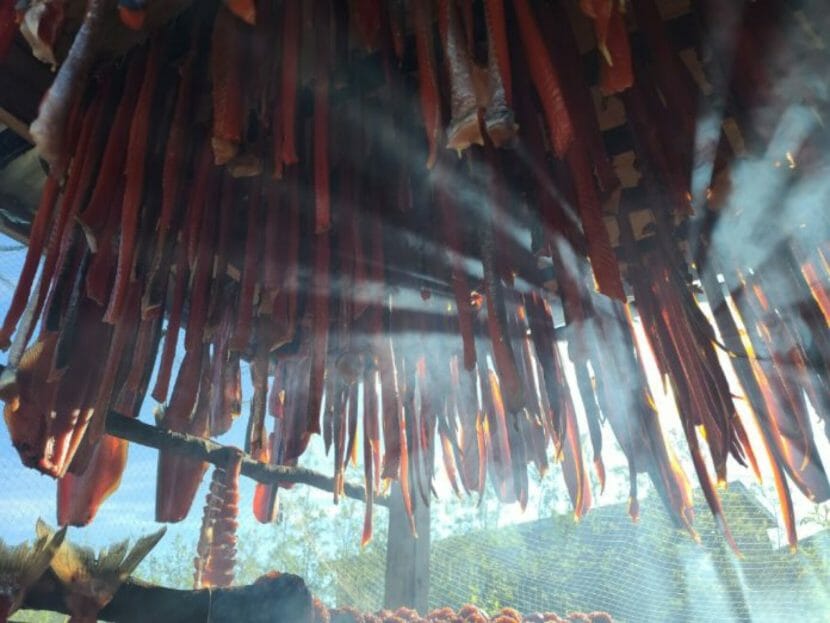
Fritz Charles’ fish rack is filled only with reds and kings. This year he didn’t even catch one chum. (Photo courtesy of Sharon F. Charles)
There are many theories behind the salmon crash. Most scientists have attributed it to issues out at sea. Many have theorized that climate change is negatively impacting the salmon’s ocean environment.
Subsistence fishermen say that salmon fishing in the ocean is hurting their chum run
Charles and many other local fishermen have another theory as to why the chum are crashing.
“They’re being slaughtered out at sea,” Charles said.
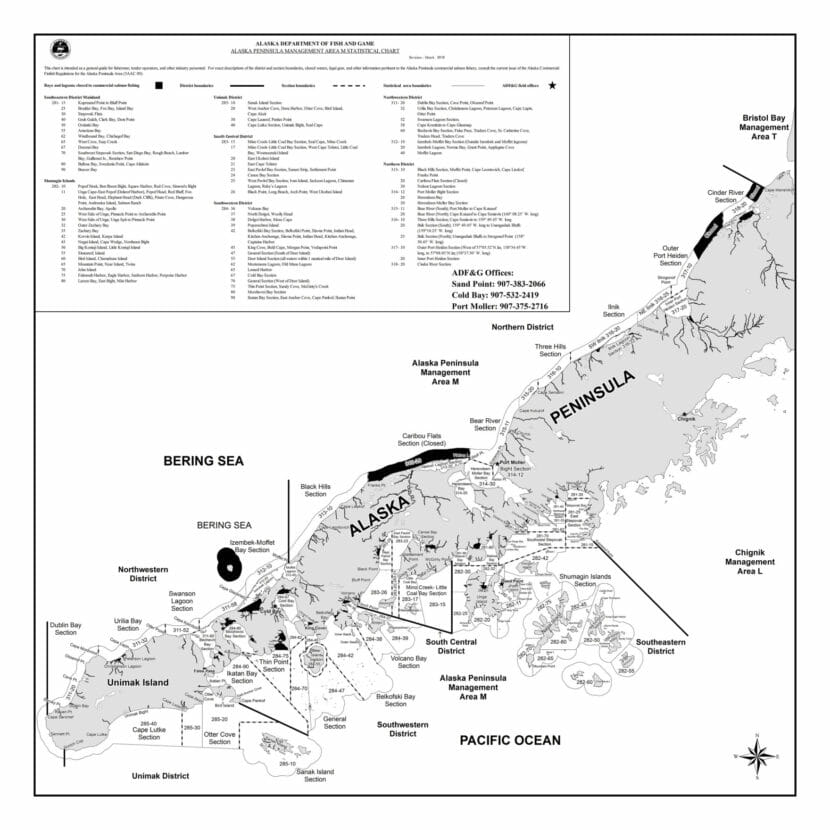
They’re concerned about one part of Alaska waters in particular, called Area M. Area M is a state-managed section of water along the western Alaska Peninsula and eastern Aleutians. It’s called an intercept fishery because most fish caught there originated elsewhere. They must pass through Area M on the way back to their spawning grounds.
In June, oceangoing vessels there scoop up fish bound for coastal western Alaska. The fishermen primarily target sockeye, but they also catch and sell chum and chinook salmon. Area M fishing is different from bycatch, where commercial fishermen targeting non-salmon species discard incidental salmon catches.
There have been clashes over regulating Area M for decades, but the battle heated up after the chum crashes started.
Map of Area M. (Alaska Department of Fish and Game)
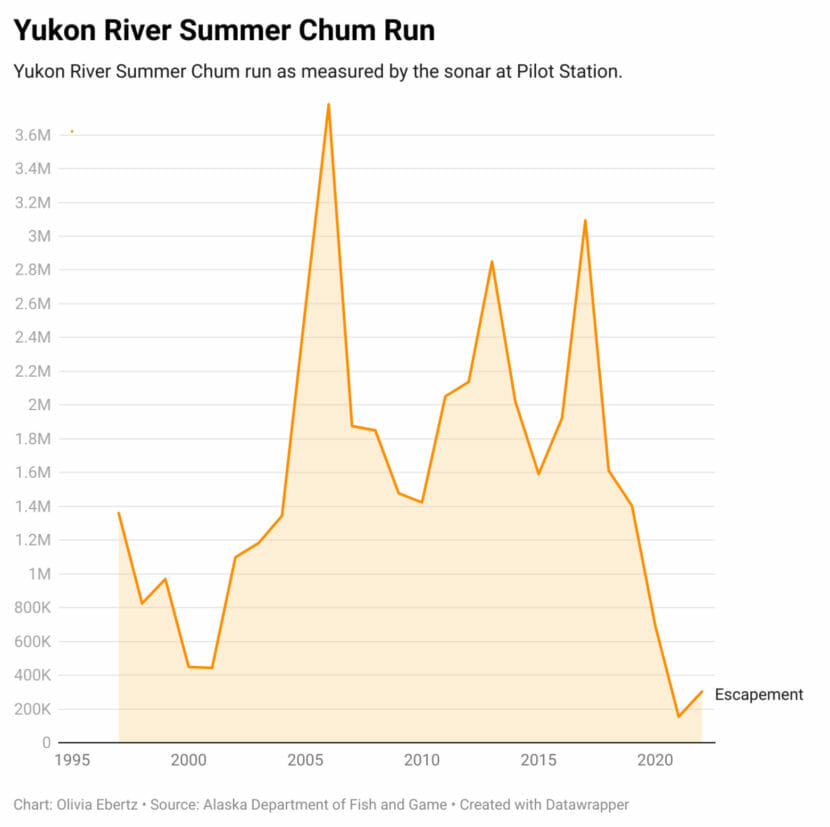
In 2021, 153,497 summer chum salmon swam up the Yukon River. That’s compared to an average of about 1.7 million summer chum. The river was missing about 1.5 million fish.
At the same time, Area M commercial fishermen caught 1,168,601 chum at sea while subsistence fishing on the rivers was closed. In the midst of the smallest chum run western Alaska subsistence users had ever seen, Area M fishermen were catching more than ever before.
Even the Alaska Commissioner of Fish and Game, Doug Vincent-Lang, who has been hesitant to over-restrict the Area M commercial fishery, acknowledged last year’s record high numbers.
“We got surprised, as it got added up at the end of the season, just how large that harvest was,” Vincent-Lang said.
Charles and other subsistence users say that Area M commercial fishermen are stealing their livelihoods, taking food that they believe belongs in their rivers and their freezers. The Bethel and Kusilvak Census Areas, where the Yukon and Kuskokwim Rivers flow, are some of the poorest regions in the United States, and people depend on fish to feed their families.
But the Area M fishermen believe they have a claim to the fish, too.
This brings us to the crux of this decades-long dispute: to whom do these fish belong?
Charles said that the fish belong to the Yup’ik people. The Yupiit have been stewards of the fish for thousands of years. Plus, he said, he only takes what his family needs to survive on the land.
“We need our fish, and we’re the end-users. They’re there just for the money,” Charles said.
He said that fishing for salmon is his culture. And with the low runs, it’s been harder and harder to pass his traditions on to his children.
Commercial fisherman say that without Area M’s June fishery, they’d have little income
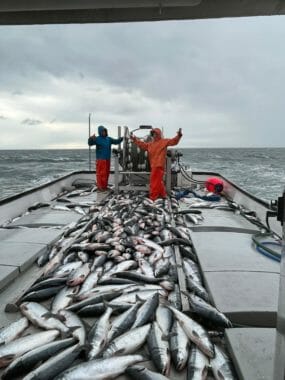
Over in Area M, Safron Kusnetsov surveys the scene from his 50-foot Polar Marine.
“I’m fishing in the Ilnik section, near Stroganoff Point. Today looks like the sun’s out,” Kusnetsov said.
Kusnetsov is a fisherman from Voznesenka, a town near Homer. He said that like Charles, his culture depends on fishing too. Like Charles, he grew up fishing.
Crew from Kusnetsov’s boat survey their catch. (Courtesy of Safron Kusnetsov)
“I am an Old Believer. Culturally, gillnetting is a way of life for Old Believers,” Kusnetsov said.
Old Believers are from a branch of Russian Orthodoxy that fled persecution in Russia long ago and eventually ended up in Alaska.
“They came to Alaska mostly because it was a lot like Russia. A lot of culture and heritage is still very Russian here. They felt connected to that. And they were looking for a similar climate to grow traditional foods and someplace with the ability to live off the land,” Kusnetsov said.
Kusnetsov said that if the June fishery were to be shut down or more tightly regulated, it would be a devastating blow to his community and to his livelihood.
“There’s a saying here that 90% of our annual income is earned in two weeks when the hot run hits,” said Kusnetsov.
Kusnetsov mainly targets sockeyes, but he sometimes catches chums and chinook, too.
Do the subsistence fishermen in the Y-K Delta or the commercial fishermen in Area M have a greater claim to the chum? About a decade ago, a comprehensive salmon genetics study of the Area M fishery confirmed that most of the chum caught in the region, around 60%, are bound for coastal Western Alaska. But when you start to break that number down further, that’s where things get complicated.
In part two of the series, we’ll look at what science can tell us about whether commercial fishing in Area M is truly taking a toll on Western Alaska salmon populations.
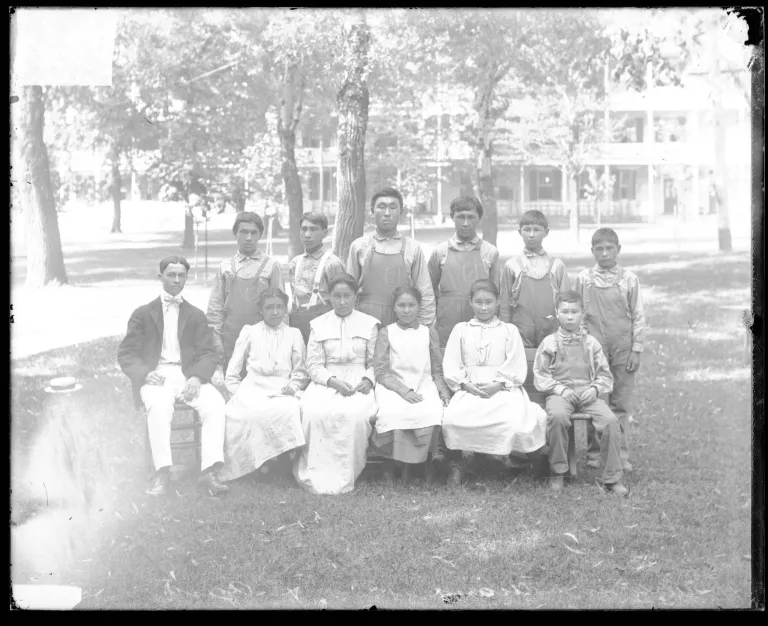
Anastasia Ashouwak, pictured third from right in the bottom row, was part of a group of Alaska Native children, pictured here, sent to the Carlisle Indian Industrial School in 1901. (Photo courtesy: Lara Ashouwak)
An Alaska Native girl who died more than 100 years ago at a boarding school in Pennsylvania will return home to Kodiak Island. Earlier this summer, the U.S. Army began the process of returning the remains of eight Indigenous children from the school to their families across the country.
According to records, Anastasia Ashouwak was taken from an orphanage on Woody Island in the Kodiak Archipelago and sent to the Carlisle Indian Industrial School after her mother died in 1901. Alutiiq Museum executive director April Laktonen Counceller says Ashouwak was part of a group of Alaska Native children sent to the school.
“There were 11 students that went on that journey,” Counceller said. “There’s records of their steamship travel, and the remainder of their travel once they hit the West Coast was by train.”
Indian boarding schools like Carlisle stripped Indigenous children of their culture and had notoriously poor conditions. Just last summer, the Department of the Interior announced it would be looking into the “troubled legacy” of Indian boarding schools in light of the discovery of 215 graves near a boarding school in Canada. It released its first report on the schools in May.
Ashouwak spent the next three years at the school before dying of tuberculosis at the age of 16.
She was buried alongside other children in the school’s cemetery. For more than a century she remained buried under a headstone inscribed with the name Anastasia Achwack.
Counceller says records indicate that Ashouwak was Sugpiaq/Alutiiq and had ties to the former village of Kaguyak on the southern tip of Kodiak Island, which was washed away in the 1964 tsunami. Her family then moved to the village of Old Harbor, where many people still share her last name.
Cassey Rowland is an Alutiiq artist from Kodiak and one of Ashouwak’s descendants. Her father, Ted Ashouwak, who is from Old Harbor but now lives in Maine, is Ashouwak’s great-nephew and closest living relation. Rowland says she never heard about the boarding schools from village elders when she was growing up.
“They just didn’t talk about it, it was just too painful for them,” she said.
Rowland has a daughter the same age as when Ashouwak left Kodiak Island for the Carlisle School, and she’s been honest with her daughter about what happened at Carlisle and other schools like it.
“We’ve been learning about the Indian boarding schools before we even learned about our ancestors being a part of it, and she’s been asking questions and I’ve been telling her the whole truth. I’m not the type of parent that’s going to hide away,” Rowland said.
Rowland and her daughter flew to Pennsylvania earlier in July where they gathered with other members of their family as Ashouwak’s grave was dug up in preparation for her reburial in Alaska. Members of the Alutiiq museum and a Russian Orthodox priest from Kodiak also joined the family.
Rowland said she brought paint to decorate the box that will carry the remains of Ashouwak home — she planned to incorporate Alutiiq and Russian Orthodox designs for the casket.
“And then the bright colors of the island just to bring her home — lots of bright greens and blues, oranges, pinks, so, just trying to make it look like a little girl,” she said.
The U.S. Army is in the process of identifying the children buried at Carlisle, and repatriating them to their families. (Photo courtesy of Lara Ashouwak)
Counceller said Ashouwak’s return to Kodiak is different. The U.S. Army oversees the cemetery at the Carlisle Indian Industrial School. It’s in the process of returning the remains of children who can be identified to their communities.
The Alutiiq Museum knows of another girl from Kodiak buried at Carlisle and hopes to bring her home next summer, Counceller said.
When Ashouwak returns to Kodiak, Counceller said she’ll receive services at the local Russian Orthodox church in the city of Kodiak and an Alutiiq ceremony at the museum. The Alutiiq Dancers — including Rowland’s daughter — also will perform. Ashouwak and her family will then be flown to the village of Old Harbor for a graveside service followed by a potluck.
Counceller says there’s a sense of relief among the community that Ashouwak will finally return home.
“As many of us Native people know, we’re kind of all related around the island so, although this is one individual, it’s a moment for all Alutiiq people to think about how important this kind of work is,” she said.
Rowland says a part of her will also be at peace when Anastasia is finally alongside members of her ancestors in Old Harbor.
“She’s gonna be where she is wanted. We need her home. And she’s gonna feel that, we believe. Her spirit will finally be at rest,” said Rowland.
Rowland says she’ll be processing why it took so long for Ashouwak to return to Old Harbor for the rest of her life.
Services and burial for Anastasia Ashouwak will be Saturday, July 9th, in Kodiak and the village of Old Harbor.
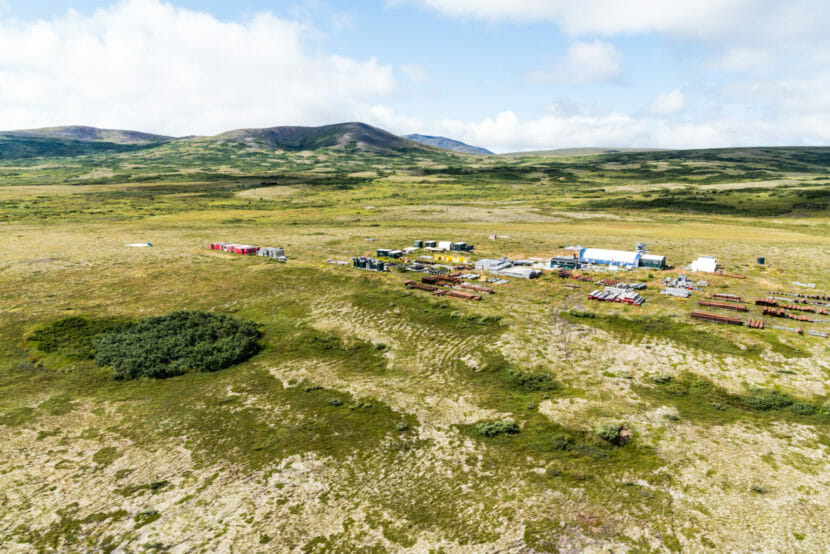
The Pebble Mine project area. (Pebble Limited Partnership)
The Upper Talarik Fire in Southwest Alaska has caused significant damage at the site of the controversial Pebble Mine project northwest of Iliamna.
The fire is part of a group of fires that officials are calling the Lime Complex. The flames burned through Pebble’s supply camp over the Fourth of July holiday weekend, according to Mike Heatwole, a spokesperson for the Pebble Limited Partnership. He said the mine had stored equipment for exploration at the camp.
Heatwole said no one was injured.
The Alaska Division of Forestry said that, as of Wednesday, the fire covered nearly 8,000 acres.
Heatwole described the damage of supplies as a “near total loss.”
“What used to be a very colorful tundra landscape is now quite charred. Most of what we had there has burned up — in some cases, tents, canvas tents, supported by metal. The metal, you know, got quite hot and collapsed,” he said. “So it’s not really salvageable.”
The fire also burned wooden pallets and railroad ties used to minimize the impact of drilling, along with tools to maintain the site’s equipment, Heatwole said.
Pebble sent some workers to the site on Thursday, and the company is still working with fire managers to take stock of the fire’s impact, Heatwole said, adding that they don’t know yet how much this will affect Pebble’s operations long term.
Kale Casey, public information officer with the incident management Team, says this year’s fire season is unprecedented.
“We reached 1 million acres of wildfire-impacted landscape 10 days before we ever have in the recorded history of Alaska,” he said.
Heatwole emphasized how much the Pebble Partnership appreciates the team’s response to the fires.
“It’s a fire, it’s devastating, but it’s just things, right? There was no one harmed. And that’s a much better story,” he said.
Casey said more information will be made public once a thorough assessment has been done.
Close
Update notification options
Subscribe to notifications
Subscribe
Get notifications about news related to the topics you care about. You can unsubscribe anytime.

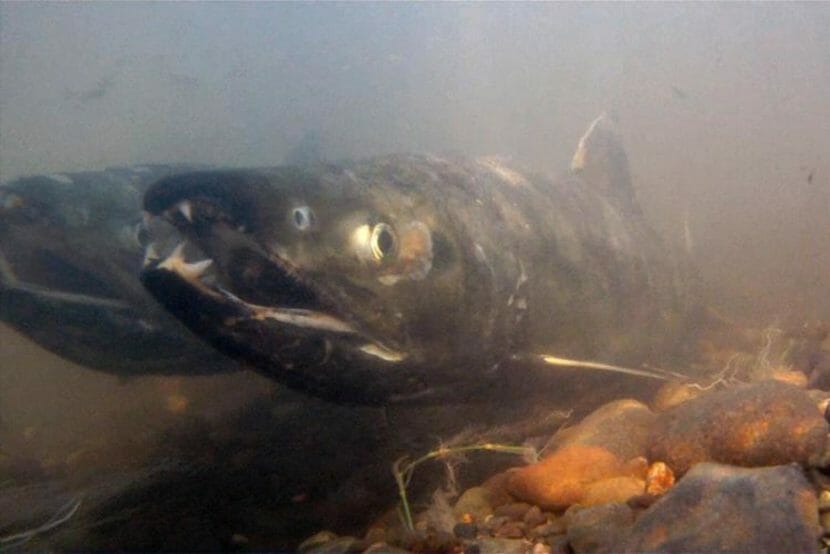
 This brings us to the crux of this decades-long dispute: to whom do these fish belong?