Southwest

Mary Peltola goes home to the Kuskokwim

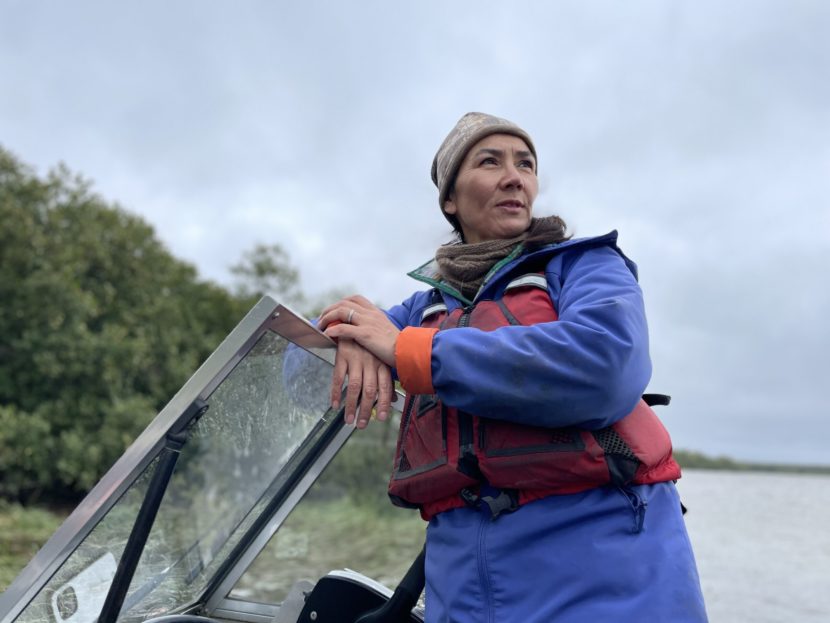
Mary Peltola stands at the wheel of a small boat
Mary Peltola has been fishing on the Kuskokwim since she was a child. (Photo by Liz Ruskin/Alaska Public Media)

Democrat Mary Peltola has been campaigning all summer to be Alaska’s representative in the U.S. House. She finally went home to Bethel last week and couldn’t wait to get out on the river.

But she had a camera crew with her and the weather was bad, so she was stuck inside, shooting campaign ads in her living room.

“It’s good fishing weather, but it’s not great filming weather. I think there’s some concern that equipment isn’t damaged,” she said. “Yeah, it’s pretty treacherous out there. South wind storms are no fun and you get a lot of whitecaps.”

Peltola, wearing a gray blazer and more make-up than she’s used to, sat back down under the bright lights and took direction from her media consultant and cameraman.

Peltola may already have won election to the U.S. House. Alaskans will learn the results of the Aug. 16 special election on Wednesday, when the ranked choice ballots are tallied. Republican Sarah Palin, the former governor and 2008 vice presidential nominee, is in a good position to win once the second-choices are counted. But for now, Alaska’s right-wing icon is trailing by almost 9 percentage points.

If Peltola wins, she’d be the first Alaska Native person ever elected to Congress. Right now, all she wants to do is fish.

By afternoon, the wind and rain have let up. The tide is favorable. Peltola happily threw off her blazer and put on bulky layers, topped with rain gear. She began throwing things in her aluminum skiff — buckets, an anchor, waterproof gloves.

“Everyone has a float coat?” she called out.

She grew up in Bethel, and in other communities in the Kuskokwim Delta. She’s pulled salmon from this river since she was a child. But the main goal of this voyage is video. Because whatever the outcome of the special election, Peltola will also be on the ballot in November. She needs TV ads. It makes for an awkward fishing trip.
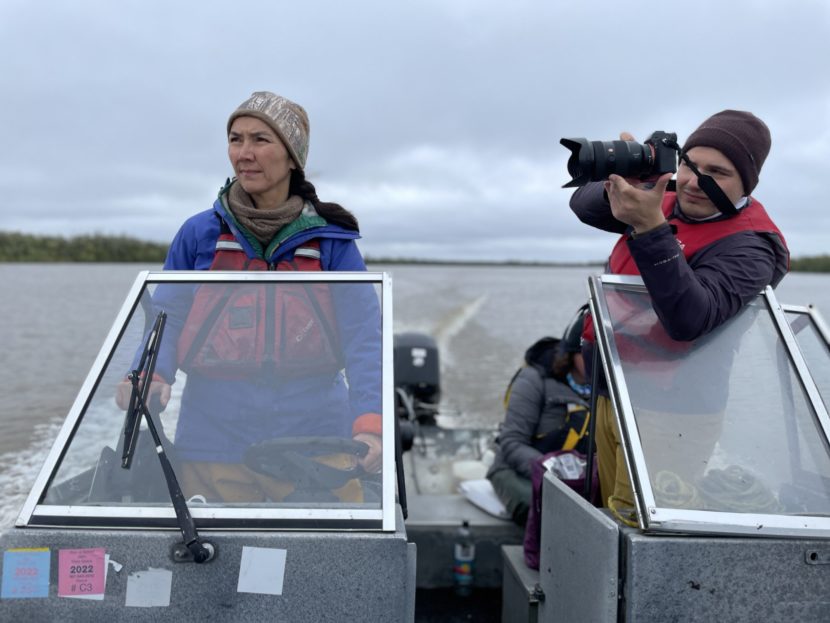
Peltola steers a boat while a cameraman stands next to her, filming
A camera crew documents Mary Peltola fishing. (Photo by Liz Ruskin/Alaska Public Media)

“I want to put this inside of here, just to have a mic on you,” says the sound guy, coming at her with a wireless microphone he wants to clip inside her rain gear.

“Right this minute?” she asks.

She thanks him for holding off until they’re closer to fishing.

There’s a more serious problem with this fishing trip: There are no fish. The silvers didn’t show up in numbers sufficient to meet subsistence needs. That’s after another year of dismal chum and king returns.

It used to be, she said, that she would fear getting too many fish. She and her husband, Buzzy Peltola, figure they can cut and clean about 70 fish a day. In summers like this one, the daily harvest might be just a handful of salmon. If the river is open to any kind of fishing at all.

This is a tragedy beyond words for this salmon-based region. Peltola has spent the past five years of her career on it, as director of the Kuskokwim River Inter-Tribal Fish Commission. Protecting salmon is a major campaign theme.
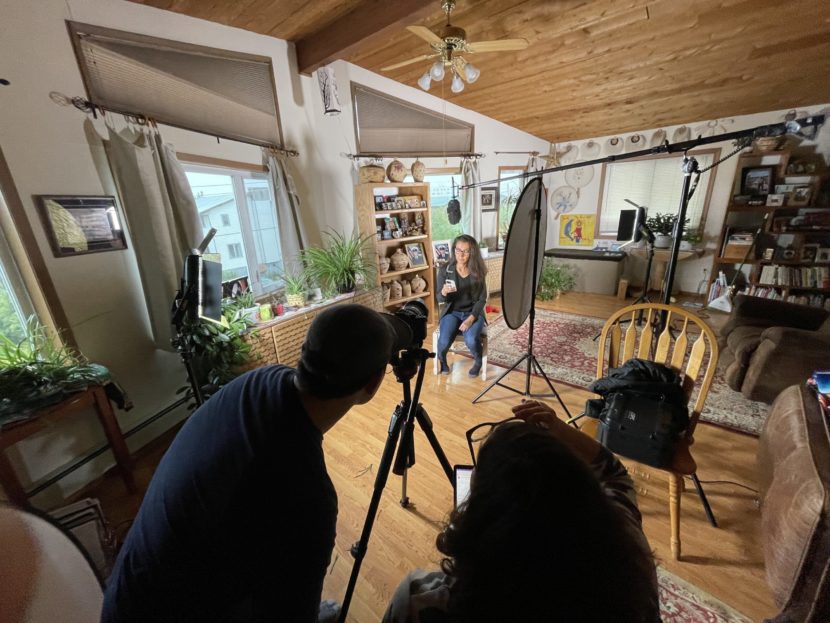
Mary Peltola sits on a chair in a living room with a reflector next to her and a cameraman filming
With a TV crew and a media consultant, Peltola filmed a TV spot in her Bethel home. (Photo by Liz Ruskin/Alaska Public Media)

Peltola turns 49 this week. Born Mary Sattler, she’s the daughter of a Yup’ik mom and a Nebraskan dad who went north to teach school and later became a Bush pilot.

As she drives her skiff through the braids of the Kuskokwim, she points out the bank where her great-grandparents lived, and on the other side, where her mother was born during berry-picking season.

“Yeah, this is kind of the center of my universe,” she said, at the mouth of a tributary called the Gweek. “Just because my uncles taught me exactly where to put the net to catch certain kinds of fish.”

Scientists aren’t sure why the salmon aren’t returning to this river. Climate change and ocean acidification are factors. Peltola also attributes it to the thousands of salmon caught by accident by trawlers targeting pollock.

(The At-Sea Processors Association, which represents some of the largest factory trawlers, says it’s taking steps to limit bycatch, but says larger factors are to blame.)

Non-salmon producing tributaries of the Kuskokwim are open to fishing. So, primarily for the camera, Peltola feeds a small set net into the water. Sometimes salmon make a wrong turn. But when she checks the net later, it’s empty.

“I stay hopeful right until the end, because sometimes you get lucky, right at the end meshes,” she said.

Peltola went away to college, but at age 24 ran for state House and beat an incumbent. She stayed in office for a decade, overlapping with then-Gov. Sarah Palin. They bonded in the state Capitol, as two pregnant moms in office. When Palin left Juneau for the campaign trail, Peltola said, she bequeathed her backyard trampoline to Peltola.

Palin didn’t respond to interview requests.

She vilifies Democrats in general but recently called Peltola a “sweetheart.”

The lack of rivalry goes both ways.

“I think she’s great,” Peltola said.

That politeness is on-brand for her. In the Legislature, Peltola was known for uncommon kindness.

“She was never bitter. She was never angry. She was never partisan,” Andrew Halcro said. He and Peltola were freshman legislators in 1999. As a Republican representing the Sand Lake area of Anchorage, he ignited statewide fury with a speech he now regrets. He likened Bush residents to children who don’t learn to tie their laces because the state keeps sending Velcro shoes.

A lot of Alaskans wrote Halcro off as a racist.

But within hours, he said, Peltola was at his office door, asking if she could offer a different perspective on Power Cost Equalization, the rural energy subsidy he had derided. He came to see the program as she does, as a matter of equity for regions that didn’t benefit from expensive hydroelectric projects the state funded.

“I think with Mary Peltola, you should never, ever misconstrue kindness for somebody who’s not going to stand up for what she believes in,” Halcro said.

Bev Hoffman of Bethel has known Peltola her whole life and admires her.

“She is nice. But she is so tough,” Hoffman said.
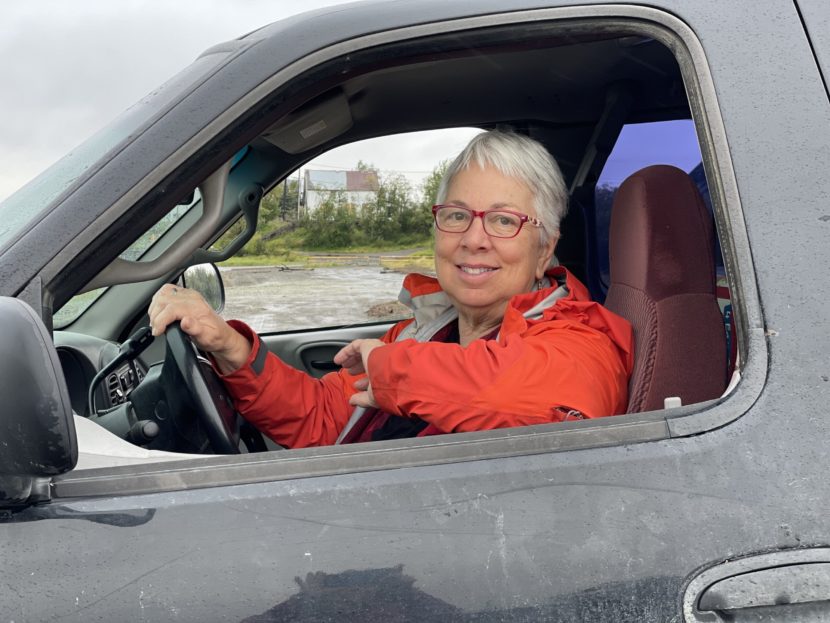
A woman sitting in the cab of a truck
Bev Hoffman says Peltola is no pushover: “She is nice. But she is so tough.” (Photo by Liz Ruskin/Alaska Public Media)

They fought together on fish issues, and to get a swimming pool for Bethel, where drownings were common because few people learned to swim. They were at odds for six years, when Peltola worked as manager of community development and sustainability for Donlin Gold, a mine project Peltola no longer supports.

Hoffman said Peltola has a way of listening intently and drawing people of opposing views together.

“She doesn’t yell at people,” Hoffman said.

Peltola says yelling isn’t effective. She credits her upbringing and her mentos for her political style.

“The region where I’m from, there is a big premium on being respectful, on not using inflammatory language or harsh tones,” she said.

Peltola believes in the power of small gestures. She said she once defused an urban Republican legislator, just by pointing out that he — being decades her senior — had lived more years in Alaska than she had.

She said they got on great after that, and to her, that’s good politics.
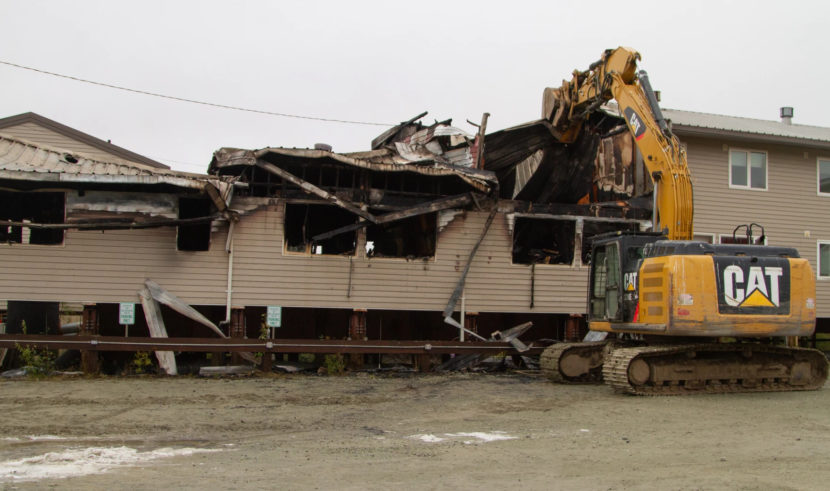
Witnesses say responders came unprepared to fight Bethel apartment fire that killed 3

An excavator demolishing a burned-out apartment
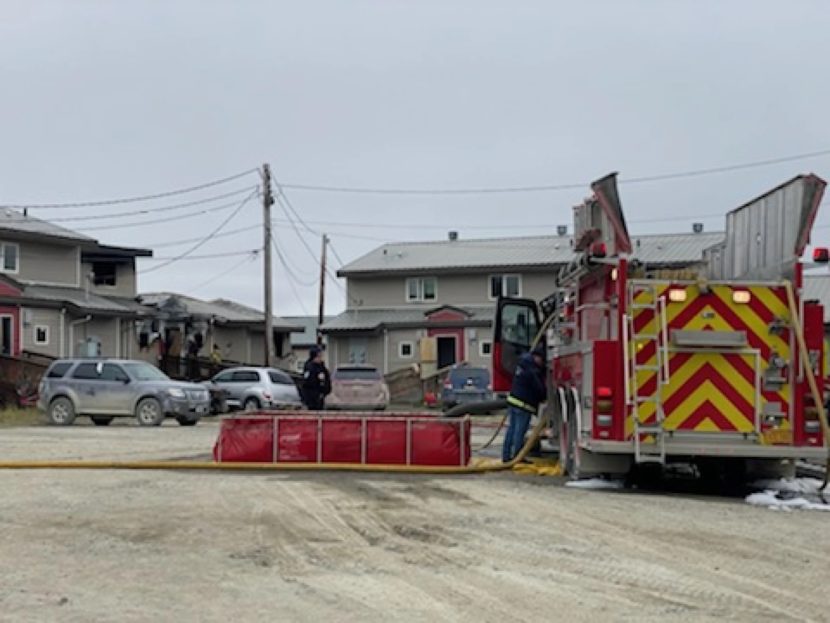
The burned units at AVCP Regional Housing Authority Low Rent Units in Bethel on Aug. 12, 2022. (Photo by Olivia Ebertz/KYUK)

Michaela Mike is moving into another apartment at the Association of Village Council Presidents Regional Housing Authority apartment complex in Bethel. Her old one is cordoned off with crime scene tape. Next to it is the burned wreckage of her neighbors’ apartments.

On Aug. 12, a fire tore through the apartment complex, killing three people and injuring six others. It destroyed two units completely and damaged more, Mike’s included.

Residents like Mike that witnessed the fire have criticized how police, firefighters, and other city workers responded.

“It could have been better. When I came out, they were just standing around,” she said.

People who witnessed the response question if the deaths could have been prevented. Six of these witnesses spoke to KYUK, giving consistent accounts of how the response played out. KYUK has chosen to protect the identities of a person who survived the fire and a minor who witnessed the fire.

The witnesses said that firefighters arrived without enough water or a ladder to reach the second floor, where the fire’s victims slept. Tenants largely said that they were not evacuated from their apartments, and they said that emergency responders restrained a resident from attempting to rescue his family members who died in the fire.

According to a city emergency dispatch log, a community service officer called in the fire to the city dispatch at 4:13 a.m. Two police cars and one fire truck arrived just a few minutes later. But interviews, photos, video and the dispatch log all point to delays and difficulties getting water onto the fire and attempting to rescue people trapped inside.

The fire began in the entryway of the building and took 20 minutes to reach the second floor, trapping nine people in two units. Within that 20 minute span, all but three of them jumped out second-story windows to escape, according to eyewitnesses and court documents. The three who remained inside on the second floor died.

They were Sophie Engebreth, age 68, and her adopted teenage granddaughters: Brianna Engebreth, age 13, and Melissa Engebreth, age 15.

Witnesses question if firefighters had enough water 

The fire department showed up either with very little water to fight the fire or with no water at all, the six witnesses who spoke with KYUK said.

Mike recalled seeing a fire hose with no water coming out of it. Another resident, Tanya Leopold, said that she saw plenty of first responders when she first evacuated her apartment, but they didn’t seem to be trying to suppress the flames or evacuate people.

“There was a fire truck, and it had all its equipment to turn off a fire, but they didn’t have a ladder on there. There was at least three, four cop cars there already,” Leopold said. “So it was like, every minute or so, there is another cop car. The cops multiplied, and they just stood there.”

Bethel Police did not respond to KYUK’s multiple calls and emails asking for comment.

Leopold said that that shortly after the fire engine arrived, it ran out of water.

“They came very unprepared. They should have had their gear ready, their water ready, any fire extinguishers, at least axes. They could have done something for those ladies,” Leopold said.

Leopold and Mike’s testimonies are corroborated by photo and video evidence obtained by KYUK and by interviews with city officials. According to photos and videos, about 20 minutes after the fire was first reported, no water had been deployed to fight it.

Bethel Public Works Director Bill Arnold oversees sending water trucks to fire scenes. He said that he was first contacted at about 5 a.m., more than 45 minutes after the fire started. He said that the first city water truck arrived on scene 15 minutes later at 5:15 a.m., more than an hour after the fire started.

The dispatch log shows that the first fire engine on the scene reported being out of water a few minutes after that, at 5:19 a.m., but it’s not clear if it’s referring to the fire engine itself or the newly arrived water truck. Then at 5:22 a.m., a fire truck hooked up to a nearby fire hydrant.

The Bethel Fire Department said that it could not respond to any of KYUK’s questions about its response to the fire, so it’s not clear why it took an hour to connect to a hydrant. But Bethel City Manager Pete Williams suggested that it could be because sometimes in the Bethel Heights Subdivision, connecting to a fire hydrant shuts off water to other houses.

Tenants were trapped on the second floor

Witnesses said that all emergency response vehicles were parked in front of the building, but the fire victims on the second floor would have been better reached from the back.

“They could have used those [fire engine] ladders. They could have gone behind the building where Sophie and the girls were, but there was no fire truck back there,” Mike said.

Several other witnesses corroborated her story. One of Sophie’s sons, Richard Engebreth, posted on Facebook that the fire department first arrived without a ladder. Though a second fire truck did arrive with a ladder later, he said that firefighters did not use it to try to help people escape. Engebreth also wrote that his three family members who died were calling for help from the second-story back windows.

Witnesses Leopold and Mike said that a crowd had gathered and were asking firefighters to step in.

“Then there’s a whole bunch of other people, and there’s these girls. They were yelling, telling them to do their job to save them,” Mike said.

At one point, the women said that police handcuffed Engebreth to keep him from trying to enter the building to save his mother, who died.

“I know he was really hollering and crying for his mom. I don’t see why they handcuffed him. He was just crying and wanting his mom just like anybody else would,” Leopold said.

The dispatch notes show that at 4:48 a.m., about half an hour after the fire started, the officers called the Yukon Kuskokwim Correctional Center and asked if they had cells available for several people.

According to dispatch notes and testimony from tenants, when police arrived on scene, they spent more time controlling the crowd and handcuffing people than they did evacuating residents.

Eventually, witnesses said that water began flowing freely to the fire, and a ladder moved to the back of the building. But by then, it was too late. The witnesses speculate that if firefighters had entered the building or used a ladder earlier, the victims’ lives may have been spared.

City struggling with staffing

The city has been struggling with staffing issues.

A firefighter told KYUK in July that during the pandemic the fire department had lost 22 of its 25 of its volunteers. However, Bethel Fire Chief Daron Solesbee also told KYUK that he had started to regain some in recent months.

Earlier in the summer, the Bethel Public Works Department reported that it was critically understaffed for water truck drivers and that they were “mentally and physically tired.”

Apartment complex criticized

Tenants also criticized the apartment complex. Residents told officers there were no sprinklers or alarms inside. Tenant Galen Frank told KYUK that he only woke up because of the smell of smoke.

AVCP RHA operates the building. President and CEO Mark Charlie said that he could not answer any of KYUK’s questions about the sprinkler systems, the alarm systems, or anything else related to the fire. However, he did tell KYUK that the apartments have fire extinguishers.

Lawsuits may follow

Two weeks after the fire, the apartment building is a grim sight. The two second-story apartments that were total losses have burned and collapsed. The remaining walls and floor are charred black. Their windows are gone.

In one of those ruined apartments lived the three people who died, with a relative who escaped by jumping out the window. In the other, there lived five who also escaped through the window.

The survivors of both apartments have retained lawyers. Lawyer Myron Angstman said that he represents the Engebreth family, and that they are exploring their legal options. Another lawyer, Jim Valcarce, did not answer KYUK’s calls or emails, but one of his clients, a survivor, told KYUK that they plan to sue the City of Bethel, AVCP RHA, and any other responding entities.

Yukon River chum and coho runs remain too low to open subsistence harvest

""
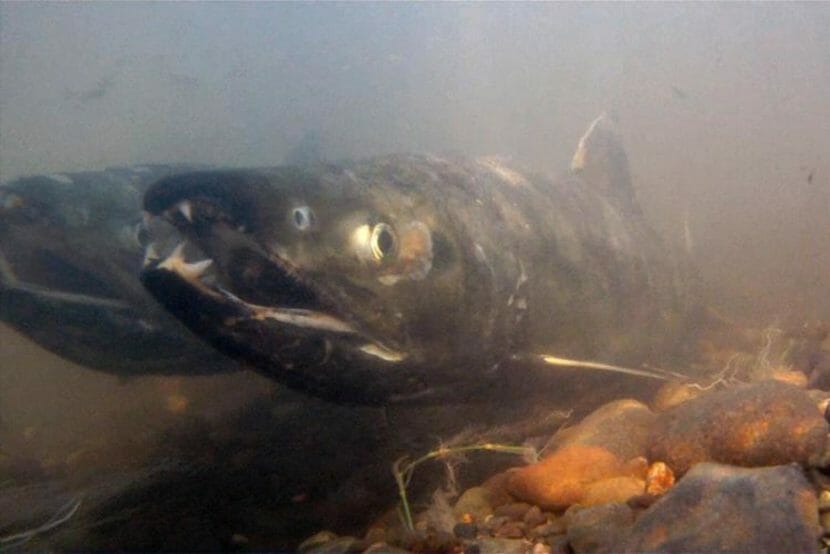
Chum salmon (NOAA photo)

Both the fall chum salmon and the coho salmon runs on the Yukon River remain too low to open subsistence harvest. Alaska Department of Fish and Game biologists do not expect either to reach their goals for fish reaching their spawning grounds.

An estimated three quarters of the fall chum salmon run is past the lower river. As of Aug. 21, the state-run sonar at Pilot Station counted 194,000 fall chum. That’s compared to a historical medium of 486,000 fall chum by that date.

The fall chum that have returned are slightly older than the historical average and with slightly fewer females than the historical average. The fish are also smaller, measuring 26 millimeters less than their historical average length.

The Yukon River coho salmon run is also far below its average run size but coming in higher numbers than last year’s record low. The Pilot Station sonar has counted 43,000 coho, compared to a historical average of 73,000 by this time.

Like the fall chum, the coho are also returning smaller. The coho are averaging 31 millimeters less than their historical average length. The sampled coho length averaged 544 millimeters, compared to a historical average of 575 millimeters.

At Russian Mission, state biologists have attached radio tags to over 118 coho as of Aug. 19. ADF&G asks anyone catching a coho carrying a tag to call the department at 907-459-7274.

Fishing for fall chum and coho salmon remains closed on the Yukon River. Selective gear types remain allowed, and fall chum must be returned to the water alive. Four-inch mesh gillnets are also allowed.

Yukon River state fishery manager Christy Gleason says mesh size restrictions are unlikely to lift until early October.

Correction: This story originally said that both fall chum and coho caught in selective gear must be returned to the water alive. That is incorrect. Coho can be retained along with non-salmon. Only fall chum must be returned to the water alive. Also this story originally said that four-inch mesh set nets are allowed on the Yukon River. That has been corrected to say that four-inch mesh gillnets are allowed.

A Bristol Bay principal bet his hair on his seniors’ success

Two high school boys pose with a man with a shaven head
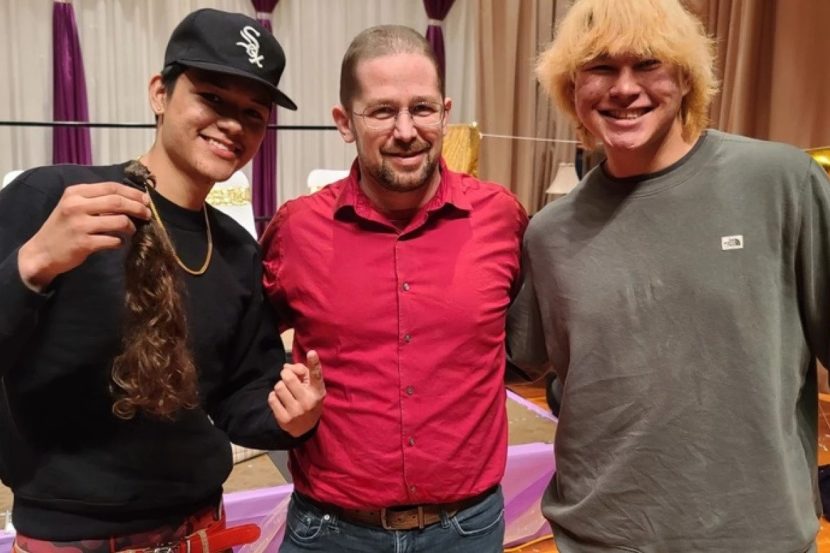
Junior Torino, Principal Shannon Harvilla, and Nathan Hansen in May 2022. Harvilla had agreed to let Torino shave his head if Torino and the rest of the senior class graduated. (Bristol Bay Borough School District)

Shannon Harvilla is the principal and assistant superintendent of the Bristol Bay Borough School District, which has around 100 students. He says he wants to help all of them as much as he can, but last year, his sense of duty was put to the test when he got a surprising request from one of the seniors.

“Junior Torino approached me at the beginning of the school year, semi-joking, because I had long hair, [asking] if he could shave it,” Harvilla said.

Harvilla agreed under one condition.

“I let him know that if the entire senior class graduated this year that he could have the honor of shaving my head,” he said.

Torino said he had had a rough start to the school year.

“I was pretty short on credits, and so I didn’t  think I was gonna graduate,” he said. “But midway through the year, I started cranking out some more classes that I needed.”

Torino said his bet with Harvilla motivated him to persevere through some tough parts of the 12th grade.

“Oh yeah, it pushed me a little bit more,” he said. “I really wanted to see him bald. It was really stressful. I had some doubts, but I didn’t let that stop me from anything. I knew that he would stick to his word. I didn’t expect a lot of the kids to come down and watch. But it was fun. I’m glad I got to do it in front of everybody and everyone got a chance to see.”

Torino graduated last spring along with 10 of his classmates. The students celebrated with the rest of the community; Harvilla said it was the first real in-person event the school hosted since the start of the pandemic two years earlier. Torino spoke at graduation. He said he was nervous.

“I was one of the class speakers, so I had to talk about my whole class in front of everybody at graduation, so I was kind of nervous. But once I got up there it was fun,” he said. “There’s definitely been some good times with them. And it’s going to be different, but everyone’s going to go their separate ways, and maybe we’ll stay connected somehow.”

Afterward, he made one last trip to school to shave Harvilla’s head in front of the student body. Harvilla said the haircut was worth it.

“I knew that [Torino] would have to put in extra work in order to graduate. And I knew that any bit of motivation we could provide as adults would help him get to his goal of graduating,” he said.

Now Torino is working at the borough dock. The Bristol Bay Borough’s 2022 school year starts this week — no word yet on what Harvilla plans to do if all the seniors graduate this spring.

Private plane makes emergency landing on Bethel road

A small private plane being towed down a public street on a trailer
(Photo by Nina Kravinsky/KYUK)

Tyler Bartlett and his copilot were just three miles from the Bethel airport when he felt his Cessna 172 begin to sputter. He was coming from McGrath in a private plane to accrue hours for his commercial license, and he estimated the flight would take about two hours. Bartlett loaded up with three and-a-half hours worth of fuel for the flight.

But as he approached Bethel, he was running on empty.

“Lost a lot of the power. Had a little bit, but that wasn’t really helping keep us up, so we’re slowly going down,” Bartlett said. “First thing to do, find a place to land.”

Bartlett quickly realized he wasn’t going to make it to the airport and told air traffic control that he had to make an emergency landing. At first he aimed for the road leading out to the dump, but a quick burst of power gave him hope he might be able to make it to the runway after all. A few seconds later it became clear he didn’t have enough, and he chose to land on Ridgecrest Drive instead.

“I was able to avoid traffic, saw a car pass and it was clear ahead, so I was like, alright, put it between these power lines,” Bartlett said. “Touched down basically right in front of Fili’s.”

Bartlett managed to maneuver the plane past any power lines on the way down, and the slow Sunday traffic meant that there were few cars on the road.

Bartlett, who is 20 years old, grew up in Anchorage and has been living in Bethel for about a year and a half. His dad is also a bush pilot, and his mother is the office manager for Fox Air, a local airline charter service. Bartlett isn’t employed by the company.

Bartlett got his private license in the spring of 2020 and said he’s never had to make an emergency landing before. Still, Bartlett said he didn’t panic.

“Just a bit of a shock to lose power, but I knew I had the road to land on,” Bartlett said.

His mother, Jonna Bartlett, trusts her son’s abilities and is glad he’s safe.

“It was definitely one of those things moms don’t want to hear about, but at least he’s safe,” Jonna Bartlett said. “Missed the signs, missed any cars, just like a crazy, crazy day.”

Police arrived to help manage traffic. Bartlett and his father towed the plane to the airport with a motorcade of police and state vehicles.

No tickets or citations were issued for the emergency landing.

All charges dropped against man accused in Bethel apartment fire that killed 3

Three people died in a fire at an Association of Village Council Presidents Regional Housing Authority apartment complex in Bethel on Friday, Aug. 12, 2022. (Olivia Ebertz / KYUK)

All charges have been dropped against a man who was charged earlier this week in an Aug. 12 fire that killed three at an apartment complex in Bethel.

Adam Andrew had been charged with three counts of murder in the second degree and one count of arson, along with seven more felonies and six misdemeanors.

According to court documents, Bethel Police Department Investigator Skyler Smith had relied on the testimony of just one fifteen-year-old eyewitness who said he saw Andrew start the fire.

Prosecutor Chris Knowles would not say whether the fire was still being investigated as arson or whether they were looking at other causes. He did say there is still an active investigation and that Bethel Police Department is still investigating all leads.

The fire started last Friday at around 4 a.m. at Bethel’s Association of Village Council Presidents Regional Housing Authority townhouses.

Family members identified the people who died as Elder Sophie Engebreth, 15-year-old Melissa Engebreth and 13-year-old Brianna Engebreth. Melissa and Brianna were Sophie’s granddaughters by birth and daughters by adoption.

Five more people were injured. Neighbors said that no sprinklers or fire alarms went off during the fire.

Site notifications
Update notification options
Subscribe to notifications