Western

Murkowski thanks Obama for restoring Denali; Obama directs his gaze on climate change

Down the valley towards Denali on with the park road wending its way. (Creative Commons photo by Nic McPhee)

President Barack Obama touched down in Alaska Monday for a three-day tour to the state, and beyond focusing on climate change in visits to Anchorage, Dillingham, and Kotzebue, the president began his trip by restoring the Koyukon Athabascan name to North America’s highest mountain.

Senator Lisa Murkowski, in a video posted on YouTube Sunday, thanked the president for the long-sought change.

“For generations Alaskans have known this majestic mountain as The Great One,” Murkowski’s video message begins. “Today we’re honored to be able to officially recognize the mountain as Denali. I’d like to thank the president for working with us to achieve this significant change to show honor, respect, and gratitude to the Athabascan people of Alaska.”

Beyond Denali, Obama’s Alaska itinerary focuses on climate change. It’s a topic he’ll discuss at the GLACIER conference in Anchorage, an acronym for the international meeting on global leadership in the Arctic. He also plans to discuss an initiative assessing relocation needs of more than 30 Alaska Native communities due to the changing climate and rising sea levels. The effort will be led by the Denali Commission, an independent federal agency, with Senator Murkowski at the helm.

In a video released by the White House Friday, Obama turned the national spotlight on those Alaska communities.

“A lot of these conversations begin with climate change,” the president said, “and that’s because Alaskans are already living with its effects: some of the swiftest shoreline erosion in the world—in some places more than 3 feet a year. This is happening to our fellow Americans right now. In fact, Alaska’s governor recently told me four villages are in imminent danger and have to be relocated. Already rising sea levels are beginning to swallow one island community. Think about that. If another country threatened to wipe out an American town, we’d do everything in our power to protect ourselves. Climate change poses the same threat, right now. Because what’s happening in Alaska is happening to us, it’s our wake-up call.”

On Wednesday, Obama will head to Western Alaska, spending the morning in Dillingham and finishing his trip in Kotzebue. Many in Western Alaska have wondered about the impacts the president’s visit will have on the vital air transportation and freight so many rural residents rely on.

Like Anchorage, the Federal Aviation Administration is implementing Temporary Flight Restrictions in both Kotzebue and Dillingham. In each case, the TFR will consist of an inner 10-mile ring of heavily restricted airspace, and an outer ring of less restricted but still limited flying to 30 miles out. Airmen are urged to check the TFRs for updates and specific information.

The FAA notes all aircraft within 10 miles of Kotzebue will be prohibited to only law enforcement and military flights Wednesday between 4:30 p.m. and 9 p.m., but those times are expected to fluctuate.

As all eyes move to Kotzebue for Obama’s trip—the first time a sitting U.S. president will travel above the Arctic Circle—the president’s schedule has him on the ground for just a few hours, delivering remarks at the community school.

But the trip has left many in Nome—which the U.S. Army Corps of Engineers picked as the leading candidate for a deep-draft Arctic port—wondering why the potentially strategic harbor isn’t seeing a presidential visit.

White House senior adviser Brian Deese told a conference call of reporters last week that the president’s agenda is simply too full.

“If we had more time and more space the president would love to visit more of the state,” Deese said. “Lots of things [are] going on in Nome, including the Army Corps’ exploratory work that’s ongoing. This is a packed trip, he is using every minute of his time to try see as much as he can, but we can only get in so much.”

The White House says Air Force One will take off from Kotzebue Wednesday evening—ushering President Obama out of Alaska.


Crews train to prevent repeat of Selendang Ayu grounding

U.S. and Canadian Coast Guard crews recently conducted a joint training exercise with the Emergency Towing System. Deployed to eight communities in coastal Alaska, the ETS can be used when tugs aren’t available to assist large vessels like disabled freighters and cruise ships that are in danger of running aground.

During the exercise that occurred during the annual Buoy Tender Roundup in Juneau earlier this month, the ETS was loaded aboard the USCGC Maple before it left Station Juneau. Earlier plans called for a Coast Guard H-60 helicopter to lower the towing system by sling to the Maple’s deck, but the helicopter was called away just before the training exercise.

Once out in the middle of Gastineau Channel, the Maple’s engines were disengaged while deck crews worked to unpack the package and extend lines to the Canadian Coast Guard vessel Bartlett.

Canadian Coast Guard vessel Bartlett takes a powered-down USCGC Maple in tow during a recent transit of Gastineau Channel. (Photo by Matt Miller/KTOO)
The ETS that was used in the Juneau exercise is normally stationed in Sitka and can be used to tow over 50,000 deadweight tons.

The system was developed after the freighter Selendang Ayu lost power and grounded off of Unalaska Island in December 2004. Six crew members were killed when the ship broke in half and spilled oil and its soybean cargo along the shoreline.

Related link: Alaska Emergency Towing Systems Project – ADEC

The Emergency Towing System consists of a messenger line, 10 inch main tow line, and a set of buoys in a package that can lowered to any vessel by crane or helicopter. (Photo by Matt Miller/KTOO)
The Emergency Towing System consists of a messenger line, 10-inch main tow line, and a set of buoys in a package that can lowered to any vessel by crane or helicopter. (Photo by Matt Miller/KTOO)
After use, the components of this Emergency Towing System will be dried out and repackaged for redeployment in Sitka. (Photo by Matt Miller/KTOO)
USCGC Maple pulls away from Coast Guard Station Juneau. (Photo by Matt Miller/KTOO)

For Nome Public Schools, survey shows success and room for improvement

Parents, teachers, and other community members discuss results from the 2015 School Climate and Connectedness Survey during Community Night on Aug. 17. (Photo by Laura Kraegel, KNOM)

Jenni Lefing says a survey means nothing if it just sits on a shelf. That’s why she’s been all over Nome, sharing the results of the Alaska School Climate and Connectedness Survey.

Lefing is a community engagement educator with the Association of Alaska School Boards, which designed the statewide survey to measure how students and staff feel about the environment at school.

“If students and staff feel safe at school, if they feel respected, if they think that students and other people in the community care about them — then the research shows those students are more likely to graduate and be successful at school and after school,” Lefing said.

Nome Public Schools has administered the survey since 2011. But this year, they’ve shared the results more widely than ever before.

Families dove into the data during Community Night at Old St. Joe’s. Teachers reviewed the results during their in-service days while the school board went over the report at a special work session. Community organizations got involved too — from Kawerak and Checkpoint Youth Center to Nome Eskimo Community and the Norton Sound Economic Development Corporation.

The results show Nome Schools have improved in several areas since last year. Students report more positive attitudes about safety, school leadership, student involvement, and their relationships with peers. The staff survey indicates improvement across all measures of school climate.

“Each year, I feel like we’re just getting that much more involved and that much more support — more engagement from staff members, more engagement from students. So it’s been really neat to see something build from the ground floor,” said Kaley Slingsby, the community engagement advocate at Nome-Beltz Jr/Sr High School.

In partnership with AASB, Slingsby works to grow student leadership and connect Nome Schools to the community. Students eat lunch with elders at the XYZ Senior Center, train in bullying prevention, mentor younger students, and sit on the Sitnasuak Elders and Youth Committee.

But the survey shows there’s room for improvement too. For instance, fewer students felt supported by adults this year — and 26 students reported they had “given up on school.” That’s just eight percent of surveyed students, but school board member Jennifer Reader says it’s still too many.

“That’s concerning — that that many kids have given up on school. Because our goal here obviously is to make sure that we have every student graduate and want to be here,” Reader said.

Slingsby said the goal is to make the school a positive place for everyone — students who excel, students who are at risk, and the staff members who work with them. Using the survey data, parents, teachers, and community members brainstormed ways to improve school climate. Ideas included bringing more community speakers into the classroom, matching students with adult mentors, and making time to build relationships outside of academic lessons.

Nome Public Schools is still working with the survey data, and Slingsby is creating a community engagement plan for the upcoming school year, which starts Aug. 24.

Sled dog killed, another injured in muskox goring outside Nome

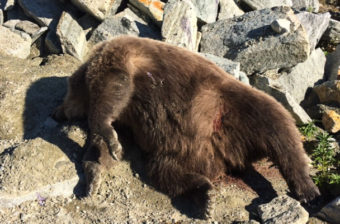
A bull muskox. (Photo by Tim Bowman/U.S. Fish and Wildlife Service)

A grimly familiar sight to Nome dog owners returned with the fatal goring of a local musher’s dog by a bull muskox Wednesday.

Alaska Department of Fish and Game wildlife biologist Bill Dunker said Nome police called his office Wednesday afternoon to report two dogs were injured—one fatally—in the attack before the bull muskox was killed in what Dunker calls a clear case of “defense of life or property.”

“Everything appears to be a justifiable DLP,” Dunker said.

The dogs belonged to musher Rolland Trowbridge, who ran the Kuskokwim 300 earlier this year. He also ran the Yukon Quest in February—withdrawing near the race’s midpoint. Daughter Janelle Trowbridge also ran dogs from the family kennel in her 2014 Junior Iditarod run.

Trowbridge declined to comment on the incident.

Dunker said it’s the first fatal clash between muskox, and Nome residents and their animals, so far this summer. That’s a far cry from the multiple gorings and dog fatalities seen last year, including a DLP kill of a muskox harassing a dog and a similar DLP kill in the community of Wales.

“This summer has been much better with regard to conflicts with muskox,” Dunker said. “We’re still having them on occasion, but certainly last year was kind of the ‘perfect storm’ of muskox conflicts in the Nome area. It’s certainly been the case that this year has been much less active with regard to muskox conflicts.”

But just what makes up that “perfect storm” isn’t fully understood. Dunker said “anecdotal” observations on brown bear predation may have pushed muskox into the Nome area last year. But so far this summer, that’s not the case.

“We haven’t made those same observations this year,” he said, “so we can’t say one way or the other that it was brown bear predation that was the smoking gun that ultimately drives them into the Nome area.”

Dunker said Fish and Game’s muskox mitigation is ongoing. Failed attempts last year included everything from rubber bullets to bear decoys and the spraying of bear urine. This year he said ADF&G is trying an experimental electric fence installed at the Nome airport. Biologists are still waiting to see if the fence is effective.

“But to be honest,” Dunker said, “we haven’t had a muskox bump into the fence yet. So we’re still investigating its effectiveness.”

As for the DLP kill, salvage requirements include surrendering the meat from the animal, but in this case, the meat will stay local: it’s been donated to the Nome Covenant Church. The animal’s hide and the skull were salvaged and turned over to the department.

Pastor Harvey Fiskeaux with the Covenant Church said the muskox in currently hanging in a church member’s shed, and a group from the church will be processing the meat tomorrow and putting it into the church’s freezer.

Fiskeaux said they’ll be serving muskox roasts and stew at their Friday soup kitchens beginning in September.

Man accused of distributing child pornography arrested in South Carolina

Gene Geisler was arrested Wednesday in South Carolina. (Image from LinkedIn)

Authorities have arrested the former computer network manager at the Yukon-Kuskokwim Health Corporation who is accused of possessing and distributing child pornography.

After a grand jury indicted Gene Geisler, 38, Wednesday, authorities said the man’s whereabouts were unknown after he had fled the state. He was arrested around 9:30 p.m. in Goose Creek, South Carolina, located outside Charleston. Megan Peters is a spokesperson for the Alaska State Troopers.

“He was pretty much taken into custody without incident by the Berkeley County Sheriff’s Office down there,” said Peters.

He was booked in the Berkeley County jail and held on $200,000 bail. An extradition process is underway now to bring Geisler back to Alaska to face the charges. If he waives extradition Alaska officials could go to South Carolina and bring him to court.

“However if the person fights extradition, there would be more court proceeding and then the District Attorneys’ office would have to get like a Governor’s warrant from the Governor to sign off on it,” said Peters.

For the last six months, Geisler’s LinkedIn profile says he was working with a Navy advanced technology SPAWAR group. Courier reports that Geisler was an employee of UrsaNav, a contractor that does work for the Navy. They say he was employed there until his arrest.

Geisler faces two to 12 years in prison for each count, if convicted, and could face 99 years behind bars

Bethel City Council nixes local option vote in October

Bethel voters will not have the option to go into local option this October and open a city-run store like Kotzebue, pictured above. (Photo courtesy City of Kotzebue)

There will not be a vote this October for Bethel to go into local option status and pursue opening a city-run liquor store. The Bethel City Council by a vote of 5-1 rejected sending the vote to citizens.

Council member Chuck Herman cast the only vote in support, citing the ability for more local control and the opportunities for partnering with villages that are possible with a version of local option.

“We can work together with them as a community and figure out what regulations and restrictions they need so we’re not providing a massive space for importation to flow straight down the river. This would be medium that I personally think would be the best for the Delta as a whole. The people in the city would be able to purchase alcohol from the store and they would not feel like a criminal going into the city-run store,” said Herman.

Bethel left local option in 2009 and citizens voted again in 2010 to stay out while still rejecting local sales. That triggered a liquor status that allows for unlimited importations and no local sales.

Vice Mayor Leif Albertson said that’s agreeable for many.

“That was something that a lot of people felt they could live with. Moving forward, we don’t know what the state’s going to allow us to do. I think for many of use, before we’d make what I’d consider a drastic decision to go into local option, I think it’s important to know what our options are. And we’d have a better idea after the advisory vote after we hear from the ABC Board,” said Albertson.

The city is seeking an appeal of the state liquor board’s rejection of their formal protest of Bethel Spirits application, which is still pushing for the first liquor store in Bethel in four decades. The Alaska Commercial Company is also applying to open a liquor store.

Among the many moving pieces, the Council will send Councilmember Zach Fansler to the next ABC board meeting in September in Kotzebue. The board will hold a hearing in Bethel in October. That’s the same month as the advisory vote.

And on that ballot, Bethel voters decide whether to tax future marijuana sales at 15 percent.

The council passed an amendment to raise it from 12 to 15 percent sales tax. Mayor Rick Robb opposed the higher rate.

“We’d be in danger of driving a legal product to being an illegal produce. Instead of getting 15 percent, we’d get zero percent and we also continue with crime and the associated economic crime that comes with illegal drug crime,” said Robb.

The council could lower it in the future without putting it to citizens in a public election.

Leading up to Alaska’s first legal marijuana sales in 2016, municipalities have options for regulating the commercial industry. And there will be local option provisions that could opt Bethel out of local sales or manufacturing, but the city hasn’t taken that up.

The city can also implement an excise tax, which doesn’t need to be approved by voters.

The council also established a marijuana advisory committee to run from September of this year through the start of 2017. The panel is tasked with making marijuana recommendations to the council.

Site notifications
Update notification options
Subscribe to notifications