The City and Borough of Juneau has bought three more months to avert a fecal cliff.
The city has extended its contract with Waste Management to dispose of processed municipal sewage through March. It was previously set to expire with the new year.
“I guess the cliff has been stayed,” said City Engineering Director Rorie Watt.
Waste Management has been shipping the partially processed sludge to a landfill in Oregon. It’s been reluctant to continue doing so indefinitely because of odor and shipping issues.
Now, city staffers are working on a proposal that would improve processing at the Mendenhall Valley Wastewater Treatment Plant and buy even more time. Most of Juneau’s sewage passes through that facility.
About $3 million in upgrades there would let the plant turn sewage into biosolids that meet the Environmental Protection Agency’s minimum level for recycling as fill or fertilizer, Watt said.
“It wouldn’t be the final thing that we do, but it would give us stability in the short run in our shipping, it would lower our volume that we produce, and it would hopefully feed into what our long term solution is,” Watt said.
Disposing of the stuff has been problematic since the city’s sewage sludge incinerator went offline in 2010.
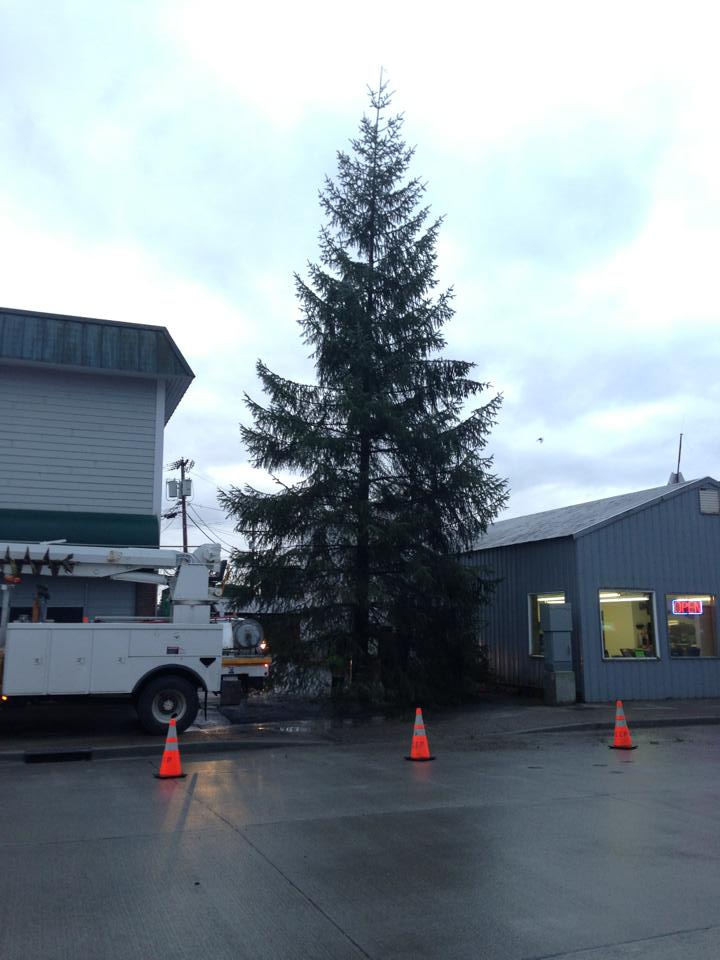
Christmas tree in its stand – Photo by Shady Grove Oliver/KSTK
Wrangell’s Christmas tree has come out of the forest and into its new home downtown.
Tuesday. Downtown Wrangell. 12 o’clock sharp. A fully grown man is shimmying up a massive Picea Sitchensis—that’s Sitka Spruce—in the middle of town.
Wrangell Municipal Light & Power Superintendent Clay Hammer explains:
“He is climbing up the tree to unhook the cable that we used to swing it and put it up there. Dwight is our tree monkey this time around…he’s the youngest,” says Hammer.
It’s big, it’s green, and it goes up a lonnnnng way.
“It’s about 45 feet tall. I don’t know how many stories that is. I know Petersburg’s is two stories tall. The Elks is at least two stories and it’s a lot taller than the Elks, so for bragging rights, I’m going to go with three,” says Hammer.
Now, we haven’t seen Petersburg’s ourselves, but word on the street agrees with Hammer that ours is bigger–an important detail to note.
And getting such a huge tree into town takes a lot of preparation and work.
First, you’ve got to find the right tree. In this case, the Forest Service gave permission to take a tree out the road.
“Basically we start canvassing the town in the early part of mid-October. We start looking for trees around town and if we don’t find any good candidates in town, we start branching out a little further,” says Hammer.
So they branched out, no pun intended, to about a quarter mile past the pavement end out the road.
And, as luck would have it, this coniferous giant came from the same stand as last year’s tree.
“It just happens that there’s a bunch of reprod there—some second-growth that’s coming back on a Forest Service timber sale years ago. And those trees in that area right now just happen to be ideal,” says Hammer.
And just how long ago did our mighty specimen first peek its first buds out of the ground?
“Actually I was counting the growth rings to find out how old it was and I counted 34 rings, so it’s about 34 years old,” says Hammer.
For three decades, this mighty spruce stood tall in the Tongass. And yesterday, several people worked together to bring it to town.
Lineman Mark Armstrong explains the complicated process:
“Well, we had a new trailer this year. So we built some different stands for it. We had to take the line truck out there to lift it with. The Public Works provided a dump truck to haul the trailer. So, Stan Campbell hauled the tree in for us this year. Just cut it, pick it up, put it on the trailer and haul it in. We shout like crazy as we come down the highway to make sure nobody gets brushed off to the side.”
Clay Hammer agrees:
“We didn’t lose any branches along the way, so that’s a good thing. We didn’t wipe out any garbage cans or anything like that. With a big, wide tree like that you have to worry about that sometimes.”
So, despite the potential havoc Clay Hammer is describing, the tree made it to town. The Public Works guys winch it up—making sure the bottom is heavier than the top. The tree rights itself; they slide it into its stand and bolt it in place.
The last step? Again, Mark Armstrong:
“We’re trying to get it straight, but I think it’s going to be what it is. Looks like this year, our tree’s going to lean a little bit north, but we’ll do what we can.”
Now, the tree has to be decorated, covered in lights, and generally *cough* spruced up to get ready for the Tree Lighting ceremony on December 6th. But we’ll save that for another story.
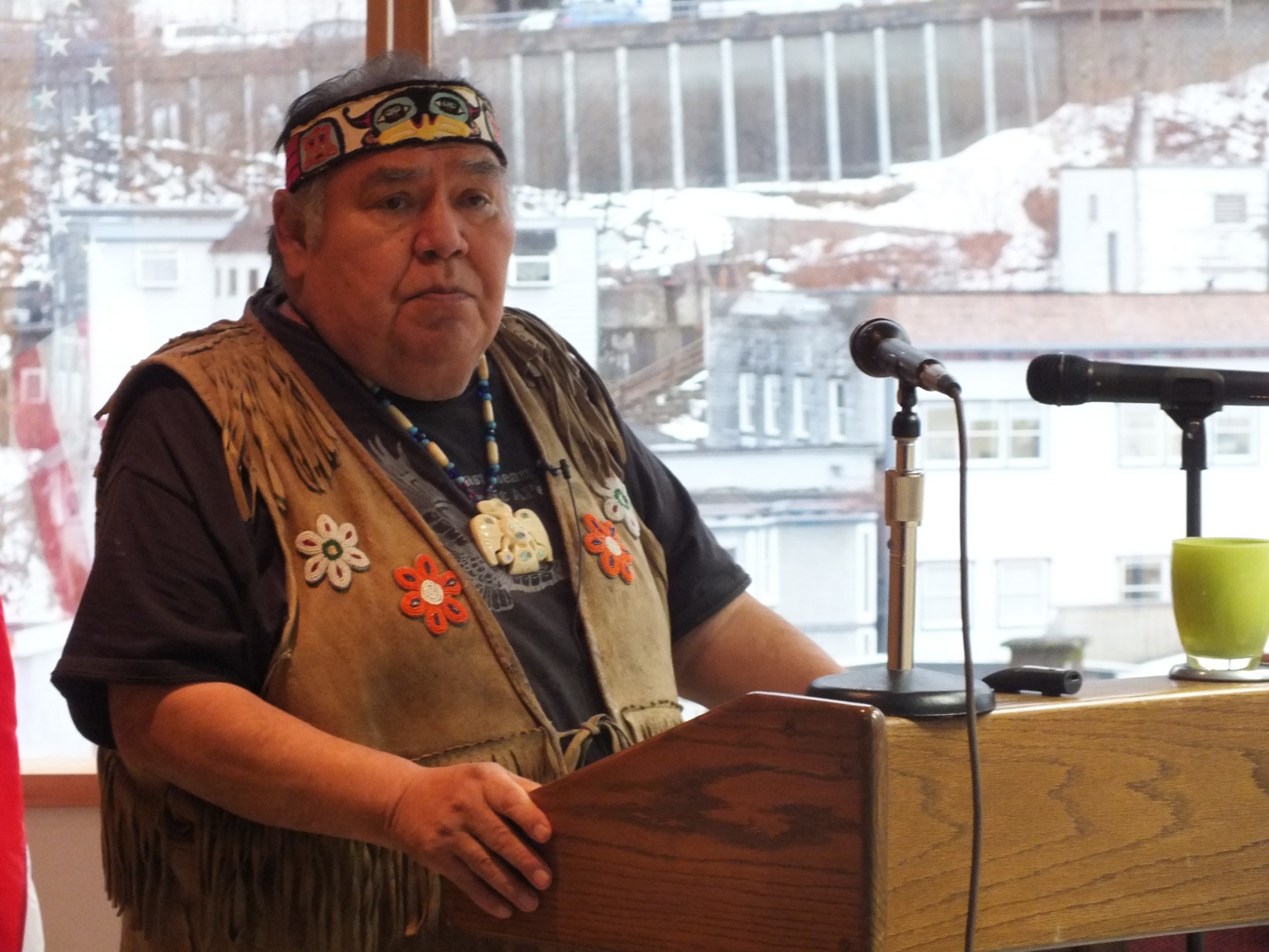
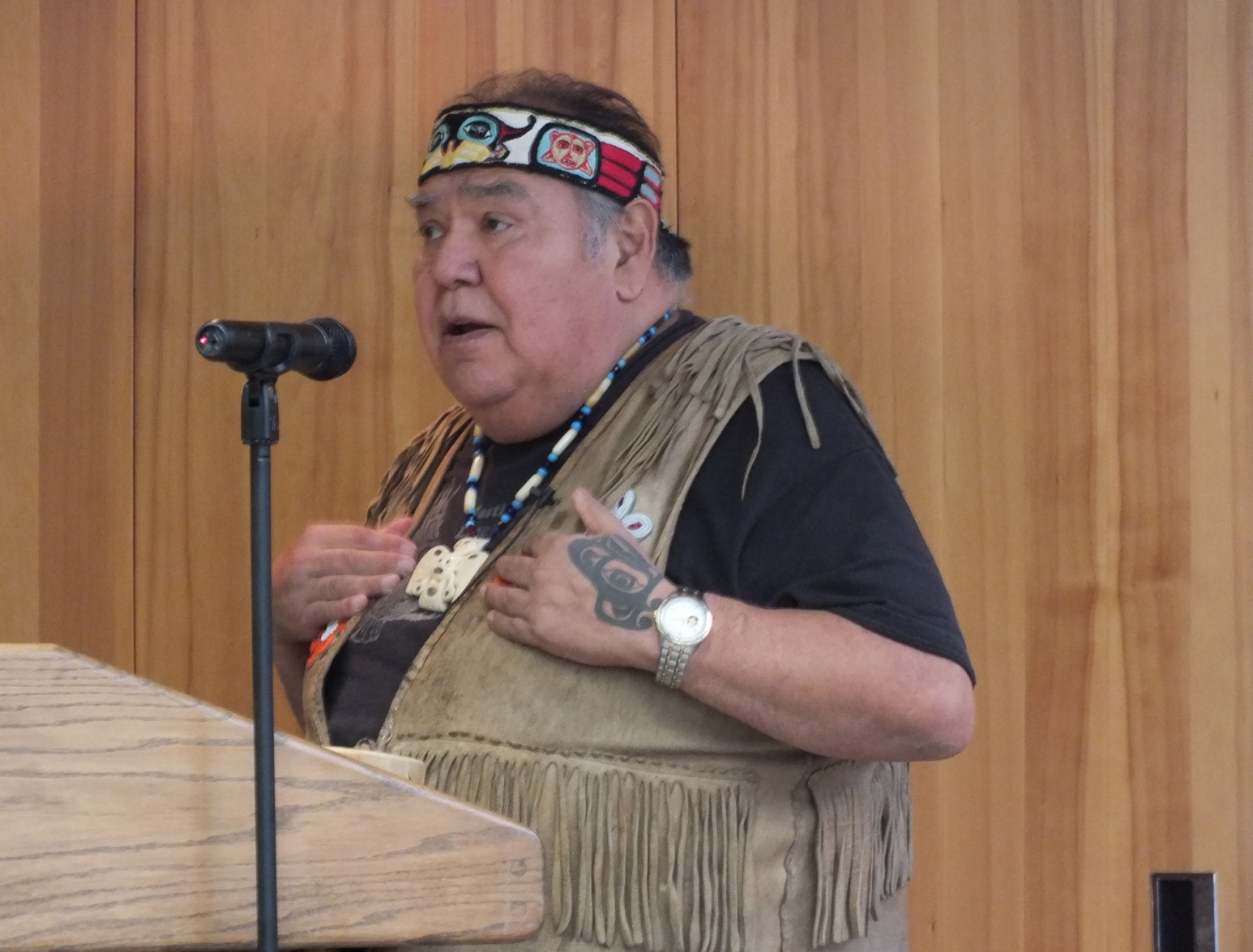
David Katzeek is a Shangukeidí Clan leader. Photo by Casey Kelly/KTOO.
One of the speakers for Forum@360: Living the Language, David Katzeek was the first president of the Sealaska Heritage Foundation, now known as the Sealaska Heritage Institute. (Photo by Casey Kelly/KTOO)
A Shangukeidí Clan Leader says the essence of Tlingit spirituality is this: Everything has a spirit.
David Katzeek spoke Tuesday in the final installment of Sealaska Heritage Institute’s Native American History Month Lecture Series.
“We have words for it,” Katzeek said, speaking the phrase first in Tlingit, then English. “I have the spirit within me.”
In the Tlingit tradition, Katzeek said the words he spoke came not from him, but from his teachers and ancestors.
“Because the spirit of humbleness is acknowledging those who taught you,” he said. “Those who loved you enough to sit with you, and share with you beautiful jewels that you can experience, that you can have, that you can enjoy, that you can use, that you can apply.”
Katzeek was the first president of the Sealaska Heritage Foundation (now the Sealaska Heritage Institute), serving in that job from 1982-1992. He’s a Chilkat Eagle of the Shangukeidí Clan from the Thunderbird House.
A video still from a 2013 episode of Alaska Robotics News with host Pat Race. (Courtesy of Alaska Robotics)
Update, 7:13 p.m. 11/26/2013: Pat Race says the $8,245 figure on Kickstarter doesn’t include another $225 in “brown bag” contributions from people in politically sensitive positions who gave anonymously.
Original post:
Alaska lawmakers and politicians will have a few more committed critics to contend with this session, but at least these guys have a sense of humor.
Juneau-based Alaska Robotics is a label that Pat Race, Aaron Suring and Lou Logan use when they put out videos, illustrations, comic strips and other creative media.
Juneau Police say a juvenile brown bear was hit and killed by a car early Tuesday morning on Glacier Highway in the Lemon Creek area. Lt. Dave Campbell says the accident happened near Tyler Rental in the 5200 block. He says the driver was not cited, no one was injured and the car had minor damage.
Alaska Fish and Game wildlife biologist Ryan Scott examined the young male and said it appeared to be 2 to 4 years old. The bear weighed about 300 pounds, and based on the amount of fat in its stomach, Scott says, it was in pretty good condition.
“We didn’t do a full necropsy on him but we did examine the stomach contents and it was full of plastic and human food and things like that, candy wrappers, stuff like that. It’s another reminder to all of us that even right now we still have bears active in Juneau,” Scott says. “I know it’s late, everybody knows it’s late, but they’re not going to go away if they continue to get food.”
Scott says he’s had plenty of reports of black bears still out and about in the Mendenhall Valley and the downtown area. While it’s unusual to have brown bears in the more populated parts of Juneau, they are more prevalent out the road. He doesn’t think the brown bear killed on Tuesday was the same brown bear seen along the Mendenhall River in mid-November.
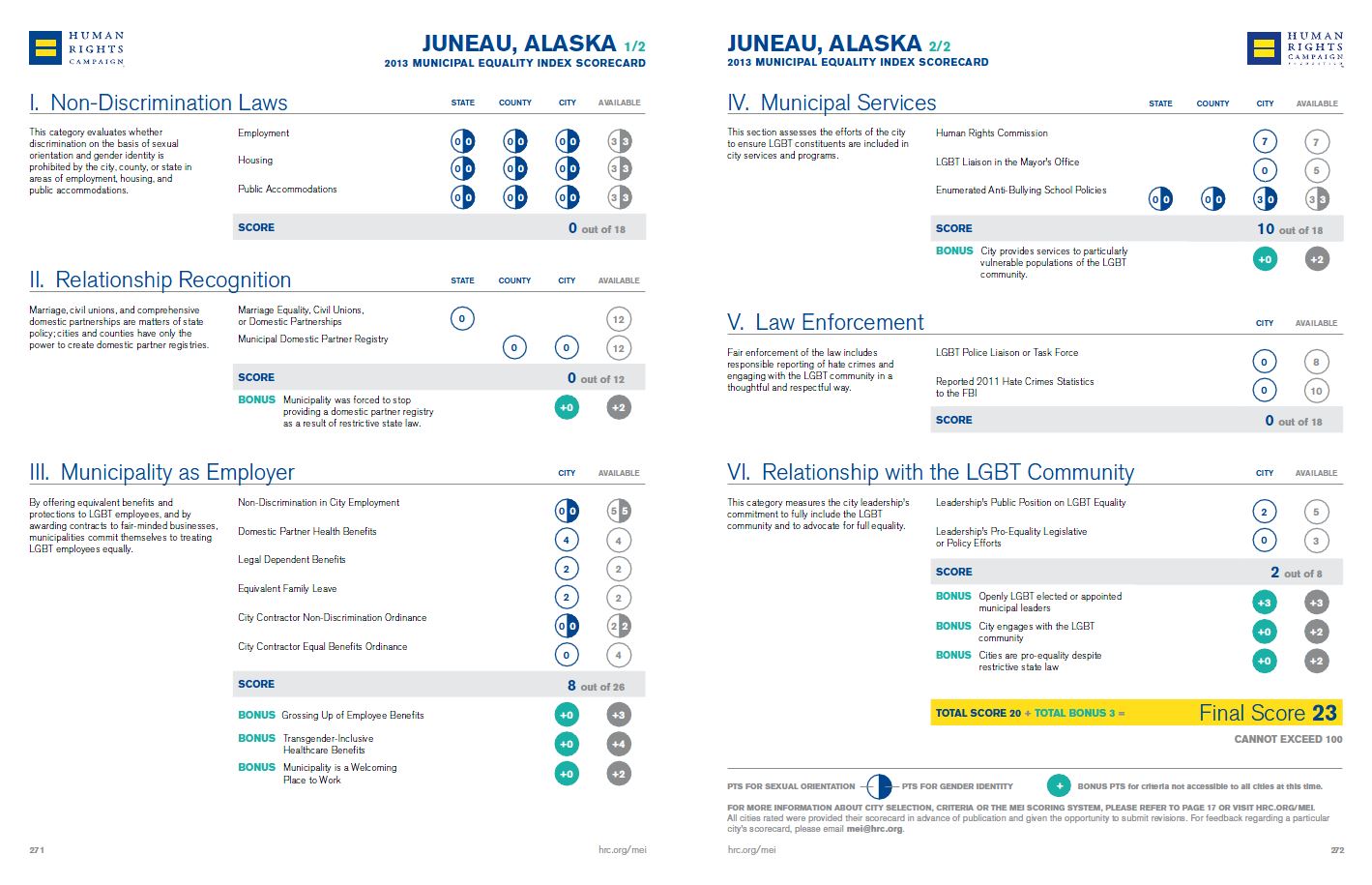
Alaska’s three largest cities were included in the recent Municipal Equality Index. The survey is a scorecard that that evaluates the rights of lesbian, gay, bisexual and transgender people.
The results show that Alaska’s three largest cities have a lot of room for progress.
Juneau scored 23 points out 100 points. There was an additional 20 bonus points possible.
Juneau received credit for having domestic partner health benefits, legal dependent benefits and equivalent family leave. The city also received points for having a Human Rights Commission and anti-bullying school policies. Three bonus points were awarded for having openly LGBT elected or appointed municipal leaders.
Nearly 300 cities were involved with the survey which measured city laws, employment practices, services, law enforcement and relationships with the LGBT community.
25 cities included in the survey had perfect scores including Missoula, Atlanta, Austin and Phoenix.
The study does note that not all cities are able to enact laws or ordinances that the survey measures due to restrictive state laws.