Alaska Native Corporations

Alaska’s top court questions restrictions on ANCSA shareholder speech

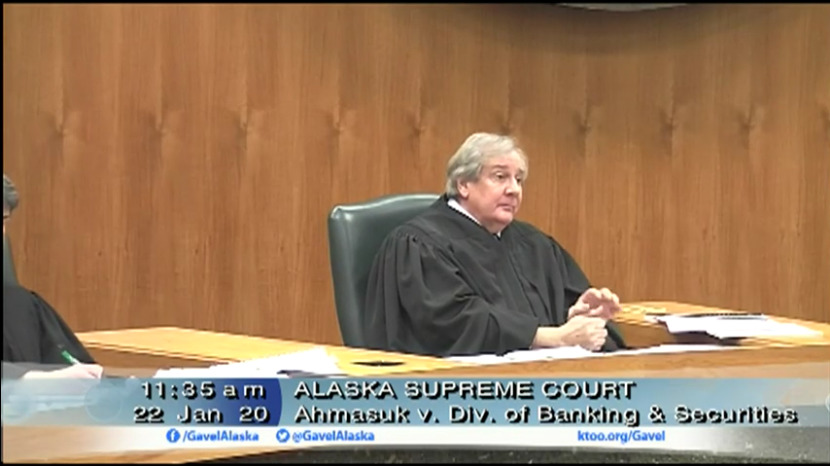
Supreme Court justice Daniel Winfree questions the state’s broad authority to regulate shareholder speech during Wednesday’s oral arguments in a case that tests the limit of free speech in Alaska Native corporation board elections. (Screenshots courtesy of KTOO/Gavel Alaska)

Alaska Supreme Court justices expressed skepticism over the state’s broad power to regulate the speech of Alaska Native corporation shareholders. A case was brought before the court by the American Civil Liberties Union of Alaska to test the limits of the state’s power to regulate free speech in corporate elections.

It all started with a letter to the editor penned in 2017. The author didn’t say who shareholders should vote for. Rather, he urged Sitnasuak Native Corporation shareholders reading the Nome Nugget to avoid casting “discretionary proxies.” That’s the equivalent of handing in an unmarked ballot, that could be filled by the incumbent board of an Alaska Native corporation.

In this instance, the corporation complained to state regulators from the Division of Banking & Securities. The division stepped in and sanctioned letter writer Nome shareholder Austin Ahmasuk. He was charged with civil penalties for not filing a disclosure form prior to writing to the newspaper. The state also alleged there were misstatements. But, that point remains unresolved and — Ahmasuk’s lawyer said — legally irrelevant to the case.

“Alleged misstatements are not at issue here,” the ACLU’s Susan Orlansky told the justices during Wednesday’s oral arguments in Anchorage. “Mr. Ahmasuk was fined and is in front of this court, because he failed to send the letter to the division on the same day that he sent it to the newspaper, because he failed to fill out the disclosure form.”
ACLU of Alaska senior counsel Susan Orlansky delivers opening arguments of an appeal filed on behalf of a Nome man sanctioned by the state over a critical letter to the editor he published in the Nome Nugget in 2017. (Screenshots courtesy of KTOO/Gavel Alaska)
ACLU of Alaska senior counsel Susan Orlansky delivers opening arguments of an appeal filed on behalf of a Nome man sanctioned by the state over a critical letter to the editor he published in the Nome Nugget in 2017.

Alaska Native corporations were created by an act of Congress nearly 50 years ago as part of the Alaska Native Claims Settlement Act. But the federal government left it up to the state to regulate them. That regulation includes the board of director elections and there are restrictions over public statements that can sway the election.

Assistant Attorney General Robert Schmidt represented the state’s financial regulator and he says the rules are important.

“Without division oversight it would be a free-for-all with the only enforcement mechanism being litigation between corporations and shareholders,” he told the court.

He said this oversight role keeps the state financial examiners busy.

“Of all the division’s enforcement areas, banks, financial institutions, securities, the division spends more time on ANCSA solicitation enforcement than any other program area,” he said.

In 2019, the division received 27 complaints to investigate public statements by Alaska Native shareholders. Five of the complaints generated formal enforcement actions — all but one of these involving social media chatter on Facebook.

Austin Ahmasuk v. Division of Banking and Securities is a test case for these types of actions. The ACLU’s Orlansky argued the division’s requirement for disclosure filings in advance of any statement that could sway elections has over time, become too broad and effectively chills public speech around corporate governance.

“And that gets the division into regulating all sorts of political speech dissident speech – ‘What’s wrong with this corporation?’ – as well as favorable speech,” she said.

At one point, Justice Daniel Winfree quizzed Schmidt over how broad the state’s authority is over shareholder speech by posing a hypothetical:

“If you wrote nothing other than, ‘It’s time for everybody come to the shareholder meeting instead of voting by proxy, don’t execute proxies come to the meeting and vote.’ That’s a violation of law?”

Yes, your honor, the state attorney replied. He clarified that it would require the shareholder to file a disclosure form with the division.

“And if you don’t register it’s a violation of the law?” Winfree said.

Yes, replied the attorney.

“Isn’t that a little much?” Winfree said.

Chief Justice Joel Bolger asked about the consequences of the ACLU’s argument. He said the state regulations over corporate speech also ensure Native corporations don’t put out false information that could dupe shareholders.

“And so if we do as you say, aren’t we opening a loophole?” Bolger asked Orlansky. “That will be a loophole not only for the weak, but also for the mighty? “

Orlansky said that Alaska could model its rules after the federal Securities and Exchange Commission which regulates publicly traded corporations, but not ANCSA corporations.

The SEC loosened its restrictions in 1992. It no longer requires shareholders not running for a board set to pre-file disclosures before making public statements. But it’s kept the regulations in place for corporations to ensure no misleading or false statements are made.

“And so that I think is part of the answer,” Orlansky said, “is that this may not necessarily need to be a scheme that is even-handed.”

The justices said a written decision would be forthcoming. They didn’t indicate when.

 

For Alaska Native shareholders, criticism on social media during board elections can trigger state fines

Social media phone
(Creative Commons photo by Jason A. Howie)

State regulators will fine some Alaska Native corporation shareholders over their criticism on social media. That’s because free speech is not protected when it comes to corporate elections.

Sealaska Shareholders Underground is a Facebook page with about 1,600 followers. It’s the mouthpiece of Dominic Salvato.

“Every year we see the same millions of dollars go to the same people,” the Anchorage-based Sealaska Corp. shareholder and perennial critic of the corporation’s management said in a recent interview. “We just get separated further and further from the ownership of our stock.”

But Salvato’s comments were more than simple criticism. State regulators accuse him of misrepresenting how Sealaska pays out incentives to shareholders to vote in board elections. He faces a $1,500 fine.

In Sitka, Clarice Johnson moderates a Facebook forum for Sealaska shareholders. It has more than 4,800 members; she said it connects shareholders across the country.

“A lot of people are in the (Pacific) Northwest, so Facebook was the most efficient way to reach the most shareholders,” she said.

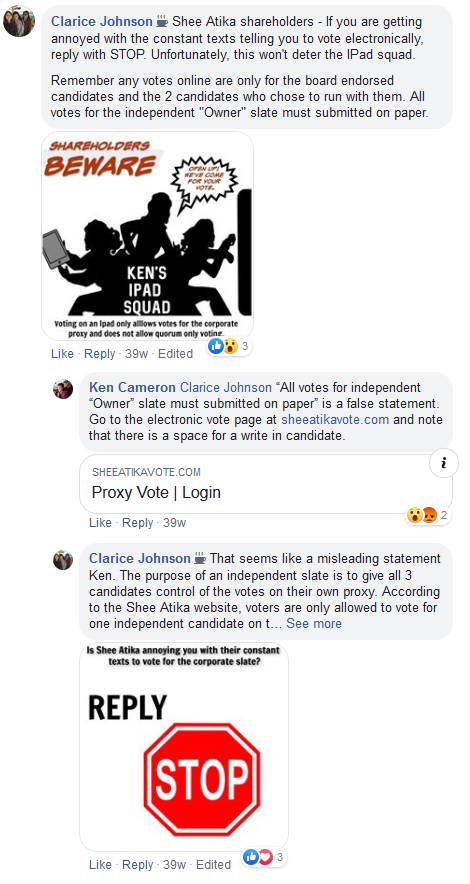
But her critical comments in a different forum about Sitka urban Native corporation Shee Atiká’s electoral process brought a state enforcement action against her. She’s on a three-year probation and has a suspended $1,500 fine hanging over her head.

“I think that shareholders don’t really understand their potential liabilities,” she told CoastAlaska. “We think we have free speech, and we don’t. I don’t know how we came to this situation, but it’s really disturbing.”

Both Johnson and Salvato were fined because they violated the state’s Division of Banking and Securities regulations. In 2019, they were among four shareholders who received cease-and-desist letters with civil penalties for online posts about board elections. That’s because in the corporate universe, any statement that could influence voting has to be preceded by formal disclosures — that includes Facebook comments.

Division officials declined an interview request earlier this month. By Jan. 14, they had not answered written questions sent on Jan. 9.

The division regulates Alaska’s financial industry — including Alaska Native corporations. It levies civil fines, though shareholders do have the right to a hearing.

“Although the term ‘elections’ is used, and it suggests in people’s minds the First Amendment, when it comes to corporate elections, the First Amendment is not a relevant concept,” said Lloyd Miller, an attorney specializing in Alaska Native issues, told CoastAlaska.

Regulations policing what a shareholder can and cannot say are designed to punish false or misleading statements that could hurt a company.

“So these rules that are intended to apply for the Exxon corporations of the world, or General Motors or Boeing, are also being applied in a very different context with very peculiar results,” Miller said.

Enforcement orders begin as confidential complaints that are investigated by the state. But Miller said they’re apparently weighted in favor of the powerful. That’s because corporate managers have a legal team and know the rules. Shareholders often don’t.

But that complaint-driven system can work in the other direction. After Johnson was sanctioned for her posts about Shee Atiká’s election process, the corporation’s then-CEO responded on Facebook.

“He had the resources to know what he could and couldn’t say, and he chose to violate it,” Johnson said in a recent interview.

There was a back-and-forth in April 2019 on a Facebook group called “Sitka Chatters” between Shee Atiká shareholder Clarice Johnson and then-CEO Ken Cameron over whether a shareholder could support more than one independent board candidate using the corporation’s online voting portal. (CoastAlaska screenshot)

She filed her own complaint against the CEO. The division placed Shee Atiká’s top executive on a five-year probation with a suspended $1,000 fine. He wasn’t accused of making false statements. He just hadn’t filed the required disclosures in advance of his Facebook posts.

And filing a proxy disclosure isn’t simple. It’s a multi-step process. The disclosures ask a lot of information. And it’s the same whether a shareholder wants to send a mass mailer or post on social media.

Sealaska executives say the regulations are designed to keep everyone playing fair. Jaeleen Kookesh, Sealaska’s vice president for policy and legal affairs, said management sometimes has to remind its own board members to abide by the strict limits placed on corporate election campaigns.

“It’s about everybody running for the board of directors following all the rules. Otherwise, it’s unfair to other candidates,” Kookesh told CoastAlaska.

Bringing the state in to police shareholder speech is a last resort, she said.

“It’s very rare that we go to Banking and Securities and file an actual complaint,” Kookesh said. “We generally try to communicate with the shareholder directly … and usually that’s all that it takes.”

Salvato said he’s got no intention on backing off. He’d like to see the state’s restrictions on corporate speech reviewed by a judge.

“I try to goad them into suing me and get me into court — Sealaska itself,” Salvato said. “But they use the Banking and Securities as a buffer. It’s insulation.”

His case is pending in an administrative process overseen by the division.

Johnson also said, even though she was sanctioned, she refuses to be silenced by the threat of civil fines.

“I think that the increase in complaints to Banking and Securities against shareholders is a direct result of increasing power of shareholders as they gather in Facebook groups,” she said. “We’ve seen a rise of independent candidates across the board. So I think that this is just the way the corporations are pushing back against the will of the people.”

Miller said it’s unreasonable for the state to regulate Native corporation board elections like that of just another investor-owned company.

“There really is a bit of a mismatch between the corporate world and the Alaska Native corporation,” Miller said. “The Alaska Native corporations were forced upon people. People don’t buy in based upon investor interest.”

He said the state’s regulations could and should be updated. Many were designed in the 1970s to prevent misleading mailings that could dupe shareholders, though there are specific regulations that explicitly cover “electronic forums.”

“Now it’s very quick back-and-forth among hundreds, potentially thousands of people on Facebook and Instagram, other platforms,” Miller said. “And the regulatory regime hasn’t kept up with that world at all. It really needs to change.”

Dissident shareholders like Salvato say the rise of social media has been a game changer.

“But I warned Sealaska about that. I said, ‘When you bring the young kids aboard with the new shareholders, they’re not as dumb as the old ones,’” Salvato said. “They’re going to be a lot smarter. They’re not going to be able to pull this stuff for as long.”

Opening the Arctic Refuge brought Alaska’s largest Native corporation $22.5M from BP and Chevron

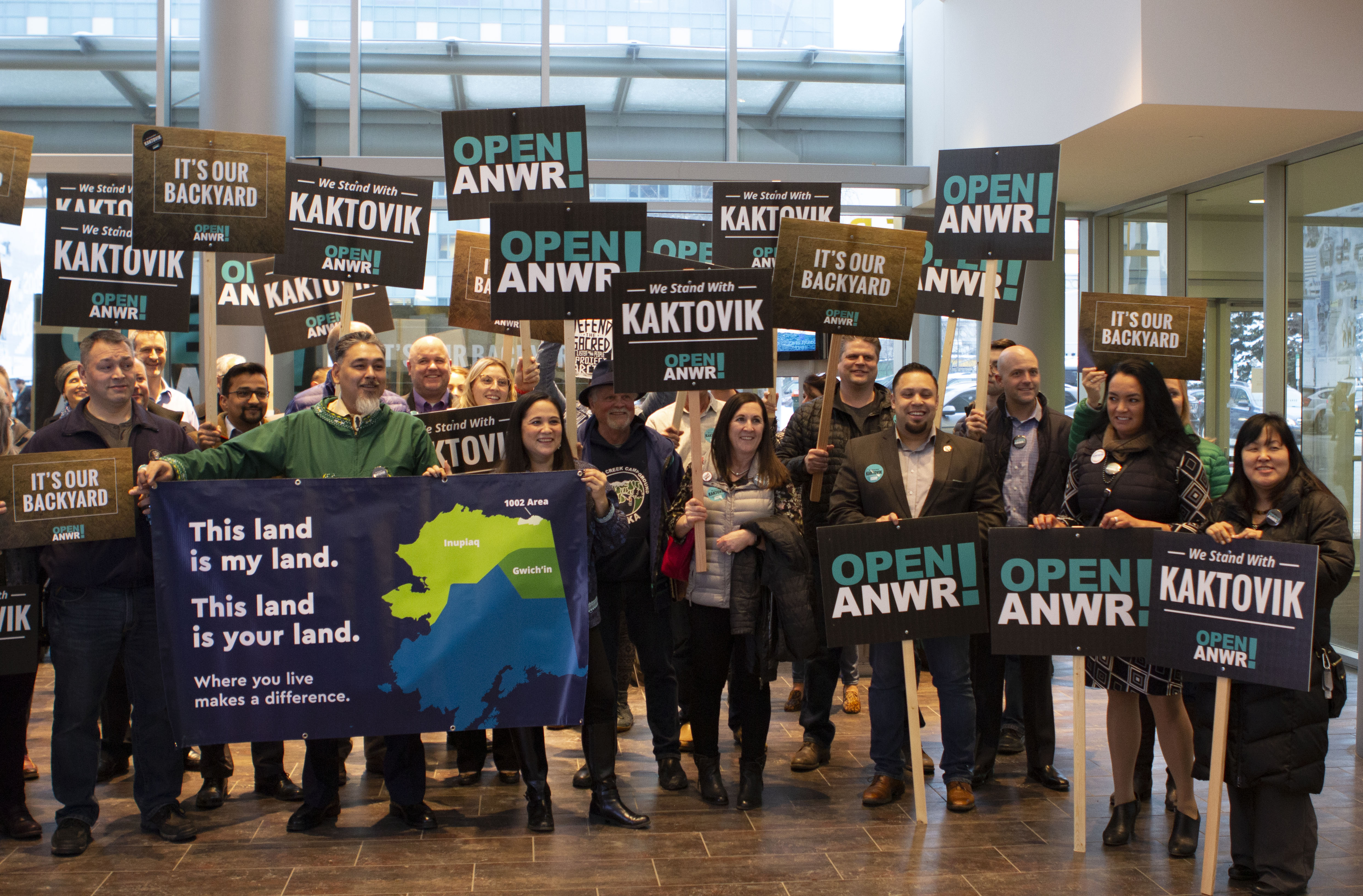
Arctic Slope Regional Corp. leaders and supporters held a press conference outside an Anchorage public meeting on oil leasing in the Arctic National Wildlife Refuge on Feb. 11, 2019. (Photo by Elizabeth Harball/Alaska’s Energy Desk)

The Alaska Native regional corporation for the North Slope collected $22.5 million from a pair of oil companies after Congress opened the Arctic National Wildlife Refuge’s coastal plain to drilling in 2017, according to corporate documents.

Arctic Slope Regional Corp., whose 13,000 Alaska Native shareholders own the oil rights to 140 square miles along the coastal plain, has long been one of the most aggressive advocates for opening the refuge to oil development. The payment, referenced in ASRC’s latest annual report, underscores just how much the corporation had to gain from the congressional action. It stands to benefit further if the oil companies, BP and Chevron, ultimately find and produce petroleum on its property.

ASRC’s 92,000 acres, along with the 1.6 million acres of federal lands in the coastal plain, were all off-limits to drilling until late 2017, when Congress passed the tax overhaul that opened the area to development. ASRC previously confirmed that a payment had been made under an existing, decades-old lease agreement with the oil companies, but it declined to reveal the amount.

ASRC is the largest Alaska-owned business, with annual revenues exceeding $3 billion and more than 15,000 employees inside and outside the state.

The corporation is heavily invested in oil and gas, with its own refineries and an oil-field services business; it also collects royalties from oil production on some of its lands outside the Arctic Refuge.

Those holdings have proven valuable to its owners: ASRC’s most recent annual dividend was $7,000 for each shareholder with the standard 100 shares. But the corporation’s pro-development position has recently caused tensions with other Alaska Native groups, whose members say they’re threatened by global warming. And ASRC recently withdrew its membership from the Alaska Federation of Natives.

ASRC spokesperson Ty Hardt declined to comment on the payment from the two oil companies. A Chevron spokesperson, Veronica Flores-Paniagua, and a BP spokesperson, Meg Baldino, each confirmed that the payment had been made, but declined to comment further. Officials at Hilcorp, which is acquiring BP’s stake in the Arctic Refuge lease in a pending business deal, declined to comment.

ASRC’s shareholders are descendants of the Iñupiat people who originally inhabited the North Slope, and the corporation acquired roughly 5 million acres of land through the 1971 Alaska Native Claims Settlement Act. The act granted a dozen Alaska Native regional corporations a total of $960 million and 44 million acres, or a little more than 10% of the state’s total area. In exchange, Alaska Native groups set aside their aboriginal land claims, which had delayed construction of the trans-Alaska oil pipeline.

When the act passed, ASRC was barred from claiming potentially valuable oil-bearing lands in the Arctic Refuge and the National Petroleum Reserve in Alaska, because those areas had already been set aside by the federal government. But a decade later, ASRC struck a deal with President Ronald Reagan’s administration to trade 101,000 acres of the corporation’s land within Gates of the Arctic National Park for 92,000 acres of subsurface rights within the refuge — around the village of Kaktovik.

The land trade set the stage for a 1984 lease between ASRC, BP and Chevron, and it also gave them the right to drill the only exploratory test well ever placed in the Arctic Refuge. The results from the well are still one of the oil industry’s most tightly-guarded secrets, though a New York Times report last year suggested that they were not promising.

After the well was drilled, both the corporate and federal lands along the coastal plain remained closed to actual oil production until Congress’ 2017 vote. ASRC had allowed Chevron and BP to suspend their lease payments while the closure remained in place, said Teresa Imm, an ASRC resource development executive, in an interview last year.

ASRC was a major participant in the lobbying campaign to open the refuge to oil development, nearly doubling its federal lobbyist spending in 2017 to $590,000, according to figures compiled by the Center for American Progress, a Washington, D.C.-based liberal advocacy group.

ASRC’s lands along the coastal plain are far from existing oil infrastructure, meaning development there could still be decades away. But drilling opponents are already questioning how the ASRC-controlled area fits into the Trump administration’s plans to open the refuge’s federal lands to development, and they want to know what environmental safeguards will apply.

“ASRC lands potentially being open to oil and gas is a major change in private land use that must be clearly addressed,” a coalition of more than two dozen opponents wrote in a March comment letter to the Bureau of Land Management, which is leading the environmental review in advance of drilling in the refuge. The groups added: “BLM must be clear on this point.”

BLM officials pointed to the agency’s written response to the letter, which was published as part of a 2,100-page document that addressed the thousands of unique public comments on the Trump administration’s draft environmental review.

That review, BLM wrote, “is not intended to address ASRC’s management of oil and gas exploration and development on its lands.” Restrictions and environmental safeguards adopted by BLM, the agency added, “will only apply on federal lands within the coastal plain.”

Any development on ASRC’s land would still have to comply with national environmental laws like the Clean Water Act and Marine Mammal Protection Act, which could trigger permitting and other requirements for individual projects. And the 1983 land trade also gave the U.S. Fish and Wildlife Service authority to review proposed oil development on ASRC lands, and includes a list of specific environmental safeguards that companies must follow.

Longstanding tensions underlie Arctic Slope Regional Corporation’s withdrawal from AFN

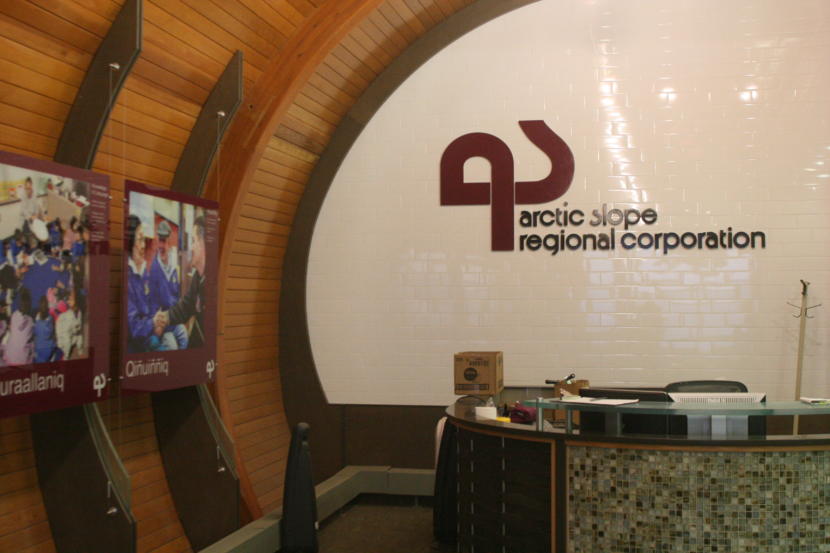
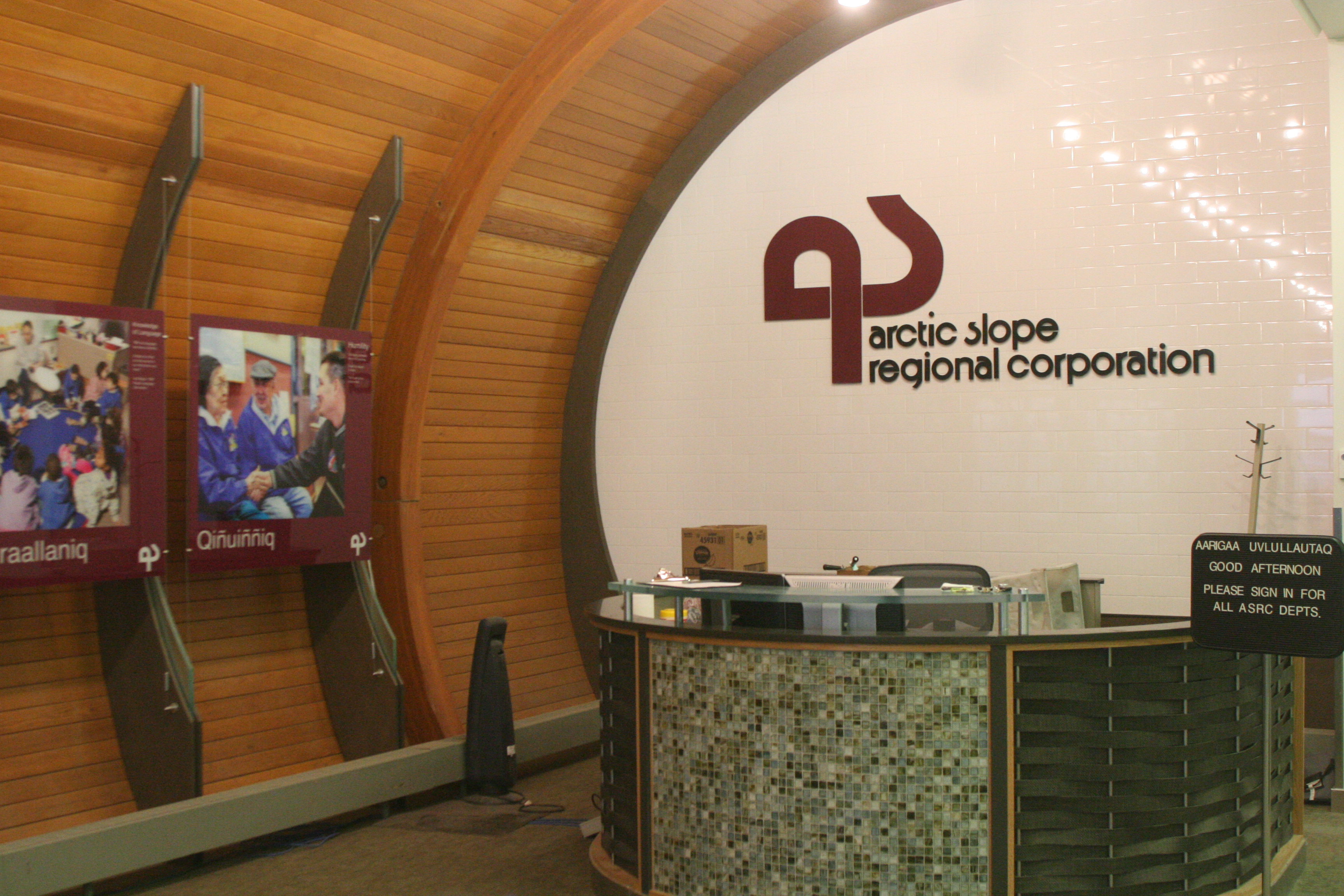
The Arctic Slope Regional Corporation’s corporate headquarters in Utqiaġvik, Alaska. January, 2018. The corporation announced its withdrawal from the Alaska Federation of Natives in December, 2019. (Ravenna Koenig/ Alaska’s Energy Desk).

Long before Arctic Slope Regional Corporation (ASRC) announced its withdrawal from the Alaska Federation of Natives (AFN) last week, there were signs of a schism between Alaska’s largest Native corporation and most influential Native advocacy group.

At the center of it: oil, ASRC’s responsibilities to its shareholders, AFN’s wider responsibilities to its member groups and growing pressure caused by climate change’s impacts on infrastructure and subsistence.

Tensions between ASRC and AFN appeared to be building in recent years. In a hard-fought U.S. Senate race in 2014, AFN took the rare step of endorsing a candidate: incumbent Democrat Mark Begich, who delegates praised for his connection to rural Alaska and his support for Natives’ subsistence traditions.

Board members of ASRC, meanwhile, endorsed Begich’s Republican opponent, Dan Sullivan, citing his support for “responsible energy development.” And while AFN endorsed Democrat Hillary Clinton in 2016, ASRC’s executives celebrated at the Trump White House a year later, after Congress approved the legislation opening part of the Arctic National Wildlife Refuge to oil development.

ASRC is charged with representing the business interests of some 13,000 Inupiat shareholders. It explained its withdrawal from AFN last week by saying only that the corporation intends to focus on the needs of the North Slope. An ASRC spokesman, Ty Hardt, declined to be interviewed or answer questions about the decision.

Since the corporation’s announcement, some have speculated that the split stems from AFN’s convention in October, where an ASRC leader clashed with delegates who were pushing for more action on climate change.

But ASRC says the decision was under consideration for more than a year. And in fact, North Slope Native organizations have long had a fraught relationship with AFN, stemming in part from members’ unique homeland, which lies atop billions of barrels of oil.

A more complete explanation of ASRC’s decision, according to people who have worked with the corporation, is that global warming has put new pressure on the existing fault lines among the different institutions that look out for Alaska Natives’ well-being.

Alaska’s 12 regional corporations, including ASRC, are big for-profit businesses, with a relatively narrow focus on generating revenue to support cash dividend payments to shareholders. Tribal governments and nonprofits, meanwhile, are more focused on providing services and supporting Natives’ social welfare.

Climate change threatens to pit those interests against each other in new ways. Tribal governments and nonprofits say they’re being saddled with climate change’s costly impacts, while some regional corporation leaders see greenhouse gas regulations as a potential threat to their bottom line.

“On one side, you have monetary impact, and on the other side you have even greater impact on the planet itself,” said Roy Huhndorf, the former chief executive for Cook Inlet Region Inc., the Native regional corporation for Southcentral Alaska.

“I think Native corporations are the same, in a microcosm, as the Exxons and BP’s of the rest of the world who don’t want to abandon oil production now because it hurts them financially,” he said. “On the other hand, you can understand where the rest of the world is wanting to go.”

Native corporations are some of Alaska’s largest and most influential businesses, with ASRC at the top of the heap.

ASRC’s revenues last year exceeded $3 billion, with dividends of $7,000 paid to each shareholder with 100 shares, according to the corporation’s annual report. It has more than 13,000 employees spread across Alaska and beyond, working in six major areas of business.

Among ASRC’s holdings is PetroStar, which owns oil refineries in Valdez, and near Fairbanks in North Pole. It sold a record 356 million gallons of oil products last year and generated $885 million in revenue. ASRC also owns an oilfield services company, with more than 2,300 workers in Alaska, that does engineering, construction and permitting for some of the world’s largest oil and gas companies, in both Alaska and the Gulf of Mexico.

The corporation also benefits directly from oil development on its own land entitlement of nearly 5 million acres on the North Slope — an area almost the size of New Jersey. It collects royalties from oil production in the Colville River Unit, home of ConocoPhillips’ Alpine field, and reported natural resource earnings averaging $50 million a year over the past three years.

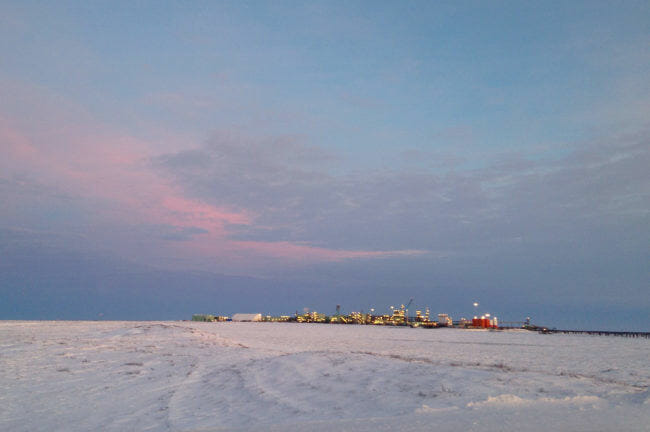
ConocoPhillips’ Alpine facility on the North Slope. Conoco’s Scott Jepsen said a new processing facility in NPR-A would be about the same size. (Photo by Elizabeth Harball/AED)
ConocoPhillips’ Alpine facility on the North Slope, which pays oil royalties to Arctic Slope Regional Corp. (Photo by Elizabeth Harball/Alaska’s Energy Desk)

At AFN’s convention in October, when two teenage delegates were pushing for approval of a statement declaring an emergency on climate change, ASRC’s board chair, Crawford Patkotak, pushed back. He asked to add language to preserve Natives’ “rights to the resources,” saying that the declaration risked inviting “unnecessary regulation” with devastating economic effects.

Patkotak wasn’t the only regional corporation leader who was concerned: Gail Schubert, chief executive of the Nome-based Bering Straits Native Corp., also urged delegates to be cautious. Native corporations, she said, “were charged with creating economies, delivering dividends and other benefits to our shareholders.”

“I understand and accept and have said publicly that we are experiencing climate change,” Schubert said. “But I also want to make sure that we don’t do something, as a body, that allows outside groups to come in and basically dictate what we can do and can’t do in terms of both our natural and our subsistence resources.”

Several other delegates argued against Patkotak’s proposed language before it was rejected, including Esau Sinnock, a young man from the village of Shishmaref, on the Chukchi Sea coast in western Alaska. Rising sea levels are forcing residents there to consider relocation.

“My one and only home is being eaten by the sea,” Sinnock said. “It’s very important to talk about climate change urgently, right now, because it affects so many indigenous people.”

Diverging interests among regional corporations like ASRC and other Native organizations are not new — they date back to the 1971 Alaska Native Claims Settlement Act, which created the corporations.

But in addition to those institutional fissures, the North Slope is also unique as a region. When AFN voted overwhelmingly to urge President Richard Nixon to sign the 1971 legislation, representatives of the Arctic Slope Native Association vehemently disagreed.

They objected to the settlement because it allowed the state of Alaska — not ASRC — to keep the North Slope’s most valuable oil-bearing lands. And it also required ASRC to share its oil revenues with other regional corporations, though those other corporations would also have to share their resource revenue with ASRC.

“They’ve got a righteous argument in saying they should have been able to select lands that they traditionally used ahead of the state, but they weren’t — the state had already finished selecting the land by the time ASRC had come into existence,” said Huhndorf, the former CIRI executive. “They feel that they were used from all sides.”

ASRC, in its announcement last week, said it intends to focus “on the various needs within Alaska’s North Slope, where there is an increased degree of alignment as well as additional efficiencies related to shared geography and other interests.”

The corporation’s perspective won’t be completely lost from AFN, because some of the corporation’s shareholders will still belong to the federation, as delegates from the North Slope’s regional nonprofit, village corporations and tribal councils.

“They’re still Native people, so it doesn’t end cooperation and talking or working together on things,” said Julie Kitka, AFN’s president. “We don’t second guess them, we don’t attribute motives to them — we take them at face value.”

Karlin Itchoak, an ASRC shareholder who directs the Anchorage office of The Wilderness Society, an environmental organization, said that the urgent challenge posed by climate change makes it an especially important time for Alaska Native organizations to work together.

“Stopping all dialogue at AFN is not being a part of the solution,” he said. “It would be better if folks could just get along and work together and agree to disagree. Stay at the table and continue to have a dialogue on how we can mitigate the adverse environmental impacts of climate change that are directly related to extraction.”

No corporation goes forward with development without considering the environmental consequences and impacts on villages — and without doing everything possible to make sure it’s safe, said Georgianna Lincoln, a board member of Doyon Ltd., the regional corporation for Interior Alaska.

But the debate around climate change will “absolutely” force other Native corporation boards to have similar conversations to the one ASRC’s must have had before its decision to withdraw from AFN, she added.

“We have to reassess where we are,” Lincoln said, “because times have changed.”

Donlin Gold enjoyed years of support from neighboring communities, but as the project becomes more real, that’s changing

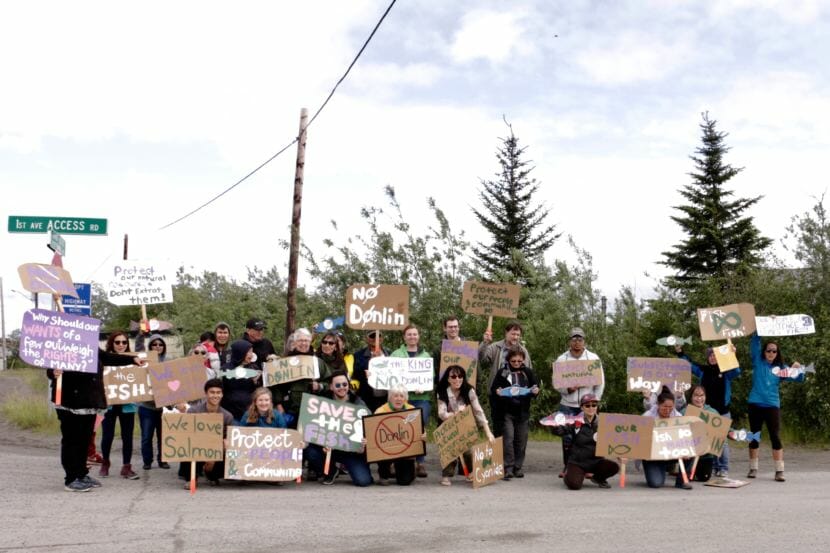
The Orutsararmiut Native Council in Bethel organized the first public march against the Donlin Gold mine in June 2018. (Photo by Christine Trudeau/KYUK)

For the last two decades, mining companies have been working to develop the massive Donlin Gold prospect in the Yukon-Kuskokwim Delta. And most of that time, the development has claimed support from neighboring communities. But that’s changing. Tribes, organizations, and communities have begun opposing the mine development and organizing.

In June 2018, the Orutsararmiut Native Council (ONC) organized the first public march against the mine. The final Environmental Impact Statement for the proposed Donlin mine had been published a couple months before.

Peter Evon is ONC’s executive director. He grew up in Akiachak, one of the villages along the Kuskokwim River more than 100 miles south of the mine site.

“You know, I was in junior high when I first heard about it. They were bringing in bikes, bringing in recycling programs and handing out trash bags with Donlin Gold on them,” Evon recalled.

The Donlin prospect has been around for decades, ever since the Calista Corporation and the Kuskokwim Corporation (TKC) selected the site for development under the Alaska Native Claims Settlement Act of 1971. Calista owns the mineral rights.

A company called Placer Dome struck a deal with Calista and TKC to develop the mine in the mid 1990s. After a series of business acquisitions, that venture became known as Donlin Gold.

Donlin has put a focus on what’s sometimes called “corporate citizenship” — investing in communities near the proposed development. In any village in the Yukon-Kuskokwim Delta, and in Bethel, you see Donlin Gold’s logo in the schools: on sweatshirts and coats and hats. Donlin Gold has paid to remove waste from villages. It has rebuilt churches, and purchased scoreboards for village schools.

Evon says that the company knew those steps would be welcomed in one of the poorest regions in the United States that has some of the highest costs of living.

“So anything free is usually associated with something positive, and so they took that approach and that’s all I knew growing up,” Evon said.

But Donlin Gold spokesperson Kristina Woolston has said that it’s the right thing for the company to do.

“It’s important that, you know, that your neighbors show a vested interest, and this is something we are, you know, showing every day, year after year: that we’re investing now, and we’re investing in the future of these communities,” said Woolston.

When the company signed the leases with the Native corporations that own the land and mineral rights, Donlin promised to prioritize jobs for their shareholders. There could be 800 mining jobs in the region once the mine is operational. Most of the time that the mine has been in development, it hasn’t generated many headlines. People have spoken against it at meetings and hearings, but there weren’t many organized, public protests.

In 2006, the Association of Village Council Presidents (AVCP) , a tribal consortium that represents 56 tribes in the region, passed a resolution supporting the proposed Donlin Gold mine as long as it was built in an environmentally-sound manner. Six years later, in 2012, Donlin Gold submitted an application for the environmental process. In 2018, the environmental review was finalized and published. Donlin also received a handful of major state and federal permits. That’s when tribes began to object, and to organize.

“Well, we came together very recently as part of the Y-K River Alliance just last month,” said ONC tribal member Danielle Craven in a 2018 interview.

Craven said that she knew and had concerns about the mine for years, but it wasn’t until the final EIS was published that she realized how real it could become. Like many people in the region, Craven is concerned that a mine accident could destroy the fish in the Kuskokwim River, and that the extra barge traffic would damage the habitat of smaller fish, like smelt. Donlin Gold had to start from scratch to study the smelt, and opponents say that there is not enough data to show that barge traffic will not impact them.

“We became concerned that this was going to harm our way of life and living in the Delta, and so we decided to come together,” Craven said.

Donlin has said that it will continue to monitor smelt habitat.

Craven helped lead a grassroots effort along the Kuskokwim River during the summer of 2018, urging tribes to pass resolutions protesting the Donlin mine. Twelve did. Then the protesters turned their attention to Calista, the regional Native corporation that owns the mineral rights. Shareholders staged a sit-in at Calista’s annual shareholder meeting in Bethel in July 2018.

Then ONC turned its attention to rescinding the 2006 AVCP resolution supporting the Donlin mine. They teamed up with the Native Village of Kwinhagak at this year’s convention.

“The tribes felt it was not worth it just for 30 years out of thousands of years that’s always been there,” said Darren Cleveland, president of the Native Village of Kwinhagak.

Tribal delegates rescinded the 2006 resolution and passed an anti-Donlin resolution by huge margins. It marked a significant shift in the region: the Donlin Gold mine no longer enjoyed support from many villages. Now, at least 35 out of 56 tribes in the region are on record against the mine. KYUK sent multiple emails and followup emails to give Calista the opportunity to participate in the story, but Calista was not able to make anyone available. Donlin Gold says it will continue to build the mine as safely as possible, according to Woolston.

“Calista and The Kuskokwim Corporation selected the mine site with their lands specifically for the broad and significant benefits mining is able to provide to the region’s residents. These benefits complement subsistence traditions and the very limited economic opportunities available now and in the foreseeable future. Donlin Gold is engineered with modern, sophisticated environmental safeguards, and the rigorous and comprehensive permitting process, which is largely complete, includes engineering, environmental and safety requirements to protect Alaskans.”

In response to the anti-Donlin vote, Donlin Gold and Calista released a two-page statement detailing the hundreds of meetings that both companies have held with shareholders over the past two decades.

Tisha Kuhns is the vice president for public lands and resource development at Calista. In a statement to KYUK in September, she emphasized that mines can be developed safely.

“Calista’s board will continue to review and manage any regional resource development on ANSCA lands with full awareness and active participation,” Kuhns said.

Since then, Calista has intensified their marketing efforts, releasing opinion pieces statewide and a new promotional video. But as Calista promotes the mine, many of its shareholders want a vote on it. Some of them are against the mine. Others think the vote would ensure all shareholders get a say in whether or not the mine is developed. Calista has said that it is considering it.

Arctic Slope Regional Corp. to leave the Alaska Federation of Natives

The Arctic Slope Regional Corp. corporate headquarters in Utqiaġvik in January 2018. (Photo by Ravenna Koenig/Alaska’s Energy Desk)

A powerful Alaska Native corporation is withdrawing from the Alaska Federation of Natives at the end of this year.

In a news release sent out late Friday afternoon, Arctic Slope Regional Corp. Director of Communications Ty Hardt wrote that the organization’s board of directors voted unanimously to end its membership in AFN on Dec. 31.

“With this decision, ASRC intends to focus on the various needs within Alaska’s North Slope, where there is an increased degree of alignment as well as additional efficiencies related to shared geography and other interests,” Hardt said.

According to the release, the corporation had been in talks about withdrawing “for more than a year.”

The statement does not include specific issues or areas of divergence between ASRC and AFN, and Hardt did not answer multiple phone calls Friday evening. The Utqiaġvik-based company serves Iñupiat shareholders living primarily in Alaska’s North Slope. It is the largest corporation based in Alaska.

Particularly on issues around climate change and government regulation, fissures have emerged between ASRC and other influential tribal and corporate entities in Alaska. During the most recent AFN convention in Fairbanks, a resolution on whether to declare a climate emergency stalled for more than an hour, with many of the most vocal opponents hailing from the North Slope region.

ASRC would be the only Alaska Native corporation in the state not to be a member of AFN, which is the state’s largest Native organization. All 11 other Alaska-based regional corporations, along with 12 regional nonprofit organizations and 171 village corporations, are part of the federation.

A spokesperson for AFN did not return calls Friday evening.

Site notifications
Update notification options
Subscribe to notifications