Alaska Native Corporations

House Dems launch ethics investigation of Tara Sweeney’s support for CARES Act money for Alaska Native Corporations

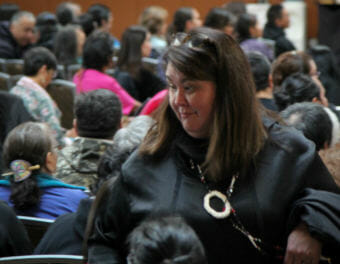
Tara Sweeney at the annual Alaska Federation of Natives convention in October 2017. Her nomination to be assistant interior secretary for Indian affairs has been held up for months.
Tara Sweeney at the annual Alaska Federation of Natives convention in October 2017. (Photo by Zachariah Hughes/Alaska Public Media)

Democrats on the U.S. House Resources Committee are asking for an investigation into Assistant Interior Secretary Tara Sweeney. This is a skirmish in the fight over whether Alaska Native Corporations are eligible for some of the $8 billion Congress set aside for tribes in its coronavirus relief bill.

The CARES Act leaves it up to the Treasury Department to allocate the funds, but the Interior Department was to consult with tribes. Tribal leaders have alleged that Sweeney is trying to give an advantage to Alaska Native Corporations.

Resources Chairman Raul Grijalva of Arizona and other Democrats wrote a letter to Inspector General Mark Greenblatt asking that he investigate whether Sweeney violated any ethics rules relating to Arctic Slope Regional Corporation. Sweeney was an executive at Arctic Slope Regional Corporation before she was chosen to be assistant Interior secretary for Indian Affairs, and she remains a shareholder.

The Interior Department says Sweeney treated Alaska Native corporations as eligible because that’s how Congress wrote the CARES Act. That’s what Alaska’s congressional delegation says, too. But tribes and many Democrats in Congress dispute that corporations are included.

A federal judge has temporarily blocked the Treasury Department from distributing any of the $8 billion to Alaska Native corporations. Treasury has not yet announced how it intends to allocate the fund.

Federal judge temporarily blocks aid to Alaska Native corporations

Alaska Sens. Lisa Murkowski and Dan Sullivan after the Department of the Interior's surprise announcement of the cancellation of off-shore drilling leases at the 2015 Alaska Federation of Natives Convention. (Photo by Mikko Wilson/KTOO)
Alaska Sens. Lisa Murkowski and Dan Sullivan photographed in 2015. On Monday, Murkowski and Sullivan said they were disappointed that U.S. District Court for the District of Columbia Judge Amit Mehta temporarily blocked the federal government from paying CARES Act fund to Alaska Native corporations.  (Photo by Mikko Wilson/KTOO)

A federal judge temporarily blocked the federal government from paying CARES Act funding to Alaska Native corporations. 

U.S. District Court Judge Amit Mehta issued an order finding that the tribes that sued to block the money from being paid to regional or village corporations were likely to win. 

The lawsuit was filed by tribes in the Lower 48 and Alaska. They argue that the corporations don’t meet the federal definitions of “Indian Tribe” or “Tribal government.” 

Alaska’s U.S. senators said they’re disappointed. 

Sen. Lisa Murkowski said the state’s delegation worked to ensure the federal law used a definition of tribes that included the corporations.   

“This is not an issue of governance,” she said. “This is an issue of making sure that those costs that have been incurred on the benefit and for the behalf of Alaska Natives — to cover those related costs to the coronavirus — can be reimbursed.”

And Sen. Dan Sullivan said the corporations have missions mandated by the federal government beyond those of other corporations. 

“This definition was mandated by Congress, and I hope the district court gives as much attention to the ANCs as it does to some of the Lower 48 tribes who brought this lawsuit, lawsuits that have, you know, billion-dollar casino operations that no one seems to be paying much attention to,” he said.

The senators spoke about the issue during Gov. Mike Dunleavy’s nightly COVID-19 news briefing.

The judge only granted part of what the tribes were looking for. He didn’t order the government to pay out all of the money that’s being disputed to the tribes.

Sullivan defends CARES Act funding for Alaska Native corporations

U.S. Sen. Dan Sullivan, R-Alaska, addressing the Alaska Federation of Natives at the Dena’ina Civic and Convention Center on Oct. 20, 2018. (Photo by Zachariah Hughes/Alaska Public Media)

Republican U.S. Sen. Dan Sullivan is defending Alaska Native corporations benefiting from the $2.2 trillion CARES Act.

The for-profit corporations created under About the Alaska Native Claims Settlement Act are eligible for a share of the $8 billion in funding set aside for Native American tribes. That’s led to some heated rhetoric in the Lower 48 and on Capitol Hill.

During a live call-in to KOTZ on Monday, Sullivan described opening the CARES Act up to Native corporations as a win for Alaska.

“And we were glad to get that in there because it would mean more resources to Alaska,” Sullivan said. “Not just for Alaska tribes, but our regional and village corporations. We thought that was very important, and we thought it was, to be perfectly honest … we thought it was noncontroversial.”

But the move has proven controversial — especially among tribal governments both here in Alaska and in the Lower 48.

Some say they’re upset that for-profit Alaska Native corporations, which are structured much differently than sovereign tribal governments, will also be entitled to that funding. So far, three Alaska tribes have even joined a lawsuit against the U.S. Treasury Department to block the funding. The lawsuit states that the companies “which conduct business worldwide through dozens of subsidiaries, are not ‘Tribal governments.’”

Sullivan said he isn’t familiar with the brewing legal fight, but he said that because Native corporations provide socially and economically for their shareholders, they are entitled to the funding.

“The tribal governments have sovereignty, and we certainly respect that and want to help all tribes. But the Alaska Native corporations also have an important and very unique role, and in many ways are delivering help to all parts of our state on behalf of Alaska Native people.”

In an op-ed to Indian Country Today, several executives from regional Native corporations echoed Sullivan’s sentiment, stating “the CARES Act is unambiguous: Alaska Native villages, Alaska Native regional corporations, and Alaska Native village corporations are ‘tribes’ under the law.”

Sullivan also accused Lower 48 tribes — which have business interests of their own — of hypocrisy.

“It’s a little bit, I would say, rich to have some of these Lower 48 tribes that have huge billion-dollar casino operations, that are clearly for-profit, somehow attacking Alaska Native regional and village corporations,” Sullivan said. “It’s a little ironic. Nobody’s talking about that.”

While money could go to tribes that operate casinos, it would not go directly to the businesses, unlike how the CARES Act has positioned for-profit Native corporations to receive stimulus funds.

Opposing tribes also have taken aim at Tara Sweeney, the assistant secretary for Indian Affairs with the U.S. Interior Department. Several tribes have accused Sweeney, who is a former executive and current shareholder with Arctic Slope Regional Corp., of putting Alaska Native corporations ahead of other tribes.

Senate Minority Leader Chuck Schumer of New York — a Democrat — joined in criticism of Sweeney, stating in a tweet that by giving money to Alaska Native corporations, Sweeney seeks to profit.

Sullivan took offense to Schumer’s comments, stating in a POLITICO interview that the concerns were a “bunch of bulls—.” He said Schumer and other critics are ill-informed.

“Some of the people attacking Tara hadn’t even read the law, because if you read the CARES Act, it’s 110% clear that some of these funds will go to Alaska tribes and our village and regional corporation shareholders,” Sullivan said. “Again, not to enrich anyone, but to help them deal with the negative impacts of the pandemic.”

Sullivan said the money set aside for tribes is set to complete disbursement by April 26.


Three Alaska tribes have joined lawsuit against the Treasury over $8B in Tribal funding

Akiak Native Community and two other Alaska Native Tribes joined in a federal lawsuit against the U.S. Department of Treasury over $8 billion in Tribal coronavirus relief funds in the CARES Act. The lawsuit objects to the eligibility of Alaska Native corporations for the Tribally allocated funding. (Photo by Greg Kim/KYUK)

Akiak Native Community, Asa’cararmiut Tribe and Aleut Community of St. Paul Island joined two other Tribal governments in the Lower 48 and filed a lawsuit against the Trump administration over funding in the CARES Act.

The lawsuit seeks to prevent Alaska Native corporations from taking part in the $8 billion coronavirus relief fund – specifically allocated for Tribes.

The lawsuit names Secretary of Treasury Steven Mnuchin  as the defendant. The Treasury is the agency responsible for allocating funds after consultation with Tribes and the Department of Interior.

The Tribal funding has been a sticking point with Tribes and Native organizations in the Lower 48. They say Alaska Native corporations should be excluded from eligibility because they are for-profit corporations – not governments.

That contention has also spilled into a fight between Tribes, Native organizations and the Department of Interior.

Tara Sweeney is Assistant Secretary of Indian Affairs – and a former executive for Arctic Slope Regional Corporation, an Alaska Native corporation.

Tribes say that Sweeney is intentionally diverting money to Native corporations and away from Lower 48 and Alaska Native Tribes.

Tribes want to exclude Alaska Native corporations from $8 billion coronavirus fund

Mike Williams Sr., senior chief of the Akiak Native Community photographed in 2016. (Katie Basile / KYUK)

Congress allocated $8 billion for tribes in its $2.2 trillion coronavirus response bill. Alaska’s Congressional delegation says the CARES Act clearly says Alaska Native Corporations are eligible for that money, too.

But some tribal leaders – in the Lower 48 and in Alaska – say the law is not so clear, and they say the corporations should not be included.

Mike Williams, senior chief of the Akiak Native Community, says the $8 billion is in a section of the CARES Act that’s intended for governments – state, local and tribal.

“I come from the poorest economic area in the United States,” said Williams, “and when we’re struggling for every bit of a dollar to provide these services, I think we need to have the maximum amount of support for each tribe to battle this COVID-19.”

Williams said his tribe will incur expenses of at least $1 million to keep his Kuskokwim River village of 400 safe.

Among those expenses: Akiak leaders are trying to increase the working hours of tribal police officers and health aides. They need masks and hand sanitizer. They need laptops so tribal staff can work from home. And they’ve waived every household’s $105 sewer and water bill, so people can keep clean, even those that can’t afford it. Williams said they’re also refurbishing two houses in case they need to isolate sick people.

“We’ve dealt with the Spanish Flu in 1918 around here, and there were mass deaths,” he said. “And we don’t want to ever see that again.”

The Native corporations don’t have governmental responsibilities, Williams said. They are for-profit companies that benefit Alaska Native shareholders. Williams said they should get money from other parts of the CARES Act that are set aside to help businesses.

Decisions about how the money will be allocated are up to the Treasury Department, after consultation with the tribes and the Interior Department.

Some tribes are directing their anger at Assistant Interior Secretary Tara Sweeney, a former executive of the Arctic Slope Regional Corporation.

A spokeswoman for the Interior Department said Sweeney is not trying to divert money from any American Indians or Native Alaskans.

Sealaska pledges $1M for pandemic relief funds to Alaska Native communities

A Sealaska corporate logo adorns the roof of the Southeast Alaska Native corportation's headquarters in Juenau on May 2, 2018.
A Sealaska corporate logo adorns the roof of the Southeast Alaska Native corporation’s headquarters in Juneau on May 2, 2018. (Photo by Jeremy Hsieh/KTOO)

Story updated Saturday, April 11 at 8:50 a.m.

Sealaska Corp. is pledging $1 million to communities of its 22,000 shareholders impacted by the COVID-19 pandemic.

CEO Anthony Mallott said the company has been in a good position to help their most vulnerable populations — especially Elders and youth — in Native villages and in areas with concentrations of shareholders, like Anchorage and Seattle.

“We know that a million dollars pales in comparison to the government stimulus,” said Mallott. “If we can help entities, first off, make sure they’re getting access to that government stimulus, and then use our million to offer it to areas that have unmet needs that the government stimulus doesn’t cover.”

The first round of relief will go to first responders and Native villages that were already impacted by recent ferry service delays.

Sealaska Board Chair Joe Nelson said the company will see if communities need more assistance after they get the relief.

“I’m sure we’ll assess the needs down the road here as things do evolve, because obviously there’s going to be lingering impacts and residual impacts and things that are just going to continue for quite a while here, as far as the economy and all these other issues,” said Nelson.

The first half of the money was expected to be dispersed starting Friday. The second half will be utilized to assist shareholder entities in the coming months.

A full list of donation recipients is on Sealaska’s coronavirus updates page.

Site notifications
Update notification options
Subscribe to notifications