Alaska Native Corporations

ASRC, Alaska’s largest private employer, cuts jobs after coronavirus causes oil price collapse

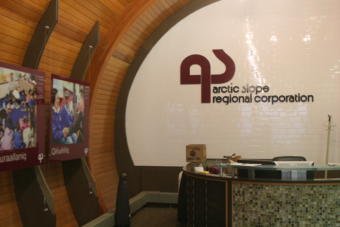
The Arctic Slope Regional Corp. headquarters in Utqiaġvik, January 2018. (Photo by Ravenna Koenig/Alaska’s Energy Desk)

Alaska’s largest private-sector employer, Arctic Slope Regional Corp., has laid off employees and cut charitable giving due to the collapse in oil prices and the economic shutdown caused by the global coronavirus pandemic.
That’s according to an April 3 letter from the chair of ASRC’s board of directors, Crawford Patkotak, to the company’s 13,000 shareholders. An ASRC spokesperson would not say how many employees were let go.

ASRC’s letter to shareholders said the corporation had cut “many of the charitable programs in our region,” eliminated all corporate bonuses and incentives for executives, and reduced the board of directors’ compensation — in the form of a stipend — by 30%.

“It’s a challenging time for a lot of businesses right now, and let’s hope we can all weather the storm and get back to a new normal soon,” ASRC spokesperson Ty Hardt wrote in an email.

Hardt declined to answer any further questions about the cuts.

“Unfortunately, the total impact of the COVID-19 response (and low oil prices) isn’t quite known yet and it could get worse before it gets better,” Hardt wrote, referencing the disease caused by the coronavirus.

Hardt said ASRC has 15,000-plus employees in Alaska and the Lower 48, and in its most recent available annual report, from 2018, it reported revenues of more than $3 billion.

The Alaska Native corporation is heavily invested in oil and gas, including ownership of an oil refining business, and represents residents and descendants of Iñupiat communities on Alaska’s North Slope, from Point Hope to Kaktovik.

ASRC paid out dividends of $7,000 to each shareholder with 100 shares in 2018, according to its report for that year.

In its letter to shareholders this month, ASRC said it was cutting spending in areas that were not generating revenue the corporation needs to pay shareholder dividends.

“In 2020, it is likely we will have to decrease the amount of the ASRC dividend disbursements, but we do not yet know by how much or for how long,” the letter says.

The letter says ASRC will continue plans to expand into the Lower 48 and diversify its investments away from oil and gas.

Commenters on a private Facebook group for ASRC shareholders had mixed responses. Some felt the corporation’s board was too highly compensated and had not done enough to cut at its higher levels of management. A few vowed to vote out the current board members.

Others thanked the board for making difficult decisions to keep the corporation afloat during tough economic times.

Alaska’s Energy Desk reporter Nat Herz contributed reporting to this story.


https://ktoo.sandbox.5mts.com/2020/04/07/north-slope-borough-commandeers-ravns-north-slope-assets/

In Bristol Bay, spring means salmon — and thousands of fishermen from coronavirus hot spots

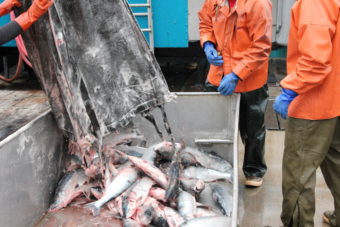
Sockeye salmon delivered in Bristol Bay. (File photo by KDLG)

ProPublica is a Pulitzer Prize-winning investigative newsroom. Sign up for The Big Story newsletter to receive stories like this one in your inbox.

Later this spring, Alaska’s Bristol Bay will blossom into one of the largest annual salmon fisheries in the world.

The regional population of about 6,600 will triple in size with the arrival of fishermen, crews and seasonal workers on jets but also private planes and small boats, many traveling from out of state.

And yet the heart of the health care system in southwestern Alaska, in a corner of the state where the Spanish flu once orphaned a generation, is a 16-bed hospital in Dillingham operated by the Bristol Bay Area Health Corp. Only four beds are currently equipped for coronavirus patients. As of Wednesday, the hospital had a few dozen coronavirus tests for the entire Florida-sized region, tribal leaders said.

If those newly arrived workers need to quarantine for two weeks, as mandated by the state, residents said it’s unclear where everyone will hunker down. Local store shelves are already bare of Clorox, Lysol and rubber gloves.

Dillingham, the largest community in the Bristol Bay region with a population of 2,300, is 320 miles from Anchorage by air.

“We’re scared. … People come from all over the world for Bristol Bay fishing,” said Gayla Hoseth, second chief for the Dillingham-based Curyung Tribal Council. “There’s 7,000 of us who live here, and this hospital cannot handle the 7,000 of us if we get sick. Imagine (when) our population triples and quadruples in the summertime.”

Compounding matters, the hospital executive who ran daily operations for the health care system is out of a job after downplaying the coronavirus threat to colleagues.

A March 16 email from the executive — which repeated a conspiratorial meme suggesting the coronavirus is somehow a politically motivated phenomenon — set flame to a deep anxiety among some tribal leaders over the vulnerability of Alaska villages in a pandemic.

“Just a reminder that FLU kills many every year!” wrote Lecia Scotford, who was the chief operating officer. (The coronavirus is not like the flu. It appears to be more contagious and more lethal.)

The message soon began to circulate in the Bristol Bay region, drawing a blistering response from some tribal and local leaders.

Robert Clark, president and chief executive of Bristol Bay Area Health Corp., said Scotford’s last day was Monday. He would not say if she was fired, citing “personnel stuff,” but said “she was separated.”

Scotford did not respond to emails, phone calls and Facebook messages requesting comment. Her email to lists of “division managers” and “department managers” within the regional health organization also emphasized the need for calm, common sense and good hygiene, and for the hospital to be prepared to serve the public.

“That (email) was very concerning to me because that kind of lets people’s guard down,” Norman Van Vactor, president of the Bristol Bay Economic Development Corp., said in a phone interview.

Bristol Bay is a magnet for people in the summer, with a seasonal migration of about 13,000 workers for the lucrative fishing season. The commercial salmon fishery here is the largest in the state, but as of 2010, about 60% of earnings went to out-of-state permit holders.

Almost all the major Bristol Bay seafood processing companies are based in Seattle, an early hot spot for coronavirus, and two thirds of Bristol Bay processing workers live in West Coast states at other times of the year, according to the Institute of Social and Economic Research at the University of Alaska Anchorage.

The Alaska Department of Fish and Game forecasts some 34.6 million sockeye salmon will be harvested there this year.

“When it comes to wild salmon, we are over half the world’s sockeye and over half of the Alaska salmon value,” said Andy Wink, executive director for the Bristol Bay Regional Seafood Development Association.

The nonprofit industry group on Thursday issued an advisory urging the fleet to delay travel to Bristol Bay until May 1.

“Keep in mind, it is possible to carry this virus without symptoms and unknowingly infect others leading to overtaxed medical capacity and/or death(s),” the advisory said. “You do NOT want to be the outsider photographed or seen around town in public spaces if this situation turns for the worst,” the group warned its fishermen.

Wink said his nonprofit is working with local governments on a plan to avoid overcrowding Bristol Bay Area Health Corp. clinics and the Dillingham hospital with sick fishermen, processors and support workers.

“We are taking the stance that we don’t want to rely on the local clinics or if we do, the need to be bolstered substantially,” Wink said.

As the health care provider for the region, Bristol Bay Area Health Corp. operates the only regional hospital and the clinics in 21 surrounding villages. It employed 470 people and reported revenue of $76.7 million in 2017, according to a tax form that Scotford submitted to the IRS.

Clark, the health corporation chief executive, said the Dillingham hospital is seeking more equipment to meet the potential for coronavirus patients among the local and visiting fishing industry patients.

Chief nursing officer Lee Yale said the hospital had 37 tests on hand as of Wednesday, and that all tests performed had returned negative. The Dillingham facility has no ICU beds, four negative pressure rooms to treat COVID patients without infecting others, plus two ventilators for the region.

“We have staffing but if they get ill we will be in a tight spot,” she wrote in an email. “(The) fishing industry will devastate our surge plan and we can not support and cover our villages if this season opens.”

Meantime, for many in Bristol Bay, the looming COVID-19 threat recalls family histories of death and loss in the face of past epidemics.

“We are the survivors of the survivors of the orphans of the Spanish flu,” said Hoseth, the Dillingham tribe second chief.

Another member of the tribe, tribal administrator Courtenay Carty, said her great-grandmother was orphaned in Dillingham by the 1919 flu and raised by family members, and her grandfather was orphaned by tuberculosis in the 1940s.

“The fact that all of our contemporary families are descendants of those children and few adults that survived 1919 is one of (the) major reasons why we are so passionate about protecting ourselves from this pandemic,” she said. “What is history to others is our tribal and familial identities.”

Her tribe declared a state of emergency because of the coronavirus on March 24, calling for a stop to all but essential travel to the city.

Clarification, April 3, 2020: This story was updated to more accurately describe who raised tribal administrator Courtenay Carty’s great-grandmother.

Filed under:


Bristol Bay health corp. executive removed after suggesting a COVID-19 conspiracy theory

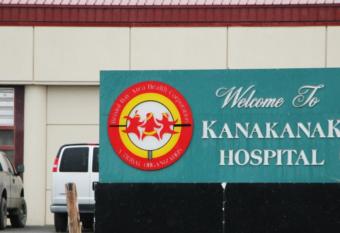
The welcome sign outside of Kanakanak Hospital in Dillingham. Oct. 29, 2018. (Photo by Isabelle Ross/KDLG)

A top official at Bristol Bay Area Health Corp. sent an email to other managers this month promoting the falsehood that the coronavirus pandemic is no worse than the flu and is part of a political conspiracy.
As of Monday, the official no longer works at the corporation.

The March 16 email subject line is “Do NOT PANIC.” It’s addressed to managers at BBAHC. In it, Dr. Lecia Scotford, the health corporation’s now-former chief operating officer, questions the gravity of the coronavirus crisis. Scotford also points to prior health crises that took place during even-numbered years. Because those are election years, she suggests without evidence that this is a political conspiracy.

In the email, she writes, “This is not political…….or is it???? Since all these years have been election years. Just a reminder that FLU kills many every year! Common sense and good hygiene are important always, virus or no virus.”

Several local leaders said they were outraged by Scotford’s claims and called on the health corporation to take corrective measures.

In a letter to the health corporation’s CEO and the board chair, First Chief Thomas Tilden of the Curyung Tribal Council wrote, “What appears to us to be absolute ignorance and blatant arrogance by BBAHC’s COO, jeopardizes the welfare of every patient, provider and employee of BBAHC as well as the general public of Dillingham and greater Bristol Bay.”

The tribe is currently in the process of withdrawing from the health corporation, in part over concerns about the hospital’s management and patient care. It held its final mediation session with BBAHC’s full board earlier in March.

Tilden also wrote that Scotford did not adhere to the mandatory 14-day self-quarantine after returning from Florida and Seattle. Instead, Tilden’s email says, Scotford reported to work at Kanakanak Hospital in Dillingham on March 23.

A March 16 email from former COO Lecia Scotford to managers of the Bristol Bay Area Health Corp. Click to expand in a new tab. (KDLG screenshot)

Norm Van Vactor is a Dillingham resident and CEO of the Bristol Bay Economic Development Corp. In an email to the health corporation, he wrote, “This type of messaging in the middle of the Health Crisis of our generation is just NOT ACCEPTABLE and I condemn it.”

Scotford’s employment was terminated abruptly Monday.

Robert Clark, the president and CEO of BBAHC, declined to say why he ended Scotford’s tenure at the hospital.

Clark confirmed that Scotford was traveling out of state and returned to work on March 23. But he said it was before the governor’s mandate went into effect.

“We obtained input from our medical staff before she was permitted to come to work on March 23. She wore a mask and stayed in her office. She was isolated from other employees and her office is far from any patient care areas of the hospital,” he said.

According to Clark, a member of the medical staff suggested Scotford work from home, and she left the hospital premises to do so. Clark wouldn’t comment on Scotford’s March 16 email.

He will be the acting chief of operations until the corporation hires a new officer.

Alaska DOT contracted private charters for Pelican and Gustavus. Two weeks later, they’re still waiting.

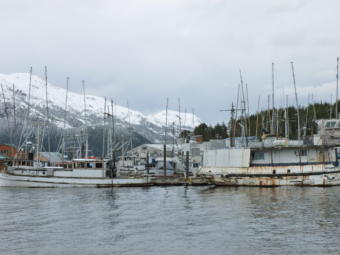
Pelican’s boat harbor in 2013. The island community has no airport or barge service making state ferries indispensable for the approximately 80 year-round residents. (Photo by KCAW)

The Alaska Marine Highway System has only two vessels running, leaving many coastal communities without ferries.

The Alaska Department of Transportation and Public Facilities inked a Feb. 26 contract with a Native corporation to fill some of these gaps with private charters through March 31.

Goldbelt, Inc.‘s CEO McHugh Pierre says Juneau’s urban Native corporation has two catamarans available but so far none have been scheduled by state transportation officials.

“We’re standing by and we’re ready to perform at a moment’s notice,” he said Tuesday.

DOT also signed a similar contract with Allen Marine of Sitka, which has already run at least two charter ferries between Juneau and the island communities of Kake, Angoon and Tenakee Springs.

The communities of Gustavus and Pelican aren’t expecting state ferries any time soon. The contract included both communities in a route — along with Juneau and Hoonah — for $9,200 per trip.

State transportation officials remain noncommittal. DOT’s regional spokesman Sam Dapcevich wrote in a statement that the agency “is assessing the transportation needs of Pelican and Gustavus.”

Gustavus City Administrator Tom Williams says he had no idea that such a contract existed.

“It’s a little frustrating and disappointing that DOT didn’t do a better job of notifying the communities that are in the contract” he said.

Dapcevich’s statement also noted that Gustavus’ state dock is scheduled to be rebuilt this spring and ferries won’t be able to tie up there. But Williams says he’s had conversations with the National Park Service to use its Bartlett Cove dock as an alternative and that residents want an opportunity to restock provisions in Juneau.

“I realize that a passenger-only ferry will provide limited amount of cargo per passenger,” Williams said. “But still, that’s a lot better than not having any opportunity at all to bring supplies over.”

The community of Pelican is scheduled for just two ferries in May when the LeConte is slated to return from an overhaul in drydock. Norm Carson of the local chamber of commerce has been in contact with state transportation officials to line up ferries for the small community’s fish processor and residents.

Carson says he didn’t know about the contract, but it would make a lot of sense.

“If we could pair that with a community like Gustavus on the way out and on the way back, then there’d be no issue with ridership at all,” he said.

The other route in the Goldbelt contract is for Upper Lynn Canal. But that route is now being covered by the state ferry Tazlina which returned to service earlier this month.


Calista, Doyon deny rumors of an exit from Alaska Federation of Natives

Calista is the regional Native corporation for much of Western Alaska. (Image courtesy of Calista Corp.)

Calista Corp. has reaffirmed its Alaska Federation of Natives membership in response to a caller on a Feb. 28 KYUK talk show, who claimed that Calista had pulled out of the organization.

In a statement, Calista said “a Calista Board Director attends and participates in AFN board meetings. Additionally, Calista staff are actively supporting and participating in efforts with AFN staff, including Census outreach.”

Anchorage-based Calista is made up of Yup’ik and Athabascan shareholders from the Yukon-Kuskokwim Delta.

Rumors have swirled about another corporation leaving AFN: Doyon Ltd., the regional corporation for Interior Alaska.

A video circulating on social media showed Doyon CEO Aaron Schutt saying that the regional Native corporation is having discussions about its AFN membership. As of last week, Doyon and AFN say that Doyon is a current member.

In December, Arctic Slope Regional Corp. departed AFN following a hotly-contested decision to pass a climate change resolution at the October convention last year. The Utqiaġvik-based corporation serves Iñupiat shareholders living primarily in the North Slope region. ASRC was the biggest opponent to the climate resolution, saying that it would hamper the corporation’s ability to pursue oil and gas resources.

The corporation said that the decision to pull out took about a year and a half to make and was not exclusively based on the resolution passing.

Alaska’s Energy Desk reporter Nat Herz contributed to this story.


Anxiety creeps into oil-dependent Alaska as banks step back from Arctic investment

A ConocoPhillips drill site within the National Petroleum Reserve in Alaska in January 2017. (Photo by Elizabeth Harball/Alaska’s Energy Desk)

As he pitches a new North Slope liquefied natural gas project to investors, Mead Treadwell, the businessman and former Alaska lieutenant governor, is keenly aware of his project’s location.

Development in the Arctic is booming as the global climate warms and ice melts. But environmental opposition has come along with it, making some big banks more reticent about investing.

Barclays and Goldman Sachs, for example, have effectively ruled out investments in new Arctic oil and gas projects, after environmentalists raised concerns about impacts on ecosystems, indigenous people and the global climate.

Many other investors remain. But an aggressive advocacy campaign against their involvement in Arctic oil means that Treadwell’s company, Qilak LNG, and others like it face more obstacles to raise the cash they need.

Qilak has adapted to this new investment climate by playing up the fact that its LNG project would connect to infrastructure that already largely exists on the North Slope — not to new oil fields, which conservation groups say would extend the world’s dependence on climate-warming fossil fuels.

Qilak is also making the case that LNG often displaces dirty coal-fired power plants, though the environmental benefits of that change are disputed by some scientists. And it’s highlighting the jobs the project would create for indigenous residents of the North Slope and other areas of Alaska.

Mead Treadwell says he would draw from his business and government experience if he's elected governor. (Photo by Wesley Early/Alaska Public Media)
Mead Treadwell. (Photo by Wesley Early/Alaska Public Media)

“I still believe that we will have billions of dollars in annual investment in the Arctic. But I will say that we’re an easier target, because it’s easier to show up at an annual meeting in some place like London or Brussels wearing a polar bear suit — there’s not a similar symbol for Louisiana or Texas,” Treadwell said. “We definitely have to be aware of that, and make sure we’ve got a good story.”

Alaska’s economy is driven by the production of the fossil fuels that contribute to global warming, which makes the state especially vulnerable to the campaign to transition away from oil. And Alaska policymakers and oil executives say they’re getting increasingly concerned as advocates turn their focus to forcing big financial institutions out of the industry.

The movement has been targeting Arctic oil and gas projects in particular, with groups arguing that development in the area poses unique environmental and social risks. The release of Goldman Sachs’ new environmental policy in December — which said the bank would refuse to finance drilling in the Arctic National Wildlife Refuge and elsewhere in the Arctic — underscored the stakes for Alaska. But the campaign doesn’t end there.

Last month, 15 Democratic U.S. senators wrote to 11 more banks asking them to follow Goldman’s lead by “shifting toward a U.S. financial sector that effectively analyzes and plans for climate risks.”

A similar letter followed Thursday from more than two-dozen House Democrats. On Friday, environmental organizations touted a new policy released by a big British bank, Lloyds Bank, that rules out financing of oil and gas exploration and production in the Arctic, and in the Arctic Refuge in particular.

On Tuesday, megabank JPMorgan Chase was set to announce its own restrictions on investment in Arctic drilling.

Andy Mack DNR Commissioner
Former Alaska Natural Resources Commissioner Andy Mack at a press conference in Anchorage on June 28, 2016. (Photo by Graelyn Brashear/Alaska Public Media)

“One position by one large company I don’t think changes a lot,” said Andy Mack, a former Alaska natural resources commissioner who helped lead the state’s push to open the Arctic Refuge to drilling. “But if you see two or three or four large companies make these types of announcements, it’s certainly something that (oil) companies will all have to take into account. And that’s why the state needs to pay attention.”

Several big Arctic oil projects are still under development on Alaska’s North Slope. But there’s a growing acknowledgment among Alaska oil industry players that environmentalists’ lobbying of financial institutions is having an effect.

“‘Arctic’ seems to have turned into a four-letter word, in the minds of a lot of these financial institutions,” said an Alaska oil executive, who asked not to be named to avoid drawing attention to his particular company.

To understand the anti-Arctic campaign’s challenge to Alaska’s oil industry, residents can look to Alberta. There, financial institutions and major insurers have distanced themselves from projects in the province’s oil sands.

One reason environmental advocates have focused their opposition on Alberta is that historically, extraction from oil sands generated more greenhouse gases than conventional oil production.

Earlier this month, BlackRock, the world’s largest asset manager, announced it would exclude companies with oil sands projects from a fast-growing, sustainability-oriented fund that it runs.

In December, The Hartford, a major insurer, said it would stop investing in and insuring companies that generate a large share of their revenues from tar sands.

Alaskans who follow the oil industry have noticed.

“Alberta is the canary in the coal mine,” said Brad Keithley, a retired oil and gas attorney who closely watches Alaska politics.

Alberta’s premier, Jason Kenney, has responded forcefully, launching a $30 million “energy war room” to rebut criticism of Canada’s oil industry.

Gov. Mike Dunleavy, R-Alaska, speaks to reporters in the Capitol in Juneau, Jan. 31, 2020. (Photo by Andrew Kitchenman/KTOO and Alaska Public Media)
Gov. Mike Dunleavy speaks to reporters in the Capitol in Juneau, Jan. 31. (Photo by Andrew Kitchenman/KTOO and Alaska Public Media)

In Alaska, Gov. Mike Dunleavy reacted to Goldman Sachs’ announcement by firing the company from a group of Wall Street firms it had chosen to help the state borrow money. The decision could cost Goldman Sachs between $200,000 and $300,000 in compensation, state officials said.

In an interview, Dunleavy suggested another way to punish banks that refuse to invest in Alaska oil projects: cutting them off from managing the assets of the $67 billion, state-owned Alaska Permanent Fund, which was originally created with oil revenue. Goldman Sachs manages some $400 million for the fund, which paid the firm a total of $17 million in fees over the past three years.

“Some of these groups that don’t want to do business in Alaska still want Alaska business,” Dunleavy said. “They probably are going to come out a loser on that one.”

The Alaska Permanent Fund is run by an independent board. Earlier this month, Chair Craig Richards said board members were not interested in making its choices of investment managers subject to political considerations.

But Dunleavy said he thinks the subject will be unavoidable for the board.

Alaska Permanent Fund Chair Craig Richards at a state legislative committee hearing in June 2016, when he was the state’s attorney general. (Photo by Jeremy Hsieh/KTOO)

“I have to believe that the board members and those that are running the permanent fund have seen what some of these lending institutions have said about Alaska,” he said. “And I’m sure they’re having discussions in their boardroom as to how they should approach this.”

In Washington, D.C., the members of Alaska’s GOP Congressional delegation have sent their own letters to banking executives, asking them to disregard the Democratic lawmakers’ request that they avoid investing in the Arctic Refuge.

U.S. Sen. Dan Sullivan also dispatched personal letters to his Democratic colleagues saying he was disappointed that they didn’t discuss the issue with him directly before writing to financial institutions.

“I can tell you for a fact I have never signed on to a letter that would specifically target investment opportunities in another colleague’s state, to shut that down,” U.S. Sen. Lisa Murkowski said in an interview.

Sen. Lisa Murkowski at a Senate committee hearing. (Photo by Liz Ruskin/Alaska Public Media)

She and other Alaska politicians note that there’s support for continuing Arctic oil development among the North Slope’s indigenous Iñupiat leaders. The North Slope Borough’s mayor, Harry Brower, wrote his own opinion piece in the Wall Street Journal criticizing Goldman Sachs’ new investment policy — he called it “subtly racist,” and argued that blocking drilling would have the effect of denying modern amenities to the region’s isolated villages.

Representatives of the groups fighting Arctic oil development say their biggest focus is investment in projects in the Arctic National Wildlife Refuge — not as much on Alaska projects more broadly. And they note that their advocacy campaign around the Arctic Refuge is aligned with the Gwich’in, a different indigenous group that opposes development there because of risks to the caribou that they subsist on.

“The community has specifically been a part of the advocacy work, saying they do not want the continued drilling,” Ruth Breech, who organizes corporate accountability campaigns for the Rainforest Action Network, said in an interview. “But I do agree that there is a broader piece around Arctic oil, and there could be more engagement and discussions about what that means for the different impacts on the communities throughout Alaska.”

Keithley, the retired attorney, said there’s a new argument that Alaska leaders could use to make their case to financial institutions: The state’s oil industry uses comparatively little energy to produce its fossil fuels, according to a newly-presented analysis from the Climate Leadership Council, an international group pushing a carbon fee and dividend program as a way to reduce emissions.

Officials from the council visited Anchorage this month and told a policy group that producing oil in the state is “really carbon cheap” compared to other major oil-producing regions, the Alaska Journal of Commerce reported. That’s in part because of Alaska’s restrictions on flaring natural gas and the industry’s “consolidated and efficient infrastructure” in the state, spokesperson Carlton Carroll said in an email.

The group hasn’t released details of its analysis yet, saying it’s not complete. But if its calculations are accurate, Keithley said, Alaska’s carbon advantage is a “story that’s not being well-told.”

“And it’s a story that needs to get out there,” he said.

Those who are working to push financial institutions out of the oil industry, meanwhile, argue that Alaska’s political leaders should be doing more to prepare the state for an economic future that’s less dependent on fossil fuels.

“There’s an opportunity to plan ahead,” said Breech. “That’s why the leadership is important now.”


Site notifications
Update notification options
Subscribe to notifications