Alaska Native Corporations

AFN will hold in-person annual convention this year with the theme ‘Good Government, Alaskans Decide’

U.S. Sen Dan Sullivan addresses the Alaska Federation of Natives Convention, Oct. 15 (Photo by Mikko Wilson/KTOO)
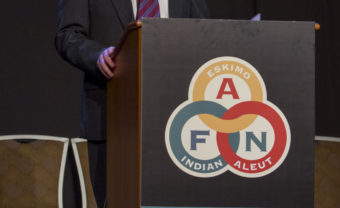
The Alaska Federation of Natives logo on a podium during the organization’s annual convention on Oct. 15, 2016. (Photo by Mikko Wilson/KTOO)

The Alaska Federation of Natives, which represents 191 federally recognized Alaska Native tribes and 11 regional corporations, has announced the date and theme of their annual convention.

This year’s theme will be “Good Government, Alaskans Decide.” A release from AFN says the theme highlights “the challenges and opportunities the Native community and all Alaskans face, including responding to and recovering from the pandemic and resulting economic downturn.”
The keynote speaker for the convention will be Alaska House Speaker Bryce Edgmon, the first Alaska Native Speaker of the State House. Edgmon is an independent from Dillingham, currently serving his second term as speaker.

This will be the first convention without the participation of the Arctic Slope Regional Corporation, who withdrew from AFN at the end of last year. The corporation is the largest in the state, representing Inupiaq shareholders primarily from the North Slope region.

The convention will be held October 15th through the 17th at the Dena’ina Center in Anchorage.

Alaska Native leaders offer alternatives to proposed university merger

Alaska Native organizations in Southeast are proposing alternatives to the University of Alaska’s Board of Regents’ controversial option to merge the University of Alaska Southeast with one of the other UA campuses.

Native leaders from Sealaska, Sealaska Heritage Institute and the Central Council of Tlingit & Haida sent a letter to select regents this week.

They’re asking for the option to establish University of Alaska Southeast as the administrative hub for rural community campuses. They say a more centralized campus in the region can increase overall enrollment.

It could also expand options for students and streamline program and course offerings. 

Sealaska Heritage Institute President Rosita Worl said the proposed merger would not result in the financial savings the university system is seeking.

Another option is to transfer UAS to a tribal college in the region.

Sealaska Board of Directors Chair Joe Nelson said the Southeast community deserves university leadership that is “committed to this native place.”

The board of regents are meeting to discuss options on Thursday and Friday.

They’re also holding public testimony by phone on Tuesday from 4 – 6 p.m. at 1-866-726-0757.

Y-K Delta tribes protest Donlin Gold in letter to mining company Novagold

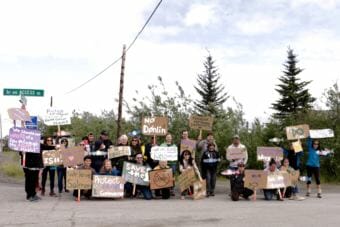
The Orutsararmiut Native Council led a public demonstration against the proposed Donlin Gold mine in Bethel on Friday, June 22. (Photo by Christine Trudeau/KYUK)

Ten tribes have sent a letter protesting the proposed Donlin Gold mine to the two companies trying to build it in the Yukon-Kuskokwim Delta.
The letter came as one of the companies, Novagold, was set to deliver its annual report to its shareholders last weekend.

The company has touted support from the region in its quarterly earnings reports and annual presentations, but this time tribes want to make sure that investors know that not all tribes support the Donlin Gold mine.

“The proposed project poses too much risk to our lands and our food sources which we have an obligation to protect and develop responsibly for future generations,” the letter said.

The letter asked both companies to withdraw their investment in the project. The mineral rights and land belong to two Native corporations formed under the Alaska Native Claims Settlement Act, and those companies have leased their rights to Canadian mining companies Novagold and Barrick Gold. The letter cited concerns about the impact extra barge traffic could have on smelt habitat, the company’s plans to store its mining waste, and the fact that the companies must treat the mine’s wastewater forever.

In a statement, Mark Springer, the executive director of Orutsararmiut Native Council in Bethel, said that the mine would threaten the tribes’ subsistence lifestyle.

“Our gold swims in the Kuskokwim River. It hangs on our fish racks in the summer and sustains us throughout the long winter months until the salmon again return,” Springer said.

Last year, 35 tribes passed a resolution opposing the Donlin Gold mine at the annual Association of Village Council Presidents’ convention. That marked a major turning point in regional support for the gold prospect. The tribes signing the letter were: Orutsararmiut Native Council in Bethel, Tununak, Eek, Chuloonawick, Kasigluk, Chevak, Kotlik, Napakiak, Kongiganak and Ohagamiut Native Council.

Donlin Gold has repeatedly said it plans to build the mine as safely as possible.

Byron Mallott: ‘My friend, we also have lived life fully, made a few contributions’

Then-Lt. Gov. Byron Mallott participates in the canoe landing ceremonies that unofficially kick off Celebration in Juneau on June 5, 2018.
Then-Lt. Gov. Byron Mallott participates in the canoe landing ceremonies that unofficially kick off Celebration in Juneau on June 5, 2018. (Photo courtesy Office of the Governor)

When Byron Mallott died on May 8, 2020, memories and condolences from leaders poured in across the state and beyond.

Mallott was most recently known as Alaska’s lieutenant governor, but his greatest legacy was likely shaping generations of Alaska Natives through political and corporate leadership.

Byron Mallott was born in Yakutat on April 6, 1943. He was Tlingit of the Raven moiety and a clan leader of the Kwaashk’i Ḵwáan.

In an interview on the KTOO-TV program “Conversations” in 1985, Mallott briefly recounted being sent away to Pius X Mission, a Catholic boarding school in Skagway.

“From the time we were 13 years old, we were essentially summer visitors at home,” he said.

The boarding school system was a government-backed effort to scrub indigenous people of their culture and force assimilation. His former chief of staff as lieutenant governor, Claire Richardson, remembers Mallott saying he had a stutter in those days.

“And he told me that he developed that stutter while attending boarding school as a child. And so he learned to think of what he was going to say ahead of time, as if there was a teleprompter in his head,” Richardson said. “Byron had the uncanny ability to speak eloquently and passionately without the use of notes or cue cards.”

His son Anthony Mallott said his dad was the class president, but got expelled after sticking up for another student.

Mallott ended up at Sheldon Jackson School in Sitka, where he graduated high school. His son said thinking of those days, playing basketball and making friends, always made his dad smile.

Then-Lt. Gov. Byron Mallott and Department of Fish and Game Commissioner Sam Cotton play basketball against Natasha Singh from the Tanana Chiefs Council in Grayling on June 26, 2018.
Then-Lt. Gov. Byron Mallott and Department of Fish and Game Commissioner Sam Cotton play basketball with Natasha Singh from the Tanana Chiefs Council in Grayling on June 26, 2018. (Photo by David Lienemann/Office of the Governor)

Mallott highlighted those relationships in a different light in his 1985 interview.

“You began to build a network of acquaintances and friends, principally Native, because those were Native schools largely, from throughout the region,” he said.

After high school, he went to Western Washington University in Bellingham. But he didn’t finish college because his father, the longtime mayor of Yakutat, died. He went home to help his mother, and successfully ran for mayor himself when he was 22 years old.

“You just kind of grow up with a sense that, if there are things happening in the community, if there are issues, you know, somehow, you ought to be involved,” Mallott said. “I mean, that was always there for us and I think everything else was a natural progression of that kind of family attitude.”

Mallott didn’t finish his term, because he took what he called a “low-level staff” job in the state agency that eventually became the Division of Community and Regional Affairs. It required a lot of travel and meeting a lot of local officials, which is how he met two other foundational figures who helped unite Alaska Natives around a statewide political identity: Emil Notti and Willie Hensley.

Byron Mallott, left, and Willie Hensley pose for a photo at Three Saints Bay on Kodiak Island in August 2019.
Byron Mallott, left, and Willie Hensley pose for a photo at Three Saints Bay on Kodiak Island in August 2019. The longtime friends first met in October 1966 when the Alaska Federation of Natives was first organizing. (Photo by James Umiivik Hensley)

“We’ve actually known each other for almost 55 years,” said Hensley. He’s one of the founders of the Alaska Federation of Natives, which successfully lobbied Congress for the Alaska Native Claims Settlement Act.

(Left) Now-Lt. Gov Byron Mallot, Willie Hensley and Roy Huhndorf testify before Congress. (Photo courtesy Willie Hensley)
From left to right: Byron Mallot, Willie Hensley and Roy Huhndorf testify before Congress. (Photo courtesy Willie Hensley)

“We met in 1966 when we were first organizing the Alaska Federation of Natives. … And when we were organizing AFN, we all kind of announced ourselves. And of course, we’re all there representing some of the different tribes around. And he said he represented the state of Alaska, and we kicked him out!” Hensley said laughing. “‘Cause, we didn’t want the state to know what our strategy was, right? On this — what was going to be the battle of the century over who owned Alaska.”

Hensley said they later let Mallott in, but as a representative of the Five Chiefs of the Yakutat.

ANCSA’s passage in 1971 established Native corporations. Mallott became a founding board member of Southeast Alaska’s regional corporation, Sealaska, and its top executive in the 1980s.

In 1985, Sealaska was the biggest of the Native corporations. He explained how creating the corporations served as more than a one-time payout.

“The benefits of the claims settlement act shouldn’t benefit just a single generation of Native people. That there ought to be a way to maintain the corpus — the land and the money — in mechanisms that would allow them to be used to flow, the continuing benefits of ANCSA, through succeeding generations. That the accident of history shouldn’t determine who participated in ANCSA.”

Hensley said there is a specific piece of ANCSA that was very contentious but has since led to the pooling and sharing of billions of dollars among Native corporations. Hensley said Mallott was instrumental in negotiating this revenue sharing part of the law, sometimes referred to as 7(i).

Mallott oversaw the creation and growth of a Sealaska shareholders’ permanent fund and a corporate investment portfolio worth over $100 million, according to an old professional biography on file at the Alaska Permanent Fund Corp.

Mallott was appointed to relatively new permanent fund corporation  in 1982. He retired from the Sealaska executive position in 1992, but stayed on the board until 2014. He became the Permanent Fund Corp.’s top executive in 1995. He had a stint in the ’90s as the mayor of Juneau, too.

More recently, Mallott ran for governor. He won the Alaska Democratic Party’s nomination in 2010 and 2014. He didn’t win, but became lieutenant governor in the second run by merging his campaign with independent candidate Bill Walker.

Alaska Gov. Bill Walker and Lt. Gov. Byron Mallott join hands after their inauguration on Dec. 1, 2014, at Centennial Hall in Juneau.
Alaska Gov. Bill Walker and Lt. Gov. Byron Mallott join hands after their inauguration on Dec. 1, 2014, at Centennial Hall in Juneau. Walker and Mallott, who ran for office on an independent “Unity Ticket,” spoke about unity and togetherness in their inaugural addresses. (Creative Commons photo by James Brooks)

Mallott’s message at the time was that joining Walker’s nonpartisan campaign was what was right for Alaska. Four years later, he resigned abruptly after making what Walker called inappropriate comments.

Claire Richardson, his chief of staff, said the circumstances of his resignation shouldn’t overshadow his life. She said, there’s a lesson in taking immediate responsibility for your actions.

“To know that there are men who make mistakes, and the ones who actually own up to it are the ones that I think we can look at and remember not just that moment, but the 50 years of public service and the good that he did for so many people” she said.

Mallott died after a heart attack on May 8, 2020.

Just the day before, Hensley had been texting Mallott about mourning another friend.

“And Byron’s response was, ‘My friend, we also have lived life fully, made a few contributions and are still going strong! I hope that is a good thing.’ … And now he’s gone. It’s so sad.”

Gov. Mike Dunleavy ordered U.S. and Alaska flags to half-staff for a week, through sunset Friday, May 15.

He is survived by his wife Antoinette, four siblings, five children and their families.

Mallott’s family doesn’t have plans for memorial services yet because of the pandemic. Anthony Mallott said his father would have wanted fun and memory-filled events in Yakutat, Juneau and Anchorage. The family has set up a memorial fund in his name through the Juneau Community Foundation. Mallott’s family said condolences may be sent to the home address, 102 Cordova Street in Juneau.

How Alaska Native corps are helping Alaska Native communities cope with the pandemic

A Sealaska corporate logo adorns the roof of the Southeast Alaska Native corportation's headquarters in Juneau on May 2, 2018.
A Sealaska corporate logo adorns the roof of the Southeast Alaska Native corporation’s headquarters in Juneau on May 2, 2018.  (Photo by Jeremy Hsieh/KTOO)

Koniag, the Alaska Native regional corporation for Kodiak island, was designed to be a for-profit company. Now, with the coronavirus threatening to disrupt the normal supply lines, Koniag President Shauna Hegna says one focus is feeding the island.

“The issue has become extremely important in the midst of a pandemic with global travel bans,” Hegna said. “Right now is a time in which we must have food security for our people.”

The corporation is helping the island’s tribal health organization to deliver groceries to tribal offices, for distribution to homes in the communities Koniag represents. Hegna said Koniag is also supporting the development of community farms and gardens. It’s contributed to a meal program for Kodiak seniors, and it’s donated to a program that’s delivering meals via school bus to vulnerable children in Kodiak city.

Shauna Hegna is president of Koniag, the regional corporation for Kodiak Island. (Photo courtesy of Koniag)

“To date, Koniag has already spent $60,000 on COVID-19 response,” Hegna said, adding that there’s likely more to come.

If the courts allow it, Alaska Native Corporations like Koniag will receive a share of the $8 billion Congress set aside to help tribes deal with the pandemic. Some tribal leaders say the corporations don’t deserve the money because their mission is profit.

Several of Alaska’s 12 regional corporations are mounting campaigns like Koniag’s. NANA, in the northwest Arctic, for instance, has pledged $40,000 for a food program and $100,000 to deliver sanitation supplies to every household in its region. Together, including $1 million from Sealaska, the corporations are spending more than $2 million to help their communities respond to the pandemic – and that’s just for actions that have been publicly announced.

For community programs and food banks, the contributions can be substantial. But these are not big line items for major conglomerates, as both NANA and Koniag have become.

Like many Alaska Native Corporations, they got into government contracting years ago and now have subsidiary offices near Washington, D.C.

NANA and its family of companies have more than 9,000 employees around the country and around the world. They report expenditures of nearly $1.5 billion.

Koniag has 1,200 employees nationwide and expenditures of $300 million.

These numbers matter, because if Treasury is allowed to send some of the $8 billion fund to ANCs, it plans to distribute some of it based on a corporation’s budget and how many employees it has.

(The figures cited above are from data the corporations provided to the Treasury Department to be a CARES Act beneficiary. A spreadsheet was widely distributed outside of government. Federal investigators are now looking into the data leak.)

Meanwhile, on the Kuskokwim River, Akiak Chief Mike Williams says his tribal council is preparing for the pandemic by restoring water service to every household in the village, to improve sanitation. The tribe is also fixing up houses, in case people become sick and need to be isolated. And, Williams said, as part of Akiak’s response to the pandemic, he wants to help hunters and fishermen buy fuel for their boats, so they can bring food to elders.

Mike Williams Sr. of Akiak. Photographed September 23, 2016. (Katie Basile / KYUK)

“We have been depending on hunting and fishing and gathering for survival for forever, Williams said. “And I think that’s going to be more important than ever before.”

Akiak is one of the tribes suing to block the Treasury department from giving part of the $8 billion coronavirus fund to ANCs. Williams believes the entire fund should go only to federally recognized tribes. He doesn’t want the money to flow through corporations to the communities.

“When they start taking the money, funding to provide services, then we’ve lost it. And we don’t want to do that,” he said. “We don’t want to set a precedent that the private corporations will provide services for us. No. We paid heavy price for (the) loss of our lands here in Alaska.”

The “loss” Williams refers to is what happened in the Alaska Native Claims Settlement Act, in 1971. The law created the Native corporations and gave them title to 44 million acres of what might have been, if not for one act of Congress, tribal land.

Some tribal advocates see the Settlement Act, and the Native corporations themselves, as tools of assimilation.

Corporation leaders and those who believe ANCSA was a force for good say the law didn’t result in a “loss” of Native lands but created a uniquely Alaska system that’s outside the tribal model to benefit Native people.

Williams, like a lot of Alaska Natives, is both a tribal member and a shareholder in Native corporations. He said his corporations aren’t helping to deliver services to prepare Akiak for the pandemic.

The website for his regional corporation, Calista, lists multiple types of COVID-19 assistance it’s providing. Among other things, it offered the tribes in its area administrative help so they can claim a share of the $8 billion CARES Act fund.

Calsita and most regional ANCs are also responding with distinctly corporate help: They’re sending early distributions of cash to their shareholders.

The average Calista shareholder household will receive about $500, which the corporation says will deliver $4 million to the economy of the Yukon-Kuskokwim Delta.

In a pandemic or not, dividends are the primary assistance Native corporations provide. In 2018, the 12 regional corporations say they distributed $217 million to their shareholders.

Injunction holds up $8B CARES Act Tribal allocation for Alaska Native corporations

Assistant Secretary of Indian Affairs Tara Sweeney speaks Oct. 18, 2018, at the Alaska Federation of Natives annual convention in downtown Anchorage. Sweeney is the subject of a call for investigation into whether she violated ethics policies in advocating for Alaska Native corporations over $8 billion Tribal allocation of the CARES Act. (Photo by Tripp J Crouse/KNBA)

The U.S. Treasury and Interior departments announced Tuesday they would begin disbursing part of an $8 billion Tribal allocation for coronavirus relief funds.

But for now, Alaska Native corporations are being left out.

The secretaries of Treasury and Interior are being sued by Tribes, who say the departments mishandled the Tribal allocation, and for the inclusion of Alaska Native regional and village corporations.

A statement from the Department of Treasury says amounts calculated for Alaska Native regional and village corporations under the Alaska Native Claims Settlement Act will be held back while that lawsuit is decided.

The CARES Act funding is to help Tribes with relief efforts in the fight against coronavirus.

Only about 60% — or $4.8 billion — will initially be distributed based on Tribal population. The population count is based on the Indian Housing Block Grant formula used by the U.S. Department of Housing and Urban Development. The initial disbursement would happen over several days.

President Donald Trump spoke Tuesday with Indigenous leaders at a roundtable in Phoenix, Arizona.

“The amount of the money that is being sent to Indian Country — as we call it — is the largest amount in the history of the U.S.,” Trump said. “You deserve it. You’ve been through a lot.”

The remainder of the Tribal allocation would be distributed at a later date based on employment and expenditure data for each Tribe or Tribally-owned business.

Democrats on the U.S. House Resources Committee are calling for an investigation into Assistant Secretary of Indian Affairs Tara Sweeney. They want the Inspector General to determine whether she violated ethics rules advocating for Alaska Native corporations to be included in the CARES Act Tribal allocation.


Site notifications
Update notification options
Subscribe to notifications