Alaska Native Corporations

Sealaska Heritage Institute awarded federal grant to publish Tlingit, Haida archives for language revitalization project

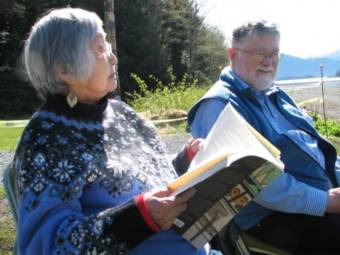
The late Nora and Dick Dauenhauer in Sitka in May 2014. The couple carried the knowledge of Southeast Alaska’s native languages into the 21st century. (Photo by Emily Forman/KCAW)

Late Tlingit scholars Nora Ḵeixwnéi Marks and Richard Xwaayeenák̲ Dauenhauer once dedicated the first volume of their book “Classics of Tlingit Oral Literature” to Tlingit orators. They co-edited the four-volume series and were two-time winners of the American Book Award.

The couple carried the knowledge of Southeast Alaska’s Native languages into the 21st century.

Recently, the federal Institute of Museum and Library Services awarded Sealaska Heritage Institute a two-year grant to process and digitally publish a massive collection of Tlingit and Haida documents archived by the late scholars.

In one of the recordings, Marks Dauenhauer has a conversation with a Tlingit speaker. The recording is just one part of the Dauenhauers’ archive.

Richard died in 2014, and Nora died in 2017. But what they left behind will last for generations.

“They came up with a method that’s kind of the standard now,” said Chuck Smythe, Director of Culture and History at the Sealaska Heritage Institute. “People are taking this as a starting point and are enhancing it and further, further developing it but it all started with the Dauenhauers.”

The Dauenhauer Literary Estate is a massive inventory of fieldwork documents and audio collections of both Tlingit and Haida languages. The estate is made up of several dozen boxes of documents and audiotape of translations and transcriptions that go back decades.

“Their books and files were so heavy that their house was literally splitting apart,” Smythe said.

The Dauenhauer Literary Estate includes more than 275 linear feet of documents, three boxes of journals, 18 boxes of media and 89 boxes of books, which will be processed over two years and made available to the public. (Photo courtesy of Sealaska Heritage Institute)

Will Geiger, a foremost scholar in Tlingit, is working on the project. He said much of the Tlingit oratory the Dauenhauers archived is to Southeast Alaska what Homer is to Ancient Greece.

“This new batch of materials, which is mostly papers, so there’s going to be a lot. I’m sure we’re gonna come across a lot of, say, draft documents that transcriptions of recordings that just haven’t been circulated or made public or published,” Geiger said.

Emily Pastore, archives collection manager at SHI, is also working on the project.

“Without the Dauenhauers, Tlingit language revival would not be where it is today,” Pastore said. “And so by making these new papers available, we could be fostering new developments in Tlingit and Haida language revitalization that could not be done without them and without these papers. ”

She says when it comes to their fieldwork, the Dauenhauers talked to everyday people.

Pastore also says the archives will also provide a way for future generations of Tlingit learners to connect to the language by giving them access to a wide range of Tlingit and Haida documents.

Once the project is done, the digital archive of the Dauenhauer Literary Estate will be public for everyone, not just academic researchers.

The song included in the radio version of this story is titled “Where Are You?” and is the exclusive property of the Lukaax̱.ádi clan.

Alaska Federation of Natives stays mum about progress on climate change task force

Alaska Federation of Natives President Julie Kitka on August 26, 2020. Kitka told Alaska Public Media that AFN is working with the National Science Foundation and the Nature Conservancy to secure funding for a climate task force. (Jeff Chen/Alaska Public Media)

The Alaska Federation of Natives Convention came to a close Friday with little discussion about how to respond to climate change. This year, the convention’s third day — when resolutions are openly debated — was eliminated.
Various Native organizations submitted 30 resolutions for consideration. There is no open resolution debate this year. Only one resolution briefly mentions climate change. It’s very much unlike last year when a resolution calling on AFN to declare a climate change emergency took center stage for hours during the convention’s final day.

From the convention floor in Fairbanks, 15-year-old Nanieezh Peter explained to AFN leadership why it was necessary to declare a climate change emergency. “It’s all of our futures and it’s all of our traditions and rights and cultures to keep this land healthy and to keep our people happy and economic growth and money is not a part of that conversation,” said Peter.

She and 17-year-old Quannah Chasinghorse Potts had a memorable back and forth with Crawford Patkotak, Chairman of the Arctic Slope Regional Corporation. Patkotak warned of a slippery slope. He worried that if Alaska Native leadership starts to take on climate change policy, it could inadvertently restrict access to resources.

“We’re fighting the critical habitat area now that the environmentalists say this is gonna help our subsistence rights, when in fact, it does not. They start to use that critical habitat as a way to regulate our hunting. We’re seeing it already with the polar bear…” he said.

In the end, AFN did declare a climate change emergency and they agreed to establish a leadership task force that would advocate for strong climate change-focused policies.

Two months later, Arctic Slope Regional Corporation announced its board had voted unanimously to leave AFN. The state’s largest Alaska Native Corporation cited lacking alignment on policy, although there was no specific mention of the climate change resolution. In the past, ASRC and AFN have diverged on the issue.

Two weeks ago, Nanaieezh Peter said she was still waiting to find out how AFN would proceed.

“Well, not a lot has happened, not nearly as much as we wanted to have happen,” said Peter on a Zoom call from her home.

Resolution authors sent an email to AFN Board President Julie Kitka last March.

“We wrote them a letter earlier this year asking them to keep us updated, putting ourselves out there asking them to put us on the task force, even,” said Peter.

“We want to make sure they are doing something, like there’s action,” added Quannah Chasinghorse Potts. And they did get an emailed response from AFN Board President Julie Kitka on March 3.

“The AFN Executive Committee has taken on this resolution,” Kitka wrote “They have had one meeting on this,” she wrote. “The first action they have taken is to urge the AFN staff to line up funding support for the effort.”

AFN declined multiple requests for comment on the progress they’ve made to establish the climate change task force since last year. In her email, Kitka wrote that AFN staff was considering approaching the National Science Foundation to secure a multi-year planning grant and that the Nature Conservancy “has offered to lend support.”

But, Quannah Chasinghorse Potts says the clock is ticking. “We’re being as patient as we can be,” said Potts. “Yeah, it’s been a year,” added Peter.

Potts stepped up her emphasis on the urgency of the situation, as she sees it. “In our title is ‘state of emergency,” said Potts. “Like, you would think that that would just click in their head that we can’t wait more years and years as our way of life is being threatened every day.  We can’t keep waiting. Like, it’s a crucial time. We can’t wait anymore.”

To further complicate things, this year’s AFN convention was entirely virtual due to the coronavirus pandemic. The online format meant there was no open debate on resolutions submitted to AFN for consideration. But Peter said she has ideas for how to get her Alaska Native peers on board. “We could have youth send in videos and it doesn’t have to be long, but it’s just powerful,” she said.

Various Alaska Native organizations submitted about 30 resolutions to AFN for consideration this year. Only one resolution briefly mentions climate change. It calls on AFN to utilize the leadership task force — the same task force that hasn’t yet been established.

Should Alaska Native Corps get COVID-19 funds intended for tribes? Answer hinges on comma, lawyers say

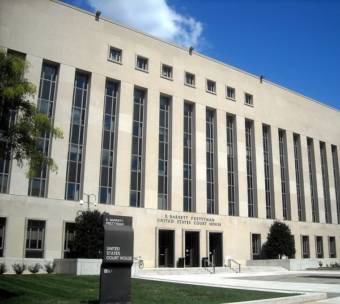
The Barrett Prettyman Court House is home to the U.S. Court of Appeals for the D.C. Circuit. (Wikimedia Commons)

Attorneys for tribes argued in a federal appeals court Friday that Alaska Native Corporations deserve no share of the money Congress reserved for tribes in the CARES Act.

At stake is perhaps hundreds of millions of dollars, but at times the arguments in the Court of Appeals for the District of Columbia turned on an age-old grammatical puzzle.

Let’s put the grammar question this way: If I say ‘We ate salty pretzels, cake and candy’ does that mean the cake and candy were salty, too?

In other words, can a modifier placed next to a list apply to only some items on that list?

The question is relevant because, in the CARES Act, Congress set aside $8 billion to help tribes fight the coronavirus, and for a definition of what a “tribe” is, it referred to a 1975 law. In that law, Congress included Alaska Native corporations in a list, and then followed the list with an eligibility clause, and — at least according to some of the attorneys — that eligibility clause excludes the ANCs.

Department of Justice Attorney Adam Jed argued that Congress would not have included Native Corporations in a list only to exclude them by the end of the sentence. He said people just make grammatical mistakes sometimes, and you have to go by what Congress meant.

And then Jed made an argument only an English major could love:

“We actually cite a couple of grammar guides where we point out that this issue — I think one guide called it an extraposed modifier — is viewed by many as a common grammatical error but is actually viewed by others as permissible,” he said.

The tribes trying to exclude Alaska Native Corporations comprise a dozen from the Lower 48 and a handful from Alaska. Arguing for them, attorney Riyaz Kanji said Congress put other money in the CARES Act for the corporations and for Native people who aren’t affiliated with a tribe.

“Nobody, of course, wants anybody left out in the cold, and that would not happen to Alaska Natives in the urban areas or Alaska Natives in the villages,” he said.

It’s not clear how the Treasury Department would distribute the money it is reserving for ANCs if the corporations lose the case — whether it would go to Alaska tribes or to tribes around the country.

More than a piece of the pie, tribes say they are standing up for the principle of sovereignty. Tribes have governmental powers, and they want it clear that corporations aren’t the same thing.

The corporations say they are also spending resources to help their shareholders combat COVID-19.

Goldbelt board member fined by state regulators over Facebook post

The cover design of Goldbelt Inc.'s 2016 annual report was inspired by the late Clarissa Rizal, a Goldbelt shareholder and weaver. (Photo by Jeremy Hsieh/KTOO)
The cover design of Goldbelt Inc.’s 2016 annual report was inspired by the late Clarissa Rizal, a Goldbelt shareholder and weaver. (Photo by Jeremy Hsieh/KTOO)

State regulators have fined a Goldbelt Native corporation board member over a social media post that implied shareholders would be paid if they’d vote a certain way.

The Juneau-based urban Native corporation had asked shareholders last year to vote in favor of establishing a new trust it said would take advantage of a change in the federal tax law. It passed overwhelmingly.

In the weeks leading up to the vote, Board Member Richard Beasley posted a picture of a check for $100 made out to his brother on Facebook. The post said his brother had voted in favor of the resolution and quote: “he got his hundred bucks.”

Screenshot of a Facebook post by Richard Beasley. State financial regulators accused Beasley of “materially misrepresenting that shareholders were required to vote in favor of the proposed settlement trust to receive $100.00 from Goldbelt.”

Everyone that participated in the election received the same incentive designed to boost participation for the Native corporation to reach quorum at its annual meeting.

In an enforcement order dated June 30, the state’s Division of Banking & Securities says: “Shareholders were not required to vote in favor of the proposed settlement trust to be eligible to receive $100.00 from Goldbelt.” It ordered him to pay a $1,000 fine.

Goldbelt shareholder Ray Austin says he’d filed a formal complaint over Beasley’s Facebook post because it was misleading.

He’s a longtime critic of the Native corporation’s management and recently was on the receiving side of sanctions over an unrelated dispute with Beasley.

“I didn’t like that statement when I saw it because I didn’t think it was truthful,” he said in a phone interview. “You didn’t have to vote ‘yes’ to get your hundred dollars.”

The state regulator fined Austin earlier in June over a Facebook post last year that accused Beasley of failing to disclose his paid contract work for Goldbelt. He says he’s requested a hearing to defend himself.

State financial regulators are empowered to broadly police speech related to board elections of Native corporations created by the Alaska Native Claims Settlement Act. Critics have accused the state regulator of overreach that violates free speech and chills dissent among shareholders in public forums in newspapers and online.

A legal challenge brought by the ACLU of Alaska earlier this year is pending with the Alaska Supreme Court

Messages left with Beasley through social media and Goldbelt’s management weren’t returned.

Federal judge halts CARES Act funds to Alaska Native corporations

Close up of a gavel (Photo by Skip Gray/360 North)

A federal judge issued an injunction that prevents Alaska Native corporations from receiving part of a Tribal funding set-aside in the CARES Act.

The decision came Tuesday, July 7, 2020, as Tribal nations appeal a ruling in late June that said the Native corporations were eligible to receive the funding.

U.S. District Judge Amit Mehta had ruled against several Tribes in the Lower 48 and Alaska. They sued the Department of Treasury and Interior over the eligibility of Alaska Native corporations to receive a portion of about $8 billion.

The decision hinged on whether Alaska Native corporations could be considered Tribal governments in relation to the funding. Though he wrestled with his decision, Mehta ultimately ruled that they could.

The injunction Tuesday paves the way for Tribes to pursue an appeal in the case. But only gives them until July 14 to do so. After that, the injunction expires July 15.

These Alaska companies got the biggest Payroll Protection Program loans

South Peninsula Hospital. (Photo courtesy South Peninsula Hospital)
South Peninsula Hospital in Homer. (Photo courtesy South Peninsula Hospital)

Alaska has received $1.2 billion from the federal Paycheck Protection Program (PPP), and the Small Business Administration has released the names of those that got the biggest share.

High-profile, established companies made the list, as did hundreds of smaller businesses that usher oil from the ground and keep Alaskans fed, housed and moving.

A dozen Alaska companies got $5 million to $10 million apiece: half of them are subsidiaries of Alaska Native Corporations, three are privately owned oilfield and industrial support companies, two run hospitals and one owns a telecom system.

A list of company names on a blue background
A dozen Alaska companies received Payroll Protection Program loans of $5 million to $10 million.

South Peninsula Hospital spokeswoman Derotha Ferraro said the Homer facility got $6.3 million. She said it was a lifeline when the Homer hospital was facing a drastic loss of revenue because of the pandemic and mandates to stop providing many services.

“We’re kind of like the greatest example of the purpose of the Payroll Protection Program. And that’s to keep critical infrastructure, small businesses alive in the rural areas in the local communities,” she said.

With PPP money, the hospital didn’t have to lay off any of its nearly 500 employees, she said.

Other big recipients of Payroll Protection Program money include JL Properties, a real estate development company in Anchorage. It is owned by two of Alaska’s wealthiest men, Jonathan Rubini and Leonard Hyde. Their firm landed between $2 million and $5 million, as did a wide range of other employers: Alyeska Resort in Girdwood, Anchorage Neighborhood Health Center, the Central Council of the Tlingit and Haida Indian Tribes and Grant Aviation.

Recipients of $1 million to $2 million include medical clinics, car dealerships and construction companies, as well as the Anchorage Daily News, law firm Birch Horton Bittner and Cherot, Ryan Air and Huna Totem Corp.

Churches and affiliated nonprofits have received Payroll Protection Program money, too: Anchorage Baptist Temple Inc., Corporation of the Catholic Archbishop of Anchorage, Catholic Schools of Fairbanks and Grace Community Church.

Alaska Public Media received $627,000 from the program, according to CEO Ed Ulman. KTOO received a portion of the CoastAlaska loan of $719,060.

In all, more than 11,000 Alaska entities have received the federal loans. They convert to grants if spent on payroll and other business expenses.

About 85% of Alaska’s recipients got less than $150,000, and the SBA did not provide their names. Some got just a few hundred.

Site notifications
Update notification options
Subscribe to notifications