In “Raven and The Hidden Halibut,” Raven (Yéil) enlists a group of animal friends to help find Halibut (Cháatl). (Image courtesy Sealaska Heritage Institute)
Sealaska Heritage Institute has published four new books to bolster its efforts of teaching Indigenous language and culture to kids. One is an original story written by kids from Harborview Elementary School in Juneau.
In “Raven and The Hidden Halibut,” two animals that are complete opposites want to play with each other.

“Halibut really wants to play with the Raven and has to talk him into it, and they end up playing hide-and-seek. And Halibut, as it turns out, is a very good hider,” said Katrina Hotch, who worked with the students who wrote the original story.
In the story, Raven enlists a group of ocean creatures to help look for Halibut.
“Raven, or Yéil, works with Téel’, dog salmon, Náakw, octopus, X’éix, king crab, Tóos’, salmon shark and Taan, sea lion,” said Hotch.
Hotch says it’s a testament to the strength of the school district’s Tlingit culture, language and literacy program that the students wrote the story.
Now the book is available through Sealaska Heritage Institute’s Baby Raven Reads program, along with three other books published entirely in Indigenous languages. Two of them are in Lingít, and one is in Sm’algya̱x.
Am’ala (Sm’algya̱x) is one of the newly translated books recently published by SHI. In this traditional Tsimshian story, a young man who is teased by his brothers for being lazy and dirty trains secretly with a spirit and gains superhuman strength. He takes on warriors, animals, and even a mountain before facing his greatest challenge – the world itself. (Image courtesy Sealaska Heritage Institute)
Tess Olympia is the program’s manager. She says it all started in 2014 as a pilot project in Juneau.
“And it was very successful,” Olympia said. “After that, it was able to expand to nine communities in Southeast Alaska through partnership with Tlingit & Haida Head Start programs.”
Olympia says three of the books are the first to be published by Sealaska entirely in the region’s native languages.
Nax̱too.aat! (Let’s Go!) teaches about Tlingit, Haida and Tsimshian subsistence harvesting activities. (Image courtesy Sealaska Heritage Institute)
“We have a lot of language learners that have been asking for this. So we’re excited to be able to be at the point with our publications, that we could make that happen,” she said.
Olympia also says the program is currently serving more than 350 children throughout Southeast Alaska. In December, the institute mailed out 1400 books to families. And more than two thirds of those families report reading daily.
Olympia says she’s gotten feedback from families all over the region who are touched to have these stories in their home.
“When they didn’t grow up with stories, like books, to represent their own selves and their own culture and their homes and so, it’s finally this opportunity to have to have that happen. And for children to see themselves in the stories, it’s very validating,” she said.
As for whether Raven was able to find Halibut, readers can find out for themselves. The new books are available to buy from the Sealaska Heritage Store.
The northwest coast of Prince of Wales Island. (Photo by Joe Viechnicki/KFSK)
Sealaska Corporation announced on Monday that it is getting out of the logging business after more than 40 years.
The move by one of the region’s economic powerhouses is the latest sign of Southeast Alaska’s economic transition away from logging.
“Logging created value for our Alaska Native shareholders for decades, and it brought us to where we are today. We’re grateful for the commitment and professionalism that led to our success,” Sealaska CEO Anthony Mallott said in a statement. “But we’ve now built an organization that can thrive well into the future, and that means engaging in activities with more enduring benefits for our communities.”
The corporation declined further comment.
The news was welcomed by environmentalists opposed to logging old growth forests.
“We are overjoyed for Sealaska at this incredible decision making by Anthony Mallott and by their board chair Joe Nelson,” Meredith Trainor, executive director of the Southeast Alaska Conservation Council, told CoastAlaska on Monday. “And just this visionary leadership of moving Sealaska away from logging and towards other ways of creating benefit for their people.”
The Juneau-based Native corporation says the transition isn’t expected to affect future profits or dividends. A joint statement says the decision is part of a long-term plan to generate “sustainable value” for shareholders.
Until now, Sealaska was a major player in the region’s timber economy with more than 360,000 acres in its portfolio.
In 2015, it began logging lands it received through a transfer by Congress of more than 70,000 acres of Tongass National Forest, largely around Prince of Wales Island.
The Alaska Forest Association, the state’s timber industry group, declined to comment on the news.
Sealaska Corporation was created by the landmark Alaska Native Claims Settlement Act. It has about 22,000 shareholders, most of whom live in or have historic ties to Southeast Alaska.
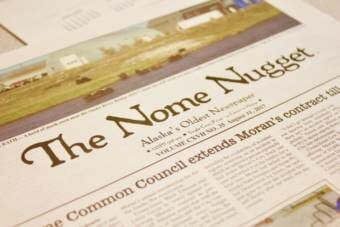
Austin Ahmasuk was fined $1,500 for a letter to the editor that the Nome Nugget published in 2017. (Photos courtesy of KNOM)
The state’s financial regulator fined Austin Ahmasuk $1,500 for a letter to the editor that the Nome Nugget published in 2017. They said he should have filed paperwork under regulations that require Alaska Native corporation shareholders to disclose their connections before soliciting votes called proxies.
Austin Ahmasuk argued that his letter wasn’t supporting or criticizing any individuals running to lead the Sitnasuak Native Corporation, of which he’s a shareholder. And that the regulations didn’t apply to his letter’s broad call to action.
The Alaska Supreme Court agreed.
“The (state financial regulator’s) interpretation and application of its proxy solicitation regulation are unreasonable on the facts of this case,” the justices ruled in a decision published on Friday.
Susan Orlansky argued the case on Ahmasuk’s behalf for the American Civil Liberties Union of Alaska. She told CoastAlaska on Friday when he wrote the letter nobody had even put their name forward to run and that troubled the Supreme Court.
“He really isn’t talking about votes for him or her,” she said.
Rather, he’d encouraged fellow shareholders with voting powers not to file discretionary proxies. Those are basically blank ballots that can later be used by a slate of candidates usually endorsed by the sitting board of directors.
Critics say blank ballots handed to the board slate give incumbents an advantage over independent challengers.
Some justices were skeptical when, under questioning last year during oral arguments, the state’s attorney conceded that even an open letter urging shareholders to attend a meeting technically falls under regulated speech.
Acting on complaints, state financial regulators routinely investigate and sanction shareholders for comments made in print and online that are perceived to sway a corporate board election — like an opinion piece in a newspaper. But more often it’s an online post in a Facebook shareholder forum.
Sitnasuak Native Corporation wasn’t party to the lawsuit. But some of the state’s regional Native corporations filed briefs supporting the state’s power to regulate shareholder speech. Doyon, Calista and the Bristol Bay Native Corporation were among them.
Orlansky says it’s good to have this decision to guide future actions.
“I would say that lawyers for other shareholders as well as lawyers for (financial regulators), or for Native corporations ought to read this decision very carefully, because I think the decision holds some suggestions,” she said.
ACLU senior counsel Susan Orlansky argued the case on January 23, 2020. (Screenshot courtesy of Gavel Alaska)
That’s because the ACLU argues the state is stifling free speech. It’s suggested the state could look to the federal guidelines established by the federal Securities and Exchange Commission. Since 1992, the feds have opted to regulate shareholder speech less broadly out of constitutional concerns.
Orlansky says the Alaska Supreme Court ruling is a win for her client. And she says the justices’ decision outlines how the state’s regulations potentially fall afoul of the U.S. Constitution on free speech and due process grounds.
“But the Supreme Court very clearly didn’t decide those questions. It did what courts often do, and decided the issue in front of it and very specifically nothing further,” she added.
State attorneys say they’re reviewing the court’s decision.
“The court emphasized that its decision is limited to the particular facts and circumstances of this case and less about the medium used to communicate,” wrote Assistant Attorney General Charlotte Rand in a Friday email. “Communications might be proxy solicitations even if those communications are in mass media or social media.”
The Division of Banking and Securities welcomes questions about compliance with its regulations, she added.
A digital simulation of what the proposed Pebble Mine’s foundation will look like. The State of Alaska is appealing the U.S. Army Corps of Engineer’s denial of a permit for the mine. (U.S. Army Corps of Engineers)
Alaska Gov. Mike Dunleavy is appealing the U.S. Army Corps of Engineer’s decision to deny a permit for the proposed Pebble Mine, back in November.
The state’s Department of Law will file an administrative appeal with the federal government, according to a media release.
In that release, Dunleavy calls the denial a “dangerous precedent” that would harm Alaska’s future. His Department of Natural Resources Commissioner Corri Feige echoed that sentiment in the release, saying that it has “ominous implications for our rights as a state to develop our resources for the benefit of all Alaskans.”
Alaska Gov. Mike Dunleavy announced on Friday, Jan. 8, 2021 that the state is appealing the U.S. Army Corps of Engineer’s decision to deny a permit for the proposed Pebble Mine. (Nat Herz/Alaska Public Media)
The Army Corps denied the permit after determining that the plan for the mine would not comply with the Clean Water Act, and that the project is not in the public interest.
Fishermen and tribes in Bristol Bay have been fighting the project for more than a decade.
If built, the open-pit gold and copper mine would be one of the largest in North America.
Dan Cheyette, Vice President for Lands and Resources at the Bristol Bay Native Corporation, said they “completely disagree” with the governor’s decision. He said the corporation has “always held” that Pebble is unlike any other resource development project.
“Because of its location, because of its size, because of the type of deposit that it is, and the fact that it is in the midst of one of the world’s greatest wild sockeye salmon fisheries, it can’t be judged against any other project,” he said.”
Cheyette said he believes the Army Corps will uphold its decision to deny the permit.
The United Tribes of Bristol Bay are strongly opposed to the project.
Opponents of the Pebble Mine protested in Anchorage in 2019, arguing that the Corps of Engineers’ environmental review of the mine was inadequate. (Liz Ruskin/Alaska Public Media)
“Bristol Bay residents and Alaskans have been clear that we will not trade one of the world’s last robust salmon fisheries for a gold mine,” wrote Deputy Director Lindsay Layland in an emailed statement. “It’s outrageous that Gov. Dunleavy and his administration would go against the will of Alaskans to benefit a foreign mining company that has no value to our state, and shows once again how out of touch he is.”
Robin Samuelsen is the chairman of the board of the Bristol Bay Economic Development Corporation. He has opposed Pebble for more than a decade and he’s not surprised by Dunleavy’s announcement.
“We’ve got two of our federal senators opposing the Pebble Mine, hundreds of thousands of people opposed to the Pebble Mine. And we’ve got a rogue governor that doesn’t care what Alaskans think,” he said. “We’ve always asked our congressional delegation, the state of Alaska to treat us fairly out here. And they always said they’re going to treat us fairly. But now, it just goes to show that the governor is stepping outside the bounds.”
Despite this most recent development, Samuelson said, he thinks Pebble is “on its way out.”
“I’m not against mining, but that mine is in the wrong place,” he said. “It’s in the spawning grounds — the most productive spawning grounds in the world. We have our gold, it’s called sockeye salmon.”
Sue Anelon, who works with the Iliamna Development Corporation, said she supports the governor’s decision. She said that the lack of jobs in Iliamna is forcing people to look for work.
“If we don’t do anything, we’re going to be stagnant,” she said. “We’re going to still depend on the government. I don’t want to move out of my hometown just to get a job, but people are moving, and I love this place and I’d rather be home.”
Anelon says people in her community commercial fish, and they also depend on a subsistence way of life, but that they need money even when fishing and hunting for food.
“If you’re going to go catch a moose, you have to buy your shells, you have to buy your gun, you have to buy your gas. You have to buy everything to keep your meat — your vacuum sealers and your bags,” she said. “So it takes money to put your food away.”
The Canadian-based parent company of the Pebble Limited Partnership is currently caught up in a class-action lawsuit alleging that the company mislead its shareholders about the viability of the project.
Correction: A previous version of this story misspelled Robin Samuelsen’s name, it has been updated.
Russian Mission in 2018. (Dept. of Commerce, Community, and Economic Development)
A story about the baby formula shortage in Russian Mission caught the eye of artist and activist CeeJay Johnson, who stepped in to organize a big donation. The post office in Russian Mission has been intermittently closed for nearly half a year. Both the village store and mothers who receive benefits from the Women, Infants and Children Program rely on U.S. Postal Service for formula shipments and have been running dangerously low.
When Johnson caught wind of the story, she posted the information to her Facebook page, Kooteen Creations, and her page on Reddit. She received many messages of support and offers to donate supplies. Johnson organized the donation deliveries, which were dropped off before Christmas.
Although Johnson has never been to the Yukon-Kuskokwim Delta in person, she knows the struggles of the region well. She was born and raised in Sitka, and she went to Mt. Edgecumbe boarding school where she made friends with many students from the Y-K Delta villages.
She’s also Indigenous herself, with Sioux and Tlingit ancestry. Johnson spent many years working in tribal governance in Alaska as well as in the Lower 48. In short, she was uniquely prepared to help with relief efforts.
Johnson originally started her Kooteen Creations Facebook page as a platform for selling her art and beadwork. But when the pandemic struck, she started using it as an antidote to feelings of isolation among Native communities.
“I noticed that a lot of Native peoples were having some difficulties coping with the burden of self-isolation. So I started this project called ‘Bead Your State,” she said.
For the project, Johnson beaded Alaska and Washington and she invited Indigenous people from all over the U.S. to join in and help her complete the map. The project grew to include the provinces of Canada and her platform grew to thousands of followers.
Johnson always used her platform for political posts, but she started organizing donations in October when she read an article reporting that the Yukon-Kuskokwim Health Corporation was dangerously low on gloves. She organized a team to donate supplies and soon the efforts expanded.
Now she coordinates donations of hand-sewn masks, other personal protective equipment, baby formula and many other supplies to villages. In just two months from her initial relief effort, her team has grown to dozens of volunteers. Donated supplies are sent to a storeroom owned by Calista Corporation in Anchorage, where they are inventoried, packed up and shipped off to the villages.
“Because the last thing we wanted to do was send 5,000 masks to villages with 400 people because they don’t need that many,” she said.
Johnson knows that post offices can’t always be relied on in rural Alaska, so it’s best to coordinate deliveries directly through small shipping services like Ryan Air, which gave their services to her relief efforts for free.
“I’m really good at getting people to help,” laughed Johnson.
She’s not lying. To get Ryan Air to help, she reached out to her former high school classmate who is married to its president.
Russian Mission is benefitting from Johnson’s efforts.
Margie Larson, who is a mother of a 5-year-old and a 7-month-old, hasn’t received a formula delivery from WIC in almost two months so she was relieved to get the formula canisters.
“I was posting almost every day on Facebook channel for formula, any kind of formula ’cause my daughter was out. We were really, really happy for that package that came in from KC,” Larson said.
But the donation formula will only last her two weeks. A temporary postmaster was supposed to show up early last week, according to a representative for USPS. But Olga Changsak, the tribal administrator, said that she was two days late. The tribe was concerned that she would only be in town for one day, and would not have enough time to get to all of the WIC boxes.
Russian Mission still has one applicant for the position of postmaster, who is waiting to hear back. But the process usually takes at least 30 days, and the company handling the background checks has been slow since the start of the pandemic.
In the meantime, Johnson is sending more donated formula.
Ohmer Creek south of Petersburg on Mitkof Island shows signs of low water in July. The creek usually brings in a variety of salmon to spawn. (Photo by Joe Viechnicki/KFSK)
The Petersburg Borough Assembly may take a position on proposed legislation that would transfer national forest land to five new Native corporations sometime next year. That’s after hearing again from supporters and opponents of the bill.
The legislation, introduced by Alaska’s congressional delegation this fall, would grant over 23,000 acres each to five new urban Native corporations, in Petersburg, Wrangell, Haines, Tenakee and Ketchikan.
Alaska’s senators and congressman say the bill will fix the omission of those communities from the Alaska Native Claims Settlement Act. The landmark 1971 law awarded nearly one billion dollars and 44 million acres to Alaska Natives and called for formation of village and regional corporations.
The legislation has been introduced before, but the latest version includes specific land selections. Near Petersburg, it identifies parcels from the Tongass National Forest on Mitkof and Kupreanof islands, along with Thomas Bay on the mainland. Some of those selections also include roads, forest service cabins and other public infrastructure.
Some opponents are concerned about losing access to national forest land and the potential for logging those parcels. And Petersburg resident David Beebe, who opposes the measure, questioned the cost of the transfer.
“Given the amount of public infrastructure certainly measured in the tens of millions of dollars in these land selections, it would be good to know what the taxpayer has forfeited to these five brand new Native corporations should this bill pass,” Beebe told the assembly.
Supporters of the legislation also weighed in.
Cecilia Tavoliero is president of the Southeast Alaska Landless Corporation, which sent the assembly a letter about the legislation. She and others would be shareholders of a new Petersburg urban corporation that would use the land for economic development and other uses. They say the 1971 land settlement and a cash payment in 1968 were not a good deal, and they’re asking for a tiny fraction of the land that was once theirs.
They also say the corporations will look for other ways to make money off the land other than logging, like carbon credits or tourism.
Nicole Hallingstad, granddaughter of Petersburg civil rights leader Amy Hallingstad, said the parcels in the legislation weren’t chosen with logging in mind.
“We did not select these parcels because of timber development,” she said. “We selected many of these parcels because they were the only lands available for selection at that time.”
Hallingstad also said the legislation ensures ongoing public access, unlike the 1971 law.
“This particular Alaska Natives Without Land bill preserves public access to all of the lands proposed to be conveyed to the new urban corporations,” she said. “It guarantees in perpetuity that the land shall remain open and available to subsistence uses, non-commercial recreation hunting and fishing and other non-commercial recreational uses by the public.”
The bill does have allowances for “reasonable restrictions.” Those include public safety and minimizing conflicts between recreational and commercial uses. The legislation would phase out U.S. Forest Service outfitting and guide use of the lands.
Also calling into the meeting this month was anthropologist Chuck Smythe, one of the authors of a 1994 report that looked at whether Congress had inadvertently denied the five communities eligibility to form village or urban corporations with their own land. Instead, members of the five communities were enrolled as at-large shareholders of the regional Native corporation Sealaska.
Areas in red show proposed land selections on Mitkof and Kupreanof islands near Petersburg. (From U.S. Forest Service maps presented to the U.S. Senate Energy and Natural Resources Committee)
The report, which is cited by both supporters and opponents of the current legislation, found nothing in ANCSA or its supporting documents that clearly explained why the communities were left out.
But Smythe, who now works for the Sealaska Heritage Institute, said Alaska Natives from Southeast villages may have been treated differently because of prior cash settlements in court cases over Native land claims. At the same time, though, a court had determined that earlier settlement did not extinguish all aboriginal claims in the region.
Smythe also said the 1971 law included a special provision to allows four other communities that were not small rural Native villages — Juneau, Sitka, Kodiak and Kenai — to gain eligibility for urban corporations.
“This provision was introduced by Senator [Ted] Stevens in the final bill during its consideration by the conference committee,” Smythe said. “No one objected to the four communities gaining eligibility at the last minute, but as stated in the report, the sense of the conference committee was that no more communities would be accepted for urban corporation status.”
Representatives from three of the five communities left out — Tenakee, Ketchikan and Haines — appealed their eligibility status but were denied. An appeal board ruled the law had “created an exclusive list of eligible villages in Southeast Alaska which cannot be added to.”
Assembly member Jeff Meucci, who asked to have the topic on the assembly’s agenda this month, asked to continue the discussion on the new legislation.
“I guess my original intent here was to — if this legislation was moving forward in a faster pace than everybody was comfortable for — at least have a conversation about it,” Meucci said. “It seems like we’re going to have an opportunity hopefully in the month of January or so, to have a wide ranging conversation to answer these questions and have more dialogue.”
The legislation has been introduced in both the U.S. House and Senate, but it will have to be reintroduced if it’s not passed by the end of this year.
Close
Update notification options
Subscribe to notifications
Subscribe
Get notifications about news related to the topics you care about. You can unsubscribe anytime.