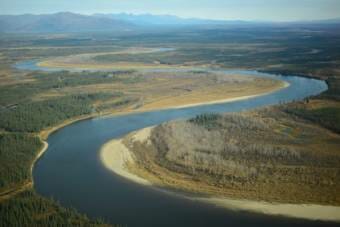
A map of the proposed Ambler Road project (Bureau of Land Management)
In the latest move forward for the controversial Ambler Road project, the Alaska Industrial Development and Export Authority reached an agreement with regional Native corporation Doyon to conduct survey and feasibility studies on the corporation’s lands.
The proposed 211-mile road would stretch west from the Dalton Highway to the Ambler Mining District in Northwest Alaska. The area is rife with mineral deposits, including zinc, gold, silver and cobalt. The road has drawn controversy from environmentalists and subsistence advocates over it crossing Gates of the Arctic National Park and potential impacts to caribou migration.
The land along the road’s route near the highway and the village of Evansville is owned by Doyon, the state’s largest private landowner. The agreement is not a right of way and does not guarantee long-term access to the area by AIDEA or the road project.
In a statement, Doyon President and CEO Aaron Schutt said that the corporation has not changed its position on the project, neither opposing or supporting it.
AIDEA plans to continue its summer field activities along the proposed route. The current budget for those activities totals about $13 million, a cost the state corporation will split 50-50 with Ambler Metals, the primary mining company interested in developing the Ambler Mining District.
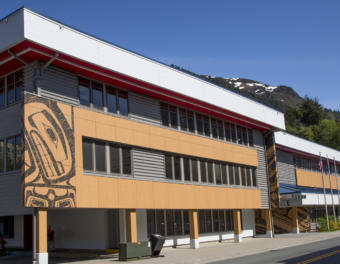
The Andrew Hope building houses offices for the Central Council of Tlingit and Haida Indian Tribes of Alaska in Juneau.
A huge amount of money is on its way to Alaska tribes under the American Rescue Plan Act passed by the U.S. Congress in March. Alaska tribes will receive over $1 billion of the $1.9 trillion the act provides.
Unlike the CARES Act funding, which had a short deadline, tribes can take as long as three years to spend these funds. Teresa Jacobsson of the Alaska Tribal Administrators Association said tribes will have more leeway on how to spend the funds, but the government can’t just give tribal members checks.
“You can’t do that,” Jacobsson said. “You’ll end up having to pay it back. You have to show a need, which is show basic living essentials like housing and rent expenses, utilities, internet connectivity, personal cleaning and sanitation products. You have to tie the money to a COVID-related need.”
Tribes will also have to carefully document the spending because their records will be reviewed by auditors. They can spend part of the funds to get professional help for managing and auditing the spending, but Jacobsson said that they will need to be careful. Word of the funding has gotten out, and there are some unscrupulous people who will want to take advantage of small tribal groups. At one of the Zoom meetings held by ATAA to help tribes, a lawyer shared stories about what happened to some tribes outside of Alaska.
Jacobsson said that these were “horror stories about some tribes in the Lower 48 they represent who were taken advantage of by consultants or contractors with this big pot of money.”
“So what we’ve been telling the tribes is ‘be mindful,'” she said. “Yes, it’s appropriate and necessary sometimes to use an outside entity to help support some of these needs, but we want to make sure that they’re doing their due diligence.”
Jacobsson said that ATAA has a list available of reputable auditors and other resources to help tribes. They can be reached at 907-222-1310 or on the ATAA website.
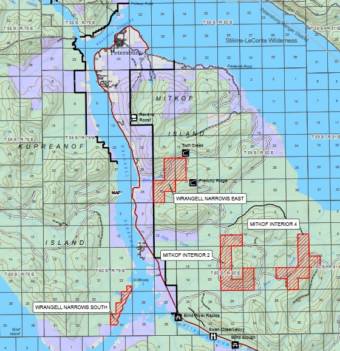
Areas in red show proposed land selections on Mitkof and Kupreanof islands near Petersburg. (From U.S. Forest Service maps presented to the U.S. Senate Energy and Natural Resources Committee)
Community members have another chance to weigh in tonight on the potential transfer of Tongass National Forest land to five new urban Native corporations.
Petersburg’s borough assembly holds a work session by teleconference Wednesday, March 10 on legislation that last year was called the Unrecognized Southeast Alaska Native Communities Recognition and Compensation Act.
That bill sought to amend the landmark 1971 Alaska Native Claims Settlement Act and grant 23,040 acres each to five new urban Native corporations in Petersburg, Haines, Wrangell, Ketchikan and Tenakee. It did not pass Congress last year, but Alaska’s Congressional delegation is expected to introduce it again this year.
Assembly member Jeff Meucci thought the assembly was getting ahead of the process by taking comment on legislation that has yet to be proposed in a new session.
“The legislation that was introduced last year didn’t make it as far as people would like it to,” Meucci said. “You know there was lots of concerns with that legislation from a lot of people we heard from when we had, I don’t know if it was a community meeting, but we had a lot of public testimony.”
Mayor Mark Jensen and borough manager Steve Giesbrecht recently took part in a teleconference with Wrangell officials and staffers from Sen. Lisa Murkowski’s office about the legislation. Jensen said tonight’s session for Petersburg would allow for more public comment.
“This is the start of gathering official public comment and the way I understand it, the way it stands now, the legislation and the maps will be reintroduced, potentially just like they are if there is no objection,” Jensen said. “So the maps are not set in stone. The wording in the legislation is not set in stone. And you’re right it hasn’t been reintroduced, so it is kind of … the document we would be working off, people should be working off of, in my understanding, is what was introduced last year.”
Jensen thought the legislation might be reintroduced in May or June. Supporters of the bill say the new corporations would look for economic development potential on the lands other than logging and say public access for hunting and fishing would continue. The bill as drafted would require the lands to remain open to subsistence hunting and fishing but would also allow a new urban corporation to restrict access in certain cases.
Assembly member Taylor Norheim would qualify as a shareholder of the new corporation and supports it.
“Maybe you want the federal government to own this land still and keep it public, although the tribe has said that they’re not going to keep people off the land, that over one third of all federal land in the United States of America is in Alaska,” Norheim said. “That’s a lot of land. I don’t see a real problem with putting a little more land out of the federal government’s control and into the hands of let’s just say the people who were here first.”
The bill and land selection maps are posted on the borough’s website.
People can call into the work session to offer testimony at 1-800-954-0633 starting at 6 p.m. Written comments can be emailed to assembly@petersburgak.gov
Davis-Ramoth School in Selawik. (Photo courtesy of Northwest Arctic Borough School District)
Several weeks after an outage knocked out power in the Northwest Arctic village of Selawik, officials say it has been restored. However, the outage has exacerbated chronic problems at the local water treatment plant.
On Febr. 14, the diesel generators went out in Selawik, knocking out power at the school, dozens of homes and — perhaps most critically — the village’s water treatment plant. As local, regional and state officials worked to solve the issue, the community of roughly 800 people was without running water and had to conserve power, relying on back-up generators while power was slowly restored.
Tribal administrator Tanya Ballot said officials don’t know for sure what the cause was, but she suspects wear and tear on the engines.
“Just like any regular engine, if it’s not maintained properly it doesn’t work. So that may have been the problem,” Ballot said.
Having power issues during any time of year would be rough on the village, which is about 90 miles east of Kotzebue, but Ballot said the winter weather is making things tougher.
“Mother Nature is not helping us right now,” Ballot said. “It’s 17, 18 below with a 50 below wind chill factor today. We have been cold for the last two weeks.”
Ballot said power was restored to two of three engines this week, and the community no longer has to conserve power or boil water. However, she said the power was out for so long, that serious damage was done.
“Having the power restored a little late was detrimental to the water treatment plant,” Ballot said. “Those lines had a chain effect and froze so far, that we’re still not thawed out today.”
Ballot said community members now have to haul their water from the water treatment plant to their homes, instead of being able to rely on their pipes or water taps. She said it’s led to a lot of frustration among residents.
“They’re right in their frustrations because we’ve become accustomed to having running water out of a tap, and being able to flush our dishwater down a drain, and our bath water and our toilet water and whatever else is in a toilet down the drain,” Ballot said. “And it makes more work for us to haul it out and pack it in and empty it out in a bucket. And it’s not sanitary.”
Ballot said she’s concerned that the lack of clean water could have other, less obvious consequences.
“We’ve seen increased illnesses and skin problems because people aren’t able to stay as clean as we’re used to,” Ballot said. “Attendance at school may or may not be affected because students don’t want to go to school with dirty clothes or smelling stinky. So it really has a bigger effect on us than we think.”
Having frozen pipes isn’t a new problem in Selawik. Ballot said long-term issues at the 30-year-old water system have persisted for years.
“We keep putting band aid fixes on it that don’t seem to stick,” Ballot said. “And we need a complete overhaul of this system. And parts are not cheap.”
Ballot said they need new motors, which cost about $26,000. Additionally, they need a new water pump which costs about $5,000.
“We don’t have that kind of funding in our pocket,” Ballot said. “So we’re going to be putting through some applications. We’re going to request for state funding, emergency funding to try to help get these necessary parts. Above-ground water and sewer is very, very… it’s a challenge to maintain.”
Ballot said the village has seen a lot of support from surrounding communities, including parts from the Alaska Native Tribal Health Consortium, water donations from the Kiana AC store, and emergency assistance from NANA Regional Native Corporation and the Northwest Arctic Borough.
“I feel very fortunate that all these folks are contributing and helping us, and I wish the same for Ambler,” Ballot said. “I understand Ambler is going through the same problem with water and sewer. And Unalakleet, and Tuluksak.”
Ballot said she’s hopeful that the impending spring weather will help thaw some of the pipes, making running water more accessible in town, though she said it’s “taking its sweet time.”
The Native Village of Kaktovik building in June 2018. (Photo by Jennifer Pemberton / Alaska’s Energy Desk)
The Native Village of Kaktovik is speaking out against the Biden administration, claiming their tribe wasn’t consulted about an agreement President Biden made with Canadian Prime Minister Justin Trudeau regarding protections of the Porcupine caribou herd in the Arctic National Wildlife Refuge.
Last week, in a joint statement with Prime Minister Justin Trudeau, President Joe Biden pledged to “help safeguard the Porcupine caribou herd calving grounds that are invaluable to the Gwich’in and Inuvialuit peoples’ culture and subsistence.”
The herd’s migration takes them through both Canada and the United States.
It’s the latest in a series of moves from the Biden administration to stop oil drilling in the Arctic National Wildlife Refuge. Shortly after taking office, Biden placed a halt on lease sales in the refuge.
Eddie Rexford Sr. is the president for the Native Village of Kaktovik, an Iñupiat tribe and the only one located within the refuge. He says they weren’t consulted by the Biden administration before the announcement. Despite their opposition, Rexford says the tribe is committed to protecting subsistence resources.
“We certainly like to protect our homelands also, but we want to utilize the natural resources that our creator provided to us,” Rexford said. “Oil and gas, so we can get use the natural gas to get away from using diesel.”
Rexford went on to say that Biden’s actions run counter to his recent memorandum to respect tribal sovereignty and self-governance.
“He promises to work with the tribes and the Native groups in Alaska, and it’s not coming to fruition to our community and tribe,” Rexford said.
The Porcupine Caribou Herd in the Arctic National Wildlife Refuge on July 3, 2019. The Gwich’in live outside of the refuge but harvest caribou from the Porcupine Herd, which breeds in the refuge. (Danielle Brigida via Creative Commons)
Rexford says the tribe had successes with the Trump administration and former Interior Secretary David Bernhardt. He’s hopeful that, if confirmed, Biden’s Interior nominee Deb Haaland, of the Laguna Pueblo people, will make more efforts to work with the tribe.
“Have her come to our community to meet with our folks,” Rexford said, “to let her know that we live here and there’s no Gwich’in homelands here in the refuge, like it’s being purported in the news nationally, internationally and statewide.”
The Gwich’in are an Alaska Native people who reside primarily in the Yukon-Koyukuk region in Interior Alaska. The Inuvialuit are a First Nations people from Northwest Canada. Both oppose opening the refuge to drilling.
Beyond the agreement with Canada last week, the Biden administration has not made any concrete plans to address how they will safeguard the caribou herd.
This is the second scuffle Kaktovik has had with the Biden administration in recent weeks. Last month, the local Alaska Native corporation Kaktovik Iñupiat Corporation was informed by the Interior department that they missed a deadline to do oil exploration in ANWR. The corporation says the federal Fish and Wildlife Service held up the process, resulting in the deadline passing.
Caribou graze on the coastal plain of the Arctic National Wildlife Refuge, with the Brooks Range as a backdrop. (Creative Commons photo by USFWS)
Last weekend, officials from the U.S. Interior Department said there would be no searching for oil in the Arctic National Wildlife Refuge this winter.
The reason: The Alaska Native corporation proposing to do it failed to meet a key deadline to identify polar bear dens in the area, which could be threatened by the trucks used to detect underground oil formations.
“It was the agency that ran the time out, not KIC,” said Nathan Gordon Sr., the corporation’s chairman.
KIC said it was blocked from making the flights to search for polar bear dens by a Feb. 13 deadline because it never got approval from the U.S. Fish and Wildlife Service, an Interior Department agency.
It blamed Fish and Wildlife’s “negligence, irresponsibility and failure to do its job” for thwarting its plans to search for oil this winter, which were largely targeting corporate-owned lands within the Arctic refuge’s boundaries.
“They held all the cards,” said Matthew Rexford, president of KIC, “and then we saw a lot of delays and excuses from them.”
Rexford, in a news release and six-page letter to Fish and Wildlife, is demanding an apology and correction from federal officials, saying they harmed KIC’s reputation and caused significant economic loss to the corporation and the village of Kaktovik — the only community within the Arctic refuge’s boundaries.
An Interior Department official said the agency had no comment on KIC’s statement.
What KIC wanted to do this winter was bring the big trucks and dozens of workers onto a piece of the Arctic refuge’s coastal plain to search for pockets of oil using seismic technology.
Much of the surface area it wanted to assess is owned by the corporation, with an affiliated regional Native corporation, Arctic Slope Regional Corp., holding rights to any oil under the ground.
But for the seismic testing to move forward, KIC needed approvals from the federal government, including an authorization for “incidental harassment” of polar bears in case the work disturbed any dens.
KIC originally applied to do the work under the Trump administration, which pushed for oil development in the Arctic refuge. But the administration didn’t take action on the request before Trump left office — leaving decisions to the anti-drilling administration of Joe Biden.
Federal officials’ correspondence with KIC suggests that one reason the review took as long as it did was a campaign opposing the seismic exploration that popped up on the popular video-sharing app TikTok.
Video creators called on people to submit comments opposing KIC’s proposal to explore for oil this winter — their messages often playing over montages of polar bears and caribou. One activist even created an “influencer kit” to help other social media users promote the campaign.
In a letter Sunday to KIC, a Fish and Wildlife official pointed out that the agency received more than six million public comments. He said the agency could not review and consider all of the comments tied to the corporation’s request by the Feb. 13 flight deadline, despite taking “extraordinary measures.”
“These efforts included hiring a contractor to process and sort the comments, assembling a team of approximately 40 service staff members to review unique comments and working nights, weekends and holidays to ensure that all substantive comments were appropriately addressed,” the letter said.
KIC says that’s no excuse.
In a response letter, Rexford, with KIC, said the corporation expected approval by late January, which would have left more than enough time for the aerial surveys.
When that deadline seemed no longer possible, Rexford said, the corporation asked if it could do the flights without the harassment authorization and was told no.
“In other words, the service put KIC in an untenable situation where it could not perform a task without the service’s authorization, and then turned around and blamed KIC for the service’s failure to provide said authorization,” Rexford wrote.
KIC’s thwarted efforts to search for oil this winter are a major blow for proponents of drilling in the Arctic refuge. Any future proposals will likely face steeper hurdles under Biden’s administration.
Close
Update notification options
Subscribe to notifications
Subscribe
Get notifications about news related to the topics you care about. You can unsubscribe anytime.