Alaska Native Corporations

Indigenous leaders hopeful Interior nominee Rep. Deb Haaland will protect Yup’ik ways of life

C-SPAN

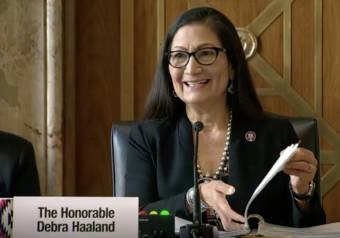
Interior secretary-nominee U.S. Rep. Debra Haaland finished a two-day confirmation hearing in the U.S. Senate on Feb. 24. Oil-state senators on the Senate Energy Committee challenged her on anti-development positions she took as a U.S. Congresswoman, but Sen. Lisa Murkowski seemed more intent on educating the nominee about Alaska’s unique circumstances.

If confirmed, Haaland will be the first Indigenous person to be the Secretary of the Interior, a cabinet position with massive oversight of Indian affairs. Haaland first addressed the committee in her Indigenous language, Keres, and then thanked them. She also made sure to show her gratitude to those who came before her. The “generations of ancestors who have sacrificed so much,” is how Haaland referred to them.

Murkowski, who sits on the committee, used her allotted hearing time to tell Haaland about Alaska’s history, the role of Alaska Native corporations and the huge volume of Alaska land under the Interior Department’s control. Murkowski also made a pitch for the Willow project in the National Petroleum Reserve-Alaska. It would be the westernmost oilfield on the North Slope.

“What I need to know is, is if you’re confirmed, will you commit to allowing the Willow project to proceed without additional changes or environmental review?” asked Murkowski.

As a congresswoman representing central New Mexico, Haaland signed a letter last year asking the U.S. Department of the Interior to stop all work on Willow. Haaland said that if confirmed, she would work to execute President Biden’s vision for natural resources, even if it differed from her own. “I think being a Secretary is far different from being a member of Congress. And so I do take that role very seriously,” responded Haaland.

Some Native corporations and organizations in Alaska have chosen not to opine on Haaland’s nomination, but the Alaska Federation of Natives publicly supports her. Support for Haaland is also widespread in the Yukon-Kuskokwim Delta Region, where many prominent female leaders have backed Haaland.
“I think my initial reaction was, it’s about time,” said Y-K Delta representative Tiffany Zulkosky. Zulkosky also said that as the only sitting Native woman in the Alaska House of Representatives, she feels a sense of solidarity with Haaland. She says that because Haaland understands what life is like for Native people, she actually has a chance at protecting Yup’ik ways of life.

One of the policies in particular that Zulkosky is hoping to work on with Haaland is about missing and murdered Indigenous women. And she expects that under Haaland, the Department of the Interior will engage more with Alaska’s state and tribal governments.

“I’m really hopeful that the new administration under Deb Haaland’s leadership will continue to develop and strengthen the relationship the federal government has with tribes,” said Zulkosky.

Former Y-K Delta representative Mary Peltola had a similar take: “I think what’s even more surprising is that it’s taken this long to have a Native American appointed to be the Secretary of the Department of Interior.”

Peltola currently serves as the executive director for the Kuskokwim River Inter-Tribal Fish Commission. Her role as a local manager of fish resources means that she works closely with the Department of Interior, which has some jurisdiction over subsistence fish and game management on federal lands and in federal waters. Working with a Department leader who can more closely understand Indigenous lifeways and values is crucial, said Peltola.

“The person who is Secretary of the Interior is important because they have so much discretion over regulation and laws that directly impact us in terms of things like hunting and fishing,” said Peltola. Peltola’s husband, Gene Peltola Jr., is the Alaska director of the Bureau of Indian Affairs, which is part of the Department of the Interior.

Vivian Korthuis, the CEO of the Association of Village Council Presidents, a non-profit consortium of tribes in the Yukon-Kuskokwim Delta, said that there’s a lot of hard work ahead for Alaska Natives, and it can finally begin at a federal level under Haaland.

“We are lacking housing, we are lacking safe and reliable transportation infrastructure and the general need for economic opportunities in our rural parts of the state. And in the Y-K Delta, I’m ready to work with her to implement all the solutions in rural Alaska,” said Korthuis.

Korthuis said that she’s looking forward to working with Haaland.

The Senate Energy Committee hasn’t yet scheduled a vote on whether to forward the nomination to the full Senate for confirmation. After the hearing ended, Murkowski told a reporter at the Capitol that she planned to meet with Haaland again.

Bristol Bay tribes and entities renew call to protect region’s watershed

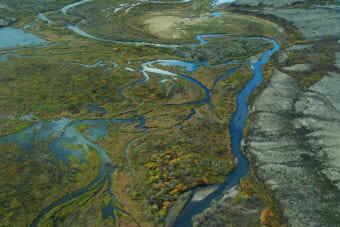
Aerial view of braided wetlands and tundra that is typical of the Bristol Bay watershed in Alaska. Upper Talarik Creek (shown here) flows into Lake Iliamna and then the Kvichak River before emptying into Bristol Bay.
Aerial view of braided wetlands and tundra that is typical of the Bristol Bay watershed in Alaska. Upper Talarik Creek flows into Lake Iliamna and then the Kvichak River before emptying into Bristol Bay (Photo from the United States Environmental Protection Agency)

The United Tribes of Bristol Bay, Bristol Bay Native Association and Bristol Bay Economic Development Corporation published “The Call” in December after the Army Corps of Engineers denied Northern Dynasty’s permit application for the proposed Pebble Mine. UTBB is a tribal consortium that represents 15 tribes in the region. The Bristol Bay Native Association and the Bristol Bay Economic Development Corporation support UTBB’s proposal.

At a virtual town hall earlier this month, UTBB presented a road map for the two-part plan.

“Tribes in the region and Bristol Bay leadership have come together once again, to revive their previous request for 404c action, and we put a proposal forward for both administrative and legislative action to permanently protect Bristol Bay,” said UTBB Deputy Director Lindsay Layland said.

The 404c section of the Clean Water Act restricts discharged dredged waste in defined waters or wetlands. Tribes in the region called for that veto over 10 years ago, when Pebble was first proposed.

Map of the Bristol Bay area that is being studied in EPA’s “An Assessment of Potential Mining Impacts on Salmon Ecosystems of Bristol Bay, Alaska.” (Map courtesy of EPA)

In 2014, the Environmental Protection Agency proposed a “preemptive veto” of a larger mine in the area under Section 404c based on the agency’s Bristol Bay Watershed Assessment. But it was never finalized, and the Trump Administration withdrew the proposal.
Renewing the veto process could prevent Pebble and future companies from dredging at Bristol Bay’s headwaters. The Native American Rights Fund supports the region’s call.

Attorney Matt Newman said the second step of the plan — could solidify permanent federal protections for the watershed.

“Proposing and seeking out legislation that will offer similar kinds of protections from hard rock mining, through the creation of a National Fisheries Area,” he said.

A national fisheries area in the region would be the first of its kind. Through this designation, the groups supporting the plan want to ban any large-scale mines from waste disposal in Bristol Bay’s waters.

A focus on water protections would bypass the need for a state designation. Newman is looking to federal water protections for fish habitat in other parts of the country for guidance.

“It’s something that is uniquely suited for a unique problem — mining in Bristol Bay,” he said. “By threading this needle carefully, we can achieve the protection of Bristol Bay and fisheries resources, but without land statuses like a park or reserve, which locals do not want to see.”

If the land is declared a park or conservation system, it could bar fishing in the protected area. The potential for federal protections in the region could happen under the Biden Administration.

The administration proposed a plan at the end of January to conserve 30% of land and water in the U.S by 2030, known as the “30×30 Executive Order.” The Department of Interior named tribes and fishers as some of the key stakeholders.

Tyson Fick is a commercial fisher who works for Salmon State, a conservation group based in Juneau. Fick is cautiously optimistic about the possibility of permanent protections.

“There’s a lot of reason to be skeptical,” he said. “What the federal and state governments are actually going to follow through on. This is just the beginning and time will tell. It is becoming rapidly apparent that we don’t have a lot of time. It is great to see that we’re going to take bold steps head-on rather than hiding it from it.”

There is currently no timetable for when legislation could be presented, or what the “30×30 Executive Order” will look like.

Other groups support resource and job development in the region. Iliamna Natives Limited sees projects like the Pebble Mine as an opportunity for their village to grow economically.

Northern Dynasty, Pebble’s parent company, also submitted an appeal at the end of January to the Army Corps challenging the permit denial.


Kaktovik Iñupiat Corporation misses deadline for seismic work in Arctic refuge this winter

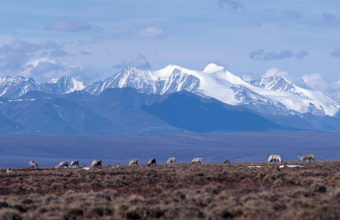
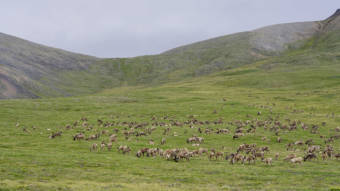
The Porcupine Caribou Herd in the Arctic National Wildlife Refuge on July 3, 2019. (Danielle Brigida via Creative Commons)

An Alaska Native corporation has missed a key deadline to search for oil in the Arctic National Wildlife Refuge, according to the Department of the Interior.

Before it could get approval for what’s known as a seismic survey, the Kaktovik Iñupiat Corporation had to make three flights to search for polar bear dens in part of the refuge.

But the corporation did not do the work before the Feb. 13 deadline, said a brief statement Saturday from Interior spokeswoman Melissa Schwartz.

It’s unclear what exactly happened. An official with KIC did not return requests for comment Monday.

The missed deadline effectively kills the corporation’s proposal to use seismic exploration to search for oil in part of the Arctic refuge’s coastal plain this winter.
It’s the latest setback for drilling proponents who have long wanted to see oil pumped out of the refuge in northeast Alaska.

Another came last month when the first-ever oil and gas lease sale in the refuge, held under then-President Donald Trump, attracted very little interest.

KIC was proposing to bring big trucks and dozens of workers onto the coastal plain to search for pockets of oil on part of the land.

But, to move forward, the corporation needed what the federal government calls an “Incidental Harassment Authorization” of polar bears.

In October, KIC submitted a request to the U.S. Fish and Wildlife Service for the authorization. The agency got inundated with more than 6 million public comments tied to the controversial request.

It had until Sunday to decide whether to give KIC the authorization.

Because the aerial work was not done, the agency told the corporation that its request “is no longer actionable,” according to Schwartz, with the Interior.

Environmental groups celebrated the news that KIC’s plan hit a major roadblock. They had raised concerns about it damaging the tundra and harming wildlife.

“The previous administration attempted to fast-track exploration on an unreasonably short timeline, so the fact that KIC was unable to do the work necessary to ensure the safety of threatened polar bears was completely foreseeable, and Interior responding by voiding the harassment request is the right move at this time,” said a written statement from Adam Kolton, executive director of the Alaska Wilderness League.

Any future proposals for seismic work will likely face steeper hurdles under President Joe Biden, who opposes oil development in the refuge.

On his first day in office, Biden directed the Interior Secretary to put a “temporary moratorium” on all oil and gas leasing activities in the refuge.

Angoon’s Native corporation welcomes new president and CEO

Debbie Atuk was hired in January and officially took over as President and CEO of Kootznoowoo, Incorporated on Feb. 1. (Photo courtesy of Kootznoowoo, Inc.)

Angoon’s Native corporation has a new leader. Debbie Atuk took over as the President and CEO of Kootznoowoo Incorporated in February after a career in corporate finance and business.

Even back when Debbie Atuk was an undergraduate student studying economics at the University of Chicago, she was thinking about Alaska Native corporations.

“I wrote a lot of essays, a lot of scholarship application essays, and I talked about the Native corporations and how I wanted to come back and apply my experience earning a degree in economics,” she said.

Atuk is Iñupiaq and grew up in Nome and Anchorage. She went on to earn an MBA from Dartmouth and most recently worked for SkyView Investment Advisors in New York City. She also serves as board treasurer for Bering Straits Native Corporation.

“It seemed like a good match for my background in banking and finance and business development, so when this opportunity presented itself, I thought it was a no brainer,” she said.

Atuk replaces interim leader Hal Dreyer. She said she’ll continue working with the corporation’s board on a strategic plan that addresses profitability, job creation for shareholders, and sustainable dividends. She also hopes to create opportunities for shareholders to engage with leadership. One idea is to host presentations over video conferences where shareholders can submit comments.

“I think about these Native corporations as family-owned businesses. It’s like a very, very large extended family. Not that everyone is related, but at some point they are,” Atuk said. “So they have a shared asset, and they feel really strongly about it. And I want to make sure that their concerns are heard and addressed.”

Although Atuk has no specific connection to Angoon, she is a shareholder in both a regional and a village Native corporation and has spent years advocating for their interests.

She first met Kootznoowoo board chair, Melissa Kookesh, while advocating in Congress for village Native corporation projects around energy, alternative energy and infrastructure, including Angoon’s Thayer Creek hydro project which would replace the town’s diesel generators.

“I’m really proud of how well the Alaska Native corporations have done, by and large, by diversifying away from natural resources and increasing their business lines beyond just extractive businesses,” she said. “Although, I’m fine with the corporations making the decisions that they make for their shareholders, as long as the shareholders have a voice in it.”

Kootznoowoo, Inc. is headquartered in Juneau and represents approximately 1,100 shareholders. Atuk says she looks forward to meeting them in person once the risk from COVID-19 subsides.

Program that brings Indigenous culture into the classroom expands to more communities in Southeast Alaska

Tlingit Elder David Katzeek addresses a cohort of teachers during a Thru the Cultural Lens seminar in the clan house of the Walter Soboleff Building in Juneau in 2016. (Photo by Nobu Koch)

A program that teaches teachers how to incorporate culture into their classrooms has moved into several communities in Southeast Alaska. The program “Thru the Cultural Lens” is run by Sealaska Heritage Institute. It’s been in some of Juneau’s secondary schools for about seven years, but this year it’s expanding to five K-12 school districts in smaller communities in the region.

There are hundreds of Indigenous students in public schools in Southeast Alaska. But many of the K-12 teachers are non-Native and have no idea how to incorporate culture into the classroom. Teachers might be aware of Tlingit, Haida, and Tsimshian cultures but don’t know how to teach it.

“Then they just don’t do it,” said David Sheakley-Early, project manager with Sealaska Heritage Institute.

He says he’s seen this happen repeatedly. It’s not that the teachers don’t want to teach students the local Indigenous culture. They’re just afraid to.

“With fear of maybe ‘I’ll do it wrong,’” Sheakley-Early said. “Maybe I’ll incorporate it and try to do something and offend somebody.”

He says the Thru the Cultural Lens program gives teachers the confidence talk about culture with their students. Studies show Indigenous students are more successful when they have their own culture in their classroom: things like having culturally responsible education materials, a place-based curriculum and the incorporation of Native languages.

“Ultimately, the bottom line is everything is for the student,” Sheakley-Early said. “So, it’s really helping to find that connection so that students can really be engaged.”

Sheakley-Early says the program teaches cultural values and that’s something that all students can benefit from.

“Honoring our land. Strength — the body, mind, and spirit. The past, present, and future generations. And then Balance — social balance, spiritual balance, balance in really everything,” said Sheakley-Early. “So, based off of those four values you can see how it is pretty dynamic, and it doesn’t have to be specifically for Alaska Native students that are going to benefit understanding and learning through these values.”

Former SHI Education Director Jackie Kookesh (standing, second from right), addresses a cohort of teachers during a Thru the Cultural Lens seminar in the clan house of the Walter Soboleff Building in Juneau in 2016. (Photo by Nobu Koch)

The five new school districts taking part in the program are in Petersburg, Wrangell, Ketchikan, Hydaburg and Metlakatla.

In Petersburg, all teachers in the district will get some training, says superintendent Erica Kludt-Painter.

“Looking at what framework and background that we all bring to instruction and learning,” said Kludt-Painter.

They will also be looking at district policies.

Some staff in the district are diving deeper into the program and getting additional training. Petersburg’s superintendent, two principals and three teachers are participating in that part. They will be spending 50 hours over several months having cultural orientation and then sharing that knowledge with other school staff.

“So we have a teacher in each building that’s participating and we’ll be able to do our own training and work with staff moving forward,” Kludt-Painter said.

Participants are learning together in a group with the other Southeast communities. They’ll each get a stipend for completing the program. They can also earn three credits through the University of Alaska Southeast if they want.

Their first course will be a sort of Southeast Alaska Native Culture 101 class, where they will learn from different speakers who Sheakley-Early calls “the cream of the crop.”

“And then the hope is that the teachers and educators take this cultural orientation, this knowledge and this background, this history, these cultural values and incorporate these into the classroom, into the schools and into the community as well,” he said.

The participants in the course will develop a final project that they teach in their classrooms and also share with the program so that other educators can use it as well.

The program also has a three-day annual education conference at Sealaska Heritage Institute around the first part of August. There, educators from around the state and country learn and talk about culturally responsive education.

The program is funded by the U.S. Department of Education and the Alaska Native Education Program Department.

This grant cycle will go through September of 2022.

As people decline COVID-19 vaccine, more doses become available to general public in Yukon-Kuskokwim

A shipment of COVID-19 Pfizer vaccinations lands in Bethel, Alaska and is transferred to a deep freezer at the Yukon-Kuskokwim Health Corporation on December 16, 2020. (Katie Basile/KYUK)

The Yukon-Kuskokwim Delta is one of the few places in the nation where, across most of the region, the general public is eligible for a COVID-19 vaccine. The tribal health corporation has been able to rapidly expand vaccine eligibility for two reasons. First, it received more doses than expected. Second, many people declined to take it.

During a virtual town hall hosted by the Yukon-Kuskokwim Health Corporation on Jan. 10, President and CEO Dan Winkelman shared an ambitious hope.

“I hope as many people as possible get vaccinated in our region and throughout the nation and the world,” Winkelman said.

The virus that causes COVID-19 has had an outsized impact on the Yukon-Kuskokwim Delta. Since last October, the region has had the highest case rate in Alaska, and one of the highest case rates in the nation. But even with the virus so widespread in the region, fewer people than expected are willing to get vaccinated.

“We have seen a fairly high declination rate throughout our region for the vaccine,” Winkelman said.

YKHC is working to combat that high declination rate with education about the vaccine, using social media posts, virtual information sessions, media interviews and public service announcements. Both the Pfizer and Moderna vaccines are 95% effective at preventing recipients from developing COVID-19, and the vaccine is one of the health corporation’s main tools to suppress the virus outbreak in the region, which has infected nearly 4,000 people and killed 19 residents.

The health corporation received more vaccinations than initially planned. It received an allocation from the State of Alaska and an unexpectedly large allocation from the Indian Health Service. The number of people declining the vaccine has created a surplus for YKHC to widely expand eligibility for vaccinations. Beginning this week in villages, anyone age 16 and older can receive it. That’s as young as federal guidelines allow. During the town hall, YKHC Chief of Staff Dr. Ellen Hodges said that villages have priority because they are more vulnerable.

“Villages have poorer access to care, requires, generally speaking, an airplane ride to be seen in a hospital, and they have less access to water and sewer. So we know that poor access to sanitation has been associated with a risk of respiratory infections,” Hodges said.

Also, many people in villages live in crowded multi-generational homes.

“Which could be considered to be congregant living settings,” Hodges said. “So that’s another reason to expand access in our villages first.”

By the end of this week, YKHC expects to distribute initial doses of the vaccine to 36 village clinics. That will leave only five clinics that have yet to receive the vaccine within the first month of it arriving in the region.

In Bethel, the vaccine is not yet available to the general public. Currently, it’s available to anyone age 50 or older, as well as frontline essential workers and people living in congregant settings. Hodges said that the health corporation may expand eligibility in Bethel in the next week or two. It will depend on how many people who are currently eligible sign up for an appointment.

Even if you are not currently eligible, Hodges encourages everyone in the region who wants to receive a COVID-19 vaccine to complete this online form on YKHC’s website.

“It doesn’t guarantee you an appointment, but it lets us know that you want to have it. And so if you fit into our current criteria, we will call you and get you scheduled as soon as we can. And if you don’t fit into the current tier that we’re on, we will add you to a list and call you as soon as you are eligible to receive the vaccine,” Hodges said.

As of Jan. 8, the COVID-19 case rate was 81 cases per 100,000 people in the Yukon-Kuskokwim Delta; 671 cases per 100,000 people in the Kusilvak Census Area; and 305 cases per 100,000 people in the city of Bethel.

Ten to 15 villages in the region have active COIVD-19 outbreaks, and widespread community transmission in Bethel continues.

Fifteen percent of people in the region receiving COVID-19 tests are testing positive for the virus. This is an indication, according to Hodges, that many people are unaware that they have the virus, but are able to spread it to others.

Site notifications
Update notification options
Subscribe to notifications