An Alaska Native nonprofit in Anchorage is suing its insurance company for million of dollars in what it alleges are unpaid claims over damages from last year’s earthquake.
On Monday, lawyers for Cook Inlet Tribal Council filed a lawsuit in federal court against United Specialty Insurance Co., saying it has refused to “investigate, adjust, and pay” for property loss in the year since the 7.1 magnitude earthquake.
In court documents, CITC said its insurer has dragged its feet reviewing damage claims, avoiding payment for losses covered under their policy, which could constitute a breach of contract. The lawsuit asks that CITC be awarded upwards of $6 million in damages, as well as the cost of legal fees, because the insurance company’s “acts of bad faith were outrageous,” and “evidenced reckless indifference” to their client.
“After immediately putting its insurer on notice of the damage and loss, CITC has been attempting to recover its losses due under the policy for the last 12 months,” wrote Brad Hillwig, CITC’s communications director. “Unfortunately, CITC has not yet received full claimed damages.”
CITC serves tribal members in communities stretching from Chickaloon to Seldovia. Its offices in east Anchorage were damaged badly enough that many of its programs are still operating out of different locations.
United Specialty Insurance Co. is a subsidiary of a larger insurance group, State National Insurance Co., based in Texas. The company did not respond to multiple messages Tuesday seeking comment.
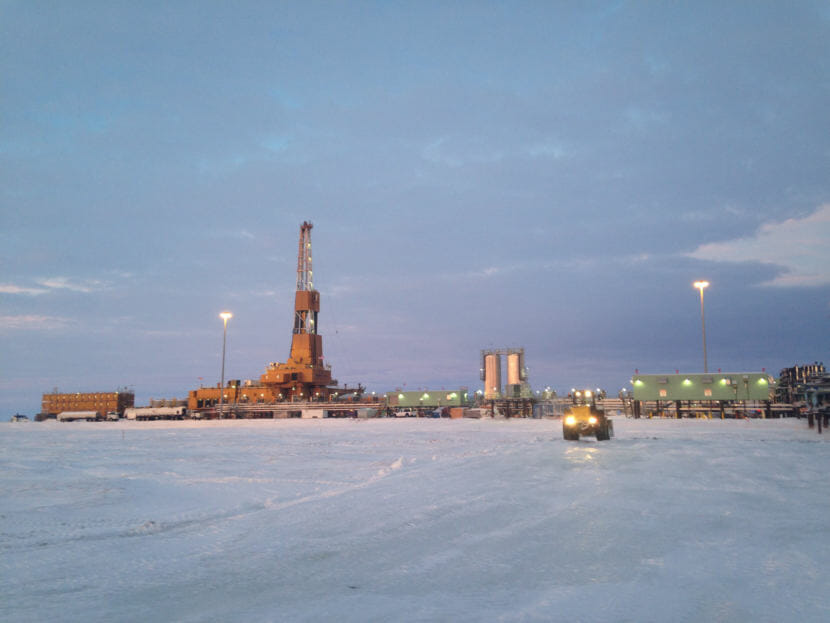
ConocoPhillips’ CD5 drill site, which is linked to its Alpine development that opened in 2000, is 9 miles from the North Slope village of Nuiqsut. (Photo by Elizabeth Harball/Alaska’s Energy Desk)
A major proposed North Slope oil project is running into local opposition from residents of the village of Nuiqsut, who are already partially surrounded by development and wary of more.
After hearing residents’ concerns at a North Slope Borough planning commission meeting that ran past midnight earlier this month, the commissioners declined to support a rezoning proposed for the Nanushuk project — a development that could produce 120,000 barrels of oil a day at its peak, or about one-fourth the amount that currently flows through the trans-Alaska pipeline.
The 4-2 vote isn’t binding, and the borough Assembly will take up the question at a meeting next month. But the decision highlights how the balance between development and subsistence is becoming increasingly fraught in Nuiqsut, a village of 450 that’s found itself in the middle of the oil industry’s resurgence on the North Slope.
Eight miles north of the village is ConocoPhillips’ Alpine project, a $1.3 billion development that opened in 2000 and is still expanding, with sites to the south and west. Another big new Conoco project, Willow, proposes to establish a gravel mine 7 miles west of Nuiqsut, with as many as 250 wells at the site of the development farther away.
Then there’s Nanushuk, pushed by Papua New Guinea-based Oil Search. The company plans to build one of its drill sites 7 miles northeast of Nuiqsut, with a processing facility — to separate out oil from natural gas and water — farther away.
Some of Alaska’s elected leaders have touted the developments as a major boost to the state’s oil-dependent economy. And many Nuiqsut residents support continuing oil development, citing the ample financial benefits and quality-of-life improvements the industry has brought to the village’s residents — particularly those who are shareholders in the village’s Native corporation.
But Sam Kunaknana, Nuiqsut’s representative to the borough and an outspoken critic of oil development’s impacts on the village, said that the other commissioners — who represent different North Slope communities — were persuaded to vote against the Nanushak resolution by testimony from Nuiqsut residents.
People are concerned about development’s impacts on the fish they’re catching and the caribou they’re hunting, Kunaknana said in a phone interview. Already, oil development has affected as much as one-third of Nuiqsut’s traditional subsistence range, according the local Native village corporation.
“It’s not just one project,” Kunaknana said. “It’s everything that’s going on around this area.”
Oil Search’s Nanushuk project and Conoco’s Willow project could, if built, together produce 250,000 daily barrels of oil at their peak, or roughly half the amount of oil that currently flows down the trans-Alaska pipeline. The companies’ management would have been watching the planning commission’s meeting closely, said Tim Bradner, a former BP employee and journalist who’s long followed Alaska’s oil industry.
“And they would be very concerned about making sure that their relationships are good with the local people up there,” he said. “Because unlike in a lot of places, the North Slope is a place where the local people really do have clout.”
Oil Search has been expanding its footprint in Alaska and recently hired Joe Balash, formerly a top official in the U.S. Interior Department; the company recently moved into office space in BP’s Midtown Anchorage headquarters. Spokesperson Amy Jennings Burnett declined to comment.
The planning commission’s vote comes as the Trump administration pushes to loosen restrictions on oil and gas development in the area. Later this week, the Bureau of Land Management plans to release an environmental review of a new land-use plan for the National Petroleum Reserve in Alaska, where the Willow project and others are located — and it’s expected to revoke some of the environmental safeguards contained in a previous, Obama-era version.
The challenge of balancing resource extraction and subsistence exists across the North Slope, but that tension has escalated in Nuiqsut amid the increasing development nearby.
“I can’t think of anywhere in the state where the juxtaposition of these issues comes to roost as it does in Nuiqsut,” Bradner said. “You have to feel some sympathy for the people — they’re surrounded by all this and they worry about their community kind of becoming a truck stop for the industry. On the other hand, there are people in the community who see a lot of upside to this.”
Nuiqsut sits in the biologically-rich delta of the Colville River, just south of where it flows into the Beaufort Sea, and it was founded amid passage of the Alaska Native Claims Settlement Act in the early 1970s. At the time, the oil industry’s focus was 50 miles east, where the Prudhoe Bay field had been discovered. But in the decades since, development has crept steadily west.
Since Alpine opened in 2000, Conoco has linked its central facility with several additional sites, with pipelines and roads now stretching nearly 180 degrees around Nuiqsut; a new connected drill site, Greater Mooses Tooth 2, is under construction.
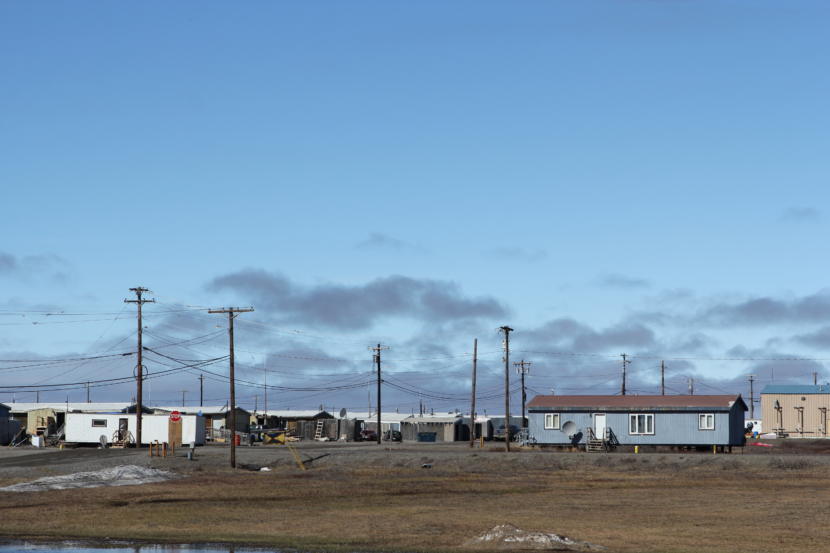
The village of Nuiqsut in June 2018. (Photo by Elizabeth Harball/Alaska’s Energy Desk)
Oil Search’s Nanushuk development is proposed northeast of Nuiqsut. And Conoco’s new proposed Willow project, to the west, is currently undergoing federal environmental reviews.
Conoco has a “long-term relationship with Nuiqsut, which goes back over 20 years with our Alpine development,” spokesperson Natalie Lowman said in an emailed statement.
“We are actively engaged with the community on our Willow project to identify concerns and seek collaborative solutions,” she said. “It is our goal to assist the community and ensure the North Slope Borough and all the NPR-A villages have the opportunity to benefit from our activities in the NPR-A.”
In February, Nuiqsut’s tribal government sued the federal government over its approval of Conoco’s exploratory drilling program for the previous winter.
But Nuiqsut’s Native village corporation, Kuukpik Corp., has taken a different approach, often partnering with the oil industry to bring cash and infrastructure improvements to shareholders and residents.
Kuukpik’s shareholders receive as much as $30,000 a year in dividends, thanks in part to royalties from oil pumped from some of Kuukpik’s lands that are part of the Alpine project. Alpine also is the source of a natural gas line that runs directly to Nuiqsut, allowing residents to heat their homes for a fraction of the cost in other rural Alaska villages.
Kuukpik has fought for, and received, concessions from oil companies to protect the village’s subsistence harvests and health. For one project, Conoco agreed to move the location of a proposed bridge away from an area where residents fish; for another, it used lower-emission generators to power a drill rig, reduced noise levels and boosted air and water quality monitoring.
The Nanushuk project also included a list of mitigation measures in the resolution that the planning commission rejected this month.
Oil Search, the company pushing the project, would have been required to hire a “subsistence representative” and conduct an array of studies on fish, caribou and the “cumulative impacts” of development in the area. It also would have been required to host an annual job fair in Nuiqsut, and to the extent possible, involve local students in their studies and hire local boat and snowmachine drivers.
The company has also agreed to build a boat ramp on the Colville River, along with a road to it, to improve residents’ access for subsistence.
“The corporation still thinks that Oil Search will be a genuine and viable partner in the Colville delta,” Lanston Chinn, Kuukpik’s chief executive officer, said in a phone interview this week. “And we’ll see where it goes from there.”
The North Slope Borough Assembly is scheduled to consider the Nanushuk rezoning at its meeting Dec. 3. The borough’s chief administrative officer, Deano Olemaun, said he could not comment on the project “until all the final processes have been completed.”
Bradner, the journalist, said he expects the Assembly to balance the planning commission’s position with the project’s potential to add to the North Slope’s tax base. Most of the borough’s $400 million budget is paid for with property taxes on oil infrastructure, and “as the industry matures on the North Slope, its existing tax base is depreciated,” he said.
“They need new projects to keep their tax base active and renewed, to maintain all the public services that they support up there,” said Bradner. “So there’s two sides to this issue, and it’s a complicated question.”
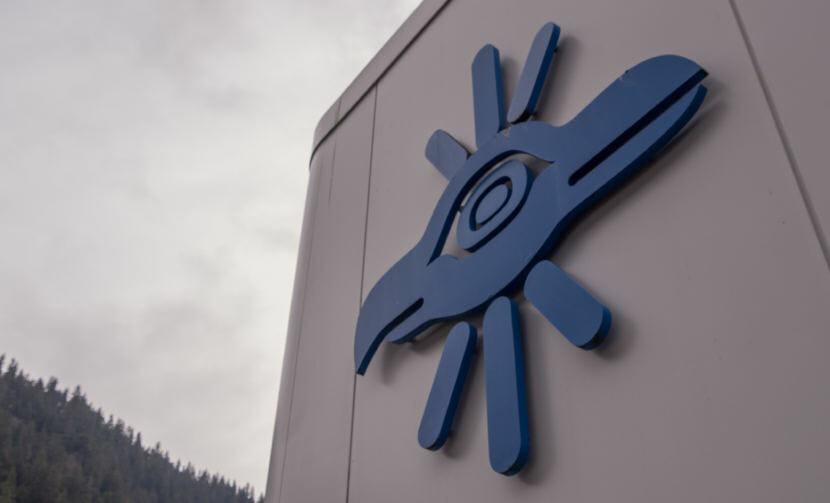
A Sealaska corporate logo adorns the roof of the Southeast Alaska Native corportation’s headquarters in Juneau on May 2, 2018. The logo has representations of the Eagle and Raven moieties of the Tlingit, Haida and Tsimshian cultures. (Photo by Jeremy Hsieh/KTOO)
Thousands of them live in the Inside Passage, and there’s a tradition to take shopping trips to larger communities. But gaps in ferry service mean many aren’t able to make the trip.
Sealaska distributed $8 million to shareholders on Friday. Albert Kookesh III lives in Angoon, where he’s the city clerk. He said he usually spends a night or weekend in Juneau this time of year.
“We go over on a Thursday, do our shopping Friday, come back on a Saturday,” Kookesh said.
The capital city has larger retailers like Fred Meyer and Costco.
“You get basically 16 good hours of shopping in, and then you jump back on the ferry the next day,” he said.
But this year, he’ll likely have to shop online — if at all. Angoon has no ferry service since the LeConte was taken out of service abruptly over a $4 million repair bill. With seaplanes charging around 85 cents per pound on freight, flying back with goods wouldn’t pencil out.
It’s a similar story for Haines, Skagway, Gustavus, Hoonah, Tenakee Springs and Kake. All are operating on a reduced ferry schedule.
More than 2,000 Sealaska shareholders live in these outlying communities near Juneau. More than 200 are in the Upper Lynn Canal. They’re usually likely candidates for capital city shopping sprees.
“You’re not gonna buy a giant flat screen and then stick it on the airplane,” said Craig Dahl from the Greater Juneau Chamber of Commerce.
Dahl said lack of ferries is bad for business. Native corporation dividends — much like the PFD — give the Southeast economy a shot in the arm.
“I’ve been here a long time and certainly enjoy and appreciate the impact when people do distribute this ton of money,” he said. “It’s important to the merchants.”
The 3,500 shareholders in Juneau should give local businesses a boost, and local merchants in outlying communities may benefit if shareholder spending stays close to home.
Sealaska CEO Anthony Mallott says the corporation is more than just dividend checks — they’re working to keep the Southeast region in ferry service, too.
“The ferry budget is a top priority for us,” Mallott said. “Whether it’s dollars, whether it’s just, you know, letter writing, whether it’s being up in the halls of our legislature … We’ve done all of it.”
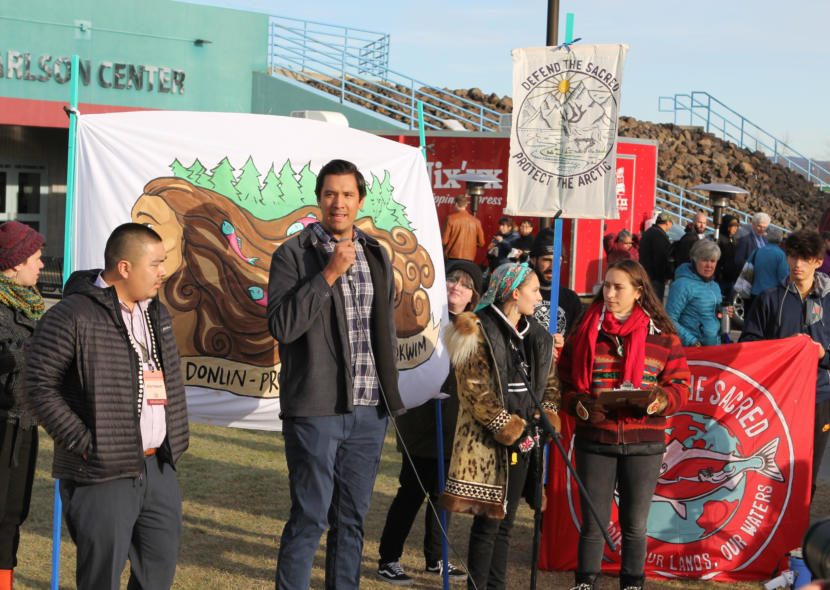
Dylan Lee speaks at a rally organized by Defend The Sacred outside the Carlson Center during the 2019 Alaska Federation of Natives convention. (Photo by Zachariah Hughes/Alaska Public Media)
The 53rd Alaska Federation of Natives convention wrapped up in Fairbanks late Saturday afternoon.
Conference attendees heard remarks by both of Alaska’s U.S. senators and voted on a number or resolutions, which included a contentious debate on climate change — a topic that came up repeatedly.
‘We’re crying up here’
AFN delegates approved a measure declaring a state of emergency over climate change. The resolution was authored by young participants in the Elders and Youth Conference and also called for the creation of a leadership task force focused on climate action.
During more than an hour of debate, the resolution received strong push back, particularly from members of the North Slope delegation.
Crawford Patkotak chairs the Arctic Slope Regional Corp. board. He said the measure leaves open the possibility that outside interests like environmental and animal rights groups could set the terms for resource development on Indigenous lands.
“These are the same organizations that come into our communities and try to split us all apart, split all the corporations, the tribes, the governments. Because they have an agenda. And if they had their agenda, we wouldn’t be able to hunt today,” Patkotak said as applause broke out. “If they had their agenda, we wouldn’t be able to develop the oil we have in the ground. That would cripple us economically.”
Opponents pushed an amendment that would have included language sympathetic to fossil fuel extraction, something the youth delegates opposed categorically, saying it defeated the resolution’s intent.
Two of the measure’s authors were on hand and fought back attempts to soften it.
“I am not an environmentalist. I am an Indigenous youth,” said Quannah Potts. “We are not here to fight with our own people. We are here to stand together. This is a serious issue. I’m worried about our future generations. We’re crying up here. We should not have to cry to you guys. We should not have to come to you worrying about our future generations, our future children and grandchildren. We should be able to live our ways of life, to hunt.”
Several elders and leaders agreed with the youth delegates. Chief Victor Joseph, chairman of Tanana Chiefs Conference, defended the measure, saying the discussion had veered away from the scope and scale the resolution calls for.
“Let’s honor these young people who stood up. They need it. And they did it eloquently and in a good way. Let’s stop the debate and give them what they want,” Joseph said.
Ultimately the measure passed and was adopted by AFN.
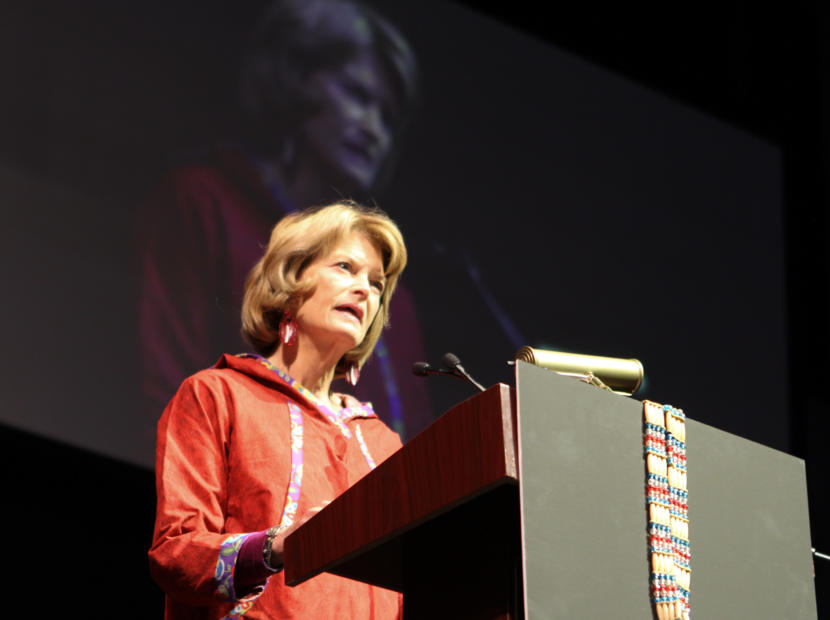
U.S. Sen. Lisa Murkowski, R-Alaska, speaking at the Alaska Federation of Natives convention at the Carlson Center in Fairbanks, Oct. 19, 2019. (Photo by Zachariah Hughes/Alaska Public Media)
‘Why did it take an outsider to see?’
In her remarks, Sen. Lisa Murkowski also mentioned the accelerating impacts of climate change on Alaska, including pallets of fans being shipped to Kotzebue this summer, shriveled blueberries from the drought in Southeast Alaska, and choking smoke from wildfires.
Reflecting on the convention’s theme of “Good Government, Alaskan Driven,” Murkowski said she sees hope in the persistence and adaptability of communities like Newtok.
“There’s been challenges, plenty of challenges. They’ve seen setbacks, they’ve had their disagreements. These are the bumps in the road that come with change and with life anywhere,” Murkowski said. “But the community stuck with it. And then just last week, 10 kids had their first day of school at Mertarvik. It is really, really good.”
Murkowski spoke extensively about the dismal state of public safety in Alaska, particularly for Indigenous women and children. She highlighted her legislative efforts to strengthen laws and channel funds to protect women.
A visit this summer from U.S. Attorney General William Barr has been advantageous for steering federal resources into the state, Murkowski said, but she is unsettled that it took a Department of Justice visit to rural Alaska for an official state of emergency to be declared.
“Why did it take an outsider to see? That’s something that continues to trouble me,” Murkoski said during an interview with reporters after her speech. “But I recognize that with every person that we bring up from the outside, we make just a little bit more headway.”
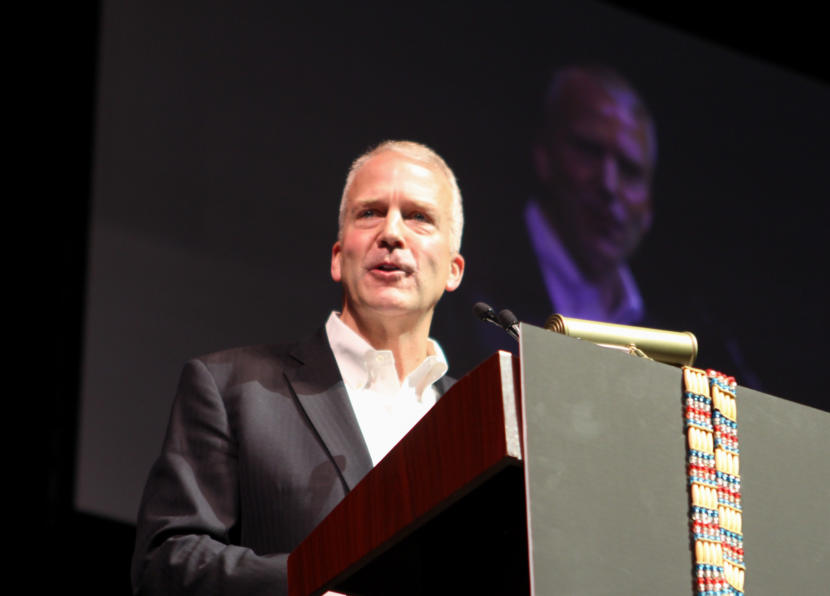
U.S. Sen. Dan Sullivan, R-Alaska, speaking at the Alaska Federation of Natives convention at the Carlson Center in Fairbanks, Oct. 19, 2019. (Photo by Zachariah Hughes/Alaska Public Media)
Public safety was a topic that Sen. Dan Sullivan spoke of at length, too, during his remarks to the convention.
He also pointed to successful passage of an act to secure land claims for Alaska Native veterans who served during the Vietnam War, when the original selection process took place. But he acknowledged there will be more challenges ahead with implementing the bill.
AFN co-chair Ana Hoffman was reelected to another term, though her challenger, Greg Razo, received substantial support for his bid.
Next year’s AFN convention will be held in Anchorage.
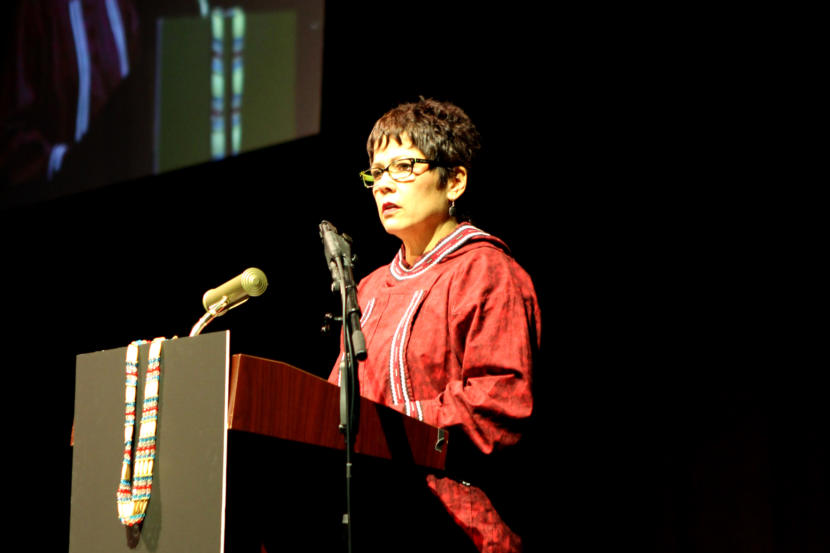
Cook Inlet Region Inc. President and CEO Sophie Minich speaks about why the Alaska Native corporation supports the recall of Gov. Mike Dunleavy at the Alaska Federation of Natives convention in Fairbanks on Oct. 18, 2019. (Photo by Casey Grove/Alaska Public Media)
During the second day of the Alaska Federation of Natives convention in Fairbanks, the effort to recall Gov. Mike Dunleavy became a heavy theme.
That was most prominent when Sophie Minich, the president and CEO of Cook Inlet Region Inc. (CIRI) took the stage to explain the company’s decision to support the recall effort.
“The governor’s violation of separation of powers and misuse of state funds, and the impacts of his misguided, ill-advised attempts to decrease government spending in Alaska were all a part of CIRI’s wake-up call,” she said.
Minich said CIRI is one of the state’s economic “powerhouses,” and it supports removing the governor from office in order to head off what it believes are disastrous policies for residents and the business community.
Like most Alaska Native corporations, CIRI rarely wades so openly into contentious political fights. But Minich said after watching the new administration closely for several months, the corporation’s leaders felt compelled to take a stand.
“Are we being good corporate citizens if we stand by in silence while this administration takes actions that are in opposition of our values and of our culture? Our answer to these questions was a resounding ‘no,’” she said.
Minich’s address was met with a standing ovation. Dunleavy was not at the convention, having left for other commitments Thursday after his speech.
In a room just outside the main convention hall, organizers for the recall effort had a booth set up. Organizers couldn’t gather any new signatures; they were waiting for a decision from the Division of Elections on the proposed recall’s legal standing. So instead, they offered information, handed out buttons and T-shirts, and asked people to sign pledges with contact information so they can reach them when the next stage of signature-gathering begins.
“I cannot tell you how popular the buttons have been. So we’re making more buttons as we speak,” said Claire Pywell, campaign director for the recall effort.
Another pointed moment, directed at the Dunleavy administration, came during remarks by Joel Bolger, chief justice on the Alaska Supreme Court. Bolger described different problems facing the judiciary, including a lack of resources for delivering timely justice.
Another issue, he said, is increasing political pressure threatening the judiciary’s independence.
“Some people want to make the judicial selection system more political. Others would like to impose political consequences for the content of judicial decisions. So I respectfully ask this convention to join me in resisting political influence in our courts,” he said.
After his remarks, Bolger declined to offer any specific examples of improper pressure on the judiciary. But one of the charges in the recall effort is the Dunleavy administration striking $335,000 from the courts’ budget because of its disagreement over a ruling on abortion access.
The proposed Donlin Gold mine would be one of the biggest gold mines in the world if completed. (Photo by Dean Swope/KYUK)
A village corporation in the Yukon-Kuskokwim Delta wants Calista Corporation shareholders to vote on whether Calista should support the proposed Donlin Gold mine.
Calista owns the mineral rights to the mine, which would be built in the upper Kuskokwim River area. Azachorok is a village corporation in Mountain Village, on the Yukon River. Azachorok’s president, Loren Peterson, says its resolution isn’t a stance on the mine, but it would give shareholders a chance to decide if they want it.
“When it’s a controversial issue like this and you have a corporation that’s designed to develop and make money, we think there should be a pause in this situation and take a look at the mission and values of the corporation,” he said
The resolution is inspired partly by what happened at the Association of Village Council Presidents’ annual convention in September. There, delegates voted overwhelmingly to rescind a 2006 resolution supporting the mine.
Under the Alaska Native Claims Settlement Act, Native corporations are tasked with two goals: maintaining the traditional way of life and promoting economic development. Peterson says that sometimes those goals can conflict, like in the case of the proposed Donlin mine.
“It can bring a lot of capital to the corporation and we could see some economic development and jobs, but at the same time, the Donlin Creek development could impact subsistence resources and our subsistence,” he said.
The Azachorok resolution doesn’t take a stance on the Donlin mine. Peterson says that the corporation sees both sides. In fact, under the Alaska Native Claims Settlement Act, Azachorok would receive some of the mine’s profits. Peterson says that the resolution advocates for the shareholders who live closest to the mine to have a voice on whether it’s built.
“If it’s a bad development in the aftermath, the fault isn’t necessarily on the corporation, and they now have a more democratic approach to where the shareholders that own the shares of the corporation and live on the land and participate in hunting and fishing, they should have a say,” Peterson said.
More than 300 female Calista shareholders made a similar argument in a letter that they sent the corporation earlier this year. They expressed concerns over the mine’s possible impact to the Kuskokwim River, the region’s main food source.
KYUK reached out to Calista for comment on the resolution last week and has not received a response.
Close
Update notification options
Subscribe to notifications
Subscribe
Get notifications about news related to the topics you care about. You can unsubscribe anytime.