Alaska Native Corporations

This old Alaska mining town is almost a ghost town. It has everything to gain from Donlin mine.

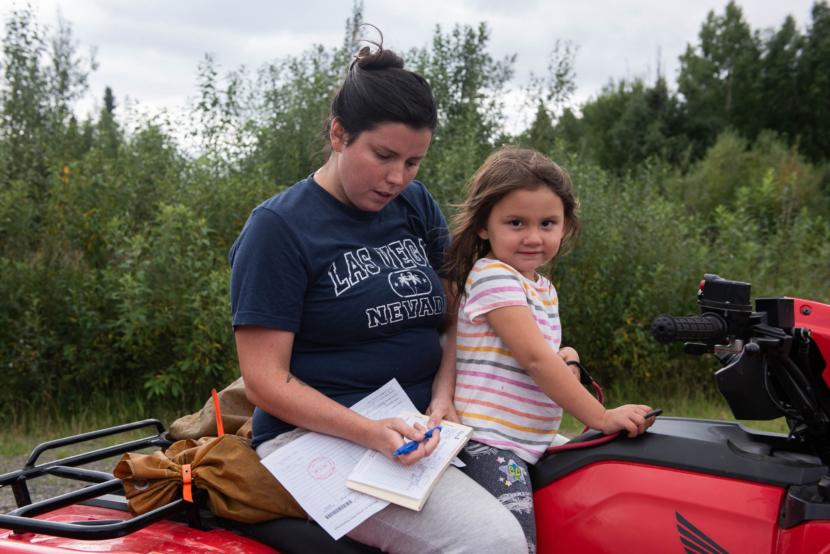
Rebecca Wilmarth and her daughter wait for a plane to arrive on the Red Devil runway on Aug. 17, 2019. Maintaining the runway and working as an agent for local airlines are two of the only jobs in Red Devil and Wilmarth’s family manages both of those contracts. (Photo by Katie Basile/KYUK)

This is a three-part series reported from a village of 20 people on the Upper Kuskokwim River that stands to gain the most from the proposed Donlin mine. Red Devil was built by mining almost 100 years ago, and now carries a toxic legacy of mine pollution. But to its residents, the Donlin Gold mine represents hope. Like so many communities in Alaska, resource extraction is at once a lifeline and a risk.

Red Devil, Alaska, Part I

Outside Rebecca Wilmarth’s kitchen window, there’s a big green well-manicured lawn. It’s an unusual sight in one of the most remote places in Alaska. Wilmarth says there’s a history of big gardens and meticulously-kept lawns in Red Devil. The gardens grow some of the only fresh produce residents will eat and then save the rest for the winter.

“You know that sounds kind of cliche but we really do, you know, think about that,” Wilmarth said.

While talking, Rebecca’s phone pings occasionally with emails. She has to string together multiple part-time jobs to make a living here. She’s the agent for Ravn, maintains the airstrip, sells fuel and occasionally puts up travelers in a small, one-room cabin next to her house.

Rebecca also sends her seven-year-old daughter to Palmer for school because Red Devil doesn’t have one.

Red Devil used to be home to Alaska’s biggest mercury mine. Before the mine started in 1933, there was no permanent village. At its height, after the mine came, the village had a bar called the Mercury Inn, a school, a clinic and a store. Miners came from nearby communities. But it shut down in 1971 and people slowly left to find other jobs. Now, there isn’t much here. The population? Roughly 20.

So we’re just kind of in this stagnant position and the people who are here just don’t want to turn their back on this lifestyle and make a lot of sacrifices to stay here. Because they think it feel like it still beats city life,” Wilmarth said. “I love everything about it. Just the isolation, I guess, from the rest of the busyness of the rest of society,”

But, Wilmarth and other residents think the proposed Donlin Gold mine could help revive Red Devil. The mine would be built just 50 miles down the Kuskokwim River. It would employ 800 people.

Rebecca Wilmarth’s father is Dick Wilmarth, the very first Iditarod champion. He also loved Red Devil and passed that on to his daughter. “Gold miner’s daughter” is tattooed on Rebecca Wilmarth’s right arm.
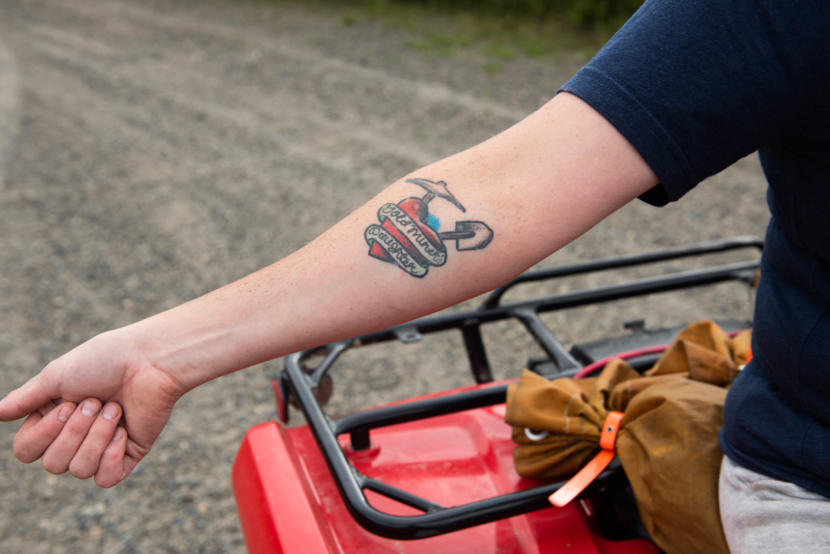
Rebecca Wilmarth’s tattoo reads ‘Goldminer’s Daughter’ and honors her late father Richard Wilmarth, a gold miner and the champion of the first Iditarod Trail Sled Dog Race. Wilmarth supports opening the proposed Donlin Gold mine which could create local jobs and revitalize the community of Red Devil. Aug. 17, 2019. (Photo by Katie Basile/KYUK)

The proposed mine requires a lot of infrastructure: a port, an airstrip, a power plant, a proposed 315-mile pipeline to bring gas for the power plant from Cook Inlet, a road and fiber optic cable. Donlin says it expects to mine 1.3 million ounces of gold over a 27-year period. And that period could be even longer. As part of its lease agreement with the two Native corporations, which own the land and surface rights, Donlin promised to prioritize hiring local shareholders, like people who live in Red Devil.

The Donlin mine could be one of the biggest gold mines in the world. And the project is well on its way. Last year, it secured two vital federal permits and a handful of state permits. This year, it expects to receive several more. It’s also completing its safety certification for the seven dams it plans to build. That can take up to two years. It’s unclear when they will actually start mining.

“I think that’s what this area needs right now is the development of some kind,” Wilmarth said.
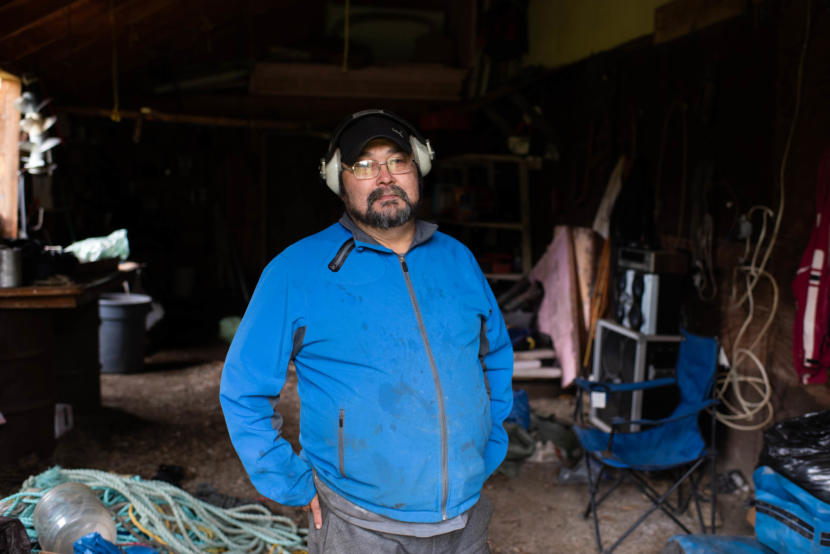
Joe Morgan in Red Devil, where he grew up and his dad worked in the nearby cinnabar mine, Aug. 17, 2019. The population and infrastructure of Red Devil fell after the mine closed in 1971, and now Morgan and fellow community members are working to revitalize the community. (Photo by Katie Basile/KYUK)

Glen Morgan and his brother Joe were raised in Red Devil but left with his family once the mine closed. Glen lived in Anchorage since 1997 but returned in 2015 with his wife, Theresa, after they  retired. Glen’s parents are buried there. Glen wants to bring back basic services, like a health clinic for the people that still live there.
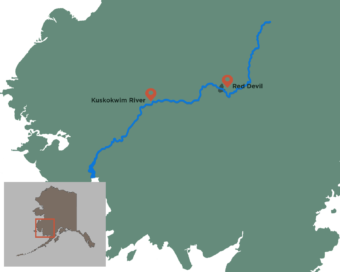
(Image courtesy Hannah Lies/Alaska Public Media)

They would love the community to grow to a population of 200 — the same size it was when the Red Devil mine was in full swing just three miles away.

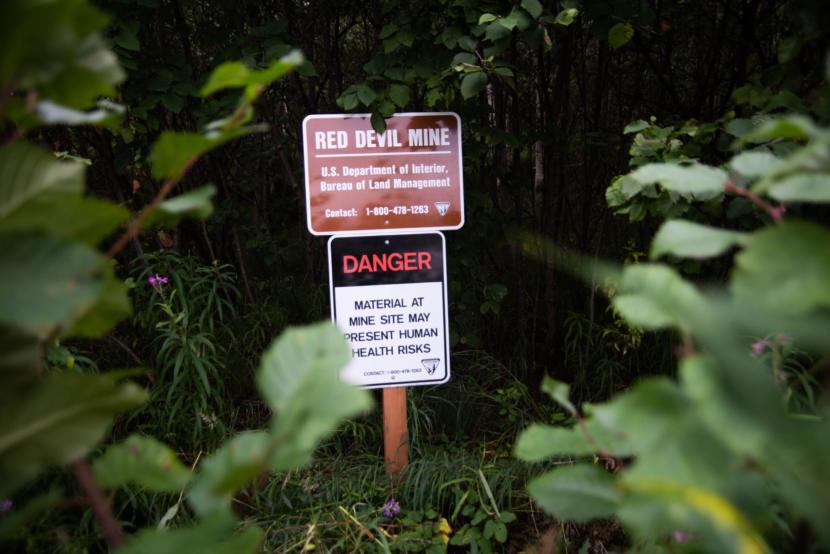
The old mine is now covered in trees and brush with a trail leading back toward where the buildings once stood. At the beginning of the trail leading to the mine site is a sign overgrown with fireweed. On a recent day, Joe Morgan hacked those out of the way.

The sign read: “Red Devil Mine, U.S. Department of Interior Bureau of Land Management. DANGER. Material at mine site may present human health risks.”

The Red Devil Mine left behind more than just the memory of good jobs. Developed before there were environmental safeguards, it also left behind pollution. The federal government has been working on a clean-up there for years.

In part two of our series, we’ll look at how Red Devil residents weigh the risks of that mercury pollution, and possible pollution from the mine, against he promise of jobs.
For people who live in remote Red Devil, an old mine’s toxic legacy is not enough to doubt Donlin’s promise

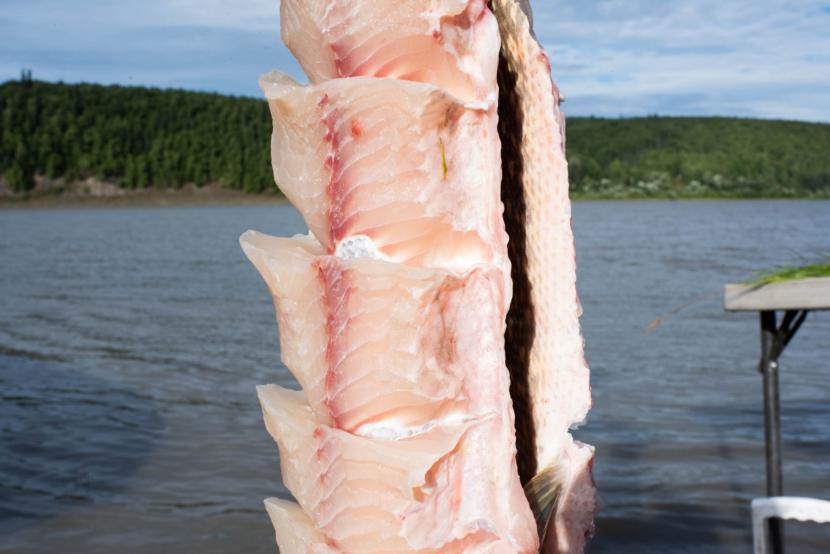
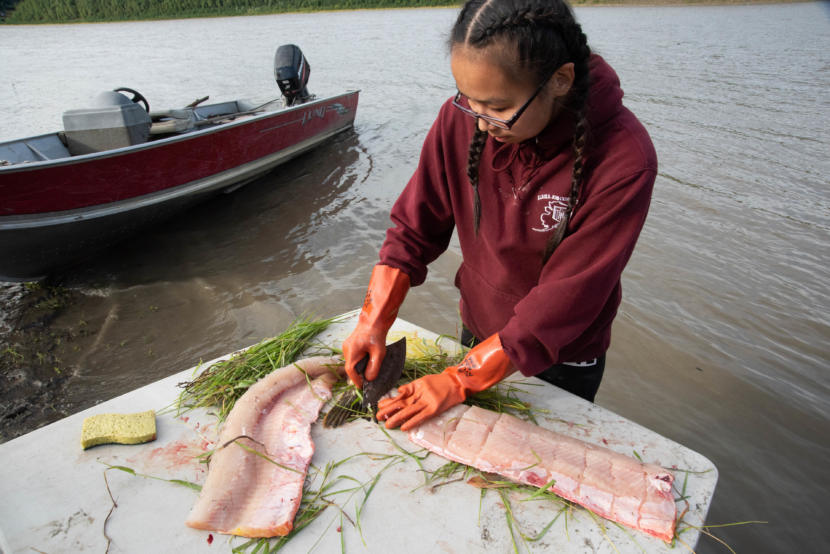
Leann Morgan cuts a northern pike in Red Devil, Alaska, on Aug. 16, 2019. Residents of Red Devil are warned to limit how much they eat of large, predatory fish like northern pike because of high mercury levels, but Leann and her father Joe Morgan depend on subsistence-caught foods and plan to eat the pike they caught. (Photo by Katie Basile/KYUK)

This is a three-part series reported from a village of 20 people on the Upper Kuskokwim River that stands to gain the most from the proposed Donlin mine. Red Devil was built by mining almost 100 years ago, and now carries a toxic legacy of mine pollution. But to its residents, the Donlin Gold mine represents hope. Like so many communities in Alaska, resource extraction is at once a lifeline and a risk.

Red Devil, Alaska, Part II

Leann Morgan stands at a makeshift table on bank of the Kuskokwim River, cutting a huge northern pike.

Leann and her father, Joe Morgan, make pike a regular part of their subsistence diet. They eat salmon, lush and sheefish. In the fall, they hunt moose.

But the pike they eat contain high levels of mercury. So high, in fact, that the federal government issued a warning to elders, children and pregnant women to limit how much they eat from the area. But Leanne and Joe Morgan aren’t worried.

Never get sick or anything … so we’re fine,” Leanne Morgan said.

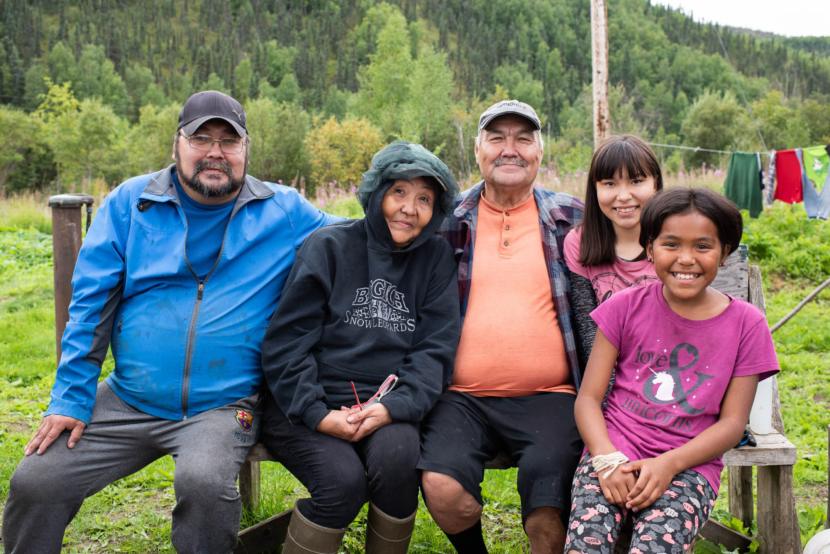
Joe Morgan, Theresa Morgan, Glen Morgan, Desirae Morgan and Tamara Stern-Morgan in Red Devil, Alaska. (Photo by Katie Basile/KYUK)

This part of the Kuskokwim winds through a mercury belt. That type of mercury is called cinnebar, and naturally infiltrates the northern pike and other fish as part of the environment.

It also makes the area ripe for mining. In 1933, when there were few mining regulations, Alaska’s biggest mercury mine started operating and created its own town. It’s called Red Devil. At the mine’s peak during 1940s through the 1960s, around 200 people lived in the town. But the mine shut down in 1971, when the price of mercury ore dropped too low to turn a profit.

After the owners left, it was discovered that the mine tailings were leaching into Red Devil Creek, a tributary of the Kuskokwim, as well as the surrounding groundwater. No one knows when they started leaking. Those tailings contain methylmercury ⁠— a particularly poisonous form that was a byproduct of the mining operations. It can cause neurological damage, especially to unborn babies. Arsenic and antimony were also found in the tailings; both can cause cancer.

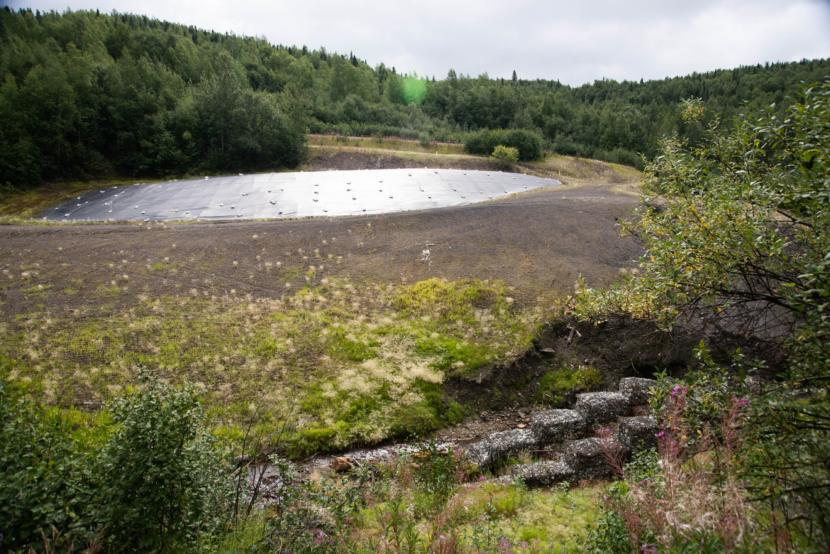
Buried contaminants from the old mine site in Red Devil, Alaska. (Photo by Katie Basile/KYUK)

Mike McCrum is the project manager for the Red Devil Mine for the U.S. Department of the Interior’s Bureau of Land Management. He says the owners did remove the groundwater from the mine site, but then literally just walked away, abandoning it.

The materials left behind were toxic enough to attract federal attention. Throughout the 1980s, the Environmental Protection Agency tested the site and found that the tailings required extensive remediation.

Typically the EPA oversees these efforts under a law called the Comprehensive Environmental Response, Compensation, and Liability Act or CERCLA. If the owner walks away from the site, like what happened in Red Devil, the EPA can use a fund called the Superfund to pay for remediation.

But what’s happening in Red Devil is different. In 1987, federal and state agencies began examining remediation. The site is not technically a Superfund site, with access to those funds. Instead, BLM has control over coordinating state agencies and local organizations, as well as paying for the cleanup.

(Image courtesy Hannah Lies/Alaska Public Media)

So far, BLM has torn down the old buildings, buried the tailings in a liner and planted a gate warning people of its health risks. It set up a weir to stop the leaching in 2014. BLM is set to come up with a final remediation proposal within the next year. But McCrum says communicating the risks from the mine to the community has been a challenge. People rely on fish food and don’t experience any immediate problems.

“Communicating risk to people is a challenge because it’s a pretty abstract concept that you’re talking to people whose food security is at risk,” McCrum said.

BLM tested the water from Red Devil Creek. It tested the fish that swam in that creek. It tested people’s hair. It tracked the northern pike and lush that swam in the Kuskokwim River and its tributaries. The state Department of Environmental Conservation and BLM tested groundwater flow around the mine and the wells of people living in the town. The results are complicated.

Signs at the entrance to the now-defunct Red Devil Mine in Alaska warn people to stay out because of potential health risks. Aug. 17, 2019. (Photo by Katie Basile/KYUK)

The northern pike that live farther up the river from the contaminated mine site showed higher mercury levels than those nearer to the old Red Devil Mine site. In fact, the BLM wrote this in a 2012 update to the Middle Kuskokwim communities:

“This report also highlighted the complexity of mercury chemistry within the aquatic food ecosystem, which includes fish species that seasonally migrate within the Kuskokwim and its tributaries.”

BLM’s McCrum says the northern pike prefer slower moving waters. Red Devil Creek, which flows into the Kuskokwim River, is very shallow and small, perfect for smaller fish but not pike. And the way the Kuskokwim River flows at the mouth of the creek is too fast for northern pike to live. McCrum says the creek dilutes the contamination before it reaches the river, and based on that, McCrum says there’s no correlation to the tailings leaking out into the river and the health of the pike.

Northern pike, a subsistence food on the upper Kuskokwim that’s vulnerable to mine pollution. (Photo by Katie Basile/KYUK)

The Kuskokwim Corp., a Native village corporation, owns the surface rights to the mine.

Vice President Andrea Gusty, says the lengthy remediation process for Red Devil is too slow, putting more residents more at risk.

“It’s been frustrating because we know the level of contamination that is in this historical mine site,” Gusty said.

Gusty is also not satisfied with the level of testing, and believes more information is needed to truly understand the risks of the mine’s contamination.

BLM says it takes a long time to gather feedback and do enough testing in order to clean up a toxic site like the Red Devil Mine.

For now, Red Devil residents aren’t too worried about mercury contamination. Joe Morgan, who caught the pike in the Holitna River, will still eat it.

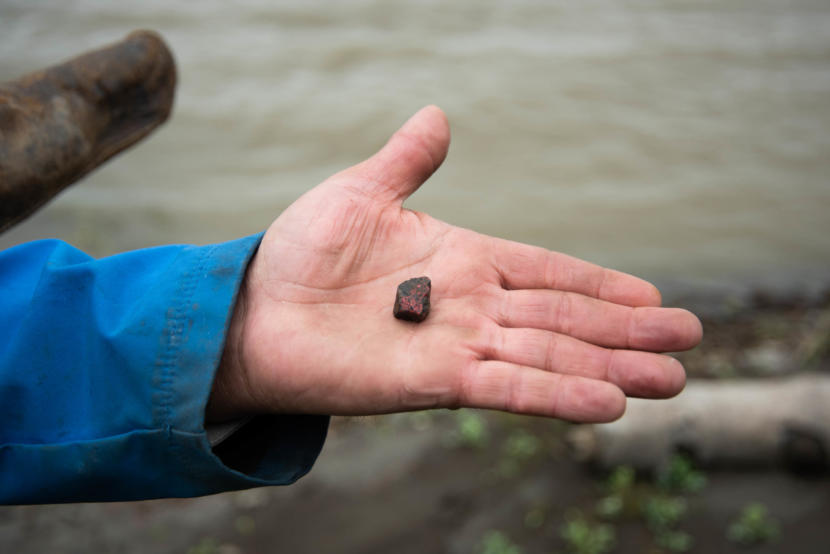
Joe Morgan holds up a piece of cinnabar found on the beach outside of the now-defunct Red Devil Mine on Aug. 17, 2019. Cinnabar was mined and process on site to make mercury. (Photo by Katie Basile/KYUK)

Despite the Red Devil clean up, the residents are not as worried about possible contamination from the proposed Donlin Gold mine that’s about fifty miles down the river from the village. It’s a massive mine plan, but residents point out that Donlin Gold has to build it under much stricter scrutiny.

Not everyone in the region agrees. The Association of Village Council Presidents originally supported the mine, but recently withdrew its support over environmental concerns and worries it would impact subsistence animals.

In Red Devil, residents emphasize jobs. The proposed mine requires a lot of infrastructure: a port, an airstrip, a power plant, a proposed 315-mile pipeline to bring gas for the power plant from Cook Inlet, a road and fiber optic cable. Donlin says it expects to mine 1.3 million ounces of gold over a 27-year period. And that period could be even longer. As part of its lease agreement with the two Native corporations, which own the land and surface rights, Donlin promised to prioritize hiring local shareholders.

Donlin already has its major federal permits in hand, as well as some state ones, and hopes to get more of its state permits by the end of the year. Its also completing its safety certification for the seven dams it plans to build. That can take up to two years. The mining will begin after that.

With lots of optimism, Red Devil residents are beginning to put in place the skeleton of basic services for the people who live there now, and the people they expect when the mine opens. In part three, we look at the challenges of reviving an almost ghost town.

A year after a dam was removed, this river near Anchorage is still waiting for water

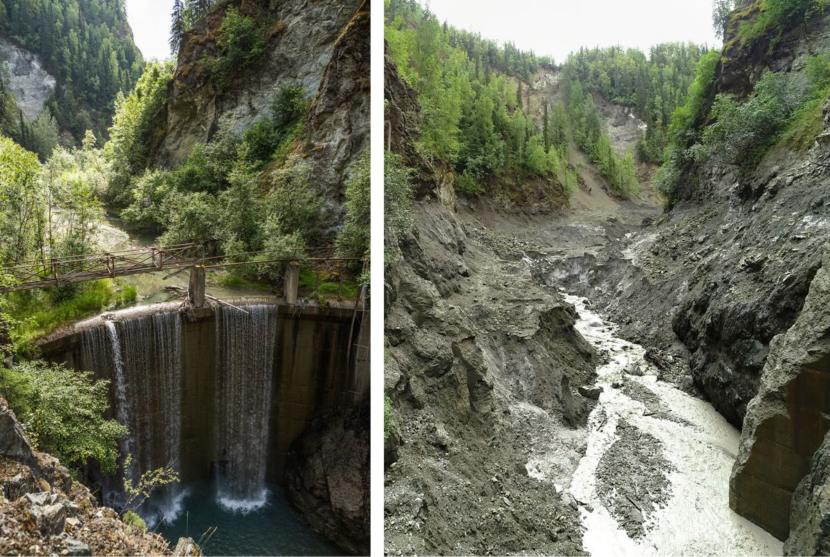
The removal of the lower Eklutna dam, pictured before and after its demolition, was finished last summer. (Photo by Loren Holmes/Anchorage Daily News)

Last summer, a conservation group teamed up with an Anchorage-area Native tribe to finish removing a defunct dam on the Eklutna River, northeast of the city.

That effort couldn’t succeed on its own, largely because higher upstream, utilities divert the river’s water into a hydroelectric power plant. The groups that removed the lower dam envisioned that their project would push the utilities into action to improve salmon habitat and boost a fishery that could bring together the Eklutna Native people, the original residents of the Anchorage area.

But now, a year later, there’s still only a trickle of water flowing through the canyon where the dam once stood.

Since its removal, the utilities have gotten an early start on a legally-mandated process to address some of the damage to fish and wildlife habitat caused by the upstream hydroelectric project. But that process begins with a study phase — no concrete steps are required until 2027.

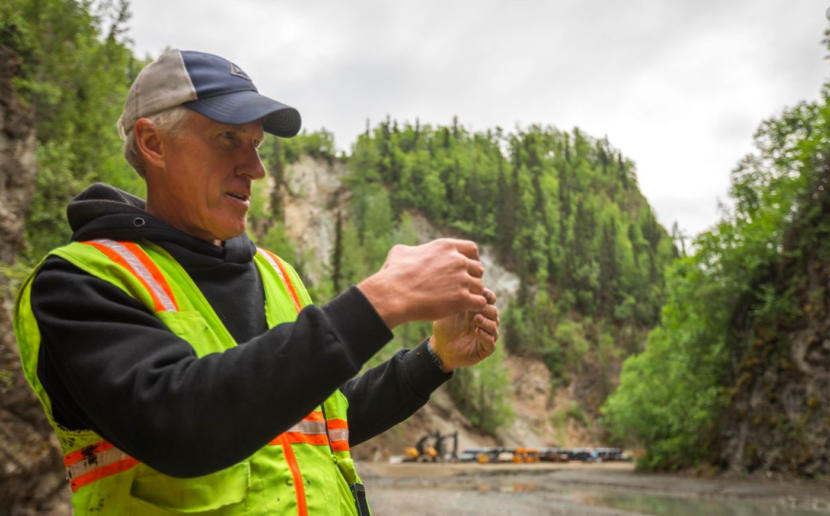
Brad Meiklejohn, who spearheaded the $7.5 million dam removal for a group called the Conservation Fund, is pushing the utilities to act more quickly. The status quo, Meiklejohn said, is “subsidizing cheap power on the backs of Natives and salmon.”

“That’s the cost we’ve externalized here,” he said. “To keep postponing this, and keep having the fish and the Native people pay the price because of our lack of innovation and creativity – I think that’s criminal.”

Brad Meiklejohn, who works in Alaska with a group called the Conservation Fund, spearheaded the dam removal project. (Photo by Loren Holmes/Anchorage Daily News)

The lower Eklutna dam was built in the 1920s to supply power to Anchorage, but it was shut down when the federal government built the much larger project at Eklutna Lake, far upstream, in the 1950s.

The federal project was a major undertaking driven by the scarcity of power in Anchorage — in the 1940s, the city resorted to generating some of its power with the stern half of the Sackett’s Harbor, a shipwrecked tanker. The Eklutna project required hundreds of workers and construction of a 4.5-mile tunnel through a mountain, which brings the lake water to the site of the project’s two generators.

In 1997, the project was transferred by the federal government to three utilities. One was Municipal Light and Power, Anchorage’s publicly owned utility, and the other two were cooperatives — Matanuska Electric Association, and Chugach Electric Association, which serves the Anchorage area.

Today, the project generates 175,000 megawatt-hours of electricity a year, or enough for 25,000 homes, according to a new informational website created by the utilities.

That’s less than 5% of the power used by the Railbelt, which runs from the Kenai Peninsula to Fairbanks. But it’s among the cheapest energy sources for the region, which makes it more valuable to the utilities.

Eklutna Lake is also the source of about 90% of Anchorage’s drinking water. But that amounts to just 10% of the water that’s diverted from the river, according to the utilities; the remaining 90% goes to generate electricity.

Meiklejohn said he doesn’t want to interfere with the city’s drinking water supply. But he estimates that just 10% of the diverted water would be needed to support salmon spawning, with minimal impacts to power costs.

“I think it’s a solvable problem. I think there’s enough water to allow some to go into the river for the fish,” he said. “And I would love to see the utilities get a little more proactive on this, and get some of their best and brightest minds working on a solution.”

The lower dam’s removal was a four-year effort that finished last year — Meiklejohn’s organization partnered with the Eklutna people to do the work, hiring Eklutna Inc., their Alaska Native village corporation, as the contractor.

In interviews, officials who work with the utilities said that they’re committed to addressing the impacts of the upstream hydroelectric project. But, they said, they also have obligations to their members and customers, and they want the studies to happen first to help guide their actions.

“We have to understand what the trade-offs are,” said Bill Falsey, the municipal manager for Anchorage, whose public utility owns 53% of the hydroelectric project. “We’re not going to know what policy option makes the most sense until we have really run all the scenarios.”

The hydroelectric project drains out of the lake through a tunnel in the bottom, and utility officials said it could also cost money to reconfigure their infrastructure to send water down the river. And, Falsey added, “it’s not even a known quantity what it will take to get fish to return.”

“That’s what this is about,” he said. “That’s why we are engaged in these studies.”

As part of the project’s transfer from the federal government to the utilities, they were not required to get an operating license from the Federal Energy Regulatory Commission. Environmental reviews and restrictions that could have accompanied the licensing process were replaced by an eight-page agreement that the new owners signed with federal agencies.

The 1991 agreement, which is enforceable by federal court, requires the utilities to begin studying fish and wildlife impacts of the hydroelectric project no later than 25 years after the purchase took effect in 1997, or 2022.

The utilities started the study process this summer, three years earlier than the agreement requires. But actions to address the impacts identified by the studies are not required to start until 2027, and they don’t have to be finished until 2032.

The agreement ultimately asks the utilities to deliver draft recommendations to the governor. The governor is then charged with adopting a formal plan that balances “efficient and economical power generation” and energy conservation with fish and wildlife, recreation, water supplies and “other beneficial public uses.”

Critics point out that the agreement contains no protections for the Eklutna people, and doesn’t reference them whatsoever.

In an interview, Aaron Leggett, president of the Native Village of Eklutna, said tribal members have gotten used to being patient. But he said he also sees the story of the lower dam’s removal as being too compelling to ignore, which leaves him “optimistic.”

“I think at the end of the day, we’ll get there,” he said. “We’re at the point where, at a minimum, we know we’ve taken the dam out. And to us, that’s something to be celebrated.”

More than half of Eklutna’s tribal members live in or near the Anchorage area, Leggett said. And reviving a salmon run in their community, he added, could help unify them.

With $500,000 in support from Sealaska, landless Alaska Native communities continue push for their own village corporations

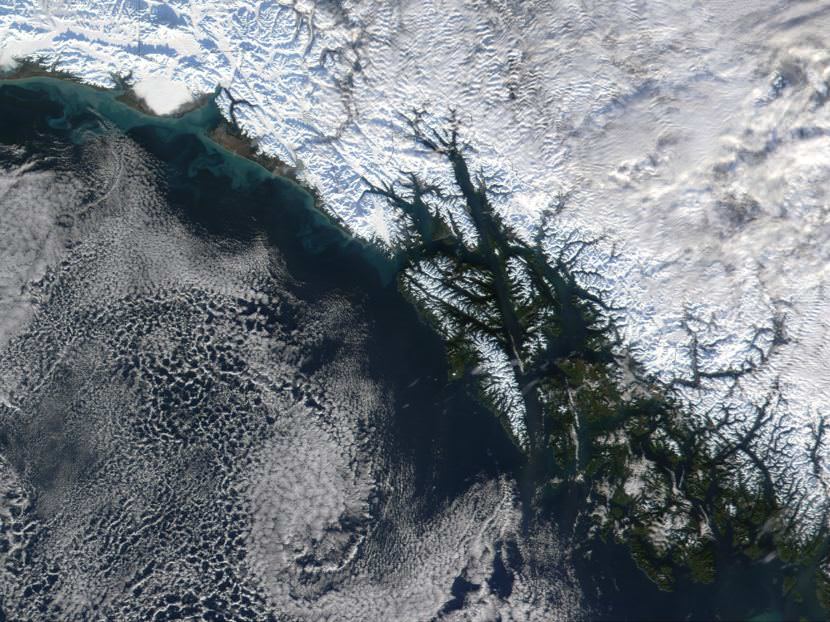
NASA satellite imagery shows Southeast Alaska in true color on Nov. 24, 2001.
NASA satellite imagery shows Southeast Alaska in true color on Nov. 24, 2001. (Public domain image
by Jacques Descloitres/MODIS Land Rapid Response Team, NASA/GSFC)

Southeast’s landless Alaska Native communities want to form five new village corporations out of 115,000 acres of Tongass National Forest. The effort has new cash and — it says — the right political climate in Washington to finally get it done.

The 1971 Alaska Native Claims Settlement Act allotted millions of acres of land to 13 regional Alaska Native corporations. But some Alaska Natives in Southeast were left out of the process.

That’s created a coalition of five landless communities in Southeast, advocating for land and their own corporations. It’s an issue that has simmered for decades. But a recent infusion of $500,000 from the regional corporation Sealaska has energized its efforts.

At a meeting in August in Wrangell, Sealaska board member Richard Rinehart recalls the early 1970s when 200 village corporations were created across Alaska.

“We all thought we were getting land just like everybody else and it was just a big surprise that we didn’t,” Rinehart said.

There’s no apparent reason certain communities were left out. Those include the five southeast communities of Ketchikan, Wrangell, Petersburg, Haines and Tenakee Springs. Together they are home to 4,400 Sealaska shareholders.

Over the years, four bills were introduced in Congress to cede federal land to the affected communities. The most recent was the ANSCA Improvement Act introduced by U.S. Sen. Lisa Murkowski in 2017. It didn’t get very far. Her office says there was a lot of opposition in Washington over parceling out a national forest.

Now, the Southeast Alaska Landless Corporation is crafting a fifth bill they hope Alaska’s delegation will support.  It will be different than previous efforts in that it contains specifics — and maps that are now being released as the landless corporation takes it message from community to community. The bill envisions 115,000 acres to be divided between the five landless Alaska Native communities.

Rinehart says the climate in Washington is right for reshaping public lands.

“Today, we have under the Trump administration new heads of the Forest Service and they are in support,” he said. “They will not fight us they will sit down and talk with us.”

USDA Forest Service Chief and Alaska’s Regional Forester met with some of the shareholders and Sealaska’s legal team last year. The Forest Service wrote in a statement that it had given advice over existing land designations in the Tongass, but hasn’t signaled whether it would support giving up management of any forest land.

Some conservation groups are wary about carving up the Tongass. But they say they’re aware it’s a complex issue that involves trying to right historic wrongs.

“It’s our hope that we can support them by working with them in partnership,” said Meredith Trainor, the executive director for the Southeast Alaska Conservation Council in Juneau.

She says she supports tribal sovereignty but not necessarily if it means public land is lost at the expense of subsistence users.

SEACC opposed past efforts. But she says there are ways a new village corporation could get its land and be good stewards of the forest.

“Such as being included in the carbon market and through carbon sequestration where communities would be paid not to log the lands,” she said.

Rinehart said that with the decline of the timber industry, carbon credits make sense. Sealaska is already in the carbon credit market.

But the landless group says nothing — including logging — would be off the table.

The campaign is traveling to all Southeast communities releasing specific maps as it goes. The five maps should be available once its tour is completed next week.

Curyung Tribe, BBAHC’s largest tribe, will withdraw from health corporation

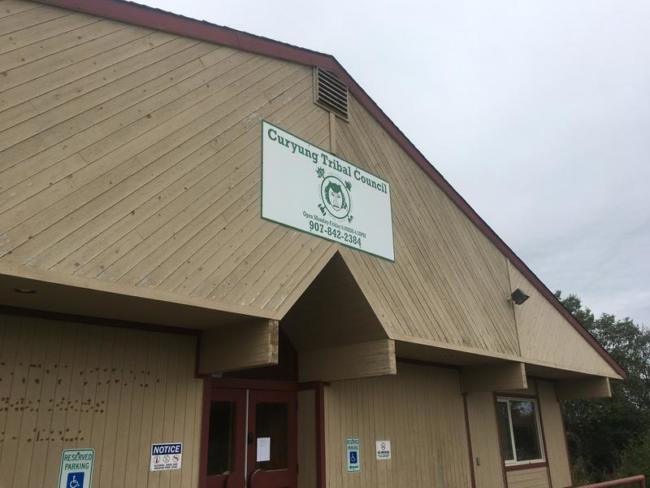
The Curyung Tribal Council building in Dillingham. (Photo by Tyler Thompson/KDLG)

The Curyung Tribe is leaving the Bristol Bay Area Health Corp.

In a statement, Robert Clark, president and CEO of BBAHC, said the corporation “does not intend to change any of its policies about who is eligible to receive healthcare in its facilities and the scope and nature of care we provide until all withdrawal issues have been addressed.”

Tribal administrator Courtenay Carty said in an email that the tribe passed a resolution in May to withdraw from BBAHC.

“The main reason for the withdrawal focuses on patient care issues and the failure of BBAHC to take concerns from our tribal members and Council, seriously,” she said.

Last fall, the Centers for Medicare and Medicaid Services found that Kanakanak Hospital pharmacy practices put patients at risk of harm or death. BBAHC manages the hospital, which is listed as a self-governance program on the Indian Health Service website.

At the Curyung Tribe’s annual meeting last November, members passed a resolution authorizing the council to leave the health corporation if their concerns were not addressed.

The hospital was deemed compliant a few months later, in January. But Carty said they had difficulty working with BBAHC, and that their decision to withdraw also came after the health corporation removed the tribe’s representative from the hospital board.

The Curyung Tribe is the largest of the 28 Alaska Native tribes that currently authorize BBAHC to provide care to their members through a contract with the Indian Health Service. In 1980, it authorized the health corporation to provide health care services through the Indian Health Service on behalf of tribal members. It reissued that authorization in 1994.

The tribe is meeting with IHS and BBAHC this week to discuss the transition. The earliest the withdrawal will take effect is May 2020.

Alaska Native corporation CIRI endorses Dunleavy recall effort

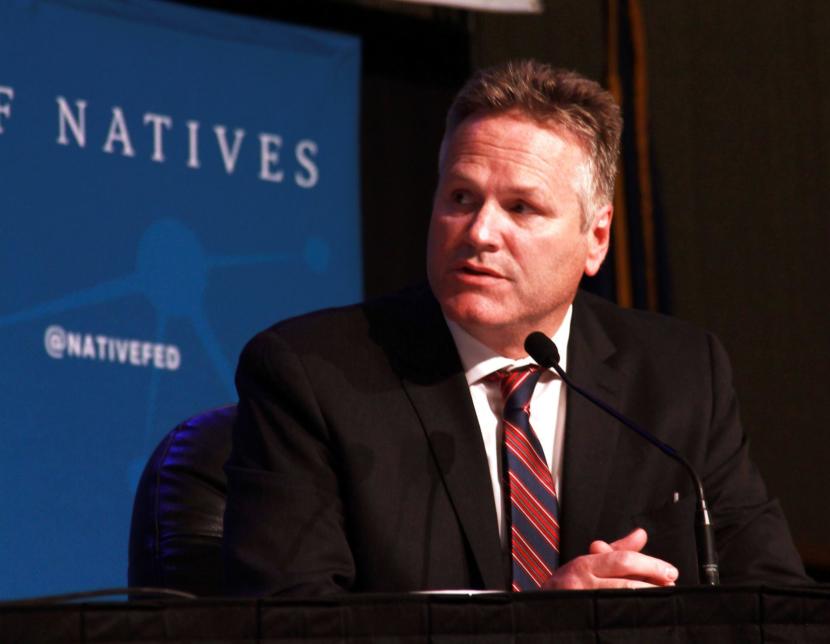
Alaska gubernatorial candidate Mike Dunleavy answers questions during a candidate forum Friday, Oct. 19, 2018, at the Alaska Federation of Natives annual convention in Anchorage, Alaska. (Photo by Tripp J Crouse/KNBA)

The board of directors of Cook Inlet Region Inc., or CIRI, announced Thursday that they support the effort to recall Gov. Mike Dunleavy.

The Anchorage-based Alaska Native corporation made its announcement in an email message to shareholders and on its website.

Ethan Tyler, director of corporate affairs for CIRI, said the Recall Dunleavy campaign outlined four points in their messaging that CIRI supports.

“In looking at those four points, CIRI believes that the fact of those four actions, or those four points or actions that the governor has taken, negatively impacts our business here in the state of Alaska and ultimately our shareholders,” Tyler said.

According to the post online, CIRI breaks down those four points: “The governor has repeatedly violated Alaska law and the state constitution, and demonstrated his unfitness for office by refusing to appoint a judge within the legal time frame; misusing state funds for political ad campaigns; violating the separation of powers; and incompetently vetoing state funds.”

Tyler said the last time CIRI entered into political waters was in support of Alaska Republican Lisa Murkowski’s write-in campaign for U.S. Senate.

“CIRI rarely wades into the political realm,” he said. “We thought that this presented a credible threat to our ability to fulfill our mission, and that is why CIRI is supporting the recall effort. “

According to its website, CIRI has about 8,800 shareholders.

Site notifications
Update notification options
Subscribe to notifications