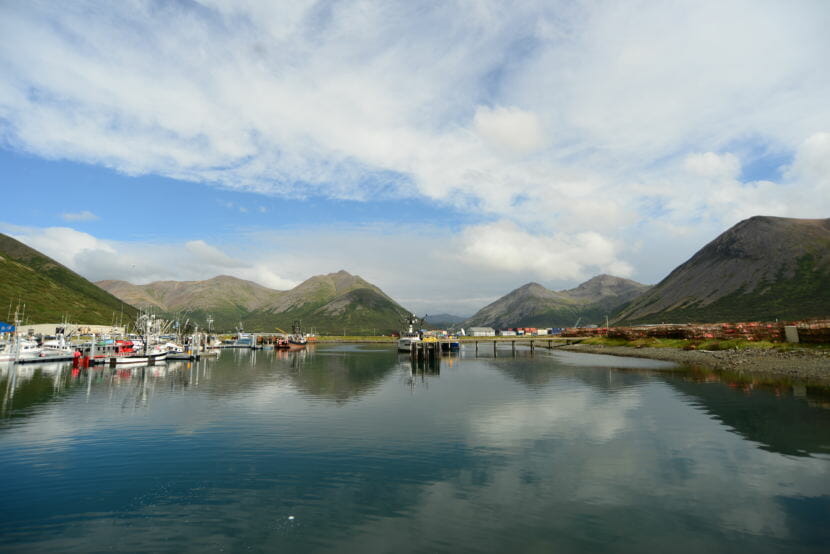
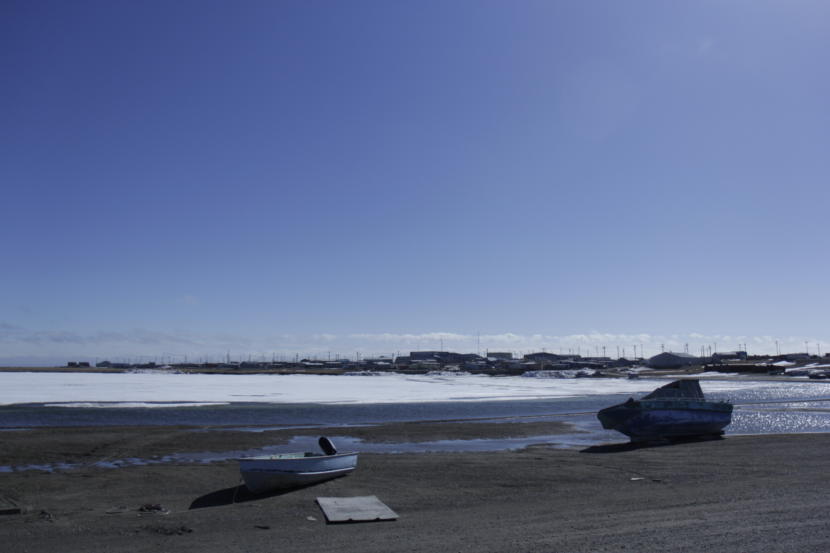
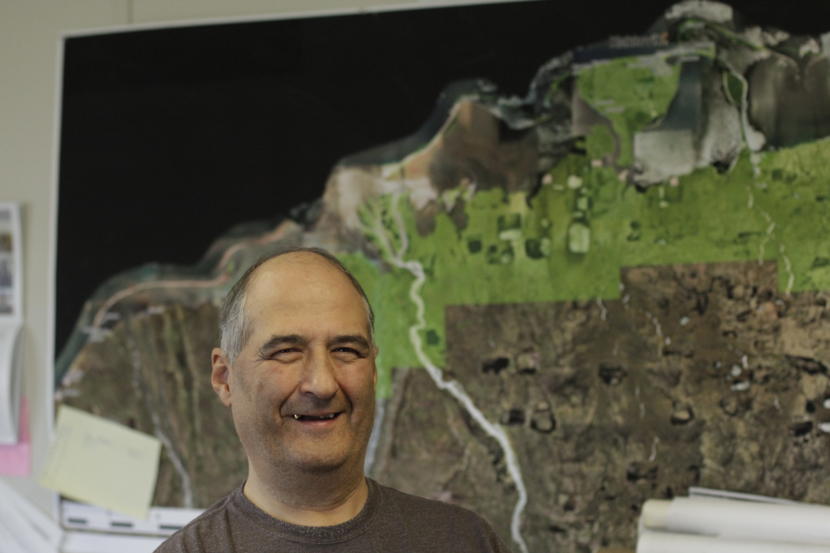
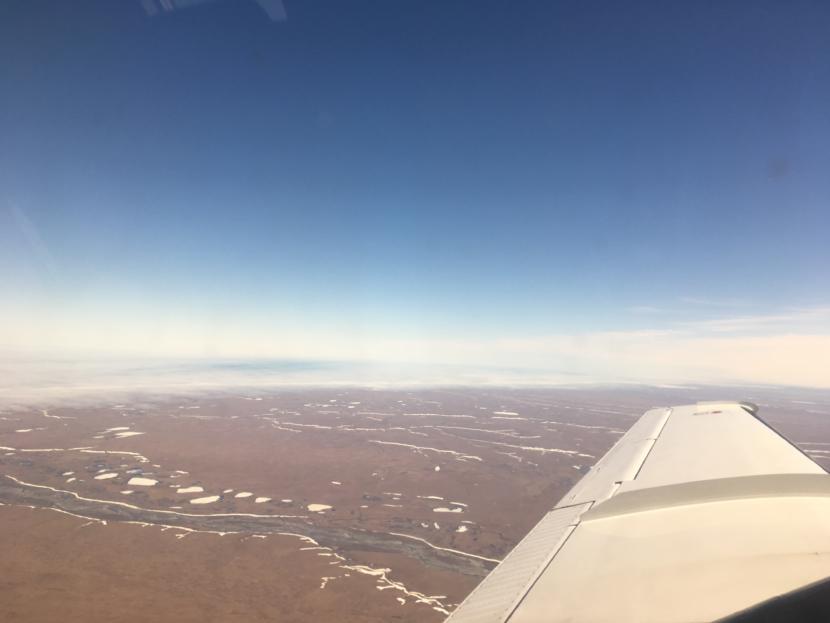
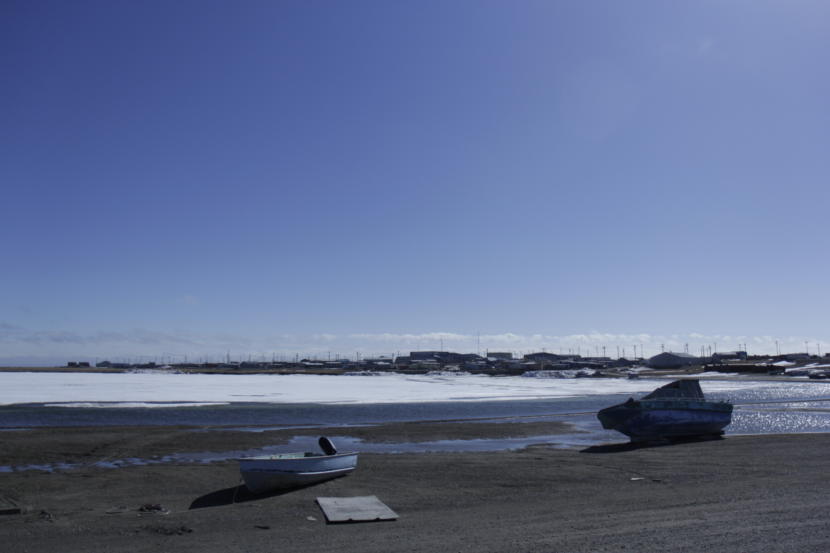
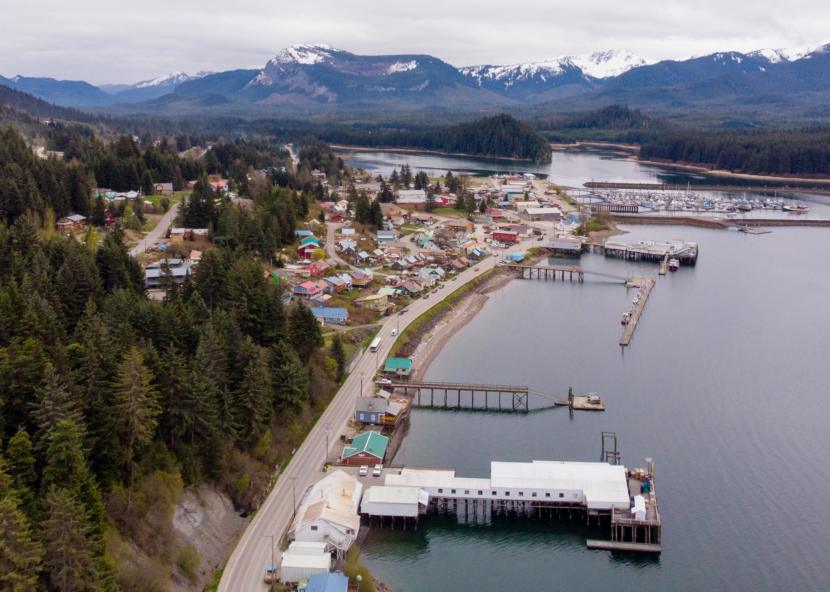
A view of King Cove. (Photo by Berett Wilber/KUCB)
The Wilderness Society and eight other environmental groups have filed a new lawsuit to block a road in the Izembek National Wildlife Refuge.
For nearby King Cove, it’s the latest in a long series of legal and political hurdles dating back decades.
“We’re not surprised,” said Della Trumble of the King Cove Corporation.
She is a longtime proponent of the proposed road, roughly 12 miles through the refuge, to connect King Cove to Cold Bay and its all-weather airport. She says it’s a matter of life and death in medical emergencies. But environmental groups have always stood in the way.
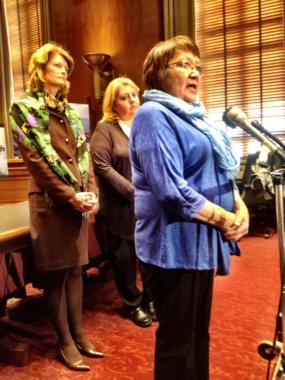
Della Trumble of King Cove Corporation, advocating at the U.S. Capitol in 2014 for a road in the Izembek National Wildlife Refuge. (Photo by Liz Ruskin/Alaska Public Media)
The lawsuit “just continues the basic concept that they don’t care about the lives of the people out here,” Trumble said. “The birds have more priority.”
The lawsuit challenges a land swap agreement U.S. Interior Secretary David Bernhardt and the King Cove Corporation signed last month to create a road corridor that would be owned by the village corporation.
The conservation groups claim the swap violates environmental laws and the Alaska National Interest Lands Conservation Act.
It’s similar to their last lawsuit, which the groups won in March. A judge agreed the Interior Department hadn’t justified its switch from an anti-road position during the Obama administration to its current pro-road stance. This time, along with the new swap agreement, Bernhardt wrote 20 pages of justification.
The lawsuit claims the justification is still inadequate.
The Center for Biological Diversity is one of the plaintiffs. Its public lands program director, Randi Spivak, said she doesn’t prioritize birds over humans, but she said the people of King Cove have other transportation options.
“What is also important is that this refuge is internationally important for birds all over the world, and wildlife,” she said.
A road, Spivak said, wouldn’t solve all of King Cove’s transport problems.
“Look, they’re way out there in the Aleutians. Very remote area with severe weather conditions,” said Spivak, who has visited the Alaska Peninsula community. “That road would not provide guaranteed safety 365 days of the year, either.”
King Cove leaders say the road would be passable nearly all the time and is the only practical option.
The suit was filed by Trustees for Alaska, a law firm that represents environmental groups. Other plaintiffs include Friends of Alaska National Wildlife Refuges, Alaska Wilderness League, Defenders of Wildlife, National Audubon Society, the National Wildlife Refuge Association, Sierra Club and Wilderness Watch.
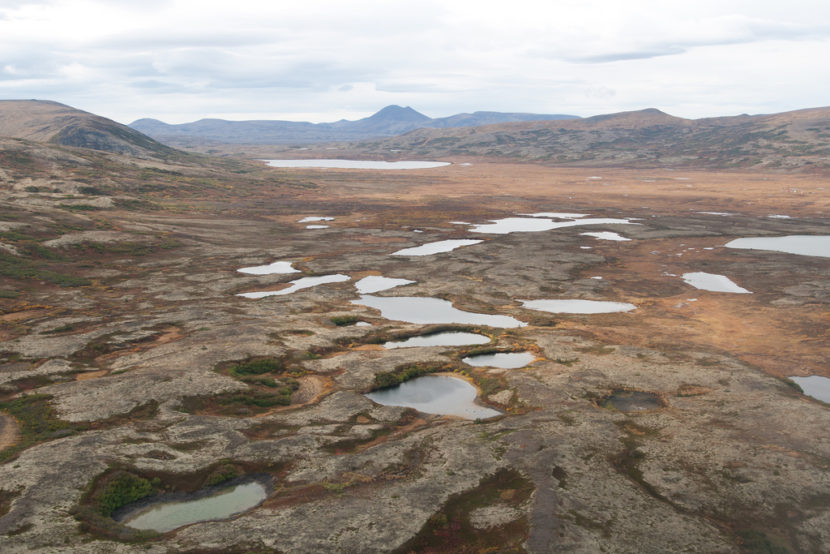
The proposed Pebble Mine site, pictured in 2014. (Photo by Jason Sear/KDLG)
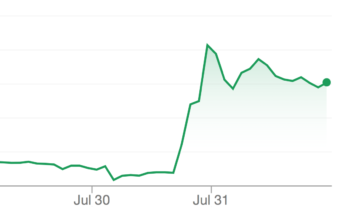
Northern Dynasty Minerals, the sole owner of the Pebble Limited Partnership, saw a 60% jump in share price on Tuesday. The surge came after the Environmental Protection Agency withdrew proposed restrictions on the Pebble Mine project, clearing a potential hurdle to its development.
The value of Northern Dynasty stock has been low amid recent controversy surrounding the proposed mine. It hasn’t seen a boost of this magnitude in more than two years.
Northern Dynasty CEO Ron Thiessen said the stock movement reflects investor optimism that the project is on the right course.
“You saw it in the market,” Thiessen said. “Our shareholders felt this was a major impediment, and clearing it was a major milestone.”
Not everyone shares that positive outlook. Norm Van Vactor, president of the Bristol Bay Economic Development Corporation, thinks Tuesday’s movement on the markets was nothing more than a knee-jerk reaction to the day’s headlines. He still sees plenty of significant obstacles to the mine’s development.
Northern Dynasty, which trades as NAK on the New York Stock Exchange, saw shares go from 54 cents to 91 cents on Tuesday. (Google Finance graphic)
“At the end of the day,” Van Vactor said. “I have a high degree of confidence that science and reason will prevail. It’s certainly not where I would be putting my retirement funds or even my play money if I had any.”
KDLG reached out to a number of financial analysts for this story, but they all declined to comment.
Northern Dynasty shares have not seen much action over the past few years, a time during which the debate over Pebble Mine’s potential environmental impact has grown.
Thiessen said certain worries about the mine’s effects on Bristol Bay are unfounded.
Bristol Bay Economic Development Corporation CEO Norm Van Vactor. (Photo by Skip Gray/360 North)
“People shouldn’t have been scared away,” Thiessen said. “And our share price shouldn’t have been depressed, because people don’t tell the truth about the potential impact of this project on a fishery.”
Van Vactor disagrees. He’s holding out hope that the permitting process will take scientific findings into account and keep the project from getting too far.
“This is another bump in the road,” Van Vactor said. “We’ve seen a lot of them before and we will see more in the future. But at the end of the day I’m very optimistic that science and truth will prevail.”
Northern Dynasty stock was hovering around 80 cents at the end of trading on Wednesday. The next major step in the permitting process comes in early 2020, when the Army Corps of Engineers expects to release its final environmental review.
Kaktovik sits on an island in the Arctic Ocean on Alaska’s northeast coast. It’s the only village within the Arctic National Wildlife Refuge’s coastal plain, which Congress opened to oil exploration in 2017. (Photo by Nat Herz/Alaska’s Energy Desk)
After Congress opened the Arctic National Wildlife Refuge to oil drilling in 2017, the Kaktovik Iñupiat Corp. (KIC) should have been poised for a new era of prosperity.
Instead, its businesses were mired in lawsuits.
The corporation, which grew out of the 1971 Alaska Native Claims Settlement Act, was designed to generate profits for indigenous Iñupiat shareholders from Kaktovik, on the Arctic coast — the only village inside the refuge boundaries.
The company filed a lawsuit in April to recover the money. But with that case unresolved a month later, KIC’s businesses were facing more than a half-dozen of their own lawsuits from an array of creditors.
Then, John Rubini stepped in.
Rubini is one of Alaska’s most successful investors; his real estate company’s properties include several of Anchorage’s largest buildings, like the downtown offices of oil company ConocoPhillips. Forbes calls him one of the state’s two richest men.
In May, Rubini helped stave off the creditors and, with the corporation and a few other investors, formed a joint venture. The idea is to merge KIC’s local knowledge and proximity to the refuge with the investors’ deal-making experience, Rubini said in a phone interview.
“If there’s going to be development activity, I wanted to make sure that the community of Katovik had the tools and resources to participate fairly and effectively in that process,” Rubini said.
Rubini’s interest in Kaktovik underscores how the coastal plain’s opening has put the village in a new spotlight. It’s still too early to know if petroleum even exists in the refuge in commercially-viable quantities. But if it’s found, Kaktovik’s residents are simultaneously positioned to be among the biggest beneficiaries, and to experience some of the biggest disruptions.
The isolated village, on the oil-rich North Slope, already straddles the divide between traditional and modern. Oil industry taxes have helped pay for infrastructure in Kaktovik that’s lacking in other rural Alaska communities; its homes have flush toilets, and there’s a $16 million new basketball gym. Meanwhile, residents still subsistence hunt for caribou, and some of KIC’s board members double as captains of the boat crews that hunt whales off the coast.
While sharp divisions still exist over oil drilling in the village, a string of recent political and business decisions have increasingly set Kaktovik on a course aligned with development. Last year, Kaktovik’s city council ousted an anti-drilling mayor, Nora Jane Burns.
“We want to make sure that the actual voice of Kaktovik and its people are heard. That hasn’t been the way it’s been in the past,” said Charles Lampe, a KIC board member and drilling proponent.
Charles Lampe, a whaling captain and Kaktovik Inupiat Corp. board member, sits at a community meeting in Kaktovik last month. (Photo by Nat Herz/Alaska’s Energy Desk)
Opponents of development, meanwhile, have been increasingly marginalized in Kaktovik — and have turned elsewhere for help.
In December, Burns, the former mayor opposed to drilling, flew to Fairbanks. She was part of a group of Kaktovik residents that also included Evelyn Reitan, another drilling opponent, who was working at the time as the city administrator.
In Fairbanks, the delegation held an unusual meeting with leaders of the Gwich’in people, a different Native group that lives outside the coastal plain. The Gwich’in people, citing possible harm to the caribou they subsist on, have lobbied relentlessly to keep the refuge closed to development — much to the frustration of Kaktovik’s Inupiat drilling supporters, who see the coastal plain as their land to manage.
When Kaktovik’s drilling supporters found out about the summit, it didn’t sit well, since many view the Gwich’in people as adversaries in the fight over the refuge. But Burns, who remains on the city council, said she felt compelled to go, though she knew it would “upset some people.” She and other Kaktovik drilling opponents have the same concerns as the Gwich’in, about the caribou, she said.
“You have to hear what they have to say, because they eat the same animals that migrate into our land,” she said
Bernadette Demientieff, a Gwich’in leader who participated, said she didn’t want to get into the specifics of the discussion, though she called the meeting a “healing and honest conversation.” But the event didn’t help the drilling opponents’ standing in Kaktovik: The village’s new mayor, Amanda Kaleak, subsequently fired Reitan from her job as city administrator.
Kaleak declined to be interviewed about city politics and her own views on development, saying she had to remain “unbiased.” But last year, when Burns was still mayor, Reitan had worked with her and the rest of the city council to issue a statement on Kaktovik’s behalf that called federally-run oil and gas development a “hostile process being imposed by government agencies acting in bad faith.”
Evelyn Reitan, an opponent of oil development in the refuge, worked as Kaktovik’s city administrator until she was fired recently. (Photo by Nat Herz/Alaska’s Energy Desk)
Reitan said she wasn’t given an explanation for her firing. She said she thinks a lot of things went into the decision — though she also said that she saw the move as driven by people she’s clashed with in the village, who support oil development.
The stakes
To understand what’s at stake in Kaktovik, the best place to look is 175 miles to the west — at Nuiqsut, another North Slope Inupiat village that Kaktovik residents on both sides of the drilling debate cite as a cautionary tale.
Nuiqsut sits at the edge of the National Petroleum Reserve in Alaska, an Indiana-sized tract of federal land that’s become a hot oil prospect in the past few years.
Kuukpik Corp., the Native claims settlement corporation that’s Nuiqsut’s version of KIC, owns more than 200 square miles inside the reserve’s boundaries. And it’s leveraged those holdings into lucrative oilfield-service contracts and land use agreements with oil companies. Those deals, in turn, help sustain annual dividends of $30,000 for each of Kuukpik’s shareholders.
The flip side of that? Oil developments have slowly encircled Nuiqsut; a major oil processing facility is visible on the horizon. As much as one-third of the area that residents use for subsistence hunting and fishing has been affected by development, according to Kuukpik. And some residents fear that diminished air quality is affecting their health.
A recent poll of 93 people conducted by Kaktovik’s city government found half in favor of oil development in the coastal plain, 30 percent opposed and the rest undecided.
But even opponents of drilling say they’re frustrated by the way the federal government has thwarted development on Kaktovik’s corporate lands inside the refuge.
On a map, Kaktovik is a dot, on the Beaufort Sea coast midway along the refuge’s northern edge. But residents see a huge swath of the refuge lands to the south, all the way to the Brooks Range mountains, as their territory, too.
The Iñupiaq people have thousands of years of history on the North Slope, and some used Barter Island as a seasonal home to fish, and hunt for marine mammals. When they weren’t along the coast, they were hunting sheep and caribou in the mountains.
Kaktovik sits on Barter Island, on the Beaufort Sea coast. (Photo by Nat Herz/Alaska’s Energy Desk)
“None of this country is wilderness. It never has been. It has been continuously used and occupied by us and by our ancestors for millennia,” Kaktovik residents wrote in “In This Place,” a 1991 manifesto that outlines their views about land and development.
Through the 1971 Native claims settlement act, Kaktovik’s village corporation received a little less than 150 square miles, or less than 10 percent of the area that Congress opened to oil leasing two years ago.
Edward Rexford, pictured in his office in Kaktovik, works for KIC and is an avid supporter of oil development in the Arctic Refuge’s coastal plain. (Photo by Nat Herz/Alaska’s Energy Desk)
Even that comparatively small, corporate-owned area was off-limits to drilling until lawmakers’ 2017 vote. And Kaktovik’s residents, along with everyone else, are barred from driving four-wheelers into the surrounding Arctic Refuge land — unless they have a Native allotment and a special federal permit.
“The federal government took all our property, all the resources in the mountains, and gave us just a sliver,” said Edward Rexford, an avid supporter of oil development who works for KIC. “We felt kind of shortchanged.”
Land already leased
The support for development among Kaktovik residents stems, in large part, from the ample benefits they’ve already derived from oil production in Prudhoe Bay, to the west.
Drilling boosters envision an array of new gains that could come from development on the coastal plain: jobs, cash flowing into the village, new infrastructure like natural gas piped in to heat people’s homes, or even road access.
Those types of ventures — partnering with or working for other, larger businesses involved in the search for oil in the refuge — are likely to yield the most immediate benefits for KIC.
But beyond getting a chunk of the drilling action, more direct benefits to Kaktovik could come from development on the 150 square miles of coastal plain owned by KIC — which is also the area closest to the village. Oil production from those corporate lands could generate a lucrative stream of royalties for KIC and Arctic Slope Regional Corp. ASRC is the regional Native corporation for the entire North Slope, and it owns the rights to the oil beneath KIC’s land.
An aerial view of the Arctic National Wildlife Refuge near Kaktovik. (Photo by Nat Herz/Alaska’s Energy Desk)
Congress placed a 2,000-acre limit on oil infrastructure in the refuge in its 2017 vote. But that limit only applies to federal land, not corporate land. And ASRC has already leased its entire 150-square-mile area to oil companies Chevron and BP.
The agreement was signed in 1984, and afterwards, the oil companies spent $40 million on the only oil well ever drilled on the refuge’s coastal plain. The companies have gone to extraordinary lengths to keep the results secret, though a recent New York Times investigation suggested they were not promising.
When the coastal plain remained closed to drilling, ASRC allowed Chevron and BP to suspend their lease payments. But since Congress opened the area in 2017, those payments have resumed, said Teresa Imm, an ASRC executive who works on resource development.
Imm, in a phone interview, declined to discuss the financial details of the lease. But she said ASRC is proceeding cautiously. It’s too late, she added, for companies to make plans to drill exploratory wells next winter; if there was a proposal for the following winter, ASRC would work with Kaktovik to try to provide economic opportunities while minimizing negative impacts on the village, Imm said.
“Everybody thinks there’s this rush to the finish line. But because ANWR’s been sitting there unopened for years and years, there’s lots of work that has to be done to get ready for a program, including on our lands,” she said. “It’s a constant dialogue.”
How close to home?
Not everyone in Kaktovik trusts ASRC to safeguard the village’s interests, given that the regional corporation — Alaska’s largest privately held company, with some 12,000 employees — has its own financial interests at stake.
ASRC is based in Utqiagvik, 300 miles to the west, and that distance means that the corporation’s executives won’t feel the impacts of drilling as acutely as Kaktovik’s residents.
The corporation does, however, stand to receive an unusually large share of any oil revenue: Normally, the Native claims settlement act requires that regional corporations like ASRC share 70 percent of their resource development revenue with the 11 other regional corporations. But that requirement doesn’t apply to the corporate lands outside Kaktovik, because ASRC acquired the oil rights through a special land trade with the federal government.
Carla Kayotuk, a drilling opponent from Kaktovik, described being galvanized when she heard a former North Slope Borough mayor and ASRC board member, George Ahmaogak, talking on the radio. Ahmaogak, Kayotuk said, was vowing to block oil development around Teshekpuk Lake, a different area of the North Slope where he and other Utgiagvik residents have hunting and fishing cabins.
“I’m like, ‘Wait a minute!’” Kayotuk said. “‘You’re willing to open up my homelands for oil development but you don’t want it in your area?’ I’m like, ‘No, I’m not going to be quiet any more.”
Drilling opponents like Kayotuk said there’s already evidence that the village’s needs are being skipped over in the opening of the refuge.
For years, Kaktovik’s residents and institutions pushed for provisions in refuge-related legislation that would protect the village from and compensate it for impacts that arise from oil development. But none were expressly included in the 2017 bill — no Congressionally-mandated provisions to divert any of the oil revenue to Kaktovik, or to accommodate the village’s subsistence practices.
“The political process that led to the final vote to open ANWR required the legislation to be stripped down to its bare financial bones, without any of the meat addressing environmental protections, subsistence use and access, community impact aid and other provisions that define our region’s stake in the venture,” Sayers Tuzroyluk Sr., president of the pro-drilling Voice of the Arctic Iñupiat, wrote in an opinion piece last year.
U.S. Sen. Lisa Murkowski, who led the push to open the refuge to drilling in the 2017 tax bill, was unavailable for an interview, a spokeswoman said.
Kaktovik’s drilling boosters said they have no interest in oil development that would harm the spots residents hunt and fish; they use those areas, too.
“We want to make sure those places are identified and set off-limits, and make sure that the development isn’t going to intrude,” said Lampe, the village corporation board member, who also captains a whaling crew. Opponents of development, he added, “think that we’re trying to make where it’s just going to be a big oil field out there. That’s not what we’re trying to do.”
But Burns, the anti-drilling city council member and former mayor, said she thinks it will be tough for Kaktovik to stop development from happening in the areas that companies find petroleum.
“No matter what we say or do, I think they’re going to try to go where the oil is easily extracted,” she said.
Lampe said KIC is taking steps to keep oil development from dividing the community, namely by issuing a new class of shares.
In Nuiqsut, where the village corporation pays huge dividends stemming from nearby oil production, that dynamic has created something of a generational split: older residents who own shares tend to support development, while younger people who lack them are more likely to oppose it. Kaktovik’s village corporation wants to avoid that problem, and last month, its board decided to roughly double the number of its shareholders.
It’s better to do that, Lampe said, “before one drop of oil is developed, before any money is taken in.”
“We want to make sure that it doesn’t only benefit the original shareholders,” he added. “Because there are so many more of us that are going to be affected by development.”
Ravenna Koenig contributed reporting to this story.
Richard Glenn, left, and Matthew Rexford, tribal administrator for Kaktovik, wait to testify at a 2019 U.S. House of Representatives hearing on drilling in the Arctic National Wildlife Refuge. (Photo by Liz Ruskin/Alaska Public Media)
Richard Glenn is an inconvenient truth for those who want to stop drilling in the Arctic National Wildlife Refuge.
In congressional hearings, he presents a challenge to the narrative prevalent in Washington, D.C., that Native people oppose development in the Arctic. Glenn has been a compelling witness in favor of drilling in ANWR for about 20 years.
Sen. Maria Cantwell, D-Wash., looked past Glenn as he waited to testify in front of the U.S. Senate Committee on Energy and Natural Resources at a 2017 hearing on ANWR. She said she was disappointed there weren’t more tribal members on the witness list.
“Individual tribal members, as we have seen throughout Alaska and throughout the United States of America, don’t support this kind of development because they believe in the wildlife nature that God has given us and that we are stewards of Mother Earth,” she said.
That generalization, from the committee’s top Democrat at the time, put Glenn in a slow burn.
Glenn is executive vice president for external affairs at Arctic Slope Regional Corporation. ASRC and its Iñupiat shareholders stand to profit from drilling in ANWR. When it was his turn to speak, Glenn pointed out he is also a member of a tribe. So were three other Alaska Native witnesses who testified for drilling.
“And I was particularly stung by the ranking member’s comments that she didn’t see tribal members,” Glenn said. “Maybe she just didn’t find enough tribal members that agreed with her position.”
But Glenn doesn’t match the image some senators have in their heads for what a tribal member should look and sound like. In his dark suit and metal-rim glasses, Glenn wouldn’t have looked out of place in an accounting firm.
And he would not let himself be painted as less Native because he supports oil development in ANWR. He’s Iñupiaq with a deep connection to the ice and soil.
Opponents of drilling say the coastal plain of the refuge is sacred land to the Gwich’in people of the Interior. Glenn told the senators it’s all sacred land, north and south. Lands across the North Slope bear the bones of his ancestors, he said. He meant that literally.
“Some of my ancestors’ bones, my grandfather’s grandmother, are in Prudhoe Bay,” he said. “Others are scattered along the coastal plain, from the Canadian border to Point Hope.”
Glenn told the senators that his people depend on sacred land for both food and resource development. Glenn is comfortable with the idea that land can be sacred and produce oil. Synthesizing the knowledge of two worlds is what he’s all about.
Kaktovik sits on an island in the Arctic Ocean on Alaska’s northeast coast. It’s the only village within the Arctic National Wildlife Refuge’s coastal plain, which Congress opened to oil exploration in 2017. (Photo by Nat Herz / Alaska’s Energy Desk)
When Alaska’s Energy Desk inquired to Glenn about profiling him, he and the public relations department of Arctic Slope Regional Corporation declined to participate. They insisted the Energy Desk should first profile a pro-drilling tribal representative from Kaktovik, the only community in the refuge. And it’s easy to see why they might want that. The anti-drilling side sometimes portrays the battle over the Arctic Refuge as for-profit corporations fighting tribes. Money versus culture. Suits versus moose-hide vests.
But from Glenn’s perspective, it’s not that simple. And he has told his story before.
“I was born in 1963, in Mountain View, California,” Glenn said when Karen Brewster interviewed him in 2016 in his home in Utqiaġvik for an oral history project.
Glenn told Brewster his mom is a daughter of the Ahmaogak family from Utqiaġvik, also known as Barrow. His dad is a son of Nebraska, sent to the Arctic to work on the Distant Early Warning Line, or DEW Line — the Cold War-era early warning radar system.
“And in those days, you weren’t allowed to fraternize with the locals,” Glenn said. “But there were a few Barrow people who worked out on the DEW Line station. And they like to say they played cupid for my mom and my dad.”
The young couple left the North Slope when Glenn’s dad took a tech job in what would soon be called Silicon Valley, so Richard was born and grew up in the Bay Area. Richard and his siblings learned Iñupiaq from their mom, and they knew other North Slope families living in that part of California. They also had a stream of visitors going to and from Barrow.
“So we had a communications network,” Glenn said. “Everyone had Eskimo food in their freezer all the time.”
His first trip to Barrow, aside from when he was a toddler, was at age 13. It was a summer of cousins and an introduction to hunting.
“I made a promise to myself that I’d go back, even if my family didn’t,” Glenn said in the interview with Brewster. “So every summer I did, from the day that school was over till the day school started, from seventhgrade on. And it was a great upbringing.”
As he learned to hunt — ringed seal, bearded seal and caribou — Glenn began to learn about ice: how to move on it, how to be safe, how it drifts and breaks off. By his 20s, he was on spring whaling crews and became a whaling co-captain.
He became, he said, obsessed with ice. Infatuated with it. He told Brewster he got to double-dip in ice education, with traditional knowledge and a master’s degree in geology from the University of Alaska Fairbanks. Every ice trail he cuts tells a story, and Glenn reads the details.
“You’re looking at that popcorn junk ice that your pick hates to swing on. Or the mud-rich stuff that was born when the slush was dragging the bottom,” he said. “Or this kind of columnar basalt-looking ice that grew all at once and just stayed that way, from birth to — just a flat, tabular ‘bang,’ hit it with a pick, it all breaks like that.”
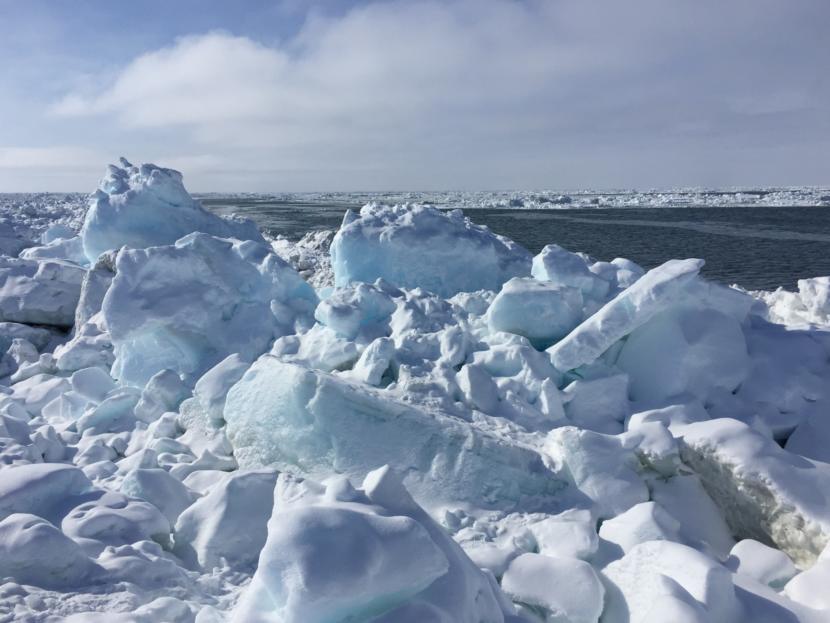
A view of the sea ice and the Arctic Ocean near Utqiaġvik, April 16, 2019. (Photo by Ravenna Koenig/Alaska’s Energy Desk).
The Gwich’in say to allow drilling in the Arctic Refuge will destroy their Native way of life. But Richard Glenn sees a fruitful integration. The oil industry pays local taxes, and Arctic Slope Regional Corporation owns some of the subsurface rights in the refuge. As Glenn sees it, oil development provides the cash that allows the Iñupiat to continue to live in the Arctic and teach future generations how to hunt on ice.
“If my DEW Line father and my Iñupiat mother have taught me anything, it’s taught me that there’s these two ways of looking at the world, but they overlap in the middle,” he said at a forum in Washington, D.C. “And if you can find that place where the overlap exists, it’s nothing but pay dirt, as far as good lessons to learn.”
The city of Hoonah on May 2, 2019 (Photo by David Purdy/KTOO)
It’s well known that traumatic experiences can have lifelong impacts on health and well-being. But it’s possible that those effects can last longer than a single lifetime. A new study asks whether the effects of trauma have been passed down genetically in Tlingit families in Hoonah.
Much of the history is familiar to rural Alaska Native communities anywhere in the state: children taken from their families and sent to boarding schools, language suppressed. But the Tlingit community of Hoonah has also experienced unique traumas, such as a fire that destroyed much of the town in 1944.
“This major fire that occurred there in the in the ’40s. And Bureau of Indian Affairs was very much involved in our lives, and at the time, they wouldn’t allow them to rebuild clan houses,” Worl said.
Rosita Worl is the president of the Juneau-based Sealaska Heritage Institute (SHI). She’s also an anthropologist. Some of her first work looked at the social and cultural impacts of historical trauma in Alaska Native communities.
“And then now, how many years later, to find out that these changes, these impacts, could change our very physiological being,” said Worl.
Trauma might even affect our DNA, our most basic stuff. And, if that’s the case, those changes could be passed down through families, impacting people generations removed from traumatic events.
It’s a young field of research, and SHI is part of it. The non-profit just launched a study to see if residents and descendants of Hoonah have experienced any genetic changes because of that trauma.
Principal investigator Ripan Malhi is a molecular anthropologist at the University of Illinois Urbana-Champaign. Malhi and his team explain it like this: Your DNA is fixed. It’s like a sheet of music; all the notes are already printed on the page. Those are your genes. But as in music, it’s all about expression.
“It’s the musician that can change how the music is played, or you can stress some notes really loudly or play other notes really softly,” Malhi said. “And so that’s kind of like gene expression that changes the level of how the genes are expressed, even though the notes are the same.”
Trauma, so the thinking goes, can change someone’s gene expression. And that could impact their health — maybe make them more likely to develop certain diseases — or it could affect the health of their children, even grandchildren.
Working with the Hoonah Indian Association, SHI is inviting Tlingit residents and descendants of Hoonah to take part in the study, called Epigenomic Effects of European Colonization on Alaska Native Peoples. Participants have their blood drawn, for the DNA sample, and they complete a survey. It asks about both historic and more recent traumatic events, as well as how participants feel about that trauma, how much they think about it. It also asks about participation in cultural traditions, which could act as a buffer. Malhi and his team will then analyze the DNA samples to see if they can find any evidence of genetic change that tracks with the trauma recorded in the survey. Malhi says they’ll compare what they find to the results of similar studies done with survivors of the Holocaust and the Rwanda genocide.
This kind of research is still pretty new, and Malhi says so is the approach. Rather than dropping in on a community, collecting data and leaving, Malhi’s team of scientists is working with Hoonah residents as partners who will give feedback and help direct the research at every step. Starting with what questions to ask and how to ask them.
“And when we get results, we’ll come back and provide an update and get some feedback on what the patterns may mean,” Malhi said. “And things that we can’t explain, maybe community members have a good explanation for it.”
No samples will be shared with other labs, and SHI and Hoonah representatives will review and edit any papers before they’re published.
Malhi says Indigenous communities around the world already have a deep understanding of their own trauma. But genetic evidence of trauma’s impact could be more compelling to Western institutions like state governments or health insurers.
“They may not take traditional knowledge as being real, but when scientific knowledge says the same thing, then all of a sudden it becomes real,” Malhi said.
Building that scientific knowledge is a long and complicated process, and this is just the beginning. The researchers expect the whole study and analysis to take about eight years, although Worl hopes to share initial findings as soon as next year.
“And why do I want to do it? It’s because I think we need to be aware of these kinds of impacts, when we make policy decisions,” said Worl.
Worl can see the research informing, for example, the management of subsistence resources. A collapse due to overfishing can be a cultural loss, too.
Taking part in a study about your own trauma is heavy work, Worl says, “But yet our people knew that it could be a potential benefit for us. And, you know, I always attribute that to our value system, that we learn from our past to protect our future.”
It’s not just history, Worl says. It’s still happening.
Hoonah descendants now living in Juneau had the opportunity to participate in the study earlier this month. The researchers are planning a trip to Hoonah in September — aiming for a narrow window between ceremonies and subsistence activities.
Oil Search Alaska President Keiran Wulff. (Photo by Elizabeth Harball/Alaska’s Energy Desk)
The federal government has given a key approval to a large North Slope oil project.
Papua New Guinea-based Oil Search announced Thursday that it received a permit from the Army Corps of Engineers for its Pikka development, planned west of Prudhoe Bay.
While important, the Army Corps’ permit isn’t the final word on the project’s future — the company still needs more approvals before it can move forward.
Oil Search estimates the project could produce approximately 120,000 barrels of oil per day. The Trans-Alaska Pipeline System currently pumps some 500,000 barrels daily, so state analysts think Pikka has the potential to contribute significantly to Alaska’s future production.
“It’s a really important project to the state,” Oil Search Alaska President Keiran Wulff said in an interview earlier this year.
To produce that much oil, Oil Search plans to build up to three drill sites, about 25 miles of roads, about 35 miles of pipelines, a central processing facility, two bridges and an operations center with beds for 200 workers. During construction, the company says it could employ thousands.
Pikka would be on state and Native-owned land, as close as seven miles to the village of Nuiqsut.
One of the main questions about the project is how it will affect subsistence hunting and fishing for Nuiqsut residents. Oil Search has made several changes to the project to address the village’s concerns, like relocating infrastructure and planning a new boat ramp for residents on a nearby river.
“We are committed to close collaboration with the people and organizations of Nuiqsut,” Wulff said in a statement accompanying Thursday’s announcement.
But an Oil Search spokesperson said the company is still in talks to reach a land-use agreement with Kuukpik Corporation, the Alaska Native village corporation for Nuiqsut. And the company will need dozens more state and local permits before it can begin construction.
Close
Update notification options
Subscribe to notifications
Subscribe
Get notifications about news related to the topics you care about. You can unsubscribe anytime.