Tourism

The National Park Service could soon have its first Native American director

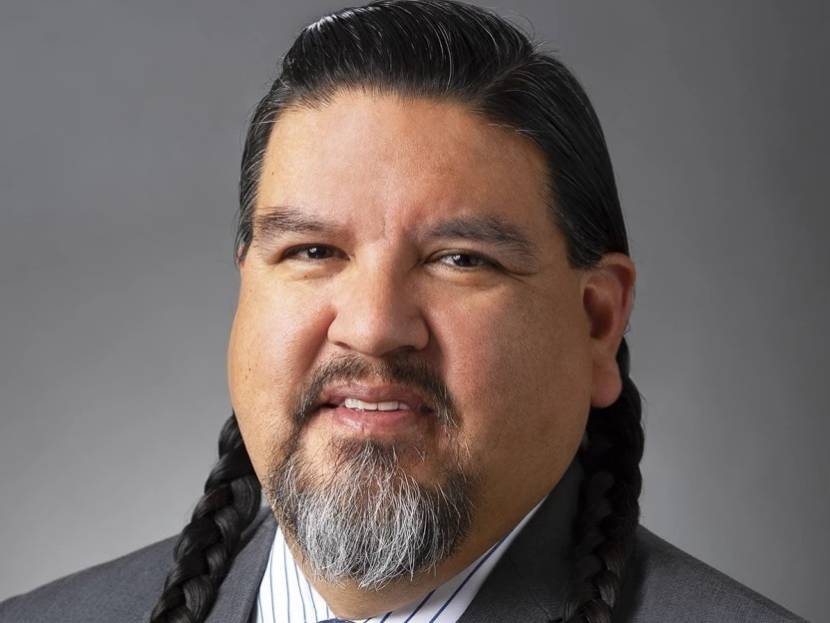
A photo portrait of Charles "Chuck" F. Sams III
Charles “Chuck” F. Sams III is President Biden’s pick to lead the National Parks Service. (Oregon Governor’s Office)

Charles “Chuck” F. Sams III could soon become the first Native American to head the National Park Service in the agency’s 105-year history.

Sams is an enrolled member of the Cayuse and Walla Walla tribes, which are part of the Confederated Tribes of the Umatilla Indian Reservation, and has decades of experience in land management. The Senate Committee on Energy and Natural Resources meets Tuesday to consider his nomination.

The Biden administration nominated Sams in August, noting his leadership in state and Tribal governments, including as the former national director of the Tribal & Native Lands Program for the Trust for Public Land.

Sams’ confirmation would bring change to an agency that hasn’t had a permanent Senate-approved director in more than four years. The department has been helmed by a series of acting directors since the last director of the National Park Service retired in 2017.

Sams is a U.S. Navy veteran and lives on the Umatilla Indian Reservation with his wife and their four children. The announcement of Sams’ nomination was met with celebration from Native groups as well as Sams’ local community.

“It’s one of those things that we’re going to talk about for generations,” Modesta Minthorn, who has known Sams for years, told the East Oregonian. “I can see [myself], talking to grandkids, telling them, ‘Be more like that guy.’ ”

Fawn Sharp, president of the National Congress of American Indians, recognized Sams as uniquely qualified to lead the agency.

“As the Park Service’s first Native American director, Chuck is well-positioned to balance recreational uses and stewardship with our Tribal Nations’ needs to maintain our traditional and ancestral ties to these lands,” Sharp said.

As NPR’s Kirk Siegler reports, the next Park Service director will be faced with a backlog of maintenance and critical infrastructure projects at national parks, as well as the consequences of recordbreaking crowds during the pandemic.

The National Park System covers more than 85 million acres in all 50 states, as well as the District of Columbia, American Samoa, Guam, Puerto Rico and the Virgin Islands.

The National Park Service is a bureau of the Department of the Interior, which is led by Secretary Deb Haaland, a member of the Pueblo of Laguna. She made history when she was confirmed as the first Native American cabinet secretary in March.

Haaland and Sams’ nominations come as more Indigenous people are gaining leadership positions nationwide and as some states are working with Tribal leaders to use Native eco-stewardship practices such as traditional burns to manage wildfire threats.

Copyright 2021 NPR. To see more, visit https://www.npr.org.

Wrangell seeks ‘COVID greeter’ to tell visitors about local mandates

A white camper trailer used for COVID testing
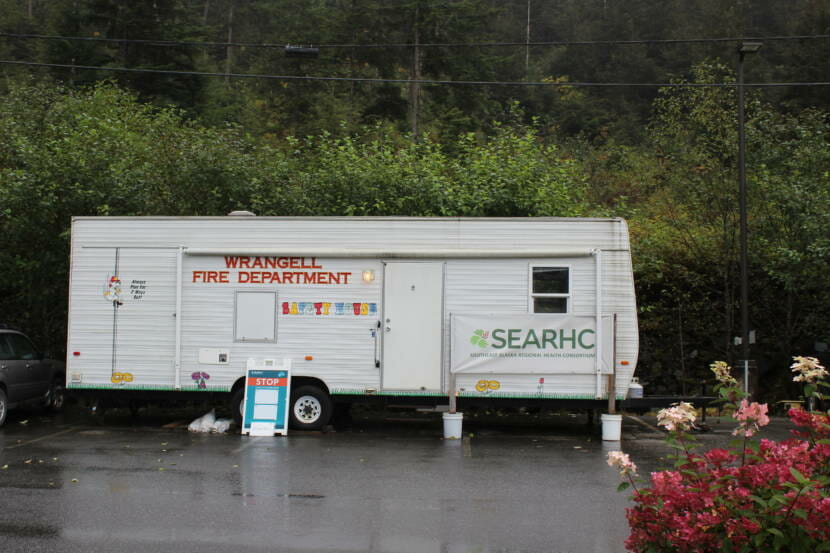
While community COVID-19 testing used to take place at the airport, it’s now run from SEARHC’s testing trailer from 12-4 p.m. Monday through Saturday. (Sage Smiley/KSTK)

In late September, Wrangell’s community COVID-19 test site moved from the airport to the hospital, a little over a mile away. But Wrangell’s local government mandates testing for unvaccinated people arriving in the community.

So the emergency operations center is looking to hire a greeter to help air passengers find their way to the testing site.

Borough Manager Lisa Von Bargen says the EOC developed the position “to be able to try to provide folks at the airport to assist with providing information, since the testing is no longer being held there, it’s up at the at the clinic, or to provide information, whether it be answering phones or wherever we may find we need an information greeter.”

That information could include telling arriving people about local mandates, where to test and access to COVID-19 vaccines.

The greeter would report to the local emergency operations manager and could provide information at the ferry terminal, harbors or other locations where people might be arriving.

And there could be more than one greeter working at a time.

“Likely this will be more than one person because you can’t have coverage [of] both flights seven days a week with just one person,” Von Bargen said. “So it may be two or three different people that are serving this need at different times.”

Wrangell’s assembly approved the position, with Jim DeBord as the only ‘no’ vote. DeBord did not explain his opposition.

The position will earn the same hourly wage as a city clerical position, just over $15 per hour. The position does not include benefits.

Von Bargen says the city will pay for the positions through an unspent $125,000 grant from the state meant to help boost local COVID-19 testing and vaccinations.

The position is expected to last through at least the end of the year, when Wrangell’s testing mandates are slated to expire. Unless renewed, the state’s contract for cost-free COVID testing for incoming travelers will expire then as well.

A city survey on Juneau tourism issues wraps Friday. Then what?

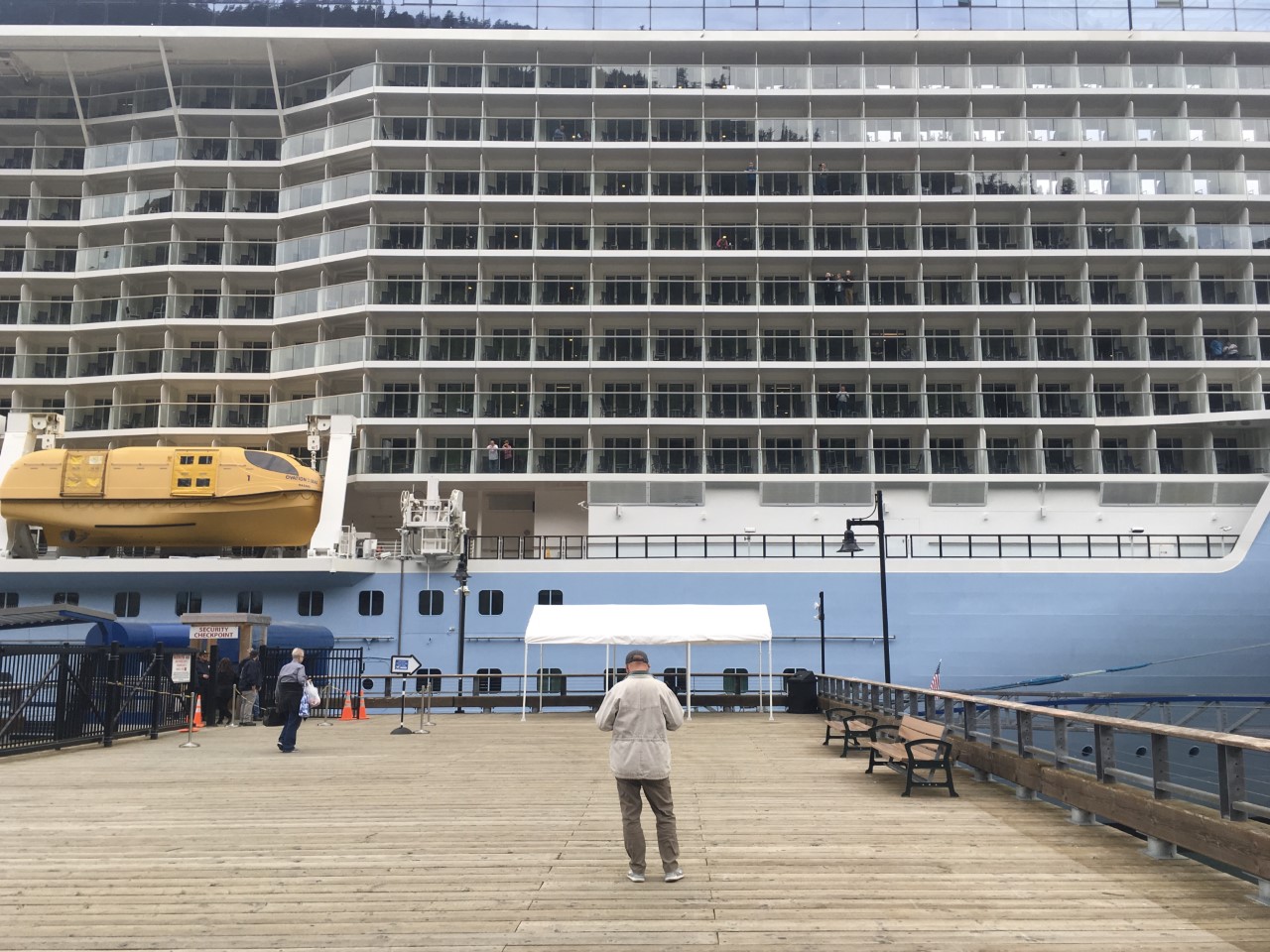
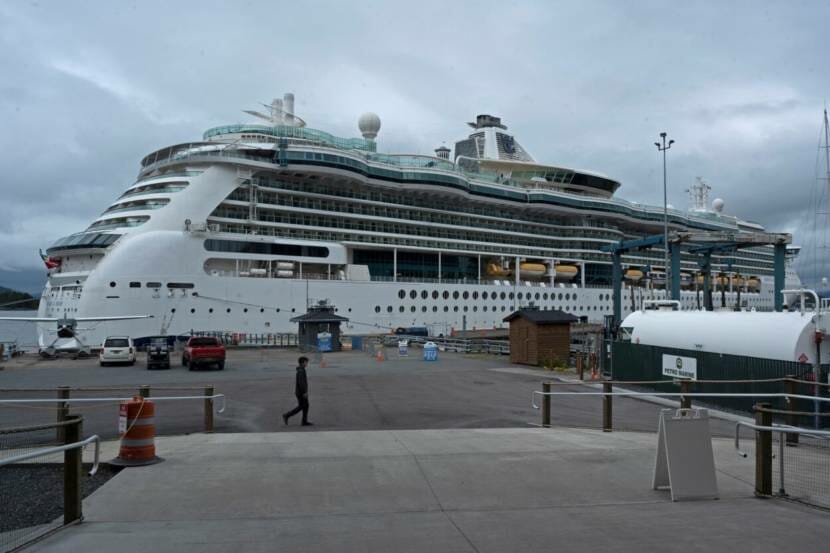
A passenger stands on the dock in Juneau near the Ovation of the Seas cruise ship on May 19, 2019. (Photo by Ryan Cunningham/KTOO)

Public opinion surveys on tourism in Juneau are wrapping up Friday and the results are likely to influence how local policymakers try to manage the visitor industry — big cruise ships especially.

Alex Pierce with the Juneau’s Community Development Department is working on the city’s Visitor Industry Task Force recommendations. This survey was one of them. She said the city used to do similar surveys more frequently in the 1990s and early 2000s.

“Recognizing that that data was really helpful for us, we resurrected the survey with the intent of some of the questions remaining the same so that we could compare data year over year,” she said.

Some of the holdover questions from older surveys are about people’s opinion on the industry’s impact on them. Overall, and in terms of crowding, vehicle congestion and noise.

The survey also asks fresh questions about hot-button cruise ship topics: possible limits on cruise ship traffic, Norwegian Cruise Line’s plan to develop a fifth large cruise ship berth. And, a possible ban on “hot-berthing” at the two big floating docks the city owns. Hot-berthing is when more than one ship uses a berth in a single day.

Pierce said the city paid McKinley Research about $34,000 to conduct the survey. Results should be released next month.

City officials could use survey results to back up decisions on Norwegian’s plan for a new dock. One leverage point has to do with an existing, long-term land-use plan that may not allow for Norwegian’s new dock. Pierce said after the survey results are out, city staff will draft changes to that plan for elected officials to consider.

Pierce said she’s also looking forward to the city manager’s office filling a new tourism manager position. The job posting went live recently and closes on Oct. 29.

“For whatever reason, we haven’t been as proactive as we could or probably should have been for the last decade and a half or so,” Pierce said. “So creating this position is really an effort to be more proactive and engaged in tourism management issues.”

The person is also expected to run with other visitor industry task force recommendations. Like taking a more active role in scheduling ship visits at city-owned docks, creating new rules for tour permits on city streets and sidewalks, and encouraging tour operators to stick to standards for environmental stewardship, sustainability and community impacts.

Alaska’s economic recovery lags behind most states

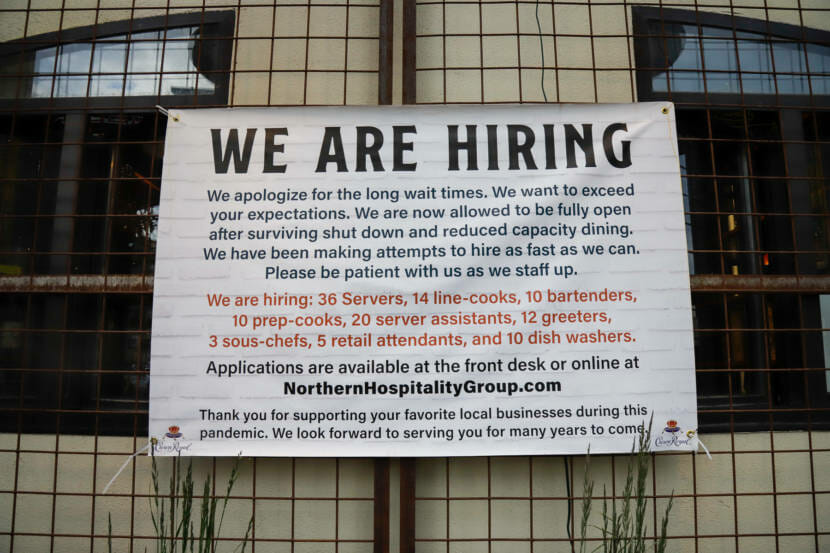
A sign outside 49th State Brewing in downtown Anchorage apologizes for long wait times and states, “We are hiring”. The wait to be seated on a Wednesday evening in July was roughly 1.5- to 2-hours, according to staff and patrons. (Jeff Chen/Alaska Public Media)

While the country continues to build back jobs after a sharp drop-off at the start of the pandemic, Alaska’s economic recovery is lagging behind most states, according to Dan Robinson, chief of research and analysis with the state labor department.

As of July, Alaska had made up less than half of its COVID-related job losses. The makeup of the state’s economy is an important factor, said Robinson. Many of the states struggling to recover jobs have large fossil fuel sectors.

“COVID hit the oil industry really hard and it’s been slow to bounce back,” he said. “It’s just barely in the last three or four months starting to bounce back. And it’s been a weak bounce.”

Tourism is another sector that has struggled to bounce back since 2020. Alaska and Hawaii share similarities there.

“It’s the specifics of Alaska and Hawaii’s tourism sectors,” Robinson said. “You have to fly, you have to spend a lot of money. For Alaska, cruise ship tourism is the obvious casualty, especially summer of 2020.”

The nationwide labor shortage has also impacted job growth in Alaska.

Job openings are at historic highs right now and Robinson said data is still being collected as to why that is. Some economists speculate that people may not be rushing to return to jobs in retail and hospitality with the extra constraints of working in a pandemic.

“And then, it’s a little frou-frou, but there’s a lot of talk about workers, partly because of COVID, wanting more meaning from their work,” Robinson said.

He said a lack of affordable child care may also be at play for working parents weighing whether to return to work.

Robinson said he doesn’t think the labor shortage is going to be a long-term drag on the state’s economy, but it does mean that employers may have to respond with higher wages and better benefits, at least in the short term.

The rise of the highly-contagious delta variant of the coronavirus has also thrown even more uncertainty into Alaska’s economic future. But Robinson said it’s too soon to tell how the largest surge of the pandemic could impact the state’s lagging recovery.

Petersburg group raises money for long-term upkeep of historic Southeast lighthouse

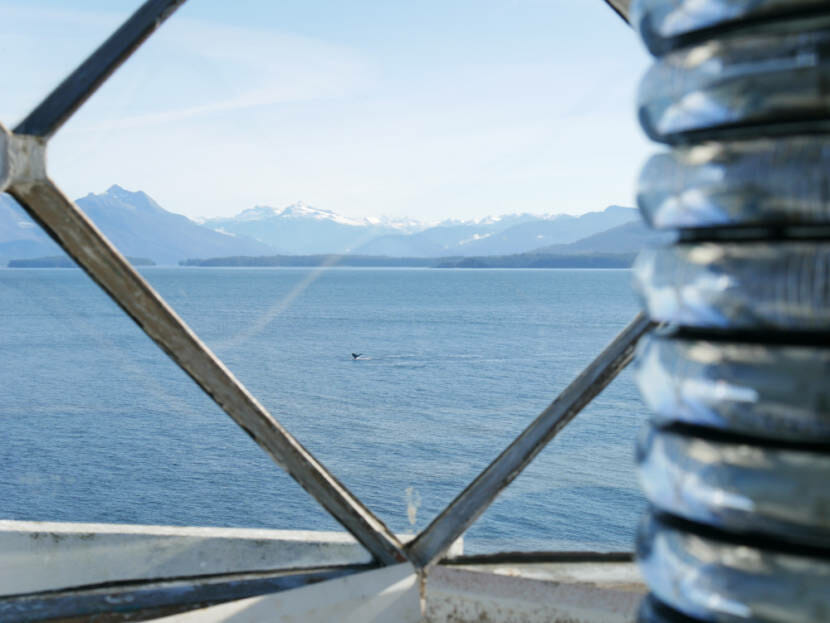
Humpback whales are a common sight from the light at Five Finger. (Joe Viechnicki/KFSK)

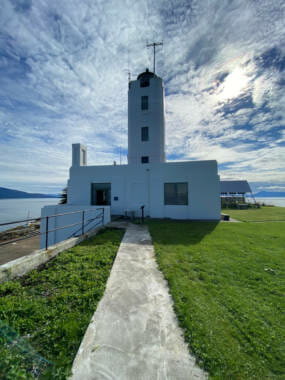
It’s a rare blue sky day in between autumn storms of mid-September at Five Finger Lighthouse. A little over 40 miles north of Petersburg, the light endures on a windswept, salt-sprayed rock on the inside passage where Stephen’s Passage meets Frederick Sound. Humpback whales feed offshore, fattening up for the long trip to Hawaii while sandhill cranes have already started their migration south.

Today those aren’t only sounds on the island.

A side view of the historic 1935 building (Joe Viechnicki/KFSK)

A work party for the Five Finger Lighthouse Society tackles a list of projects, winterizing the building, draining pipes, putting away equipment and buttoning up windows and doors. Interpretive signs along the trails of the small island are stowed away until next year.

The society has assumed ownership and maintenance of the light. For years, a Juneau-based organization did that work. Now this group of Petersburg residents is putting more shingles on a new roof for the boathouse. The old one blew off last winter. They’re also getting a troublesome generator to run.

“It looks pretty good. The roof project still has a ways to go,” said Josef Quitslund, one of the volunteers. He’s been multiple times to the remote spot.

“Well it’s hard to get here,” Quitslund said. “I’ve only been here on calm days but the really cool thing about it is it’s right in the middle of everything. You know there’s so much life going on around here with whale swimming right along shore and seals and birds all over the place. It has its own unique little biosphere of critters out here.”

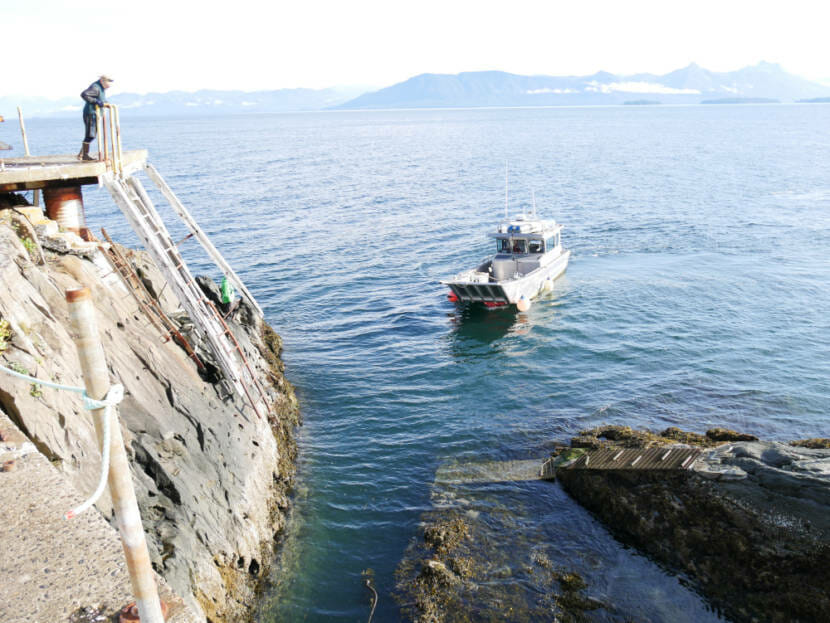
Besides being far from other places, the island is a difficult place to get ashore. Anchoring nearby is difficult. There are a few spots to tie boats up to the rock when the tides and waves cooperate. There’s a rusting ladder up steep rock and rock stairs to an access ramp.

A lighthouse society work party ties up for the day at Five Finger. (Joe Viechnicki/KFSK)

“You can see too there’s been efforts to be able to increase the safety as far as access,” said Eric Castro, a board member of the society. “That’s one of the major challenges that still exists really is accessing the island. So even though there are hundreds of people that pass by, that transit by this island, getting onto the island is one of the major obstacles.”

Names of the last Coast Guard crew to live at the light year-round. (Joe Viechnicki/KFSK)

The lighthouse building dates back to 1935, built in the art deco style. It replaced one completed in 1902 that burned to the ground in 1933. The light’s automated now. The last year-round Coast Guard crew to live there left their names in the basement of the building in 1984.

It’s peaceful out here between storms. But the evidence of the harsh conditions is everywhere. The salt air has rusted a horseshoe on the shop building nearly away. Inside the light itself someone’s built a system of indoor gutters to move the constant rain.

Board member Karen Dillman says there’s been a lighthouse keeper onsite for part of the past two summers, and the group has someone lined up for part of next year as well. She’s hoping a local fund raising effort will help the society land some grant money.

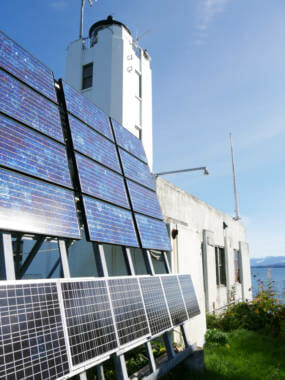
“I think that’s the main goal is really just tapping into some other grants too that really like catapult the whole process into a whole other realm, just because of the power situation, the solar polar, the access, those are big ticket items, if you want to have more people show up and use it as a retreat,” Dillman said.

Lighthouse keepers welcome visitors on passing boats while the structure is open, usually at least part of the time between May and September. The light has also housed whale research and even yoga sessions for cruise ship passengers.

Solar panels help power the light. (Joe Viechnicki/KFSK)

The owners hope it could be a destination again.

“You know you have to have the right person, right group of people who can come out here with the knowledge they might be left out here for a week or more at a time due to inclement weather and just the inability to be able to make it off the island. So it takes a certain kind of grit,” Castro said.

“Grit and flexibility, right?,” Dillman adds. “You don’t want to have a plane to catch tomorrow and come out here the day before or something because that could change,” she said.

Besides fixing things that break, the society has a list of things that would make the island more livable, like a new bank of batteries to store power from solar panels and a better access ramp.

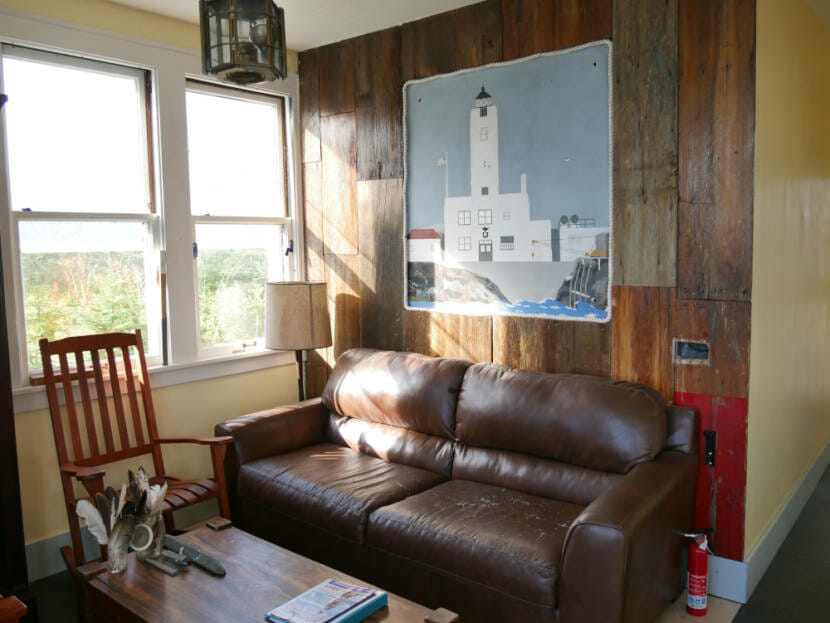
The living room with a painting of the light discovered during former renovations. (Joe Viechnicki/KFSK)

The society has solicited donations from artists and they have an online auction underway. The society has canceled its in-person auction because of COVID cases. The online auction now has a closing date of Oct. 31. The art works will be on display at the Clausen Museum Oct. 4-15.

Sen. Murkowski aims for ‘a permanent fix’ to the old law that halted Alaska cruises

The Serenade of the Seas in Sitka on July 21, 2021, the first port call of the curtailed 2021 cruise season. (Tash Kimmell/KCAW)

Sen. Lisa Murkowski has introduced a bill to permanently waive a requirement for Alaska-bound cruise ships to stop in Canada.

Murkowski unveiled the bill at the annual meeting of the Southeast Conference in Haines this month. She argued that the century-old Passenger Vessel Services Act proved unintentionally harmful to the Alaskan economy during the coronavirus pandemic.

Murkowski is calling her bill “The Cruising for Alaska’s Workforce Act,” but if you’re hoping to read it, you’re better off searching for “A bill to permit under certain conditions the transportation of passengers between the State of Alaska and other United States ports on vessels not qualified to engage in the coastwise trade that transport more than 1,000 passengers, and for other purposes.”

Or you could look for Senate Bill S.2818.

If it sounds like Sen. Murkowski is attempting to thread the needle with that title, she is. The Passenger Vessel Services Act was originally passed in 1886 as a way to protect the U.S. shipbuilding industry.

The requirement that foreign-flagged vessels originate or stop in a foreign port before engaging in “the coastwise trade” made sense at the time, and it hasn’t been much of a barrier to the Alaska cruise industry — until 2020, when Canada closed its ports to large cruise ships.

“What we discovered was that when the pandemic hit, this was a law that protected Canada at the expense of the Alaskan economy,” Murkowski said.

To be fair, the U.S. Centers for Disease Control also imposed severe limitations on cruising in 2020 that effectively eliminated the Alaska cruise season that year. But in 2021, as COVID-19 vaccines became available, the Alaska cruise industry began to look viable, at least for the second half of the summer. Sens. Murkowski and Sullivan, and Congressman Don Young pushed for, and won, passage of a temporary waiver of the PVSA to allow ships to come to Alaska without that critical stop in Canada.

S.2818 is intended to make that permanent.

“I think we have learned that we never want to be in a situation like this again, where the Alaskan economy is really held back by a law that is benefiting another country,” said Murkowski. “So we’ve been working to try to find a permanent fix.”

Congress moves slowly, though, and what was urgent legislation this spring may be on a slower track now.

Robert Venables is the director of the Southeast Conference. He says the Alaska cruise season could be looking at a full comeback next year, and the bill probably won’t pass overnight.

“I’m not sure if this piece of legislation will rise above other priorities that exist,” he said. “But I’m always hopeful, always appreciative, always supportive, but it may take a while.”

Venables observes that any legislation in the U.S. Senate is “interwoven into a labyrinth of other legislation and personal relationships across the floor,” but he thinks Murkowski’s bill is a common sense solution for a real problem.

And he doesn’t think that lifting the requirement that ships stop in Canada means that they won’t stop there.

“In a free market global economy, you want every port to put their best case forward, and I think the Canadian stops are great added value,” Venables said. “But they shouldn’t be able to totally obliterate Alaska’s economy because they need to make their own decisions about closing their borders.”

S.2818, the “Cruising for Alaska’s Workforce Act,” was introduced in the U.S. Senate on September 23. It was referred to the Committee on Commerce, Science, and Transportation.

Site notifications
Update notification options
Subscribe to notifications