University of Alaska

Juneau schools, UAS closed due to dangerous weather

Harborview Elementary School on Monday, Jan. 10. Schools were closed for the day and other services were canceled due to hazardous weather and slippery road conditions. (Photo by Bridget Dowd/KTOO)

Update — Monday, Jan. 10, 2:50 p.m.

Juneau schools and district offices will be closed again on Tuesday because of hazardous roads and sidewalks. One school, Riverbend Elementary, will also be closed Wednesday because of a burst pipe that caused flooding in the school.

Crews at Riverbend will be cleaning up and repairing the damage. The elementary school will contact families about its plans for reopening.

After-school programs are canceled for all students and employees. The school district says there will be no online classes during the closure.

Original story — Sunday, Jan. 9, 5:46 p.m.

Juneau School District schools and offices are closed Monday for all students and staff because of hazardous weather in the city. After-school programs and activities are also canceled.

Monday was supposed to be Juneau students’ first day back from winter break. The district’s chief of staff said in an email that classes will not move online during the closure.

University of Alaska Southeast also closed buildings Monday following the school district’s announcement. There will be some university services available through phone and email. According to an email from the university, employees are encouraged to work remotely.

The university sent automated messages to students who are taking classes online saying they should check Blackboard to see if they have class on Monday.

Ed Rasmuson remembered for dispersing wealth to support Alaska and its people

“”
Ed Rasmuson at the Rasmuson Wing of the Anchorage Museum in 2020. (Kyle Seago/Magnetic North via Rasmuson Foundation)

Alaska lost a champion and a colossal philanthropist when retired banker Ed Rasmuson died Tuesday at age 81.

Friends and leaders around the state remembered him as an unflashy guy who was fiercely dedicated to Alaska. Through the Rasmuson Foundation, which he chaired, he devoted himself to giving away the family wealth to support the University of Alaska, the Anchorage Museum, countless non-profits and individual Alaskans.

Rasmuson’s daughter, state Sen. Natasha von Imhof, has served on the foundation board since 2005, but she says she really learned her dad’s values around the campfire, at the family cabin in the Mat-Su. That’s where Rasmuson instilled in her the importance of philanthropy focused on building up Alaska.

“And it’s always long-term,” she recalled her father telling her. “You gotta think about, not just two years, not just two decades, but two generations.”

Rasmuson committed the family foundation to helping Alaskans meet basic needs for shelter, safety and education, and also to fostering arts and culture.

In a 2019 interview, he said the state needs a full range of educational opportunities, as he sought for himself when he left to study at Harvard College.

“I knew I was going to go into banking but I told my dad I didn’t want to just study economics,” he said. “I wanted to go into history and literature and music, which I did. And I never regretted it. I have more of a broad base to myself than just money and banking.”

Rasmuson was born in 1940, to Elmer and Lile Rasmuson. He was destined to join the family business — National Bank of Alaska — and he became chairman of the board. In 2000, he orchestrated the bank’s sale to Wells Fargo for $907 million.

The sale helped fuel the Rasmuson Foundation, which became the largest private philanthropy in Alaska. Since its founding in 1955, it has made charitable contributions totalling more than $475 million, according to the foundation.

Rasmuson was a political conservative who supported the 2018 election of Gov. Mike Dunleavy, but he regretted that support the next year, when Dunleavy proposed deep budget cuts, particularly to the University of Alaska. At the time, Rasmuson said the foundation was distributing more than half a million dollars a week, investing in projects across Alaska.

“We’re basically very committed to our state and I don’t like to see it torn down,” he told Alaska Public Media’s Casey Grove in 2019. “My father used to say, ‘You can’t build a state with a hatchet.’ And that’s what we’re doing. We’re building it with a hatchet right now, and that’s wrong. Absolutely wrong.”

Dr. Tom Nighswander lived next door to Rasmuson in East Anchorage for nearly 30 years, when they were both raising children. Nighswander said they were daily running partners.

“When you run with a guy every morning for 26 years, you kind of know what they even dream about,” Nighswander said. “So we are actually quite close.”

Their friendship flourished despite the political chasm between them — Nighswander on the left, and Rasmuson on the right. Nighswander says they were both content to respect their differences.

Rasmuson, who was awarded a medal from the pope last year, was an active member of Anchorage First Presbyterian Church.

“He said grace with every meal and read the Bible every day,” Nighswander said. “And I think some of his orientation, and his ethic, is really a lot from the New Testament.”

One of Rasmuson’s causes was the Anchorage Museum, which owes a lot of its footprint to the Rasmuson Foundation.

“He didn’t want us to lose our own culture and history,” said Museum Director Julie Decker. He believed “that those shouldn’t be exported outside the state, that we had to figure out ways to hold on to, not just objects, but our own story, our own narratives. That those were ours to hold.”

Decker thinks she probably owes her career to him, because when she was 19 she wrote Rasmuson a letter. She knew him as a banker who supported the museum.

“I wrote, I’m sure, a very naive note saying, ‘I’m a college student interested in museum studies and art and would like to do an internship in my hometown,’” she recalled.

She never got a reply letter. Rasmuson answered in banker style: He sent a check so that the Anchorage Museum could hire her as an intern.

“I think it transformed my life,” Decker said. “I don’t think that’s an exaggeration.”

Outside of the foundation, Ed and his wife, Cathy, were generous in less visible ways. Nighswander said they’ve quietly provided help to non-profits and families in need.

Rasmuson died at home of brain cancer after a year of treatment.

“It was a very peaceful passing,” Von Imhof said. “My mom, my husband and I were all holding his hands and we just watched him fade away.”


University of Alaska students sue to protect fund for scholarships, medical education

The University of Alaska Anchorage campus on Dec. 30, 2021. Four students sued on Tuesday, seeking to maintain a fund that pays for scholarships. Two attend the Fairbanks campus, one attends UAA and one is a medical student. (Lyndsey Brollini/KTOO)

Four University of Alaska students are suing the state government in an attempt to maintain a fund that pays for scholarships. 

The Alaska Higher Education Investment Fund has been under threat of being emptied of more than $400 million as a result of legislative budget fights. It pays for Alaska Performance Scholarships, need-based Alaska Education Grants and the state program for medical students, WWAMI.

Riley von Borstel of Seward is one of the students who sued. She’s the student body president at the University of Alaska Fairbanks. She said the scholarships are essential for her and other students. 

“If this funding weren’t available to students anymore, I think the University of Alaska System would see a significant decline in enrollment amongst Alaskan students,” she said. “I think many of them would decide not to attend school in Alaska if this funding weren’t available.”

Students Madilyn Short, Jay-Mark Pascua, Kjrsten Schindler and von Borstel filed the lawsuit on Tuesday against Gov. Mike Dunleavy, the Office of Management and Budget and the Department of Administration.

According to the Dunleavy administration, the money in the fund must be swept into state savings account if three-quarters of each legislative chamber doesn’t vote each year to maintain the funding. And this vote failed last year. 

Another lawsuit, filed by the Alaska Federation of Natives and 17 other plaintiffs, successfully protected the Power Cost Equalization Endowment Fund, which also has been threatened by the legislative disputes. That fund pays to lower the cost of electricity in high-cost rural areas. 

In the new lawsuit, lawyers for both sides jointly asked that a judge hear arguments in the case quickly and issue a ruling by Feb. 22, leaving time for an appeal and for the Legislature to take the ruling into account in the budget. 

Dunleavy said in a statement that he supports funding the scholarships. 

University of Alaska Interim President Pat Pitney wrote in a letter to students that the university supports the lawsuit. 


In undersea recordings, Alaska’s killer whales have a lot to say

The fins and heads of a pod of orcas visible above the water.
The population of endangered southern resident killer whales has dwindled to 76 individuals. (Courtesy Holly Fearnbach/NOAA)

A University of Alaska Fairbanks researcher who listens to killer whales using underwater microphones has learned some interesting things about the creatures.

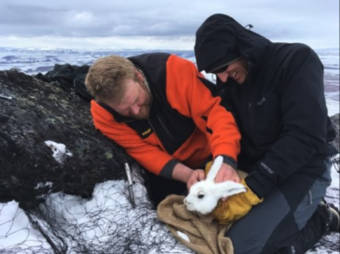
Hannah Myers is a Ph.D. marine biology student with UAF’s College of Fisheries and Ocean Sciences. A recent paper Myers co-authored in the journal Scientific Reports delves into the mysteries of where North Pacific killer whales spend their time in winter and which of their undersea calls originate from which pods or ecotypes, which are like subspecies.

Myers says the most abundant of the three main ecotypes living in the waters off Alaska’s coasts are the resident killer whales, which vocalize distinct, repeated calls that can be used to identify them.

Listen here:

The following transcript has been lightly edited for clarity.

Hannah Myers: So when I hear a particular call in a recording, and it’s a resident killer whale, I often know which family group is present or which pod is present. So, obviously, it’s pretty tough to do winter fieldwork on the water in Alaska due to, you know, really nasty weather, limited daylight hours. And so we only had data from May to October. And that’s where this acoustic study was really something brand new.

So questions that we had: Where can we find the whales in the winter? What might they be doing there? Is it the same whales? Is it somebody different? Things like that.

Casey Grove: So hydrophones, I mean, describe the process to me of actually going and using those. You have to take them out, drop them down, you said, and then you have to go pick them back up, right?

Hannah Myers: Yeah, we do. And it’s always kind of an exciting and nerve-racking process. We put them on an anchor and drop them overboard and then come back to our GPS points a year later, and we actually grapple for them — so drop out a hook over the side of the boat and try and pick up the line connected to the hydrophone and bring it back up. And we’ve actually had pretty remarkable success doing that in over 100 feet of water.

It’s always an exciting and relieving feeling when that line comes over, and the hydrophone comes up with it covered in, you know, all kinds of algae and weird invertebrates growing on it close to the sea floor over the course of a year. But yeah, scrape those off, get her cleaned up and open it up and take the the memory cards out and replace the batteries and drop it back down.

Casey Grove: That almost sounds like “Deadliest Catch” to me or something with the hook. So, you extract this audio from the hydrophone, and we actually have a clip of some of that I’m going to play right now.

Killer whales: (whale calls)

Hannah Myers: What we’re hearing there is the 8016 pod. And that’s a group of 13 whales, resident fish-eating whales. And in that group we have a grandmother and her three brothers, her three adult daughters, adult son and then her daughter’s offspring. So resident killer whales are thought to be unique among mammals, in that both their female and male offspring stay with the mothers for life. And so in this recording, you can hear sort of the two main call types that are part of that 8016 dialect that I mentioned. We sort of have nicknames for the different calls. So in that recording, you heard the “hey” call, and then the three-tone call. And whenever I hear those, I know that the 8016s are present.

Casey Grove: So they’re literally saying, “hey,” in at least one of those calls?

Hannah Myers: Well, I wish I knew what the whales were actually saying to one another, but I don’t, that’s just what we’d nickname it, because it almost sounds like someone yelling, “Hey!” But yeah, I mean, it’s thought that these unique dialects are probably useful for group identification for the whales, since they have this really important social structure. We sometimes compare it to if you were running around shouting your last name sort of.

Casey Grove: “Myers! Myers!”

Hannah Myers: Exactly.

Casey Grove: We all do that at family gatherings from time to time. That’s super interesting. And what about your research, what results surprised you the most?

Hannah Myers: Yeah, there were a few things that surprised me about this work. So we dropped the hydrophones in areas where this long-term monitoring had showed the killer whales could be found pretty reliably during summer months. But, like I said, we really had no idea if they were going to be there in winter or not. We just didn’t know where they were going to be.

And we found really high use throughout the winter in some areas, and especially Montague Strait, which is the western entrance to Prince William Sound. So on some winter months, we were hearing killer whales, you know, nine out of 10 days, which was really surprising because a lot of the time when we document whales in a given area, there’s a clear correlate with that, like a chinook salmon run that we would expect them to be interested in, you know, being in that area to eat that salmon. But obviously that’s not happening in winter. So it’s a big mystery, you know, what it is that they’re out there for at that time.

And then another thing that was pretty exciting about this study is recording the mammal-eating killer whales as much as we did. They, on average, are a lot quieter than the fish-eating killer whales because their prey can hear them, so they can’t really afford to be vocalizing a lot. That being said, we did record them.

We have the Gulf of Alaska transients, and this is thought to be over 100 — possibly several 100 — animals, but we didn’t really have good recordings of them that we could use to identify them on the hydrophones. And so we were hearing this group of calls on the hydrophones pretty consistently, one of them we nicknamed the “rooster call” because it sounded exactly like a rooster crowing. And it was sort of this mystery, like, who’s making these calls? And a researcher we collaborate with, she actually recorded a group of Gulf Alaska transient killer whales in Kachemak Bay in August 2020 and photo-identified them and got this really amazing recording that included those calls. That was a really exciting part of the study, solving the rooster mystery.

University of Alaska Southeast employees aren’t federally required to get COVID-19 vaccine yet

Photo of the UAS sign in Juneau
The main University of Alaska Southeast campus is located near Auke Bay in Juneau. (Photo by Bridget Dowd /KTOO).

Thousands of employees of the University of Alaska system are required to be vaccinated against COVID-19 under federal contract requirements; but currently, no University of Alaska Southeast employees fall into that category. 

Michael Ciri, UAS Vice Chancellor for Administration, coordinates the pandemic response for the Juneau-based campus.  He said it’s a moving target to figure out which university employees fall under the federal requirements. 

But UAS doesn’t have any federal contracts over $250,000 — the cutoff for when COVID-19 vaccination requirements kick in. Ciri said he doesn’t expect that to change soon. 

But on Thursday, the Biden administration rolled out different vaccine requirements covering more than 100 million workers nationwide. Ciri said it’s not yet clear what those new rules will mean for UAS employees.

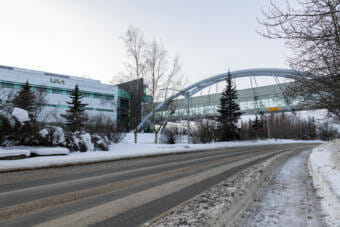
There are university system employees in Juneau who will have to be vaccinated under the federal contracting guidelines. Ciri said employees of the University of Alaska Fairbanks who work at the Lena Point fisheries Facility in Juneau will have to be vaccinated against COVID-19. 

The University of Alaska Fairbanks expects more than 2,000 university employees will be required to be vaccinated against COVID-19 under federal contract requirements.

The university announced Tuesday that about 750 employees directly paid with federal contract funds would fall under the vaccine mandate, but it also covers those who support them or work near them.

Spokesperson Marmian Grimes said UAF has 3,100 employees, and as of Wednesday, more than 1,300 said they are already vaccinated.  

A mix of ongoing and new UAF federal contracts totaling $300 million include the employee vaccination requirement. 

The compliance deadline is Dec. 8.

2,000 University of Alaska Fairbanks employees must get their COVID vaccines due to federal funding

The University of Alaska Fairbanks campus
The University of Alaska Fairbanks campus. (University of Alaska photo)

A large group of University of Alaska Fairbanks employees must get their COVID-19 vaccines by Dec. 8 due to federal contract requirements. University of Alaska interim President Pat Pitney announced the mandate Tuesday, citing $300 million in recently renewed, or soon-to-be signed federal contracts.

“With the federal contract provisions that require vaccinations,” Pitney told reporters during an online news conference on Tuesday.

Pitney said the federal contract vaccination requirement applies to a large but defined set of employees estimated to total 2,000. The group includes anyone paid by a federal contact — estimated at more than 750 UAF and UA employees. Plus, it includes “anyone who supports them or works near them,” Pitney said.

The federal contract employee vaccine mandate is in addition to existing UAF vaccination requirements for students living in dorms, those in certain classes where social distancing isn’t practical and student athletes.

Noting that while medical and religious exemptions will continue to be offered, UAF Chancellor Dan White said employees covered by the federal contract vaccine requirement must comply to keep their jobs.

“With respect to what happens on Dec. 8 or soon thereafter, this vaccine requirement becomes a condition of employment,” he said.

White said he’s already received some feedback.

“There have been different opinions expressed, but the majority have been support,” he said.

Alaska is challenging federal vaccination mandates and Gov. Mike Dunleavy issued an administrative order Tuesday defending Alaska from “federal government overreach.” President Pitney said the university does not fall under the order because it is not a state agency, adding that it voluntarily chose to sign the contracts.

“We’ve chosen to protect the jobs of more than 750 individuals and to protect the research mission and in some sense the economy of the state,” she said.

Pitney said she supports state efforts challenging the scope of Biden administration vaccination mandates.

Editor’s note: This story has been updated to clarify how many university employees the vaccine mandate impacts. It applies to about 2,000 workers — not about 750 — after accounting for those who work with and near staff directly paid through federal grants.

Site notifications
Update notification options
Subscribe to notifications