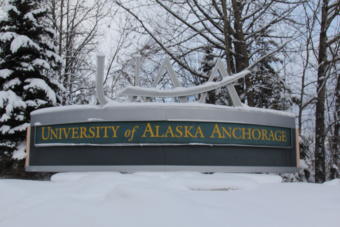
The University of Alaska Fairbanks campus. (University of Alaska photo)
University of Alaska interim president Pat Pitney has turned down a request from University of Alaska Fairbanks Chancellor Dan White to implement a COVID-19 vaccine requirement for all Fairbanks-based faculty, staff and students.
During a call with reporters on Monday, Pitney pointed to practical, legal and health requirements that weighed in the decision.
“The practical application of going with a broad mandate at only one of the universities when we’re a single employer was both, from a practical standpoint and a legal standpoint, a little bit different,” she said. “And from a health standpoint was really not differentiable.”
Pitney said an existing system-wide mask mandate and targeted vaccination requirements for some groups at individual campuses, including those living in dorms, are proving effective.
White said that the broader vaccination mandate was sought by UAF faculty, staff and student organizations. They asked Pitney to approve it earlier this month, with a Jan. 1 start date.
“The federal OSHA mandate we’re anticipating sooner than later, with an expectation of implementation on Jan. 1,” she said.
Pitney said the federal mandate will apply to the university system because it has federal contracts. She said that all campuses could also be subject to a potential U.S. Department of Education COVID-19 vaccination requirement.
Pitney said she supports vaccination regardless of mandates.
“I encourage that from a health perspective,” she said.
White said earlier-approved UAF vaccination requirements for students in dorms, student athletes and some classes remain in place. The university will also consider additional vaccine requirement requests on a case-by-case basis.
“We have scuba diving classes, for example, that require that you share a respirator, and those kinds of situations we’ve already approved,” he said. “It’s my expectation that over the last two weeks there’s been a number of other requests that have been kind of waiting for President Pitney’s response. So I do expect to get more vaccine requirement requests, and we’ll look at those on a case-by-case basis.”
White said about half of UAF faculty have said they’re vaccinated against COVID-19, with lesser percentages for staff and students. As of Monday, UAF said it knew of 446 COVID cases among students, employees and contractors at all of its locations since March 2020.
A group of students gather to observe Fairbanks Transit Bus 142 at the Engineering, Learning and Innovation Facility Wednesday, Oct. 6, 2021 at the Fairbanks campus. (JR Ancheta/UAF)
The University of Alaska Fairbanks has moved the “Into the Wild” bus to a UAF engineering building lab for repairs.
Originally dragged into the wilderness for a road-building camp along the Stampede Trail, the 1940’s Fairbanks public transit bus is where young adventurer Christopher McCandless lived and starved to death in 1992. His story was popularized by the book and movie, “Into the Wild.”
An Army National Guard Chinook helicopter carries the dilapidated Fairbanks bus away from its former resting place near the Teklanika River, close to Denali National Park. (Alaska National Guard)
Senior Collections Manager Angela Linn, who is leading the bus project, says the UAF Engineering Building’s high bay lab is an ideal facility to begin preparing the bus for display.
“It’s dry, it’s warm, it’s safe there. It’s kind of the best possible solution on the campus for doing this next phase,” she said.
Linn says the bus project involves materials science as well as structural engineering, so it will provide learning opportunities for students.
“Understanding the structural elements of objects and how they degrade over time and what can we do to slow that degradation process down,” Linn said. “It’s a great educational opportunity.”
She says the first project is to thoroughly photograph and 3D-scan the bus for both documentation purposes and potential development of a virtual tour, which could have an “augmented reality component.”
“You could place yourself in the bus back on the Stampede Trail,” Linn said.
A team of about 25 people are helping guide the broader bus project. Linn says the future exhibit will be about the bus’s entire history, not just Christopher McCandless’s story.
Bus 142 is lowered at the Engineering, Learning and Innovation Facility’s high bay structural lab for preservation Wednesday, Oct. 6, 2021 at the Troth Yeddha’ campus. (JR Ancheta/UAF)
As far as readying the actual bus for eventual permanent outdoor exhibition, Linn the plan is to stabilize its condition and make it safe. The bus has rust holes, broken windows, and worse.
“There’s big holes in the ceiling and in the floor from when they helicoptered it out,” she said
Linn says a cost estimate for the project is still being developed.
“It’s gonna be a big number, though, for sure,” she said.
Linn says the museum plans to raise money for the bus repairs and exhibit development through a mix of sponsorships, crowd funding and grants.
In the meantime, the public can view the bus inside the UAF Engineering Building on weekdays from 8 a.m. to 8 p.m. through large windows overlooking the high bay lab. The museum says it also plans to install a webcam so the public can watch the conservation work online.
The R/V Sikuliaq, owned by the National Science Foundation and operated by the University of Alaska Fairbanks. (courtesy of Mark Teckenbrock/University of Alaska)
The research ship Sikuliaq is wrapping up a marine geology expedition this week. The nearly 2-month long journey took the ice capable ship — which is owned by the National Science Foundation and operated bu the University of Alaska Fairbanks — over 500 miles north of Utqiagvik.
That’s the farthest north the Sikuliaq ever been.
“Where we were up in the northern Chukchi, we were breaking new ground,” said UAF Geophysical Institute professor Bernard Coakley, speaking from the Sikuliaq by satellite phone.
Coakley and colleagues have used an array of technology to survey the ocean floor of the Canada Basin and adjacent Chukchi Borderlands. Coakley says the features they observed included channels in the sea bottom.
“Where the gouges are parallel, we call them mega-scale glacial lineations,” he said. “They’re evidence that a continental glacier once scraped across the top.”
Coakley says other features, like random plow marks made by icebergs and piles of sediment created by now inactive faults, can help us better understand the ocean area’s formation.
“I like to say we’ve been working backwards in the Arctic, where we stand on the edges and make our observations, and then we say ‘well, therefore, the ocean is this,’” Coakley said. “But I think the real answer to the question of how the ocean formed is to be found by looking at the features.”
Coakley says surveying the seafloor has practical implications for things like mineral exploration and defining the extent of U.S. territory in the Arctic, but there’s also the pure intellectual pursuit.
“We want to know, we want to understand. That’s what drives me,” he said.
Coakley and fellow UAF researchers are scheduled to disembark from the Sikuliaq in Nome and be back in Fairbanks this week.
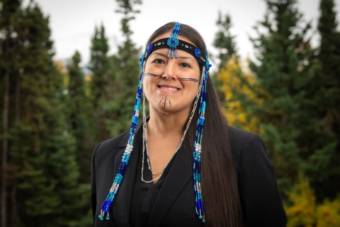
Elizabeth Mik’ Lindley is one of the students in UAF’s Tamamta program, which brings together Indigenous and Western sciences to transform graduate education and research in fisheries and marine sciences. (courtesy of Elizabeth Mik’ Lindley)
A program focused on bridging the gap between Indigenous knowledge and Western science is entering its second year at the University of Alaska Fairbanks.
It’s called Tamamta, a Yup’ik and Sugpiaq word that means “all of us” or “we,” and it’s part of UAF’s School of Fisheries.
Fisheries professor Courtney Carothers is the faculty member in charge. She says the nine Indigenous graduate students starting their fellowships this year are from all over Alaska, but they’re united by a common goal.
Listen here:
The following transcript has been lightly edited for clarity.
Courtney Carothers: The clear message coming out of a lot of different projects was that there’s this sense that the kind of persistent deep inequities that Alaska Native people are facing in fisheries, education, research, governance systems is pronounced.
There’s this real lack of Indigenous people, Indigenous values, Indigenous knowledge systems included in how we teach and research and govern fisheries in Alaska. And we feel like that’s a real gap and problem. And so we can sort of do our fisheries and marine work in a different way, really trying to elevate Indigenous knowledge systems that are in Alaska — 14,000-plus years deep, to really be used alongside Western science in these systems.
Casey Grove: There really is a lot of knowledge there. What does it mean to include Indigenous knowledge and science? What does that look like?
Courtney Carothers: We really try to advocate against including Indigenous knowledge in Western science and more moving to recognize that Western science is its own knowledge system — it’s a knowledge system, kind of with European worldview and values, norms, assumptions. And recognizing that Indigenous knowledge systems are diverse, but equally valid and they’re based on different worldviews and values and norms and assumptions. So they’re distinct. And so we really try to elevate and recognize Indigenous knowledge systems as their own intact knowledge systems. They don’t need to be validated with Western science. I think sometimes in Western education and resource governance and management, Western science is thought of as the only system or that it’s universal — that everyone shares the same worldview and ways of thinking. And, of course, in Alaska, that’s not true. And we think it’s for the betterment of all to use multiple ways of knowing in our research and in our education and in our governance systems.
Casey Grove: If we were talking about a research paper or a project, what specifically, if there was an example, would be different?
Courtney Carothers: So I think some of the really core features in many Indigenous knowledge systems are core values around respect and reciprocity, relationships and even really fundamental assumptions. You know, in the case of fisheries, in the Western worldview, fish are a resource, right? They’re a natural resource. We think about them to make money or maybe for food.
But in the Indigenous worldview, fish are non-human kin. They’re a relation. They’re a being with as much agency, with as much intentionality as people. And so they deserve respect in the same way that people do.
And so, if research was done from an Indigenous knowledge system with regard to fish it would be really different by design than a Western project that might think about counting fish, extrapolating the returns of fish. In an Indigenous context, the whole nature of what we’re studying, how we study it, why we’re studying it, might look really different. And so it’s hard to bring those two knowledge systems based on really different understandings of the world together, but it’s being done in really unique and interesting ways.
Casey Grove: The students are all graduate students, but they’re from all different parts of the state. I wonder, could you tell me about two or three of them?
Courtney Carothers: Yeah, most of the fellows in our cohort are first-year graduate students this year, like you said, from all over the state.
Tazia Wagner, is Ts’msyen, Lingít, Haida and Athabascan student based in Metlakatla. And so she just graduated with her BA in fisheries from UAF in the spring. She works at the Department of Fish and Wildlife for the Metlakatla Indian Community and they run the largest tribal fishery in the nation. And seeing her work evolve, you know, she’s really wanting to get trained in Western fishery science, but also recognizing such a depth of knowledge from her elders and her family and community in Metlakatla and the way they are able to manage their tribal fishery and trying to really study some of the the ways in which the Western management at the state level and the federal level has negatively impacted Alaska Native communities. So the limited-entry program is one topic that she’ll be exploring and how that program which, again, has Western assumptions built into it, that fishing is individual, that the right to it should be commodified, that you should purchase a permit to have access — these are values that don’t align well in Alaska Native communities. And so she’s studying the impact of that program on her community and the fishermen from her village and throughout Southeast Alaska.
And then we have a few students who are further along in their studies. Elizabeth Mik’aq Lindley is a Yup’ik student who was born and raised along the Kuskokwim River in Bethel. She’s starting her second year of her master’s in fisheries. And, you know, hearing her speak about her deep cultural ties to salmon and Yup’ik ways of knowing and being really brought her to be studying salmon and fisheries and having these reflections, you know, that Western fishery science in her undergraduate degree didn’t necessarily have much recognition for Yup’ik ways of understanding, Indigenous ways of understanding fishery systems. And so in her master’s work, she’s studying salmon in the Arctic and trying to bridge some of the Western, more recent observations of salmon and environmental change with longer-term, Indigenous understandings of salmon and other species and long-term environmental shifts in the Arctic.
So, that’s just a couple. There’s nine fellows, all with amazing biographies on our website. I really hope folks check out the fellows page. They’re just already doing amazing work. And I’m sure they’ll be doing much more as they progress through their careers and education.
Casey Grove: Does it feel like this is a very long-term project, that you’re sort of slowly trying to turn the ship in a way?
Courtney Carothers: I think that is a good analogy. And that’s been our sense that this is kind of long-term work. But I will say, having this first cohort start, nine Indigenous students pursuing their master’s and PhDs in fisheries, marine sciences, Indigenous studies feels like a big shift. And it’s shocking in 2021 that that’s the case in Alaska. But it is. And to have this powerful cohort of Indigenous students, again, already doing amazing work, they’re leaders in their communities, they’re leaders in our classes, and looking forward to having their credentials and degrees and to really be doing this kind of work in a different way, in an Indigenous way, it’s really transformative. And it brings a lot of hope, and deep love and hope for the future for those of us that have been trying to work on some of these issues for a long time. And many of us before. You know, this work is also standing on the shoulders of many others who’ve been trying to promote similar changes for decades and longer.
Mat Wooller with mammoth tusks (JR Ancheta/University of Alaska Fairbanks)
A new University of Alaska Fairbanks study featured on the cover of the journal Science explores the life story of a woolly mammoth that lived 17,000 years ago.
Thousands of years ago, a woolly mammoth that researchers have named Kik lumbered across what is now the state of Alaska. There were times when he stayed in one area, likely in a group with other mammoths.
At one point Kik took off on a long trip, covering great distances of icy landscape. Researchers think that means he left his mother’s herd and struck out on his own. At 28 years old Kik, died above the Arctic Circle, likely of starvation.
“It was kind of like watching this soap opera of this mammoth’s life kind of emerge in front of our eyes real time,” said lead researcher Mat Wooller, who directs the stable isotope facility at UAF.
How could researchers uncover such detail about the life of a long-dead animal? They used information stored in Kik’s fossilized tusk to learn about his life. The first step was figuring out how to cut the tusk down its center.
“It took us an entire day to split it, and six people and a very large band saw. You don’t want to destroy a fossil like this,” Wooller said.
Then researchers chemically analyzed each section of the tusk.
“This is the young mammoth, here,” Wooller said, showing off the tusk in his office. “You see this dark part here? This is what’s called the pulp cavity.”
The scientists found clues about Kik’s life in the isotopes in the fossil. Isotopes are different versions of atoms of a single element. When an animal eats or drinks, its body takes on the unique isotopes from the materials they ingest.
The character of those isotopes depends on the location that food comes from.
“There’s a little phrase that goes with isotope science,” Wooller said. “You are what you eat. And you’re not just what you eat, you’re also where you eat.”
Parts of the body that grow longer over time — like hair, or in Kik’s case, tusks — serve as a record of what and where an animal ate and drank. Scientists matched the isotopes in Kik’s tusks with the isotopes present in different areas in Alaska to create a map of his life.
“It’s like a chemical GPS unit,” Wooller said.
Wooller said the study contributes to a large body of research about the reasons woolly mammoths went extinct. And Kik’s story could also hold answers about the future. That’s because changes in climate likely played a role in mammoths’ extinction.
“It’s also shining a light on our concerns for existing animals that live in the Arctic today and are facing very significant environmental change and climate change,” Wooller said.
Kik’s tusk will be displayed at the Museum of the North in Fairbanks, accompanied by a life-sized artistic rendering of the mammoth painted by paleo artist James Havens.
Wooller worked with the artist, so the painting reflects what the study uncovered about Kik’s life. In it, the mammoth stands enormous against an icy backdrop, staring at the viewer from deep in the past.
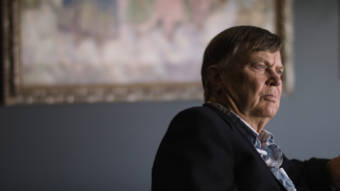
John E. Havelock, 89, died Aug. 31, 2021. He spent his final days greeting friends and reflecting on his legacy. (Liz Ruskin/Alaska Public Media)
Former Alaska Attorney General John Havelock died Tuesday.
He was 89 and died at home of cancer, his wife, Mona, confirmed.
Havelock played a role in some of Alaska’s most important federal statutes, including the Alaska Native Claims Settlement Act and the trans-Alaska pipeline bill. He also drafted the language for Alaska’s constitutional amendment recognizing the right to privacy.
One afternoon last month, Havelock reflected on his life and legacy.
“I am a short-timer, you understand,” he said from a hospital bed set up in his Anchorage living room. “Well, I’m happy about it. I’ve had a good, strong life, full of accomplishments, and I don’t need anything else.”
Havelock came to Alaska the year statehood began — 1959 — with a newly-minted Harvard law degree to work in the AG’s office. He served as attorney general under Gov. Bill Egan from 1970 to 1973.
Havelock said he got a first draft of Alaska’s privacy amendment from Sen. Terry Miller, R-Fairbanks. He thought it was too wordy.
“So I went back to the office and I wrote it the way it is now and went out in the hall, handed it to him,” Havelock recalled. “And that became the Privacy Amendment.”
Section 22 of the Alaska Constitution is just 20 words: “The right of the people to privacy is recognized and shall not be infringed. The legislature shall implement this section.”
It is the backbone of Alaska Supreme Court opinions decriminalizing marijuana and upholding the right to abortion.
When it was written, in 1972, the concern was the government collection of personal data, but Havelock said applying it to abortion is appropriate.
“It is a broad idea. Privacy should apply to that situation,” he said. “A woman’s consultation with her doctor — Jiminy Crickets. There’s a limit to what you can do with that with a judicial proceeding.”
Havelock was a founding partner in the law firm Ely, Guess, Rudd & Havelock. He taught justice and political science at the University of Alaska. A room in the UAA Justice Center will be named for him.
Close
Update notification options
Subscribe to notifications
Subscribe
Get notifications about news related to the topics you care about. You can unsubscribe anytime.