University of Alaska

Librarians worry for future of statewide library catalog after governor’s funding veto

The Soldotna Public Library is a net borrower from the Alaska Library Catalog. That means it borrows more books than it lends to other Alaska libraries. (Sabine Poux/KDLL)

Go to most libraries in Alaska, and you can ask for just about any book, movie or magazine. And 99% of the time, it’ll get to you, said Rachel Nash, librarian at the Soldotna Public Library.

“This system allows us to say yes every time,” she said.

That system is the Alaska Library Catalog. Gov. Mike Dunleavy vetoed $635,900 in funding for the program and others as part of a slew of budget vetoes earlier this month.

The Soldotna and Kenai libraries are among the 85 Alaska libraries in the Alaska Library Catalog. Members can borrow and lend materials to one another, like videos and magazines.

“And of course, what everyone thinks of are books,” Nash said. “There are 3.2 million titles.”

The Dunleavy administration said libraries can operate sufficiently without the funding.

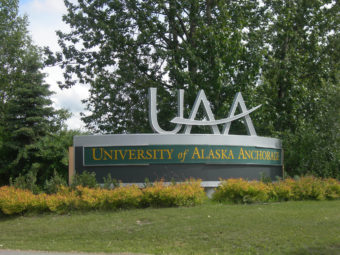
But the Alaska Library Catalog may have to cut back services if it can’t get a stable source of funding into the Legislature’s budget, said Steve Rollins. He’s a dean at the University of Alaska Anchorage Library, which oversees the consortium and contributes half its funding. The other half comes from subscriber libraries.

“But the reason that money is needed is that over the last seven years, libraries in Alaska have had very significant budget reductions,” he said.

Like the UAA library. Several years ago, it contributed $600,000 to the program, Rollins said. This year, he thinks they can eke out $100,000 to put into the statewide resources.

“So our ability to collectively put money into these programs are being put in jeopardy,” he said.

Nash, the Soldotna librarian, also said the need for statewide material sharing has gone up as the program grows, which has made it more expensive to meet costs like shipping fees.

It’s caused some libraries to drop out. The Haines Borough Library left the consortium last year after it became too costly for it to mail materials to other libraries. Rollins said he’d like the library catalog to put more toward subsidizing those shipping costs.

Nash said the program is important for smaller libraries like hers. The Soldotna library is a net borrower, so it borrows more books from other libraries than it loans out.

She said without the funding, the Alaska Library Catalog will have to cut two of its administrative positions.

“And those are the two positions that keep it going,” Nash said. “They’re the ones that make sure that we can share a catalog and keep it up and running and are able to make deals with vendors to save us time and money over the course of the life of the catalog.”

Dunleavy also vetoed funding for the Statewide Library Electronic Doorway program, or SLED. That system connects Alaska library users with digital archives and databases, and saw 22 million searches in the 2020 fiscal year, Rollins said.

Some resources within SLED are safe from the veto, like Live Homework Help and Online with Libraries, a system primarily used for remote training and videoconferencing. Both were added as line items in previous budget cycles.

This year, Nash said, the Alaska Library Catalog and SLED will be OK, thanks in part to federal COVID-19 relief funds. But she says the current system of funding is not sustainable long term.

“And if that funding continues to not be available, I would predict that we would see more smaller libraries dropping out of the system,” she said.

This is the second time this has been in the Legislature’s budget and vetoed by the Governor. Rollins said they’ll put forward a similar request for funding next year.

Pfizer vials, Zoom costumes and plexiglass: The Museum of the North is building its pandemic collection

A COVID-19 piñata waits to be smashed by Carolina Tolladay Vidal’s customers. The Museum of the North is looking for iconic objects like this to document Alaska’s experience of the pandemic. (Hannah Lies/Alaska Public Media)

As fewer COVID-19 cases show up at Alaska hospitals, many are hoping to put the COVID-19 pandemic behind them. But before too many people move on, the Museum of the North wants to collect culturally important objects that represent Alaska’s response to the pandemic.

Angela Linn is a senior collections manager at the University of Alaska Museum of the North.

“I have to always be thinking, like, 20 years, 40 years from now, what are people going to want to know about this crazy experience that we’ve all just gone through,” she said.

Linn is not curating an exhibit about the pandemic. But she wants to seize this moment, while people are still living it.

“For future generations, you know, that’s what we have to think about for museums,” Linn said. “It’s not what stories speak to me right now. It’s, what are people in the future — what will they find interesting and compelling enough to do research or put together an exhibit on this stuff?”

Some of the problem is figuring out what will be important later while it is happening now. Linn thought the Museum of the North should have some items about the pandemic in its permanent collection. As her idea came together earlier this spring, she reached out to public health officials, including Dr. Anne Zink, Alaska’s chief medical officer, who gave her some ideas.

“Oh, it would have been awesome if I could have gotten, like the first box of the first vaccine you know, that came into the state,” Linn said.

Linn connected with Lanien Livingston, the public information officer for Interior Alaska’s joint incident command.

At a mass vaccination clinic held at the Carlson Center in Fairbanks, Livingston was able to collect quite a few artifacts.

“A Moderna box, there was a Johnson and Johnson vial, a couple of Pfizer vials, stickers and some blank vaccination cards. All provided to me by public health.,” Livingston said.

Other people suggested to Linn that she look at the do-it-yourself response that Alaskans put together as the pandemic widened. Such as hand-sewn headbands and 3-D printed mask hooks and the different plexiglass barriers businesses came up with.

Linn is looking for iconic things. Symbolic things.

“Different things that people were doing like, Zoom squares as Halloween costumes, or you know, some of these out-of-the-world things,” Linn said.

University of Alaska will cover student scholarships until lawmakers reach deal

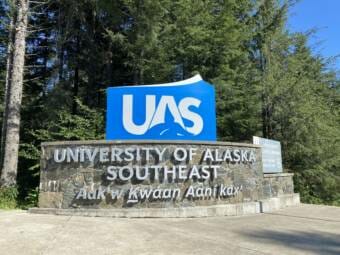
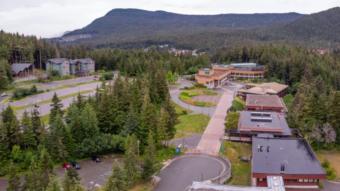
University of Alaska Southeast (Photo by Heather Bryant/KTOO
Students at the University of Alaska Southeast campus in Juneau in 2013. (Photo by Heather Bryant/KTOO)

Legislators voted earlier this week to avoid a partial government shutdown, but they couldn’t agree on how to fund college scholarships to support more than  5,400 Alaska students. So those funds are not currently in the state budget. 

But the University of Alaska announced Thursday that it will honor the scholarships for current and incoming students. 

In a statement, Interim President Pat Pitney said she was confident the legislature would resolve the funding of these scholarships during the special session in August.

The Alaska Performance Scholarship and the Alaska Education Grant programs provide students across the state with vital funds for their studies. Most of them are students at the University of Alaska. 

The University of Alaska Southeast had about 150 students who received scholarships last year. The university sent out a message to the students letting them know that it’s carefully monitoring the situation, says Lori Klein, Vice Chancellor for Enrollment Management Student Affairs.

“While waiting, of course, is very difficult and challenging. We want students to stick with their plans for the fall, and to come to us and to stay in state and to plan on having those funds,” Klein said.

She also says the program funds directly impact the state’s future.

“These funds impact our future state leaders,” she said. “They impact their future state residents, our business owners, our professionals. You know, many of our students will stay in state after they get their degrees and they will contribute back to their home communities.”

The legislature reconvenes for a special session in August. Klein says she hopes by then legislators can bring certainty to students for the upcoming school year.

Editor’s note: This article has been updated to include information from a statement by University of Alaska Interim President Pat Pitney. The headline has been updated to include that the university system will honor the scholarships.

Alaska’s state budget is signed, but programs to lower electricity costs and provide scholarships remain unfunded

The Alaska State Capitol doors have required key cards to unlock throughout the 2021 legislative session, June 16, 2021. (Photo by Andrew Kitchenman/KTOO and Alaska Public Media)
The Alaska State Capitol hosted special sessions in the past six weeks. But legislators have not reached a consensus on how to fund the Power Cost Equalization and university scholarship programs, as well as other programs that have been funded from separate accounts. (Photo by Andrew Kitchenman/KTOO and Alaska Public Media)

Gov. Mike Dunleavy signed the state budget late Wednesday afternoon. But programs to lower the cost of electricity in high-cost areas and to pay for university scholarships won’t be funded starting on Thursday. And permanent fund dividends are set at $525. That’s the lowest level in PFD history when adjusted for inflation.

Both the governor and legislators from every caucus have said they want to fund these programs, but legislators haven’t agreed on how to fund them.

In previous years, the programs were funded through separate accounts the state has maintained, like the $1 billion Power Cost Equalization Endowment Fund and the $340 million Higher Education Investment Fund. 

But this year, both the House of Representatives and the Senate fell short of the support of three-quarters of their members needed to maintain the programs, by drawing from the Constitutional Budget Reserve to refill these accounts. The Constitutional Budget Reserve vote passed in previous years. But it was delayed in 2019, which led to the programs briefly being suspended. 

Wasilla Rep. Cathy Tilton leads the all-Republican House minority caucus. She said the members of the caucus will withhold the votes needed to fund these programs for now. They are first asking that the Legislature discuss and vote on a plan for the future of the budget. 

“We still have the three-quarter vote ahead of us,” she said on Monday. “And we’re going to hold onto that.” 

Along with Power Cost Equalization and university scholarships and grants, several other programs will have to stop until they receive funding. The soonest that can happen is during the next legislative special session, currently scheduled to begin on Aug. 2. 

Some members of the House minority have said they want the programs to be funded in the regular state budget, rather than from separate accounts. But majorities in both chambers oppose that approach because it would eliminate the Power Cost Equalization Endowment Fund and other accounts. They have said that eliminating the funds will undermine the programs. 

Dunleavy has proposed combining the PCE Endowment Fund with the Alaska Permanent Fund, which he said would protect it. But some lawmakers have expressed skepticism about his overall plan, which includes setting permanent fund dividends at roughly $2,350. After a backlash to his budget proposal two years ago, Dunleavy hasn’t proposed policy changes that would both pay for larger dividends and balance the state budget. 

Anchorage Democratic Rep. Chris Tuck is the House majority leader, after having served as the minority leader several years ago. He pointed out during the debate on Monday that the vote used to fund these programs gives the minority caucus influence. 

“Negotiations aren’t done yet,” Tuck said. “There is tremendous power in the three-quarter vote. As the minority leader in the past, I knew the importance of that three-quarter vote.”  

Along with the Power Cost Equalization program and university scholarships and grants, the unfunded programs also include the program to fund medical education

A working group with members from each legislative caucus is expected to make recommendations ahead of the August special session for a fiscal plan that would include funding these programs.

Editor’s note: This article has been updated to reflect the governor signed the state budget late Wednesday afternoon.

Unangax̂ educators will teach Unangam Tunuu language class at University of Alaska Anchorage

Haliehana Stepetin (Unangax̂) is an instructor for the elementary course in Unangam Tunuu — the Unangax̂ language — at the University of Alaska Anchorage in the fall of 2021. (Photo by Jaiden Willeto)

The University of Alaska Anchorage will offer Unangam Tunuu courses as part of its Alaska Native Studies coursework.

This fall, students can take a course in Unangam Tunuu — the Unangax̂ language — at the university.

Course instructor Haliehana Stepetin says it’ll be a regular part of the school’s offerings for the next two years.

“It’s really wonderful to include it in the Alaska Native Studies curriculum because it shows this density and it will hopefully teach more people about who we are and where we come from in our differing experiences and our similar goals of cultural revitalization presence,” Stepetin said. “And more than just that, but thriving.”

Stepetin is Unangax̂ and a Ph.D. candidate in Native American Studies at the University of California Davis. She will teach the course with help from her longtime mentor and Unangax̂ Elder Moses Dirks.

“I think this is our opportunity to try and convey to people that there are differences in language and cultures, so Unangax is so unique,” Dirks said. “With very few speakers, I think it’s important to pass it on to interested Unangax people that would be interested in taking it.”

Dirks is a longtime Unangam Tunuu linguist and has taught it at Alaska Pacific University and University of Alaska Fairbanks to culture camps.

He says that for the last 10-20 years, he’s continued to seek out people willing to learn and document Unangam Tunuu.

“My hope always was to try to preserve the language, but everything was spoken in terms of verbal language and it was passed on from generation to generation. And nothing was documented,” Dirks said. “My primary goal was to document the true Unangam Tunuu and to keep the dialect separated so that they have their own identity in each of the villages.”

The course will be one of several Alaska Native language courses offered at the university through its Alaska Native Studies program.

In the past, Unangam Tunuu was taught at the university on a trial basis, but this will be the first time that it’s regularly taught at UAA.

Stepetin says the course will be offered virtually as a way to be more inclusive to Unangam Tunuu learners, including those that may live outside of Anchorage:

“I know that people aren’t going to get fluent in a semester or two, but the focus of language learning that Moses and I have been doing is fluent in conversations of conversations about the weather, conversations about who you are and where you’re from and or cooking or fishing,” Stepetin said. “I want them to get interested enough to keep going because I think having more people interested in learning the language is really valuable. And over time they’ll continue to carry on the language.”

The course will be Tuesdays and Thursdays from 5:30 to 7 p.m. For more information, visit the UAA website.

Dinosaurs likely lived in Arctic year-round, according to recent Alaska discovery

Researchers dig for dinosaur bones on a bluff on the Colville River (Photo courtesy of UAF)

The discovery of baby dinosaur bones on Alaska’s North Slope has paleontologists rethinking the animals’ lives and physiology.

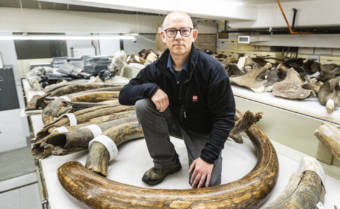
University of Alaska Museum of the North director Pat Druckenmiller and colleagues from the University of Alaska Fairbanks and Florida State University made the discovery along the Colville River.

Druckenmiller said the area of eroding bluffs has yielded many dinosaur fossils over the last couple of decades. But these bones are different.

“Tiny little baby bones and teeth, not of adults and juveniles, but of actual very, very young animals that died either in the egg or just after they hatched,” he said.

The baby dino bones were found in sediments collected by University of Alaska Fairbanks and Florida State University scientists. They ranged from those of small bird like animals to giant Tyrannosaurus. Druckenmiller said the discovery of the baby dinosaur bones so far north indicates year-round residency.

“Dinosaurs likely had incubation periods upwards of five to six months for some species. And if that’s the case, a dinosaur laying its eggs in the spring would have been hatching them late in the summer,” he said.

If dinosaurs were migrating, they would have had very little time to move to lower latitudes with newborns, which suggests that the animals did not, in fact migrate.

“We think it’s more likely they actually managed and adapted to living in the Arctic conditions, year-round,” he said.

Given that the site where the bones were found was closer to the North Pole 70 million years ago, Druckenmiller said even in that era’s warmer climate, the dinosaurs endured pretty extreme conditions.

“Yes, it was cold. Yes, it was freezing conditions and probably snow. But at 80 to 85 degrees north you have to deal with three to four months of continual winter darkness. That’s the kind of world we don’t generally envision dinosaurs living in,” he said.

Druckenmiller said living in such relative cold is also telling about the dinosaurs’ physiology.

“If you lived up there year-round, you almost certainly had to have made your own body heat and probably maintain some elevated internal body temperatures,” he said. “And that, in a nutshell, is warm-bloodedness.”

Druckenmiller said that adds to evidence from other studies pointing to warm-blooded dinosaurs. Findings from the study are published in the journal Current Biology.

Site notifications
Update notification options
Subscribe to notifications