University of Alaska

Dunleavy announces Alaska medical school, state scholarships will be funded

University of Alaska Anchorage sign
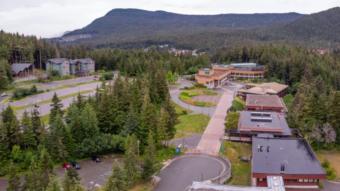
The University of Alaska Anchorage, where the state’s WWAMI medical education program is based. The governor announced WWAMI and 17 other programs would be funded this year. (Photo by Jimmy Emerson)

Alaska’s medical education program and scholarships to attend college will be funded this year, announced Gov. Mike Dunleavy on Wednesday.

Dunleavy said he ordered his Office of Management and Budget to release funding for the WWAMI medical education program plus 17 other programs.

Kathryne Mitchell is a second-year WWAMI student. She’s glad about the announcement.

“We’re very excited that the funding for our program is secure for this year,” Mitchell said.

Without WWAMI, Mitchell would have to take on an extra $120,000 for four years of medical school — plus student loan interest.  She wants Dunleavy and the Legislature to secure long-term funding for the program.

“When this battle for funding for WWAMI comes up every year, we lose students — students who will go on to become excellent physicians. We lose them and they go train in other programs, where there’s more certainty as to funding. And then we don’t get them back as physicians in Alaska,” she said.

She’s originally from North Pole and wants to practice family medicine in rural Alaska.  She says the program benefits the whole state.

“For Alaska, it’s really, really important that we train home-grown students to become physicians here, because they’re the physicians that are going to stay,” she said.

The announcement allows more than $42.8 million to be spent on WWAMI and other programs that include funding to attend college through both $11.8 million in Alaska Performance Scholarships and $6.4 million in Alaska Education Grants. Oil spill prevention also received $3 million in additional funding.

WWAMI received $3.3 million. And reimbursements to municipalities to pay off their debt to build schools received $4.2 million.

Dunleavy’s administration previously had said that these programs could not be funded without the agreement of three-quarters of both chambers of the Legislature.

But Dunleavy said Wednesday that his administration reviewed this funding after a recent decision by a Superior Court judge. And this review led him to OK the spending.

That judge’s decision said that money in the Power Cost Equalization Endowment Fund was not subject to the three-quarters vote.

The administration said these programs received funding for this year’s budget before the money in the accounts used to fund them was swept into the Constitutional Budget Reserve.

Remembering Frank Soos, former Alaska Writer Laureate and creative writing teacher

Frank Soos (Photo courtesy of 49 Writers.)

Former Alaska Writer Laureate and University of Alaska Fairbanks professor Frank Soos has died. Soos was on a solo bicycle ride in Maine last Wednesday when he suffered a fatal accident.

Frank Soos was born in 1950 and grew up in the Virginia coal mining town of Pocahontas. His parents owned a market, and that upbringing taught Soos and his brother the value of hard work and community. Soos never lost his regional drawl nor his self-deflecting courtesy. While his literary interests sparked in high school,they took flame at Davidson College.

“Davidson sort of looked like this dream,” Soos said in 2019. “There were all these guys sitting under trees reading books and talking. I thought, wow, if this is college, I can do this.”

At Davidson Soos would meet his lasting friend and sometime collaborator, the art historian and painter Kesler Woodward. After college Soos taught high school for a time and discovered he loved it, but the writing life beckoned and he entered University of Arkansas’ Creative Writing program, graduating with an MFA. Soos said grad school was instructive in unexpected ways.

“It was an awful program,” he said. “It was intentionally cruel, and I made up my mind I would never participate in a program like that if I were a teacher.”

Those lessons found expression when he joined the University of Alaska Fairbanks English Department in 1986. There he met poet Peggy Shumaker and together helped forge a creative writing program that attracted writers from across the country and formed a new generation of noted Alaska authors.

“We had graduate students who would come to see me and I would say ‘Here’s where you can compress’,” said Shumaker. “And then they’d go see Frank and Frank would say ‘Well, maybe this is a place where you can make it longer.’ And I’m sure we bewildered a lot of students at first, but believe it or not, it worked.”

Shumaker said Soos was the most generous teacher she’d ever met.

“You learn when you’re a teacher that if you’re going to make demands on students, you’re going to make them on yourself,” Soos said in 2019. “So, to turn that stuff around mean you sit at your desk and read a lot of papers and make a lot of comments to get ready for all these conferences. That’s what teaching is.”

That commitment to hard work extended to his writing. Shumaker says besides his elegantly crafted sentences and uncanny ear for dialogue, Soos kept writing no matter what.

“He worked for decades with very little recognition, and then suddenly he had two books at once,” she said. “And he was characteristically modest. But what he did always, in good times and bad, he kept plugging away.”

That tenacity resulted in Soos winning the Flannery Connor award in 1998 and serving as Alaska Writer Laureate in 2014. A posthumous collection of Soos’ stories is scheduled to be published in 2023.

While Soos always claimed he was a loner, he managed to form a series of creative collaborations — with Shumaker and painter Woodward and most intimately with his wife and artist Margo Klass. He is also inescapably linked to Fairbanks’ biking and skiing clubs. Long-time friend and fellow Nordic skier Susan Sugai said if Soos wasn’t participating in races like the 50K Sonot Kkaazoot, he was volunteering handing out bibs or timing races.

“He knew that times are important to people,” she said. “It’s not the people who necessarily win, it’s the people who participate and try to improve. He loved that.”

Back in session: How the UAS campus looks different this year

Photo of the UAS sign in Juneau
The University of Alaska Southeast campus is located near Auke Bay in Juneau. (Photo by Bridget Dowd /KTOO).

Monday was the first day of the fall semester at the University of Alaska Southeast and operations look a little closer to normal this year.

The University of Alaska Southeast campus in Juneau welcomed about 140 students at its new student orientation last week. The event was held in person this time instead of over Zoom, like last fall — where just dozens of students participated.

Lori Klein is Vice Chancellor for Enrollment Management & Student Affairs at the school. She said they’re offering a mix of online and in-person courses, whereas most classes were online last year.

Headshot of Lori Klein
Lori Klein is Vice Chancellor for Enrollment Management & Student Affairs at the University of Alaska Southeast. (Photo courtesy of Lori Klein)

“There’s a lot of great energy on campus today,” Klein said. “It feels really good. The students are really engaged with each other and with the staff. So here we are – we’re off and getting ready to go and very excited.”

Masks are still required at school-sponsored events and on campus — except inside students’ private residences — and social distancing is encouraged when possible. All 200 or so students living on campus were required to get a COVID-19 vaccine unless they’ve been approved for an exemption.

“This is a process we have available for all of our vaccines,” Klein said. “If you live on campus, there’s a wide number of vaccines that we require you to have, not just COVID. But we follow the State of Alaska religious and medical exemption process. So students fill out a form and have it notarized and provide that.”

More students are able to live on campus this year, but some rooms are still reserved for “quarantine housing.”

“We’ve carved out housing available to relocate students who have been exposed to someone who is COVID positive or who get sick themselves,” Klein said. “[It’s] a space on campus where we can still provide them all of our services, but it allows them to either wait out test results or isolate, should they test positive.”

Nearly 1,200 students are enrolled this year, down about 5% from last fall. Klein said there was a bit of an artificial bump in enrollment at that time, due to COVID.

“We think the difference is that so many people waited until the middle of August last year to make decisions,” Klein said. “When schools in other places decided to go online, a lot of students ended up staying in Juneau and so we had a huge influx of students who eventually went to other places and we don’t have that this year.” 

She said students were very compliant with COVID-19 mitigation measures last year and the school experienced very few outbreaks. Klein hopes that trend will continue this semester.

UAS, UAA add vaccine requirements for students living in dorms

The University of Alaska Southeast campus in Juneau, shown on July 25, 2019 (Photo by David Purdy/KTOO)
The University of Alaska Southeast campus in Juneau, shown on July 25, 2019 (David Purdy/KTOO)

Students living in dorms at the University of Alaska Southeast and University of Alaska Anchorage this fall must be fully vaccinated against COVID-19.

UAA said the shots are highly encouraged before students move in. If not, they have 45 days to get vaccinated if they want to remain in campus housing. At UAS, students will be given 10 days to meet the requirement unless they have a religious or medical exemption.

“To minimize the chance of community spread, which would be detrimental to the academic pursuits of large numbers of students, UAA requires that all residents be fully vaccinated for COVID-19,” Bruce Schultz, UAA’s vice chancellor for student affairs, wrote by email.

The new vaccine requirements from Alaska’s largest university come as colleges across the U.S. try to determine how to best protect their campuses against COVID-19 while navigating the rise of the highly contagious delta variant plus politics and legal questions.

UAA says its Dean of Students Office will review any requests for a waiver from the vaccine requirement.

Roughly 400 students are expected to live in the university’s residence halls and apartments this fall, according to Schultz. They share lounges, kitchens and bathrooms. Schultz said the university already requires students to show proof of other immunizations. Now, the COVID-19 vaccine will be added to the list.

Meanwhile, the University of Alaska Fairbanks said it will require students living in dorms at its Bethel campus to be vaccinated due to limited health care facilities in the region.

UAF Chancellor Dan White said Tuesday he’s still weighing whether to require vaccinations for students living in residence halls at the main campus in Fairbanks. Students can request a vaccinated roommate.

UAA, UAF and UAS are all part of the public University of Alaska system. While the decision on vaccination requirements was left to each university, UA does have a systemwide policy on face masks. UA President Pat Pitney announced last week everyone must mask up again inside UA buildings in communities with high or substantial spread of the coronavirus, as well as outside, if it’s impossible to stay 6-feet away from others.

Alaska Pacific University is also requiring masks. It’s strongly encouraging students to get vaccinated and said it may be required to participate in certain activities.

University of Alaska, Anchorage School District recommend masking for school year

Anchorage School District Superintendent Deena Bishop at Huffman Elementary School on Monday, Nov. 2, 2020. (Tegan Hanlon/Alaska Public Media)

Anchorage School District Superintendent Deena Bishop is recommending universal masking inside district buildings, according to a letter sent to families Saturday evening.

“These past few weeks I have gathered information, heard from parents and staff, and spoken with experts,” said Bishop’s letter. “The science tells us the new variant is highly contagious, is circulating around the globe, and is at a high rate in our community.”

The letter outlined a mitigation plan for the school year that encourages parents to keep sick children at home, continue to offer vaccination clinics to those who are eligible and not require close contacts to quarantine if they are vaccinated.

Families have been awaiting a decision from the district as other federal and national organizations have updated mask guidances for schools in recent weeks. The highly contagious delta variant of the coronavirus has led to a surge in cases across the country and throughout Alaska just weeks before school is about to begin for many students.

Parent groups on all sides of the debate have been organizing email write-in campaigns and testimony at the next school board meeting, Tuesday, Aug. 3.

In an interview last week, the superintendent called the feedback “divisive” and evenly split between families who want a mask mandate and parents who don’t. But the district will continue to follow the science, Bishop said.

The school board will discuss the superintendent’s recommendation at the Tuesday board meeting.

Meanwhile, University of Alaska president Pat Pitney announced Friday face masks will be required indoors at all University of Alaska locations in communities with “high” or “substantial” transmission under the Centers for Disease Control and Prevention guidelines. The policy makes exceptions for private residences and individuals alone in a private office with the door shut. UA’s masking requirement goes into effect Monday.

Alaska Pacific University enacted a similar policy last week.

Alaska Public Media reporter Kavitha George contributed to this story. 

UAF team excavates Chena, the abandoned gold rush town that lost out to Fairbanks

UAF archeologist Josh Reuther, center, examines an excavation at the Chena Townsite while term Assistant Professor Justin Cramb explains the technique to students and project volunteers, in background from left: Katie Baum, Sam Steele, Kent Lisibach, Kyler Collier and Sheri Karikomi. (Tim Ellis/KUAC)

A group of University of Alaska Fairbanks researchers and students who spent six weeks at an archeological site just west of the city are compiling reports on what they found in the area, where the gold-mining town of Chena boomed more than a century ago — before going bust.

UAF Term Assistant Professor Justin Cramb took a break from helping excavate the foundation of an old log cabin to explain to a visitor why he and a group of students are digging around in a wooded area off Chena Pump Road near the north bank of the Tanana River.

“What we’re looking at is basically the foundations of old structures,” he said. “Things that were left behind after the town of Chena was abandoned.”

The casual observer wouldn’t know a town with dozens of buildings and hundreds of residents once stood in what’s now a swampy thicket, overgrown with willow and alder.

The town was founded in 1902 and served as a commercial hub during a gold rush that drew hordes of miners into the Interior during the first decade of the last century.

“Fairbanks comes into existence just a little while later,” he said. “And they become competitors.”

Chena had the advantage of location — right on the Tanana, conveniently accessible to the big riverboats and also near the mouth of the Chena River. Freight could be off-loaded there and and transferred onto smaller boats, which took the goods and passengers on to Fairbanks and beyond.

Chena boomed in the first decade of the 20th century, largely because of its location on the Tanana River that enabled the town to handle freight and passengers for the area, which was booming due to the gold rush under way around the Interior. (Rasmuson Library Alaska & Polar Regions Digital Collections & Exhibits)

But historians said Fairbanks had a different advantage.

“Fairbanks was far more successful politically, which was one of the factors that led to the downfall of Chena within 20 years,” Cramb said.

The political success came in the form of influence exercised by the legendary Judge James Wickersham, who persuaded federal authorities to build a courthouse in Fairbanks. Miners had to go there to stake their claims, which attracted other gold-related businesses, including some formerly based in Chena.

Before long, most of the town’s population followed. Railroad tracks were pulled up. Vacant structures were dismantled and salvaged.

“Buildings were repurposed — taken to either Fairbanks or Nenana,” Cramb said. “People moved out, and then Chena was just abandoned.”

Several decades later, the state built a day-use picnic park at the townsite. But for the most part, it sat empty for nearly a century. Then, seven years ago, UAF researchers Josh Reuther and Scott Shirar began excavating the site. And in May, Cramb and his students picked up where Reuther and Shirar left off.

“We’ve found glass bottles,” Cramb said. “We’ve found leather boots that we tentatively will place with the Chena era. A ton of metal nails that are of course one of the hallmarks of historic archeological sites …”

Artifacts found and catalogued by Cramb, Reuther and Shirar include a pair of boots, left, and numerous pieces of glass, like this bottle. (Courtesy Justin Cramb/UAF)

One of the UAF undergrads working at the site says excavating and analyzing all those artifacts has deepened her appreciation for anthropology. And it’s convinced Sheri Karikomi to apply for grad school to continue study the subject.

“It helps me understand a lot more about cultural anthropology,” she said. “How people — how they lived, y’know, based on their culture and things that are left behind — their structures, their small artifacts, big artifacts.”

The students have cataloged most of the artifacts they collected during the archeological field school, which ended late last month. Cramb said he and Reuther and Shirar are analyzing their findings and compiling a detailed report, which they plan to present at this year’s Alaska Historical Society meeting and a national historical archaeology conference in Philadelphia next year. After that, they plan to publish their findings in academic journals.

Editor’s note: Click here to read a report on the challenges of locating and surveying the Chena Townsite written in 2013 by Fairbanks historian, surveyor and retired municipal platting officer Martin Gutoski.

Site notifications
Update notification options
Subscribe to notifications