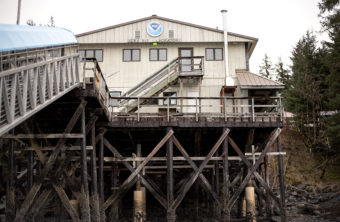
Juneau and the University of Alaska Southeast previously submitted competing applications for the waterfront parcel that contains the Auke Bay Marine Station, shown here in January. The two entities now want to share the 4 acres of land along Auke Bay. (Photo Tripp J Crouse/KTOO)
The City and Borough of Juneau and the University of Alaska Southeast say they are making progress on a plan to share 4 acres of land along Auke Bay.
The city primarily wants to use the waterfront to expand Statter Harbor. The university wants to expand its campus.
CBJ Port Engineer Gary Gillette said in a news release that subdividing the property is a compromise good for both parties and the community.
The land and facilities were previously a National Oceanic and Atmospheric Administration lab. Those functions have since moved to the Ted Stevens Marine Research Institute at Lena Point, so the feds are offering it to other government entities at no charge.
The city and university had previously submitted competing applications vying for the waterfront parcel.
Whatever agreement the city and university put together is ultimately subject to approval by the federal General Services Administration.
University of Alaska Anchorage Chancellor Tom Case addresses faculty and staff at a recent UAA 2020 gathering. (Photo by Philip Hall /University of Alaska Anchorage)
The University of Alaska Anchorage chancellor has announced his retirement.
Chancellor Tom Case sent a letter to colleagues and students today saying he will leave at the end of June, after 12 years with the University.
Case previously worked as the Dean of UAA’s College of Business and Public Policy. He has been UAA chancellor since 2011.
Case said in his letter he was “humbled to have done meaningful and rewarding work alongside passionate, dedicated people.”
Provost Sam Gingerich will serve as interim chancellor.
The University Of Alaska Board Of Regents is holding a special meeting 1-3 p.m. Thursday at the University of Alaska Fairbanks Butrvich Building, to discuss contingency plans in light of State Senate approved budget cuts.
Last week the Senate passed a budget that cuts $22 million from the $325 million in university funding supported by the House and Gov. Bill Walker.
”In the event that a number comes from the legislature that is less than that, the University needs to be prepared for those cuts,” university spokeswoman Roberta Graham said.
Regents anticipated the Senate reducing the level of funding, but not by $22 million, she said. University President Jim Johnsen is talking about additional budget options with campus chancellors.
”What they think would be likely cuts on those campuses,” Graham said. “And those will be options that come forward to the regents.”
Last week Johnsen called the Senate cut “devastating,” while noting that the UA budget has already been reduced by $53 million over the past three years, and that the university is in the process of downsizing, but needs time to carry out a plan to reduce reliance on state funds by 2025.
Graham said there’s also concern about a lack of capital funding for the university, noting a $1 billion backlog in deferred maintenance. The UA Regents meeting is scheduled for
Git Hayetsk dancers perform their chief’s headdress dance honoring Smgyigyet (chiefs) and Sigidmhana̱’a̱x (matriarchs) on March 25 at University of Alaska Southeast in Juneau. (Photo by Caroline Halter/KTOO)
If you’re a longtime resident of Southeast Alaska, you may have heard the story of the founding of Metlakatla, a community in the Annette Islands Reserve, Alaska’s only reservation.
It’s usually told like this: in the wake of a growing rift with the Anglican Church, missionary William Duncan led more than 800 Tsimshian people on a canoe voyage from British Columbia to establish their own devout community in Alaska.
University of Alaska assistant professor Mique’l Dangeli tells a very different version of that history.
The dancers of Git Hayetsk share a common ancestry to the Sm’algyak speaking peoples of the Nisga’a, Tsimshian, and Gitxsan nations.
The dancers recently traveled from British Columbia to perform at University of Alaska’s Juneau campus. It’s a journey similar to one their ancestors made in the late 1800s.
Dangeli leads the group with her husband, Mike, and uses the performance to tell the version of Metlakatla’s founding told to her by prominent oral historians in the Tsimshian community.
Dangeli put it bluntly: “We didn’t follow William Duncan, William Duncan followed us.”
“It was our people’s decision to come back to Alaska and to argue for land rights with the U.S. government,” she continued. “We’d been denied by the Canadian government (and) it led to our decision to move.”
The song that tells the story is called “Paddle to Metlakatla.” It describes a particular moment on the canoe journey when one woman stood to rally the group who was grieving the choice to leave home.
“The words in that song are ‘Wha! T’iina tleexgn!” which is one way of saying ‘stop crying,'” Dangeli said.
From there, the dynamic of the dance changes.
The drum starts beating faster.
The dancers look up, and they start paddling harder.
“They let go of their fear of starting all over again,” Dangeli said.
As for William Duncan, well, Dangeli said he wasn’t even present on that journey.
“We celebrate our founder’s day in Metlakatla on August 7th. Our people started coming over in March, so the day that we celebrate as our founders day is the day that William Duncan finally arrived,” Dangeli said. “He came on a steamer.”
That’s one piece of what Dangeli calls a counter narrative, in contrast to the story that has come to represent the Tsimshian, even within parts of their own community.
“William Duncan, he’s always portrayed as this pied piper and we were just these rats scurrying along behind him,” she said. “Unfortunately, some of our people have internalized this colonial narrative.”
Git Hayetsk invited audience members to participate. (Photo by Caroline Halter/KTOO)
According to Dangeli, the idea that the Tsimshian people completely converted to Christianity, abandoning their own customs, also is false.
She explained that while most history books focus on the Tsimshian’s conversion to Christianity, her people continued their cultural practices “under the guise of Christian practices like Christmas parties and Easter parties.”
Some of those cultural practices have been absorbed into Tsimshian culture, but Dangeli said the cultural survival story was strategically hidden by Duncan.
He tightly controlled the flow of information in and out of Metlakatla to preserve his reputation as a missionary that had complete control over the community. He even went so far as to burn books that documented their ongoing cultural practices.
Toward the end of the Git Hayetsk performance, the group performs a victory song belonging to Dangeli’s husband.
“After war, they would line the beach and they would laugh and taunt their enemies because they had survived,” she said. “Now we use that song to talk about survival … in a much larger way.”
Longtime Sealaska regional Native corporation board member Rosita Worl will step down as a director in June. She will continue to head up the Sealaska Heritage Institute. (Photo by Lakeidra Chavis/KTOO)
One of the Sealaska regional Native corporation’s longest-serving leaders is stepping down.
Rosita Worl has spent 30 years on the Juneau-based corporation’s board of directors. She said she’s been thinking about leaving for a while.
“I probably would have resigned three years ago, but at that point in time, I was chair of the Lands Legislation (Committee) and I felt like I wanted to see that completed before I left the board,” she said.
That controversial bill traded corporate land near shareholder communities for more valuable timber properties within Southeast’s Tongass National Forest.
After several attempts, it passed Congress in 2014.
Worl will complete her final three-year board term, which ends in June. That will leave an open seat on Sealaska’s board of directors, to be filled during spring shareholder elections.
In the past, many departing board members resigned during their terms and were replaced by an appointee, who then ran as an incumbent.
The anthropologist, who’s taught at the University of Alaska Southeast, says she’s looking forward to completing some academic projects.
“I’ve had to spend most of my energies on Sealaska and Sealaska Heritage Institute. And I’d like to finish a couple of manuscripts that I have: Tlingit property law and an ANCSA study, for example,” she said.
Worl’s leadership roles have extended outside Southeast Alaska.
She’s been on the boards of the Alaska Federation of Natives, the Indigenous Languages Institute and the National Museum of the American Indian.
She’s also chaired the federal Native American Graves Protection and Repatriation Act Review Committee.
Her Tlingít names are Yeidiklats’akw and Kaa háni and she is Eagle of the Shungukeidí (Thunderbird) Clan from the Kaawdliyaayi Hit (House Lowered from the Sun) of Klukwan and a Lukaax.ádi yadi (Child of the Sockeye Clan).
State Sen. Peter Micciche, R-Soldotna, shown here at a Senate Majority press availability on Feb. 24, says cuts to the Department of Health and Social Services were difficult. (Photo by Skip Gray/360 North)
The state Senate is looking to make up to $300 million in cuts to the state budget. But the Senate subcommittees looking to trim state agencies’ budgets are finding much smaller cuts.
The subcommittees planned to finish their work Tuesday.
The biggest recommended cuts were to the Department of Health and Social Services, which saw a $55 million cut, and the University of Alaska, whose budget was cut by $16 million.
Sen. Peter Micciche, R-Soldotna, said it was difficult to make the Health and Social Services reductions.
“It was certainly easier a couple of years ago, when perhaps there was some fat,” Micciche said. “I think we’re past those days. We don’t have the perpetual benefit of continued cuts. At some point, there will be someone that is going without a constitutionally required service.”
Sen. Gary Stevens, R-Kodiak, said of the university budget cut that Alaskans may not understand the effect of deeper cuts.
“I hate to see this happen, but I think the problem is the public is just not aware of the horrible situation we are in,” Stevens said. “And although all of these budget cuts are painful and we’re sorry to see them happen, we just have got to get the public awareness out there that we’ve got a serious problem — and the inclination of the public to do something about it.”
Anchorage Democratic Sen. Berta Gardner said cutting the university budget is unwise at a time when the state’s need for a better educated workforce is large and growing.
Gardner doesn’t believe $300 million in cuts will make it into the final budget, she said.
“I don’t see where it’s coming from,” Gardner said. “I think the House wouldn’t tolerate it either.”
The House has rejected a series of amendments proposed by the Republican minority caucus over the past two days. The House Finance Committee cut the budget by $31 million.
The Senate Finance Committee plans to hear public testimony on the budget Friday.
Editor’s note: A previous version of this story said the Senate Finance Committee would hear public testimony on Wednesday. The story’s been updated to reflect a scheduling change to Friday that was announced after publication.
Close
Update notification options
Subscribe to notifications
Subscribe
Get notifications about news related to the topics you care about. You can unsubscribe anytime.