University of Alaska

Scientists see the future in the bellies of fish

Emily Whitney and Doug Duncan pull in a seine net. Photo by Anne Beaudreau. (Click image for larger version, 2.6 MB.)
University of Alaska Fairbanks students and volunteers pull in a seine net. (Photo courtesy of University of Alaska Fairbanks)

Southeast Alaska is home to hundreds of glaciers and a lucrative fishing industry. As those glaciers retreat, the freshwater they send into the ocean could begin to dry up. Scientists are trying to figure out how that will impact the marine environment.

The gut lab at the University of Alaska Fisheries Department in Juneau has all the traces of its namesake: fish parts preserved in jars of yellow ethanol. But none of the smell.

Masters student Doug Duncan lifts open a cooler to show off this morning’s catch.

“We’ve got our one lone fish in here. And as you see, it’s a small one,” Duncan said.

It’s a baby chum salmon, no bigger than an anchovy. Typically, the scientists are trying to catch predator fish to bring back to the lab. And juvenile salmon are sometimes along for the ride, too, in the bellies of those larger fish. This little guy didn’t meet that fate.

But Anne Beaudreau, an ecologist at UAF, says figuring out how hatchery salmon end up becoming lunch is a little like playing detective.

“Sometimes I like to talk about stomach content analysis of fish like forensics because you’re piecing together all of these clues to try and figure out what it was when it was eaten,” Beaudreau said. “It’s totally like CSI Fish.”

It’s not the only mystery Beaudreau’s team is trying to solve with fish guts. This study builds on another one that looked at glacial estuaries.

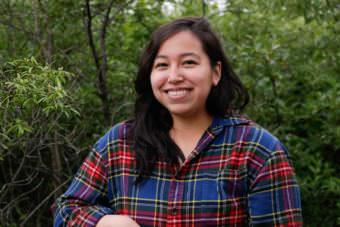
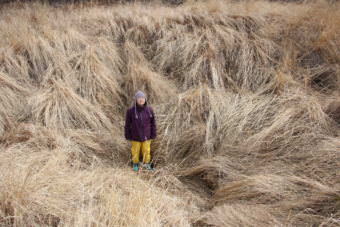
Doug Duncan and Emily Whitney work at one of the sampling sites. Photo courtesty of Emily Whitney. (Click image for larger version, 2.3 MB.)
Master’s students Doug Duncan and Emily Whitney work at one of the sampling sites. (Photo courtesy of University of Alaska Fairbanks)

About five years ago, Beaudreau moved from Seattle to Juneau, and she was curious about what she saw.

“I was really struck by the fact that you can be out on the water in the marine environment and looking at a glacier that’s really not that far away,” Beaudreau said. “Thinking about with glaciers melting and receding rapidly throughout Southeast, Alaska, all of that water is going somewhere.”

Eventually, it ends up in glacial estuaries. Beaudreau set out to find what type of fish lived in those waters and what they were eating.

Freshwater glacial runoff mellows out the salinity of the ocean water, which is good for some kinds of fish. Plus, it can wash down debris, like leaves, that the fish like to eat.

Beaudreau says scientists compared what fish were eating in estuaries near glacial rivers to those in rain-fed creeks.

“As glacial systems transition to more rain-fed systems, it kind of gives us a window into what the future might look like,” Beaudreau said.

It also helps scientists establishing a baseline something to contrast the future with, which right now is crucially important. Most of the world’s glaciers are losing ice because of climate change.

Beaudreau says scientists know that it’s happening. What they don’t know is how that melt will affect the marine environment. But one thing this study does prove is the interconnection between land or glacier and sea.

Still, Beaudreau says more research is needed to answer the big question: what does that mean for fish? And she says a lot is riding on the answer.

“Not even the million dollar question, the billion dollar question,” Beaudreau said. “I think that the work that we’re doing is a really important start.”

The research is on pause while Beaudreau looks for new funding for the project.

In the meantime, her team is working on the hatchery study, and she’s also holding on to tissue samples, in the hopes of someday continuing the one on glacial estuaries.

But right now, it’s not easy to find federal dollars for climate change research.

“A lot of people are concerned about the ability to keep this work funded,” Beaudreau said.

She says her team will keep investigating the stomachs of predator fish. 

“Every little study that we do is just one piece of a bigger puzzle,” Beaudreau said.

A puzzle, she says, that will take a lot more scientific research to solve.

University and city near deal over feds’ Auke Bay property

The Auke Bay Marine Station on Tuesday, Jan. 31, 2017. Juneau Docks and Harbors is interested in the property for a potential expansion of Statter Harbor. (Photo Tripp J Crouse/KTOO)
The Auke Bay Laboratory in January. Juneau Docks and Harbors is interested in the property for a potential expansion of Statter Harbor. (Photo Tripp J Crouse/KTOO)

A former federal marine lab that’s up for grabs on Auke Bay could be formally split between the City and Borough of Juneau and the University of Alaska Southeast.

The deal hasn’t been signed. But City Manager Rorie Watt told the Assembly Monday they are very close.

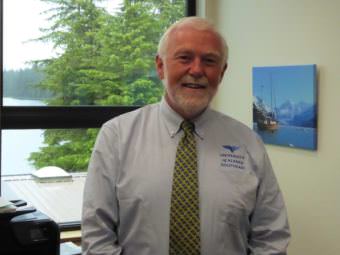
Rorie Watt said he's "terribly excited" to be Juneau's next city manager. (Photo by Autumn Sapp)
Rorie Watt

“We’ve come up with an agreement to share the parcel by subdividing it along a line that allows the university to obtain the lab building and sufficient land, and Docks and Harbors to obtain the remainder of the parcel,” Watt said.

Docks and Harbors wants to expand Statter Harbor. The university wants to use the former NOAA marine lab for its campus. The compromise would require subdividing the 4-acre property and building a new driveway for the university.

The federal government is willing to give the property away. But Watt said the city’s costs for subdividing the land and closing the deal could be a quarter million dollars. That would require planning commission approval and formal agreement from the Assembly at a later date.

UAA starting surgical technology program in response to industry need

The University of Alaska Anchorage is in the final stages of starting a new program that focuses on positions that assist doctors during surgery.

The Health Sciences Building on the campus of the University of Alaska Anchorage (Photo courtesy University of Alaska Anchorage)

It’s called the surgical technology program, and the curriculum will train students for difficult-to-fill positions in the state’s health care industry.

Robin Wahto, director of UAA’s School of Allied Health, said the Surgical Technology program was created in response to industry need.

“Many of the larger institutions are currently hiring folks from outside to move to Alaska to fill those positions,” Wahto said. “We obviously want to be able to help fill some of those positions with people who are here in Alaska.”

Surgical technologists assist surgeons in a variety of ways, including preparing the operating room, ensuring equipment is working properly and by maintaining a sterile operating environment.

A survey by the Alaska Department of Labor and Workforce Development estimates the need for surgical technologists to grow 13 percent by 2024.

Wahto said the program, which the UA Board of Regents approved in March, is going to start small.

“We want to make sure that we are producing the number of students that will be able to find employment,” Wahto said. “We feel as though 12 is a really safe number to start with, both in order to make sure our students are having an excellent experience in the practicum, and also to make sure that those students are able to find jobs at the completion.”

The university recently hired an additional faculty member, who is a certified surgical technician.

Graduates of the program will earn an associate degree in Surgical Technology.

For now, the entire program will be based in Anchorage, but Wahto hopes it can expand to other parts of the state that are in need of surgical technologists.

“If there’s a student from one of those communities, we hope that eventually they would be able to do at least part of their practicum back in their home community,” Wahto said. “Which also increases their chances, probably, of being able to maybe, perhaps continue to work there after their practicum is completed.”

UAA still is awaiting official approval from the Northwest Commission on Colleges and Universities, but expects it to come through before June 15, at which point students can be admitted into the program.

Several industry groups donated money to help fund the program, including Providence Alaska Medical Center, Alaska Native Tribal Health Consortium and Alaska Regional Hospital.

State funding cuts to University of Alaska could deeply impact rural campuses

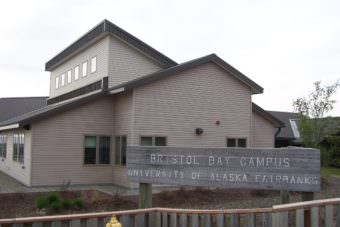
University of Alaska's community campuses, such as University of Alaska Fairbanks' Bristol Bay Campus in Dillingham, Alaska, could face dramatic changes as the university faces further funding cuts from the state. (Creative Commons photo by <a href="https://www.flickr.com/photos/jstephenconn/3633752706/in/photolist-6x6W5J-exCjS">J. Stephen Conn/Flickr</a>)
University of Alaska’s community campuses, such as University of Alaska Fairbanks’ Bristol Bay Campus in Dillingham, Alaska, could face dramatic changes as the university faces further funding cuts from the state. (Creative Commons photo by J. Stephen Conn/Flickr)

University of Alaska campuses are bracing for change as the university system faces up to $22 million in cuts from the state.

University administration are entertaining several different long-term options to reduce the costs, which it is calling Strategic Pathways.

Some of the options could have profound effects on higher education in rural Alaska.

“The purpose of Strategic Pathways is to give the president options of how to proceed with the budget cuts that are coming,” said Vivian Viar, the assistant director of the Bristol Bay Campus in Dillingham. “There are six avenues that Strategic Pathways lists. The community campuses are leaning toward option six, which is just increased collaboration among the other community colleges in Alaska. However, the president is leaning toward the learning center option unfortunately.”

That option would decrease education opportunities in the region dramatically Viar said. Learning centers provide computers, internet and tutoring in some cases. On-campus classes, however, would be outside of their scope.

“It would be devastating,” Viar said. “We service so many villages, flying students in, flying instructors out, providing student service support, offering classes. All of that would pretty much go away.”

In addition to decreased state funding, community campuses such as Bristol Bay’s would no longer be eligible for the significant federal grant funds that they receive.

“Currently we have approximately $7 million in federal funding that serves our villages and the Aleutian-Pribilof region,” Viar said. “The state funding would drop dramatically as we would not have the staff and the resources that we needed that is paid for by the state funding.”

University President Jim Johnsen held a mid-April news conference  after a special meeting with the Board of Regents to discuss contingency plans and preparations for Fiscal Year 2018.

Johnsen discussed both e-learning and increased collaboration as possible immediate contingency options for rural campuses.

“I think more e-learning, more online technology will be part of the solution there in our community campuses,” Johnsen said. “Another thing that I think is a real opportunity is sharing among the community campuses. The directors of our community campuses meet regularly. They work together on new program development.”

The Board of Regents’ will meet in May for an update on how the state budget will affect the university’s budget and again in June to discuss Strategic Pathways and the school budget for the next fiscal year.

Correction: A previous version of this story reported that University President Jim Johnsen held a mid-March news conference. This version has been corrected.

March for Science: Alaska communities to host events, urge all to ‘stand up for science’

University of Alaska Fairbanks ecology professor says, "We’re concerned about the threats that face science and scientists." (Photo by Tim Ellis/KUAC)
University of Alaska Fairbanks ecology professor says, “We’re concerned about the threats that face science and scientists.”
(Photo by Tim Ellis/KUAC)

Ten Alaskan communities will join hundreds of others worldwide Saturday to show support for science and the role it plays in improving the lives of people.

Two Alaskans who’ll be participating in their communities’ March for Science observances say they’ll also be protesting steep budget cuts proposed for federal agencies and programs and politically-motivated attacks on science and scientists.

Christa Mulder, a professor of ecology at the University of Alaska Fairbanks, said she’ll be marching here mainly to express her alarm with a political environment that’s grown increasingly hostile to science.

Juneau science rally

A March for Science rally will be 9-10 a.m. Saturday, April 22, on the steps of the Capitol Building, Juneau.

Fourth Street from Main to Seward streets will be closed to vehicle traffic.

After the rally, the group will march to Juneau Douglas High School. Participants will not impact traffic.

For information, contact Theresa Soley at (414) 688-6715.

“We’re marching to celebrate science, but we’re also marching to demonstrate to people that we’re concerned about the threats that face science and scientists,” she said.

Mulder worries that political leaders and others have grown skeptical about science – as shown in resistance to such programs for vaccinating children and, of course, monitoring climate change.

Her concerns are intensified by the near-daily barrage of criticism of science by President Donald Trump and other conservative leaders and their proposals to slash funding and eliminate programs. And their growing tendency to censor and intimidate researchers and suppress their data.

“It’s those kinds of things,” she said. “When you undermine any credibility in what science tells you, you’re really causing, I think, enormous damage to society.”

Bryan Box will be marching for science in Anchorage because the hostile political environment that followed the Nov. 8 election of Trump cost him his job – and a shot at a research position with a federal agency in Alaska.

“Nov. 10,” he said, “my bosses tell me ‘Hey look, because of the election, we’re not going to give you that job. And so we’re also going to have to let you go from the job that you already have, on Jan. 20.’”

Box is an Army veteran who served two tours in Afghanistan and went on to earn an undergraduate degree in biological sciences from the University of Alaska Anchorage.

He asked that the agency that he’d hoped to work for not be mentioned in this report, because he’d still like to work for it. But for now he and his fellow researchers are just trying to cope with such problems as the loss of scientific data that’s been“scrubbed” from federal websites.

“More and more of these researchers were freaking out because huge sections of the (federal) government (online content) were starting to go black, as far as like parts of the EPA website, that sort of thing.”

Box is also discouraged by censorship imposed on federal employees by an administration gag order requiring them to gain high-level clearance for release of many kinds of science-related information to the public.

“Somebody who has absolutely no idea about our field whatsoever is going to be reading our peer-reviewed journal articles for political correctness, or whatever you want to call it.”

Fairbanks’ observance of March for Science will begin at 10 a.m. Saturday at Ryan Middle School, 1450 Cowles St.

The event will begin with a rally at Ryan followed by a march along Airport Way around the Cowles Street intersection.

Box and Mulder both say they’re not particularly politically minded people, and that people of any political affiliation are welcome to participate in the marches – as long as they support science and research free from political influence.

“Science is not by itself political,” Mulder said. “It is not a partisan march. We really don’t care who you voted for. Anybody who’s willing to come out and stand up for science … is very, very welcome.”

Box reiterated that emphasis on inclusion. He’s invited many scientists and science-minded people to show up and share their work.

“If you use peer review, if you use empirical evidence, you use the scientific method to do something, I want you to show up with your data ready to talk to people.”

Online information about the marches is available on Facebook andmarchforscience.com.

University of Alaska moves forward with Title IX changes

The University of Alaska Fairbanks campus on Jan. 18, 2017. (Photo by Amanda Frank)

The University of Alaska is moving forward on Title IX initiatives stipulated under an agreement with Federal Office of Civil Rights to correct past mishandling of sexual assault and other offenses.

Recently hired University of Alaska Fairbanks Office of Diversity and Equal Opportunity director Margo Griffith said the office is writing up and disseminating information to help victims that she described as “resources that they can reference that give them clear information and that those resources are easily available and easy to find.”

Griffith said the information and outreach efforts are being developed through consultations within and outside the university community. Other UAF actions include filling a second case investigator position as well as hiring a case manager.

“That position will communicate quite frequently with individuals that may have complaints or have question about the Title IX process,” Griffith said. “We didn’t have that before. That was a big of the communication that was missing.”

Griffith said there are deadlines in the agreement with the Federal Office of Civil Rights, including May 1, when updated policy and regulation documents are due.

She said agreement required Title IX employee training is scheduled for the week of June 12.

April is sexual assault awareness month, and the UAF Nanook Diversity and Action Network is sponsoring a talk Tuesday night by Sophie Karasek, co-founder of the national group: End Rape On Campus.

Site notifications
Update notification options
Subscribe to notifications