Climate Change

Alaska’s Arctic and boreal ecosystems see climate change-driven ‘microbial awakening’

Tundra voles are among the small mammals Dr. Phil Manlick, with the U.S. Forest Service, studies to understand how warming is changing boreal and Arctic food webs.

Tiny organisms are making big moves in Alaska’s boreal and Arctic ecosystems, encouraged by climate change.

Underground fungi and bacteria are becoming more active as permafrost thaws in northern regions, breaking down dead plants and other organic matter that was previously frozen in the soil. Scientists call this new activity a “microbial awakening.”

A new study led by U.S. Forest Service research biologist Phil Manlick found that the microbial awakening is actually changing the structure of the Arctic and boreal food webs, that is, it’s changing the interconnected relationships between organisms and what they eat.

“What it means is that a food web that was in the past, supported by primary production in plants, is now supported by decomposition,” Manlick said.

Manlick and his team studied samples from small mammals collected at the Bonanza Creek Experimental Forest near Fairbanks over the last 30 years of warming. During that period, they determined that fungi were becoming a bigger part of the animals’ diets.

Manlick calls this a “browning” of the food web. In the past, most of the energy supporting small mammals like shrews and voles came from eating plants. Now, he said, for some species, most of that energy is derived from fungi.

“We can say, with very strong certainty, that fungi are becoming a really, really important player in terms of energy,” Manlick said. “If you look at a shrew in 1990, they were probably getting 40 to 50% of their energy from fungi. And now it’s like 90 to 100%.”

Manlick said there’s still a lot that scientists don’t understand about the ripple effects this new abundance of energy will have on northern ecosystems, which are rapidly transforming as a result of human-caused climate change.

Amanda Koltz, a University of Texas ecologist who co-authored the study, said it’s already understood that increased microbial activity as a result of permafrost thaw has global implications.

Decomposition in the soil releases carbon dioxide and methane into the atmosphere, which adds to the carbon emissions humans are already pumping out, speeding up global warming.

The world’s permafrost is estimated to hold twice as much carbon as is currently in the atmosphere.

“Even though these northern ecosystems — at least for folks down south — seem very far away and irrelevant, it’s not actually true, because what happens in the Arctic and in the boreal is really globally relevant,” Koltz said.

The Arctic is already warming four times faster than the rest of the planet due to climate change.

Manlick and his team have more research planned to study how the microbial awakening is impacting higher levels of the food web this summer.

Listen: Peltola touts Willow Project, defends ranked choice voting

U.S. Rep. Mary Peltola in KTOO’s studio on Saturday, Jan. 27, 2024. (Katie Anastas/KTOO)

Alaska’s sole U.S. representative, Mary Peltola, visited Juneau over the weekend as part of a series of meet-and-greets she hosted across the state to kick off her reelection campaign. 

Peltola, a Democrat, spoke with KTOO about her first term, why she thinks FEMA needs an overhaul, and more.

Listen:

This interview has been edited for length and clarity.

Mary Peltola: One of the things I’m very proud of is the work that my office has done in really leading the charge to convince the FTC not to approve the mega merger between Albertsons and Kroger. This really will affect every Alaskan household. Even if you’re in the bush, this will affect you. …

And of course, working on Willow. Willow is something that our leaders have been working on in Alaska for over a decade. And I am proud of the fact that I helped bring it across the finish line. I was the one who worked with the leadership in my caucus, to really insist that Joe Biden meet with us. That was not a sure thing. And it was really a coup that we were able to get a meeting with him and John Podesta and two of his other staff. And the senators and I made very compelling cases. And I do feel like I singularly did push that forward. …

One other thing I’m really proud of is the executive order that came out a few weeks ago, banning illegal Russian trawling, where they’re poaching our salmon, and marketing them through China using slave labor, Uyghur labor, driving down our prices. And that will affect fishermen in Southeast tremendously. If we can get those fish prices back up where they need to be, we can keep fishing. We can have fishing families that can continue to fish and make a profit. 

Clarise Larson: The Alaska House Judiciary Committee advanced a bill earlier this month that would repeal ranked choice voting and open primaries. There’s also a group hoping to put the repeal question on the 2024 ballot. How has ranked choice voting shaped your campaigns, and what are your thoughts on these repeal attempts? 

Mary Peltola: You know, a lot of people projected onto me that I was polite and didn’t slam other people because of ranked choice voting. That is like muscle memory for me. The 10 years that I worked in the legislature, that was a real take-home lesson that I learned, that you need to have 59 best friends if you want to get anything done. And I really have that just built into my habits, so that was natural. And it worked well for ranked choice voting. And I think that Americans and Alaskans want more civility and more middle-road candidates. It’s really interesting to me to hear very, very conservative people blasting ranked choice voting, because with ranked choice voting, we also elected the most conservative governor in the United States, Mike Dunleavy. … I do hope that other states look at this and see the success that it has brought, and it is not a complicated system. It’s very, very simple. And I’m very optimistic that ranked choice voting can help bring more middle of the road candidates forward who will put their names forward and work in a more collaborative way. 

Clarise Larson: In Southeast and across Alaska, we’re seeing an increasing number of disasters that could be made more common or severe by climate change. What role can you play in helping Alaskans better prepare for that future? 

Mary Peltola: FEMA needs a systemic overhaul. They were designed to accommodate six natural disasters a year. I believe last year, we had about 28. The size and scope of our natural disasters have compounded so much, and FEMA hasn’t really kept up with that in terms of their systems. So that is something that long-term needs to be addressed, and I’ll be happy to work on. …

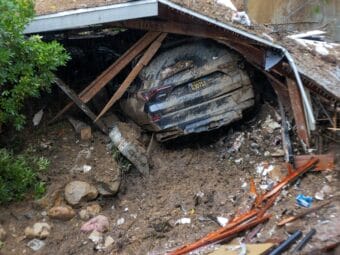
We have seen in Southeast Alaska three very concerning mudslides, one in Haines, one in Sitka, and one in Wrangell. I was able to go to Wrangell and see firsthand the impact of the slide, talk to one of the victims, an amazing woman who survived the slide. I was able to talk with folks from the municipality and people who are there rescuing that night. And one of the things that we need to be working on in Alaska is really partnering with universities to get things like soil stability samples, taking a much closer look at areas that are of concern in Wrangell. The folks there on the ground said that there were multiple other sites that they would have guessed would have had a mudslide before the site that had it. So even for the folks who’ve lived there all their lives or have families who’ve lived there their whole lives, it’s really hard to tell where these mudslides might happen. And it’s really important as Alaskans for us to start getting a better ability to predict where these are and get out of harm’s way before a disaster happens.

Clarise Larson: To a lot of Americans, Congress seems pretty dysfunctional, with very little getting passed. And it seems like national politics are about as far as they could get from the kinds of bipartisan models we’ve seen in Alaska politics. Do you have any hopes left for a more productive Congress or thoughts on how that could come about?

Mary Peltola: I’m always hopeful. And I do believe that Alaska has so much to teach the rest of the nation in terms of working collaboratively and working across party lines and setting partisanship to the side to solve our problems. Nowhere else in America are you going to see a tripartisan House Minority and a tripartisan House majority, and I think that that is so reflective of Alaska. 

Alaskans see bitter cold, record-breaking snow and a winter defying El Niño predictions

A man pulls a sled full of shovels down Muldoon in Anchorage on Monday, Jan. 29, 2024. (Matt Faubion/Alaska Public Media)

Alaska has had quite a wintry start to 2024. The Interior’s seen temperatures nearing 60 degrees below zero. Parts of Southeast have gotten record-breaking snowfall. And Anchorage — often a microcosm of the state as a whole — has had a taste of all of it.

Simply put, Alaska’s winter is defying predictions that an El Niño climate pattern would produce a warmer, less-snowy season.

National Weather Service climate researcher Brian Brettschneider, from our Ask a Climatologist segments, says that while the snow is
notable — and yes, temperatures have been cold recently — we’re still living in an Alaska that’s warmer than it used to be.

Take Fairbanks, for example:

Listen:

This interview has been lightly edited for length and clarity.

Brian Brettschneider: The cold that they (Fairbanks) had the other day, which got down to minus 43, you know, now that happens about, on average, once or so per year. And historically it happened 10 or 12 times a year. So it can still happen, it can still get that cold, but much less frequency. And the deep cold, the 50s below (zero) used to happen every year, and now it may happen once a decade.

And this is probably going to be a little bit unpopular to state this, but in Fairbanks, the UAF outdoor thermometer and the Fred Meyer West outdoor thermometer tend to run a couple of degrees too cold. So when people are standing out there (taking pictures), and it says minus 40, it’s probably not quite minus 40. Still cold, but those have a little bit of temperature, inflation or, I guess, deflation.

Casey Grove: And even colder if you take off all your clothes except for a bathing suit, right?

Brian Brettschneider: Oh, definitely.

Casey Grove: So here in Anchorage, too, it’s been fairly cold. And in my time here, I don’t remember it getting colder than 15 below. But that’s about what we hit over the weekend. Is that notable? Is that a record or anything?

Brian Brettschneider: Really across much of the western two-thirds of the state, this is this is about a four-year cold snap. So it’s been about four years since we had a cold snap this intense and of this duration. So, you know, officially, the Anchorage International Airport has only been down to minus 8. But elsewhere around town, Merrill Field was minus 19. Campbell Creek Science Center was minus 24. And it’s going to get similarly cold here by the end of the week.

Casey Grove: I thought that we were going to have a warm winter. We were all worried that it was going to, like, rain or something in the middle of the winter. And the, you know, the snow forecasts were going to be low for this year, just based on the seasonal outlook from NOAA and the El Niño prediction. And yet here we are, you know, there’s been tons of snow, there’s been some real cold days. What happened?

Brian Brettschneider: Well, would you believe me if I said we are still in the warmest one-third of winters on record in Alaska?

Casey Grove: I know by now that I should believe you, but some people might not.

Brian Brettschneider: So for the month to date through (Jan. 28), Alaska is just slightly warmer than normal for the month of January. And we were half a degree warmer in the month of December. And those are against the 1991 to 2020 normal periods, which is much warmer than previous decades. So for recent years, this is kind of an average year. Historically, this is still quite a warm winter.

Really the most noteworthy part is the snowfall. In an El Niño winter, we typically were more likely to get some winter rain events. But we’ve really kind of threaded the needle this winter. When we have had storms come through, they’ve pretty much been all snow, and so we’ve been able to really pile up the snowfall.

Casey Grove: So, I mean, we’re sitting here in Anchorage, and it’s notable that it snowed as much as it did, and as cold as it was, and affected as many people as live here. But down in Juneau and in Southeast in general here recently they’ve seen a ton of snow, right?

Brian Brettschneider: Yeah, especially in Juneau. So January has now had 70 inches of snow, and that is the third snowiest month on record at the airport. But this is really an extreme amount of snow for the Juneau area. Now, they’ve really flipped the switch. They had their deepest snowpack in over 50 years just five days ago, and now it’s gone. And they’ve been setting record high temperatures. So while, on average, statewide, the last few days have been the coldest days since January 2020 — so in four years — that’s occurred while, you know, Sitka and Ketchikan have all set record high temperatures and are receiving lots of rain.

Report: Alaska’s Railbelt can shift to renewables, but that would require big capital investment

Sunlight reflects off solar panels lining the student recreation building at the University of Alaska Fairbanks campus on June 2, 2018. Solar and wind energy, with a blend of other sources, can help Alaska’s Railbelt generate 70% to 96% of its electricity from renewables, according to a new report from UAF’s Alaska Center for Energy and Power. (Photo by Yereth Rosen/Alaska Beacon)

Alaska’s most populous corridor can generate most of its electricity through renewable energy, but would require significant upfront capital investment, a University of Alaska Fairbanks team said in a new report.

The report, issued last week by UAF’s Alaska Center for Energy and Power, found that by 2050 non-fossil energy can supply anywhere from 70% to 96% of the power needed to produce electricity along the Railbelt. The region comprises communities from Fairbanks in the Interior to Seward on the Kenai Peninsula, the corridor along the Alaska Railroad line that hold the vast majority of the state’s population.

The report compared four scenarios for power generation, from a continuation of the current heavy reliance on natural gas to varying blends of solar, wind, hydro, tidal and nuclear energy.

Under the business-as-usual scenario, with continued use of existing power plants, some new fossil fuel units and continued use of wind and solar energy at current rates, renewables would supply 11% of energy to generate electricity, and required capital investment would be $2.3 billion.

The other scenarios would require much more investment: $7.7 billion for a mix integrating tidal power, wind and solar to achieve 70% renewable energy; $10.1 billion for a mix of wind, solar and small modular nuclear reactions to achieve 96% zero-carbon generation; and $11.8 billion for a mixture of large-scale hydro, wind and solar projects to achieve 88% renewable energy.

Findings were presented Friday during a meeting of the state Senate Resources Committee.

One takeaway from the report is that wind and solar are consistently the cheapest forms of energy, but that they have quantity limits, said Jeremy VanderMeer, a research assistant professor at ACEP and one of the report authors.

For that reason, there is a need to mix in hydropower, continued fossil fuel use, batteries or some combination of those, VanderMeer told the committee.

“You need firm sources or power. Firm just means you can rely on it to supply power whenever you need it,” he said.

Investment would target improvements in power transmission through the Railbelt communities, said Derek Stenclik, founding partner of Telos Energy, a company that specializes in isolated energy systems. Stenclik was a report coauthor.

Wind turbines on Fire Island, off the coast of Anchorage, are silhouetted against the evening sky on Sept. 23, 2023. The turbines are owned and operated by a subsidary of Cook Inlet Region Inc. and supply energy to Chugach Electric Association. (Photo by Yereth Rosen/Alaska Beacon)

“Transmission is really a key enabler for all of these portfolios,” Stenclik told the committee. Battery storage is another “key enabler,” and something that would prevent interruptions or blackouts, he said.

While the need to invest $10 billion or so may seem daunting, that capital investment can be offset by future savings in annual operations costs, Steve Colt, an ACEP research professor and a report coauthor, told the committee.

“If we were able to make that kind of investment, we would have to pay a lot of money for capital, but we would potentially save three quarters of a billion dollars of fuel costs every year,” Colt told the senators. “So to me, that helps put in perspective the daunting challenge of investing maybe $10 billion, that you could save something approaching $1 billion every year for as long as the equipment operates.”

In the long term, costs of the four different scenarios evaluated in the report were largely equal, he said.

There is pending legislation that would address some of the needs described in the report.

In response to a question from Sen. Matt Claman, D-Anchorage, Stenclik said that legislation to establish a renewable energy portfolio standard, or RPS, would probably be helpful and could be important for the Railbelt.

He pointed to experience in the Lower 48, where plant development may be economically justified but where “having that RPS or having that policy backing provides the certainty to the investors and the certainty to the market to bring it to fruition,” he said, pointing to his experience in the Lower 48.

“I do think a lot of the projects would be economic in their own right today. But I think it does provide that certainty and the scaffolding that we can start using to build out a roadmap,” he said.

There are two pending versions of that legislation, House Bill 121 and Senate Bill 101, but neither made it to the House or Senate floor last year.

Additionally, said resources committee Co-Chair Cathy Giessel, R-Anchorage, legislation is in the works to help upgrade the transmission system.

Work on the report started in 2022. It was funded by the federal government through the Office of Naval Research and by the state, ACEP said. Railbelt utilities and the Alaska Energy Authority helped in the research, and Telos provided modeling and analysis support, ACEP said.

This story originally appeared in the Alaska Beacon and is republished here with permission.

As the permafrost melts, the houses in Nunapitchuk are breaking down

Erosion has left some houses in Nunapitchuk on their own little hills. The houses provide shade and support for the soil left underneath. (Sunni Bean/KYUK)

A large crack runs down the center of James Berlin Sr.’s faded brick-red home. He’s been the mayor of Nunapitchuk for 16 years, and a pillar of the community. His house needs a new porch and a new foundation.

“The best choice would be to build a new house,” Berlin Sr. said. “But right now it needs to be repaired.”

Some houses in Nunapitchuk sit on their own little hills as the soil erodes around them. Whole neighborhoods have sunk as seeping sewage mixes with the soil of the melting tundra. One long bridge on the southwest of town is blocked off now with a set of wooden planks. All of the houses in the neighborhood it once connected are abandoned.

Not far from the Johnson River, Natalia “Edna” Chase’s two room plywood home is one of the houses in especially urgent need. For the last decade, the ground beneath her house has been giving way.

A stack of lumber blocks access to the part of Nunapitchuk where all of the houses are abandoned. (Sunni Bean/KYUK)

Gaps form between the plywood floor, letting in frigid wind and blowing snow. Each time someone opens the door in the winter, Chase goes behind them and puts paper towels into the gaps with a butterknife. The floor is always moving, sometimes sloping upwards, tripping up her brother, who had a stroke and shuffles, and her partner, who struggles to balance since losing an arm.

“I’ve been trying to move around furniture because this side is sinking faster than before,” Chase said, pointing to the sagging floor under the kitchen. “We usually have rainwater coming in before winter and I have no place to put it, so we’re using buckets to bring the water in. For drinking and all that.”

Water pours in when the snow melts too. When there are sunny days in the spring, Chase stays up all night vacuuming the water gushing in from the corner of her floorboards and putting the water in a row of large buckets. Chase estimates that about 500 gallons of water flood into their home in the spring.

“I usually try to keep furniture up by using two by fours so the air can circulate under,” said Chase. “We have to keep it about 80 degrees every day to keep the floor dry. Sometimes I have five fans going on when it’s really wet outside to keep the floor from getting too moldy.”

Houses and sheds lean as they sink into the melting soil. (Sunni Bean/KYUK)

Every week, despite her chronic back pain, she moves every item and appliance and gets on her knees to clean underneath them. When she hasn’t kept up with constant cleaning, she’s seen mold patches that look like flowering orchids grow to the size of a football.

“This mold, it sticks on clothes, it sticks on the bed, the mattress, everything. That moldy smell,” Chase said. “I have to rewash every clothes. I’ll wash clothes. If I leave them out, they start stinking and I have to wash them again.”

Her partner has developed a chronic respiratory illness and recently her 14-year-old had to get an inhaler.

“It gets very depressing. Most days I can’t shake it off until I, I don’t know, maybe get mad and it will shake off. But we’re trying to deal with it,” said Chase.

Except for school for her son, they rarely leave the house. All of her time is devoted to taking care of the house and family. Chase worries about how her own health issues might mean she won’t be able to keep up with all the work.

“I wouldn’t want them to go through what I have been going through all this time with this house. It’s very debilitating, especially when you’re disabled. To see your partners cough away. And that black mold. I have to get started even though I’m hurting so much.”

A house was knocked down and moved to a nearby plot with firmer soil. (Sunni Bean/KYUK)

The lots next to Chase’s home are empty, filled with abandoned chests of drawers and washers, heavy items that made the homes sink faster. Her neighbors knocked down their houses and moved in with nearby relatives because of the flooding and increasingly unstable ground.

Chase wants to move, too, but there’s nowhere to go. There’s no land in Nunapitchuk that’s good enough to build on anymore. That means a lot of houses are overcrowded. James Berlin Jr. recently moved in with his dad.

“Practically everybody here, practically every family you know have multiple families living in houses now,” Berlin Jr. said. “Living conditions, with our water and sewer system, it’s causing health issues that we normally wouldn’t be seeing.”

Berlin Jr. said that he thinks their house is sinking because the nearby sewage lagoon is seeping out. Many residents point to the toxic chemicals in the multiple sewage lagoons dotting the center of town, soaking into the soil and speeding up the already rapidly-melting permafrost.

When we walked around, Berlin Jr. pointed at the large number of snowmachines gathered by properties for different members of households. Overcrowding was one reason Nunapitchuk was one of the first places in Alaska to see the coronavirus run rampant.

“I’m not saying everybody’s sick, but you know, it’s more common to see people going to the clinic for respiratory issues like colds, head colds, flus, sore throat,” said Berlin Jr.. “You know, all kinds of common flus and stuff that you see, but it’s more so here in Nunap[itchuk] because we have multiple family units living in small spaces.”

(Sunni Bean/KYUK)

It’s not the first time the village has seen widespread disease, but in the past, one of their protections was the spread out nature of their community and their nomadic lifestyle. Nunapitchuk resident Morris Alexie explained.

“When they brought in, they call it the Black Death. If we were all gathered in a village like we’re gathered now, I bet it would wipe out almost all of the community,” Alexie said. “But then since they were in, in tribal, in small tribes separately, that Black Death they called would leave, like, only one remaining family of that tribe.”

Salmon compete with mining companies as melting glaciers reveal new habitat

Jonathan Moore of Simon Fraser University studies sockeye salmon in a formerly glaciated river within the Taku watershed in British Columbia, Canada. (Photo courtesy of Mark Connor)

The Gitanyow nation of British Columbia has long relied on two productive salmon streams, known as the Hanna-Tintina creeks, which flow in the Nass watershed. 

But back in 2016, a tribal fisheries report revealed that salmon were changing their spawning habits. 

“We learned that Strohn Creek — which is called Xsik’alaa’n in our language — was actually really productive,” said Naxginkw Tara Marsden, Sustainability Director of the Gitanyow Hereditary Chiefs. “Over 40% of the spawners were in this creek, which historically had not been a producer.”

The nearby creek had not been a salmon habitat because 100 years ago, most of it was covered by a glacier. 

But climate change is rapidly transforming the landscapes of western Canada and Southeast Alaska. With warming fueled by the burning of fossil fuels, many of the region’s glaciers could melt away by the end of the century.

In their wake, they’ll leave thousands of miles of brand new salmon streams. But according to a recent study published in the journal Science last November, those streams may be threatened by resource extraction before the fish even get there. 

A river flowing through a deglaciating landscape in the Taku watershed in British Columbia, Canada. (Photo courtesy of Jonathan Moore)

By the time salmon were discovered in Xsik’alaa’n, mining companies had already staked claims in the surrounding hillside. And the study finds that much of the region’s new salmon habitat overlaps with a mining hotspot where dozens of claims have already been staked on newly melted land. 

“So we have a choice as to how we steward those nascent ecosystems,” said Jonathan Moore, a researcher at Simon Fraser University who led the study. “Are we going to protect them for future salmon habitat? Or are they going to be mined?”

Moore, Marsden and collaborators from the University of Montana and the Taku River Tlingit First Nation compared maps of glacial retreat and future salmon habitat in the transboundary region of Alaska and Canada against mining claims within a three-mile radius. 

Out of 114 watersheds, they identified 25 watersheds where half the future salmon habitat overlapped with mining claims, and 17 watersheds with more than 90%. 

That’s largely because many of the region’s fast-melting glaciers are within the “Golden Triangle,” a mining hotspot in Canada’s western Stikine region. As the name implies, most of the mining activity there is focused on gold.

And this modern day gold rush is facilitated by the Mineral Tenure Act, a colonial mining law that allows mining companies to get the rights for exploration and development with little consultation and a nominal fee. 

Under this law, mining companies have been able to stake claims on top of glaciers that are still frozen, and on the unceded First Nations land.

If a mining claim develops into a more permanent mine, it’s subject to various environmental assessments and regulations under the Mineral Tenure Act. But those environmental laws do not mandate the consideration of climate change or future habitat. 

“That’s not surprising, given how fast the world is changing and how hard it is to change policy,” Moore said. “But I think there’s an urgent need for environmental laws to look to the future and ask whether they’re protecting future habitats and not just current habitats.”

According to a recent decision by the Supreme Court of British Columbia, the Mineral Tenure Act violates Indigenous constitutional rights to stewardship too.

“The hurdle that gets created when [mining companies] stake their claims, is that then they’re owed something,” Marsden said. “We’ve stewarded these lands for tens of thousands of years, and we’re not owed anything.”

According to the court decision, the mining claims staked under the Mineral Tenure Act undermine the Canadian government’s duty to consult with Tribal nations before approving environmental permits. The province has 18 months to rewrite the Act.

Tribal governments like the Gitanyow Hereditary Chiefs hope that the province will follow their lead. In Gitanyow territory, mining in around the Hanna-Tintina creeks was already banned by the Gitanyow Lax’yip Land Use Plan in 2012.

And in 2021, they extended the same protections to Xsik’alaa’n, Strohn Creek through the declaration of the Wilp Wii Litsxw Meziadin Indigenous Protected Area. 

Though Tribal governments have led the way, the study notes that it’s possible for federal or provincial governments to establish proactive protections too. In the summer of 2023, the U.S. Forest Service established a ban on mining in areas around the retreating Mendenhall Glacier in Juneau. 

Site notifications
Update notification options
Subscribe to notifications