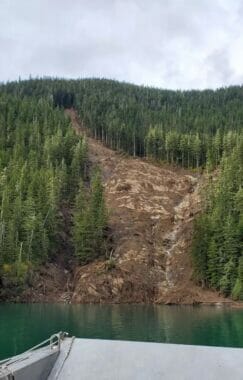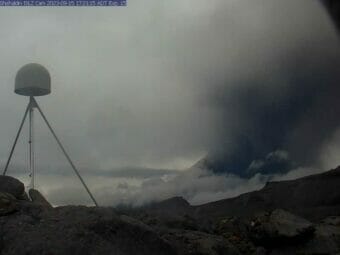
An aerial photo shows the Mt. Leeper airplane crash site and debris field in Wrangell-St. Elias National Park on Sept. 5, 2023. (Courtesy of NPS/Harper)
Recovery efforts for a small plane that crashed in Wrangell-St. Elias National Park last month have been called off.
Clint Johnson with the National Transportation Safety Board said it’s rare that a wreck is this inaccessible.
“It’s not often we see this where we can’t get to an accident site or recover the victims or the wreckage,” Johnson said.
Alaska State Troopers reported on Aug. 28 that a Beechcraft Bonanza carrying two people had gone missing after leaving Glennallen the day before on the way to Ketchikan.
Officials say Clayton McMartin and Melissa McMartin from Roanoke, Texas were on the plane.
The plane was last heard from 18 miles inland of Cape Yakataga, near Yakutat.
A U.S. Coast Guard aircraft spotted wreckage in a glaciated area with deep crevasses near Mt. Leeper in Wrangell-St. Elias National Park on Aug. 28.
National Park staff, Alaska State Troopers, and the National Transportation Safety Board have been attempting to recover the wreckage since then, but poor weather conditions hampered early efforts.
Now, officials say that the wreckage location, in an area with deep crevasses, is permanently inaccessible.
The NTSB preliminary report does not give a clear reason for the crash, but Johnson said that based on the information they have and photos of the crash site, it was a high-speed crash.
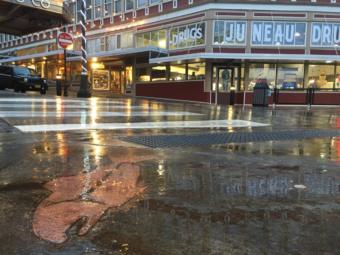
Water over roadway sign on Glacier Highway on August 13, 2021 in Juneau Alaska. (Photo by Lyndsey Brollini/KTOO)
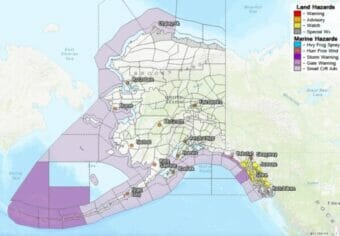
Heavy rainstorms beginning Wednesday night may trigger flooding and landslides for some neighborhoods around Juneau. The National Weather Service has issued a flood watch from Thursday morning through Friday morning.
NWS Meteorologist Andrew Park said that communities across the panhandle, including Sitka, Petersburg and Juneau, should expect 2 to 4 inches, with the heaviest showers coming Thursday afternoon.
“This atmospheric river is going to push multiple rounds of precipitation from now through Saturday,” Park said.
Park said that kind of rainfall typically happens every two to five years, and it’s enough to raise water levels in small creeks and streams. In Juneau, neighborhoods around Lemon Creek, Montana Creek and Jordan Creek should be wary of minor flooding on roads and low-lying areas.
The rainfall is unlikely to cause flooding for the Mendenhall River.
Park said heavy rains could also trigger small, isolated landslides in neighborhoods with steep terrain across Sitka, Kake and Juneau.
Park said the weather service does not have a formal warning system for landslide events, but people in those neighborhoods should keep a close eye on further communications from the city.
Mariners should also be wary, as the storms will bring strong, gale force winds to areas like Icy Strait and Hawk Inlet.
“Before you get on the water, check the current conditions and check the forecast,” Park said.
Though the heaviest rainfall is expected to subside by early Friday, showers will continue through the weekend.
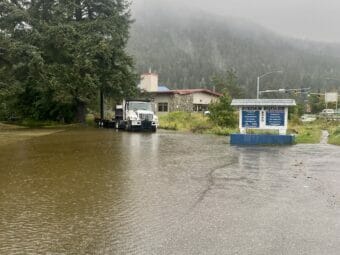
Erosion near the end of Main Street on Sept. 11, 2023. (Phillip Manning/KTNA)
The Matanuska-Susitna Borough has declared a local disaster for Talkeetna after high water caused rapid erosion in the community.
According to a statement by the borough Tuesday morning, the disaster declaration allows access to emergency funding as well as support from state and federal agencies. It also allows for emergency response plans to be carried out.
Downtown Talkeetna lies at the confluence of the Susitna, Chulitna and Talkeetna rivers. Multiple days of heavy rain resulted in high water throughout the Northern Susitna Valley earlier this month.
That high water event destroyed over 300 feet of the rock revetment near the end of Talkeetna’s Main Street, meant to stabilize and protect the riverbank from erosion. In less than a day, the riverbank was eroded back more than 60 feet, threatening some cabins near the river.
Last Friday, the borough authorized transporting 900 tons of rock to the end of Main Street to stage for future repairs. Staff from the borough’s public works department and the U.S. Army Corps of Engineers have visited the site multiple times since last week.
According to borough spokesman Stefan Hinman, the public works department and the Army Corps of Engineers are working on both immediate protective measures and long-term repairs.
Skilak Lake in the Kenai National Wildlife Refuge. Skilak Glacier Lake started releasing on Thursday, sending water into Skilak Lake and ultimately down the Kenai River. (Sabine Poux/KDLL)
A rare double glacial dam release into the Kenai River is causing high water levels and flood risks on the Kenai Peninsula.
Two glaciers — the Snow and Skilak — are releasing large amounts of water at once, which is flowing downstream into the Kenai. The phenomenon is a glacial dam release, which can happen after part of a glacier melts, leaving behind a seasonal lake where ice used to be.
“And that is dammed up by the main glacier. Every couple years, when that gets full, it releases. It’s enough of what we call hydrostatic pressure that it can force its way under the glacier, and then it will all flow out within a couple of days,” said Kyle Van Peursem, a forecaster at the Alaska Pacific River Forecast Center in Anchorage.
Photos of Skilak GDL taken by Mike Davidson this AM. Notice the bathtub ring of ice and how much water is still left to drain. Flood warning out for Kenai River downstream of Skilak Lake. Expect moderate flooding at Kenai Keys, approaching Sept 2012 levels.#akwx@NWSAnchoragepic.twitter.com/xF1Cn1O09i
Usually, these two glacial lakes release every two or three years, but two at the same time is unprecedented.
“It’s pretty rare that those go in the same year, even more rare that they go within a few days of each other,” he said.
It’s also unexpected, because the Snow Glacier Lake also released last year. Van Peursem said there’s no good explanation for why that’s occurring.
He said the Snow Glacier lake began releasing water Wednesday into the Snow River and down to Kenai Lake. Skilak Glacier Lake started releasing on Thursday, sending water into Skilak Lake and ultimately down the Kenai River.
The low-lying Kenai Keys area in eastern Sterling is at the biggest risk for flooding.
“They’re already seeing some pretty high water in the Kenai Keys. Our observer there is giving us observations, saying the canals in the Keys are completely full, and the roads are about to be inundated overtop by water,” he said.
?(1/2) UPDATE: Flooding cont for the Kenai River from the Snow & Skilak Glacier-Dammed Lakes (GDLs) releasing
Key Updates: ⚠️Flood ADVISORY ISSUED for Kenai River (downstream of the bridge in Soldotna) ❗Flood WARNING REMAINS in effect for Kenai River (Cooper Landing to Skilak) pic.twitter.com/YjXFKC9yhb
A glacial dam release is the same type of event that caused major flooding and damage in Juneau in early August. But Van Peursem says the Juneau release was a 1,000 year event — this double release on the Kenai may be unprecedented, but it’s not expected to bring that level of destruction.
Van Peursem said the peak threat will be tomorrow, but a warning remains in place through next weekend. He advised boaters not to create a wake through those high water areas, where it would cause even worse flooding for riverside residents.
The Malaspina Glacier, located on the edge of Wrangell-St. Elias National Park near Yakutat. (U.S. National Park Service)
The National Park Service has identified the two people who are presumed dead in a plane crash that happened last week in Wrangell-St. Elias National Park.
Clayton McMartin, 59, and Melissa McMartin, 58, from Roanoke, Texas were believed to be on the plane.
Alaska State Troopers reported on Aug. 28 that a Beechcraft Bonanza carrying two people had gone missing after leaving Glennallen the day before on route to Ketchikan. It was last heard from 18 miles inland of Cape Yakataga, near Yakutat.
A U.S. Coast Guard aircraft spotted wreckage in a glaciated area with deep crevasses near Mt. Leeper in Wrangell-St. Elias National Park.
Recovery efforts are ongoing in coordination with the National Transportation Safety Board, according to the Park Service.
In this Friday, Sept. 29, 2017, photo, Lexi Montgomery poses with supplies she has purchased in the event of another storm, in Miami Beach, Fla. Hurricane Irma was the first hurricane that Montgomery ever experienced. (Alan Diaz/AP)
Sherri McKinney, the national spokesperson for the Red Cross, knows just how unpredictable natural disasters can be. She lived through the deadly Nashville tornadoes in 2020 – the 6th costliest tornado in U.S. history. 25 people died, over 300 were injured, and the city suffered 1.6 billion dollars in damage.
The tornado hit overnight quickly and unexpectedly, leaving McKinney and others without any time to evacuate ahead of it touching down.
“Emergencies are more common than people may think, and disasters happen anywhere and any time. It can even begin in someone’s own home,” said McKinney.
McKinney says that proper preparation can make navigating a disaster event less difficult.
“Being prepared for any type of emergency or disaster can make the difference between life and death,” McKinney added. “We can’t stress that enough. Have a plan, have a kit, and know how to evacuate your area.”
After a disaster happens, it could take days before first responders are able to reach people. And it’s usually friends or neighbors in your community who can get to each other first.
Lea Crager, FEMA’s Ready Campaign Director, says there are still steps you can take to prepare yourself for situations where your access to medical assistance is limited.
“That’s why we tell people [to] take a CPR class, have a first aid kit, know that if something happened in your neighborhood or community, you may be having to help some of your neighbors or they may be having to help you,” said Crager.
Crager added that the more prepared you are as a community, the easier it is on first responders. Because there are only so many resources to go around.
A go bag is an important part of your emergency prep
The Red Cross is helping recovery efforts in Maui, and McKinney is stationed there. Following a disaster like the Maui fires, McKinney says people are most in need of food, water, and clothing.
“I think people may think they’re ready when something’s going to happen. But they usually haven’t taken the time to know where a few key items are in their house or things they might need in case of an emergency,” said Crager. “You kind of take for granted that everyone will know what to do. But when real events happen, a lot of times, people are stressed and don’t think as clearly.”
When it comes to a properly stocked go bag, McKinney suggests packing several essential items. Your go bag should be ready with a three-day water supply per person. Make sure that you have foods that are shelf-stable and don’t have an expiration date. You should also include first aid supplies.
“We heard of people leaving here with burns on their legs and arms. To have that emergency kit with product in it that you can treat a quick burn or a quick cut is critically important sometimes,” McKinney said.
It’s important to start slowly building an emergency kit that you can keep nearby, such as in your garage or closet. You can start by buying one item at a time. Or you may opt to create a full list of items you need in your go bag and purchase them in bulk. No matter how you choose to build your go bag, the Red Cross says a go bag should have enough items in it for your entire family for three days.
But the amount of food and water you should have is dependent on where you live. Some local or state officials ask for you to have more than three days of items.
“If you live on an island like Puerto Rico, they request you have 7 to 10 days worth of supplies,” said Crager. “If logistical chains are broken, it’s going to take longer to get aid and relief to some areas. So if you’re in a more rural area, you’re probably going to need more than someone who’s in an area where you’re going to have resources readily available.”
You can visit the Red Cross website for a full list of basics to have in your own go bag.
These items include:
1. Water: one gallon per person, per day (3-day supply for evacuation.)
2. Food: non-perishable, easy-to-prepare (3-day supply for evacuation)
3. First aid kit
4. Medications (7-day supply) and medical items.
5. Copies of personal documents (medication list and pertinent medical information, proof of address, deed/lease to home, passports, birth certificates, insurance policies)
6. Family and emergency contact information.
FEMA emphasizes that everybody will have a different list because everybody’s needs are different.
“What my mom needs in her bag or what your coworker needs are all going to be different things. Do you have a pet? Do you have children? Do you have prescription medication? Look at what your needs are and what you’re going to need to be able to leave your house,” said Crager.
While stocking their go bags, people often forget about their medications. When there’s a disaster, The Red Cross will replace any and all medications, as well as medical equipment, eyeglasses, and other health needs. “We do see people many times evacuating and they leave that all behind,” McKinney said.
Another common item to forget is personal documents like a renter’s agreement or the deed to your house. Crager says that FEMA always tells people to save backup copies of these documents in the cloud.
If you don’t want to start an emergency kit from scratch, McKinney says the American Red Cross has go kits or emergency kits on their website redcross.org. She says they make great gifts for weddings, Christmas, and for people who are going to be new homeowners.
“It’s really important that we think of that kind of gift as a gift of life,” she said. “To make sure that we’re protecting our loved ones.”
But FEMA stresses that a ready-made go bag needs to be customized to your needs. Crager suggests you sit down and go through the bag with your family to make sure it has all your essential items.
Don’t forget to craft a detailed emergency plan
And while building an emergency go bag is crucial, McKinney emphasizes the importance of also talking to your family and making an emergency plan to stay in touch if you’re separated during a natural disaster.
It’s important to include your children in these conversations too. Tell them someone they can reach if they can’t reach you, where they should go, and where they can meet up with you again.
“If a disaster happens, people think they’re going to be with their children. And we’re seeing more and more that disasters can happen while kids are at school or at an after-school program. And parents can’t reach their kids,” said Crager. “So have those conversations where everyone would know the roles we would play and what we’d have to do if we were separated.”
Copyright 2023 NPR. To see more, visit https://www.npr.org.
Close
Update notification options
Subscribe to notifications
Subscribe
Get notifications about news related to the topics you care about. You can unsubscribe anytime.