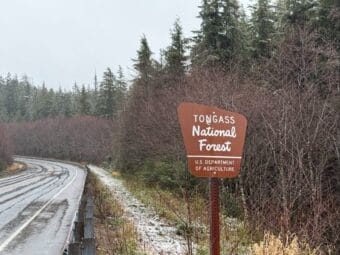
The end of the road leading out of King Cove. June 2024 (Theo Greenly/KUCB)
A controversial stretch of road connecting two Eastern Aleutian communities is heading toward construction.
The Alaska Department of Transportation has applied for a U.S. Army Corps of Engineers permit to build the road and is taking public comments on the proposed work until Jan. 12.
The 19-mile road would pass through the Izembek National Wildlife Refuge, connecting King Cove residents to nearby Cold Bay. King Cove community leaders say the single-lane, unpaved road could provide life-saving access to Cold Bay’s all-weather airport, but conservation groups have fought the proposal for decades.
The refuge will swap 490 acres of land for the road, in exchange for about 1,700 acres of the corporation’s land. According to the permit, King Cove Corp. also relinquished its selection rights under the Alaska Native Claims Settlement Act to 5,430 acres of land within the Izembek Refuge, which means it gave up its legal ability to select those parcels under ANCSA in return for the agreed land exchange.
Several environmental groups and dozens of Alaska tribes have called for the road to be stopped. They say the refuge shouldn’t be developed because it would threaten wildlife, some of which are precious subsistence resources for communities across the state.
Subsistence is also part of King Cove’s argument in favor of the road. The tribal government says the road would help them access their own subsistence lands, much of which is inaccessible except by boat.
According to the Corps, the road would cross numerous streams, some of which are home to spawning salmon. The project area also covers the habitat of endangered and threatened species, like the Steller’s eider and the short-tailed albatross.
The corps will consult with various organizations, including the U.S. Fish and Wildlife Service, the State Historic Preservation Office and federal tribes before issuing permits. They are also accepting public comments during the application process.
Comments can be submitted via email or sent to the Army Corps field office in Fairbanks. You can find more information on the Army Corp’s website.
The ferry terminal at Pier 1 in Kodiak is seen on July 14, 2021. (James Brooks/Alaska Beacon)
A years-old mistake by the Alaska Department of Motor Vehicles voter registration program has endangered the citizenship of two prominent Kodiak residents and could cause them to be deported, according to a newly filed lawsuit in Alaska’s federal court.
The suit, filed Thursday by Eva Benedelova and Pavel Benedela in the U.S. District Court for the District of Alaska, says U.S. Citizenship and Immigration Services canceled their citizenship oath ceremony because they were erroneously registered to vote in Alaska when they updated their driver’s licenses in 2022.
USCIS is overdue on a decision about their citizenship, the suit claims, and it asks a judge to order final action.
Attorney Margaret Stock, who is representing the couple, said there’s a bigger issue at stake: Many more Alaskans may unknowingly be facing the same problem.
According to a timeline provided by the Alaska Division of Elections, between 2022 and 2024, “less than 50” Alaskans, “mostly non citizens,” were “being registered to vote through DMV online transactions such as address updates, license renewals, etc.” despite stating that they were not U.S. citizens and did not want to register to vote.
The Division of Elections admitted the error involving the Kodiak couple, apologized, and wrote a letter saying that Benedelova and Benedela did nothing wrong. The couple never voted and immediately canceled their voter registration when they discovered the problem.
Alaska Senate President Gary Stevens, R-Kodiak, and Rep. Louise Stutes, R-Kodiak, submitted a letter of support for the couple. The office of U.S. Sen. Dan Sullivan, R-Alaska, has also been working on the case and advocating for the couple. The couple’s employer, North Pacific Seafoods, backs them too.
“The errors in 2022 and 2024 were committed by the Alaska DMV, not by these upstanding individuals,” wrote Dave Hambleton, President of North Pacific Seafoods.
Despite that support and extensive documentation about the error, USCIS sent a letter to Pavel Benedela on Dec. 5 stating that the federal agency is seeking further evidence and that “false claims to U.S. citizenship and voting violations … even renders an alien deportable.”
The couple have two children who have grown up in the United States, Stock said. If either one of them becomes a citizen, the children will, too. If they don’t, all could be deported.
“It’s an insane situation,” Stock said. “It shouldn’t be happening. It’s not right. It’s unjust. The state’s at fault, and they shouldn’t be punishing these folks because of errors made by State of Alaska employees.”
According to the complaint, the delay in the Kodiak couple’s citizenship application appears to be due in part to a federal policy implemented by USCIS in May 2025 that requires the agency’s headquarters to approve all matters where an applicant has been registered to vote in the United States.
“By the way, blanket policies like that are unlawful,” Stock said.
According to a timeline of events provided by the Alaska Division of Elections, the errors affecting the Kodiak couple and an unknown number of other Alaskans took place at the DMV between 2022 and 2024.
Alaska law allows people who update their driver’s licenses — or get new ones — to automatically register themselves to vote.
It’s supposed to be an opt-in process, but in 2022, an update to DMV’s system “cause(d) online transactions with DMV to automatically opt-in people who don’t select either yes or no,” an act that sent voter registrations to the Division of Elections, the division’s timeline states.
In the case of Benedelova and Benedela, someone along the process — likely a state employee — filled out the voter registration form in their name, copying their signatures without their knowledge or consent.
“I confirm that Mr. Benedela and Mrs. Benedelova did not specify on any DOE document that they are U.S. citizens,” wrote elections supervisor Ryan Wilson on Dec. 12. “Additionally, your signatures on the voter registration forms are a digital copy of which neither of you was aware of its use.”
Stock said that while Benedela and Benedelova are the only people who have come forward publicly about the issue, she is aware of others in the same position.
“I can tell you that I know other people the same things happen to, so it’s not just a one-off with these two people,” she said.
Stock said that in her career, she’s seen many examples of people mistakenly registered to vote because of a lack of understanding about what a citizen is, but this case is something different.
“The creepy thing is that the registration form says you’re not allowed to use an electronic signature on it, but the state’s been doing that anyway. … We have a copy of their voter registration form, and the state created that on their own, without the immigrants’ knowledge, and submitted it and checked off that they were US citizens. Some employee of the state is really doing bad things, basically,” Stock said.
A spokesperson for the Alaska Department of Administration, which oversees the DMV, did not answer questions by the deadline for this article on Friday.
The Division of Elections, which has been examining the issues for years, provided detailed documentation and explanations, as well as an apology it sent the couple.
According to its timeline of events, Benedelova was registered to vote through the DMV process in September 2022.
The division became aware of noncitizens being registered to vote by the DMV in 2023 or 2024 and worked with the DMV to reword their forms and change the process so people who opted out did not have their information sent to the division.
An additional question was also added to the process: “Are you a U.S. Citizen?”
Despite those changes, the effects of the erroneous process appear to be lingering. This summer, the U.S. Department of Justice asked Alaska and other states to provide copies of their voter rolls in order to identify noncitizens who may have illegally participated in state or local elections.
The data provided by the division and obtained by the Beacon via a public records request included an inactive voters list with 541 people whose records were tagged as “NC” for non-citizen.
Among those 541 people were Benedelova and Benedela, who had canceled their registrations in 2024 immediately after learning they had been erroneously registered.
At the time the record was released, the director of the Division of Elections said to treat it cautiously because some people might have been erroneously labeled.
“When we have gone in there and looked and contacted them, we have found that usually it was a mistake,” she said.
Moonrise over the U.S. Capitol on Oct. 18, 2021. (Brett Davis)
WASHINGTON — It’s been a rough year for Alaska’s 15,000 federal employees. Along with job losses and funding uncertainty, in March President Trump signed an executive order to take away union protections from a large swath of the federal workforce.
But the U.S. House gave public employee unions a ray of hope last week.
The Republican-led House delivered a rare rebuke of Trump and passed a bill to restore union rights for federal employees.
Twenty Republicans joined Democrats to pass it. Alaska Congressman Nick Begich wasn’t among them.
Stephanie Rice, a federal worker from Anchorage, said she was surprised by his vote, given Alaska’s high number of federal jobs.
“That’s 4.6% of the state’s total employment. That’s a huge chunk of his constituents that are directly impacted by this legislation,” she said. “And so I was very disappointed to see that he didn’t vote to restore our collective bargaining rights.”
Rice is president of National Federation of Federal Employees Local 1945. She works for the Bureau of Land Management’s National Operations Center but said she’s speaking for herself and her union, not the agency.
Begich didn’t respond to an interview request nor provide a statement explaining why he voted no.
But James Comer, R-Ky., who led the debate against the bill on the House floor, said Trump got rid of union contracts to provide more effective personnel management and “more streamlined disciplinary procedures” for federal employees.
“The reality is that pre-existing union agreements the president never signed onto can subvert these efforts,” Comer said. “They provide barriers to accountability beyond basic employee protections that exist in law.”
Begich’s vote, and his position on organized labor more generally, align with most Republicans in Congress, but it marks a departure for Alaska’s congressional delegation.
The AFL-CIO ranked Alaska’s Dan Sullivan and Lisa Murkowski as the Republican senators who most often voted pro-union in the last Congress. And unions were big contributors to the late Congressman Don Young’s political campaigns.
“Congressman Young always said that the unions weren’t the enemy. They were the canary in the coal mine telling Congress when things were wrong in the facilities or the agency,” recalled David Traver, chief steward of AFGE Local 3028, which represents employees at the Veterans Affairs medical center in Anchorage.
Traver said Begich hasn’t shown an inclination to be the champion of organized labor that Young was.
Begich last year won the endorsement of the National Right to Work Committee, a counter force to union power, while the AFL-CIO endorsed his opponent.
Unions like the one at the Anchorage VA are still representing employees, but Trump’s order in essence tore up their contract. Travers said it leaves workers vulnerable to unfair treatment.
The House-passed bill to restore union contracts hasn’t gone before the Senate yet. Labor leaders say a likelier route for becoming law would be as part of a government spending bill next year.
The Mendenhall Glacier Visitor Center on Friday, Feb. 21, 2025. (Photo by Clarise Larson/KTOO)
Listen to this story:
A U.S. Forest Service plan to revamp the Mendenhall Glacier Visitor Center to accommodate more tourists could be upended by a lawsuit brought by a nearby homeowner.
Katharine Miller has lived in the Dredge Lake area near the visitor center for about 22 years.
“It’s my backyard,” she said. “I do spend quite a bit of time there.”
Last July, she sued the Forest Service, claiming the agency violated the National Environmental Policy Act, or NEPA, when it designed its visitor center improvement plan. The plan expands facilities and increases the cap on the number of visitors allowed to come through commercial tour operators.
Miller’s lawsuit argued that the Forest Service planned the project to accommodate more tourism without considering other options, which it’s legally required to do. In September, a federal court agreed and ruled in her favor.
Now, she’s requesting that the U.S. District Court for Alaska throw out the improvement plan altogether. The Forest Service is asking the court to leave the plan in place, arguing there’s a serious possibility the agency would reach the same decision to deal with existing overcrowding, and that revisions can be made instead.
But Miller said it mattershow the federal government arrives at decisions.
“Federal agencies like the Forest Service manage resources on behalf of the U.S. public,” she said. “They’re public resources, and I think it’s important to hold agencies accountable to include us in that process in a realistic way.”
Miller said she had objected to the agency’s process before the plan was finalized, but felt ignored.
On top of increasing the number of visitors tour companies can bring to the area, the improvement plan includes building a new welcome center and five new cabins, improving the existing visitor center, paving more parking lots and expanding trails. According to the court decision, the improvements are based on an assumption that tourism will grow 2% per year and the agency’s position that it should strive to meet the demand.
In its ruling, the U.S. District Court for Alaska found the agency’s options for improving the facilities were all narrowly focused on facilitating more tourism. None focused on restricting the number of visitors.
Miller said the Forest Service should have considered a wider range of options beyond supporting tourism growth.
“Because this isn’t something that’s necessary, it’s something that you want to do,” she said in reference to the Forest Service. “So you need to explain, you know, why that’s better than figuring out a better carrying capacity.”
The annual visitor capacity for the Mendenhall Glacier Visitor Center is a little more than halfa million. The improvement plan allows for nearly double that — bringing the cap to 999,000 — with 87% allowed to be allocated to commercial use.
The U.S. Department of Justice’s brief on behalf of the Forest Service argues the agency can delay raising the capacity and revise parts of the plan that mention the 2% projected tourism growth.
Despite citing significant congestion, the Forest Service doesn’t have a system for consistently tracking exactly how many people go to the visitor center each year, according to Paul Robbins, a spokesperson for the Tongass National Forest. He said a safe estimate is probably around 700,000 per year. He wrote in an email to KTOO that an estimated million or so people visit the wider Mendenhall Glacier Recreation Area annually.
According to a court file the Forest Service submitted, the area’s busiest days over the summer of 2025 ranged from 3,849 to 6,257 visitors.
Robbins declined to comment on the status of the improvement plan due to the ongoing lawsuit. He said agency staff plan to address deferred maintenance at the visitor center in the fall of 2026, work that was supposed to happen this year. It includes things like lighting, HVAC, flooring and painting. He said this maintenance is not part of the improvement project.
It’s unclear when the court will decide whether to throw out the improvement plan as Miller wants, or choose a different way to address the Forest Service’s violation.
Alaska Organized Militia members, assigned to Task Force Bethel, survey Nightmute, Alaska, while conduct post-storm recovery efforts for Operation Halong Response at Oct. 27, 2025. (Courtesy photo by the Alaska National Guard)
The State of Alaska and the Federal Emergency Management Agency have extended their deadlines to apply for individual disaster assistance for those impacted by storms in Western Alaska, including Typhoon Halong.
How to apply for State of Alaska or FEMA individual assistance:
Or visit an assistance hub set up in Bethel through Dec. 19.
State and federal officials are continuing to encourage residents to register for both state and federal assistance programs to maximize their potential benefits. The new deadline for applications is February 20, 2026.
“We know that there may be more people out there, and we want to give them this opportunity to register,” said Jeremy Zidek, a spokesperson for the Alaska Division of Homeland Security and Emergency Management.
Zidek urged residents to apply for both assistance programs if they have experienced any level of storm damage. He said registrations can be updated once they have been filed.
“We always say that if people are unsure about their damages or unsure if they want to apply, to just go ahead and apply,” he said. “They can always amend their application at a later date. But after those deadlines, it becomes very difficult for us to register people, so we really urge anyone that had damage, even if it was a little bit of damage, to apply and go through the process.”
The state has received 1,920 aid applications and FEMA has received 1,630 applications for assistance as of Dec. 10. The programs provide relief for damage to homes, damage to essential personal property and medical, dental or funeral needs directly related to the disaster. State disaster aid also includes assistance for damage to subsistence camps. The Small Business Administration is also providing low-interest loans, including up to $100,000 for repairs to subsistence camps.
The state and FEMA have distributed over $41 million in disaster assistance as of Nov. 25, and have visited 43 communities.
An estimated 1,160 residents evacuated from Western Alaska following Typhoon Halong, with dozens of communities sustaining damage across the region.
Since the evacuations, 678 residents have been staying in hotels in Anchorage. The first group of families began moving into longer term housing last week, according to a state update. The state’s emergency management division is working with local property owners and non-profit partners to locate apartments and housing units throughout Anchorage for long-term housing for storm displaced residents.
Officials also set a Dec. 15 deadline for owners to claim pets. Over 200 dogs were evacuated from Western Alaska after the storms, and 21 dogs remain unclaimed. Pet owners who have not yet claimed their dogs can search for them at a website created by volunteers.
Federal disaster areas include:
The Northwest Arctic Borough
Lower Yukon Regional Education Attendance Area
Lower Kuskokwim Regional Education Attendance Area
State of Alaska disaster areas include:
North Slope Borough Northwest Arctic Borough
Yupiit Regional Education Attendance Area
Lower Kuskokwim Regional Education Attendance Area
Bering Straits Regional Education Attendance Area
Lower Yukon Regional Education Attendance Area
Kashunamiut Regional Education Attendance Area
Pribilof Islands Regional Education Attendance Area
Pollution response teams from U.S. Coast Guard Sector Western Alaska and U.S. Arctic conduct post-storm assessments in Kipnuk, Alaska, Oct. 22, 2025, after the community was impacted by severe flooding from Typhoon Halong. Personnel deployed to affected areas to identify pollution concerns and work with state, federal, and industry partners to conduct clean-up operations. (U.S. Coast Guard photo by Petty Officer 1st Class Shannon Kearney)
Photo of Anthony “Bone” Lekanof (Courtesy of Michael Livingston)
For those who haven’t filed for their Native allotments, Alaska Native veterans don’t have much time to claim 160 acres of federal land. The window for applications closes permanently on Dec. 29.
ANCSA ended 1906 Native allotment program
The land grants were part of a government program created over a hundred years ago, to promote homesteads and private property ownership. But the 1906 Native allotment program shut down in 1971, after Congress passed the Alaska Native Claims Settlement Act passed.
But in the years leading up to the land claims act, Natives scrambled to file for their land allotments. But during that time, a lot of Native Vietnam veterans missed out, because they were stationed overseas. Many were engaged in combat.
The Alaska Congressional delegation eventually succeeded in passing legislation to fix this. In 2019, President Trump signed a bill into law that opened a five-year window for Natives vets to claim their allotments. But despite the special exemption to apply for the land, it isn’t easy to do. There are still many hurdles.
Application process is “onerous”
“It’s one thing to make laws,” said Jim LaBelle, an Inupiaq Vietnam veteran. “But it’s quite another thing when the bureaucracy kicks in and starts developing these onerous processes that were never really anticipated.”
Jim and Kermit LaBelle at the Mount Edgecumbe boarding school in Sitka. (Photo courtesy of Jim LaBelle)
LaBelle’s challenges began before the war when he and his younger brother, Kermit, were in boarding school. He says they were unable to qualify for their allotments, because they were far from home and couldn’t prove they worked the land they hoped to receive.
(Photos courtesy of Jim LaBelle)
Then both brothers went to fight in the Vietnam War, and Kermit was killed in action at the age of 18.
After the war, LaBelle had about given up on efforts to claim his land but tried again. A few years ago, the government finally accepted his application.
Veterans unhappy with federal land available
“It took a little doing, but I managed,” he said. “And I can’t say I was very happy with the lands that I got.”
LaBelle wound up with land near the Interior Alaska community of Tok, far away from his Inupiaq homelands.
“It’s an area I’m not familiar with but was available at the time,” LaBelle said. “The way I look at the map, I’d have to have a helicopter to fly in.”
LaBelle is now focused on getting his late brother Kermit’s allotment. To do that, he needed a death certificate.
“I have to prove that he was killed in Viet Nam. I also have to prove that he had a CIB, Certificate of Indian Blood,” LaBelle said. Michael Livingston has volunteered to help vets like Jim LaBelle apply.
Michael Livingston, an Alaska Native veteran’s advocate, has volunteered to help vets like Jim LaBelle apply.
“It’s not a user-friendly process,” he said. “Out of the 2000-some veterans that are eligible, only about 500 of them have applied, so that’s only about 25 percent.”
Livingston believes the limited land available to veterans has discouraged them from applying but says age is probably the biggest barrier. He says most of the veterans he’s worked with are now in their 70’s and 80’s. Many are in poor health and don’t have the computer and internet skills it takes to navigate the bureaucracy, so they’ve given up.
Livingston says it also takes a lot of persistence, which he is willing to supply.
“So far, I’ve helped about 50 Alaska Native veterans apply for about 160 acres of land,” he said. “And that adds up to over 8,000 acres that potentially is going to return to the hands of Alaska Natives. So, in that sense, it’s been pretty rewarding.”
Livingston encourages Native vets to file before the Dec. 29 deadline, even if their application is incomplete. He says if veterans need help, it’s OK for them to email him at the following address: michaelpocatelloATgmail.com.
Sen. Dan Sullivan offers staff assistance
Alaska U.S. Senator Dan Sullivan also says vets shouldn’t worry about filing a complete form, that it’s more important to meet the deadline.
“Get your application in, we can work with you,” Sullivan said. “We can help. If it needs to be updated, we can do that.”
Sulllivan says staffers in his Alaska offices are prepared to assist. For now, he is racing against the clock to get a bill passed to extend the program.
“I just wish we could get my colleagues to see that this is not a big ask,” the Republican senator said. “Believe it or not, the bill is a two-word change. It’s from five years to ten years.”
Screen grab from Sen. Dan Sullivan’s Senate floor testimony on Nov. 19, 2025. In making a case to extend the deadline for Alaska Native Veterans to apply for Native allotments, he complained that attempts by Democrats to block his bill were part of an ongoing pattern to lock up Alaska federal land. (U.S. Senate)
In his advocacy for the extension, Sullivan reminds his colleagues that Alaska Natives veterans have some of the highest rates of service of any ethnic group in the nation.
“You’ll go to a small Native community and ask how many veterans there are,” Sullivan said, “and like, almost all the men in the town hall you’re doing, raise their hand.”
Although Sullivan has attempted to make new lands available for veterans to claim, his current bill, S785 and its companion House bill, HR410, does not include new land. It simply extends the application period to December 2030.
Sullivan says his bill has Republican support – and he’s worked with Democrats to attach his legislation to other bills that include things they want. But the senator believes they continue to block his extension, because they think it’s a backdoor attempt to usher in more development, which he says is not true.
“They’ve just been very reluctant to get more people land and access to federal lands in Alaska,” said Sullivan, who remains hopeful he’ll be able to win an extension in time.
“But just to be safe, get your application in before the end of the year,” he said.
Close
Update notification options
Subscribe to notifications
Subscribe
Get notifications about news related to the topics you care about. You can unsubscribe anytime.