A recount of Skagway municipal election ballots Monday shows the senior center bond question passing by five votes.
The Canvass Board counted 228 votes for the $6 million bond and 223 against. Those results are just slightly different than the initial ballot count last week.
The board tallied one more “for” vote in the recount.
Borough Clerk Emily Deach said that sometimes happens if the mark on the ballot is too light for the machine.
The borough assembly ordered the recount because the margin was so slim.
At last week’s assembly meeting, resident Nancy Corrington spoke out about the senior center and housing project.
Her input gave a window into why the vote may have been so close.
“I just think there are a lot of details that have not been really addressed,” Corrington said.
Corrington wondered about the $6 million price tag on the facility, which will include a permanent senior center and seven senior apartments.
“It’s like, oh you want a swimming pool? We’ll get you a swimming pool. You want senior housing? OK, we’ll get you senior housing. It’s just one thing after the next, it’s like saying yes to a child who doesn’t know how to stop himself from requesting because there are no boundaries set.”
Corrington isn’t the only one who is worried about the expense of the capital projects Skagway is taking on. The $6 million bond for the senior facility would bring the town’s bond debt up to about $29 million.
Proponents of the project say grant funding should ease some of the cost.
Borough Manager Scott Hahn said at last week’s assembly meeting that the Skagway Development Corporation was working with a tight deadline to apply for a grant for the project. The Greater Opportunities for Affordable Living grant comes through the Alaska Housing Finance Corporation.
“The GOAL grant has a million dollars in the pot, that’s for the entire state,” Hahn said. “In the pre-application, we said we’d apply for $250,000. But we can request the entire million dollars. I don’t know if that’s very wise.”
Hahn said the development corporation needed guidance from the assembly as soon as possible about whether to move forward with the GOAL grant application and how much to apply for.
Michael Baish is the chair of the senior ad hoc committee, which took the lead on the senior center initiative. When he heard the results of the recount, Baish said he was relieved. He said the close vote made the last week a bit stressful.
“It was tense, yeah. It was scary,” he said. “First time I’ve ever been scared by an election.”
When Baish learned of the results, he was hanging out at the Big Dippers building, which serves as a temporary senior center in fall and winter. Baish says he’s happy to think there may soon be a permanent gathering place for Skagway’s growing senior population.
“[I’m] happy that it’s gonna happen in my lifetime,” Baish said. “Because if it got shot down, who knows when it would start. The last attempt was in ’92.”
The results from the Canvass board are not official yet. They’re set to be certified by the assembly at the Oct. 20 meeting.
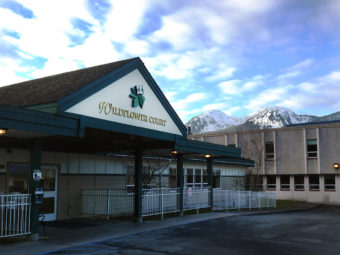
Wildflower Court is a non-profit, 57-resident long-term-care facility in Juneau. Inspectors in December documented five deficiencies there with potential for minimal harm. (Photo by Ed Schoenfeld/CoastAlaska)
So far this year, 10 nursing homes in Alaska have been cited more than 100 times for health or safety shortfalls, according to state and federal inspection reports.
The state has some of the highest rates of nursing home deficiencies in the nation, according to ProPublica, an investigative reporting outlet. But Alaska inspectors say context is important.
Alaska nursing homes are inspected on the state and federal level annually to make sure they’re meeting regulations.
Brenda Vincent runs the state’s program that oversees health facilities’ licensing compliance, which includes nursing homes.
She says the inspections are unannounced, and that over a few days, a small team of surveyors analyze everything from the fire safety code to treating residents respectfully.
Nursing Home Inspect
Lookup inspection reports from nursing homes in your community or elsewhere on ProPublica’s Nursing Home Inspect site at ProPublica.org.
“We use tools of observation, interviews, record reviews,” Vincent says,”all just to ensure that they’re being compliant and following state and federal regulations, and ensuring that the best care is delivered to residents in those facilities.”
Angela Rick has been inspecting nursing homes for eight years. She says that over time, there are some things that nursing homes are repeatedly cited for.
“Our most common ones would be dignity of the resident, so making sure that it’s a homelike environment and the resident is treated in the manner that you would want to be treated or your family member treated,” Rick said. “Infection control would be a common deficiency (as well).”
Rick says high turnover among nursing home staffers can contribute to some of the inconsistencies.
“We used to say that you’re only as good as your worst performer,” she said. “So it’s very difficult sometimes to monitor what the staff is doing, and so one person could make a mistake or could have a practice and that would cause you do a get a deficiency in that area.”
According to data from the Centers for Medicare & Medicaid Services, inspectors logged 147 deficiencies at the 10 Alaska nursing homes visited so far this year. Alaska has a total of 18.
Source: Centers for Medicare & Medicaid Services. (Graph by Lakeidra Chavis/KTOO)
Most of the deficiencies are categorized as causing minimum to no harm. Some incidents are isolated, some are repeated. There are serious deficiencies, too.
At the nursing home in Petersburg, for example, deficiencies included administering the wrong medication dose and not returning a resident’s money after the person died.
In Wrangell, a resident with a condition requiring a “nectar consistency” diet to reduce choking risk, reportedly used a spoon to drink over thickened coffee because a staffer added thickener without measuring. Other residents reported similar problems.
Vincent says although the number of citations is high, the goal is to keep these institutions accountable.
After each inspection, nursing home administrators are required to submit a plan of correction, which surveyors review.
“And if we find a deficiency, we need to bring that forward to the facility and let them know,” Vincent said. “You know, if you don’t, then change isn’t going to be made and that’s important. I mean, if you see something wrong, it needs to be corrected. If you don’t bring it to the light, then it just stays uncorrected.”
Nursing homes with severe deficiencies can rack up penalties. Since 2013, the agencies have fined nursing homes more than $100,000, or denied Medicare and Medicaid payments.
Source: Centers for Medicare & Medicaid Services. (Graph by Lakeidra Chavis/KTOO)
For the Prestige Care & Rehabilitation Center in Anchorage, the problems were so bad that the state took control of the facility last year to address the issues.
After a national investigation into nursing home safety, ProPublica, ranked the states with the most severe deficiencies in nursing homes. Their most recent data ranks Alaska as the fourth worst.
“Number-wise, we’ve heard that and I don’t know why,” she said. “I just think that we have a really good team.”
Vincent says that compared to the Lower 48, the turnover for Alaska inspectors is low and the nursing homes are a lot smaller.
She says in about a year, the state will switch to a newer model of surveying, following a national trend. It will combine the traditional boots-on-the-ground method with a computer-based survey.
Vincent says that it’s important for people to know that there is oversight. She worked as a registered nurse in Alaska before switching to the inspection side five years ago.
“I’m on the other side ensuring the care that you are getting is quality, and safe, and complies with best practices and standards that have been set,” she said. “So I really think that what I do and what my team does, makes a difference.”
Becky Hultberg is the president of the Alaska State Hospital and Nursing Home Association, which lobbies for its members.
She says inspection reports are just one of the ways to measure nursing home care.
Becky Hultberg, president and CEO of the Alaska State Hospital and Nursing Home Association, gives a presentation about Medicaid expansion at the Alaska Capitol, March 19, 2015. (Photo by Skip Gray/360 North)
“As an example, there are several CMS quality measures where Alaska skilled nursing facilities have better outcomes than most facilities in other states,” Hultberg said. “Specifically, Alaska does very well in preventing falls, reducing the use of antipsychotics and successfully managing the use of physical restraints.”
She says Alaska is a small state with a small number of nursing homes, and that calls the attention of federal regulators.
“I would note that there are times where we have more surveyors in a facility than we have residents…the ProPublica data was not a huge surprise to me,” she said.
Hultberg says a lot it has to do with a federal law she calls the minimum of five.
“The federal government is required to survey five percent of facilities in a state a year, or a minimum of five facilities,” Hultberg said. “Well if you’re a state that has hundreds of facilities, obviously you’re going to be getting fewer federal surveys, than a state like Alaska where we only have 18 facilities.”
Based on inspection reports alone, of the 10 nursing homes inspected so far this year, Alaska’s most deficient are the Prestige Care and Rehabilitation Center of Anchorage, Wrangell Medical Center and the Yukon Kuskokwim Elders Home in Bethel.
Human life spans have been increasing for decades thanks to advances in treating and preventing diseases and improved social conditions.
In fact, longevity has increased so much in recent decades that some researchers began to wonder: What is the upper limit on human aging?
“We never had so many centenarians as we have now,” says Jan Vijg, who studies molecular genetics at the Albert Einstein College of Medicine in New York. “Maybe we can actually live much longer than 100. Maybe this goes on and on and on.”
So Vijg decided to try to find out if that’s the case. His conclusion, published online Wednesday in the journal Nature: The seemingly inexorable rise in the human life span may have hit a ceiling of about 115 years.
“We cannot break through that ceiling,” Vijg says. “The take-home message essentially is this whole ever-increasing life expectancy of humans cannot go on.”
“Every year we looked at who was the one who died in that year and was the oldest human in existence,” Vijg says.
The researchers found that the age of the oldest people dying had indeed increased steadily between the 1960s and 1990s, according to their report.
But beginning in the 1990s, “you no longer see that,” Vijg says. “You see that it stays the same.”
The absolute maximum human life span may be as high as 125, the researchers calculated. But the chances of anyone actually living that long are less than 1 in 10,000.
“If we would have 10,000 worlds like ours, only one individual across all these 10,000 worlds would reach 125 in any given year,” Vijg says.
But, he added, “the take-home lesson from what we found is that the human species most likely has a maximum life span of about 115 and we cannot break through that ceiling, at least not as far as we now know.”
Other experts say it’s not surprising that human longevity may have hit a ceiling.
“Right now, all we’re doing is we’re combating one disease at a time: heart disease, cancer, stroke,” says S. Jay Olshansky, who studies aging at the University of Illinois and wrote a commentary article accompanying the report
“It’s like a game of whack-a-mole. You know: One disease goes down another comes up,” he says.
Olshansky says the only way that could change is if scientists figure out a way to fight the underlying cause of aging, not just individual diseases.
“That would be a game changer,” he says.
Scientists are conducting a range of research to try to do that, including studying the genes of families that seem to have a lot of members who live unusually long lives. Some are also trying to identify beneficial substances in the blood of young people that might improve their chances of having a long life, he says.
But no one expects scientists to discover some kind of pharmaceutical Fountain of Youth any time soon.
Copyright 2016 NPR. To see more, visit http://www.npr.org/.
Vandals caused up to $1,400 worth of damage earlier this week to vehicles that are dedicated to transporting seniors and people with disabilities.
Catholic Community Services operates Ketchikan Senior Services and the transit service for seniors and people with disabilities.
Marianne Mills, the Juneau-based director of Catholic Community Services, said she got a call early Tuesday morning reporting the vandalism.
“Five out of six of our vehicles had been vandalized,” she said. “On each of the five vehicles, one of the tires was slashed.”
Officials with the Ketchikan Senior Services discovered the vandalism at about 4 a.m., Mills said, and they contacted the police to give a report, before scrambling to get the vans fixed.
“Bob the mechanic at the borough was extremely helpful,” she said. “And the site manager and the dispatcher should be commended on how they just took care of everything so quickly with the help of Bob and Shaub, who provided assistance with the tires in a very expedient manner so we were able to continue our transportation service without turning down any of our para-transit clients, which is pretty amazing.”
The Ketchikan Gateway Borough contracts with the senior center to provide required ADA public transportation services.
The center also receives transit funding through the state, Mills said.
Ketchikan Police Department Deputy Chief Josh Dossett said police are investigating the vandalism, which took place in a gravel parking lot near Berth 4 downtown.
“There are security cameras in the area,” he said. “I don’t know if they actually covered that part of the lot. That’ll be part of the investigation to find out.”
Insurance should cover the cost of repairs to the five vehicles, Mills said.
She said repairs were completed quickly enough that they were able to maintain service for all of their scheduled clients.
When Alaska Vocational Technical Center, or AVTEC, closed its Allied Health Program in Anchorage this year, it was forced to end relationships with some rural communities that used AVTEC’s professors for their certified nurse’s assistant, or CNA, programs.
The good news for students in Bethel is that not much will change for them.
Jeremy Osborne, director of programs at the Yuut Elitnaurviat Learning Center, said that despite the AVTEC program’s closure, Yuut’s six-week CNA program will run as planned.
“So we were going to do this regardless of if they closed down or not, but when they decided to close down, we got the same instructors. It’s just a little bit cheaper,” Osborne said.
He said that because the instructors are working as independent contractors, it saves Yuut money. Not much, but that’s money that can be spent in other places.
The CNA program at Yuut already has been a direct path to jobs for many Delta residents.
Many graduates go to work at the Yukon Kuskokwim Elders Home, he said.
“It’s an amazing job. It’s very demanding, it’s elder care,” Osborne said. “And right now they’ve pretty much told us that they will take as many people as we can train.”
University of Alaska Fairbanks, Kuskokwim Campus in Bethel offers a similar semester-long program that will also continue as usual.
The Sitka Pioneer Home was the first such facility. It and others in Ketchikan, Juneau, Anchorage, Palmer and Fairbanks have lost staff due to budget cuts. (Photo by Emily Kwong/KCAW)
Alaska’s Pioneer Homes have stopped accepting new residents, at least for a while. It’s one more impact of state budget cuts.
The state’s six homes usually serve about 440-450 Alaskans at any given time.
State Pioneer Homes Division Director Vickie Wilson said reduced funding is dropping that number by about 30, or 7 percent.
“They are beds that we are not filling because we don’t have adequate staff to be able to ensure good, safe care,” she said.
Wilson’s agency has lost 30 positions, mostly because of attrition. And since senior care is labor-intensive, fewer people can be housed.
Jacque Farnsworth and Jack Brandt play for Juneau Pioneer Home residents earlier this year. (Photo by Lisa Phu/KTOO)
That means the homes, three in Southeast and three in the Railbelt, can no longer accept new residents in the highest category of care. It’s called Level 3, and it’s pretty much like a nursing home, with 24-hour, hands-on assistance.
“Right at the moment, it’s all six of them. No one’s taking any of the level 3s right at this point,” she said.
More than half of all residents, and a large number of applicants, are in that category. Two lower levels, different types of assisted-living care, require less staffing.
Wilson said seniors seeking such care might have a chance to get a bed. But, probably not right away.
“We would look carefully at their level of care and see if we could manage them with the staff that we have,” she said.
“This is devastating,” said Ann Secrest, communications director for the Alaska branch of AARP, a nationwide senior advocacy group.
She said Alaskans are living longer and staying at home as late as they can. But there comes a time when more care is required. So pioneer home cuts remove a much-needed option.
“The majority of individuals are cared for at home. There are approximately 120,000 and 128,000 Alaskans who serve as unpaid family caregivers. So there’s going to be more of a burden put on those unpaid family caregivers throughout the state,” she said.
Alaska, overall, falls far short of providing the care its seniors desire.
The Ketchikan Pioneer Home is one of six in Alaska caring for older residents. (Photo by KRBD)
“We have the fastest growing senior population in the nation, by percentage. There’s nothing much we can do about that,” she said.
She said it’s no surprise pioneer homes are facing cutbacks. But she objects to those who say reductions don’t have to affect services.
“Some people call it the low-hanging fruit. I don’t. We’ve already cut all of that off. We’re now into the mid-level branches,” she said.
Residents, or their families, do pay for part of their care. Charges run from about $2,500 to $7,000 per month.
The state considered turning the homes over to the private sector to save money. But it’s dropped that idea, though services such as pharmacies could still be privatized.
Of course, beds open up as residents die. Pioneer Homes Director Wilson said 20 to 25 percent of beds become available each year.
That could allow more new residents in. But Wilson said that’s only if funding remains the same.
“Being a realist, as we take cuts, we will continue to have to consider that more beds will have to be cut,” she said.
Even in better times, it’s hard to get into a pioneer home. As of mid-summer, close to 600 people were on the active waiting list.
The inactive list, those waiting until they’re in greater need, is much larger.
Note: Finding residential care is just one of the challenges facing older Alaskans and their families. CoastAlaska’s Aging Southeast series, produced earlier this year, describes other concerns.
Close
Update notification options
Subscribe to notifications
Subscribe
Get notifications about news related to the topics you care about. You can unsubscribe anytime.