Buzz Aldrin, who walked on the surface of the moon with Neil Armstrong in 1969, is being medically evacuated from the South Pole, the National Science Foundation says.
Aldrin, 86, was visiting Antarctica as part of a tourist group. In a Tweet about the trip on Monday, Aldrin wrote, “We’re ready to go to Antarctica! May be our last opportunity to tweet for a few days! We’re go for departure to the launchpad!” and tagged his manager, Christina Korp, and another apparent travel companion.
A second Tweet showed Aldrin and a group of about a dozen travelers whom he referred to as “Buzz’s Polar Penguins.”
The tourist company with which they were traveling said in a statement that Aldrin’s condition had “deteriorated” during his visit to the South Pole station.
“As a precaution, following discussion between the White Desert doctor and the US Antarctic Program (USAP) doctor, Mr Aldrin, accompanied by a member of his team, was evacuated on the first available flight out of the South Pole. … His condition was described as stable upon White Desert doctor’s hand-over to the USAP [medical] team.”
The National Science Foundation, which manages the U.S. Amundsen-Scott South Pole Station, said in a statement that it had provided the evacuation flight on Thursday from the South Pole station to another U.S.-run station on the Antarctic coast, and then to New Zealand.
The NSF said the first leg of the evacuation was on a ski-equipped cargo plane flown by the Air National Guard, which provides planes to and from U.S. installations in Antarctica.
Aldrin was one of three astronauts on NASA’s Apollo 11 mission to the moon, on which he was tasked as the lunar module pilot and rendezvous expert. A live video allowed people on Earth to watch as he and Armstrong became the first two men to set foot on the moon’s surface.
Aldrin retired from NASA in 1971. In recent years, he has advocated for a manned mission to Mars.
Copyright 2016 NPR. To see more, visit http://www.npr.org/.
Cuban-Americans celebrate upon hearing about the death of longtime Cuban leader Fidel Castro in the Little Havana neighborhood of Miami, Fla., on Saturday. AFP/AFP/Getty Images
Fidel Castro, the controversial ruler who took power during the Cuban revolution in 1959 and led his country for nearly half a century, died in Havana, Cuba, at age 90.
Castro lived through 10 U.S. presidents who were determined to overthrow him, as NPR’s Tom Gjelten reported, in addition to surviving the collapse of the communist alliance that bolstered his success.
The former president has suffered ill health since undergoing emergency intestinal surgery in July 2006, when he ceded power to his younger brother, Raúl, who formally assumed the presidency in 2008.
In a short, televised message, an emotional President Raul Castro announced that his brother had passed at 10:29 p.m. late Friday night, as NPR’s Carrie Kahn translates:
“With profound pain I share with our people and the friends of America and the world that today, on the 25th of November at 10:29 p.m., the head commander of the Cuban Revolution, the comrade Fidel Castro Ruz died. In following the wishes expressed by Fidel, his remains will be cremated.
“In the early hours of tomorrow, Saturday the 26th, the funeral organizing commission will provide the people detailed information about the organization of a posthumous tribute to the founder of the Cuban Revolution. Towards victory forever.”
Castro’s rule was marked by his relationship with two global powers: the Soviet Union as his ally, the U.S. as his adversary, Tom tells our newscast.
“The Eisenhower Administration initially welcomed Castro to power; but as a nationalist he was determined to assert Cuba’s independence from the United States, and by early 1960, Castro was reaching out to the Soviet Union for support. Before long, the U.S. government was helping Cuban exiles who wanted to overthrow Castro or even have him assassinated.
“The Soviet Union meanwhile gave Castro billions of dollars per year — enough to support health and education programs that won Cuba praise around the world. Castro lost that help when the Soviet Union collapsed; Cuba soon became impoverished.
“Relations with the U.S. never really improved during the time he was in charge, and Fidel Castro will be remembered as much for what he survived as for what he achieved.”
The death of the polarizing former president has set off both mourning and celebration worldwide.
Silence has swept much of Cuba. The Cuban government announced Saturday morning that Castro’s ashes will be interred on December 4, following nine days of national mourning, which officially began at 6 a.m. on Saturday.
As CNN notes, citing the state-run outlet, Granma, “During this time, all activities and public performances will stop, and the flag will be flown at half-staff in public and military establishments. Radio and television will broadcast patriotic and historical programming.”
Fidel Castro was one of the most iconic personalities of the 20th century. India mourns the loss of a great friend.
Foreign allies are paying tributes and expressing sorrow on Twitter, including Indian Prime Minister Narendra Modi and Mexican President Enrique Pena Nieto, who said Castro “was a friend” of Mexico.
Venezuela’s socialist President Nicolas Maduro said “revolutionaries of the world must follow his legacy.”
President Obama released a statement acknowledging the United States’ fraught history with Cuba under Castro’s regime and the two countries’ renewed diplomatic relationship. He also said:
We know that this moment fills Cubans – in Cuba and in the United States – with powerful emotions, recalling the countless ways in which Fidel Castro altered the course of individual lives, families, and of the Cuban nation. History will record and judge the enormous impact of this singular figure on the people and world around him.
Obama’s statement concluded: “Today, we offer condolences to Fidel Castro’s family, and our thoughts and prayers are with the Cuban people. In the days ahead, they will recall the past and also look to the future. As they do, the Cuban people must know that they have a friend and partner in the United States of America.”
On Saturday morning, President-elect Donald Trump tweeted: “Fidel Castro is dead!”
Trump later released a longer statement saying his “administration will do all it can to ensure the Cuban people can finally begin their journey toward prosperity and liberty.”
Meanwhile, just some 200 miles from Havana, the Cuban exile community in Miami, Florida’s Little Havana, are spilling into the streets in jubilation, waving Cuban flags, cheering and dancing.
Cuban-Americans in Congress also reacted to the news of Castro’s death. Democratic Sen. Bob Menendez of New Jersey released a statement that read, in part:
Since he took power over half a century ago, Fidel Castro proved to be a brutal dictator who must always be remembered by his gross abuses of human rights, systemic exploitation of Cubans, unrelenting repression, and stifling censorship upon his own people.
Fidel’s oppressive legacy will haunt the Cuban regime and our hemisphere forever.
In a statement, Republican Sen. Ted Cruz of Texas said:
Fidel Castro’s death cannot bring back his thousands of victims, nor can it bring comfort to their families. Today we remember them and honor the brave souls who fought the lonely fight against the brutal Communist dictatorship he imposed on Cuba.
Republican Sen. Marco Rubio of Florida echoed these sentiments in his statement, adding:
The dictator has died, but the dictatorship has not. And one thing is clear, history will not absolve Fidel Castro; it will remember him as an evil, murderous dictator who inflicted misery and suffering on his own people.
And Republican congresswoman Ileana Ros-Lehtinen of Florida’s 27th district celebrated Castro’s death on Twitter.
The U.S. is home to roughly 2 million Cuban-Americans because they, or the generations before them, fled the island during Castro’s rule. The majority live in Florida, NPR’s Greg Allen reports to our newscast, where the U.S. government once launched failed attempts at overthrowing the young Castro regime:
“As Castro tightened his grip on Cuba, large numbers of people began fleeing the island. There were firing squads and property seizures. …
The first wave of exiles were mostly from Cuba’s elite, businessmen and professionals. They came to Miami where many began working on an urgent goal—to oust Fidel Castro and take back their homeland.
In Miami, a group of Cubans formed a paramilitary group, Brigade 2506. They worked with the CIA on a plan to retake Cuba after landing on a beach in the Bay of Pigs. The invasion was a disaster. More than 120 members of the invading force were killed. 1,200 were captured by Castro’s military. Most of those captured were released a year later.”
This post has been updated to include reactions to Castro’s death.
Copyright 2016 NPR. To see more, visit http://www.npr.org/.
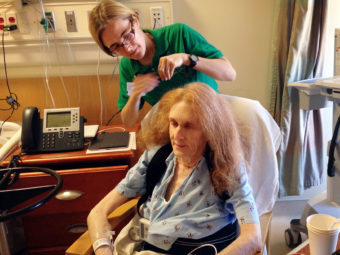
Volunteer Julia Torrano helps Estelle Day, 79, style her hair while she’s a patient at UCLA Medical Center. (Photo by Ina Jaffe/NPR)
Loneliness can be a problem for older people, especially when they’re in the hospital. Their children may have moved away. Spouses and friends may themselves be too frail to visit. So a California hospital is providing volunteer companions in the geriatric unit.
One of the volunteers at the UCLA Medical Center in Santa Monica is 24-year-old Julia Torrano. She hopes to go to medical school. Meanwhile, her twice-weekly volunteer shifts give her a lot of practice working with patients.
One of them is Estelle Day. She’s 79 years old, a slender woman with a wild mane of hair that is still mostly red. Torrano peppers her with questions.
“Where were you originally from?” asks Torrano. Day replies that she grew up on Long Island in New York. Torrano also wants to know how Day met her husband, where she learned to play the harp, where her travels have taken her.
Day is happy to answer everything. She says she likes people and describes herself as “windbaggy.” That’s especially true if she’s talking about playing music. She is a lifelong musician and retired music teacher. She plays harp and guitar, but her favorite instrument is the pipe organ. “To be able to rock a building under your hands and your feet is exciting,” she says.
This was Day’s fifth day as a patient in the geriatric unit. She says multiple chronic conditions brought her here, but she didn’t want to name them. Visible were a bulky back brace she wears for her osteoporosis, an IV drip and a heart monitor.
When that heart monitor suddenly began beeping, Torrano was out of the room like a shot. She returned seconds later with a nurse who solved the problem with the push of a button.
Torrano and the other volunteer companions aren’t just candy stripers, bringing snacks and magazines. She knew what to do when the heart monitor started beeping because, like all of the volunteers in this program, she’s been trained. As Dr. David Reuben, chief of geriatrics at the Geffen School of Medicine at UCLA explains: “Just because you’re willing to do something doesn’t mean you know how to do it.”
Volunteers learn about medical confidentiality, what to do in an emergency, and how to interact with patients, including patients with dementia. Reuben says they go through a “vigorous training process and vetting process before we allow them to be with patients.” There are nearly three dozen volunteers so far. The program started just a few months ago, and the hospital plans to expand it.
Loneliness is a legitimate medical issue. There are a number of studies linking loneliness and social isolation in old people to poorer health and earlier death, including one published earlier this month in JAMA Psychiatry associating loneliness, social isolation and brain changes typical in Alzheimer’s. Reuben cautions that those studies weren’t done in a hospital setting. Nevertheless, he says, “you might suspect that being more engaged, more energized … might promote a speedier recovery.”
So now the hospital is designing studies to find out if the volunteer companionship improves medical outcomes, or at least improves the patient’s experience in the hospital.
Torrano says she’ll sometimes spend her entire four-hour shift with a single patient. Like Estelle Day, many are happy to share their life stories. She remembers one man in particular who had been a political prisoner in Iran. He’d run an underground newspaper. “He was in jail so much,” she recalls, yet he told her he also misses Iran. “Even though it was very traumatic, he still wishes he was there,” Torrano says.
Estelle Day says she’s not especially lonely, but she has been alone much of the time since she was admitted to the geriatric unit. So it helps to have a companion who will not only listen to her life story, but can also troubleshoot the little problems that can make life in a hospital such a challenge. “Somebody who is sensitive and tuned-in and is very helpful,” explains Day, the way Torrano was when Day’s heart monitor started acting up.
And companionship can take many forms. On the day of Torrano’s visit, one of Day’s most pressing issues was fixing her hair. It had been shoved up in a rubber band since she was admitted.
So with Day’s encouragement, Torrano picks up a comb and gently begins detangling. Whatever it takes to make the patient look good and feel better.
Copyright 2016 NPR. To see more, visit http://www.npr.org/.
A judge on the High Court in London granted a dying British teenager’s request to be cryogenically frozen. The ruling was last month, but media coverage was restricted while the girl was still alive. Tim Ireland/AP
A 14-year-old girl in the U.K. who was dying of cancer won the right to be cryogenically frozen, in a case that’s being described as remarkable — and potentially the first of its kind.
The girl wanted to have her body preserved in the hopes that scientists someday would be able to bring her back to life and cure her illness. Her wishes were initially supported by her mother but not her father, which led the girl to seek a judge’s intervention to ensure that her mother would decide what would happen to her body.
The judge granted her request — and her father changed his mind and agreed to support his daughter’s last wish.
The girl, who is not being named to protect her privacy, has since died. The Associated Press reports that the court ruling came in October, but media coverage was restricted while the girl was still alive.
“During the last months of her life, the teenager, who had a rare form of cancer, used the internet to investigate cryonics. Known only as JS, she sent a letter to the court: ‘I have been asked to explain why I want this unusual thing done. I’m only 14 years old and I don’t want to die, but I know I am going to. I think being cryo‐preserved gives me a chance to be cured and woken up, even in hundreds of years’ time.
” ‘I don’t want to be buried underground. I want to live and live longer and I think that in the future they might find a cure for my cancer and wake me up. I want to have this chance. This is my wish.’
“The girl’s parents are divorced. She had lived with her mother for most of her life and had had no face-to-face contact with her father since 2008. She resisted his attempts to get back in touch when he learnt of her illness in 2015.”
The AP notes that cryogenic technology “has not yet been proven to be effective.” As Marcelo Gleiser wrote for NPR last year, the technical challenges of preserving and reconstructing a human brain, for instance, are “horribly daunting” — and it’s not at all clear whether it’s even possible. People who choose to preserve themselves cryogenically argue that future science may be leaps and bounds ahead of what’s currently understood to be feasible.
The girl’s mother supported her interest in cryogenics and agreed to her desire to have her body preserved. But her father was opposed, as the BBC reports:
“He said: ‘Even if the treatment is successful and she is brought back to life in let’s say 200 years, she may not find any relative and she might not remember things and she may be left in a desperate situation given that she is only 14 years old and will be in the United States of America.’
“Although he then changed his mind, saying he respected his daughter’s decision, he subsequently wanted to see his daughter’s body after her death — something to which she would not agree.”
The girl was too young to make a legally binding will, so she asked the court to intervene to guarantee that her mother would be solely responsible for determining how her remains would be handled.
The judge visited the teenager in the hospital and said he was impressed by the “valiant way” she faced her death, and that he had no doubt she had the mental capacity to file a lawsuit, according to the AP. He called the case unprecedented.
The girl died with the knowledge that she would be frozen, and her body has been sent to the United States for long-term cryogenic storage at a cost of $46,000, the AP reports.
The BBC notes there were some concerns among hospital staff about the way her body had been prepared for cryogenic freezing, and the judge in the case suggested there might be a need to regulate cryogenic freezing in the future to prevent problems in carrying out wishes such as these.
Copyright 2016 NPR. To see more, visit http://www.npr.org/.
More grandparents are facing the challenge of raising their grandchildren because their own kids are addicted to opioids or have died from an overdose. (Creative Commons photo by Province of British Columbia)
The number of grandparents who are raising their grandchildren is going up and increasingly it’s because their own kids are addicted to heroin or prescription drugs, or have died from an overdose. For some, it’s a challenge with little help available.
In 2005, 2.5 million children were living with grandparents who were responsible for their care. By 2015, that number had risen to 2.9 million.
Child welfare officials say drug addiction, especially to opioids, is behind much of the rise in the number of grandparents raising their grandchildren, just as it was during the crack cocaine epidemic of the 1980s and ’90s. An estimated 2.4 million people were addicted to opioids at last count.
Caseworkers in many states say a growing number of children are neglected or abandoned by parents who are addicted. That has forced them to take emergency steps to handle a growing crisis in foster care — and often to turn first to grandparents for help.
“Obviously, the numbers have grown because of the current national opioid epidemic,” said Maria Moissades, who heads Massachusetts’ Office of the Child Advocate. “You’ve got grandparents who thought they were going to spend their retirement fishing and traveling. Now they’re raising [as many as] five grandkids.”
Federal law requires that states consider placing children with relatives in order to receive foster care and adoption assistance. And grandmothers and grandfathers often are the first — and best — choice when state and local caseworkers have to take a child out of a home and find someone else to take custody, said Angela Sausser, executive director of the Public Children Services Association of Ohio, a coalition of public child safety agencies in the state.
“When we are seeking caregivers for a child, you want to see who that child has relationships with,” Sausser said. “You’re removing them from their [nuclear] family. To minimize the trauma and help them feel some normalcy, you obviously want to seek out whoever is closest to that child.”
In some instances, caseworkers say, grandparents are also struggling with addictions.
In Ohio, for instance, the opioid epidemic has grown so large that caseworkers sometimes have a hard time finding any relatives who can step up, said Kim Wilhelm, protective services administrator for Licking County (Ohio) Department of Job and Family Services.
For every child in foster care who has been placed with a relative, another 20 children are being raised by relatives outside the system, said Jaia Lent, deputy executive director of Generations United, a Washington, D.C.-based family research and advocacy group.
Many grandparents face a host of emotional and financial challenges in their renewed parenting role. And there are often few state or local resources to draw on for help.
Twenty-one percent of grandparents caring for grandchildren live below the poverty line, according to Generations United. About 39 percent are over 60 and 26 percent have a disability. And because many are not licensed in the system, they are not eligible for the same services and financial support as licensed foster parents.
“Can’t y’all make it easier for grandparents? That’s my request,” said Dot Thibodeaux, president and founder of the grassroots support group Grandparents Raising Grandchildren Information Center of Louisiana.
“Most of us are on Social Security,” she said. “When the family grows, the Social Security does not. You have to make do with whatever you were getting, and that’s kind of hard.”
State help
A handful of states are trying to help. In Louisiana, state lawmakers in June voted to establish a grandparents’ council in the governor’s office to study remedies for those tasked with raising grandchildren.
In New Mexico, lawmakers voted in February to set up a task force to study the issue and recommend concrete policy changes that could help grandparents, from legal and financial help to food and housing assistance.
A bill lingering in the Massachusetts Legislature would provide grandparents caring for their grandchildren with property tax relief. And Georgia lawmakers considered bills that would make it easier for grandparents to take grandchildren in their custody to the doctor or to enroll them in school, but failed to pass them.
The growing trend and the problems it can cause are being noticed by Congress too. In May, U.S. Rep. Danny Davis, D-Ill., introduced a bill that would, among other things, make it easier for grandparents caring for children to receive Temporary Assistance for Needy Families. It’s lingering in committee.
In September, U.S. Senate inaction effectively killed a bill that would have provided federal funding for substance abuse programs for families with children at imminent risk of entering foster care. The bill also would have allowed states to waive foster care licensing standards for grandparents and other relatives.
Barriers to help
Grandparents — especially those who don’t become licensed foster parents or legal guardians of their grandchildren — face a host of emotional and legal challenges in getting help.
Many of them often don’t want to apply for legal custody because that would mean taking their own children to court. Or if they apply for welfare, the state could try to make their own children, who may already be struggling with addiction, pay child support.
Licensed foster parents have access to services and can get financial assistance with everything from medical care to a clothing allowance. But to qualify, grandparents would have to go through a lengthy process and meet certain requirements.
To be a licensed foster parent, for instance, states have specific requirements about square footage and bedrooms for each child. This makes sense if a child is being placed with a stranger, but creates barriers for grandparents who may need to accommodate multiple grandchildren in their homes, Lent said.
Although Louisiana offers financial subsidies to help grandparents with the costs of raising children, few apply because they are unaware of the help. Others don’t qualify because they make too much money — even if they earn very little, Thibodeaux said.
“You almost have to be on the streets,” said Thibodeaux, who serves on the governor’s grandparents’ council.
Some child welfare advocates say that what’s needed is more help for “kinship care” — relatives taking in and raising the children who’ve been neglected.
“Everyone agrees that kinship care is the right thing, but there’s no money to pay for it,” said Moissades, the Massachusetts child advocacy official.
But there could be a payoff if some help was provided grandparents who aren’t part of the foster care system. According to analysis of foster care payments by Generations United, grandparents and other relatives raising children save taxpayers $4 billion each year by keeping the children out of the foster care system.
A multigenerational problem?
Back in the 2000s, some states passed legislation establishing “kinship navigator” programs that serve as one-stop shops linking grandparents and other relatives with services such as counseling, housing assistance and short-term financial help.
With these programs, other grandparents raising children often served as the “navigators” to advise on how to get help with everything from legal advice to parenting skills.
But in some states, budget crunches have made funding for some of these programs unstable, Lent said. In 2008, Congress passed the Fostering Connections to Success and Increasing Adoptions Act, which included competitive grants for kinship navigator programs. Some states used the money to create new programs, but not all are available statewide. Some states, including Florida and Ohio, have federally funded navigator programs that cover part of the state.
Today Connecticut, Delaware, New Jersey, New York and Washington state still have statewide, state-funded programs.
Child welfare workers say that more federal funding is needed if every state is to have a navigator program and offer services statewide.
Isabel Barreiro, of the Children’s Home Society of New Jersey, which is contracted by the state to serve as a kinship navigator in Central New Jersey, said she’s often limited in how much she can do to help her clients.
For example, she said, many of her clients live in public housing. Sometimes multiple grandchildren can be dumped on a grandparent’s doorstep, which forces her to try to find a bigger place to live. Barreiro said she doesn’t have the ability to make a bigger apartment magically appear.
State child welfare agencies have some power to intervene with housing, she said.
“Child protection services needs to do a better job of really stabilizing these families,” Barreio said. “Don’t place a child with a 60-year-old grandmother who’s in Section 8 housing, and not help her.”
For the first half of 2016, seniors have claimed sales tax exemptions at one-third of the levels claimed for the same period in 2015.
The Juneau Assembly restricted the senior tax break last year in an effort to save the city a projected $1 million. But at least one newly elected assembly member thinks the reform should be revisited.
A large part of Norton Gregory and Mary Becker’s successful assembly campaigns focused on bringing the full senior sales tax exemption back.
Beth Weldon, who ran unopposed, also supported the push after speaking to people on the campaign trail.
Juneau Assembly candidate Beth Weldon leads a train of supporters into Assembly Chambers to watch election night results on Tuesday. Weldon was unopposed. (Photo by Jeremy Hsieh/KTOO)
She says the assembly should take up the issue again. She thinks the city’s initial projection might be off.
“Well, I think we need to revisit the prediction myself first, because one of the ways they paid for the deficit — because there was $400,000 extra in sales tax (revenue) that they didn’t predict,” Weldon said. “So, I think we need to relook at the prediction before we can have a decision.”
But city finance officials say their savings projection is still on track. They’ll have the exact numbers early next year.
Weldon says the city should look to other revenue sources, like the marijuana tax. But she couldn’t name anything specific beyond that.
The old Juneau Assembly restricted the senior sales tax break to essential items like food and heating fuel. It took effect at the beginning of the year.
Arnold Liebelt ran against incumbent Mary Becker for the District 1 seat.
Liebelt said that even though he didn’t win, he’s proud of the race he ran.
If there’s one thing he doesn’t want to see happen on the assembly — it’s bringing back the full senior sales tax break.
“I just think that would be such a big step backwards,” Liebelt said. “That should’ve been done, put to rest and not brought up again. And my opponent just kept bringing it up again and again, and I don’t know how they can do that knowing we had a $4.8 million shortfall this year.”
When the assembly voted to restrict the senior sales tax last year, Mary Becker voted against it.
She could not be reached for comment.
Norton Gregory also campaigned on the senior sales tax exemption, criticizing his opponent Kate Troll for voting in favor of the restrictions.
But now he says he’ll need to take a closer look before voting.
“You know, I didn’t really have an opportunity to dig into the numbers…Now the rubber’s going to have to meet the road,” Gregory said, “and we’re going to have to sit down and dig into those things because it is a community issue.”
Candidates, supporters and press filled Assembly Chambers at Juneau City Hall to watch election night results on Tuesday. Attendance — and voter turnout — was up significantly from recent years. (Photo by Jeremy Hsieh/KTOO)
Gregory said on the surface, he would vote yes. But he couldn’t be specific about how to make up for the budget hit.
“That’s something I can’t answer directly right now with a specific answer,” Gregory said. “I need to sit down and look through the city budget and understand all aspects of that budget and how that will affect our community and government. … But of course I’d like to talk to the mayor and the other assembly members who fully understand the issue, and I think that’s something the community can expect from me.”
He said he’d like to look into the senior sales tax rebate program, an opt-in program for lower-income seniors that completely exempts them.
During his campaign for mayor, Ken Koelsch also opposed scaling back the senior sales tax.
Koelsch did not return multiple requests for comment on the issue.
City Manager Rorie Watt said it’s important to understand how much the city’s demographics have changed.
“From 1980 to present, the senior population has increased over 400 percent,” Watt said, “and during that same period, the school age population in the community has gone up about 30 percent.”
He said as the senior population continues to grow, the program would cost the city more money.
“I think, like everything the assembly does, there are pros and cons, and it’s a policy question and a financial question,” he said.
From January through June of this year, residents have claimed senior tax exemptions on more than $9 million of sales, the city’s finance department says. That’s about a third of what it was in the same time frame last year.
Close
Update notification options
Subscribe to notifications
Subscribe
Get notifications about news related to the topics you care about. You can unsubscribe anytime.