The Skagway Borough Assembly will hold its first reading of an ordinance to put a senior center bond question on the October ballot on Thursday.
The up to $7 million bond would fund construction of a senior center and housing facility that proponents say is needed to better serve the town’s aging population. A property tax increase may be implemented to pay for the bond.
The assembly will also hold a first reading on an ordinance prohibiting parking within 20 feet of any street intersection.
There is a discussion set for a letter to bus companies regarding ‘numerous reports’ of large tour buses driving unsafely. The letter asks for companies to address road safety with drivers.
Mayor Mark Schaefer requested the assembly discuss issues related to graffiti in Skagway. A recent graffiti incident at Smuggler’s Cove was publicized by the Skagway Police on Facebook.
The assembly will hear an update on the August 8 meeting between the Alaska Department of Environmental Conservation and ore terminal stakeholders, including the municipality.
The DEC meeting will also be discussed behind closed doors. An executive session is scheduled with the borough attorney.
The meeting convenes at 7 p.m. Thursday in assembly chambers.
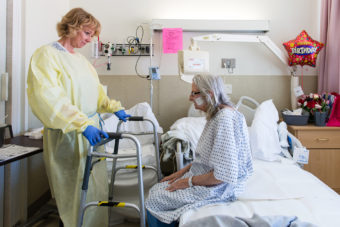
Nurse specialist Annelie Nilsson checks on patient Janet Prochazka, during her stay at the Zuckerberg San Francisco General Hospital, after Prochazka took a bad fall in March. (Heidi de Marco, Kaiser Health News)
Until March of this year, Janet Prochazka was active and outspoken, living by herself and working as a special education tutor. Then a bad fall landed her in the Zuckerberg San Francisco General Hospital.
Doctors cared for her wounds and treated her pneumonia. But Prochazka, who is 75, didn’t sleep or eat well in the hospital, and became confused and agitated. Then she contracted a serious stomach infection.
Patients over 65 tend to be less resilient during a hospital stint than younger patients, research finds, and more vulnerable to mental or physical deterioration, even if they recover from the illness or injury that sent them there. One study published in 2011 found that about a third of patients older than 70 and more than half of patients over 85 left the hospital more disabled than when they arrived.
As a result, many previously independent seniors are unable to care for themselves after discharge, and need assistance with daily activities such as bathing, dressing or even walking.
“The older you are, the worse the hospital is for you,” says Dr. Ken Covinsky, a physician and researcher at the University of California, San Francisco’s division of geriatrics. “A lot of the stuff we do in medicine does more harm than good. And sometimes with the care of older people, less is more.”
As hospital staffs focus on treating the acute injury or illness, they may fail to ensure that older patients get adequate nutrition, he says, or fail to get them out of bed enough or control their pain adequately.
Hospital patients are often inadvertently restricted in their movements because of tethers to oxygen tanks and IV poles. They are subjected to various procedures and medications, and are often in noisy rooms, where careful monitoring means checking their vital signs at all hours of the night.
Ron Schwarz, 79, was hospitalized after falling in the shower. He spent time healing the Acute Care for Elders unit at San Francisco General, one of about 200 such units nationwide. (Heidi de Marco, Kaiser Health News)
And if the drug side-effects, interrupted sleep, unappetizing food and long days in bed are annoying when we’re young, they can cause lasting damage as we get older, Covinsky says. Studies find that elderly patients often process medications differently than younger people, for example, and frequently have multiple medical problems, not just one.
Their needs are particular enough that some hospitals have established separate medical units to treat elderly patients.
San Francisco General is one such hospital. Its Acute Care for Elders ward, which opened in 2007, is staffed by a health team trained in geriatrics. They focus less on the original diagnosis and more on how to get patients back home, living as independently as possible.
Early on, for example, the staff tests patients’ memory and assesses how well they can walk and care for themselves at home. Patients are also encouraged from the start to do things for themselves as much as they are able throughout their stay. The health team removes catheters and IV tethers as soon as medically advisable, and supports patients in getting out of bed and eating in a communal dining area.
“Bed rest is really, really bad,” says the unit’s medical director, Dr. Edgar Pierluissi. “It sets off an explosive chain of events that are very detrimental to people’s health.”
Such units are still rare — there are only about 200 around the country. And even where they exist, not every elderly patient is admitted, in part because space is limited.
Prochazka initially went to the emergency room, and was admitted to the intensive care unit from there. She was transferred to ACE about a week later.
Though the move to the specialized unit helped Prochazka, her doctor says, it couldn’t completely restore her former health.
“She will not leave here where she started,” Pierluissi said several days before Prochazka was discharged. “She is going to be weaker and unable to do the things you really need to do to live independently.”
Still, the unit’s staff — a team that includes a doctor, a nurse, a pharmacist and a social worker — came up with a plan specifically for Prochazka’s needs that helped her heal. They weaned her off some of her medications. They got her up and walking. They also limited the disorienting night-time checks.
Prochazka says that, once on the unit, she got “the first good night of sleep I have had.” Ultimately, she was able to return home, and her health has continued to improve as she slowly regains strength.
How hospitals handle the old and very old is a pressing problem, geriatricians say. Nearly 13 million seniors are hospitalized each year — a trend that will only accelerate as baby boomers age.
Yet hospitals face few consequences if elderly patients become more impaired or less functional during their stay, Covinsky points out. The federal government penalizes hospitals when patients fall, get preventable infections, or return to the hospital within 30 days of their discharge, but the institutions aren’t held accountable if patients lose their memory while there or become so weak they can’t walk. As a result, most hospitals don’t measure those things.
“If you don’t measure it, you can’t fix it,” Covinsky says. The extra investment needed to create specialized units would pay off in the long run, he believes — for patients, hospitals and for the U.S., as it works to bring down health care spending.
ACE units have been shown to reduce hospital-inflicted disabilities in older patients, decrease lengths of stay and reduce the number of patients discharged to nursing homes. In one 2012 study published in the journal Health Affairs, researchers found that hospital units for the elderly saved about $1,000 per patient visit.
Kaiser Health News is an editorially independent news service that is part of the nonpartisan Henry J. Kaiser Family Foundation.
Copyright 2016 Kaiser Health News. To see more, visit Kaiser Health News.
An inspection found that at one Los Angeles nursing home an employee took video of a co-worker “passing gas” on the face of a resident and posted it on Instagram. (Universal Images Group/Getty Images)
Editor’s note: This story contains language that some may find offensive.
Federal health regulators have announced plans to crack down on nursing home employees who take demeaning photographs and videos of residents and post them on social media.
The move follows a series of ProPublica reports that have documented abuses in nursing homes and assisted living centers using social media platforms such as Snapchat, Facebook and Instagram. These include photos and videos of residents who were naked, covered in feces or even deceased. They also include images of abuse.
The Centers for Medicare and Medicaid Services, which oversees nursing homes, said in a memo to state health departments on Friday that they should begin checking to make sure that all nursing homes have policies prohibiting staff from taking demeaning photographs of residents. The memo also calls on state officials to quickly investigate such complaints and report offending workers to state licensing agencies for investigation and possible discipline. State health departments help enforce nursing home rules for the federal government.
“Nursing homes must establish an environment that is as homelike as possible and includes a culture and environment that treats each resident with respect and dignity,” said the memo signed by David Wright, director of the CMS survey and certification group. “Treating a nursing home resident in any manner that does not uphold a resident’s sense of self-worth and individuality dehumanizes the resident and creates an environment that perpetuates a disrespectful and/or potentially abusive attitude towards the resident(s).”
CMS said that nursing homes have a responsibility to protect residents’ privacy, to prohibit abuse, to provide training on how to prevent abuse and to investigate all allegations of abuse. If homes fail to do so, they can face citations, fines and theoretically even termination from the Medicare program.
Also last week, Sen. Charles Grassley, R-Iowa and chairman of the Senate Judiciary Committee, called on other federal agencies to take action on the problem. He sent letters to the Department of Justice and to the Office for Civil Rights within the Department of Health and Human Services asking whether “rules and protections are in place to prevent and punish these types of abuses.” He also has sent letters to social media companies, calling on them to pay more attention to this. The Office for Civil Rights is working on its own guidance related to social media but hasn’t released it yet.
In a statement to ProPublica, Grassley praised the new CMS memo. “This guidance is welcome and necessary,” he wrote. “Nursing homes are obligated under the law to keep their residents free from abuse. Exploitation on social media is a form of abuse, and the agency memo makes that clear. We need to prevent it, and we need to punish it when it happens.”
ProPublica has identified 47 instances since 2012 in which workers at nursing homes and assisted-living centers shared photos or videos of residents on social media networks. This includes three discovered in recent weeks. At one Los Angeles nursing home, an employee took video of a co-worker “passing gas” on the face of a resident and posted it on Instagram, according to a May inspection report.
“An interview was conducted with Resident 1 and the resident stated that facility employees pass gas in his face as often as every month,” the report said. One employee resigned and a police report was filed.
While some states have taken harsh steps against nursing homes at which social media abuse occurs, other states have not. We reported last month that Iowa health officials recently discovered it wasn’t against state law for a nursing home worker to share a photo on Snapchat of a resident covered in feces because his genitals weren’t visible. Officials are trying to change the law when the Iowa Legislature reconvenes early next year.
The federal government memo sets uniform standards for how such abuse should be written up by inspectors and the severity of sanctions that should be levied. In the past, there was great variability.
Last month, the industry’s trade group issued its own suggestions for dealing with such situations, encouraging training and swift responses by these facilities when allegations are brought to light. The group also is holding training events around the country. While many facilities ban the use or possession of cell phones by employees when in resident areas, some have also found such rules impractical to enforce.
Greg Crist, a spokesman for the American Health Care Association, the trade group, said the CMS memo dovetails with the industry’s effort to stop social media abuse.
“The two words in that CMS directive that stand out most to me are ‘privacy’ and ‘responsibility,’ ” Crist wrote in an email Monday. “That’s why we have taken responsibility and made a concerted, nationwide effort to educate and share best practices with our centers not only on how to detect and root out this abuse, but also proactive steps to ensure it doesn’t happen in the first place.
“It’s not an issue that is conquered overnight,” he wrote, “but every day, we get smarter about it.”
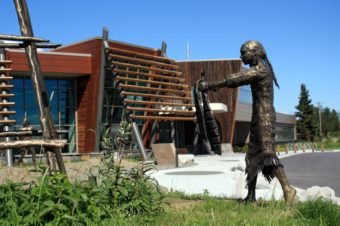
A “Łuq’a Nagh Ghilghuzht” sculpture by Joel Isaak depicts traditional Dena’ina life at fish camp outside the Kenaitze Indian Tribe’s new Dena’ina Wellness Center in Old Town Kenai. (Photo by Patrice Kohl/Redoubt Reporter)
Alaska got a glowing report in a checkup from a top federal health care official. Though there are issues that need further treatment and support, communities showed a healthy dose of innovation in delivery and integration of care.
Mary Wakefield, acting deputy secretary for the U.S. Department of Health and Human Services, toured Alaska from Aug. 1 to 4, visiting Barrow, Fairbanks, Circle, Anchorage and Kenai. But she wasn’t bringing a prescription from Washington. Instead, she got ideas for the treatment of health care in rural communities that can be brought to other areas of the country.
“I’ve seen some phenomenal examples of Alaska Native and American Indian communities that are really focused on comprehensive services that are delivered effectively and very efficiently on behalf of their communities. So there’s some wonderful examples to draw from this state and from these communities and try to think about how we might apply some of these examples in other parts of the United States,” Wakefield said.
HHS provides funding for a wide range of community services. A big part of the department’s presence in Alaska is through Indian Health Services, which funds facilities and programs administered through Native tribes throughout the state.
During her visit to Kenai on Aug. 4, Dr. Wakefield toured the Kenaitze Indian Tribe’s Head Start program, elder center, tribal court and Dena’ina Wellness Center, which offers medical and dental care, behavioral health services and a wide variety of general health and wellness programs. The center provides care to Alaska Native and American Indian people. Behavioral health services are available to anyone in the community.
Jaylene Peterson, executive director of the Kenaitze Tribe, says it was an honor to meet with Dr. Wakefield.
“This is an unprecedented visit. It was an amazing time that we were able to share with the deputy secretary, and we were able to show her what we’ve been able to accomplish with funds that have not always met the true need. So we’ve been blessed by this trip. I believe that she has learned much about the Alaskan community and why things are so different and more challenging here in an Alaskan setting,” Peterson said.
Peterson hopes the visit will help remove some stumbling blocks that come with HHS funding. She says that some of the reporting and training requirements can be onerous.
“I don’t disagree that we should be accountable for the funds that we receive, but sometimes it can be a lot more than should be required. So, there are ways that I believe that we can be smarter with our money,” Peterson said.
Primarily, though, the tribe wanted to show its holistic approach to health care.
“It’s just phenomenal. The leadership, the commitment, the approach that is innovative in terms of the integration of a wide range of services on behalf of the people who are served here is absolutely exceptional,” Wakefield said.
Before her trip to Kenai, Wakefield participated in a summit in Wasilla on opioid abuse.
“It is an absolute epidemic in every state the across the country, including right here in Alaska. And there are some pretty serious problems in communities within the state that are really adversely impacting families and putting special burdens on law enforcement, (and) special burdens on health care providers,” Wakefield said.
She says the Obama Administration is focusing efforts on making sure health care providers have the clinical skills necessary when prescribing opioids, closing the gap between people who want treatment and access to that care, and making sure people who have overdosed have immediate access to life-saving medications.
Among its many social services, the Kenaitze Tribe offers a chemical dependency recovery program.
A common phone scam is once again making an appearance on the Kenai Peninsula. But this time, scammers are targeting seniors.
Michelle Tabler, Alaska Regional Manager for the Better Business Bureau, says she has gotten several reports of the so-called “Publishers Clearinghouse scam” in Homer and Soldotna.
“It’s a typical lottery scam, but in this situation, they’re telling people that they’ve won Publishers Clearinghouse or they call it PCH. The amount varies several million dollars. Then they call back and say, well there’s some fees associated with this and that there’s some taxes,” said Tabler.
The scammers tell victims they must send money or gift cards before they can receive their sweepstakes prize.
“We just want people to know that these are not legitimate phone calls and you should never have to pay any fees if you ever have won. We advise people just to hang up the phone. You didn’t really win,” said Tabler.
Residents who suspect they were a victim of a phone scam should report it to their local police department. More information can be found on the Better Business Bureau website, www.bbb.org.
Kenai Peninsula Borough voters will have their say on whether the borough’s optional senior property tax exemption will be phased out.
Currently, seniors in the borough receive $350,000 in property tax exemptions — $150,000 mandated by the state, $150,000 offered by the borough and another $50,000 from the borough for all residential property owners.
“The minimum exemption you will ever receive is $200,000. It simply phases out the optional $150,000,” assembly member Gary Knopp said.
Current seniors and anyone turning 65 years old next year will continue to receive $350,000 in exemptions. After that, residents turning 65 in the next six years will get lower levels of exemption, which they will continue to receive in perpetuity. Seniors turning 65 in 2024 or after won’t get any additional exemption.
Larry Persily, assistant to the mayor, says that’s still generous, compared to the rest of the state. Only the North Slope Borough, with $600 million in savings, offers more.
“But we’re competitive. We’re equal or stack up very well against the next two, Skagway and Mat-Su, and have a better senior benefit than 32 other municipalities in the state,” Persily said.
Borough Mayor Mike Navarre says the phase-out was created to address changing demographics in the borough. From 2000 to 2030, the senior population is expected to grow at a rate of 300 percent compared to the rest of the population of the borough, according to state estimates. That means the property tax burden will increasingly shift to younger residents, Navarre says.
The borough will continue to offer its hardship exemption for low-income seniors, so their property taxes can’t exceed 2 percent of their annual income. But the state doesn’t allow a hardship exemption for those under 65, Navarre says.
“There are many seniors on fixed incomes. Many other people are on fixed incomes. Many are low income. People at various ages have a hardship,” Navarre said.
The majority of public testimony over the past few meetings has been against the ordinance. Linda Hutchings of Soldotna spoke in favor Tuesday.
“I look at young families paying a higher price for their taxes. As a senior, I like my exemption, but I understand we need to tighten our belt and give more to younger people to encourage them to come back to our area and build an economy,” Hutchings said.
The assembly voted seven to one to put the measure on the ballot, with assembly member Wayne Ogle opposing the ordinance.
Borough voters will see the question on the municipal ballot Oct. 4. More information on the measure can be found on the mayor’s page on the borough’s website, www.kpb.us.
The borough assembly voted at its meeting Tuesday to place a question on the October municipal ballot, seeking voter approval to phase out the borough’s $150,000 property tax exemption for seniors.
Close
Update notification options
Subscribe to notifications
Subscribe
Get notifications about news related to the topics you care about. You can unsubscribe anytime.