State regulators in Alaska are working with a Native organization that wants to serve its nursing home residents seal oil, a traditional staple that’s banned in public settings because of its high risk for botulism.
The Alaska Department of Environmental Conservation says it would grant an exemption to the Kotzebue-based Maniilaq Association if it can demonstrate a safe method for rendering the oil.
Alaska consistently has among the highest rates of foodborne botulism, which can lead to temporary paralysis.
Maniilaq hopes it can add seal oil to the list of traditional foods that can legally be donated to facilities such as its Kotzebue nursing home, which serves elderly Inupiat Eskimos. The organization, a regional tribal health care nonprofit, has also recently begun to incorporate other traditional foods on the menu.
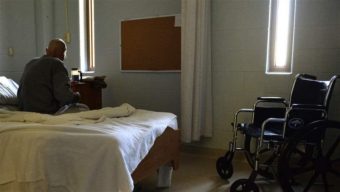
A patient in the medical wing of the Kentucky State Reformatory in LaGrange. As the elderly population in state prisons keeps climbing, correctional systems are adding more services geared toward aging inmates, including hospice services and assisted living units. AP
CAPRON, Va. — Walter Melvin Atkinson is a bit vague about how long he has been in the assisted living portion of the Deerfield Correctional Center and how long he has left on his sentence. He claims to not even remember the crime — pedophilia — that landed him here.
At 92, “Speedy,” as he is called ironically by fellow prisoners and guards, is frail enough to require a wheelchair to get around, and his inmate caregivers rushed to his side to grab from his shaking hand a coffee mug that seemed destined to spill all over his cot. A huge, bright orange star has been sewn on to the white blanket that covers the cot — an idea the unit manager, Kathy Walker, dreamed up to help Atkinson spot his own bed among the six rows of beds in the spotless unit.
Atkinson is representative of an ever deepening trend in state corrections systems, and an ever growing problem, too. According to Human Rights Watch, from 2007 to 2010, the increase in the elderly population, 65 and up, being sentenced to state and federal prison outpaced the increase in the total population by 94 to 1.
Nearly every state is seeing that upward tick in elderly state prisoners. In Virginia, for example, 822 state prisoners were 50 and over (corrections officials usually consider old age for prisoners to begin at 50 or 55) in 1990, about 4.5 percent of all inmates. By 2014, that number had grown to 7,202, or 20 percent of all inmates.
For state prisons, the consequence of that aging is money, more and more of it every year. Health care for aging prisoners costs far more than it does for younger ones, just as it does outside prison walls. Corrections departments across the country report that health care for older prisoners costs between four and eight times what it does for younger prisoners.

In 2013, nearly half the $58 million that Virginia spent on off-site prisoner health care went to the care of older prisoners, according to Trey Fuller, acting health services director in the state Department of Corrections. “Over time,” Fuller said, “we’ll need more and more money for that population because they will need more drugs, more specialist visits, more nursing hours, more everything.”
Many states have taken steps to reduce their prison populations by releasing nonviolent inmates or by diverting some offenders to community programs before sending them to prison. But corrections officials say those reforms alone will do little to decrease the population of older prisoners who are serving mandatory sentences or have committed violent crimes.
Several states have adopted programs such as early release for geriatric patients or “compassionate release” for the dying. But advocates for prisoners say the programs are often so cumbersome and restrictive that few older prisoners are able to take advantage of them.
Accommodating the Elderly
The graying of the U.S. prison population reflects the rising median age of Americans since 1970. But that broader trend doesn’t fully explain the sharp increase in older prisoners. For that, corrections officials point to two factors. One is a steady increase in the rate of older adults entering prison. The second, and more potent, factor is changes enacted in the get-tough-on-criminals 1990s that resulted in longer prison sentences.
“It was the push for mandatory sentences and three strikes you’re out,” said Linda Redford, who studies health issues related to aging prisoners and is the director of aging and geriatrics programs at the University of Kansas Medical Center. “So we’re seeing people who came to prison in their 30s and 40s and 50s in their 50s and 60s and 70s today.”
Virginia’s problem was compounded in 1995 when the General Assembly eliminated parole for any offender entering its prisons from then on.
To accommodate the growing number of older prisoners, most states have been adding or retrofitting facilities.
“Prisons weren’t designed for patients who are getting older,” said Owen Murray, chief physician for Correctional Managed Care, University of Texas Medical Branch, which overseas health care for most of that state’s prisons. “They were designed for people 18 to 55” and who were able to walk, Murray said. One in five Texas prisoners is older than 50.
States have had to install ramps and shower handles and make other physical modifications. Many prisons have had to create assisted living centers with full-time nursing staffs, as Deerfield has. In addition, at least 75 U.S. prisons, including Deerfield, provide hospice services for dying prisoners, according to the Vera Institute of Justice, a nonprofit that advocates for criminal justice reform.
In prison, services for the elderly are often stretched thin. The 57-bed assisted living unit at Deerfield is always full; there’s a waiting list to get in. The nearby 18-bed infirmary provides hospice services, but its beds are also needed for nonterminal acute care patients, such as inmates who have just had surgery and need special care while they recover.
As a result, Deerfield has tightened restrictions on which elderly patients can go to assisted living or hospice care. For example, it used to be that prisoners would be considered eligible for assisted living if they could not perform any one basic task such as bathing, dressing or walking, said Susan Wright, nurse manager of assisted living at Deerfield. Now, they must be unable to do two or three or them.
Worse Health
People sent to prison are generally less healthy than the general population, having abused drugs and alcohol or neglected their health for many years. Prisoners have much higher ratesof cardiac disease, high blood pressure, hepatitis C, diabetes and other chronic diseases than the general population. That is why corrections officials consider that old age comes much sooner for prisoners.
“The norm in prisons is to use 55-and-older as the metric associated with older prisoners primarily because the consensus is that our population is 10 years ahead, clinically,” of people on the outside, Murray said.
Prison is a particularly treacherous place to get old. Getting to a top bunk is difficult for many aging prisoners, as is climbing stairs. Hearing loss, dementia and general frailty can make it difficult to comprehend or obey rules. And being infirm in an institution full of young predators can make older prisoners vulnerable. “If there’s an old lion or gazelle,” said Phillip Wheatley, one of the prisoner caregivers who tends to Atkinson, “the young ones are going to take advantage.”
When aging prisoners do reach the end of their sentences, corrections officials often have a hard time placing them, even if they look beyond their state. “Private nursing homes don’t want to take elderly offenders who were murderers or sex offenders,” said Virginia’s Fuller. He is currently keeping a wheelchair-bound former prisoner in a hotel, where a nurse visits daily, “because we couldn’t find a home for him,” he said.
Atkinson seems likely to present a similar problem. He was sentenced to 27 years in 1990 for pedophilia, paroled in 2005, and taken back into custody in 2008 for entering a school in violation of his parole. Thanks to credit he earned for good behavior, Atkinson could be released later this year, but his criminal record will likely make it difficult to find an outside assisted living facility or nursing home willing to take him.
Varying Approaches
Dealing with an aging prison population isn’t so complicated, said Texas’ Murray. “Either you figure out ways to get them out of the prison system and on to Medicare, or you choose to take a firm line that those patients have to do their time and you need to fund those facilities and care services that are necessary.”
So far most states have opted for the second approach, which means continuing to add services for an elderly population, including a special dementia unit for prisoners in New York state and housing units just for the elderly at Ohio’s Hocking Correctional Facility.
In 2012, Connecticut contracted with a private nursing home in Rocky Hill to care for elderly and infirm inmates granted parole. But even there, the state is locked in a battle with the federal government over whether the facility qualifies for Medicare or Medicaid reimbursement.
Several states have a mechanism they could use to shed some older prisoners. Louisiana, Ohio and Virginia have “geriatric conditional release” laws that make old age grounds for consideration for an early release. In Virginia, prisoners are automatically considered for release if they are 60 and have served 13 years or if they are 65 and have served five years.
Last year, 505 eligible prisoners were considered for geriatric release, according to Karen Brown, chairwoman of the state’s Parole Board. Only 3 percent were granted release, she said, adding that many of those who were denied had committed violent crimes.
Decisions about aging prisoners and the risk they would pose to the outside world should better reflect their medical conditions, said Brie Williams, an associate professor of geriatric medicine at the University of California, San Francisco, who studies aging in prison. “Health care professionals and criminal justice administrators should be coming together … to evaluate people for release,” she said. “We need to develop different approaches to their parole that are informed by their medical state.”
Virginia, like most other states, also permits the governor to grant clemency to prisoners certified by doctors to have less than 90 days left to live because of terminal illness. Last year,two Virginia prisoners received such clemencies.
Studies have found that older ex-offenders are less likely than younger ones to commit additional crimes after their release. But politicians and the public don’t seem willing to release former murderers, rapists and sex offenders, even though they are decades removed from their crimes and physically incapable of repeating them, said Liz Gaynes, president of the Osborne Association, a nonprofit that works on behalf of ex-offenders.
“It comes down to they did a bad thing and they should be punished,” she said. “Endlessly.”
States will be forced to pay more and more for that attitude, Gaynes said. “What to do about this is going to be the challenge for prisons in the next 20 years.”
Focus On Hospital Room Sign With Doctor Talking To Patient. Photo from Kaiser Health News.
JUPITER, Florida — She didn’t want to spend the rest of her days seeing doctors, the 91-year-old woman confessed to Dr. Kevin Newfield as he treated a deep wound on her arm.
“You don’t have to, but you have to tell me what you do want,” Newfield replied.
“I’m not afraid of dying. I’m afraid of being 106,” she told the surgeon and her daughter, who was in the room with them.
The woman’s spontaneous admission in Newfield’s south Florida office that January day triggered a 20-minute discussion about living wills, hospice and other end-of-life issues, Newfield said.
An orthopedic surgeon who sometimes performs amputations, Newfield is comfortable having those conversations.
Many doctors are not, but a Medicare policy, known as advance care planning, that took effect in January could help change that.
Physicians can now bill Medicare $86 for an office-based, end-of-life counseling session with a patient for as long as 30 minutes. Medicare has set no rules on what doctors must discuss during those sessions. Patients can seek guidance on completing advance directives stating if or when they want life support measures such as ventilators and feeding tubes, and how to appoint a family member or friend to make medical decisions on their behalf if they cannot, for instance.

The new policy reflects Americans’ growing interest in planning the last stage of their lives when they may be unable to make their wishes known.
In 2014, the Institute of Medicine, an influential panel of experts, found that the nation’s health system was not adequately dealing with end-of-life care, and among its recommendations was that insurers pay providers for advance care planning discussions.
Last September, a Kaiser Family Foundation poll found 89 percent of the public said that doctors should discuss end-of-life care issues with their patients, though just 17 percent of Americans — and 34 percent of people 75 and older — said that they have had such conversations. (KHN is an editorially independent program of the foundation.)
Under the new Medicare policy, doctors can give end-of-life advice during a senior’s annual wellness visit or in a routine office visit. Nurse practitioners and physician assistants can also get paid for having the talks. Counseling can also occur in hospitals.
“For doctors already providing this counseling the payment is an added benefit and for doctors on the fence about talking about the issue with patients, this may be enough to inspire them to try it,” said Paul Malley, president of Aging with Dignity, a national advocacy group based in Tallahassee, Florida.
Newfield, the Florida surgeon, is less optimistic. He said he doesn’t think the money will cause him to initiate more end-of-life discussions — and that doctors who weren’t doing them before now are unlikely to start. After all, said Newfield, doctors make money by keeping people alive.
The payment idea was first floated in 2009, as part of the congressional debate over the Affordable Care Act. Back then, a proposal to have Medicare pay for such discussions sparked political controversy and fueled concern that they would lead to so-called death panels that could influence decisions to avoid medical care. The proposal was quickly dropped.
Medicare’s policy now has broad support from health providers and patient groups, but neither physicians nor the American Medical Association foresee a surge in end-of-life planning among Medicare’s more than 50 million enrollees. The AMA, which supports the reimbursement, estimates Medicare will pay for fewer than 50,000 counseling sessions in 2016.
The numbers may well be held back by the small reimbursement rate for half an hour of counseling, but another obstacle rests with doctors themselves. Many are not trained to offer such advice or they are uncomfortable talking about it with patients.
“Just The First Step,” the journal Health Affairs headlined an article about Medicare’s new policy in its March issue.
“The perception that lack of training could be a major stumbling block to the greater implementation of advance care planning is widely shared,” wrote David Tuller, a lecturer at the University of California, Berkeley, School of Public Health.
“A lot depends on how you deliver the message and how you go about it,” said Dr. Jay Poonkasem, who specializes in palliative care in Clearwater, Florida.
“We will see more of this counseling, but only if doctors feel more comfortable and are trained in the right way to handle talks about end-of-life and advance care planning.”
Medical schools such as the Cleveland Clinic Lerner College of Medicine and the University of California, San Francisco, have recently begun expanding training on the subject.
At UCSF, all medical students are taught how to conduct advance care planning discussions and educational programs also exist for residents, nurses and other physicians at the hospital.
“This kind of training is crucial — one of the things that gets in the way of understanding and using patient preferences is that clinicians are often uncomfortable having these challenging conversations,” said Dr. Robert Wachter, professor and interim chair of UCSF’s Department of Medicine. “The issue of end-of-life conversations is so compelling and fraught — teaching it also allows us to teach about more general communication skills.”
Some doctors admit they could do better.
Dr. Scott Dunn, a family physician in Sandpoint, Idaho, said he regrets not having done more recently to help a 76-year-old patient avoid spending his final weeks in intensive care, connected to machines breathing for him and feeding him. That meant the patient may have needlessly suffered and cost the health system tens of thousands of extra dollars, he said.
“I wish I had taken the time months earlier to have that end-of-life discussion, but I did not,” he said.
Dunn said the incentive payment will entice him to have more such discussions with patients, but they won’t become routine in his practice. “Medicare pays us more to do other stuff.”
Michael Guarino came to a different view after watching his elderly father die last year, weeks after he became unable to move or talk. Guarino decided then that the 800-physician organization of which he is executive director — the Independent Physician Association of Nassau/Suffolk Counties in New York — would include end-of-life discussions for all adult patients.
To guide those discussions, the association’s physicians and nurses use a 12-page booklet called Five Wishes, which outlines how patients can designate someone to make decisions on their behalf if they become unable, as well as choose what treatment they want, if any, at the end of their life.
Dr. John Meigs, Jr., a family doctor in Centreville, Alabama, and president-elect of the American Academy of Family Physicians, said he sees value in doctors helping patients prepare for death.
Last July, a stroke left a 95-year-old nursing home patient of his with difficulty speaking and swallowing. The woman’s daughter questioned Meigs’ decision not to give the patient a feeding tube. Meigs reassured the daughter that her mother had made clear she didn’t want that in many talks with him and in her advance directives.
No heroic measures were made and the woman died a few days later.
The Sitka Pioneer Home was the first such facility. Five others operate in Ketchikan, Juneau, Anchorage, Wasilla and Fairbanks. (Photo by Emily Kwong/KCAW)
The pioneer homes are a purely Alaskan invention. The assisted-living and nursing-care facilities are state-funded and provide long-term boarding for residents over 65.
And judging by the growing waitlist, the service provided by Alaska’s six pioneer homes – three of which are in Southeast – is needed more than ever. As part of CoastAlaska’s series, Aging Southeast, we visit the oldest home in the system.
Betty Decicco is in love with a mountain meadow that she’s never been to. The 86-year-old first came to the Sitka Pioneer Home as a volunteer in 2001, calling bingo.
“When I would look out the window as I was calling, I would see Verstovia and there’s this meadow,” Decicco said. “I call it my meadow.”
The meadow is a flat place that turns green in the summertime. Going there isn’t possible for Decicco, but that doesn’t mean she hasn’t tried.
“Jokingly I said to one of the [members of the Coast Guard], ‘Don, can you do a reverse rescue? Can you put me up there?’ He said, ‘No.’ And of course walking up there is out of the question,” she said. “So I stare at the window now.”
Betty Decicco, left, and Fredi Young became fast friends while volunteering in the gift shop and living at the Sitka Pioneer Home year-round. (Photo by Emily Kwong/KCAW)
If Decicco sounds uncommonly grateful, it’s because she almost lost that view entirely.
In 2014, she moved into an assisted-living facility in Seattle to be near her son and granddaughter. It was privately operated and in her words, “luxurious,” but the schedule of activities bored her. She told the coordinators.
“They looked at me like, ‘What are you talking about? Look at this and this and this on the schedule.’ I said, ‘I don’t want to be entertained, I want to do something,’ and she couldn’t comprehend it,” Decicco explained.
Decicco moved back to Sitka and has been living at the pioneer home for the past three months. She works in the gift shop, goes to Bible Study, and takes ceramics classes. She’s got her meadow back and she wants her ashes scattered there one day. Reflecting on her happiness at the home, Decicco said, “I think as older people we need a purpose in life.”
Vickie Wilson, director of the state Division of Alaska Pioneer Homes, said that giving residents ample reason to get up in the morning is what the pioneer homes are all about. “There are three plagues within assisted living and it’s the loneliness, helplessness and boredom,” she said.
To counter this, all six homes follow the Eden Alternative®, which is a care model that tries to build community among residents. Wilson said that this type of care flips the script of what getting older means.
“You don’t line people up in the hall anymore to take them all to dinner. It is a home. It’s not home-like. The pioneer homes are homes.”
In addition to a packed schedule filled with volunteer opportunities and classes, residents are allowed to keep their pets and plants. The Fairbanks home is filled with art. In the Palmer Veterans & Pioneer Home, there’s a wheelchair-accessible garden. In the Sitka home, residents don’t just listen to someone play the piano. They sing along.
But there’s a serious challenge. The governor’s budget proposes a 2 percent cut to the Pioneer Homes. Last year’s cut saw the loss of 19 personnel. Fewer staff means a home can’t operate as many beds, and fewer beds means longer wait times for the hundreds of Alaskans hoping for immediate placement.
Phil Welsh is the administrator of the Sitka Pioneer Home, which has a small waitlist compared to Anchorage and Fairbanks. (Photo by Emily Kwong/KCAW photo)
Phil Welsh is the administrator of the Sitka Pioneer Home. “Sitka has the shortest waitlist. We’ve have 40-50 folks on ours. Some stretch into the hundreds,” he said. And as Alaska’s senior citizen population grows, particularly in Southeast, the lists are only getting longer.
It works like this: anyone who is 65 or older and has lived in Alaska for one year can apply to be on the inactive waitlist, which has over 4,000 names. And once you’re ready to be move into a home, you are transferred to active lists (for whichever homes you prefer) and wait for that phone call saying, ‘We have a spot for you.’
Fifteen years ago, getting a call from one of the Southeast homes – in Juneau, Ketchikan or Sitka – took four and a half months at most. Last year, the longest wait time was four and a half years. And average wait time is about a year and two months.
Welsh said it’s not only the wait period that’s changing.
“I think our average age in the homes is around 84, 85. The population that comes in is older than it was in the past.”
The population is also frailer. Sixty percent of residents have been diagnosed with Alzheimer’s disease or another form of dementia. And compared to the pioneer homes in Anchorage or Fairbanks, the Southeast homes have a smaller proportion of residents able to manage their own medications, feeding and bathing.
Basically, the pioneer homes have had to adapt, catering to a more fragile clientele as Alaskans enter the homes later in life. And the breaking point usually comes when the caregiver – sons, daughters, spouses- just can’t do any more on their own.
Fredi Young has lived in Alaska for 31 years. Of her life story, she said, “There’s too much to tell, but I was born in Texas, in West Texas, on a ranch.” Fredi’s husband, George Young, was a pastor. Fredi was a teacher.
Residents at the Sitka Pioneer Home are growing flowers. “The most important thing we can do as an organization is to maintain the dignity of those we serve. If we do that, I think we’ve done the job we need to do,” said administrator Phil Welsh. (Photo by Emily Kwong/KCAW)
In 2004, George’s Parkinson’s disease reached a severe stage. Doctors in Hoonah urged him to consider entering a pioneer home. “He was tall and had big bones and he was heavy, you know?” Fredi recalled. At the time, she couldn’t lift him up any more. “I think when he realized that,” Fredi said, “he was willing to come.”
Fredi and George took an open spot in Sitka and moved into a shared apartment. For Fredi, the weight of managing his medical needs was lifted off her shoulders. “Everyone else did the work and that lifted such a load. I could just sit and talk with him and visit him and be his companion rather than his caretaker,” she said.
George died in 2013, but she didn’t consider leaving.
“We had not ever had a home. We were gypsies, moving from place to place. I stayed because I’d loved it here. It was my home, you know?”
Looking around, she adds, “And it’s the nicest home I’ve ever had.”
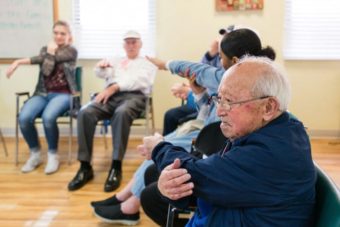
Toru Lura, stretches during the morning exercises at the WISE & Healthy Aging adult day service center for seniors with dementia in Santa Monica, California, in February 2016. (Heidi de Marco/KHN)
April Pearce is in the middle of her freshman year at UCLA, settling into life away from home for the first time. But instead of thinking about dorm food or exams, the 19-year-old is focused on something a little more abstract: old age.
That’s because of a unique course Pearce is taking called Frontiers in Human Aging, designed to teach first-year college students what it means to get old — physically, emotionally and financially.
Pearce said that before, she barely noticed elderly people when she passed them on the street. Since being in the aging class, seeing them fills her mind with questions: Do they live alone? Will they develop dementia? Do they interact with anyone apart from relatives?
“It’s weird, I know,” she said. “But before, I didn’t have any knowledge really about aging. I didn’t even interact with any older people except for my grandmother. Now I’m learning so much.”
In addition to teaching students about aging, the professors have another goal in mind: inspiring them to pursue careers working with the elderly.
With more than 10,000 baby boomers turning 65 every day, there is a growing need, said Rita Effros, a professor at UCLA’s David Geffen School of Medicine who teaches both undergraduates and medical students.
People over 65 represented about 14 percent of the U.S. population in 2013, and that figure is expected to increase to nearly 22 percent by 2040. During that same time period, the number of people over 85 is expected to triple.
And jobs working with the elderly won’t just be in medicine but also in social work, psychiatry, technology and law, Effros said.
“We try to make it clear that aging is going to be big business,” she said. “Whatever their interests are, they should think about serving the elderly.” The strategy seems to be working on many of the students, including Pearce. She started UCLA in the fall wanting to be a veterinarian and now is thinking about becoming a geriatrician.
The class, which has about 120 students, is taught jointly by Effros, an immunologist, Paul Hsu, an epidemiologist, and Lené Levy-Storms, a social welfare professor. UCLA started offering the course in 2001, but the professors said it is becoming increasingly important.
Throughout the year, students hear lectures about anxiety, genetics and dementia. They discuss ageism and read about Social Security. They stage debates on assisted suicide and watch films about growing old.
April Pearce, 19, talks to a representative from Saint Barnabus Senior Services during the Frontiers in Human aging service learning fair in Los Angeles in January 2016. Pearce, a freshman at UCLA, will request an internship with one of the senior centers for her aging class. (Heidi de Marco/KHN)
The course lasts from September to June, and students can go on to take other classes about aging, including ones that focus on diversity or public policy.
Effros said she wants the students to understand people don’t suddenly become old. Rather, the aging process starts when they are conceived. “A lot of life habits and choices they make as college students can affect them decades later,” she said.
During one guest lecture, UCLA medical school professor David Reuben explained how geriatricians evaluate patients and told students about some of the most common problems older people face — dementia, falls, sensory impairment.
He also described how the students’ own lives will change as they age. Instead of traveling the world, older people eventually become unable to travel out of their own bedrooms.
One student raised his hand and said being a geriatrician sounded gratifying, but also seemed heartbreaking. “You watch so many people decline … how do you handle that?”
Reuben responded that he does get sad and he does cry. “Nobody lives forever and nobody should live forever,” he said. “Death is part of the human experience.”
Michael Margolis, 17, said being in the class has made him think for the first time about his own mortality. “It’s not something we typically think about as teenagers,” he said.
One requirement of the class is that students spend a total of 20 hours volunteering with seniors.
Just after the New Year, the students gathered in a large room on campus to meet representatives from several agencies that serve the elderly. Andres Gonzalez, a director at St. Barnabas Senior Center in Hollywood, told the students they could teach technology classes to active seniors or help deliver meals to homebound ones.
“Even that short interaction becomes very meaningful to the seniors,” Gonzalez said. “You might be the only person they see that day. And they get even more excited seeing younger people.”
April Pearce was assigned to WISE & Healthy Agin
April Pearce, 19, participates in the physical exercises during her internship at WISE & Healthy Aging adult day service center for seniors with dementia in Santa Monica, California, in February 2016. (Heidi de Marco/KHN)
g, which runs an adult day service center for seniors with dementia. Catherine Jonas, who previously directed of the center, said the students bring a lot of energy to the center, and they often lead bingo games and exercises. They also have lengthy conversations with the seniors.
“What the older adults need is that dialogue,” Jonas said. And for students interested in learning about dementia, interacting with people affected by it “is so much better than what they get from a book,” she added.
One morning early last month, the center was decorated for Valentine’s Day, with red and white streamers and cut-out hearts hanging from the ceiling.
One of the student volunteers, Julia Gierasimow, led the group as they rolled their shoulders, stretched their legs and tried to touch their toes. Gierasimow, who is also considering a career in geriatrics, said all the seniors she’s met so far have interesting life stories.
“I don’t know if they remember me from week to week … but they are very friendly,” she said. “As bad as their dementia may be, they still give you a hug.”
After the physical exercises, Pearce sat in a chair in the middle of the room, picked up a microphone and commenced with the mind exercises she’s led each visit. Today’s activity: a quiz game about football.
“Which team won the first Super Bowl ever?” she asked, smiling.
Several of the seniors shrugged. One man, 76-year-old Tracy Williams, yelled out the right answer: “Green Bay Packers!”
Williams, retired from the Air Force, said he enjoys when the college students come to visit — even though he never would have done the same at their age. “When I was young, I didn’t want to even be near an old person,” he recalled.
Pearce said that in just a few weeks of volunteering, she is becoming more patient and is learning how to talk to people with dementia. “If they say it’s Tuesday, you’re supposed to go with it,” she explained.
Pearce said the class has given her a new perspective on her own life, too. She is trying to eat less fast food and exercise more. And she tries not to worry so much about things like not doing well on an exam. “I am going to have health problems later if I let the stress get to me,” she said.
Pearce is also seeing her grandmother in a new light, especially after doing an in-depth interview with her for a class assignment.
She said she learned that her grandma had undergone hip replacement surgery, a kidney transplant, and treatment for cancer. She also discovered her grandma had loved to dance when she was younger, and was popular with the boys.
“I had never really thought about my grandmother as a young woman,” Pearce said. “This class is making me appreciate her more.”
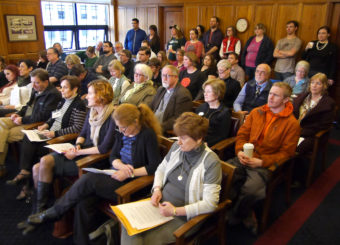
A crowd representing a variety of interests gathered in the House Finance Committee room during public testimony on the state budget, Feb, 29, 2016. (Photo by Skip Gray/360 North)
Alaskans giving public testimony this week on the House’s budget proposal oppose cuts to many areas.
The Republican-led majority released a budget proposal this week that included $145 million more in cuts than Gov. Bill Walker’s budget. It would reduce spending on everything from public libraries to senior benefits.
Roughly 100 people testified Monday and Tuesday on the budget.
The cuts include reduced grants to mental health and addiction treatment programs.
Residents also opposed cuts to prekindergarten, public libraries and the University of Alaska. And they said they want the House to avoid cuts to senior benefits and public broadcasting.
Juneau resident Kara Nelson directs Haven House, a faith-based home for women leaving prison. She opposed cuts to behavioral health grants.
“There are over 120 people today alone that died from an accidental overdose in our nation,” Nelson said. “That is an Alaska Airlines flight that died every single day, and that was in 2015. And so I urge you that we are trying to lessen the beds in our prisons, but we have no supports already to support the well-being of our people.”
Elizabeth Ripley, executive director of the Mat-Su Health Foundation, shared her concerns over behavioral health cuts.
“Cutting behavioral health grants will only reinforce the current system that drives people to seek care in the emergency room,” Ripley said. “A 2013 data analysis shows that Mat-Su Regional Emergency Department had five times the number of visits than our community mental health center. These visits to one hospital cost Alaskans $23 million in 2013, not including doctor, EMS or police costs.”
Kodiak Public Library Director Katie Baxter urged House Finance Committee members to restore funding for the Online With Libraries, or OWL, program. It funds high-speed internet connections and receives federal funds — known as E-Rate — that match state contributions.
“I am here to urge you to restore the governor’s funding of $761,800 to restore the OWL internet connectivity program,” Baxter said. “This program is an intricate system that is cost efficient that involves local and federal funding. By eliminating the OWL program as the house subcommittee has done, now we are leaving federal E-Rate dollars on the table. And I for one really don’t want to do that.”
The House Finance Committee will hear more public testimony Wednesday and Thursday.
Close
Update notification options
Subscribe to notifications
Subscribe
Get notifications about news related to the topics you care about. You can unsubscribe anytime.