Aging

House subcommittees cut state operating budget deeper

The Legislature completed the first stage of its annual budget process today. House Finance Subcommittees recommended more than $120 million more in cuts on top of the $100 million that Gov. Bill Walker proposed.

Health and Social Services was the department that received the deepest cuts. They include eliminating $5.18 million in cash assistance to seniors, and $3 million in behavioral health grants.

Rep. David Guttenberg, a Fairbanks Democrat, opposed the cuts. He said reducing treatment of people with addictions will cost the state more in the long run.

“These grants will clearly prevent increases in costs in other places, in the courts, in the Department of Law, in our prisons, in our various higher-end costs,” Guttenberg said. “Dealing with folks that have issues and troubles at the most efficient place to touch them, is something that we need to do.”

Overall recommended cuts to Health and Social Services total $41 million, roughly one-third of all cuts that finance subcommittees recommend.

Rep. Dan Saddler, an Eagle River Republican, compared the difficulties faced by those with addictions to the choices the Legislature faces.

“There are many unfortunate and difficult challenges we face in life and running away from them in a bottle or a needle is not the way to solve them,” Saddler said.

“The way to get through problems is to face the difficult choices and to make difficult choices. And I think that is what we’re doing in this budget, and that’s what we’re doing in this particular allocation. In addition to a heroin crisis in Alaska, we have a fiscal crisis in Alaska. And I think we are making the difficult, but responsible decisions to scale our resources to meet our needs the best way we can.”

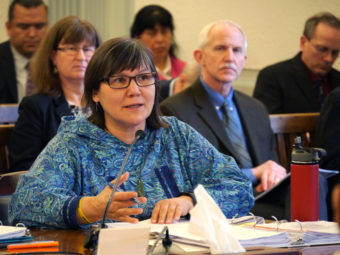
Health Commissioner Valerie Davidson during a discussion on Medicaid reform in Senate Finance Feb. 24, 2016. (Photo by Skip Gray/360 North)

Health and Social Services Commissioner Valerie Davidson said she’ll be working to inform legislators about the exact effects of the proposed cuts before the entire Legislature finishes its work on the budget this spring.

“We’ll definitely continue to work with members of the Legislature,” she said. “We realize that cuts have to be made. And our job is to make sure that everybody understands the implications of the cuts that are being made.”

Institute of Social and Economic Research economist Gunnar Knapp said that budget cuts will have broader impacts on Alaska’s economy, along with the direct effect on services.

Institute of Social and Economic Research Director Gunnar Knapp presents possible economic effects of state budget proposals to the Houses Finance Committee, Feb. 25, 2016. (Photo by Skip Gray/360 North)

Knapp told the budget committee on Thursday that for every $100 million  in broad-based cuts to state government, the state will lose 1,260 jobs and $115 million in income.

In comparison, introducing a similar amount in income taxes would impact fewer jobs, but could mean 20 percent more lost income.

Knapp urged legislators to close the state’s $3.5 billion dollar budget shortfall.

 “The smoothest transition is to make a significant start on reducing the deficit this year,” Knapp said. “Not making major progress this year would have a big impact. The rating companies have promised that they would further downgrade our credit ratings and then there would be impacts due to a loss of business confidence and reduced private investment.”

The Legislature will hear public testimony on the budget next week (Feb. 29 to March 3) at locations across the state.


Aging Southeast: Older residents impact region’s economy

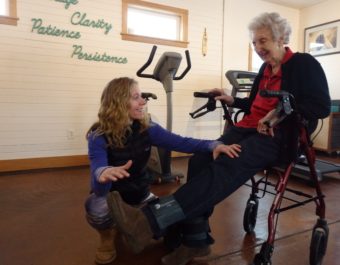
Haines physical therapist Marnie Hartman works with 92-year-old patient Marge Ward. Hartman says most of her business comes from people 65 and older. (Photo by Emily Files/KHNS)
Haines physical therapist Marnie Hartman works with 92-year-old patient Marge Ward. Hartman said most of her business comes from people 65 and older. (Photo by Emily Files/KHNS)

As senior populations grow throughout Southeast Alaska, what kind of impact do they have on the economy? According to experts, it’s a good one. A state report on Alaska’s aging population said seniors contributed an estimated $2.4 billion to the economy in 2014. That comes mostly from retirement income, health-care spending and wages.

As part of CoastAlaska’s Aging Southeast series, KHNS’s Emily Files takes a look at the senior economy from Haines.

Ron Jackson is 75 years old. He moved to Haines 15 years ago, after retirement.

“This was the closest thing to home that I’d ever felt. So that was pretty cool. It was like, I belong here. And I’ve been here longer than I have any place in my life.”

Ron Jackson at a Haines coffee shop. He said, "Senior income is stable ... it survives the ups and downs of an economy." (Photo by Emily Files, KHNS)
Ron Jackson at a Haines coffee shop. He said, “Senior income is stable … it survives the ups and downs of an economy.” (Photo by Emily Files, KHNS)

As Jackson puts it, in Haines, there’s “gray hair everywhere.” Eighteen percent of residents are 65 or older. And seniors are on track to make up more than a third of the population by 2024.

Haines also has the oldest median age in the state – 48.5. That’s about 14 years above the state average and nine years above the region.

How does the abundance of seniors in this 2,000-person town impact its economy?

“One thing is that retirement income works as an injection into the economy, where it’s basically outside dollars that retirees are able to use on goods and services purchased locally. So it’s money that wouldn’t otherwise be circulating the economy,” said state economist Conor Bell.”

Hear and read other reports in our Aging Southeast series.

“It does seem that we have a thriving senior community. A lot of our business is from the seniors,” said Christy Tengs, who owns the Bamboo Room Restaurant. The majority of customers she saw on a recent Monday morning were seniors.

Jackson said older customers are especially important in communities such as Haines, where the economy booms in the summer and busts in the winter.

“Throughout that entire year, a senior income is stable, generally it’s some annuity that’s been earned or Social Security and it survives the ups and downs of an economy,” Jackson said.

Economist Bell said another benefit that comes from a large senior population is increased demand for healthcare.

Marnie Hartman, a doctor of physical therapy in Haines, said that’s been her experience.

“I would say probably 50 to 60 percent of my patient base, depending on the flow at that time, qualifies for Medicare, which is 65 and older,” she said.

After nine years at the local clinic, she opened her own practice. She wasn’t sure if she would have enough patients. But she’s been almost too busy to handle the load.

Those 65 and older have a positive economic impact by bringing in stable, outside incomes and more healthcare spending. But what about the tax breaks they receive?

Take for example, the state-mandated senior property tax exemption. It tells municipalities not to charge property tax on the first $150,000 value of a home.

“So if you had a $200,000 house, you were only paying on $50,000,” said Kathie Wasserman, executive director of the Alaska Municipal League.

AML is fighting the tax-exemption mandate. She said the state should reimburse local governments for the money lost on the exemption.

“We have always said that municipalities need the freedom to look at this policy within their own community and say, ‘OK, this is our financial position at this time and we can afford this much, but we can’t afford to exempt everybody.’”

State data shows that in Fiscal Year 2015, the exemption cost Southeast communities more than $5 million.

In addition to that lost revenue, some municipalities have senior sales tax exemptions. Sitka, Petersburg and Juneau leaders are among those who have considered doing away with the breaks. With a rapidly aging population, some say they’re unsustainable. But all of those efforts were met with community backlash.

“I think I paid my dues, I really, truly do. I’m 80 years old and I’m still working. And, I don’t know, it’s just disgusting that you keep picking on the old people,” Sitkan Shirley Robards told her community’s borough assembly in 2015.

The only one of those three Southeast towns that successfully scaled back senior tax breaks is Juneau.

Economist Bell said things like tax exemptions lead some people to view an aging population as inherently bad for an economy. But he disagrees.

“It’s underrated the amount of impact retirees and an aging population can bring to a community,” Bell said.

Jackson, the 75-year-old retiree, said Haines seniors are involved.

“The definition of a senior isn’t an old person who sits around a lot and drains the system. They’re out there hiking the trails and working on projects,” he said.

He said aside from spending at local businesses, seniors volunteer and serve in government. And he’s not alone in that view. Many in Haines say the same thing – seniors here are active, they contribute to the community.

Aging Southeast: Seniors find purpose, friendship at The Bridge

The Bridge in Juneau is only one of two formalized adult day programs in Southeast. (Photo by Elizabeth Jenkins)
The Bridge in Juneau is one of two formalized adult day programs in Southeast. The program costs $180 a day and accepts Medicaid waivers. (Photo by Elizabeth Jenkins/KTOO)

Health care and housing options are limited for seniors in Southeast, but a few adult day programs are offering relief for care providers, families and friends. They’re often a stop-gap solution until space opens up in a home.
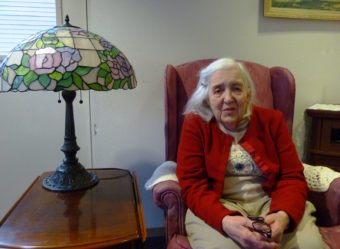
At Juneau’s Bridge Adult Day Program, it isn’t all bingo and reruns of Lawrence Welk. Kelsey Wood, the program supervisor, says the aging adults go on field trips. They play Nintendo Wii –virtual bowling is a favorite. And they do what some might describe as contemporary exercises. The seniors recently learned a pop-culture dance phenomenon known as the Nae Nae.

“There’s some leg movements that go to it. There’s like a stanky leg thing or something like that. … They’re like, ‘This how people dance right now?’ And they’re like, ‘Oh, we remember when the twist was popular,’” Wood said.

Like a lot of things at The Bridge, Wood says the exercises can be adapted for seniors with limited mobility. And that same thoughtfulness is given to people with memory loss, which most of The Bridge’s clients experience.

This morning, Wood is playing 7-up with some of The Bridge’s clients.

“It helps if you put all of the suits together,” Wood explains. 

Later there’s a party planned in celebration of Wood’s upcoming wedding. But for now, she’s helping Beth Fletcher play her best game. And after a few minutes playing cards, Fletcher is throwing down winning hands. It’s an activity she’s nostalgic for. She grew up playing Buck Euchre with her siblings in Minnesota and says she loves the attention she gets from Wood.

“Boy, my memory isn’t very good you know, I’m 90 something. So I can’t remember a lot of what I did when I retired,” Fletcher said. “When I was young, I rode horseback. Before I could walk, I rode horseback. … My mind doesn’t hold things very well. But anyway, I had a great life.”

Fletcher comes to The Bridge four times a week. The difference between a program like this and a nursing home or assisted living facility is she goes home to family at the end of the day. For some seniors, it’s the best option.

“For folks that are waiting to get into a (Pioneer Home), are waiting to get into nursing-level care, it fills that gap,” Wood said.

Depending on the location, state-run Pioneer Homes screen applicants on application date and other criteria. In Juneau, it’s first-come-first-serve. In Sitka, it’s based on date and level of care. Still, the wait can sometimes be years before a space becomes available. And Juneau’s Wildflower Court, which is a nursing home, doesn’t admit clients–based on memory loss alone. So are there enough adult day programs to help fill the gap in Southeast?

“No, there are not,” says Maryanne Mills, the director of Southeast Senior Services.

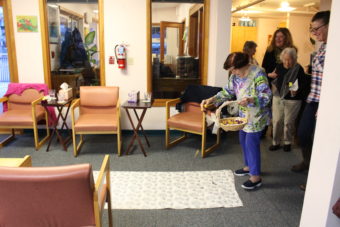
Kelsey Wood's flower girl drops petals before Wood's walks down the aisle. The pretend wedding was organized so members of The Bridge could see Wood's get married before her weekend nuptials.
Kelsey Wood’s “flower girl” tosses petals down the aisle. The pretend wedding was organized so clients of The Bridge could celebrate Wood’s upcoming nuptials. (Photo by Elizabeth Jenkins/KTOO)

“In fact, a couple of years ago, we worked with Centers for Community to submit a proposal to Alaska Department of Health and Social Services for a program in Sitka,” Mills said.

There are only a few formalized adult day programs in the region, like Ketchikan’s Rendezvous Senior Day Services. The grant intended for Sitka wound up going to the Matanuska-Susitna Valley.

“And of course right now, with Alaska’s fiscal crisis, getting state general funds to start such a program is probably not going to happen in the immediate future. We trying to hold on to what we have.”

Mills says keeping the doors open for adult day programs saves money when you consider the alternative. Remember, most of the people at The Bridge have some form of memory loss, which could mean expensive full-time care.

So for those who do stay at home, Mills thinks the time to socialize is important.

“It’s sometimes not the natural way to be,” Mills said. “A lot of people tend to isolate when they get older, but that’s not what they should be doing if they want to live a long independent life for as long as possible.”

Back at The Bridge, the cozy living room atmosphere has been transformed into a pretend wedding. The seniors wear frilly corsages and sip sparkling grape juice.

The bridge
“People aren’t always going to remember your name, but they remember if you do something nice for them and treat them kindly,” said Kelsey Wood.  (Photo by Elizabeth Jenkins/KTOO)

And after a while, Wood and her fiance are ready to walk down the aisle. She’s wearing jeans, clutching a bouquet made out of sparkling brooches — the one she’ll carry on her actual wedding day.

DeeAnn Grummett and her 78-year-old husband are looking on. Grummett brings him to The Bridge four days a week.

“You know I pop in and out at different times and they’re always engaged in an activity. They’re not just sitting around staring at the walls,” Grummett said. “They seem to enjoy each other’s company, and the staff is wonderful.”

Both Grummett and her spouse are on the waitlist for the Pioneers’ Home, but she wants to keep him with her as long as she can. She says The Bridge plays a crucial role in helping her do that.

“At this point for us, it’s much better than even in-home services because what we need is a social experience. My husband has reached the point where he can’t plan and carry out his own social life, and he needs a social life,” Grummett said.

She says when she drops her husband off in the morning, and if he’s in a not-so-great-mood, he’s always feeling better by the end of the day.

Aging Southeast: Region’s senior population growing quickly

Mary Lou Spartz discussing aging issues in the parlor of Fireweed Place, , a seniors’ apartment building in downtown Juneau. She among Southeast Alaska's growing older population. (Photo by Ed Schoenfeld/CoastAlaska News)
Mary Lou Spartz discusses aging issues in the parlor of Fireweed Place, a seniors’ apartment building in downtown Juneau. She’s among Southeast Alaska’s growing older population. (Photo by Ed Schoenfeld/CoastAlaska News)

Southeast Alaska is growing older faster than any other region in the state. This so-called “Silver Tsunami” is expanding the need for housing, transportation, healthcare and social services.

CoastAlaska public radio stations are presenting a series of reports talking to our older community members – and those they work with – about many of the issues they face. In our first Aging Southeast report, we explore why our senior population is growing.

Mary Lou Spartz sits in the parlor of Fireweed Place, a seniors’ apartment building in downtown Juneau.

Spartz, in her mid-80s, chats about aging in the city that’s been home for most of her life. Not long ago, she ran into a friend at a concert. Both noticed something that’s becoming more and more common.

“We looked around the room and he said, ‘You know, these are the same people that were going to concerts 20 years ago, 25 years ago. Except they’re all turning gray or white’,” she said.

Spartz is part of the fastest growing demographic group in Southeast Alaska.

She and about 9,200 others make up a little more than 12 percent of the region’s population. That’s almost a one-third increase over five years ago. It puts Southeast’s average age at about five years older than Alaska as a whole.

But it hasn’t always been that way. Spartz remembers when cold winters and limited medical care sent more Alaskans south.

“When I was a young person growing up, it was just accepted that you would leave Juneau once you reached retirement age,” she said.

More housing, improved health care and other factors provided seniors with more options as the state grew.

Analyst Meilani Schijvens stands by Sitka's Crescent Harbor and lightering dock. She told the Southeast Conference fishing and tourism are growing in the region. (Ed Schoenfeld/CoastAlaska News photo)
Meilani Schijvens of Rain Coast Data stands by Sitka’s Crescent Harbor and lightering dock. She’s been tracking demographic changes in Southeast. (Photo by Ed Schoenfeld/CoastAlaska News)

Meilani Schijvens, director of Juneau-based Rain Coast Data, said today’s growing population has roots dating back almost 50 years.

“In Alaska and in Southeast Alaska, you had this huge cohort of the baby boomer generation coming in in the 1970s,” she said.

Boomers are defined as those born after World War II, primarily between 1946 and 1964.

Some began their lives here. Others came to work in newly developed oil fields and on the trans-Alaska pipeline. With a recession hitting the Lower 48, still others moved for retail, construction or government jobs created as oil revenue increased.

“And that generation has really aged in place. So you’ve seen this really big bubble of baby boomers moving across the aging spectrums. And now that age bubble is moving into their older years. So they continue to dominate the demographic shifts in Southeast Alaska,” she said.

Some people still head south for an easier climate, advanced medical care or to be closer to family. But Alaska Commission on Aging Executive Director Denise Daniello said it’s now easier to grow older without moving.

“Alaska has a really strong base of supports: Senior meals, transportation for seniors, homemaker services, along the continuum of care, which has really helped to support seniors being able to continue living in their homes and in the community longer,” she said.

But that doesn’t cover everyone. Older small-city and village residents often can’t find advanced care without moving to Juneau, Sitka, Ketchikan or beyond. And if they do, they find a shortage of nursing home and assisted living beds, as well as specialists familiar with their problems.

“We don’t have a pulmonary doctor. We don’t have a cardiologist,” said Dr. Susan Hunter-Joerns, the only neurologist in Southeast. She helps diagnose dementia, among other disorders.

“We don’t have rheumatology, don’t have a plastic surgeon anyone, do have orthopedic and physical medicine rehab, but many times there are surgeries that need to be done that are not done frequently enough up here and have to be done down south,” she said.

Southeast Senior Services Director Marianne Mills poses with a list of other organizations it works with. (Photo by Ed Schoenfeld,/CoastAlaska News)
Southeast Senior Services Director Marianne Mills poses with a partial list of other organizations it works with. (Photo by Ed Schoenfeld/CoastAlaska News)

Still, the region has seen growth in senior centers, housing, meal programs, village clinics and home-care services. Southeast Senior Services Director Marianne Mills said her organization works with everyone it can.

“No single agency provides all the continuum of care for older Alaskans. So we need to be really on top of what services are out there,” she said.

She said one goal is to help people live independently as long as possible.

That can be as complicated, with a home monitoring system and regular visits from nurses and house-cleaners. Or it can be simple as rebuilding a doorway to make a bathroom accessible – or making sure a floor isn’t too slippery.

“When someone breaks a hip, often times they’ll go to the hospital and then live the remainder of their days in the nursing home and their lifespan will be decreased,” she said.

She said institutional care can cost nearly $250,000 dollars a year in Alaska. Home and community-based care costs around $30,000.

While the growing older population stretches services, those programs are facing challenges as state and other government budgets shrink. Mills notes an outreach program — targeting some of the most vulnerable people – recently got the ax.

“Last July, we had a program to identify seniors that are having problems with substance abuse or mental illness. And then, all the grantees were notified the program was closing,” she said.

Fireweed Place, a 67-unit seniors' apartment building in downtown Juneau. (Photo by Ed Schoenfeld/CoastAlaska News)
Fireweed Place, a 67-unit seniors’ apartment building in downtown Juneau. (Photo by Ed Schoenfeld/CoastAlaska News)

Back at Juneau’s Fireweed Place, Mary Lou Spartz ponders some of the frustrations of growing older in her hometown. She’s worked most of her eight-plus decades, including as a senior advocate. And she’s watched as older residents’ benefits and exemptions have shrunk or gone away.

“The attitude is people who grow old, what are we supposed to do with them? They’re just a burden. That’s not the way I think we should be thought of,” she said.

And it should be no secret to anyone that the numbers are growing. Researcher Meilani Schijvens said we’ve known about this trend for a good 40 years.

KTOO’s Elizabeth Jenkins contributed to this report.


When Mom Has Alzheimer’s, A Stranger Comes For Christmas

Helen Downs looks through some of her old recipes with her daughter-in-law Mary Downs. Helen used to be a big baker, but now Mary does most of the cooking. Meredith Rizzo/NPR
Helen Downs looks through some of her old recipes with her daughter-in-law Mary Downs. Helen used to be a big baker, but now Mary does most of the cooking.
Meredith Rizzo/NPR

On the northern Virginia farm where Helen Downs spent her childhood, Christmas meant a freshly butchered hog and an epic family meal. When she had her own children, Helen brought this spirit of abundance to their home.

“When I think about Christmas growing up,” her son Terry says, “I remember my mom cooking in the kitchen for hours.” There was turkey and glazed ham, two kinds of stuffing, buttery yeast rolls flecked with cinnamon and pies: chocolate, lemon and cherry. She made it all, and she made sure everybody got a present. For the Downs family, Helen was the heart of Christmas.

Helen and her late husband, Raymond, pose with the family in 1997. Christmas was a big event then, with matching outfits, stacks of presents and lots of food. Meredith Rizzo/NPR
Helen and her late husband, Raymond, pose with the family in 1997. Christmas was a big event then, with matching outfits, stacks of presents and lots of food.
Meredith Rizzo/NPR

Then Helen was diagnosed with Alzheimer’s disease and moved in with her son. As she slowly forgot how to make her famous yeast rolls and use her microwave, her daughter-in-law Mary helped her send out greeting cards, buy presents and bake loaves of banana bread for everyone at Helen’s day care center. She took on the Christmas dinner, too.

Caring for Helen as her mind deteriorates has never been easy for Terry and Mary, but the holidays make things harder. They have to strategize about how to celebrate without disrupting Helen’s routine. They struggle with how to prepare relatives for Helen’s inevitably worse condition and brace for the anger and disappointment they’ve come to expect when fewer friends turn up every Christmas.

Some 5 million Americans have Alzheimer’s, and more than 13 million family members care for them. “There are families in every town, in every state across the country that are dealing with the realities of Alzheimer’s disease at this holiday season,” says Ruth Drew, who runs the national phone helpline for the Alzheimer’s Association.

Caregiving is plenty trying without the emotional freight holidays carry, Drew says, and the expectations surrounding a family celebration can make the season feel overwhelming. At this time of year, calls to the helpline become more urgent. “If you’re calling a helpline on Christmas Eve, you’re calling because you really need help.”

Mary and Terry Downs built an apartment onto their home for Helen seven years ago, so she could live there safely with Alzheimer's. Meredith Rizzo/NPR
Mary and Terry Downs built an apartment onto their home for Helen seven years ago, so she could live there safely with Alzheimer’s.
Meredith Rizzo/NPR

Things have changed in the seven years since Helen moved in with Terry, 54, and Mary, 53. She’s still charming at age 86, with her Southern warmth and cap of silver curls, but her condition is taking its toll on everyone. “We’re tired,” Terry says. “We’re just trying to get through Christmas now.” As Helen has declined, the Downses have had to accept a new reality.

“We can’t make everybody’s Christmas anymore,” Mary says. “To try to pretend that the losses aren’t happening doesn’t do anybody any good. It doesn’t help your family members understand what’s happening.”

Being open with family is important, says Drew. As ever more Americans are diagnosed with the disease — the association estimates some 14 million cases by 2050 — understanding how to navigate difficult holiday situations will only become more important.

Emailing or calling relatives ahead of time to brief them on what to expect and how best to support the person with Alzheimer’s can help, Drew says. Smaller gatherings can make things easier for caregivers and those with Alzheimer’s. Noisy events and big groups can be overwhelming, so Drew suggests preparing the ailing relative by talking about holidays ahead of time, and looking at photos of family members. Providing a quiet room where the person can rest during the celebration is helpful, too, she says.

For Mary and Terry, taking some of the pressure off has made Christmas more bearable, but they can’t shake the sense of loss that comes with it. “For me the hard part is that my mother-in-law is still with us physically, but mentally she’s not there,” Mary says. “It’s almost like having somebody that’s a stranger at Christmas.”

Last year they took what felt like a radical step — they left. With Helen in good hands, they flew to Hawaii to spend Christmas at the beach. This year they’ll be at home, but that’s all they’ve decided. Maybe they won’t celebrate at all.

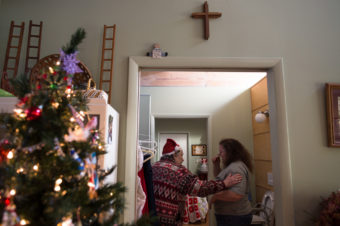
But Terry will put up a tree in the small apartment he and Mary built onto their house for Helen. She’s sitting at a table, 25 puzzle pieces spread out in front of her, when Mary brings out a box full of ornaments. “Helen, Christmas is coming up soon,” Mary says. “What do you want for Christmas?”

Helen looks up from her puzzle. “All I ask is to be in good spirits and in good health so I can come and show myself off when we have the party.”

Mary raises her eyebrows and glances at Terry. “You want to have a Christmas party this year?”

Copyright 2015 NPR. To see more, visit http://www.npr.org/.
Read Original Article – December 21, 2015 4:23 AM ET


Search suspended for missing Unalakleet elder

The search for a missing Unalakleet elder has been suspended. Alaska State Troopers had been searching for 74-year-old Vivian Foote since last Wednesday.

Foote was last seen walking near her home in the early afternoon. The community — led by the Unalakleet Search and Rescue team — conducted a preliminary search for the missing woman before notifying Troopers of her disappearance around 6 p.m. Wednesday.

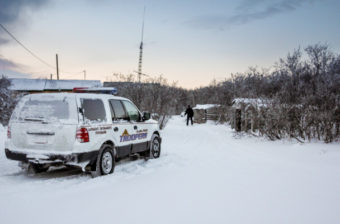
Alaska State Troopers. (KNOM file photo)

Troopers arrived in Unalakleet two days later to investigate and assist with the search. As of Monday afternoon, all search efforts — including sweeps by four rescue dog teams and more than 120 community volunteers — have found no sign of Foote.

Rescue efforts escalated from door to door searches on the day Foote went missing, to shoulder-to-shoulder sweeps across city limits the day after. Rescue dog teams were flown in from Anchorage and Fairbanks after a crowdfunding campaign raised money for their charter. They were also unable to find any sign of Foote.

The dog teams left Unalakleet Sunday night to avoid the incoming winter storm, and Troopers called off their search Monday afternoon.

Middy Johnson is a coordinator with the Unalakleet Search and Rescue team. On Sunday, he said the community would continue its search with closer looks at the outskirts of town and along the water.

“It does get tiring a little bit, but right now we’re hanging in there,” Johnson said. “We’ve had plenty of calls from other communities that are on standby — just waiting for us if we want to expand it more and need more personnel. So we appreciate that, and we’ll just keep going until we’ve exhausted all our efforts or until we find her.”

Troopers say Foote may suffer from medical ailments. Anyone with information on the whereabouts of Vivian Foote should contact the Alaska State Troopers and the Unalakleet Search and Rescue Team.

Site notifications
Update notification options
Subscribe to notifications