Aging

Can A Cancer Drug Reverse Parkinson’s Disease And Dementia?

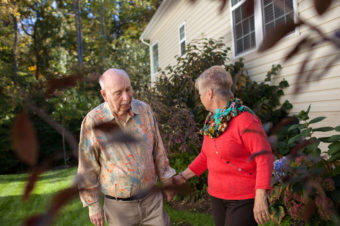
Alan Hoffman, shown with his wife, Nancy, at their home in Dumfries, Va., found that his Parkinson's symptoms improved when he took a cancer drug. Claire Harbage for NPR
Alan Hoffman, shown with his wife, Nancy, at their home in Dumfries, Va., found that his Parkinson’s symptoms improved when he took a cancer drug.
Claire Harbage for NPR

A drug that’s already approved for treating leukemia appears to dramatically reduce symptoms in people who have Parkinson’s disease with dementia, or a related condition called Lewy body dementia.

A pilot study of 12 patients given small doses of nilotinib found that movement and mental function improved in all of the 11 people who completed the six-month trial, researchers reported Saturday at the Society for Neuroscience meeting in Chicago.

And for several patients the improvements were dramatic, says Fernando Pagan, an author of the study and director of the Movement Disorders Program at Georgetown University Medical Center. One woman regained the ability to feed herself, one man was able to stop using a walker, and three previously nonverbal patients began speaking again, Pagan says.

“After 25 years in Parkinson’s disease research, this is the most excited I’ve ever been,” Pagan says.

If the drug’s effectiveness is confirmed in larger, placebo-controlled studies, nilotinib could become the first treatment to interrupt a process that kills brain cells in Parkinson’s and other neurodegenerative diseases, including Alzheimer’s.

One of the patients in the pilot study was Alan Hoffman, 74, who lives with his wife, Nancy, in Northern Virginia.

Hoffman was diagnosed with Parkinson’s in 1997. At first, he had trouble moving his arms. Over time, walking became more difficult and his speech became slurred. And by 2007, the disease had begun to affect his thinking.

“I knew I’d dropped off in my ability to read,” Hoffman says. “People would keep giving me books and I’d have read the first chapter of about 10 of them. I had no ability to focus on it.”

“He had more and more difficulty making sense,” Nancy Hoffman says. He also became less active, less able to have conversations, and eventually stopped doing even household chores, she says.

But after a few weeks on nilotinib, Hoffman “improved in every way,” his wife says. “He began loading the dishwasher, loading the clothes in the dryer, things he had not done in a long time.”

Even more surprising, Hoffman’s scores on cognitive tests began to improve. At home, Nancy Hoffman says her husband was making sense again and regained his ability to focus. “He actually read the David McCullough book on the Wright brothers and started reading the paper from beginning to end,” she says.

The idea of using nilotinib to treat people like Alan Hoffman came from Charbel Moussa, an assistant professor of neurology at Georgetown University and an author of the study.

Moussa knew that in people who have Parkinson’s disease with dementia or a related condition called Lewy body dementia, toxic proteins build up in certain brain cells, eventually killing them. Moussa thought nilotinib might be able to reverse this process.

His reasoning was that nilotinib activates a system in cells that works like a garbage disposal — it clears out unwanted proteins. Also, Moussa had shown that while cancer cells tend to die when exposed to nilotinib, brain cells actually become healthier.

So Moussa had his lab try the drug on brain cells in a petri dish. “And we found that, surprisingly, with a very little amount of the drug we can clear all these proteins that are supposed to be neurotoxic,” he says.

Next, Moussa had his team give the drug to transgenic mice that were almost completely paralyzed from Parkinson’s disease. The treatment “rescued” the animals, he says, allowing them to move almost as well as healthy mice.

Moussa’s mice got the attention of Pagan from Georgetown’s Movement Disorders Program. “When Dr. Moussa showed them to me,” Pagan says, “it looked like, hey, this is type of drug that we’ve been looking for because it goes to the root of the problem.”

The pilot study was designed to determine whether nilotinib was safe for Parkinson’s patients and to determine how much drug from the capsules they were taking was reaching their brains. “But we also saw efficacy, which is really unheard of in a safety study,” Pagan says.

The study found that levels of toxic proteins in blood and spinal fluid decreased once patients began taking nilotinib. Also, tests showed that the symptoms of Parkinson’s including tremor and “freezing” decreased. And during the study patients were able to use lower doses of Parkinson’s drugs, suggesting that the brain cells that produce dopamine were working better.

But there are some caveats, Pagan says. For one thing, the study was small, not designed to measure effectiveness, and included no patients taking a placebo.

Also, nilotinib is very expensive. The cost of providing it to leukemia patients is thousands of dollars a month.

Hoffman says his symptoms have gotten worse since he stopped taking the medication as part of a study. Claire Harbage for NPR
Hoffman says his symptoms have gotten worse since he stopped taking the medication as part of a study.
Claire Harbage for NPR

And finally, Parkinson’s and dementia patients would have to keep taking nilotinib indefinitely or their symptoms would continue to get worse.

Alan Hoffman was OK for about three weeks after the study ended and he stopped taking the drug. Since then, “There’s (been) a pretty big change,” his wife says. “He does have more problems with his speech, and he has more problems with cognition and more problems with mobility.”

The Hoffmans hope to get more nilotinib from the drug’s maker, Novartis, through a special program for people who improve during experiments like this one.

Meanwhile, the Georgetown team plans to try nilotinib in patients with another brain disease that involves toxic proteins: Alzheimer’s.

Copyright 2015 NPR. To see more, visit http://www.npr.org/.
Read Original Article – Published OCTOBER 17, 2015 2:18 PM ET


Suing A Nursing Home Could Get Easier Under Proposed Federal Rules

Proponents of arbitration say the system is more efficient than going to court for both sides, but arbitration can be costly, too. And a 2009 study showed the typical awards in nursing home cases are about 35 percent lower than the plaintiff would get if the case went to court. Heinz Linke/Westend61/Corbis
Proponents of arbitration say the system is more efficient than going to court for both sides, but arbitration can be costly, too. And a 2009 study showed the typical awards in nursing home cases are about 35 percent lower than the plaintiff would get if the case went to court.
Heinz Linke/Westend61/Corbis

As Dean Cole’s dementia worsened, he began wandering at night. He’d even forgotten how to drink water. His wife, Virginia, could no longer manage him at home. So after much agonizing, his family checked him into a Minnesota nursing home.

“Within a little over two weeks he’d lost 20 pounds and went into a coma,” says Mark Kosieradzki, who was the Cole family’s attorney. Dean Cole was rushed to the hospital, says Kosieradzki, “and what was discovered was that he’d become totally dehydrated. They did get his fluid level up, but he was never, ever able to recover from it and died within the month.”

Kosieradzki says that Virginia Cole had signed a stack of papers when her husband was admitted to the nursing home. As is often the case, one of the forms was a binding agreement to go to arbitration if she ever had a claim against the facility. So instead of taking the nursing home to court, her claim for wrongful death was heard by three private arbitrators. They charge for their services.

“The arbitration bill for the judges was $60,750. That was split in half between the two parties,” says Kosieradzki.

Virginia Cole won her claim, but after paying the arbitrators, expert witnesses and attorney’s fees, she was left with less than $20,000.

The federal government is now considering safeguards that would regulate the way nursing homes present arbitration agreements when residents are admitted.

But more than 50 labor, legal, medical and consumer organizations have told the government that’s not enough. They want these pre-dispute arbitration agreements banned entirely. Thirty-four U.S. senators and attorneys general from 15 states and the District of Columbia also have called for banning the agreements.

“No one should be forced to accept denial of justice as a price for the care their loved ones deserve,” says Henry Waxman, a former congressman from California. Arbitration agreements keep the neglect and abuse of nursing home residents secret, Waxman says, because the cases aren’t tried in open court and resolutions sometimes have gag rules.

“None of the systemic health and safety problems that cause the harm will ever see the light of day,” he says.

The proposed federal regulation would require nursing homes to explain these arbitration agreements so that residents or their families understand what they’re signing. It would also make sure that agreeing to arbitration is not a requirement for nursing home admission.

The American Health Care Association, which represents most nursing homes, is against this proposed change in the rules. Clifton Porter II, the AHCA’s senior vice president for government relations, says that’s because “they’re prescribing us to do things that we, frankly, already do.” Porter acknowledges, however, that practices vary from facility to facility, depending on state law.

Arbitration agreements, he says, are common throughout the health care industry — in hospitals, surgery centers and doctors’ offices. “Why aren’t rules being promulgated to eliminate arbitration in those settings?” he asks.

In any case, Porter says arbitration is more efficient for both sides than going to court would be.

“It actually allows consumers to get an expedited award,” he says. “And you have the benefit of not having to use the courts and go through the entire process.”

But that expedited award is about 35 percent lower than if the plaintiff had gone to court. That’s one conclusion of a study commissioned by Porter’s organization in 2009.

If the federal government does regulate or ban the signing of arbitration agreements for new nursing home residents, Porter says the American Health Care Association will probably fight the move in court.

Copyright 2015 NPR. To see more, visit http://www.npr.org/.
Read Original Article – Published OCTOBER 19, 2015 3:30 PM ET


Seniors pack assembly chambers to fight scale back of sales tax perk

Seniors wore bright, yellow pins reminding, "We vote." (Photo by Elizabeth Jenkins/KTOO)
Seniors in assembly chambers wear bright yellow pins that say “We vote.” (Photo by Elizabeth Jenkins/KTOO)

Despite pleas from a packed house, the Juneau Assembly voted 7-2 Monday to scale back the senior sales tax exemption.
Low-income seniors will remain exempt from Juneau’s 5 percent sales tax. Other seniors will have to pay, unless they’re purchasing essential items like food, heating fuel, electricity and city water and sewer utilities. The assembly also voted to exempt garbage removal and recycling services.

More than 40 people gave passionate testimony on the issue. Nora Laughlin said when she retired, the sales tax exemption helped her stay in Juneau. She stressed seniors do a lot to give back to the community.

“The amount of hours we put in and give to this city are phenomenal. And you want to balance the budget on our backs. Come on!” she said. “I do free taxes for people: seniors and low-income during tax season. And I volunteer at nonprofits. I’m not the only one. That’s what seniors do. We are valuable assets.”

A handful of testifiers said middle-income families were suffering more. But others worried what effect the change would have on local businesses.

Melissa Highfill, the owner Seaside Yarns, said seniors with exemption cards make up 10 percent of her sales.

“I can’t afford to lose up to 10 percent of my business by people shopping online,” Highfill said. “Having things delivered for free and not paying sales taxes. I try to educate people to see it here, buy it here and keep me here. Seniors know the value of that.”

Assembly member Kate Troll  pointed out that the city’s senior population has doubled since the sales tax exemption was created and that number is projected to go up.

Troll said by making these “modest” changes now, the program could remain sustainable.

“It’s only a matter of time before the question really comes, do we do away with the exception at all?” Troll said. “As many people here have said, we know the state’s fiscal situation isn’t very rosy. And we need to make sure we keep the programs and services the seniors depend upon.”

Mayor Merrill Sanford and assembly member Mary Becker were the only no votes.

The city’s finance officials have forecast the changes will raise an extra $1 million a year from local seniors. The ordinance takes effect Jan. 1, 2016.

California Approves Physician-Assisted Suicide; Bill Heads To Governor’s Desk

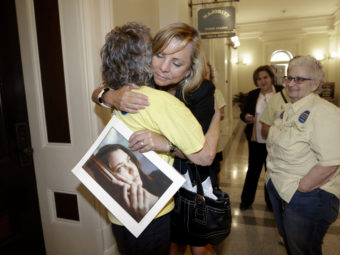
Debbie Ziegler holds a photo of her daughter, Brittany Maynard, as hugs supporter Ellen Pontac after a right-to-die measure was approved by the state Assembly on Wednesday in Sacramento, Calif.

A controversial bill to legalize physician-assisted suicide in California is headed to the governor for consideration, after almost nine months of intense — often personal — debate in the legislature.

If Gov. Jerry Brown signs the bill, California would become the fifth state to allow doctors to prescribe lethal medication to terminally ill patients who request it, after Oregon, Washington, Vermont and Montana.

“Our hope, our fervent hope, is that Gov. Jerry Brown will sign this bill and bring relief to hundreds of dying Californians,” said Toni Broaddus, state campaign director for advocacy group Compassion & Choices.

The California bill was modeled after the Oregon law. It requires two different doctors to determine that a patient has six months or less to live before prescribing the drugs. Patients must be physically able to swallow the medication themselves, and must have the mental capacity to make medical decisions.

Numerous additional safeguards were added to the bill in recent months to sway opponents, including a sunset clause that ends the law in 10 years. Patients must request the drugs three times to receive them — once in writing before two witnesses — and they must sign a form two days before ingesting the medication.

“I can assure you that the joint and co-authors on this bill … have endeavored to build in protections in this law that are stronger than the protections in any of the states where this has been practiced,” said Sen. Bill Monning, D-Carmel.

The bill continued to face fierce opposition, however, from religious groups and disability rights advocates. They are concerned that elderly and disabled people, especially those who are low-income, could be pressured into taking the drugs in order to end or avoid expensive, life-sustaining care. They fear the protections are not enough, and that family members or other heirs could slip the drugs to the patient without their knowledge or consent.

“The legislation effectively paints a target on the back of each and every elderly and disabled person in our state,” said Sen. Joel Anderson, R-San Diego, paraphrasing an elder abuse advocate. “The promises and assurances of the safeguards and protections from the representatives of those in favor are based in innocent ignorance.”

Opponents also criticized the procedure for getting the bill through the Legislature. During the normal legislative session, the bill stalled in the Assembly Health Committee when authors couldn’t get enough votes. Several Democrats from Southern California would not support it.

But proponents managed to navigate through that roadblock by re-introducing the bill during a special session on health care financing, where committee memberships were different. The bill passed the Assembly on Wednesday 44 to 35, and it passed the Senate on Friday 23 to 14.

Gov. Jerry Brown’s office also criticized the political pathway, saying the special session was not the appropriate venue for the physician-assisted suicide bill. But Brown has not indicated where he stands on the issue itself, nor whether he will sign or veto the bill. If he does nothing, after 30 days the bill will become law.

This story is part of a reporting partnership with NPR, KQED and Kaiser Health News.

Copyright 2015 KQED Public Media. To see more, visit http://www.kqed.org.
Read Original Article – Published SEPTEMBER 12, 2015 3:20 AM ET

Access to benefits focus of VA Secretary’s visit to Point Hope, Kotzebue

Point Hope’s old townsite. (Photo by Emily Russell/KNOM)

Walking amongst the old sod and whalebone houses on the edge of the Bering Sea, it’s easy to let the world around you fade away. We’ve come to Point Hope, Alaska, one of the oldest continuously inhabited communities in North America, 200 miles north of the Arctic Circle.

The barrier between the old abandoned town site and the new community is the airport, which sees multiple small-plane departures and arrivals each day, though today is a bit different. Today a pearly white plane is parked on the runway. On the side it reads “United States of America,” which feels like a million miles away from where we are.

McDonald at a listening session in Point Hope. (Photo by Mitch Borden/KNOM)

The official aircraft came all the way from Washington DC to made good on a request from local. Leonard Barger, Transportation Director of the Native Village of Point Hope, wrote to the Secretary of Veterans Affairs, Robert McDonald, last year requesting a visit to honor the community’s veterans.

Barger explained the importance of McDonald’s visit to the 49thstate. With the highest number of veterans per capita in the country, even the most remote communities throughout Alaska have vets. Along with Point Hope, Barger acknowledged the veterans in communities like Barrow, Point Lay, and Unalakleet. “All these people in Alaska, they’re going to Afghanistan,” Barger said, “they’re leaving their family, but they’re serving their country, they’re sacrificing their lives for us.”

Along with visiting Point Hope, McDonald also held a listening session that day in Kotzebue. It took Walter Sampson, a Vietnam vet living in Kotzebue, 11 years to get serviced by the VA in Anchorage, a 500-mile journey and a $600 plane ticket away from home. Sampson made sure to remind McDonald of the unique challenges that many of Alaska’s vets face in accessing the benefits they’ve earned.

Whalebones welcome visitors to Point Hope. (Photo by Mitch Borden/KNOM)

“Remember that we’re in bush Alaska,” Sampson said, “We’re in roadless communities.” While Fairbanks and Anchorage have the clinics, the VA officers, and the hospitals, he stressed that, “for bush Alaska we’ve got nothing at all.”

Without the VA facilities and representatives, information has a hard time reaching vets in bush Alaska. Sampson expressed a feeling that many vets seemed to share. “As a veteran, do I really know who [the] VA is?” Sampson asked himself. “What benefits does it have for me?
Sampson is frustrated by the convoluted nature of the VA support system, which often requires multiple phone calls, website logins, and, in the end a system too complex for its own good. McDonald was quick to acknowledge those inefficiencies.

“Walter’s right,” McDonald admitted, “we’ve got too many 1-800 numbers, it’s too confusing.” With over 900 1-800 numbers and 14 websites that require different usernames and passwords, many vets get lost in the system before they ever get help. “We’re going to go to one 1-800 number, we’re going to go to one website,” McDonald promised, “it’s just too complex, we’ve got to simplify it, that’s what we’re working to do.”

But a simplified system is only one step towards getting vets throughout Alaska the benefits they deserve. With McDonald gone and many questions left unanswered, the support system that seems the most promising comes from within the state.

Chester Ballot, another Vietnam vet in Kotzebue, was trained in Anchorage as a tribal veteran representative and now works to sign up fellow vets to the VA. The Alaska VA also sent two representatives to both Point Hope and Kotzebue to sign up and inform vets of their benefits. So far the Alaska VA has sent representatives to 39 of the state’s nearly 300 villages.

Although McDonald is back in DC, Leonard Barger hopes this will not be his last visit to Point Hope. Barger and other community members encouraged him to return in the spring to take part in a whale hunt, one of the many benefits of living on the edge of the Bering Sea.

Vets deliver fiery testimony to VA secretary during Mat-Su visit

Dozens of people lined up during Thursday’s listening session to speak on concerns and experiences with the VA. Though overwhelmingly critical, many laid out positive experiences receiving care in Alaska. (Photo by Jillian Rogers)

A listening session held Thursday night in Wasilla by the head of the Department of Veterans Affairs was dominated by complaints about the healthcare system for veterans. The VA is struggling in Alaska to rebuild trust as policy changes unfold from Washington, D.C. all the way to the state’s most remote clinics.

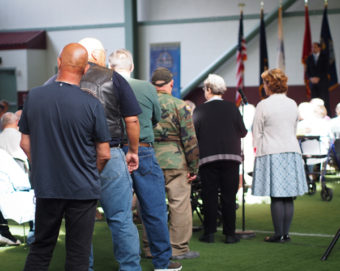
On the green AstroTurf soccer field at Wasilla’s Menard Sports Center, a crowd of hundreds — mostly older — turned out to talk about the VA.

“Obviously the Department of Veterans Affairs had a crisis,” said Secretary Robert McDonald from a stage, not using notes or a script as he gave an overview of the massive problems hampering service in recent years. “The primary reason, as I looked at this situation, was the aging of the American Veteran population.”

There are more veterans coming on the rolls, and also more recognition of ailments like post-traumatic stress, Agent Orange exposure and Hepatitis C from Vietnam-era blood transfusions. Just as needs are ballooning, there’s a compounding shortage of staff.

“We didn’t have enough doctors or nurses,” McDonald said of when he took over. “When I first testified in front of Congress I said ‘I need to hire 28,000 medical professionals nationally.’”

Staffing concerns have been an issue in Alaska–particularly at the nearby Mat-Su Valley outpatient clinic.

At the heart of the crisis, according to McDonald, are Congressional budgets that cap spending on veteran health. But where to lay blame for such enormous problems was one of the many things the crowd pushed back against.

“One hour, with all of us? Come on, let’s get real,” said retired Air Force Sergeant Mike Kuntz ahead of a heated exchange with McDonald.

“I thank Dan Sullivan for making you come up here,” Kuntz said.

“Wait, wait, wait, let’s be clear: nobody made me come here,” McDonald shot back.

“Dan Sullivan had a lot to do with it,” Kuntz replied.

“No he didn’t. He had nothing to do with it,” McDonald said, before the subject moved on.

Testimony was overwhelmingly critical of the VA, filled with stories of personal misfortune and professional misconduct — some stretching back decades.

James Perkins is a recent vet from the 10th Mountain Division, and drove up from his home on the Kenai Peninsula to explain that in spite of efforts to overhaul the system in Alaska and across the country, it’s still vastly inadequate measured against the need.

“I’ve lost over six brothers that I’ve served with, in less than a year, to suicide. And I’ve almost been a victim of veteran suicide myself,” Perkins said. “The struggle is real.”

Stories of suicide, over-medication, and VA staffers too overworked or indifferent to help received cheers of agreement from the audience.

Army veteran Joe Oswald Jr. began his fiery remarks noting that many local veterans are afraid to raise problems they’ve experienced.

“Me speaking here is going to get me retaliation from VA,” Oswald said. “And VA is part of the reason veterans commit suicide — because they suggest suicide. And nobody is addressing it, sir, everybody is just passing the buck and hoping you go away.”

As Secretary McDonald listened, he would periodically refer people to VA staffers set up at tables in the back of the event.

Scott Harrison is a Marine Corp vet who lost his home from spiraling health problems. He doesn’t expect any one person to solve all his health issues, but believes the frustration for many, himself included, is wrangling complex paperwork just to get plugged in to their benefits.

“Nobody knows who I’m supposed to talk to,” Harrison said, emotion creeping into his voice. “They cannot find my records. I was at so many different duty stations, so many different bases, so many different operations — there’s absolutely no way that every record along the path is lost.”

McDonald interrupted him to flag down a staffer to get the marine’s info. Harrison spent about 15 minutes talking with a VA employee as she scribbled down notes.

Afterward, Harrison explained that in spite of struggling to find enough care, he does see folks trying hard to help within a flawed system.

“I think people are emotional on all this, and I think maybe people are maybe wanted to blame the secretary or hold him to task,” Harrison said, pausing to add, “The man’s doing a job.”

“We follow up on everything,” the Secretary said during an interview after the event. He stayed late taking questions, and had to hustle out the door in order to make his flight, but called from the road. He insists the listening sessions are more than a show. His staffers take notes during testimony and follow up with every individual case to see if it’s valid, and if so what can be done.

Asked whether that was a general goal or a literal protocol, McDonald replied quickly, “Every single thing.”

The Secretary’s visit also included a trip to Kotzebue, and a headstone ceremony on Wednesday in Point Hope.

Site notifications
Update notification options
Subscribe to notifications