Aging

Homeless Dillingham man lives tough life — on his own terms

Matfie McCarr has been homeless since 2002, one of just a few in town who call the streets home. It's been his choice to live this way, he says, though he's not always proud of how he got here. (Photo by Avery Lill/KDLG)
Matfie McCarr has been homeless since 2002, one of just a few in town who call the streets home. It’s been his choice to live this way, he says, though he’s not always proud of how he got here. (Photo by Avery Lill/KDLG)

Christmas lights are up and a chilly wind is blowing on a snowy December day in downtown Dillingham.

A gentle, smiling 61-year-old man hanging out near the grocery store finishes off a cigarette butt he rescued from the trash.

Then Matfie McCarr pulls out a harmonica with crushed metal sides that changes its tone and blows a few notes. He’s thankful for the company his music keeps during lonely hours at his camp.

“That’s really helped my thoughts,” he said.

McCarr is homeless, one of just a few in Dillingham during the winter.

A long road brought him here, but it’s a road he says he has chosen to follow.

Born in Old Koliganek in 1955, McCarr remembers moving to Dillingham after the Great Alaskan earthquake of 1964.

He went to boarding school, then to the Sheldon Jackson College in Sitka where he studied religion and land management.

In Sitka, he married, started a family, and worked a variety of jobs — everything from construction to teaching to fishing.

Drugs and alcohol took their toll, and he spent some time in prison.

In 2002, McCarr moved back to Dillingham, and has been homeless mostly ever since.

His camp is an abandoned shipping container that offers a little protection from the elements, though he admits it gets cold and wet.

Thoughts of his children and family punctuate the isolation.

“I don’t have a radio,” he said. “The only thing I have is a harmonica and a Bible, of course.”

When his neck is warm, he sleeps better.

Sometimes he has to choose between sleeping with his socks on his feet and wearing them like a scarf. Other nights, it’s just too cold to sleep.

“I would wake up certain hours early in the morning and, you know, just wondering about time because I don’t wear a watch. But I get up when I start feeling my muscles start jerking or getting cramped.”

When that happens, he gathers his things and walks through town to keep his blood circulating.

Normally, he can count on one meal a day from the senior center, and sometimes people give him food.

Other times he digs scraps out of the Dumpster, and says one can learn to “read” food from the garbage to avoid getting sick.

But health is a concern.

About a month ago, McCarr says, he had an operation to remove his colon.

Now he’s on a lot of medication, and it’s been hard to keep up his weight.

That’s important when you’re living outdoors and need the insulation and energy.

As McCarr reflects on being homeless, the word he uses most often is choice. Choices that he has made in the past and the ones he makes every day.

“Everybody goes through different things in lifestyle,” he said. “We don’t know what it holds for each person. It’s their own choosing what they want, and this was my own choosing what I wanted.”

Yet, for all his pleasant pride in living life on his own terms, McCarr acknowledges that some of his choices were not good ones, nor easy.

Thinking on the circumstances that brought him to a life on the streets does bother him.

“It’s been eating me inside, which I never talk about for a long time,” he says. “It do involve alcohol, and it involves drugs. It involves losing jobs and marriage, so I can’t go back to those things every day like I want to, and I have to make that choice for myself.”

McCarr says there are things he chooses not to worry much about, like whether he will ask a relative for a place to stay for the night, or when he will look for work. Nor does he spend much time worrying over the past.

“I learned not to think backwards,” he said. “That’s the most important thing in life. You can’t look at yesterday. You can look at today, but you can’t look at tomorrow.”

Today has enough choices to make, like when to get up and move to beat the cold, where to look for a bite to eat, and how to stay clear of drugs and alcohol.

Winning these battles won’t fix the past and won’t lead to a better future. But they have kept this amiable elder going into his 60s, including the last 14 years on the streets.

Life isn’t great, but with his harmonica and a song to sing, Matfie McCarr says it really isn’t all that bad either.

Ketchikan High School club donates pie proceeds to Pioneers

Every November, just before Thanksgiving, Ketchikan High School’s Rotary Interact club – the high school version of Rotary – organizes a pie auction. Money from the auction goes to the Ketchikan Pioneers Home, and usually the students are able to raise a couple thousand dollars.

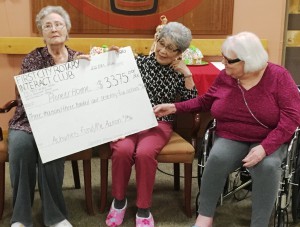
This year, they raised the most money ever. In a special ceremony on Thursday, three graduating seniors from Interact handed over a check for Pioneers Home seniors.

Kayhi Rotary Interact members Angie Gomez, Alison Blair and McKenzie Harrison are ready to present a big check to the Ketchikan Pioneers Home. (Photo by Leila Kheiry)

Kayhi Interact co-presidents Angie Gomez and McKenzie Harrison, and past-president Alison Blair were all smiles as they presented a gift-wrapped big check – suitable for photos – to members of Ketchikan Pioneers Home’s resident council.

The residents, too, smiled as they unwrapped the early Christmas present. The big check – and the normal-sized official check – was for $3,375. Gomez said they raised that much because they had so many pies donated to the auction by Ketchikan’s generous bakers.

“I don’t even know how many pies we had – there was a lot,” she said. “We had more than we’ve ever had this year, which was great.”

The money will go into the resident council’s activities fund. Pioneers Home activities director Hilary Koch said that helps pay for all kinds of things that aren’t funded through the ever-shrinking state budget: Holiday decorations, for example, and bingo prizes.

“All kinds of supplies,” she said. “Newspaper and coffee supplies – a newspaper subscription. Cat food – we do have a cat, we have two birds, we have probably seven fish – nail polish and spa supplies,” and arts and craft supplies, even furniture.

Koch said the pie sale and the annual Pioneers Home garage sale are two big sources for that fund, along with individual donations from people in the community.

After the brief ceremony, Gomez, Harrison and Blair gave a few more details on the pie auction. They said Marna Cessnun’s pies raised the most money, as they do most years.

“I think it went $200 – almost $300,” Gomez said of the most expensive pie. “That was a cherry pie or an apple pie? (She made both) Her pies both went for a lot, but that cherry (or) apple pie – we don’t know – it definitely went for the highest.”

Harrison said Dick Miller’s pies also went for more than $200 apiece. Those also were classic cherry and apple. In fact, there were a lot of apple pies, and they sold well. But, she said, “We also had some rhubarb pies, cherry, pecan.”

Pioneers Home residents with the big check, representing the proceeds of this year’s Rotary Interact pie sale. (Photo by Leila Kheiry)

“Lots of apple, though,” Gomez said.

“There was a freezer one – a s’mores pie,” Harrison added.

Gomez said, “We had some cheesecakes too.”

“Another surprising seller, you could call her and ask her to make a certain type of pie, so it was an empty pie dish,” Harrison said. “That was a good seller. It ended up being an apple, though.”

Getting hungry? Let’s talk about something else, then. Like TAFCOM. That’s a non-profit organization in Tanzania. Here’s Gomez, explaining how Kayhi’s Interact helps that group: “There’s different groups in TAFCOM – there’s the education one and we mostly fundraise for the education: Schools and supplies and whatever they need for their schools.”

To do that, Gomez said, women in the Tanzanian villages make various items, such as scarves and bags. Interact sells those items here in Ketchikan, and then sends that money to TAFCOM for specific projects.

“We just recently sent them $1,500 because they need to furnish a school that they haven’t furnished yet, so that’s going to desks and school supplies and whatever else they need,” she said.

Blair said helping others is part of why she has enjoyed her four years with Interact.

“I like giving back to both the community I’ve grown up in and also our global projects we do, especially in Tanzania,” she said. “It’s just an amazing feeling you get when you help others.”

Gomez said she especially enjoys the various opportunities for community interaction.

“The activities that we do – the pie auction is one of my favorites – the Winter Arts Faire just gets you in the feeling for the holidays, TAFCOM is an amazing organization,” she said. “Just being able to say what we do and how it affects people; it’s really just great.”

Harrison said she feels blessed to be able to help others, and she appreciates the ongoing community support of Interact’s efforts.

“I would like to thank everyone who donates money, time and pies, also with buying the items,” she said. “I know sometimes it’s kinda the same items every year but people still tend to support us and we’re very grateful for our community’s help.”

This is the last year of Interact for the three seniors, which made the pie auction’s success somewhat bittersweet.

There is a college version of Rotary called Rotaract, which they say they might try to organize if their colleges of choice don’t have one already.

Zsa Zsa Gabor, An Icon Of Camp, Glitz And Glam, Dies At 99

Updated at 11:41 p.m. ET

Zsa Zsa Gabor — the woman who probably inspired the term “famous for being famous” — died on Sunday, according to multiple media outlets. She was 99 years old, just two months shy of her 100th birthday.

NPR confirmed Gabor’s death with her publicist, Edward Lozzi, who issued the following statement:

Zsa Zsa Gabor in 1954.
Zsa Zsa Gabor in 1954. Hulton Archive/Getty Images

“Zsa Zsa Gabor has died. I am pleased that she is finally out of her misery. For the past five years, Zsa Zsa has suffered chronic dementia, locked away in her mansion laying in a hospital bed being fed through tubes in her naval, not able to speak, see, write or hear. Nor knowing who she was or how famous she was. Being her publicist during the famous Beverly Hills cop slacking incident and providing those services for her daughter Francesca Hilton were highlights of my PR career.

Zsa Zsa did not suffer fools well. That fact, along with her European post-war survival techniques inspired by her mother, Zsa Zsa Gabor was one tough cookie. Her beautiful lips and mouth would be her worst enemy when and if she turned on the verbal machine gun. Most of her problems resulted from that beautiful mouth.

Despite the people who came into her life these past years, and the controversy they have caused with their behavior, many that are still around who worked with her, knew her, from the 1950s, 1960s, 1970s, 1980’s know that Zsa Zsa Gabor is an American icon and the key link in the Gabor/Hilton Dynasty which will still exist for generations to come.

Zsa Zsa and her daughter Francesca Hilton are together again. Always remembered.”

Buxom and blond, vampy and campy, the Hungarian-born screen siren mainly contributed to cultural touchstones such as The Love Boat, The Naked Gun 2 1/2 and Hollywood Squares — where she answered (or, more accurately, couldn’t answer) questions about Cheez Whiz.

Zsa Zsa Gabor strikes a glamorous pose during a rehearsal for CBS's As The World Turns in 1981.
Zsa Zsa Gabor strikes a glamorous pose during a rehearsal for CBS’s As The World Turns in 1981.
Mary Lederhandler/AP

But it would be a grave mistake to trivialize Gabor’s achievements.

“She is one of the most important figures of the late 20th century in terms of thinking about celebrity, thinking about women,” says Kirsten Pullen, a professor at Texas A&M University.

Pullen is not joking. As far back as the 1950s, when women were expected to be decorous, Gabor sought and got constant press for her juicy hookups, her fabulous bling and her public antics. She could dominate a newsreel about a movie premiere — for a movie she wasn’t even in — just by showing up in a diaphanous gown. She was arguably the prototype for today’s Kim Kardashians and Paris Hiltons.

(In fact, Gabor and Hilton had family ties: Gabor was once married to Conrad Hilton, who is Paris Hilton’s great-grandfather.)

“You can’t make this stuff up,” Pullen says wryly. “Whether or not we think it’s great to be famous for being famous, she is the one who really set the template for that.”

Gabor followed her sister Eva from Hungary to Hollywood in the 1940s. Zsa Zsa scored some small movie parts from big movie directors — Orson Welles and John Huston among them — and was also featured in some movies probably best forgotten, such as Queen of Outer Space.

But if she wasn’t known for her skilled acting, dancing or singing, Gabor was an irrepressible performer — and she excelled at playing herself, once endless rounds of Hollywood gossip and publicity made her own persona larger than any character.

She had charm, which made her jokes about marrying for money rather than romance more palatable right when women were starting to demand more financial control. Her oft-stated fondness for sex dented traditional expectations of passive femininity, Pullen says: “She paved the way for the sexual revolution.”

And when Gabor slapped a policeman who pulled her over in 1989, she parlayed the incident into a full-blown comeback, without any apparent help from mangers or publicists. The incident put her back on the talk show circuit, where she chattered merrily about the challenges of maintaining a beauty regimen in the slammer.

Even as an older woman, Gabor tended her image as the glamorous starlet who married something like 10 times. She threw out lines like, “I am a marvelous housekeeper. Every time I leave a man, I keep his house.”

But she also, ironically enough, had this to say about Paris Hilton: “I think she’s rather silly. She does too many things for publicity.”

Copyright 2016 NPR. To see more, visit http://www.npr.org/.

Dr. Heimlich, The Man Behind The Life-Saving Maneuver, Dies

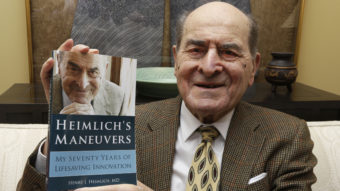
Dr. Henry Heimlich has died in Ohio at age 96. He's seen here in 2014, holding a copy of his memoir at his home in Cincinnati. Al Behrman/AP
Dr. Henry Heimlich has died in Ohio at age 96. He’s seen here in 2014, holding a copy of his memoir at his home in Cincinnati.
Al Behrman/AP

He’s credited with saving thousands of people from choking to death, thanks to the method he popularized in 1974. Now comes word that Dr. Henry Heimlich has died at age 96.

Heimlich died early Saturday at Christ Hospital in Cincinnati, Ohio, according to Bryan Reynolds, spokesman for Episcopal Retirement Services, which operates the retirement home where the physician lived for years.

According to Reynolds, Heimlich was experiencing complications from a massive heart attack he suffered in his home Monday.

Since its invention, the Heimlich Maneuver has become both a life-saving tool and a part of modern culture. It’s uncertain how popular it would be if the move was still known by its original term: subdiaphragmatic pressure.

As Heimlich told NPR back in 1999, that’s the name he assigned the method when he described it in a medical journal in June of 1974.

That original name didn’t last long. As Heimlich said, “the editors of the Journal of the American Medical Association called me, and they said, ‘We have found that so many lives have been saved in less than two months, we would like to name this after you.'”

By 1980, he said, the Heimlich maneuver had gained enough prominence to be an entry in foreign-language dictionaries.

The thoracic surgeon famously used his own maneuver earlier this year to help a fellow resident at his retirement home — an 87-year-old woman who began choking on a hamburger during dinner.

In a statement, Heimlich’s family said they were saddened by the death of a man who’s seen by a hero by many. And they said the physician’s legacy extends beyond his famous life-saving method:

“As a young surgeon, Dad was the first American to devise and perform a total organ replacement. Later, he came up with a device that saved thousands of soldiers’ lives during the Vietnam War. The Heimlich Chest Drain Valve is still used worldwide for patients undergoing chest surgery.

“Dad was firm in his convictions and passionate for his causes. He didn’t play politics well. Instead, he was single-minded in his quest to find better ways to save lives. Dad dreamed that anything was possible in the field of medicine, even when critics said otherwise.”

Some of those critics focused on Heimlich’s theory of malariotherapy, in which malaria is induced in people suffering from HIV, Lyme disease and other conditions with the goal of using malaria’s high fevers to help patients. Heimlich has acknowledged performing such research on HIV patients in China, telling Boston.com in 2014 that he feels the idea deserves to be researched.

Other disagreements have centered on the use of the doctor’s eponymous maneuver. The Red Cross says it should be used only after slapping a choking victim’s back, for instance, and the Red Cross and other organizations have also said drowning victims should get mouth-to-mouth resuscitation rather than the Heimlich maneuver.

The Heimlich Maneuver is relatively simple to perform; it’s also been deployed to rescue people from Carrie Fisher and Halle Berry to President Ronald Reagan and New York Mayor Ed Koch, as Radiolab has reported.

Here’s how Heimlich himself described the maneuver to NPR:

“There are several positions. Now everybody knows where you stand behind the person, put your thumb inside of your fist just above the bellybutton — remember, below the chest. And you grasp your fist with your other hand and you press inward and upward. Now you repeat that until the object comes out.

“But it also can be done with a person lying down on their back. You kneel astride their thighs and put one of your hands on top of the other, and the heel of the bottom hand just above the bellybutton, and press your weight in. And that’s how children have saved their parents. In addition, its widest use now is to save drowning victims.”

You can also see examples of the maneuver in videos from the physician’s Heimlich Heroes website.

Copyright 2016 NPR. To see more, visit http://www.npr.org/.

Retired Coal Miners At Risk Of Losing Promised Health Coverage And Pensions

Retired coal miners could face the loss of health benefits if Congress doesn't implement a fix by Friday. Steve Helber/AP

Retired coal miners could face the loss of health benefits if Congress doesn’t implement a fix by Friday. Steve Helber/AP

Without congressional intervention, about 16,000 retired miners in seven states will lose their health care coverage by the end of the year.

A proposal to temporarily extend the benefits is working its way through Congress. But two Senate Democrats, who are advocates for a more comprehensive plan, say the temporary provision isn’t enough.

They are threatening to hold up a spending bill that needs to pass by Friday night to keep the government running.

Coal mining is dangerous work. For many miners, a government-backed promise of lifelong health care for them and their dependents made the risk worth taking.

Roger Merriman, 65, worked in the coal industry for 28 years.

“When we all started in the mines, we were promised health care for life – cradle to grave,” he says. Merriman’s employer, Patriot Coal, filed for bankruptcy in 2012, then again in 2015. He is now slated to lose his pension and benefits. Merriman says that possibility of losing health benefits for his wife, who is younger than he is (at 65, he qualifies for Medicare), and their pension, is devastating.

“We’ll have to make a choice of whether [we’re] going to the doctors and buying prescriptions or paying bills and eating. It’s a life and death situation realistically is what it is,” he says.

In 1946, the United Mine Workers of America and the U.S government agreed that union miners who put in 20 or more years would get lifelong pension and health benefits. Patriot is one of six major coal producers in the U.S. that has sought bankruptcy protection in the last few years, a process that often includes an attempt to drop retiree benefits.

After the Patriot bankruptcy in 2012, the UMWA negotiated a $400 million payment in bankruptcy court for retirees benefits. Existing companies pay into a UMWA fund for retirees, but as those mines close, there is less money going into the pot and the number of retired miners who are drawing from it is increasing. The fund is about to run out of money.

The UMWA’s hope was that the $400 million would give federal lawmakers the time they needed to pass legislation that would protect the miners.

Senate Democrats have been working for years to pass the Miners Protection Act — a bill that would move money from the Abandoned Mine Lands Reclamation Fund into a fund to pay for the pension and health care benefits of tens of thousands of coal miners and retirees.

West Virginia Sen. Joe Manchin, a Democrat, is frustrated by the benefits Band-Aid. “We’re asking for a permanent fix, we have a plan to pay for a permanent fix — it’s the excess that we have, the surplus in the AML money,” he said Tuesday on the Senate floor.

Manchin and colleague Sherrod Brown, D-Ohio, are trying to block a key government spending bill on the Senate floor until miners get their full health care and pension money.

“I haven’t ever used this tactic before, but I feel so compelled that I said we are going to do whatever we can to keep this promise,” he said Tuesday.

But the Miners Protection Act has met with resistance from Senate Republicans, who are wary of bailing out unionized workers.

Senate Majority Leader Mitch McConnell, R-Ky., proposed a temporary fix — tacking on $45 million taken from the existing UMWA fund to the continuing resolution that is needed to fund the federal government through April 2017.

The continuing resolution must be approved by Friday. Manchin and others are frustrated that it is only a solution for a few months and that it doesn’t include any money for pensions.

Critics of the Miners Protection Act say there are many struggling pension and benefits funds and that a government bailout sets a bad precedent.

This story is part of a reporting partnership with NPR, West Virginia Public Broadcasting and Kaiser Health News.

Copyright 2016 West Virginia Public Broadcasting. To see more, visit West Virginia Public Broadcasting.

Ketchikan Senior Services to relocate to Saxman Senior Center

Ketchikan Senior Services is moving to a new location.

A lease agreement was signed with the Tlingit-Haida Regional Housing Authority on Nov. 18. Programs will move from the Water Street building to the Saxman Senior Center in mid-December.

“We had an opportunity to move to a brand-new, accessible facility with ample parking, and also to join in a partnership with the Organized Village of Saxman to provide additional funding for senior services,” said Marianne Mills, program director for Southeast Senior Services.

The new building has an elevator and is fully accessible, Mills said. It also includes a commercial kitchen, dining room and offices.

All of services currently available will continue at the new location.

“We operate the seniors’ meal program, and transportation and case management programs out of that facility, and so we’ll be moving those services out to Saxman,” she said.

Services are available to senior citizens, age 60 and older, living throughout the Ketchikan Gateway Borough.

Mills says there will be no interruption in transportation services, but the meal program will close Dec. 16 and reopen at the new facility Dec. 19.

She says they are also looking for help moving. Anyone interested in helping can contact site manager Emily Fuller at 225-6578.

Site notifications
Update notification options
Subscribe to notifications