
Aging

Unalakleet constructing assisted living facility to serve elders of Norton Sound

New building under construction in Unalakleet to offer assisted living services to elders throughout the region. (Photo courtesy The Rasmuson Foundation)

Construction is underway for an assisted living facility in Unalakleet, the first building of its kind in the entire Norton Sound region.

Robert Dickens is the project manager for this new facility, which is being spearheaded by the Native village of Unalakleet.

“There’s a total of ten rooms for occupants,” he said. “Two of them are independent living, and the other eight will be for those that have Alzheimer’s or dementia problems. And then we will have two to three personal care attendants [working] ‘round the clock.”

According to Dickens, the Native village has been working to provide services for elders in the region for the past 15 years or so. It is not necessary for a full-time doctor or nursing staff to be at the facility, so Norton Sound Health Corporation will only be a partner in the project as needed.

“What brought a lot of this on is Unalakleet and many of the Norton Sound villages have seen their elders when they get to the point where they can’t receive care from their family, then they get shipped off to Soldotna, Anchorage, Fairbanks and different places, and they deteriorate pretty quickly in that scenario,” he said.

As Dickens states, just because the region’s elders are old in years, they still have things to offer their families and communities. So this new assisted living facility in Unalakaleet will give elders in the region an option to receive services in a location closer to their home communities.

Dickens mentions that even though it’s not his realm of expertise, he believes the assisted living facility will be operated similarly to Quyanna Care Center in Nome when it comes to choosing residents and occupants for the ten available rooms.

The project is estimated to cost $7.7 million, so Dickens has been requesting funds from several organizations, including Norton Sound Economic Development Corporation, Norton Sound Health Corporation, and Bering Straits Native Corporation.

Last week, the Rasmuson Foundation joined the list, by awarding the project $649,730. Todd Shenk, a senior program officer at the Rasmuson Foundation, says the assisted living facility was given a Tier 2 grant from the Foundation because of the need it will fill in Unalakleet and the region.

“We do believe that all Alaskans deserve to age in their own communities and be with family in their home community,” he said. “This project will allow elders from Unalakleet and other villages in the region to stay at home when they need a little extra assistance.”

During the Rasmuson Foundation’s latest board meeting in November, the Foundation selected almost 20 projects across the state to award funds to, including Kawerak, Inc. According to the Foundation, Kawerak’s Head Start building in Nome will receive roughly $260,000 to expand its program and serve more children.

The Unalakleet elders’ assisted living facility project is not fully funded yet, but project manager Dickens says he hopes to find other block grants and is anticipating the facility will be completed by fall of 2019.

According to Dickens, the construction crew on the project, with 40% of its force being local hires, is taking a break for the holidays. Construction should resume in January or early February.

Mixing science with traditional knowledge, researchers hope to get seal oil on the menu

Chris Dankmeyer displays a sample of seal oil from a series of experiments working to get seal oil approved for state-licensed facilities. (Photo by Anne Hillman/Alaska Public Media)

There’s a traditional foods movement happening in Alaska. Dieticians, administrators, and others are trying to get more wild foods like moose, berries, and beach greens into health care facilities and schools.

In Kotzebue, the long-term care facility is leading the way with their state-certified meat processing building, the Siġḷauq.

Things like caribou and trout are regularly on the menu.

But there’s one food that elders really, really want, and they aren’t allowed to have: seal oil.
“Seal oil has been implicated in a lot of botulism outbreaks in Alaska,” explained Chris Dankmeyer, the environmental health manager at Maniilaq Association in Kotzebue. “There’s a long record. In fact, some of the earliest records of botulism were from our region back in the ’70s.”

Botulism is bacteria that causes nausea, vomiting, blurry vision, even muscle weakness and death. “I mean, this is a very potent toxin,” he said.

Alaska has significantly more cases of botulism than other states, mostly because of fermented foods and sometimes because of seal oil.

So serving seal oil in nursing homes and schools is illegal except during potlucks.

Chris’s colleague Cyrus Harris, the Hunter Support program manager, said that’s a problem because seal oil is a necessary condiment in his culture.

“It’s a delicacy. It’s what our elders are really needing. That’s what they were raised with,” he said.

So together Chris, Cyrus, and others are developing a plan to certify seal oil.

Standing in the Siġḷauq, Cyrus opens up a chest freezer and points out bags of slick grey and black spotted frozen seal skins.

“My job was to get some seals, seal skins with blubbers,” he explained. “They’ve got the blubbers attached to them. So there’s four of them in here.”

Cyrus has been making seal oil his entire life.

He cuts the blubber from the skin, chops it into small pieces, and puts it into a container to let it render into oil.

Sometimes he stirs it. Sometimes he adds older seal oil to speed up the rendering.

But now, when he does it inside the Siġḷauq, instead of at hunting camp, every part of the process has to be documented.

That’s where Chris, the food safety expert comes in.

Seal blubber being cut from skins in Kotzebue. (Photo courtesy Maniilaq Association)

Chris points out the new scientific tools in his tiny lab.

“The most important piece of equipment that we got right now is the pH meter,” he said.

In order to serve seal oil at the long-term care center or at hospitals around the state, Chris and Cyrus have to develop a food safety plan. It’s never been done before for seal oil.

“No one’s ever really documented scientifically what’s going on from the transition of seal blubber into oil,” Chris said.

They’re working with scientists from the University of Wisconsin and the Kodiak Seafood and Marine Science Center to figure out what makes seal oil potentially dangerous.

They’re measuring temperatures, water content, and pH. They’re sending samples to labs out of state to document the microbiology.

Chris will even film the weeks-long rendering process with a time-lapse camera. They think that as long as the seal oil gets down to a pH of 5 or less and doesn’t have any water in it, then it’s safe to eat, but they have to prove it first.

“It’s the hot-button item that’s prohibited, but everybody eats,” he said, referring to people in the northwest arctic and other coastal communities. “There’s a safe way of doing it, and that’s what we’re just trying to prove.”

They’ve been working on the project for three years now — seeking collaborators and designing and running the controlled experiments.

They’ve played with ideas like adding lactic acid to lower the pH or trying traditional methods, like jump-starting the rendering process with older oil as Cyrus suggests.

But all of those options could affect the taste, so they’ll face another necessary hurdle.

“There’s going to be a taste test in the end for the elders over there to get their seal of approval on our seal oil,” Chris said.

Once the process is fully documented and a food safety plan is laid out, Chris will apply for approval from the state.

Then their plan could be used as a model for other facilities that want to serve seal oil and as guidance for seal oil rendering at home.

Hungry for more Solutions Desk stories? Subscribe to the podcast on iTunesStitcherGoogle Play, or NPR.

To feed elders, traditional foods take untraditional route

Cyrus Harris and Brittnay Anderson package meat at the Siglauq in Kotzebue. (Photo by Hillman/Alaska Public Media)

Most people in northwest Alaska grew up eating traditional foods, like caribou, seal, and different kinds of fish.

But as they aged and moved into long-term care facilities, those foods were no longer regularly available to them because of federal food safety regulations.

A team in Kotzebue is changing that with a modern-day siġḷauq.

Siġḷauq is Iñupiaq for ice cellar, but this modern one is more than a storage space cut into the permafrost.

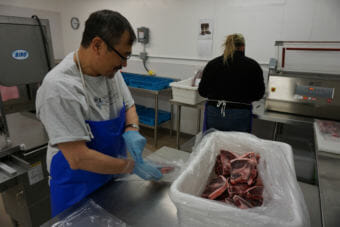
Cyrus Harris stands in a sterile-looking room with stainless steel sinks and a commercial grade band saw.

He’s helping fill plastic bags with caribou t-bone steaks then vacuum sealing them for long-term storage.

“What we have more abundance of is caribou,” he explains as the frozen chunks tap against each other. “It’s our beef. But it’s wild. It’s a wild game.”

What he’s doing – processing and storing wild foods to give to elders – is nothing new.

It’s an intrinsic part of Inupiat values like sharing, respect for elders, and hard work. It’s where he’s doing it, and how, that matters.

The Siġḷauq is a small, white former wood shop that was converted into a meat processing and cold storage facility in 2015 by the Maniilaq Association, which provides health care and other services in the northwest Arctic region.

It was built to solve a very specific problem: federal laws prohibited them from serving traditional foods like caribou and moose to elders in the long-term care facility.

The laws were put in place to make sure the meat wouldn’t make anyone sick.

But Cyrus, who grew up in the region and runs the Siglauq and other programs, says denying the elders consistent access to foods they grew up with wasn’t healthy.

“There’s a big gap missing somewhere on along the line,” he explains. “If I were at a setting and the foods that I was raised with I was restricted from eating — something’s not adding up there.”

Caribou T-bone steak ready to be packaged for the long-term care facility. (Photo by Anne Hillman/Alaska Public Media)

Donating traditional foods to schools and other organizations has been legal for years according to state law, but you couldn’t give them to federally licensed facilities like long-term care centers.

Then, in 2014 the federal government legalized it, too. Sort of.

There aren’t federal food safety laws for foods like moose or whale so the meat couldn’t be certified.

After months of back and forth, a team from Maniilaq, including Cyrus, long-term care administrator Valdeko Kreil, and environmental health manager Chris Dankmeyer, sat down with the state and the feds and figured out legal workarounds.

“They just want to see the steps that are taken to make sure things are safe for the people that are going to be eating it,” Chris says. “It wasn’t very difficult once we knew what’s the state code.”

He saod they got the state and federal officials onboard with what they wanted to do, they built the Siġḷauq up to code, got it certified, and that was that.

It helped pave the way for traditional food programs at healthcare facilities around the state, include Nome, Anchorage, and Southeast Alaska, said Melissa Chlupach, the Regional Healthcare Dietitian for NANA Management Services.

Some accept food straight into the kitchen, others send meats to licensed butchering facilities.

In Kotzebue, Cyrus runs the only processing facility of it’s kind in the state.

He inspects every animal that is brought in and asks questions about how it was harvested, though he and his hunting partners bring in most of the donations.

The animals are chopped up into usable pieces, vacuum packed, and neatly labeled.

Back in the freezer at the Siġḷauq, Brittany Anderson, who works with the Centers for Disease Control and helps Cyrus, explains the labels are another necessary step to make sure the elders are cared for.

“If there is a food borne outbreak we can contain it without it getting worse and worse,” she said.

Though they are doing everything to make sure the meat is safe, the labels are considered “best practices.”

And because they are following the best practices, elders have access to the food they’ve grown up with.

Facility administrator Valdeko Kreil said they wanted to see the project through because the elders are healthier, happier, and sleep better when the can eat their traditional foods.

“As an administrator, one of the initiatives we have to work on is improving the quality of life of our elders,” Valdeko said. “And for that, it meant working on getting the foods that they grew up with.”

Elder Richard Hensley agrees that the effort was worth it.

He laughs easily as he rolls around the long-term care facility in his wheelchair, showing off his fishing hooks and always ready to go ice fishing.

He says he can keep doing that because of one thing:

“Well, if we didn’t have no traditional foods, I don’t know how I would be getting around!” He says without the traditional foods – and Cyrus – he wouldn’t be alive.

Want to hear more Solutions Desk stories? Subscribe to the podcast on iTunesStitcherGoogle Play, or NPR.

Haines keeps title of oldest borough in Alaska

Haines, Alaska. (Creative Commons photo by Alan Vernon)

If the old adage with “age comes wisdom” is true, then on average, Haines is the wisest of Alaska’s boroughs.

The state released 2017 data on population this week.

Haines retained its superlative status as the oldest borough.

Haines Borough has the highest average age in Alaska.

That’s according to new data released by Alaska’s Department of Labor and Workforce Development.

“Haines is notably the oldest borough in the state with a median age of 49.3,” said Eddie Hunsinger, the state demographer.

But that esteemed title is itself old news.

Haines became the oldest borough sometime between 1970 and 1980, Hunsinger said — with a median age all of 29.

Today? “The statewide median age is 34.9, somewhat lower than Haines’ median age,” Hunsinger said.

State demographers expect Haines’ age will peak in 2035 at 50.3. Hunsinger said the current population structure has a lot to do with history.

“When bureaus and census areas gain populations, they’re typically younger people — young workers in their 20s to 40s. The timing of when populations expanded can have an effect.”

And as they get older, people move less, Hunsinger said.

But there’s also more fluidity in Alaska’s population than most places.

About 6 percent of Alaska’s population both leaves and arrives each year, Hunsinger said. That turnover is even more dramatic in smaller communities.

“Haines Bureau, it’s even higher, because there’s in-state migration. It’s closer 10 percent, arrives every year and leaves each year. So there’s this big turnover happening.”

There were more births than deaths in the Borough last year — 19 babies, compared with 15 people who died.

But because of migration, the population still decreased a little, by about 3 percent.

Petersburg looks at fees for tax exemption, cruise passengers

The cruise ship Le Soléal heads south in the Wrangell Narrows near Petersburg in June 2016. (Photo by Joe Viechnicki/KFSK)

Petersburg Borough Assembly heard Monday from mostly supporters of proposals to charge two new fees in the borough.

One would be an administrative fee for senior citizens who apply for an exemption from local sales tax.

Another would be a fee on cruise ship passengers visiting the area.

Both could be back in front of the Assembly later this year.

The proposed fee for senior exemptions is at $100 in a draft ordinance circulated as a starting point in the discussion this winter.

Local resident Barbara Fish thought the fee was a good idea but not that amount.

“I think the cost of producing the card should be covered by a fee,” Fish said. “I think $100 is too high. I think that $50 would be closer to the cost of producing the card and I don’t know what that cost is but I don’t think it’s $100 a card. And if something also should be added maybe that it’s based on income or a lower income person you can waive the fee, if that can be written into the ordinance that’s another possibility.”

The community of more than 3,000 people has more than 550 seniors who have applied for a card to avoid the borough’s 6 percent sales tax.

Borough officials say that number is growing as more people in the community reach retirement age.

Finance director Jody Tow reported 60 new cards were issued in the past year alone.

Assembly member Jeff Meucci has been leading the discussion on the new fees.

“It’s a tough process,” Meucci said during a work session Monday. “My intent is not to burden the people of the community who can’t afford it. I’m just trying to sort out the details to see if we can sort it out at the Assembly level.”

Meucci wondered whether the fee could be waived for low income seniors, using an application already in place for a discount on utility bills.

Tow thought that could be done. She estimated the cost of issuing the cards, leaving out about 150 low income seniors, would be around $60 a card per year.

Seniors would have to apply annually and pay the cost of the card each year. Previous cards have been good for three years, but the borough started issuing one-year exemption cards for 2018.

The group discussed waiving the fee for low income seniors. But they also continued to explore the possibility for a ballot question to limit the exemption itself to seniors.

“Going out and making basically a moral argument of like if you want this town to be successful in 50 years we need to find a way to limit this,” resident Chelsea Tremblay said.

“It’s true, you’re absolutely right, that has not been on the ballot, just limiting it to low income people,” said Tow, the finance director.

“Yeah, so that’s a very different conversation cause that’s always been the thought that people have had of knowing that there’s people on fixed incomes in town who are seniors and that’s kind of who a lot of people vote for when they go to the ballot with that question,” Tremblay said.

Meanwhile the borough’s harbor master Glorriane Wollen thought the exemption should end.

“We’ve got to figure out a way to do away with it because that number is growing,” Wollen said of the people who claim the exemption. “The number that’s paying taxes is dwindling too because people are leaving town and it’s just, it’s getting completely unsustainable.”

The City Council in 1980 created the senior exemption “with the intent of alleviating financial hardship and recognizing the valuable contributions which the senior citizens of Petersburg have made and continue to provide.”

The borough’s charter requires any change to sales tax exemptions be approved by a public vote.

Attempts to change or limit that and other exemptions have been mostly voted down, sometimes overwhelmingly. Voters have agree to end the exemption for alcohol and tobacco purchases and approved a residency requirement.

A question to stop issuing those cards in 2019 went down in a landslide in 2014.

The Assembly can approve a fee for issuing the exemption cards by ordinance and that could be in place for the following year.

Meanwhile the group also discussed a $5-a-head fee on cruise ship passengers.

A draft ordinance is based on a fee charged in Juneau.

And finance director Tow reported on the capital city’s use of that money.

“Whereas we’re talking about $35,000, they’re making $5 (million), $6 million a year and they use it for things such as additional police, hospital support because they have a few broken hips every week from passengers on the cruise ship, things like that, downtown restroom maintenance and supplies, downtown sidewalk cleaning and garbage, harbor operations, visitor center building maintenance, transient bus service.”

That $35,000 is the most Petersburg could collect from $5-a-head if all of the 116 boats scheduled to visit are filled to capacity.

It could be years before that fee built up enough money for any major projects.

“In a day and age where we’re looking for new revenue streams, $35,000 isn’t a big chunk but it’s a start.” Assembly member Meucci said.

He does not think an additional $5 a passenger will discourage people from visiting here.

Viking Travel owner Dave Berg, who’s also an agent for Cruise Line Agencies of Alaska, had some ideas for use of that money.

“I think that if we were spending money on you know access places, like Juneau’s doing, with you know downtown, not pay phones necessarily but rest areas, or an area out on Dock Street that would have a covered approach so that people, while they were waiting for a bus they wouldn’t be standing out in the rain,” Berg said. “Those types of things are certainly within the realm of acceptable uses of money that is going to come from those passengers.”

The Assembly ultimately would decide on how to spend the money during the annual budget process.

Petersburg’s draft ordinance would only apply the fee to ships with more than 20 passengers.

Berg hoped that Petersburg’s fee would be charged to ships that didn’t dock in downtown harbors but dropped their passengers off elsewhere in the borough, like the Kupreanof dock.

The harbors already charge boats for each stop, between $250 and $500 depending on where they tie up or anchor.

And that amount’s expected to increase along with a 12 percent across the board increase in moorage fees in the fiscal year that starts in July.

The passenger charge, like the senior exemption fee, could come before the Assembly in ordinance form sometime this year.

Modifying houses so seniors can stay in their homes

Shirley and Tom Clements tease each other as they pose in front of their wall of memories. (Photo by Anne Hillman/Alaska Public Media)

Shirley and Tom Clements’ home is steeped in memories.

Photos going back six generations cover the walls of the packed living room.

Knick-knacks and animal figurines fill shelves above the kitchen sink. They’ve been in the house for more than 20 years.

“Pretty much we landed a place, and we pretty much plant ourselves,” Shirley said, sitting at her kitchen table on a recent afternoon. “We don’t go out for much options.”

But will the tiny 50-year-old house keep being an option as they age? They’re adapting their home to make that a possibility.

When the Clements moved into their Palmer home in the mid-’90s, it had some cosmetic quirks, like gold-colored shag carpet.

They pulled that out fairly quickly and put in better flooring.

Eventually, they added more insulation to the walls and updated the heater. But over the past couple years, as the couple has aged, they’ve needed new types of renovations. Shirley had both knees replaced in 2009.

“It’s been rough. Well, with the knee problem, I couldn’t lift my knees over the tub to get into the tub,” she explained.

Tom decided to replace the tub in their tiny bathroom with a walk-in shower. It took him more than a year. First, he had to learn to extend the house to make room for the shower, then he taught himself to tile.

“That ain’t bad for an old mechanic, huh?” he said, laughing. “Actually, I learned to do that from a book.”

He also installed wider doors for Shirley’s walker.

Other renovations are now being completed by Alaska Community Development Corporation through the Senior Access Program.

Homeowners can receive up to $15,000  to make large and small modifications, sometimes with volunteer labor, to help stretch the funds. Renters are eligible for less.

Corporation housing manager Curt Christiansen said the objective of the program is to keep seniors in their homes as long as possible because it’s better for the whole community, and that’s what most seniors want.

“The overall cost to society is less if we can keep them in their own home and there are probably a lot of mental health benefits to staying in your own home,” he said. “You know, I see it with my parents and stuff, they don’t want to go somewhere else. They want to be where they raised their kids and stuff.”

The Clements’ home is where they cared for their grandkids, who would play on the tiny deck in the fenced yard.

Now, the rotting old deck is gone, replaced by a new ramp built by the Boy Scouts as part of the Senior Access Program.

Internal modifications included getting rid of the bumpy carpet in the bedroom that could cause tripping, and changing out sink handles.

“It’s hard sometimes for seniors to grip things,” like round knobs on sinks and doors, Christiansen said. “So we change out to levers.”

Down a short set of stairs in the passageway between the kitchen and the garage they’ll install a flip down bar and better handrails to help with Shirley’s balance problems. Similar bars will go into the bathroom, too.

Though the statewide program can serve about 70 homes per year, in many places it has a three-year-long waiting list. Different parts of the state have different lists, which vary in length. Christiansen said in Anchorage, there isn’t much of a wait right now.

Jim McCall is with the Alaska Housing Finance Corporation, which funds the program. He said people shouldn’t wait until they need their homes to be accessible.

“I tell people, ‘Plan ahead.’ Because obviously anything you can do now to continue to age in place, especially now while you’re still working and you can pay those things off, before you retire, even better.’”

Alaskans can apply for home renovation loans from AHFC to do some of the upgrades – a program that’s increased in popularity recently. Planning ahead is also important because there are one-to-two-year wait lists for senior housing, too. Nursing homes can cost around $300,000 per year in Alaska.

McCall, who has been working with seniors for 20 years, said without proper housing, people are more at risk for illnesses and behavioral issues, even seniors.

Housing “is a basic human need, so if you don’t have that, things start to go downhill pretty rapidly whether you’re 25 or whether you’re 85,” he said.

Shirley Clement and her husband want to keep aging in the house and the neighborhood where they’ve spent the last 23 years.

“I anticipate us being here, though, ’til God takes us home,” she said.

With the renovations from the Senior Access program, they might be able to do that.

Site notifications
Update notification options
Subscribe to notifications