Aging

Preventing problems with exercise for elders

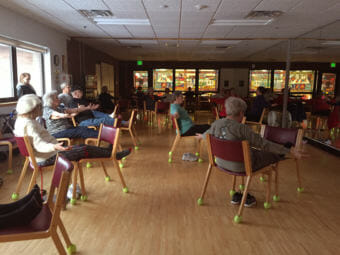
The chair yoga class at the Anchorage Senior Activity Center. (Photo by Anne Hillman/Alaska Public Media)

Outside the Anchorage Senior Activity Center in mid-December, melting snow dripped off the roof on to icy walkways. Inside,

Eileen Apodaca joined three other women in the dimly lit exercise room for tai chi class.

Facing a wall of mirrors, Apodaca patiently practiced her moves, like monkey stealing peaches.

“Ok, grab your peaches,” she said as she pantomimed reaching down and grabbing something. “Hold them tight, look both ways.”

She tightened up every muscle in her body as she clutched the imaginary peaches against her belly.

By practing the 3,000-year-old Chinese martial art, Apodaca was helping prevent a statewide problem that doesn’t have a solution – yet.

In many parts of Alaska, seniors have trouble accessing proper medical care and finding doctors who accept Medicare.

Organizations across the state are working to solve the issue but meanwhile others are trying to make the need less pressing by focusing on prevention.

In this case, exercise for seniors.

Apodaca, 71, said the slow and delicate tai chi moves that focus on balance and shifting weight have made a significant difference in her life.

“I was falling down a lot three years ago. And when I started doing this – I haven’t fallen down.”

Apodaca had polio as a child, which impacted her legs.

As she has gotten older, the lingering effects have made it harder for her to get around.

Her physical therapist recommended she try tai chi because the movements aren’t strenuous, but they provide a whole body workout. Some research says it helps overall health.

A former elementary school teacher, Apodaca said she doesn’t get sick as often since starting the exercises.

“Of course, I’m not around kindergartners either!”

Falling is a huge issue for older people.

According to the Alaska Department of Health and Social Services, it’s the number one cause of injuries for Alaskans who are 65 and older.

Falling led to 1,600 hospitalizations in 2015, each of which cost about $55,000. And falls can lead to more health problems – healing is harder when you’re older.

Richard Pankowski prefers gaining balance and flexibility while sitting down.

Twice a week he goes to the senior center exercise room, settles into a padded chair and stretches his legs out, resting them on another chair.

For the next hour, he stretches all of his muscles and meditates during a chair yoga class.

“I need the exercise to stay young and supple because of the fact that when you get to be 90, you get a little stiff, a little old,” he explained when leaving the class. “And you don’t want to do that. You don’t want to become a couch potato. So I can still climb a ladder and go up on a roof, and get yelled at for doing it.”

He said even the little stretches help him do things like turn his neck to look around when he’s driving, which makes everyone safer.

Fitness activity supervisor Brittney Mitchell shows off a letter of appreciation from a senior. (Photo by Anne Hillman/Alaska Public)

Anchorage Senior Activity Center fitness supervisor Brittney Mitchell said some people have physical improvements very quickly. One woman said it only took a week of working on the exercise machines to help her limp. Others have steadily improved their balance over time through dance focused classes.

“It’s very rare when I have people from dance cardio (class) fall anymore. And if they do, it’s for something very silly like (tripping over) a dog.”

Tripping over pets is a major cause of falling.

Area rugs on hardwood floors and slippery bathroom surfaces cause problems, too.

In fact, even in ice-covered Alaska, most falls happen in the home, when people aren’t being as cautious.

But exercise options are doing more than just keeping seniors upright – they’re helping them connect. Isolation and loneliness cause health problems, too. Friendships prevent that.

“Our treadmill walkers like to watch people in the parking lot,” she said. “They just strike up the conversation that they like someone’s shoes.” That chatting leads to the exchange of phone numbers and growing relationships.

Those friendships are part of what keeps Opodaca coming back to tai chi class.

“The camaraderie of our group – we’ve just really gelled as a group,” she said. “We go out to lunch and stuff.”

Overall, Apodaca said she feels more positive.

The exercises haven’t solved all of her problems, of course. She still worries about getting to places, like to her friend’s house for a dinner party.

“I’m already having anxiety about how am I going to walk up her driveway, especially in the ice,” she said, fretting over an invitation for the next day. “And how am I going to get up her stairs carrying a casserole. And I already have kind of anxiety feelings like eeeh!”

Apodaca knows she can’t do everything she wants to, like travel to some places and go up steep stairs, but she’s more confident in getting around in her day-to-day life.

“You just have to have an attitude about what you’re capable of and what you’re not capable of,” she said. “And you can’t grieve it. You just move on and do what you can. And be positive.”

She said working out helps her do that.

Alaskans are aging in Alaska, so now what?

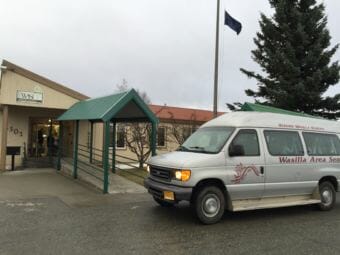
Wasilla Area Seniors provides a senior center, transportation, housing, and other services in the Mat Su Valley. (Photo by Anne Hillman/Alaska Public Media)
Wasilla Area Seniors provides a senior center, transportation, housing, and other services in the Mat-Su Valley. (Photo by Anne Hillman/Alaska Public Media)

People flooded Alaska in the 1970s and early ’80s looking for work in the oil industry and other fields.

Many are still here 40 years later. Instead of fleeing to warmer weather, Alaskans are aging in Alaska.

For the past seven years, we’ve had the fastest growing senior population in the country. With it comes wisdom, economic growth, and a different set of needs. Can our state handle it?

“Hi Gay!” Tom Russell called to his friend at the senior center in Wasilla.

“If it wasn’t for my good friends, like these ladies,” he said, gesturing to the women who settled down across from him, “I wouldn’t stick around.”

“You wouldn’t?” Gay Scott replied. “Aww!!”

Russell didn’t mean he would leave Alaska – that’s preposterous. He meant he would just check out other senior centers in the area.

For Russell, Alaska is home. He moved up nearly 40 years ago, and he’s here for the long haul.

“There’s no other place to fish than Alaska. But don’t tell anybody that. I don’t want them to catch my fish, see,” he said, chuckling.

As we talked he pulled out photos of his son and fish they caught together last summer.

He spends a lot of time in his boat with family members, though now his son drives instead of him.

Russell is slowing down some, but not much. He still lives alone and looks out for himself.

“Oh, let’s see – I’m 78 right now,” he said. “Just a youngster.”

Like many people in Alaska, Russell is staying in his house as long as he can. And here, that’s actually more feasible than elsewhere in the country.

“Alaska’s like the trendsetter,” said Elizabeth Ripley, the CEO of Mat Su Health Foundation, which focuses partly on healthy aging.

She said Alaska has prioritized developing home- and community-based services, like in home health care, chore services and meal programs.

It lets people live independently longer.

“All the other states wish they were in our spot because more people want to … stay in their homes and stay in their communities than live in an institution,” Ripley said. “And usually, it’s more cost-effective. And it usually provides greater quality of life and provides better outcomes for older adults.”

But that doesn’t mean older people can get all of their needs met right away.

In the Mat-Su Valley, the population of people who are 65 and older is growing quickly but funding for services isn’t.

There’s a shortage of primary care providers who take Medicare. Transportation options are lacking. Waiting lists for housing can range from six to 18 months. Similar problems exist statewide.

Derrick Pennington, the program director for the Aging and Disability Resource Center in Wasilla, said people who have an emergency are often left in a bind.

“I love my apartment because I’m on the top floor, and I’ve got a beautiful view,” she said effusively. “People — we must have the best building and the people on that top floor, they’re wonderful. If something happens and you need the service now, it generally is not available.”

There are no easy solutions for these issues, Pennington said, and organizations need to start collaborating now to fill in the gaps.

“We kinda gotta choose how we’re gonna pay,” he said. “Either we can pay for transportation and housing and fighting social isolation, or we’re gonna all pay with higher Medicaid bills and more assisted living and all these other costs associated with that.”

Some of the services already in place do seem to be working for those who can access them.

Back at the senior center, Gay Scott said aging in Alaska has been easy – her family helped her when she lived alone and now she’s in senior center housing.

They get together for Bible study sessions and ice cream socials. They can go to the community center to work out and eat lunch. She has a good social circle – no one she knows has considered leaving the state.

For Scott it’s simple: “Getting old is fun.”

For the next few weeks on the Solutions Desk, we’ll be exploring things that make aging fun – and feasible – in Alaska. Want to make sure you catch all of the Solutions Deskstories? Subscribe to the podcast on iTunesStitcherGoogle Play, or NPR.

World’s largest collection of Yup’ik and Cup’ik videos becoming available online

Mary Worm of Kongiganak laughs while telling a story during KYUK's "Waves of Wisdom" series, featuring interviews with YK Delta elders. This video and others are now available online through the American Archive of Public Broadcasting. (Photo by KYUK)
Mary Worm of Kongiganak laughs while telling a story during KYUK’s “Waves of Wisdom” series, featuring interviews with YK Delta elders. This video and others are now available online through the American Archive of Public Broadcasting.
(Photo by KYUK)

Remember KYUK’s old TV shows from decades past? “Waves of Wisdom” with Yup’ik elders, “Tales of the Tundra” ghost stories with John Active, or “Ask An Alaskan,” KYUK’s game show?

Selections of these programs and more are now available online.

KYUK has begun adding its self-proclaimed “world’s largest collection of Yup’ik and Cup’ik videos” to the internet.

The collection captures glimpses of nearly a half-century of life on the Yukon-Kuskokwim Delta, and for the first time it’s available to anyone searching the web.
In one video, an elder, Neva Rivers of Hooper Bay, is sitting on a floor strewn with dry brown sea grass. She’s using the grass to sew together stripes of dried, translucent seal gut. She tells the camera in Yup’ik that she takes care of everything that she’s going to use, from the seal to the blades of grass.

John Active has worked for KYUK for 40 years and helped film many of these videos.

Watching the screen he said, “When they started talking, we tried to keep quiet so they wouldn’t lose their train of thought. Because they were becoming a lost art. They’re a lost art now. I don’t know of any elders right now who sew seal intestine rain coats.”

Another video opens on a laughing elder in her 80s, wearing large glasses and a red sweater. Mary Worm, from Kongiganak, shared her stories as part of KYUK’s “Waves of Wisdom” series.

In Yup’ik she says, “You know how they tell us when we’re young that you’re going to get married and then the child says, ‘I’m not going to get married.’ That’s what I thought.”

Then she talks about her husband.

The video tells a story about how elders’ advice to the young is valuable, but often unheard.

Active remembers holding this interview with Worm at her home.

“I walked into her house, knocked on the door, no answer. I opened it and heard music in the background. There she was, sitting in front of the TV set watching “Jaws.” And she pointed at the screen to “Jaws” and said, ‘That fish in there is very wise. It knows how to catch people and sink boats.’ I had to watch it with her before we did the interview.”

That’s one of many videos that feature Active. Another is a New Years segment from the 1980s.

In the video, a young Active, sporting a full head of black hair, sits at a desk strewn with papers. Looking at the camera, he says, “Burning illegal firewood brings excitement and intrigue during otherwise cold and dreary winters like we have here.”

He goes on to instruct people downriver on how to steal trees from upriver.

“Because those upriver Eskimos didn’t want us downriver Eskimos to go up and cut their wood,” Active explained, watching the video.

The young Active continues, “The best time to gather these clandestine logs is at night, when most everyone is at bingo, church, watching R-rated programs on cable or satellite TV.”

The video is from “Frost Bits”, small segments used to fill out the half-hour newscast. TV was still new for many people at the time, and the news team used the often irreverent “Frost Bits” to hook viewers.

About 170 KYUK videos are available on the American Archive of Public Broadcasting website. KYUK still has 2,700 hours of video to add and is raising money to do so.

But money is not the only problem; memory is another.

KYUK needs your help. Over the decades, labels were lost and we don’t know who the people are in many of the online videos, or where they were filmed. Many were elders who have passed.

One example is a video of a man talking about moose hunting near Kwethluk. He explains how he would store his dried foods in the bluffs where he’d sleep during the August hunt.

Unidentified wooden tools lie in front of him.

If we knew his name, then his grandchildren could search his name and hear his story, as could schools, villages, and others searching for traditional knowledge.

If you want to help identify people featured in the videos, email KYUK’s Multimedia Director Katie Basile at katie@kyuk.org.

Bethel Community Services Foundation, Calista Corporation and Donlin Gold are the first to partner with KYUK in funding the video digitization efforts. 

Community centers in Dillingham provide places of welcome for the old and young

Paul “Elvis” Chythlook dons a pair of gold chrome shades at the piano bench. He plays for the community in the Dillingham Senior Center regularly, gospel and traditional tunes he knows by heart. (Photo by Zoey Laird/KDLG)

In downtown Dillingham, both the senior center and the Christian youth center are places to find food and fellowship with others.
Paul Chythlook plays gospel piano at the Dillingham Senior Center, and afterwards I feel like I’ve been to church.

People call Chythlook “Elvis” for his baritone impersonation of the King.

Blind in one eye and arthritic, the 71-years-old plays by ear from a mental catalog of classics, barreling from Presley’s “Don’t Leave Me Now” to the hymn “Crying in the Chapel.” I request to hear the latter again.

Chythlook’s audience leans in, listening to the lyrics, all about coming together in fellowship.

“Elvis” rocks a pair of gold chrome shades and pounds out songs he’s played all his life. Across the keyboard, I make eye contact with a man I don’t know. We can’t help but smile.

Mischaell Romo, 4, lives in the same building as the Dillingham Christian Youth Center. She’s familiar with many of the youth who spend time there, and she’s always looking for someone to draw, paint, or color with. (Photo by Zoey Laird/KDLG)

High school night at the Dillingham Christian Youth Center looks like a roomful of siblings relaxing at home.

“We’re closer to being a family at the youth center than my own family is sometimes,” Noah Theurer, 17, said. The Theurers moved to Dillingham this summer, and Noah’s a regular at the youth center now. “We all pray together, we eat together, laugh together, you know it’s the whole nine yards of being a family.”

Jasmine and Tyler Romo run the non-profit organization and raise their kids in the same building.

Tonight, they work in the kitchen, while a game of foosball, music and young voices fill the center.

Their children, Mischaell, 4, and Giuseppe, 1, are doted on like everyone’s little brother and sister.

“My brothers and sisters, I haven’t seen them in a couple years,” Frank Nicholson said, shuffling cards and waiting for the lunch bell.

He visits with folks at the senior center more than some members of his family.

Philip Andrew joins us at the card table. “Old timer,” Nicholson said, “tell your life story.” Andrew guffaws, clearly used to the teasing, and takes a seat.

The two men are neighbors and good friends. I comment on a hole in Andrew’s shirt that’s comically positioned right over his belly button. He pats his stomach and grins.

“Every time I go over to his house he’s feeding his face,” Nicholson jabs. “Take a steam, feeding his face again.” Nicholson and I burst into laughter. “Typical day around here,” he says.

An elder told Ida Noonkesser “that if you treat people the way you want to be treated … you’ll have a bigger family.”

She didn’t understand at first, but now she’s the director of the Dillingham Senior Center, and has “a big whole family” aside from her biological one.

Noonkesser’s worked here for 17 years and she says, “It gives me joy to come to work Monday through Friday, because I get to spend time with the elders.”

She takes comfort in their friendship when she doesn’t see her parents or her 97-year-old grandmother as frequently.

“I can always feel the love from them,” Noonkesser said.

Many of the elders speak Yup’ik, Noonkesser’s first language, and “they have wisdom and give out advice.”

She likes to imagine they are all her adopted grandparents, and enjoys feeding them every day.

In the morning she cooks a meal with her staff, and when the lunch bell sounds at noon, she communes with her makeshift family of elders in the cafeteria.

Dillingham Senior Center director Ida Noonkesser stands before a board of memories. Photos of community elders are displayed from years past. Noonkesser was recently recognized for 17 years of service at the center. (Photo by Zoey Laird/KDLG)

Similarly, at the Dillingham Christian Youth Center, the “ideal result of coming together is sharing joy,” Jasmine Romo said.

Kids ages 10 to 18 are hosted on a foundation of faith, of “God’s love” and “bearing each other’s burdens.”

Young people like Sara Fuller, 17, assist the Romos at the center’s coffee corner, which serves beverages to the wider community for donations.

Behind the customer counter, Fuller refers to her cross necklace, saying she believes in “good lattes and God.” More seriously, she says “this youth center has changed lives.”

I ask her how, and she tells me about friends, who instead of sitting around at home, are finally eager to be somewhere after school.

“They’re getting out there and getting to know new people and having fun,” Fuller says, and I suspect she’ll be spending lots of time here in the coming school year.

Anastasia Heyano is in Fuller’s graduating class at the Dillingham High School, and she’s usually the youngest in the senior center at any given time.

She corrects me when I ask her what she likes about working with old people. “Elders,” she says, “have stories to tell and they’re really smart. Some of them have been everywhere.”

Heyano didn’t plan to work at the senior center this summer, but now she says, “I like it a lot … they’re funny, they’re chill, I mean, there’s no drama around them or anything.”

Her uncle “John John” Heyano is a regular, and he fist bumps her on his way to the cafeteria.

After lunch, I catch him chatting at the card table. When I ask him what he thinks of the senior center, he reminiscences about a time when more people got together to “just enjoy each other,”  like the elders do here.

John John is right. Simple, present minded togetherness like this doesn’t exist in most places and for most people. Maybe that’s why it feels so rare and wonderful.

Little Mischaell Romo hands me a brush and invites me to paint.

The youth center is quiet before the usual rush of kids at 3 p.m.

I sit alongside Mischaell and we paint a princess who wears shorts, a T-shirt and a crown. When she’s finished, I suggest that our princess needs a mantra.

Mischaell asks me what a mantra is, and I explain it’s something you say over and over because you believe it.

She decides I should choose one. I pull a lyric from “You Gotta Be” by Des’ree.

The song came into my mind all week, walking between the two centers and meeting kind Dillingham people, old and young. I paint the words and speak them as they appear on the page.

“Love will save the day,” I say. Mischaell follows the line of my brush with her eyes and repeats our mantra aloud. “Love will save the day.”

Concern for seniors as pioneer homes caught in budget battle

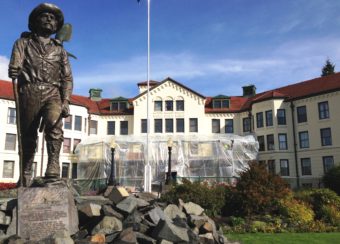
"The Prospector" statue stands in front of the Sitka Pioneers Home entrance, which was under repair Sept. 20, 2016. The homes reduced admissions as budgets were cut. (Photo by Ed Schoenfeld/CoastAlaska News)
“The Prospector” statue stands in front of the Sitka Pioneer Home entrance, which was under repair Sept. 20, 2016. The homes reduced admissions as budgets were cut. (Photo by Ed Schoenfeld/CoastAlaska News)

Residents and staff at the Palmer and Juneau Pioneer Homes, the state-run senior-care facilities, have been put on notice that a budget battle in the Alaska legislature is threatening to displace them.
The budget is far from complete, and some legislators say the governor and state officials are passing blame for the cuts and resorting to scaring the elderly to get their way.

The state said that blame lies squarely with legislators.

Meantime, the fight over Alaska’s budget is literally bringing people like Kim Kiefer to tears. Kiefer is worried about her mother, Marilyn, a Pioneer Home resident in Juneau.

“Those people love my mother, just like I do,” Kiefer said of the Pioneer Home staff, choking up. “I’m frustrated, I feel like it’s a game that’s being played right now between the Senate and the House, the blame game.”

Marilyn and other seniors at the Pioneer Homes in Juneau and Palmer are at the center of a struggle over cuts needed to balance the state budget, with the Senate, House and governor all involved.

State senators recently approved their version of the budget, including a roughly 10 percent cut to the health department’s funds to operate the Pioneer Homes.

Health officials, in turn, notified staff in Palmer and Juneau and word of the proposed cuts made it to residents and their family members, like Kim Kiefer and her mom.

And all that left Kiefer to wonder: “OK, do I need to start right now trying to look for a place for my mom that’s safe?”

It’s a question that Republican state Sen. Shelley Hughes, who represents the greater Palmer area, said Alaska’s elderly population should not have to be asking.

Hughes said it is the strategy of Gov. Bill Walker’s administration to cause a stir among constituents to pressure legislators — particularly Republicans from the Matanuska-Susitna area — to vote in support of a state income tax.

The administration has discretionary funds to make up the difference and that the warning to the Pioneer Homes was way too early in the budgeting process, Hughes said.

“Using our frail and elderly as a political football is, I can’t even think of the right adjective.” Hughes said. “It is just incomprehensible. It is despicable.”

Department of Health and Social Services Commissioner Valerie Davidson did not care for that characterization.

“I like to think that when we’re talking about elders in our state, that we never refer to them in those derogatory terms,” Davidson said of the “political football” comment.

Davidson disputed the claim that notifying the dozens of Pioneer Homes staff and residents of a possible late-summer closure amounted to “fear-mongering.” The residents and their families are already following the budget process closely, Davidson said.

The Senate made the cuts, and its own documentation shows the cuts were made directly to the Pioneer Homes, Davidson said, providing a copy to Alaska Public Media.

As for discretionary funds, Davidson said those are for unexpected expenses.

The money is not intended to bridge a gap created by legislators’ cuts, She said.

“It appears to me that the Senate’s intent was clear,” Davidson said. “It wasn’t the governor’s cut.”

Hughes and other members of the Mat-Su delegation maintain the state has the flexibility with those funds to further reduce spending and still take care of Alaska’s elderly Pioneer Home residents.

In the meantime, the budget process continues as legislators try to reconcile different versions from the House and Senate.

Alaska lawmakers deal with death in the digital age

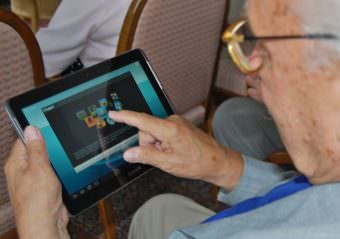
An elderly person uses a tablet. (Photo by Sigismund von Dobschütz/Wikimedia Commons)
An elderly person uses a tablet. (Creative Commons photo by Sigismund von Dobschütz)

Alaska lawmakers held the first hearing Wednesday on a bill that seeks to bring estate planning into digital age.

House Bill 108, or the Fiduciary Access to Digital Assets Act, is designed to help loved ones get access to online accounts of the deceased, from Facebook to digital photo libraries and financial investments, without having to go through a lengthy legal process.

Uniform Law Commission is a nationwide nonprofit that drafts model legislation to keep laws consistent across states and the brains behind HB 108.

Commission member Deborah Behr explained the need for the law using her own life to illustrate her point.

“My husband’s the one who takes all the family photos,” she said. “If my husband passes away and I ask Google for those pictures, Google’s going to say basically ‘Who are you? My contract was with your husband, your husband has deceased. Go get a court order.’ Which, as any of you know, if you’ve had involvements with the court, it’s expensive. It’s time consuming.” 

 The law works best with cooperation from companies.

“Online providers, Google, Facebook, will adopt what’s called an online tool,” Behr said. “When you open a new account with them, they will have a page that says ‘and if I pass away or I get incapacitated, this is what I want done with these assets.’ The main thing with that to remember is that you may say no, and if you say no that means no one gets it.”

In the absence of an online tool, the legislation specifies how people can legally transfer online assets in their written will, power of attorney or trust.

The AARP, a national nonprofit that advocates for retirees and has 95,000 members in Alaska, is in strong support of the bill, and there has been no pushback from legislators thus far.

If passed, Alaska would join 23 other states who have adopted this model legislation.

Site notifications
Update notification options
Subscribe to notifications