Alcohol & Substance Abuse

Juneau’s substance abuse treatment clinic reopens with limited capacity as demand grows

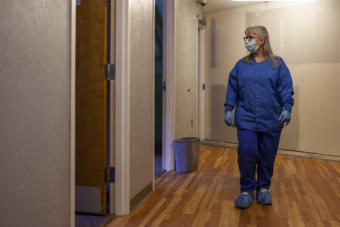
A member of Bartlett Regional Hospital’s medical staff walks through a newly converted spillover shelter for COVID-19 patients on Monday, April 7, 2020 in Juneau, Alaska. The shelter is designed to house patients who need medical care, but not critical medical care from the city hospital. (Photo by Rashah McChesney/KTOO)

After seven months, Juneau’s residential substance abuse treatment facility reopens this week.

Although Rainforest Recovery Center will limit the number of patients for now, providers say the need in and outside the community is growing.
Bartlett Regional Hospital’s Rainforest Recovery Center can typically hold 12 patients at a time.

Now that they’re reopening, they’ve cut that capacity in half. Chief Behavioral Health Officer Bradley Grigg said they’re taking it slow to reduce the risk of spreading COVID-19.

“We would be fools to think that six beds is going to meet the need. But we’re doing it based off pure safety and caution,” Grigg said.

Since the pandemic began, Rainforest has shifted some rehab services online, offering outpatient treatment for the first time in recent memory.

Grigg said they now have more than 40 patients getting counseling virtually.

“So if they meet criteria to get in, and we don’t have a bed quite yet, we’ve got outpatient services that can support them until we can get them in there,” Grigg said.

They’ll only accept people from Juneau and other parts of Southeast Alaska. Patients need a negative COVID-19 test within 72 hours of admission, and they’ll be tested weekly. Masks are required for patients and staff in common areas.

They hope to be able to expand their admissions eventually, but for now, it’s easier and lower risk to focus on helping people locally.

“What we don’t want to do is have to bring people in and have to quarantine them automatically,” Grigg said. “Once they’re here, we’d like for them to get started in treatment as soon as they’re here and we think that local is just going to be the best at that point.”

Hospital staff move equipment into the Rainforest Recovery Center. City officials converted the drug and alcohol rehabilitation center into an emergency spillover shelter for COVID-19 patients at Bartlett Regional Hospital. The shelter is designed to house patients who don’t need critical medical care. (Photo by Rashah McChesney/KTOO)

According to the statewide dashboard that tracks how many beds are available, there are about two dozen other residential treatment facilities around the state.

Many of them have open beds, but waitlists range from a few days to several months long.

One complicating factor is staffing. That’s been an issue for Rainforest. Grigg said part of the delay in reopening was due to construction on a new detox unit at the facility.

Now that it’s completed, patients going through withdrawal will be treated there, instead of across the street at the hospital. But since detox is a medical service, that means nursing staff needs to be on hand 24 hours a day.

“We went from seven 12-hour shifts, now to 21 12-hour shifts,” Grigg said. “So it’s a significant increase.”

He said they’re recruiting and have already hired new staff. They’ll also rely on travel nurses. They hope to have a new withdrawal management unit open in a few weeks. But things can change quickly in a pandemic. So they have to be flexible.

Rainforest patients were sent home in March, and the facility was converted into a backup site in case the hospital became overwhelmed with COVID-19 patients.

Although it never came to that, the equipment is still on-site just in case.

“So far, we’ve been fortunate to not have to use it. But if we have to stand it back up again, we know that we can do that pretty quickly,” he said.

For now, Grigg is more worried about what this winter will bring in terms of mental health crises.

“We have new folks who are struggling that have never struggled like this before, to where it’s obvious there that substance use is on the rise, whether it be alcohol or other drugs,” he said.

The pandemic is producing a lot of stress and social isolation, major factors that contribute to substance abuse.

“It’s increasing among children, it’s increasing among families, adults,” he said. “So that’s the bigger concern for me, of what is this going to look like five months from now?”

According to the latest data from the Department of Health and Social Services, there are roughly 145 people across Alaska waiting to get into facilities to treat drug and alcohol issues.

Rainforest Recovery Center delays reopening

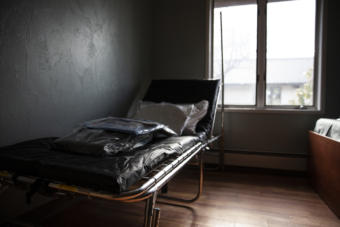
A cot inside of the Rainforest Recovery Center after city officials converted the drug and alcohol rehabilitation center into an emergency spillover shelter for COVID-19. (Photo by Rashah McChesney/KTOO)

Rainforest Recovery Center has delayed plans to reopen for at least another month.

The substance abuse treatment center had planned to reopen by the end of July. But Bradley Grigg, chief behavioral health officer for Bartlett Regional Hospital, said they had to postpone.

“At this point we are targeting, hopefully, the week of Labor Day,” Grigg said Friday. “There’s a chance it could be the week before that, but our hope is the week of Labor Day.”

The delay is partly due to construction inside the clinic, but Juneau’s steady uptick of COVID-19 cases has also raised concern that the center may need to be used as an overflow care site for the hospital.

When the pandemic began, Rainforest sent patients home and turned the clinic into an overflow site in case the hospital ran out of room.
Since then, the center has started offering telehealth outpatient services for patients in recovery.

When the center does reopen for inpatient substance abuse treatment, they’ll have only six to eight patients.

The closure has left people in Juneau and other parts of Southeast Alaska with few options for residential treatment.

“We’ve got families who are calling and saying, ‘When are you going to be open again?’ and obviously, some were hoping we’d be opening this week or next week,” Grigg said. “So we’re working with those families to try to get them to the services they need, and if they can’t leave town to go to residential we’re offering them interim support services.”

Grigg said the center can help connect people who need residential treatment to other programs that may be reopening around the state.

Task force looks to expand courts that offer treatment instead of prison time

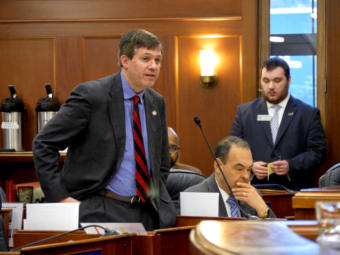
Sen. Bill Wielechowski, D-Anchorage, speaks during a Senate floor session, March 13, 2019.
Sen. Bill Wielechowski, D-Anchorage, speaks during a Senate floor session in March 2019. He is chairing the Legislature’s Task Force on Therapeutic Courts, which is scheduled to make recommendations on how to expand the courts’ capacity before the next Legislature convenes in January. (Photo by Skip Gray/360 North)

A task force of lawmakers and criminal justice experts is examining how the state can expand a system of courts that offer treatment instead of jail time. 

Anchorage resident Ron Wilson was headed to  prison in 2008, after multiple cocaine-related arrests.

“I was facing six years and just in complete dismay,” Wilson said. “And there was a lot of people hurt and affected by this: my family and my parents. And I was just completely lost and completely broken.” 

Ron Wilson is a member of the Task Force on Therapeutic Courts formed by the Legislature. Wilson related his experience with drug court during a June 18 task force meeting (Photo courtesy/ Ron Wilson)

But he was offered an alternative to prison. He attended drug court, which offered him treatment. It’s one of 14 courts around the state known as therapeutic courts. Wilson said the experience led to him stop using drugs.

“It allowed me to be out with my family, allowed me to work while I was going through treatment,” Wilson said, adding that he also benefited from the structure provided by the program. “While I was out and able to do the things that were available prior to incarceration, I was able to but refrained from it, because of the structure and also because of the oversight.”

Wilson described this experience at a June 18 meeting of the Task Force on Therapeutic Courts. The Legislature formed the task force — which includes two lawmakers and eight experts on therapeutic courts — to make recommendations on how to have more people participate in these  courts in the state. 

The courts have different names and rules throughout the state — some focus on drug use, others on alcohol. And some specialize in categories of defendants, like parents or military veterans.

Michelle Bartley coordinates the courts’ work throughout the state. She pointed to studies that have found positive results for those who complete the treatment offered by these courts. 

“These evaluations have all identified positive outcomes that include things like reduced criminal and behavioral health recidivism,” she said. 

There’s a broad interest in expanding therapeutic courts. But there are a few obstacles. The courts are at capacity in some parts of the state. And opportunities for therapeutic courts depend on the willingness of prosecutors, judges and treatment providers to participate. 

And sometimes the person charged with a crime isn’t interested because of the time it takes to complete the treatment, which can be up to 18 months. 

Bartley said a longer-standing problem is that everyone who works in these  courts needs to be trained in what makes them different from traditional courts. And with turnover in public defenders, prosecutors and treatment providers, there’s a constant need.

“Because these courts have so many working parts at one time, all it takes is one person to not be adequately trained to the process, and it kinds of throws a hitch into our get-along,” she said. “So it’s really important to train staff, and training staff can be quite expensive.” 

Deputy Public Defender Benjamin Muse also said the state would benefit from building a broader knowledge of therapeutic courts among lawyers.

Unlike criminal courts, where prosecutors and defense attorneys are adversaries, in therapeutic courts, they’re part of the same team, led by a judge, that also includes treatment providers, probation officers and others. Each team member needs to be trained.

“I think it’s a very frequent occurrence where an attorney will go for six months working with a team and then quit,” Muse said. “And they’re basically, when you’re six months in, you just kind of become competent working in that… learning the ropes, learning how to work in a non-adversarial setting, so I think there’s a lot of room for improvement.” 

Muse said it isn’t just differences in training that limit the courts’ effectiveness. Therapeutic court eligibility and the treatment offered differ across the state. 

“There is a disparity,” he said. “These courts don’t operate uniformly across the state, in terms of what their policies and procedures are.”

Anchorage Democratic Senator Bill Wielechowski chairs the task force. He said the Legislature formed the task force because it recognized the courts’ potential. 

“You’re really trying to get people who are at just critical times in their lives to change their lives for the better,” he said. “They’re very intensive, but they’re very effective at the same time, so the thought was, how can we do this in a way that it isn’t just throwing money at it haphazardly, but is more focused on what really works and is a little bit more efficient.”

Wielechowski said there’s bipartisan interest. 

“Nobody wants that revolving door where people get out of jail and 66 percent go back within one or two years,” he said. “Nobody wants that. The public doesn’t want that. The Legislature doesn’t want that. The governor doesn’t want that.”

The Legislature also has asked the task force to make recommendations in standardizing how Alaskans are screened for the courts, as well as how to provide culturally appropriate treatment resources, including Alaska Native treatment providers. The task force is scheduled to make the recommendations before the next Legislature convenes in January. 

Rainforest Recovery Center aims to reopen by the end of July

A cot inside of the Rainforest Recovery Center on April 7, 2020 in Juneau. City officials converted the drug and alcohol rehabilitation center into an emergency spillover shelter for COVID-19 patients at Bartlett Regional Hospital. They’re now hoping to reopen it as a rehabilitation center by the end of July. (Photo by Rashah McChesney/KTOO)

The substance abuse treatment center at Bartlett Regional Hospital that closed last spring may reopen by the end of July.

Rainforest Recovery Center closed for inpatient care in March due to COVID-19 health concerns, sending 11 patients home or to other facilities. The facility typically houses up to 12 people at a time.
Since then, staff have started offering outpatient treatment through telehealth services. That program will continue even after the facility opens its doors again.

“In an effort to make sure our patients are safe while they’re receiving treatment, we’re probably going to start out with single occupancy, which at this point means instead of 12 patients coming in, we will have up to eight when we reopen to start with,” said Bradley Grigg, chief behavioral health officer for Bartlett.

He said they’re working through the details and safety plans with the hope to be back open by late July or early August.

When the facility closed, it was turned into an alternative care site for the hospital in case it needed overflow space for COVID-19 patients.

That never happened. The city has since set up a quarantine and isolation site at Centennial Hall. But Grigg said the hospital is prepared for a worst-case scenario.

“We are very mindful of the fact that we may have to pivot and return it as an alternative care site again, like we did in March,” Grigg said. “So we’re keeping all of the equipment that we had in that site at close hand to where if we have to turn, pivot and stand that up again, we’re going to be prepared to.”

The facility has also been undergoing construction for a new detox clinic that they hope to open at the same time they reopen for inpatient care.

In the past, Rainforest treated patients from across the state. Grigg said for now they’ll use a phased approach to focus on local clients for the first month or two, gradually accepting patients from other parts of the region and eventually the state.

Youth risk survey reports sharp increase in suicide attempts, vaping among Alaska high school students

Graphic from the 2019 Alaska Youth Risk Behavior Survey showing an increase in use of e-cigarettes among Alaska high school students.

A recent survey from the state Department of Health and Social Services shows a sharp increase in vaping and suicide attempts among high school students in Alaska.

The Youth Risk Behavior Survey is conducted every two years among almost 2,000 high school students across the state.

The survey says one in four students reported “currently vaping” in 2019. “Currently” means at least once in the past 30 days. That’s an increase from one in six from 2017.

Christy Knight is with the department’s tobacco prevention and control program. She says the cost of vaping for teens is the impact on brain development.

“So there are many youth who are not necessarily aware when they use the products that they contain nicotine, which is highly addictive,” she said.

Just like in combustible cigarettes, nicotine impacts attention and learning memory.

“We have over 50 years of research on combustible cigarettes, whereas e-cigarettes are still fairly new and we’re still learning the long term and short term health impacts of e-cigarettes,” she said.

Graphic from the 2019 Alaska Youth Risk Behavior Survey showing an increase in suicidal thoughts and attempts among Alaska high school students.

The risk survey also reported an increase in mental health distress among high school students. One in five (19%) of students surveyed reported having attempted suicide at least once.

That’s higher than the last survey in 2017.

Leah Van Kirk is the suicide prevention coordinator with the DHSS.

“What that really tells us is that it’s really important for us to continue working to support youth and to really promote protective factors that help us be resilient and reach out and get help when they need it,” she said.

Van Kirk says along with the increase in suicide attempts, it’s important to emphasize that many students have access to lethal means.

For the first time the survey asked if students have access to firearms.

“Almost 50% of our youth have access to a loaded gun,” she said. “So that means if your child or friend’s child is experiencing a difficult time or crisis, have your firearms stored off site, maybe ask a friend ‘Hey, can you hold on to my firearms for a little while our family’s going through a hard time right now.’”

For individual families, it’s important to take preventative measures. Van Kirk says it’s okay to ask if a loved one is having thoughts of suicide.

Anyone in distress can also call the Alaska Care Line at 877-266-4357.

Editor’s note: A previous version of this story misspelled Leah Van Kirk’s name. The story has been corrected.

4-time Iditarod champion disqualified for positive meth test during race

Iditarod musher Lance Mackey at the 2020 Iditarod Trail Sled Dog Race ceremonial start in Anchorage on March 7. (Photo by Joey Mendolia/Alaska Public Media)

A positive drug test for methamphetamine has disqualified veteran dog musher Lance Mackey from the 2020 Iditarod Trail Sled Dog Race, according to a message that race organizers sent to sponsors Thursday.

Mackey’s 21st-place finish in this year’s race will be vacated after the positive test from a sample collected in White Mountain, the Iditarod statement says. Mackey finished the race, his 16th Iditarod, in Nome on March 19.

Mackey is a four-time Iditarod champion, from 2007-2010, and a four-time Yukon Quest champion, from 2006-2009. He’s also the only musher to have won both of the 1,000-mile races the same year, in 2007 and 2008.

In the Iditarod’s written statement, Mackey said he planned to go into treatment.

“I’m tired of lying to myself, friends, family, and fans, who have all supported me, rooted for me, or been inspired by me. I apologize to all of you,” Mackey said. “The truth is that I need professional help with my latest life challenge. I am in the process of making arrangements to go to a treatment center where I can get the professional help and real change I need. I’m ready to confront this with all of my focus and determination.”

Mackey did not immediately respond to a request for comment. He has spoken openly in the past about heavy drug and alcohol use earlier in his life, mostly cocaine and whisky.

The Iditarod has tested sled dogs for drugs since 1994 and instituted drug testing for mushers during the race in 2010. The decision by the Iditarod Trail Committee to test mushers came after a complaint about musher drug use from the Iditarod Official Finishers’ Club.

At the time, Mackey was the most vocal musher in pushing back against the testing, claiming he had been singled out because of his use of marijuana for pain management as a cancer survivor.

The first Iditarod disqualification for drug use came in 2012, when 38th-place finisher Matt Giblin tested positive for marijuana.

Site notifications
Update notification options
Subscribe to notifications