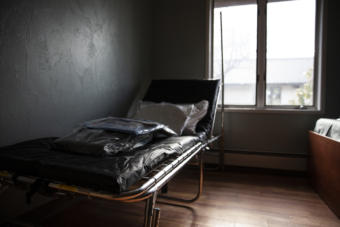
Hospital staff move equipment into the Rainforest Recovery Center on April 6. City officials converted the drug and alcohol rehabilitation center into an emergency spillover shelter for COVID-19 patients at Bartlett Regional Hospital. The shelter is designed to house patients who don’t need critical medical care. (Photo by Rashah McChesney/KTOO)
All patients in the residential substance abuse program at Juneau’s city-owned hospital were discharged last month.
According to Bartlett Regional Hospital Chief Behavioral Health Officer Bradley Grigg, Rainforest Recovery Center suspended inpatient operations in response to the COVID-19 pandemic.
Patients in recovery come from throughout Southeast Alaska and all over the state, making travel a concern as health restrictions tightened in March.

It took about two weeks to safely discharge the 11 patients they had at the time. Some went to live with family or in shelters, and a few were placed in temporary housing.
“We’re continuing to work with several of those individuals, both in Juneau and out of our region, for that matter, working with other providers for folks who are in temporary housing,” Grigg said.
Even though its doors are closed, Rainforest Recovery Center has expanded virtual services since patients left three weeks ago.
Grigg said the program has historically not had an outpatient program, but they now have 20 people receiving services remotely.
“It was not something we anticipated,” he said. “But we’re grateful that people are reaching out and are coming to us for help. And we’re going to be there for them.”
A cot inside of the Rainforest Recovery Center on April 7 in Juneau. City officials converted the drug and alcohol rehabilitation center into an emergency spillover shelter for COVID-19 patients at Bartlett Regional Hospital. The shelter is designed to house patients who don’t need critical medical care. (Photo by Rashah McChesney/KTOO)
Staff are conducting individual and group sessions with patients over the phone and via Skype and Zoom. And they’re looking for ways to make services accessible to those who may not have access to those technologies.
Grigg said they’re also trying to be flexible to patient’s needs.
“In a normal outpatient setting, we may only see them an hour a week, and in some of these cases we’re spending five to 10 hours a week with folks to make sure they’re OK, they’re sober, their needs are being met,” Grigg said.
The hospital has since converted Rainforest Recovery into an alternate care unit in case of a surge in COVID-19 cases. It has space for up to 35 patients.
Medical assistant Sarah Martin sits at the reception desk of Ideal Option, a medication assisted addiction treatment clinic in Juneau. In Dec. 2019, the Alaska Department of Health and Social Services released a new guide for offering medication assisted treatment to patients. (Photo by Kavitha George/KTOO)
As more Alaskans seek treatment for opioid use disorder, the state is taking measures to ensure that enough medical providers are there to help.

On Friday, Dec. 20, the Department of Health and Social Services released a new guide for offering medication assisted treatment to patients.
In 2016, a change in federal law made it possible for a wider array of medical providers to offer medication to people with opioid addiction. Known as medication assisted treatment, it’s an extremely effective way to stabilize patients on the spot with medicine like Suboxone.
Kathryn Chapman, with the state’s Division of Behavioral Health, says about 400 medical providers in Alaska are able to provide that service. However, estimates show that only about half of them are treating the population and prescribing for them. Chapman says the reason more providers aren’t offering medication assisted treatment is varied, but it may be the same barrier that some patients experience when they try to get help: not knowing what resources are available.
“That’s part of the challenge is that to provide opioid treatment, you need a multidisciplinary team, really, to support the treatment and recovery,” Chapman said.
So, the Department of Health and Social Services spent two years creating a Medication Assisted Treatment Guide for providers, modeled off one used in New Hampshire.
It details best practices for treating opioid use disorder and helps providers connect patients with behavioral health services around the state.
Chapman says assisting people in their recovery should include a broad package of care.
“Not just their medicine is provided to them,” Chapman said. “But that they’re safe, that they have a safe home, that they have food to eat, that their families have support, too.”
The Alaska Department of Health and Social Services hopes to update the guide as new information becomes available.
A procession of mourners embrace Abby Kelley’s moms, Cecelia Williams, left, and Christina Vazquez, after funeral services on Dec. 1 at the Tlingit and Haida Community Center in Juneau. Abby Kelley, 19, died Nov. 21 after the car she was riding in sped off the road. (Photo by Jeremy Hsieh/KTOO)
Funeral services were held this week in Juneau for 19-year-old Abby Kelley, who also went by Abby Williams-Kelley, and 15-year-old Keith Brososky Jr. They both died when the car they were in sped off the road the morning of Nov. 21.
The morning after the funeral, parents Cecelia Williams and Christina Vazquez reflected on their daughter’s life, and the turn it took in the year or so leading up to the crash. Flipping through photos of their daughter, her huge, beaming smile was a constant from a young age into her teens.
“She had dimples for days,” they both say.
Williams said she had a big voice, too.
“My sister used to babysit for her (and) me when I had to go to work and Abby was just a toddler,” Williams said. “But soon as she walked through the door, she’d be like, ‘Auntie Cam! Hi, Auntie Cam!’ And my sister would go right close to her, and Abby would still be talking loud. And my sister would be like, ‘Abby, I am right here. You don’t need to yell.’ ‘Oh, hi Auntie Cam!'”
Even on this day, the memory brings a chuckle of delight.
A photo of Abby Kelley and a dreamcatcher hang on a wall in her family’s home in Juneau on Dec. 2. Her parents say that “she had dimples for days.” (Photo by Jeremy Hsieh/KTOO)
Abby graduated from Yaaḵoosgé Daakahídi High School in 2017, a year early. Her diploma and Eagle-Wolf graduation sash are on wall in the living room, along with many family photos, school projects and artwork.
Vazquez said Abby was applying to colleges before she finished high school.
“Like, she was already on that road before she graduated,” Vazquez said.
“I mean, she was a great kid for her whole entire life,” Williams said. “We had normal obstacles to overcome with her, I guess you could say, as a teenager. But, like, towards the end of her graduation, she was a great kid, like, couldn’t ask for a better kid, you know?”
Vazquez remembered Abby’s attitude toward friends who drank in those days.
“She just chose to be more around her family than out doing things that her friends were doing. Stuff like drinking to her was — I mean, she used to say, ‘Oh, yeah, so-and-so’s drinking and they’re just so dumb.’”
“So this whole thing, it was just devastating,” Williams said. “It just seems like it happened so fast, so fast. And it got out of control so fast. Like, I just don’t even know how it happened.”
They tried talking things through with Abby. They got her into counseling briefly. They reported a store they suspected of selling booze to her daughter and other teenagers. And eventually, tough love.
Despite all that, Williams said Abby was descending into alcoholism.
“When you’re a child or whatever, you’re an adolescent trying to figure things out and figure out who you are — yeah, sure, you’re partying and you’re doing some things, but it’s not your everyday life,” Williams said. “And towards the end, this is what it became. It was her everyday life.”
After the crash, a friend of Abby’s shared a series of videos from the night before and morning of the crash with her parents. They circulated through Snapchat and suggest the group of teenagers in the car was drinking heavily. There’s raucous laughing and yelling. One clip shows Abby and the others in the car. Someone’s holding what looks like a bottle of whiskey.
Text added to one clip asks something to the effect of, why aren’t we dead?
“Apparently, they almost crashed. That’s why the caption is that,” Williams said.
There’s a timestamp in the text.
“That’s minutes before the actual crash. Like, 20 minutes,” Vazquez said.
Traffic zooms by a makeshift memorial to Abby Kelley near Mile 21 of Glacier Highway in Juneau on Dec. 2. Kelley, 19, and Keith Brososky Jr., 15, died after the car they were riding in sped off the road nearby on Nov. 21. (Photo by Jeremy Hsieh/KTOO)
Impossible “what-ifs” plague Williams.
“Just wish that there was something else that I could have done,” she said. “If I did everything right or — I don’t know. Maybe if I wasn’t trying to be so tough on her, maybe this wouldn’t have happened? But I don’t know.”
Williams wants others to know to ask for help: “I just want to encourage other parents and their children: If you’re struggling with alcohol, don’t be scared to reach out, don’t be scared to admit it. And talk to whoever you can. … Don’t ever give up.”
On the 12th day after crash, Williams and Vazquez said they hadn’t heard from investigators yet. They planned to meet with lawyers to explore options.
Juneau Police Department spokesperson Erann Kalwara said the crash case is still being investigated. That means interviews and a search warrant on the car itself. She said there’s no set timeline, and she could not comment on if the liquor store that Cecelia Williams alluded to is being investigated or not.
The other two people who survived the car wreck remain hospitalized at Harborview Medical Center in Seattle. A hospital spokesperson on Tuesday said 19-year-old Dylan Larsen is in serious condition in the intensive care unit, and 18-year-old Tyler Watkins is in satisfactory condition.
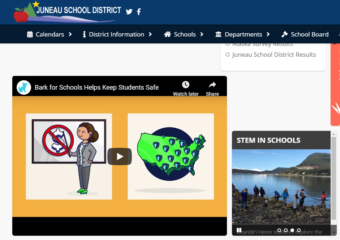
The Juneau School District posted information about Bark for Schools on its homepage, as it appears here on Oct. 31, 2019, including FAQs and an informational video produced by Bark. (KTOO screenshot)
This fall, the Juneau School District began using a third-party service to monitor emails and messages sent on school accounts, hoping to increase student safety.
Students and parents have raised concerns about privacy and data control. The district has made adjustments, but there’s still plenty of confusion.
The first time Toby Minick heard about it, he was at school. He’s a senior at Juneau-Douglas High School: Yadaa.at Kalé.
“I think it was probably in calculus class, which is my first class of the day. And a lot of people were kind of, like, murmuring and talking about it.”
Minick’s classmates were talking about Bark for Schools. Provided by a tech monitoring company called Bark, it’s a service the Juneau School District started using this fall to monitor what passes through student accounts. It screens for mentions of violence, self-harm, drug use, sexual content and cyberbullying — flagging messages for school administrators to review.
Parents can sign up to receive those alerts, but they’ll only get them right away if a message is flagged outside of school hours. Otherwise, they’ll receive them in weekly updates on their students’ accounts.
The district’s goal in using Bark for Schools is student safety, but many were unhappy to learn about the service. A handful of students, parents and teachers — and one outgoing member of the Juneau School District Board of Education, Steve Whitney — shared their concerns at the Oct. 8 school board meeting. Most pointed to a lack of communication about exactly what Bark for Schools is and what it does.
Since then, the district has shared more information on its website and directly with families. But weeks later, students like Minick still have questions.
“Until we get answers, I’m super against it. And probably when we get answers, I’ll still be super against it. It just seems like an invasion of privacy,” said Minick.
The school district sees things a little differently.
Juneau School District Superintendent Bridget Weiss on Aug. 6, 2018. (Photo by Jeremy Hsieh/KTOO)
“We have no desire to monitor anything private. We are monitoring an academic environment that we are providing,” said Juneau schools Superintendent Bridget Weiss.
Many students and parents still aren’t sure about Bark’s reach.
According to the company and the Juneau School District, Bark only monitors messages sent from — or to — school-issued email addresses and Gmail chat, as well as anything stored in student Google Drive folders or posted in Google Classroom.
Bark does monitor those accounts when a student uses them on a personal phone or computer, but it does not monitor anything else on the device. It doesn’t track internet searches, and it has nothing to do with school Wi-Fi networks.
Weiss said if a student talks about an unsafe situation on a school platform, administrators should be able to respond. She said they treat the alerts just as they would if a teacher or parent overheard something concerning and reported it.
The district has always had the ability — and a legal responsibility under the Children’s Internet Protection Act — to monitor school platforms. But with 2,500 students, Weiss said the district didn’t have an effective way to do it.
“What this is allowing us to do is to have a shield of protection for students that we didn’t have the manpower — would never have. It would be impossible to do a literal monitoring by a human being in the same way,” said Weiss.
For some parents and students, that is their biggest concern: that the monitoring is being done by a third-party company.
Minick shares that reservation.
“It is weird that our schools are monitoring us, but I feel like that’s more acceptable to me than if a company is taking our data or scanning our data and that kind of stuff,” Minick said. “I trust my school more than I trust this ethereal other company, Bark, that I don’t know anything about.”
Bark doesn’t make any money off Bark for Schools, at least not directly. It provides the free service to over 1,500 school districts in the country. According to the company’s website, its motivation was the Parkland school shooting. Through that partnership, Bark hopes to build trust and interest in its main product: a service that parents — not schools — can buy to monitor their kids’ personal messages and social media accounts.
Another complaint raised by parents at the October school board meeting was the influx of advertising for Bark’s parent product sent to parent email addresses since the service’s implementation. In response, the school district has requested Bark to stop sending solicitations, unless a parent has signed up to receive Bark notifications.
Students at the school board meeting also questioned how Bark might use the data it collects. In a phone interview with KTOO, Bark’s Chief Parent Officer Titania Jordan said data is never shared with other companies.
“We are not looking to monetize or sell your children’s personal data,” Jordan said. “Our goal as a company is to protect your family and empower you with the knowledge to protect your family.”
Jordan encouraged anyone with questions or concerns about Bark to contact the company directly at help@bark.us.
Normally, Bark deletes all data 30 days after it’s collected. The Juneau School District requested that period be reduced to 15 days.
Jordan said Bark tries to provide tools to keep kids safe at a time when technology is changing rapidly
“This is a whole new landscape, right? Kids have never had this sort of access before in human history. And schools and parents have never had to school or parent kids in this sort of environment ever,” said Jordan.
Minick, 17, said growing up in that environment doesn’t mean his peers take any of it for granted.
“I don’t think a lot of people have that opinion that, like, our privacy in a new, digitalized age is something that we should assume is already, you know, forfeit or whatever,” Minick said. “We should know where our information is going, who has it, what they’re doing with it.”
In response to concerns from students and parents, Weiss said the district is providing options.
Families have three choices. One is to stick with the status quo and use all school-provided platforms, monitored by Bark. Another is to completely opt out of school platforms — but a lot of classes rely on online tools, and it’s not clear how students and teachers will have to adjust. The third option is restricted access: Students will be able to use Google Classroom and Google Docs, but they won’t have a school-issued email address or Gmail chat. However, any messages sent to school accounts will still be monitored by Bark.
Families interested in restricted access or opting out should contact their principal.
District administrators hope they can answer remaining questions about Bark and move forward with the school year. But district chief of staff Kristin Bartlett said she’s pleased to see students engaged and thinking critically.
“All of the questions that the students have been asking are the questions that we have taught them to ask — about their privacy, and their footprint and how their information is being used. So the fact that they’re asking these questions is exactly what we would want them to do,” said Bartlett.
Bark won’t officially be on the agenda of the next school board meeting — it’s not an action item the board can vote on — but Weiss will give an update.
Members of the public can speak about Bark or any other topic during the public comment period. The board meets on Tuesday, Nov. 12, at 6 p.m. in the library of Juneau-Douglas High School: Yadaa.at Kalé.
The Drug Enforcement Administration and partner agencies seized these bags of tramadol in Anchorage during a coordinated effort this summer. (Photo courtesy DEA)
An operation by the Drug Enforcement Administration and other federal agencies has turned up a previously undocumented drug problem spread across Alaska.
The DEA estimates that more than a million pills of tramadol, a mild opioid, are reaching Alaska a year, arriving primarily in rural communities through the mail system. The investigation into illicit tramadol is an outgrowth of the Justice Department’s declaration this summer of a public safety emergency for Alaska.
On a recent weekday in the DEA’s midtown office, a table was covered in Ziploc bags stuffed with pharmaceutical packages of tramadol, the flat, white disks resembling breath mints. Beside them were piles of red and white flat-rate mail envelopes. Investigators can hear the pills rattle when they shake the parcels.
“Just tons of packages like this,” said Special Agent in Charge Keith Weis.
For 45 days this summer, the DEA launched a “surge” across the state. It was a multipronged effort that included, among other things, an operation in Anchorage between the DEA and partner agencies seizing 204 packages containing almost 48,545 illicit or unlawfully diverted pills. Almost all of those pills, 44,580, were tramadol.
“Our intelligence has always told us that tramadol is a large problem for the entire state of Alaska. It’s an underlying drug that’s being shipped in at will, especially via mail,” Weis said.
Tramadol is a Schedule IV drug, less tightly regulated than stronger opioid painkillers like oxycodone, but it works largely the same way. It has a mild narcotic high, and can help mitigate withdrawal symptoms for heavier opioid or heroin users. It’s also widely used in veterinary care. It is relatively easy to get a prescription and legally order tramadol online to be shipped in the mail.
Many Alaskans heard about tramadol for the first time in 2017 when some of Iditarod champion Dallas Seavey’s sled dogs tested positive for it. Seavey was cleared of any wrongdoing.
Based on DEA’s interdiction operation this year, Weis estimates around 100,000 pills are arriving in Alaska every month.
“It was dispersed over the whole state,” Weis said of where parcels were bound for. “It was widespread, which tells us it’s out there and pretty deeply seeded in all the communities.”
Taking higher doses of tramadol can cause seizures and depressed breathing, and is especially dangerous if used in combination with other drugs.
The investigation came as a result of U.S. Attorney General William Barr’s June visit to Alaska, after which time he declared an emergency over the lack of rural law enforcement and public safety. That move has brought more money into the state for hiring, new equipment and additional training. But it also spurred federal agencies to take a more active role in rural areas. The other pieces of DEA’s “surge” were bringing a plane up to Alaska so personnel could fly to 35 different communities: villages, hubs, cities and small towns along the Railbelt. A map on the wall was scattered with red dots marking every site where the group flew. There, they met with elders, leaders and law enforcement personnel, made presentations at schools and visited staff who handle prescribing medications in local clinics. The agency hopes those introductions will foster longer-term relationships with rural communities to better handle drug issues.
And the DEA isn’t the only agency doing that kind of work right now.
Federal prosecutors are trying to find ways to help local and state law enforcement build more criminal cases in rural areas.
“We’re looking for ways to do more,” said U.S. Attorney Bryan Schroder, “to fill an appropriate role out there.”
That may mean using legal tools uniquely available to federal prosecutors, like felons found in possession of firearms, drug trafficking, or certain kinds of cases involving child pornography. The Justice Department is hiring three new prosecutors for Alaska, and a grant is paying for two more state assistant district attorneys, all of whom will be focused on cases in rural parts of the state.
On a recent trip to Kodiak with the DEA, Schroder was moved by a meeting with Native leaders from surrounding communities.
“What struck me was how much concern there was by those leaders about drug problems in their villages,” Schroder said. “I don’t know that I was quite ready for that. There were people who were getting very emotional about the damage drugs are doing to their villages.”
The rekindled interest among federal law enforcement agencies comes as a statewide conversation is underway about the shortcomings of public safety and the criminal justice system in Alaska.
Gov. Mike Dunleavy signing the capital budget on Thursday in Anchorage (Photo by Wesley Early/Alaska Public Media, Anchorage)
The capital budget signed into law Thursday by Gov. Mike Dunleavy puts well over $100 million to work around the state, and brings in nearly a billion dollars in federal money for infrastructure and transportation.
But it came with a caveat: $34,732,800 worth of line-item vetoes, many of them for programs that serve some of the most vulnerable Alaskans.
After those cuts were announced, many in Anchorage grew alarmed by the reductions to homeless services and addiction treatment, two major issues the city is struggling with.
Dunleavy’s vetoes to the capital budget include cutting $10 million that would have gone to build substance abuse treatment facilities around the state. The governor also struck $3.6 million from the Homeless Assistance Program, cutting it in half.
But according to Jasmine Boyle, executive director of the Anchorage Coalition to End Homelessness, those issues overlap in Anchorage.
“What we know is that homelessness is a catchall,” Boyle said. “We’re the catchall for the rising trend of domestic violence in our community. We’re the catchall for the rising trend of opioid addiction. If you are impoverished and you lose a critical service, you are more likely to end up in homelessness, and in our current state in Alaska, you are more likely to end up in homelessness in Anchorage.”
Boyle’s organization represents different nonprofits and service providers in the municipality. The funds vetoed for homeless assistance would have gone to organizations around the state, including many in Anchorage that assist in keeping families housed, as well as supportive housing for the severely disabled.
“It’s basically all of our shelters,” Boyle added.
Boyle was driving between back-to-back meetings Friday as organizations scramble to deal with the knowledge that they have about half the money to serve an increasing need, as nonprofits are seeing signs of distress among the poor, disabled, and elderly.
“The United Way is showing a significant increase in calls for people looking for resources for people to maintain their housing,” said Nancy Burke, Anchorage’s homeless coordinator. “Thirty percent was the number I believe I heard from the update.”
For years, Anchorage’s local politics has been consumed with problems arising from homelessness and policies to reduce it. Now, many of the areas that have seen the most success are the very ones paid for by the recently-vetoed funds. On top of that, the operating budget is still not finalized. And if the governor maintains his deep cuts, as he has signaled he likely will, that will mean further reductions to social services and housing assistance. More than a month into the new fiscal year, the uncertainty in funding levels has caused damage for nonprofits trying to write their budgets.
“This is just really destabilizing everything,” Burke said.
At his Thursday press conference signing the capital budget, Dunleavy said reducing state spending is critical in light of the drop in revenue from low oil prices.
“I’m under no illusions that the impacts of these reductions aren’t felt by Alaskans,” Dunleavy said during remarks. “They are. When you’re reducing budgets by the tune of hundreds of millions of dollars, it’s certainly going to have an impact on Alaskans and programs and services.”
The capital cuts run the gamut from small to large. A $5,000 clean-up project in Anchorage’s Mountain View neighborhood was struck. Also vetoed was $15,000 that would have gone to earthquake-proof library shelves in a children’s reading room in Kenai.
The biggest veto, though, is $10 million that would have gone to expanding substance abuse treatment facilities around the state. Anchorage Democrat Ivy Spohnholz co-chairs the Health and Social Services Committee in the Alaska House of Representatives.
“We heard from providers that they can bill Medicaid and insurance for addiction treatment, but they just can’t scale up to meet the need fast enough,” Spohnholz said. “Having capital money would get those facilities up and running sooner in order to ensure more people get the treatment that they need.”
According to Spohnholz, local governments would have matched funds to secure those state dollars.
“There are projects that are shovel-ready or near shovel-ready in the Mat-Su Valley, down on the Kenai Peninsula, up in Nome,” Spohnholz said.
Members of the media were directed to a statement posted to social media addressing the addiction treatment veto. It explains the money was vetoed because “the funding was not attached to specific plans or proposals,” and was not requested by a particular organization or state agency.
“That’s a disingenuous answer,” said Democrat Tom Begich, who represents the downtown Anchorage district in the state Senate.
Specifics for these kinds of projects come after the money has been made available, and organizations or municipalities can prepare proposals to bid on them, according to Begich.
He sees the capital budget vetoes, and the governor’s fiscal approach, as part of a strategy to reduce state spending by shifting the cost of services to local governments. But believes that issues like addiction and homelessness aren’t so neatly separated.
“I think it’s a philosophical debate: The governor perceives that local problems should be handled by local money. But our homeless problem is not local, it’s statewide. This is the hub city for the state. The residents who are caught up in the homelessness cycle are not just Anchorage residents, they’re folks from all over the state. So this really is a statewide issue that requires statewide focus,” Begich said.
Asked about the possibility of legislators overriding the governor’s capital budget vetoes, Begich and Spohnholz were not optimistic.
Close
Update notification options
Subscribe to notifications
Subscribe
Get notifications about news related to the topics you care about. You can unsubscribe anytime.