Anchorage is raising the minimum age to 21 for residents to buy tobacco and nicotine products.
The Anchorage Assembly voted unanimously Tuesday night for a new measure that makes it illegal to sell cigarettes, electronic smoking devices and other similar products to anyone under 21 years old.
The move follows similar decisions by Sitka and hundreds of other communities across the country to raise the age for legally purchasing nicotine products.
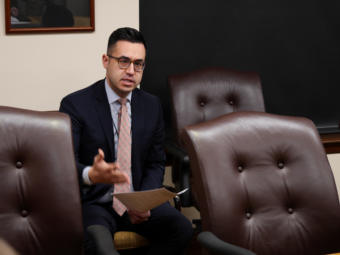
Emily Nenon with the American Cancer Society said illness related to smoking is a major public health problem.
“There are a lot of problems we’re facing in this city, and some people may even say, ‘What’s this? What’s so important about this?’ This piece is about the fact that tobacco use is still the leading cause of preventable death in Alaska,” Nenon said.
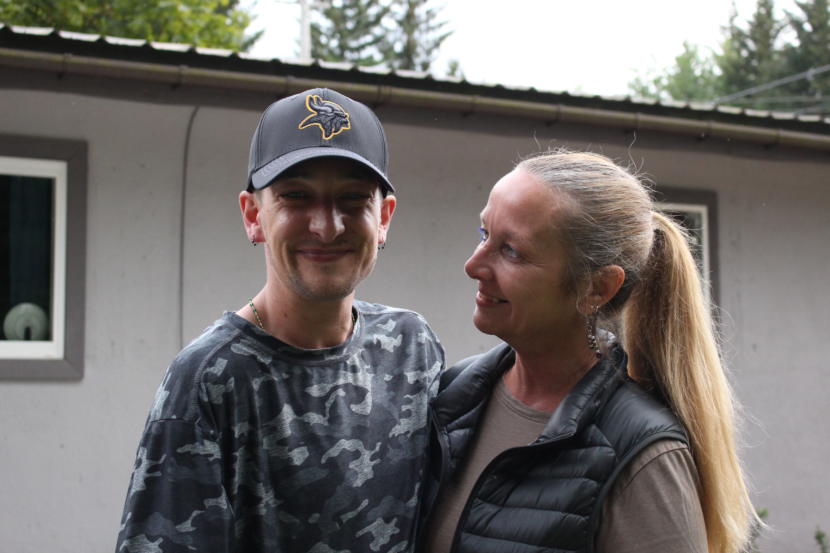
Justin and his mother, Vicki Brokken, at their home in Juneau. (Photo by Elizabeth Jenkins/KTOO)
Some hospitals in Alaska are changing the way they treat patients with opioid use disorder. A trip to the emergency room can be a crucial window to help people in their recovery.
Now some providers are giving patients a medicine to ease the transition so they can seek additional care.
Recently, a hospital in Juneau completed one year of this program with encouraging results.
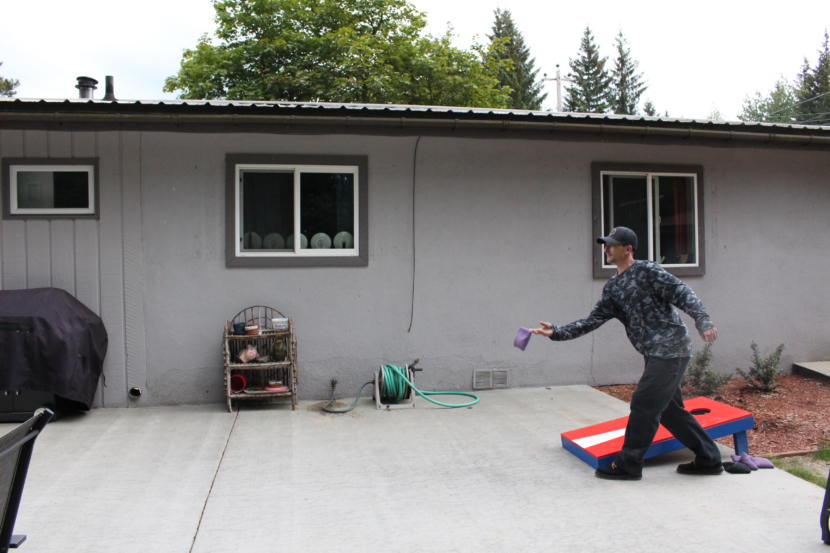
Justin Brokken, 33, has a ritual with his parents. They regularly engage in friendly competition with handmade cornhole set. Earlier in the day, his mom, Vicki Brokken, beat him 21-1.
“Now, I’m not even going to be able to hit the board. The pressure is on,” Justin Brokken said with a laugh.
The Brokkens are enjoying this new family dynamic. For years, Vicki said her relationship with Justin wasn’t like this.
“Every single time he walked out that front door. I knew, and it went through my head, that could be the last time I ever saw my son,” Vicki Brokken said.
Justin Brokken was first introduced to opioids like a lot of Americans: at the doctor’s office.
At 14, he was given a prescription for painkillers after badly burning his hand in an accident. His injury left him with a permanent scar, and he said the craving for opioids didn’t go away.
“Anybody who’s had an addiction knows it’s hard to say no to something that makes you feel better,” Justin Brokken said.
For more than a decade, he said he felt like he was stuck in a volatile cycle. He was in and out of jail on drug-related charges. He started using heroin. He had moments when he wanted to quit, but they were fleeting.
Then, earlier this year, he experienced a huge turning point.
He checked himself into the emergency room at Bartlett Regional Hospital in Juneau, prompted by swollen ankles.
“Fairly certain I was dead,” he said. “But nope. I got lucky.”
Justin Brokken learned he qualified for a new program that’s becoming the standard for how to treat opioid addiction in hospital emergency rooms across Alaska — from Petersburg to Anchorage. He hadn’t used opioids the day he visited the ER. He was in what medical staff call “acute withdrawal.” So they could give him a pill to help block the cravings.
Next, they’d connect him with a network of providers to continue medication-assisted treatment.
“It gives you time to change your life,” he said.
Justin Brokken said he likes to stay busy spending time with family and going fishing. (Photo by Elizabeth Jenkins/KTOO)
In 2016, federal legislation made it possible for a wider array of medical providers to prescribe buprenorphine, also known by the brand name: Suboxone. And since then, the numbers of prescribers in Alaska has more than doubled, according to the state.
As a result, more clinics are able to offer medication-assisted treatment, and some hospital ERs are acting as a point of contact.
Before working in the Bartlett emergency room, Dr. Lindy Jones was one of only a handful of providers in Juneau who prescribed buprenorphine.
“Initially, there was resistance because it was something new,” Jones said.
He said there’s been a shift in the way the medical community views medication-assisted treatment. In the past, there could be a misconception that it was trading one addiction for another.
Jones said more and more providers recognize it helps stabilize patients. They typically receive counseling and can eventually go back to school or work.
“I find it one of the most effective interventions for the right person that there is,” Jones said.
Claire Geldhof, a case manager at Bartlett, checks in with the same 15 former patients or their families on the phone at least once a month. Up until last summer, the emergency department was limited in how it could treat people with opioid addiction.
Emergency providers tried to make their patients comfortable.
“But it wasn’t necessarily the right medicines to be giving patients with acute opioid withdrawal,” Geldhof said.
Geldhof thinks the buprenorphine has made a big difference in the life of the ER patients.
Of those 15 people she calls regularly, 11 of them — including Justin Brokken — have continued to access services or medication-assisted treatment.
Shortly after his visit to the ER, Justin Brokken had surgery to repair a valve in his heart damaged from a bacterial infection by injecting heroin. He said he took pain medicine for a couple of days. But after that, he stopped. He talks to counselors and takes a Suboxone pill to help block the craving for opioids.
Justin Brokken credits that initial meeting in the emergency room with helping him navigate his recovery. But he thinks these new treatment options in Alaska are just the beginning.
“I think there’s still a lot more progress that needs to be done,” he said. “I think there’s a lot more spending that needs to be put into it and give it an actual shot.”
The Alaska State Hospital and Nursing Home Association is concerned Gov. Mike Dunleavy’s cuts to Medicaid could affect these kinds of programs down the line. The cuts could impact providers ability to offer services.
As for Justin Brokken, he’s adjusting to life at home and healing from his surgery. Recently, he was able to tell his mom about a big improvement: He no longer has to take blood thinners.
“The lady just called a minute ago and told me I’m off of them,” he said. “I don’t have to take them. Not even tonight. I’m done. That’s a big step!”
And that’s how Justin is approaching his recovery: one day at a time. Tonight, maybe another game of cornhole and sloppy Joes for dinner.
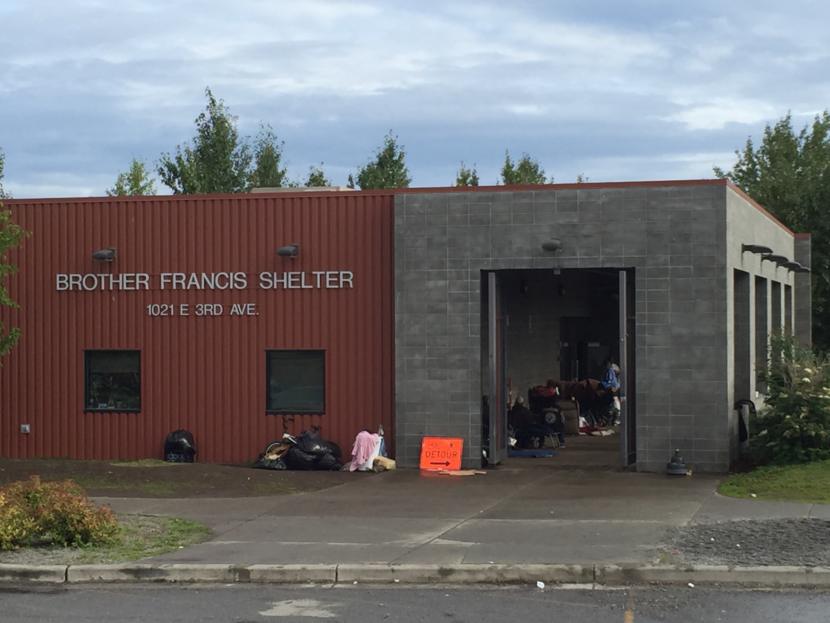
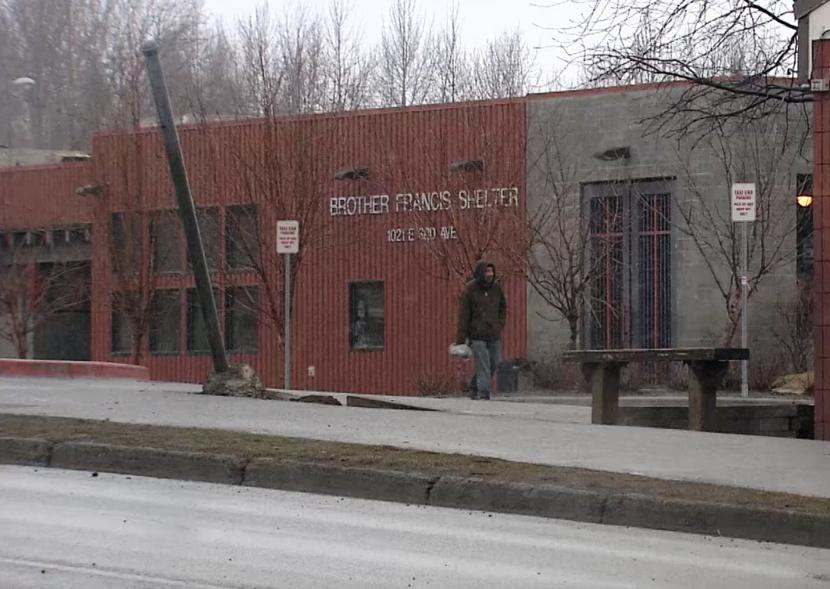
Brother Francis Shelter near downtown Anchorage. (Photo By Anne Hillman/Alaska Public Media)
On Wednesday, a few hours before the Alaska Legislature’s vote to override Gov. Mike Dunleavy’s budget vetoes would fail, Catholic Social Services executive director Lisa Aquino was all smiles as she greeted volunteers at the St. Francis House Food Pantry in Anchorage.
But alone in a conference room upstairs, it was clear that this was not a good day.
“I don’t have a lot of hope,” Aquino said. “There’s just a real impasse, and I don’t know what our chances are.”
As prospects for a veto override look increasingly slim, organizations that provide aid to low-income, homeless and other needy Alaskans say they have already had to make tough choices. But some of the choices ahead, they say, will be even more difficult.
Catholic Social Services runs Brother Francis Shelter — the biggest homeless shelter for adults in the state — and Clare House, a shelter for women and children. Both face significant funding reductions under the governor’s budget vetoes.
For example, Clare House could lose close to $200,000 in grants. Aquino said that probably means the shelter will only be able to open its doors at night.
“Instead of letting our moms and their children stay in the shelter all day and night, they would need to leave every day,” Aquino said.
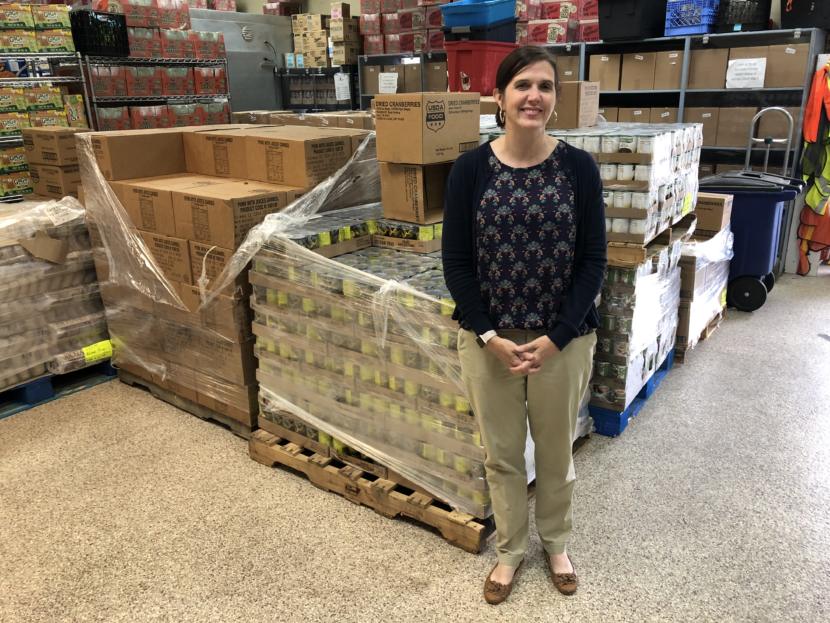
Catholic Social Services executive director Lisa Aquino in the storage area of the St. Francis House Food Pantry. (Photo by Elizabeth Harball/Alaska Public Media)
“So there will be new moms, and moms with little toddlers, out in front of the library waiting for it to open at 10, because there’s nowhere else they can go,” she said. “To me that’s just … it’s monstrous. These are children, and they shouldn’t be outside.”
Dunleavy’s budget vetoed millions in funding that goes to serve Alaska’s needy, including $1.4 million from Human Services Community Matching Grants and $7.2 million from the Alaska Housing Finance Corporation’s homeless assistance program.
Catholic Social Services projects that without state funding for their services alone, homelessness in Anchorage could increase by 48%. In total, the Anchorage Coalition to End Homelessness predicts close to 800 more homeless individuals in Alaska’s biggest city will go without shelter.
In addition to the impact on shelters, Aquino said she is concerned about the reduction in funding for case management services, which help people transition from homelessness to permanent housing.
For many, she said, “that ladder up, that foothold to take that next step, that’s gone with these cuts.”
Other organizations that aid Anchorage’s homeless population are also looking at making drastic changes. Rural Alaska Community Action Program CEO Patrick Anderson said that if the Legislature fails to override the budget vetoes, two supportive housing facilities in Anchorage — Safe Harbor Muldoon and Sitka Place — “absolutely” will have to entirely close their doors.
Anderson said he doesn’t know where the people living there now will go.
“We don’t have the resources to be able to find them alternate housing. In fact, they’re with us because there was no alternate housing for them,” he said.
Anderson said this will impact about 350 people, including families and individuals with mental illnesses.
“We have hundreds of people who have made it off of the street despite their circumstances,” Anderson said. “It is distressing that instead of moving forward, all of a sudden, we are dealing with this huge step backwards.”
Gov. Mike Dunleavy’s Press Secretary Matt Shuckerow answers reporters’ questions after a briefing in the governor’s cabinet room in the Capitol in Juneau on March 21, 2019. (Photo by Skip Gray/360 North)
Matt Shuckerow, Dunleavy’s press secretary, said he recognizes that some of the programs facing cuts have had “meaningful impacts.”
“A lot of times, this isn’t solely an evaluation of whether a program has been successful,” Shuckerow said.
But he maintained the vetoes are vital to addressing the state’s deficit.
“Part of that is evaluating what falls under a core service of the government,” Shuckerow said. “The governor in his office had to make tough decisions based on the fiscal reality that we have today.”
At Catholic Social Services, Aquino said they, too, are making tough decisions.
She said the organization has known for a while what the changes could be, like reducing the number of beds available at Brother Francis, the homeless shelter for adults.
“But now we’re in the point where we are trying to make those real. So having these discussions of, how do you go from 240 to 100 at Brother Francis Shelter?
“Who are the 100? I don’t know,” Aquino said.
Aquino said she has reached out to the governor’s office multiple times and hasn’t heard back. But she said she’s happy to take a call any time.
The Brother Francis Shelter in Anchorage in 2015. (Video still by Mikko Wilson/360 North)
Anchorage homeless shelters and services are bracing for cutbacks and closures after Gov. Mike Dunleavy announced about $400 million in line-item state budget vetoes Friday.
The Brother Francis Shelter, an emergency shelter for adult men and women, will have to reduce its capacity from 240 to approximately 100 people, according to Catholic Social Services. The Clare House, Catholic Social Services’ emergency shelter for women with children and expectant mothers, may have to close during the day. Safe Harbor Muldoon, a transitional housing facility sheltering dozens of families facing homelessness, faces closure.
So does Sitka Place, a supportive housing facility serving homeless people with serious mental illnesses, according to Patrick Anderson, CEO of Rural Alaska Community Action Program, the statewide nonprofit operating both Sitka Place and Safe Harbor Muldoon.
“That’s devastating,” Anderson said of the budget cuts.
As of Friday evening, Anderson said his organization was still assessing the full impact of the governor’s vetoes. So were other shelters and social service organizations around Anchorage. Lisa Aquino, executive director of Catholic Social Services, said the nonprofit had relied on more than $1.3 million in vetoed state funding. She said its board of directors plans to hold an emergency meeting this week to determine the next steps. One thing was immediately clear, she said.
“It’ll be devastating,” Aquino said. “And it will have big financial implications for so many in the community.”
Statewide, homeless shelters and housing services received funding through four grant programs: the Homeless Assistance Program, the Special Needs Housing Grant, the Human Services Community Matching Grant and the Community Initiative Matching Grant. The governor’s recent vetoes sharply reduced the first two programs and zeroed out the latter two.
“The State’s fiscal reality dictates a reduction in expenditures across all agencies,” read the fiscal note for the cuts.
Jasmine Khan, executive director of the Anchorage Coalition to End Homelessness, said overall state funding for homelessness services fell from approximately $13.7 million to about $2.6 million. The money funded 50 programs around the state and at least five shelters in Anchorage, Khan said. Ending the programs would have an immediate negative effect on homelessness in Anchorage, she said. The extent has yet to be realized.
“If anything shuts down, we will see more people on the streets,” Khan said.
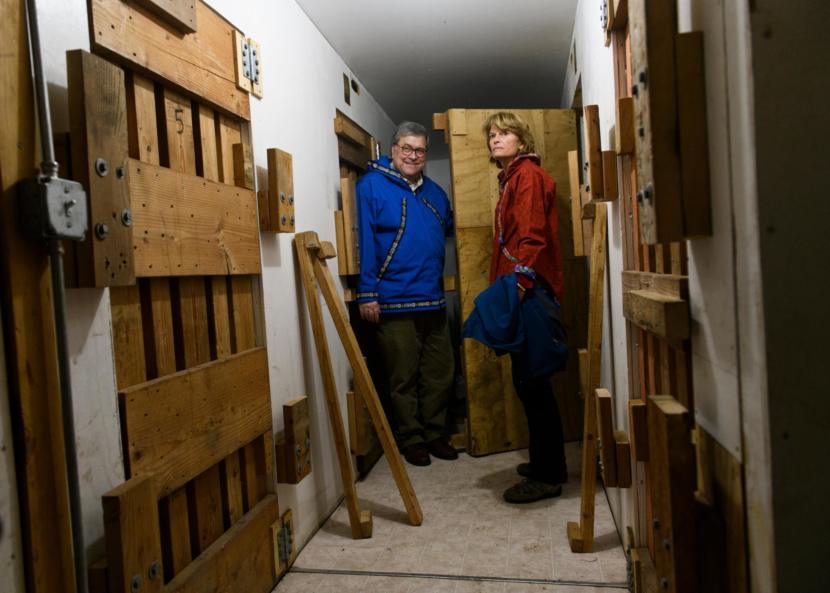
U.S. Attorney General William Barr and Sen. Lisa Murkowski, R-Alaska, tour Napaskiak’s public safety building on May 31, 2019. (Photo courtesy of Marc Lester/Anchorage Daily News)
U.S. Attorney General William Barr declared a law enforcement emergency in Alaska on June 28. The announcement follows a visit to the state where he saw firsthand how many rural communities have little-to-no public safety presence.
The Justice Department pledged $10.5 million in immediate funds to support law enforcement in Alaska Native communities. The Justice Department says that $6 million are immediately available to help hire and train village public safety officers as well as tribal and village police officers. The department plans to award $4.5 million for 20 officer positions for Alaska Native grantees by the end of July.
Justice Department official Katharine Sullivan says that the funds are part of a longer-term vision.
“We have this sort of immediate response based on the AG’s visit,” Sullivan explained. “We’re going to have a sort of medium-length response to keep things going, and a long-term plan for sustainability. That’s our goal.”
Other federal agencies, like the Federal Bureau of Investigation, will submit plans within 30 days to address Alaska rural justice. In separate funding, Children’s Advocacy Centers in rural hub towns like Bethel, as well as in Native American communities in the Lower 48, will receive $14 million in support.
The Department of Justice also laid out additional plans for funding opportunities. Sullivan said that the department wants to put a local public safety official in every rural Alaskan community.
The declaration won praise from the Alaska Federation of Natives and the Association of Village Council Presidents. AVCP CEO Vivian Korthuis called the plan “unprecedented.”
“We’ve been busy organizing a Public Safety Facility Assessment, Public Safety Summit, Statewide VPSO Strategic Plan, and creating a Public Safety Task Force. All of these efforts allowed us to lead with solutions, solutions designed to fit our unique needs,” Korthuis said in a statement.
Barr visited Napaskiak on his Alaska trip, and Napaskiak Tribal Administrator Sharon Williams is celebrating the news.
“I’m very happy. I was close to tears this morning when I heard. Now the waiting game begins,” Williams said.
The declaration exceeded her expectations. The community had asked Barr to declare an emergency because of the lack of public safety and high rates of alcohol-related deaths.
The federal declaration came hours before Gov. Mike Dunleavy vetoed $6 million from the state’s Village Public Safety Officer Program.
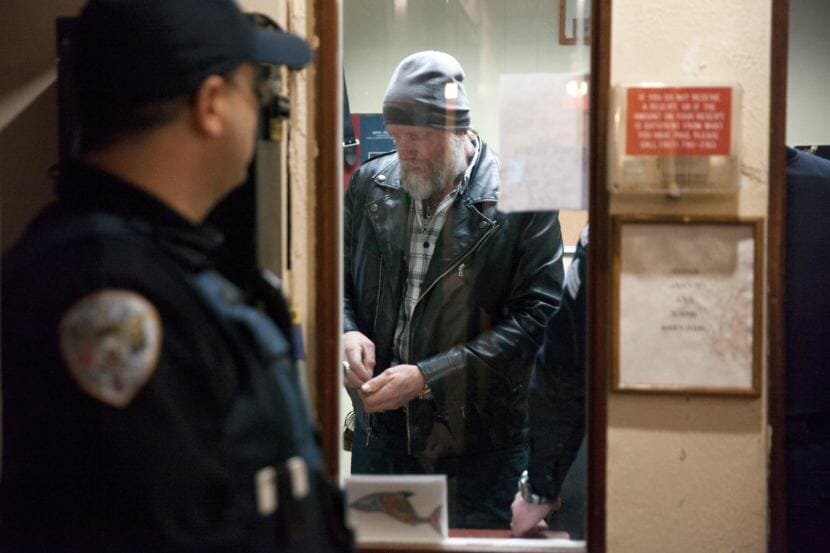
Juneau police officers confer as they arrest Chuck Cotten, property manager at the Bergmann Hotel. Cotten was responsible for removing residents from their rooms in March 2017 in Juneau, Alaska. The building was later condemned. (Photo by Rashah McChesney/Alaska’s Energy Desk)
The former manager of the Bergmann Hotel will spend the next 10 years in prison for selling methamphetamine in Juneau.
Charles Edward Cotten, Jr., 53, was sentenced on Thursday in U.S. District Court in Juneau. In April 2018, Cotten pleaded guilty to the charges and agreed to forfeit his Harley Davidson motorcycle.
Prosecutors say over 500 grams of methamphetamine were in Cotten’s possession when he was arrested in October 2017.
But Cotten’s attorney Michael Moberly said there was “no evidence he was the kingpin of this operation.” Moberly said others, like co-defendant Ricky Stapler Lisk who he said was Cotten’s son, controlled drug shipments and money.
Cotten did not comment during his sentencing hearing.
After Cotten gets out of prison, he will spend 25 years on supervised release. U.S. District Court Judge Timothy Burgess called Cotten a “dangerous person with a lifelong history of committing crimes against vulnerable people and children.” The judge noted Cotten’s previous convictions for assault, sexual crimes against children and forgery.
Cotten will likely be sent to a federal prison facility in Missouri for treatment of drug addiction and a variety of other health issues.
As part of a plea agreement last year, Lisk was sentenced to five years in prison and five years on supervised release.